fuel cap AUDI RS7 SPORTBACK 2016 User Guide
[x] Cancel search | Manufacturer: AUDI, Model Year: 2016, Model line: RS7 SPORTBACK, Model: AUDI RS7 SPORTBACK 2016Pages: 282, PDF Size: 70.78 MB
Page 231 of 282
too much. This increases the risk of an accident because it
can cause the tire to burst and result in loss of vehicle con
trol.
-Incorrect tire pressure in
creases tire wear and has a
negative effect on driving and
braking behavior, which in
creases the risk of an accident .
(D Note
Replace lost valve caps to re
duce the risk of damage to the
tire valves.
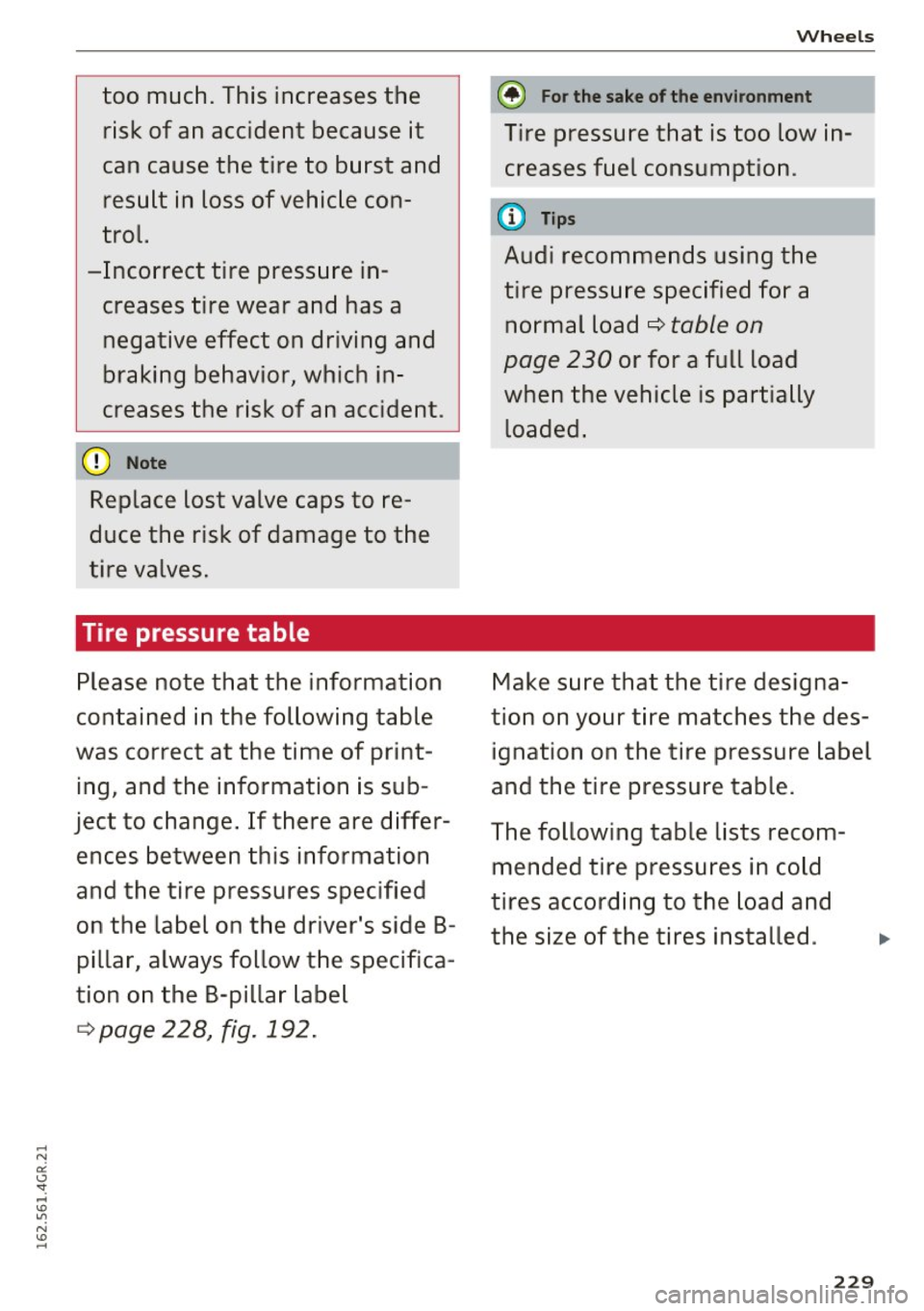
Tire pressure table
Please note that the information
contained in the following table
was correct at the time of print ing, and the information is sub
ject to change. If there are differ
ences between this information
and the tire pressures specified
on the label on the driver's side B pillar, always follow the specifica
tion on the B-pillar label
¢ page 228, fig. 192.
Wheels
'® For the sake of the environment
Tire pressure that is too low in
creases fuel consumption .
Audi recommends using the
tire pressure specified for a normal load
¢ table on
page 230
or for a full load
when the vehicle is partially
loaded.
Make sure that the tire designa
tion on your tire matches the des ignation on the tire pressure label
and the tire pressure table.
The following table lists recom
mended tire pressures in cold
tires according to the load and
the size of the tires installed . .,.
229
Page 232 of 282
Wheels
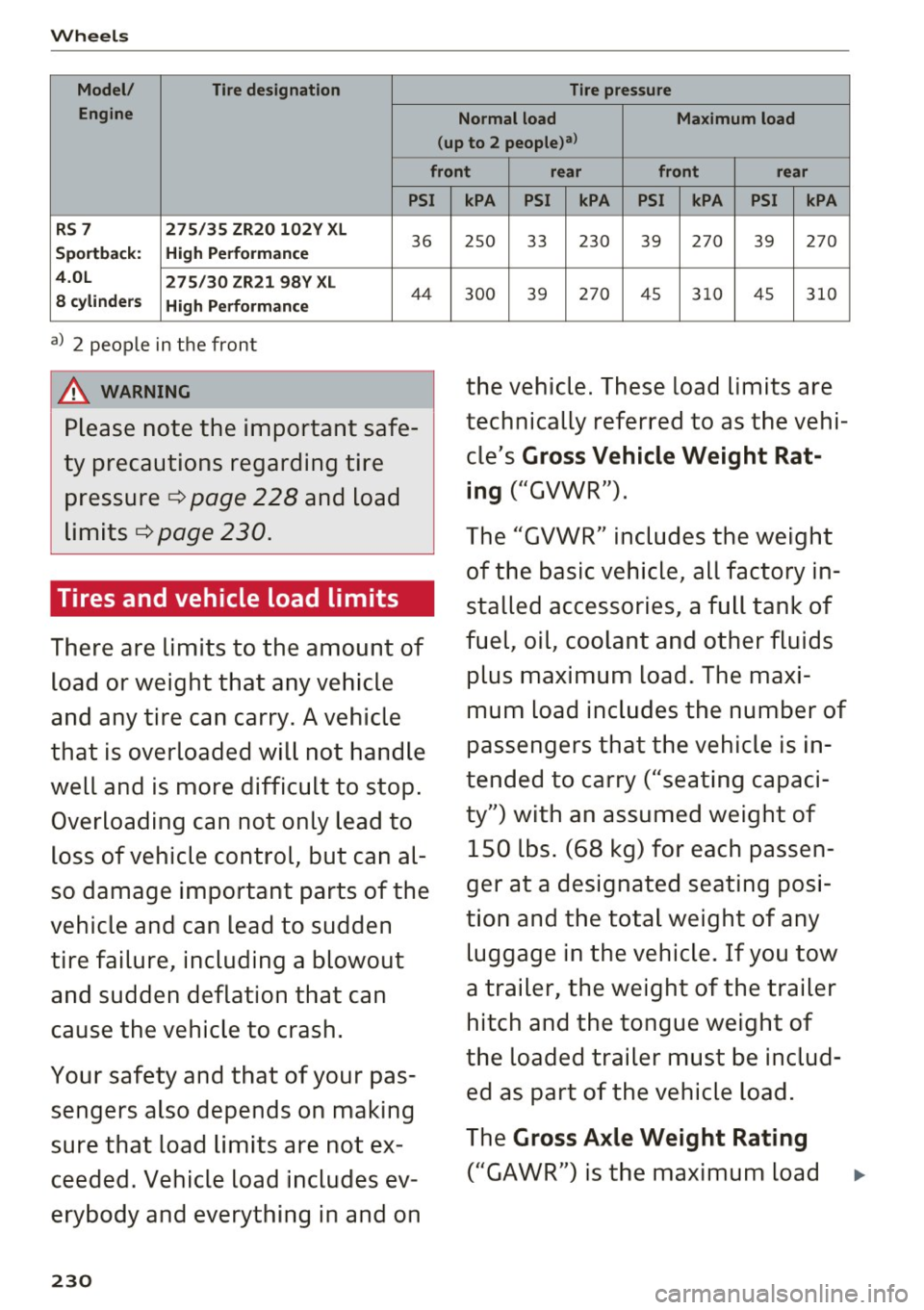
Model/ Tire designation Tire pressure
Engine Normal load Maximum load
(up to 2 people)a>
front rear front rear
PSI
RS 7 275/35 ZR20 102Y XL
Sportback: High Performance
36
4.0L 275/30 ZR21 98Y XL
8 cylinders High Performance
44
a) 2 people in the front
A WARNING
Please note the important safe
ty precautions regarding tire
pressure ¢
page 228 and load
limits ¢
page 230.
Tires and vehicle load limits
There are limits to the amount of
load or weight that any vehicle
and any tire can carry. A vehicle
that is overloaded will not handle
well and is more difficult to stop. Overloading can not only lead to
loss of vehicle control, but can al
so damage important parts of the
vehicle and can lead to sudden
tire failure, including a blowout and sudden deflation that can
cause the vehicle to crash.
Your safety and that of your pas sengers also depends on making
sure that load limits are not ex
ceeded . Vehicle load includes ev
erybody and everything in and on
230
kPA PSI kPA PSI kPA PSI kPA
25 0 33 230 39 270
39 270
30 0 39 270 45 310 45
310
the vehicle. These load limits are
technically referred to as the vehi
cle's
Gross Vehicle Weight Rat
ing
("GVWR").
The "GVWR" includes the weight of the basic vehicle, all factory in
stalled accessories , a full tank of
fuel, oil, coolant and other fluids
plus maximum load. The maxi
mum load includes the number of
passengers that the vehicle is in
tended to carry ("seating capaci
ty") with an assumed weight of 150 lbs. (68 kg) for each passen
ger at a designated seating posi
tion and the total weight of any luggage in the vehicle. If you tow
a trailer, the weight of the trailer hitch and the tongue weight of
the loaded trailer must be includ ed as part of the vehicle load.
The
Gross Axle Weight Rating
("GAWR") is the maximum load
Page 262 of 282
Tech nical data
Gross Axle Weight Rating
The G ross Ax le We ight Rating is the max imum
load that can b e applied at each axle of the vehi
cle ¢& .
Vehicle capacity weight
The vehicle capacity we ight (max . load) is l isted
eithe r on the dr iver's side 8-pilla r or inside the
fue l filler f lap.
A WARNING
- The ac tual Gross Axle Weight Rating at the
front and rear axles shou ld not exceed the
permissible weights, and their comb inat ion
must not exceed the Gross Veh icle Weight
Rating .
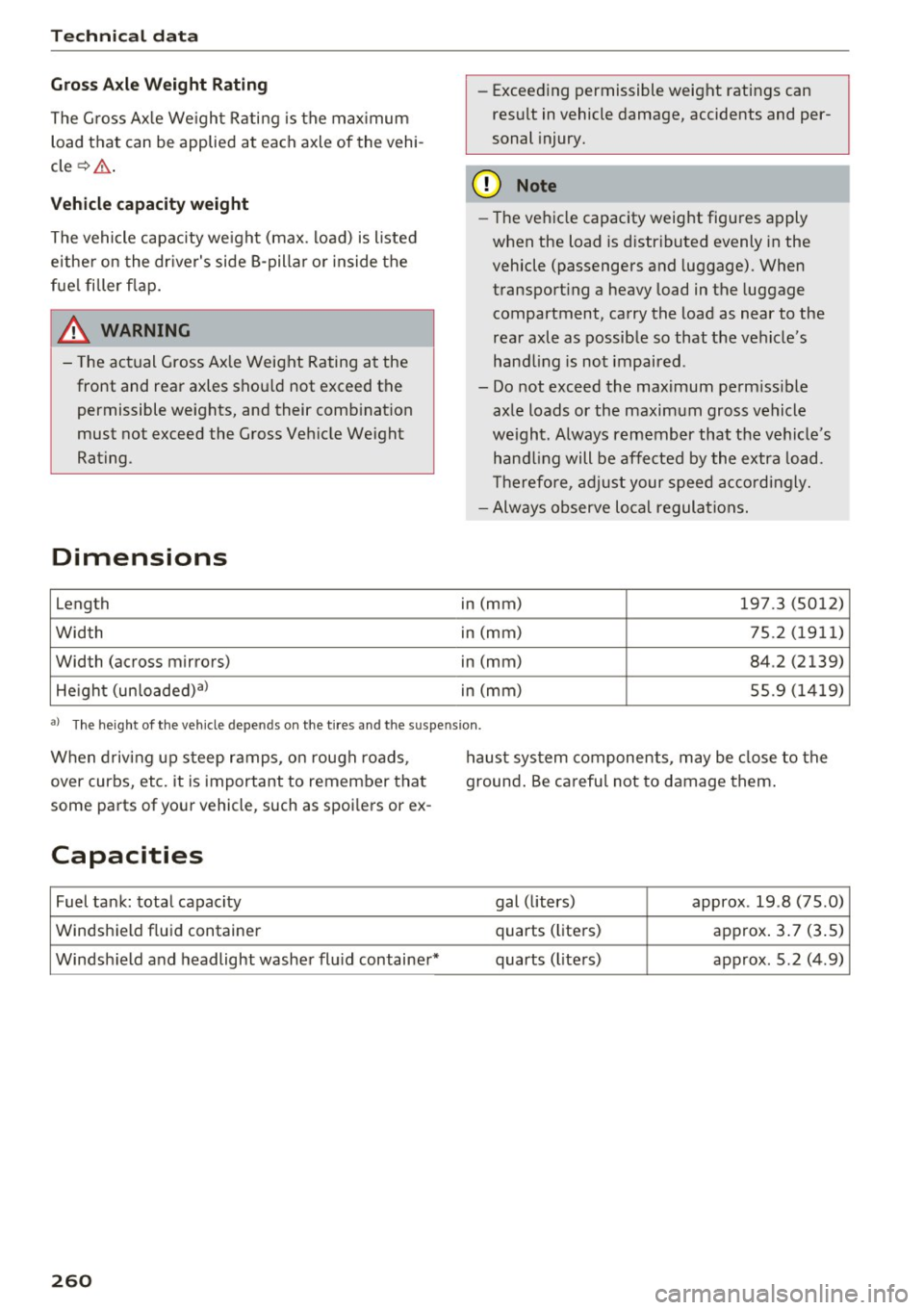
Dimensions
length
Width
Width (across mirro rs)
He ight (un lo aded) al -
Exceed ing permissible weight ratings can
result in vehicle damage, accidents and per
sonal injury.
(D Note
- The vehicle capacity weight figures apply
when the load is d istr ibuted evenly in the
vehicle (passengers and luggage) . When
t ransporting a heavy load in the luggage
compartment, carry the load as near to the
rea r axle as possib le so that the vehicle's
hand ling is not impaired .
- Do not exceed the max imum perm iss ible
axle loads or the maximum gross vehicle
we ight. Always remember that the ve hicle 's
han dling will be affe cted by the extra load .
T herefore , ad just your speed ac co rd ingly.
- Always observe lo cal regulations.
in (mm) 197.3 (5012)
in (mm) 75.2 (19 11)
in (mm) 84.2 (2139)
in (mm) 55.9 (1 419)
al The he ight of the veh icle depe nd s on the ti re s an d th e su spensio n.
When drivi ng up s teep r amps , on rough roads ,
over curbs, etc. it is important to remember that
some parts of yo ur vehicle, such as spoi lers or ex -
Capacities
Fuel tank: total capac ity
Windshie ld fluid container
Windsh ield and headlight washe r fl ui d containe r*
260
haust sys tem components , may be close to the
ground . Be ca refu l not to damage them .
gal (liters) approx. 19 .8 (75 .0)
quarts (liters) approx. 3 .7 (3 .5)
quarts (l ite rs) approx. 5.2 (4 .9)
Page 263 of 282
Technical data
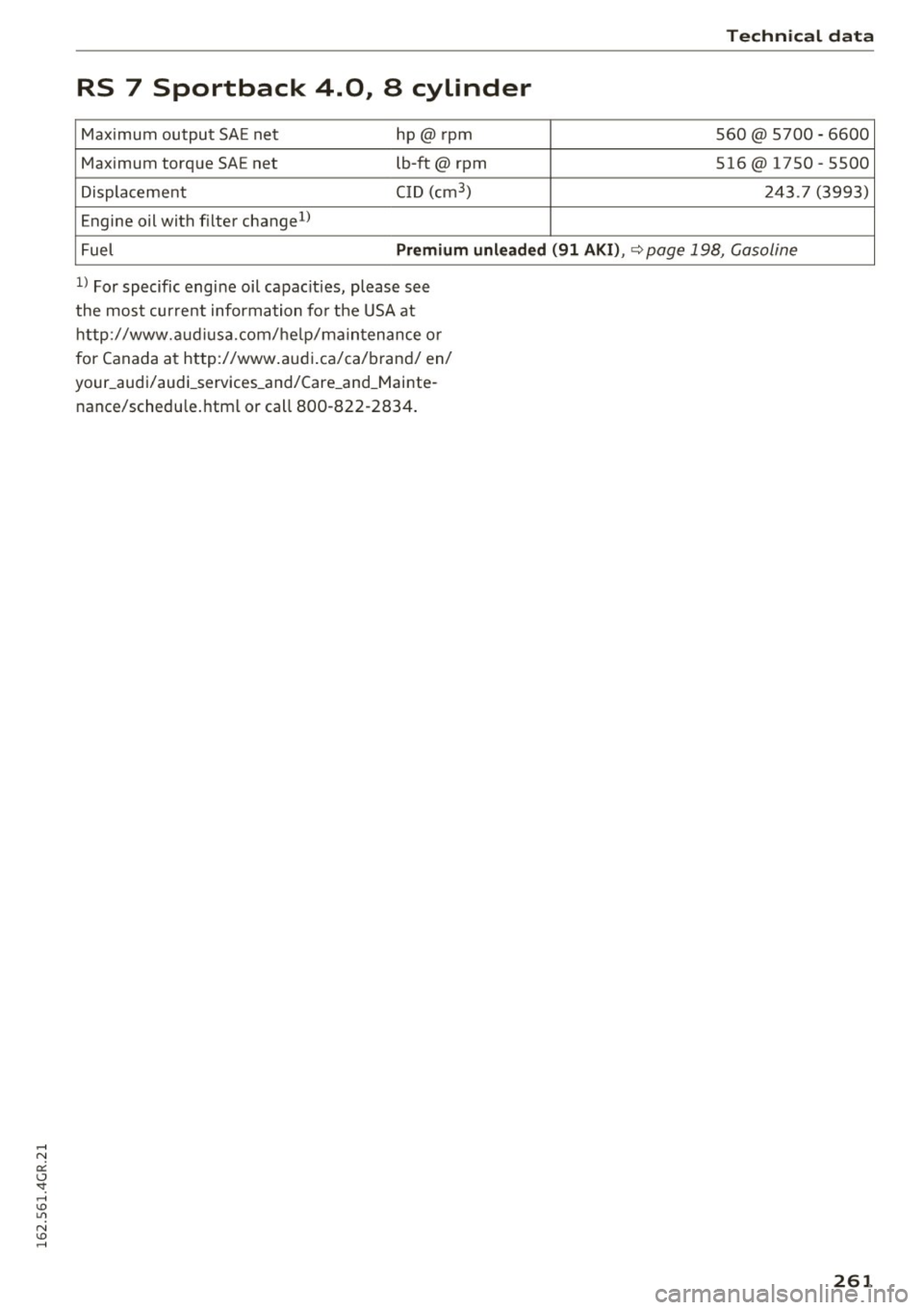
RS 7 Sportback 4.0, 8 cylinder
Maximum output SA E net hp@rpnn 560@ 5700 - 6600
Maximum torque SAE net lb-ft@ rpm 516@ 1750 -5500
Displacement CID (cm
3
) 243 .7 (3993)
Engine oil with filter change
1 )
Fuel Premium unleaded (91 AKI) , qpage 198, Gasoline
ll For specific engine oil capac ities, please see
the most current information for the USA at http ://www. audiusa.com/help/maintenance or
for Canada at http://www.audi.ca/ca/brand/ en/
your_audi/audi_services _and/Care _and _Mainte
nance/schedule.html or call 800-822-2834.
261
Page 272 of 282
Index
Starting . . . . . . . . . . . . . . . . . . . . . . . . . . . . 72
Starting with jumper cables . . . . . . . . . . . 253
Stopping . . . . . . . . . . . . . . . . . . . . . . . . . . . . 73
Engine compartment . . . . . . . . . . . . . . . . . . 205
Closing the hood . . . . . . . . . . . . . . . . . . . . 204
Opening the hood . . . . . . . . . . . . . . . . . . . 203
Safety instructions . . . . . . . . . . . . . . . . . . . 203
Working in the engine compartment . . . . 203
Engine coolant . . . . . . . . . . . . . . . . . . . . . . . 209
Adding coolant .. ............. .... .. . 210
Checking the engine coolant level. . . . . . . 209
Expansion tank . . . . . . . . . . . . . . . . . . . . . . 209
Radiator fan .... ................ .... 211
Temperature gauge . . . . . . . . . . . . . . . . . . . 10
Engine oil . . . . . . . . . . . . . . . . . . . . . . . . . . . 205
Adding . . . . . . . . . . . . . . . . . . . . . . . . . . . . 207
Additives . . . . . . . . . . . . . . . . . . . . . . . . . . . 207
Changing . . . . . . . . . . . . . . . . . . . . . . . . . . 208
Checking oil level . . . . . . . . . . . . . . . . . . . . 207
Consumption . . . . . . . . . . . . . . . . . . . . . . . 207
Indicator light . . . . . . . . . . . . . . . . . . . . . . . 16
Oil consumption . . . . . . . . . . . . . . . . . . . . . 206
Pressure malfunction . . . . . . . . . . . . . . . . . 16
Sensor defective . . . . . . . . . . . . . . . . . . . . . . 20
Specification and viscosity . . . . . . . . . . . . . 205
Temperature ind icator . . . . . . . . . . . . . . . . . 26
Eng ine sound . . . . . . . . . . . . . . . . . . . . . . . . . 95
Engine speed limitation (indicator light) 20
Engine warm-up request
I ndicator l ight . . . . . . . . . . . . . . . . . . . . . . .
20
Environment
Catalytic converter . . . . . . . . . . . . . . . . . . .
189
Disposing of your vehicle battery . . . . . . . 215
Driving at high speeds . . . . . . . . . . . . . . . . 191
Fuel. .... .. .. .. ... .......... .. .. .. . 200
Leaks under your vehicle . . . . . . . . . . . . . . 203
Letting the vehicle stand and warm up. .. 191
Proper disposal of drained brake fluid . . . 212
Proper disposal of drained engine coolant 210
Proper disposal of drained engine oil 207, 208
Recycling used engine oil . . . . . . . . . . . . . 207
Unleaded fuel . . . . . . . . . . . . . . . . . . . . . . . 198
What should I do with an old battery? . . . 215
ESC
Automatic post-co llision braking system .
181
Event Data Recorder (EDR) . . . . . . . . . . . . . 179
E . k xpans1on tan . . . . . . . . . . . . . . . . . . . . . . . 209
270
Exterior lighting . . . . . . . . . . . . . . . . . . . . . . . 43
Exterior mirrors
Adjusting . . . . . . . . . . . . . . . . . . . . . . . . . . . 47
D' .
1mming ............................
48
Heating... .. .. .. .. .. ............. ... 47
Exterior temperature display . . . . . . . . . . . . .
22
F
Fastening
Booster seats . . . . . . . . . . . . . . . . . . . . . . .
168
Convertible child safety seats . . . . . . . . . . 166
Infant seats . . . . . . . . . . . . . . . . . . . . . . . . 165
Floor mats . . . . . . . . . . . . . . . . . . . . . . . . . . . 123
Foot pedals . . . . . . . . . . . . . . . . . . . . . . . . . . 123
For the sake of the environment
Environmentally-friendly driving . . . . . . .
190
Gasoline fumes and the environment . . . . 200
Reducing eng ine noise by early upsh ifting . 10
Refueling . . . . . . . . . . . . . . . . . . . . . . . . . . 200
Saving fuel by early upshifting . . . . . . . . . . 10
w . th .
arming up e engine . . . . . . . . . . . . . . . . 72
Front airbags
D . t· escnp 10n . . . . . . . . . . . . . . . . . . . . . . . . . 139
How they work . . . . . . . . . . . . . . . . . . . . . . 144
Frontal collisions and the laws of physics . . 128
Front seats . . . . . . . . . . . . . . . . . . . . . . . . . . . 53
Adjusting . . . . . . . . . . . . . . . . . . . . . . . . . . 120
Child restraints in the front seat . . . . . . . . 136
Fuel
Additives . . . . . . . . . . . . . . . . . . . . . . . . . . .
198
Blended gasoline . . . . . . . . . . . . . . . . . . . . 198
Current consumpt ion . . . . . . . . . . . . . . . . . . 23
Fuel filler neck . . . . . . . . . . . . . . . . . . 199, 200
Fuel gauge . . . . . . . . . . . . . . . . . . . . . . . 10, 11
Gasoline . . . . . . . . . . . . . . . . . . . . . . . . . . . 198
Gasoline additives . . . . . . . . . . . . . . . . . . . 199
Indicator light . . . . . . . . . . . . . . . . . . . . . . . 20
Octane rating . . . . . . . . . . . . . . . . . . . . . . . 198
Recommendation. . . . . . . . . . . . . . . . . . . . 198
Refuelling . . . . . . . . . . . . . . . . . . . . . . . . . . 200
Saving fuel . . . . . . . . . . . . . . . . . . . . . . . . . 190
T k . an capacity . . . . . . . . . . . . . . . . . . . . . . . 260
Fueling
Fuel filler door emergency release . . . . . .
201
Fuel gauge . . . . . . . . . . . . . . . . . . . . . . . . . . 11