ignition AUDI RS7 SPORTBACK 2016 Service Manual
[x] Cancel search | Manufacturer: AUDI, Model Year: 2016, Model line: RS7 SPORTBACK, Model: AUDI RS7 SPORTBACK 2016Pages: 282, PDF Size: 70.78 MB
Page 140 of 282
Airbag syste m
Always remember, a child seat or infant carrier
installed on the front seat may be struck and
knocked out of position by the rapidly inflating
passenger's airbag in a frontal collision. The air
bag could greatly reduce the effectiveness of the
child restraint and even seriously injure the child
during inflation.
For this reason, and because the back seat is the
safest place for children -when properly restrain
ed according to their age and size -we strongly
recommend that children always sit in the back
seat
¢ page 159, Child safety.
.8, WARNING
A child in a rearward-facing chi ld seat insta l
led on the front passenger seat will be ser i
ously injured and can be killed if the front air
bag inflates -even with an Advanced Airbag
System.
- The inflating airbag will hit the child seat or
infant carrier with great force and will
smash the chi ld seat and child against the
backrest, center armrest, door or roof.
- Always install rear-facing child seats on the
rear seat.
- If you must install a rearward fac ing chi ld
seat on the front passenger seat because of
exceptional c ircumstances and the
PASSEN
GER AIR BA G OFF
light does not come on
and stay on, immediately install the rear
facing child seat in a rear seating position
and have the airbag system inspected by
yo ur Audi dealer.
- Forward-facing ch ild seats insta lled on the
front passenger's seat may interfe re with
the deployment of the airbag and cause se
rious persona l injury to the child.
.8, WARNING
If, in except ional circumstances, you must in
stall a forward-facing chi ld restraint on the
front passenger's seat:
- Always make sure the forward-facing se at
has been designed and certified by its man
ufacturer for use on a front seat with a pas
senger front and side airbag .
138
-
-Never put the forward-facing child restraint
up against or very near the instrument pan
el.
- Always move the passenger seat into its
rearmost posit ion in the seat's fore and aft
adjustment range, as far away from the a ir
bag as poss ible before installing the for
ward-facing child restraint . The backrest
must be adjusted to an upr ight position.
- Make sure that the
PASSENGER AIR BAG
OFF
light comes on and stays on a ll the time
wheneve r the ignit ion is swi tched on.
.8, WARNING
To reduce the ris k of serious injury, ma ke sure
that the
PASSENGER AIR BAG OFF ligh t will
be d isp layed whenever a ch ild rest raint is in
stalled on the front passenger seat and the ignition is switched on.
-If the PA SSENGER AIR BAG OFF light does
not stay on, perform the checks described
¢ page 146 , Monitoring the Advanced Air
bag System.
- Take the child restraint off the front passen ·
ger seat and install it properly at one of the
rear seat positions if the
PASSENGER AIR
BAG OFF
light does not stay on.
- Have the airbag system inspected by your
Aud i dea ler immediately.
- Always carefully follow instructions from
child restraint manufacturers when instal
ling child restra ints.
.8, WARNING
If, in exceptional circumstances, you must in
stall a forward or rearward-fac ing child re
stra int on the front passenger's seat:
- Improper installation of child restraints can
reduce the ir effectiveness or even prevent
them from provid ing any protect ion.
- An improperly installed child restra int can
interfere with the airbag as it deploys and
serious ly injure or even kil l the child -even
w ith an Advan ced A irbag System.
- Always carefully follow the manufacturer's
instructions provided with the child seat or
earner.
Page 148 of 282
Airbag syste m
A WARNING
Objects between you and the airbag will in
cr ease the risk of inju ry in a cras h by interfer
ing w ith the way the airbag unfol ds or by be
ing pushed into you as the a irbag inflates.
- Never hold th ings in your hands or on your
lap when the vehicle is in use.
- Never transport items on or in the area of
the front passenger seat . Objects could
move into the area of the front airbags du r
ing bra king or other sudden maneuve rs and
become dangerous projectiles that can
ca use serious pe rsonal injury if the a irbags
inflate.
- Never pl ace or attach accessor ies or o ther
objects (such as cup ho lders, te lephone
brackets, large, heavy o r bulky objects) on
the doors, over or near the area marked "AIRBAG" on the steering wheel, instru
ment pane l, seat backrests or between
those areas and yourself. These objects
could cause injury in a crash, especially
when the airbags inflate.
- Never recline the front passenger's seat to transport objec ts. Items can also move into
t h e a rea of the side airbag o r the front a ir
bag during braking or in a s udden maneu
ver. Objects near the airbags can become
projectiles and cause in ju ry, particularly
when the seat is reclined.
- Never pl ace or transport o bje cts on the
front passenge r seat . Objects on the front
passenge r seat co uld cause the capac itive
sensor in the seat to signal to airbag system
that the seat is occupied by a person when it
in fact is not, or that the person on the seat
is heavier than he or she actually is. The
change in elect ric capac itance because of
s u ch objects can cause the passenger front
airbag to be turned on when it shou ld be
off, or ca n cause the a irbag to wo rk i n a way
that is diffe rent from the way it would have
wor ked witho ut objects on the seat.
- Alway s m ake sure th at the re is nothing on
t h e fron t passenger seat that w ill cause the
capacit ive passenger detection system in
the seat to signa l to the Airbag System that
146
the seat is occup ied by a person when it is
not, or to signal that it is occupied by some
one who is heavier than the person actually
sitt ing on the seat . The presence of an ob
ject could ca use the passenger front airbag
to be turned on when it should be off, or
could cause the airbag to work in a way that is diffe rent from the w ay it would have
wo rked withou t the object on the seat.
A WARNING
-
The fine dus t created when airbags deploy c an
cause breathing prob lems for peo ple with a
h istory of asthma or othe r breath ing cond i
tions.
- To reduce the r is k of breathing p roblems,
those with asthma o r other respiratory con
ditions shou ld get fresh a ir right away by
getting out of the vehicle or opening win
dows or doors .
- If you are in a co llision in which airbags de
ploy, wash yo ur hands and face with m ild
soap and water before eating.
- Be ca refu l not to get the dust into your eyes,
or into any cuts or scratches.
- If the residue sho uld get into your eyes,
flush them w ith wate r.
Monitoring the
Advanced Airbag System
t~ (USA models) !!I: (Canada models)
Airbag monitoring indicator light
Two separate indicators monitor the function of
the Advanced Airbag System: the airbag moni
toring indicator light and the
PASSENGER AIR
BAG OFF
light.
The Advanced A irbag System as well as t he side
airbags and side curta in airbags w ith ejection
mitigation features (including the electronic con
tro l unit, senso rs and system w iring) are all
monito red cont inuo usly to make sure that they
a re functioning properly whenever the ignition is
o n. Every time you tu rn o n the ign ition, the air
bag sys tem indi cato r li ght
II (USA models) a
(Canada mode ls) will come on for a few seconds
(function check). .,.
Page 149 of 282
The system must be inspected when the indicato r light
II (USA models ) !E,I
( Canada models):
- does not come on when the ignitio n is switched
on,
- does not go out a few seconds after you have
switched on the ign ition, or
- comes on while driving.
I f an airbag system malf unct io n is de tected, the
indicator light wi ll first start flashing to catch the
driver's attention and then stay on co nti nuo usly
to se rve as a constant reminder to have the sys
tem i nspected immed iate ly.
If a malfunction occ urs that turns the front air
bag on the passenger si de
off, the PASSENGER
AIR BAG OFF
light will come on and stay on
whenever the ignit io n is on.
A WARNING
An airbag system that is not funct io ning prop
erly cannot provide supp lemen tal p rotec tion
in a front al c rash .
- If the air bag indicato r ligh t
c:;, page 17
come s whe n the vehicle is be ing use d, have
th e sys te m in sp ecte d im med iate ly by yo ur
au thoriz ed Au di deale r.
It is po ss ible that
th e air bag wi ll inf late w hen it is not sup
posed to, or will not i nfla te w hen it s hou ld .
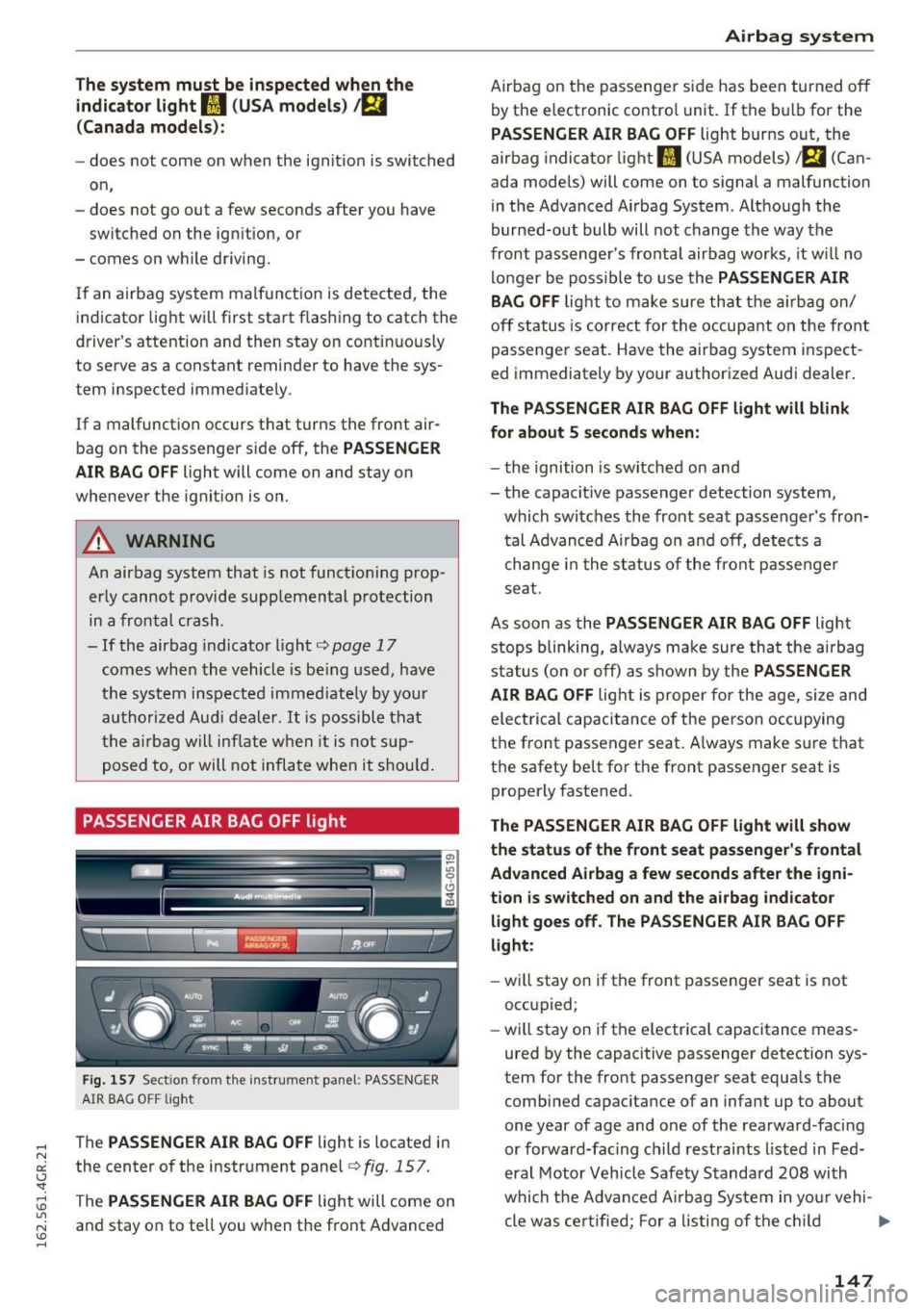
PASSENGER AIR BAG OFF light
Fi g. 157 Sect ion from t he inst rum ent pa ne l: PASSENGER
AIR BAG OFF lig ht
The PASSENGER AIR BAG OFF light is located i n
the center o f the instr ument panel
c:;, fig . 157.
The PASSENGER AIR BAG OFF light will come on
and stay on to te ll you when the front Advanced
Airbag system
Airba g on the pas senge r si de has been turned o ff
by the electronic contro l unit. If t he bulb for the
PASSENGER AIR BAG OFF light burns out, the
airbag indicato r light
II (US A models) a (Can
ada models) will come on to signal a malfunction
i n the Advanced Airbag System . Alt hough the
bur ned-out bulb will not change the way the
front passenge r's fronta l airbag work s, it w ill no
lo nger be poss ible to use the
PASSENGER AIR
BAG OFF
lig ht to ma ke sure th at th e air bag on/
of f st atus is corre ct for the occup ant on the fron t
p assenge r seat. Have the air bag system i nsp ect
ed immediately by your author ized Audi dealer.
The PASSENGER AIR BAG OFF light will blink
for about 5 seconds when:
- th e ignition is switche d on an d
- the capacit ive passenger detection system,
which switc hes the front sea t passe nger' s fron
t al A dva nced Airbag o n an d off, de tec ts a
ch ange in the st atu s of the fr ont passe nger
se at.
As soon as the
PASSENGER AIR BAG OFF light
s top s blinking , always m ake sure th at the air bag
s tatu s (o n or off) as shown by the
PASSENGER
AIR BAG OFF
lig ht is pr oper for the age, siz e and
ele ctrica l capaci tance o f the pe rso n occu pying
t h e front passenger seat. A lwa ys make s ure t hat
t h e safety be lt fo r th e front passen ger seat is
prope rly faste ned .
The PASSENGER AIR BAG OFF light will show
the status of the front seat passenger 's frontal
Advanced Airbag a few seconds after the igni·
tion is switched on and the airbag indicator light goes off. The PASSENGER AIR BAG OFF
light:
- will stay on if t he front passenger seat is not
occ upied;
- wi ll stay on if t he e lectrica l capacitance meas
ured by the capacitive passenger detection sys
tem for the front passenger seat equa ls the
combined ca pac ita nce of an infa nt up to ab out
one year of age and one of the rearwa rd -facing
or fo rwar d-fac ing ch ild rest raints l isted in Fe d
e ral Motor V ehicl e Safe ty S tandard 20 8 wi th
whi ch th e A dvanc ed Airbag Sys tem i n yo ur vehi-
cle w as ce rtifie d; For a listin g of t he c hild .,.
147
Page 150 of 282
Airbag system
restraints that were used to certify your vehi
cle's compliance with the U.S . Safety Standard
~ page 161.
-will go out if the front passenger seat is occu
pied by an adult as registered by the capacitive
passenger detection system.
- The
PASSENGER AIR BAG OFF light must come
on and stay on if the ignition is on and ...
- a car bed has been installed on the front pas
senger seat, or
- a rearward -facing child restraint has been in
sta lled on the front passenger seat, or
- a fo rwa rd-facing child restraint has been instal
led on the front passenger seat,
- and if the electrica l capacitance registered on
the front passenger seat is equa l to or less than
the comb ined capacitance of a typica l 1 year
o ld infant and one of the rearward-facing or
forward-facing child restraints listed in Federal
Motor Vehicle Safety Standard 208 with which
the Advanced Airbag System in your vehicle was
certified.
If the front passenger seat is not occupied, the
front airbag w ill not deploy, and the
PASSENGER
AIR BAG OFF light will stay on. Never install a
rearward-fac ing ch ild restraint on the front pas
senger seat, the safest place for a child in any
kind of child restraint is at one of the seating po
sitions on the rear seat~
page 136, Child re
straints on the front seat -some important
things to know
and ¢ page 159, Child safety .
If the PASSENGER AIR BAG light comes
on ...
If the PASSENGER AIR BAG OFF light comes on
when one of the conditions listed above is met,
be sure to check the light regularly to make cer
tain that the
PASSENGER AIR BAG OFF light
stays on continuous ly whenever the ign ition is
on. If the
PASSENGER AIR BAG OFF light does
not appear on and does not stay on all the time,
stop as soon as it is safe to do so and
- reactivate the system by turning the ignition off for more than 4 seconds and then turning it
on again;
- remove and reinstall the child restraint. Make
sure that the child restraint is properly instal-
148
led and that the safety belt for the front pas
senger seat has been correctly routed through
the child restraint as described in the child re
straint manufacturer's instructions;
- make sure that the convertible locking retrac
tor on the safety belt for the front passenger
seat has been activated and that the safety belt
has been pulled tight.
- make sure that no electrical device (such as a laptop, CD player, electron ic games device,
power inverter or seat heater for child seats) is
placed or used on the front passenger seat if
the device is connected to the 12-volt socket or
the cigarette lighter socket;
- make sure that no seat heater has been retro
fitted or otherw ise added to the front passen
ger seat;
- make sure that noth ing can interfere with the
safety belt buckles and that they are not ob
structed;
- make sure that there are no wet objects (such
as a wet towe l) and no water or other liquids on
the front passenger seat cushion.
If the PASSENGER AIR BAG light still does
not come on ...
If the PASSENGER AIR BAG OFF light still does
not come on and does not stay on continuously
(when the ignition is switched on),
- take the child restra int off the front passenger
seat and insta ll it p roperly at one of the rear
seat positions. Have the airbag system inspect
ed by yo ur Audi dealer immediate ly.
- move the child to a rear seat position and make
sure that the child is properly restrained in a
child restraint that is appropriate for its size
and age .
The PASSENGER AIR BAG light should NOT
come on .. .
The PASSENGER AIR BAG OFF light should NOT
come on when the ignition is on and an adu lt is
sitting in a proper seating position on the front
passenger seat. If the
PASSENGER AIR BAG OFF
light comes on and stays on or flashes for about
5 seconds while dr iv ing, under these c ircumstan-
ces, make sure that: ..,.
Page 154 of 282
Airbag system
Remember too, airbags will deploy only once and
only in certain kinds of accidents -your safety
belts are always there to offer protection in those
accidents in which airbags are not supposed to
deploy or when they have already deployed, for
example when your vehicle strikes or is struck by
another after the first collis ion .
This is just one of the reasons why an airbag is
not a substitute for the safety belt. The airbag
system works most effectively when used with
the safety belts. Therefore, always wear your
safety belts correctly .
It is important to remember that while the sup
plemental knee airbag system is des igned to re
duce the likelihood of serious injuries, other inju
ries, for example, swelling , bruising and minor
ab rasions and friction burns can also occur when
an airbag inflates.
The knee airbag system basically consists of:
-The electronic control module
- Two inflatable airbags (airbag and gas genera-
tor), one for the driver and one for the front
passenger
- The airbag indicator light in the instrument
panel
The knee airbag system will not deploy :
-when the ignition is switched off
- in frontal collisions when the deceleration
measured by the control unit is too low
- in side collisions
- in rear-end collisions
- in rollovers
- in the event of a system malfunct ion (warning/
indicator light is on) ¢
page 17 .
_&, WARNING
-Safety belts and the airbag system can only
provide protection when occupants are in
the proper seating position¢
page 144.
-If the airbag indicator light ~ page 17
comes when the vehicle is be ing used, have
the system inspected immediate ly by your
authorized Audi dealer. It is possible that
the airbag will inf late when it is not sup
posed to, or will not inflate when it should.
152
How knee airbags work
Applies to : vehicles wit h knee airbags
The risk of injury to the leg area can be reduced
by fully inflated knee airbags .
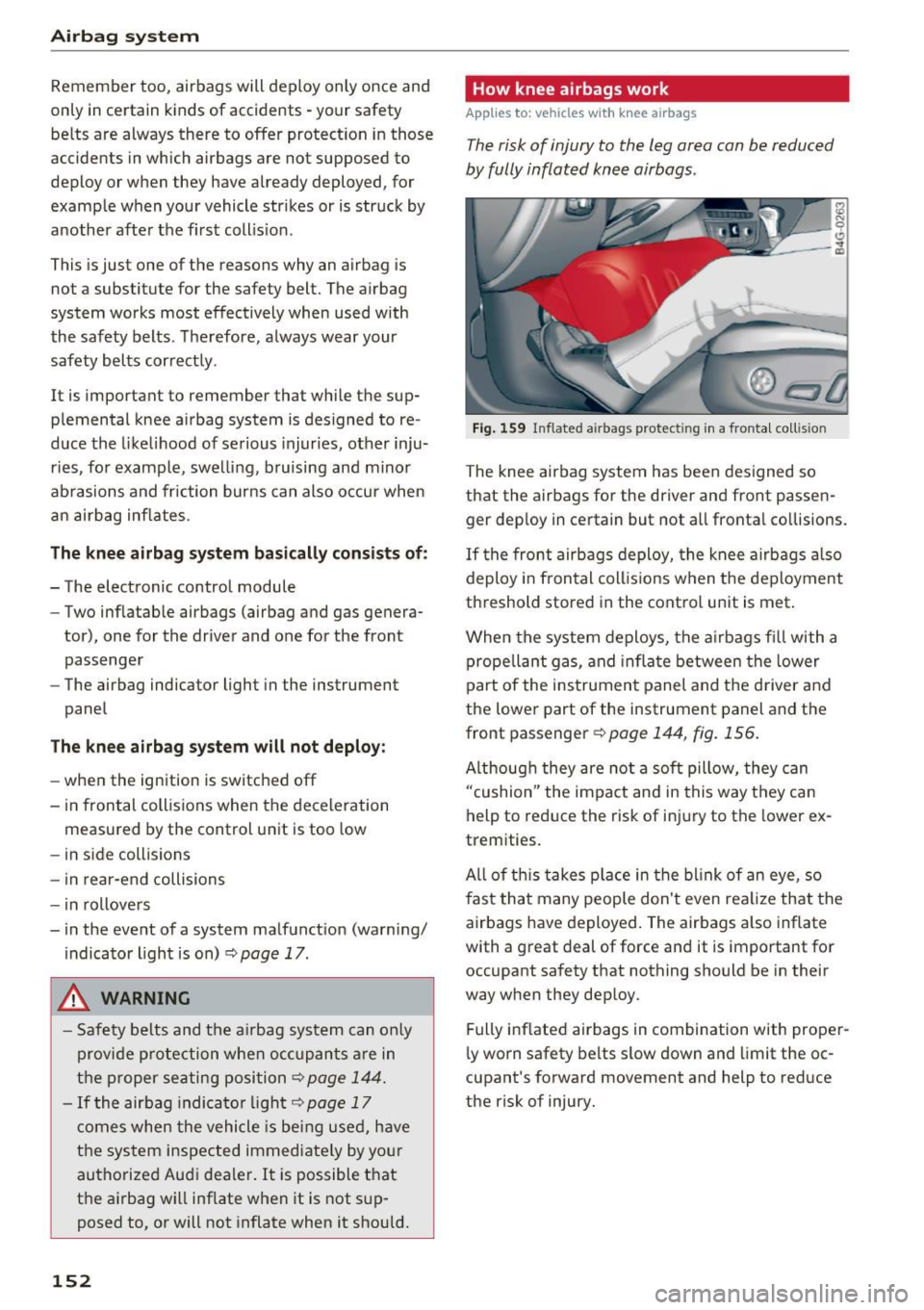
Fig. 159 Inflated airbags protec ting in a fronta l co llis io n
The knee airbag system has been designed so
that the airbags for the driver and front passen
ger dep loy in certain but not all frontal co llisions.
If the front airbags deploy, the knee airbags also
deploy in frontal collisions when the deployment
threshold stored in the control unit is met.
When the system deploys, the airbags fi ll with a
prope llant gas , and infla te between the lower
part of the instrument panel and the d river and
the lower part of the instrument panel and the
front passenger ¢
page 144, fig. 156.
Although they are not a soft pillow, they can
"cushion" the impact and in this way they can
help to reduce the risk of injury to the lower ex
tremities.
All of th is takes pla ce in the blink of an eye, so
fast that many people don't even realize that the
airbags have deployed. The airbags also inflate
with a great deal of force and it is important for
occupant safety that nothing should be in their
way when they deploy .
Fully inflated airbags in combination with proper
ly worn safety be lts s low down and limit the oc
cupant's forward movement and help to reduce
the risk of injury.
Page 156 of 282
Airbag syste m
-the e lectronic contro l modu le and external side
impact sensors
- the two airbags located in the sides of the front
backrests and the two airbags * located in the
rear backrest
- the airbag warning light in the instrument cl us-
ter.
The airbag system is monitored electronically to make certa in that it is functioning properly at all
times . Each time you switch on the ignition, the
airbag system indicator light will come on for a
few seconds (self diagnostics) .
The s ide a irbag system supplements the safety
be lts and can help to reduce the risk of injury to
the driver 's, front and rear passenger 's upper tor
so on the side of the vehicle that is struck in a
side collision. The airbag deploys only in side im pacts and only when the vehicle acceleration reg
istered by the control unit is high enough . If this
rate is below the reference value programmed in
to the control un it, the side airbags w ill not be
tr iggered , even though the car may be bad ly
damaged as a result of the collision.
It is not pos
sible to def ine an airbag tr iggering range that
will cover every possible ang le of impact , since
the circumstances wi ll vary considerably betw een
one co llision and another. Important factors in
clude, for example, the nature (hard or soft) of
the impacting object , the angle of impact , vehicle
speed, etc.¢
page 155, Important safety in
structions on the side airbag system.
Aside from their normal safety function, safety
belts work to help keep the driver or front pas
senger in pos ition in the event of a s ide collision
so that the side a irbags can provide protection .
The airbag system is
not a substitute for your
safety belt. Rather, it is part of the overall occu
pant restraint system in your vehicle . Always re
member that the s ide airbag system can only
he lp to protect you if you are wearing your safety
be lt and wea ring it p roperly. This is another rea
son why you shou ld always wear yo ur safety
be lts , not just because the law requires you to do
so ¢
page 12 7, General information.
It is important to remember that whi le the sup
p lemental side a irbag system is des igned to re-
154 duce the likelihood of ser
ious injuries, other inju
ries, for example, swelling, bruising, friction
burns and m inor abras ions can also be assoc iated
with deployed side airbags. Remember too, side
airbags will dep loy only once and only in certain
k inds of acc idents -your safety belts are always
there to offer protection .
Vehicle damage, repair costs or even the lack of
vehicle damage are not necessar ily an ind ication
of over -sens itive or fa iled airbag activat ion. In
some collisions, both front and side airbags may
i nflate . Remember too, that a irbags w ill dep loy
o nl y once and on ly in certain kinds of collisions -
you r safety be lts are always there to offer protec
tion in those accidents in which airbags are not supposed to deploy or when they have a lready
deployed.
The s ide airbag system will not deploy:
- when the ignit io n is switched off
- in side co llisions when the acceleration meas-
ured by the sensor is too low
- in front-end coll is ions
- in rear-end collisions
-in rollovers .
In some types of accidents the front ai rbags, side
curtain airbags and side airbags may be triggered
together .
A WARNING
-Safety belts and the airbag system will only
provide protect ion when occupants are in
the proper seating position ¢
page 155 .
-If the airbag ind icator light¢ page 17
comes when the veh icle is being used, have
the system inspected immediately by your
author ized Audi dealer . It is possible that
the airbag will inflate when i t is not sup
posed to, or wi ll not inflate when it should.
Page 159 of 282
control unit, the side curtain airbag will not be
triggered, even though the car may be badly
damaged as a result of the collision. It is not pos
sib le to define an airbag tr iggering range that
will cover every possib le angle of impact, since
the circumstances will vary considerably between
one collision and another. Important facto rs in
clude, for example, the nature (hard or soft) of
the impacting object, the angle of impact, vehicle speed, etc.
c:::, page 15 7, How side curtain air
bags work.
Aside from their normal safety function, safety
be lts work to he lp keep the driver or front pas
senger in posit io n in the event of a collision so
that the side curtain airbags can provide protec
tion.
The a irbag sys tem is not a s ubst itute for yo ur
safety bel t. Rat her, it is part of the overa ll occu
pant restraint system in your veh icle. Always re
member that the airbag system can only help to
protect yo u if you are wearing your safety belt
and wearing it properly . This is another reason
why you should always wear your safety belts,
not just because the law requires you to do so
c:::, page 127, General information .
It is important to remember that while the s ide
curta in airbag system is designed to help reduce
the likelihood of serious injuries, other injuries,
for example, swelling, bruising, friction burns
and minor abrasions can also be associated with
these airbags upon deployment . Remember too,
these airbags will deploy only once and only in cert ain kin ds of ac ciden ts -you r safe ty belts are
a lways there to offer protection.
The side curtain airbag system basically
consists of:
- The elec tronic contro l module and external s ide
impact sensors
- The side curtain airbags above the front and
rear s ide windows w it h ejection mi tigation fea
tures
- T he airbag indicator light in the instrument
panel
The airbag system is monitored e lectronically to
make certain it is fu nct ion ing properly at all
t imes. Each time you sw itch on the ig nition, the
Airb ag sys tem
airbag system ind icator light wi ll come on for a
few seconds (se lf diagnostics).
The side curtain airbag is not activated:
- if the ignition is sw itched off,
- in side co llisions when the acceleration meas-
ured by the sensor is too low,
- in rear-end collisions .
A WARNING
-
-Safety bel ts and the airbag system will only
p rov ide pro tect io n when occupants are in
the proper seat ing position
c:::, page 52, Gen
eral information.
- If the ai rbag ind icator light c:::, page 17
comes when the veh icle is being used, have
the system ins pected immediately by your
authorized Audi dealer . It is possib le that
the airbag will inflate when it is not sup
posed to, or w ill not inf late w hen it should.
How side curtain airbags work
Side curtain airbags can work together with side
airbags to help reduce the risk of head and upper
torso injuries for occupants who ore properly re
strained.
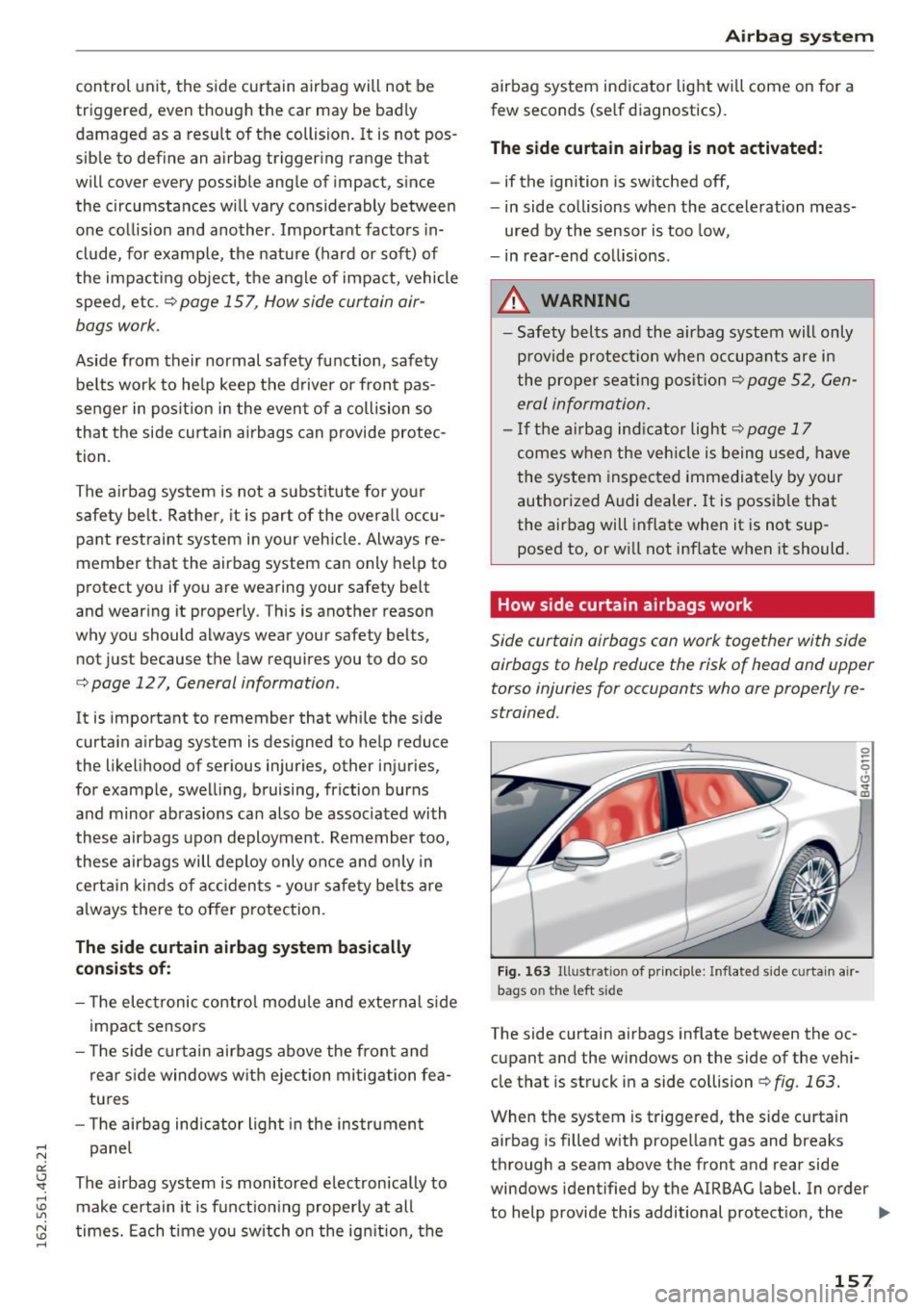
F ig. 163 Illustration of p rinciple: Inflated s ide curta in air·
bags o n the left side
The side curtain airbags inflate between the oc
cupant and the windows on the side of the vehi
cle that is struck in a side collision
c:::, fig. 163.
When the system is triggered, the s ide curtain
airbag is filled with propellant gas and breaks
through a seam above the front and rear side
windows identified by the AIRBAG label. In order
to help provide this additional protect io n, the
liJ,
157
Page 162 of 282
Child safety
exceptional circumstances and the
PASSENGER AIR BAG OFF light does not
come on and stay on, immediately install
the rear-facing child safety seat in a rear
seating position and have the airbag system inspected immediately by your Audi dealer .
A WARNING
-Forward-facing child seats installed on the
front passenger seat may interfere with the deployment of the airbag and cause serious
personal injury to the child.
- If exceptional circumstances require the use
of a forward-facing child restraint on the
front passenger's seat, the child's safety
and well-being require the following special
precautions to be taken:
- Always make sure that the forward-facing seat has been designed and certified by its
manufacturer for use on a front passenger
seat with a front and side airbag.
- Always carefully follow the manufacturer's
instructions provided with the child seat
or infant carrier.
- Never install a child restraint without a
properly attached top tether strap if the
child restraint manufacturer's instructions require the top tether strap to be used.
- Never put the forward-facing child re
straint up against or very near the instru
ment panel.
-Always set the safety belt upper anchor
age to the adjustment position that per
mits proper installation in accordance
with the child restraint manufacturer's in
structions.
- Always move the passenger seat into its
rearmost position in the seat's fore and
aft adjustment range, as far away from
the airbag as possible before installing the
child restraint. The backrest must be ad
justed to an upright position .
- Always make sure that nothing prevents
the front passenger's seat from being moved to the rearmost position in its fore
and aft adjustment range .
160
-Never place objects on the seat (such as a
laptop, CD player, electronic games de
vice, power inverter or seat heater for
child seats) . These may influence the elec
trical capacitance measured by the capaci
tive passenger detection system and can
also fly around in an accident and cause
serious personal injury.
- Never place or use any electrical device
(such as a laptop, CD player, electronic
games device, power inverter or seat heat
er for child seats) on the front passenger
seat if the device is connected to the 12-
volt socket or the cigarette lighter socket.
- If a seat heater has been retrofitted or
otherwise added to the front passenger seat, never install any child restraint sys
tem on this seat.
- Make sure that there are no wet objects
(such as a wet towel) and no water or oth
er liquids on the front passenger seat
cushion.
- Always make sure that the
PASSENGER
AIR BAG OFF
light comes on and stays on
all the time whenever the ignition is
switched on.
- If the
PASSENGER AIR BAG OFF light
does not come on and stay on, immediate ly install the forward-facing child seat in a
rear seating position and have the airbag
system inspected by your authorized Audi
dealer.
- Always buckle the child seat firmly in
place even if a child is not sitting in it. A
loose child seat can fly around during a
sudden stop or in a collision.
- Always read and heed all WARNINGS
whenever using a child restraint in a vehi
cle
¢ page 12 7, Safety belts, ¢ page 135,
Airbag system
and ¢ page 159, Impor
tant information.
(D Tips
Always replace child restraints that were in
stalled in a vehicle during a crash. Damage to
a child restraint that is not visible could cause
it to fail in another collision situation.
Page 170 of 282
Child safety
seating position on the rear seat and have
the airbag system inspected by your author
ized Audi dealer.
- Take the child restraint off the front passen
ger seat and install it properly at one of the
rear seat positions if the
P A SSEN GER AIR
BAG OFF
light does not stay on whenever
the ignition is switched on.
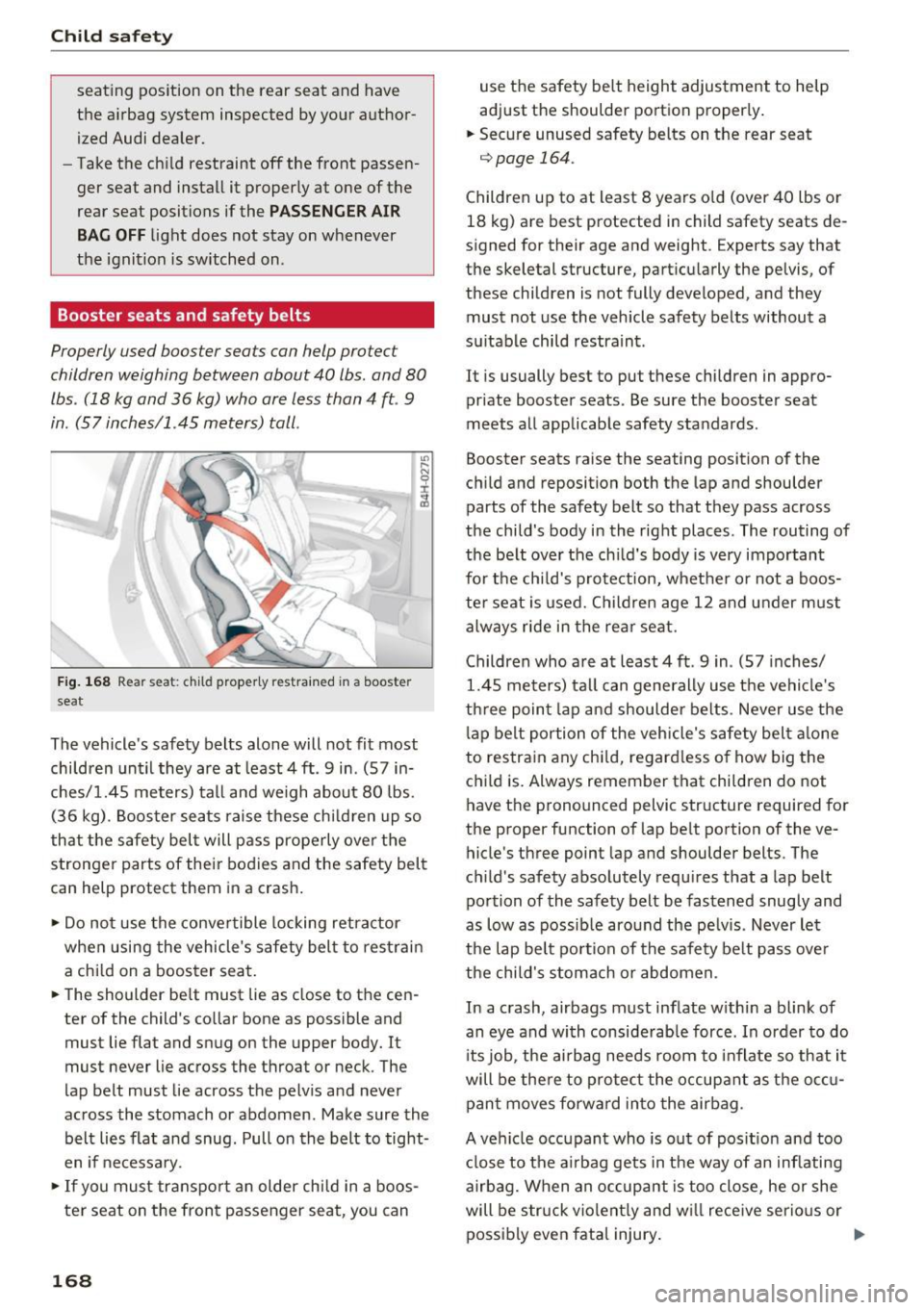
Booster seats and safety belts
Properly used booster sea ts can help protect
children weighing between about 40 lbs . and 80
lbs . (18 kg and 36 kg) who are less than
4 ft. 9
in . (57 inches/1.45 meters) tall .
Fig . 1 68 Rea r seat : chi ld proper ly restrain ed in a booster
seat
The vehicle's safety belts alone will not fit most
chi ldren until they are at least 4 ft. 9 in . (57 in
ches/1.45 meters) tall and weigh about 80 lbs.
(36 kg). Booster seats raise these chi ldren up so
that the safety belt will pass properly over the
stronge r parts of their bodies and the safety belt
can help protect them in a crash.
• Do no t use the conve rtible locking retractor
whe n using the vehicle's safety belt to restrain
a chi ld on a booster seat.
• The shoulder be lt must lie as close to the cen
ter of the child's collar bone as possible and
must lie flat and snug on the upper body. It
must never lie across the throat or neck. The
lap belt must lie across the pelv is and never
across the stomach or abdomen . Make sure the
belt lies flat and snug. Pull on the belt to tight
en if necessa ry .
• If you must transpo rt an older chi ld in a boos
ter seat on the front passenger seat , you can
168
use the safety belt height adjustment to help
adjust the shoulder portion properly.
• Secure unused safety belts on the rear seat
c::, page 164.
Children up to at least 8 years o ld (over 40 lbs or
18 kg) are best protected in child safety seats de
signed for their age and weight. Experts say that
the skeletal structure, part icularly the pelvis, of
these children is not fully developed, and they
must not use the vehicle safety belts without a
su itable child restraint .
It is usually best to put these children in appro
priate booster seats . Be sure the booster seat
meets all applicable safety sta ndards .
Booster seats raise the seating position of the
ch ild and reposition both the lap and shoulder
parts of the safety belt so that they pass across
the child's body in the right places. The routing of
the be lt over the ch ild's body is very important
fo r the ch ild's protect ion, whet her or not a boos
te r seat is used. C hildren age 12 a nd under m ust
always ride in the re ar seat.
Children who a re at least 4 ft. 9 in . (5 7 inches/
1.45 meters) tal l can generally use t he vehicle's
th ree poin t lap a nd shoulder belts . Never use the
l ap belt portion of the veh icle's safety bel t alone
to restrain any chi ld, regard less o f how big the
ch ild is. Always remember that children do not
have the pronounced pelvic structure required for
the proper function of lap be lt portion of the ve
hicle's three point lap and shoulder belts. The
c hi ld's safety absolutely requ ires that a lap belt
portion of the safety belt be fastened snugly and
as low as possib le around the pe lvis . Never le t
the lap belt po rtion of the safety be lt pass ove r
the child's stomach or abdomen.
In a crash, airbags must inflate w ithi n a blink of
an eye and with considerab le force. In order to do
i ts job, the airbag needs room to inflate so that i t
will be there to protect the occup ant as the occ u
pan t moves forw ard in to the airbag.
A vehicle occupan t who is out of pos it ion and too
cl ose to the a irbag gets in the way of an inflating
airbag. When an occupant is too close, he or she
will be struck vio lent ly and w ill rece ive serio us or
possib ly even fatal injury.
II>
Page 171 of 282
In o rder for the airbag to offer protection, it is
important that all vehicle occupants, especia lly
any children, who must be in the front seat be
cause of exceptional circumstances, be properly restrained and as far away from the airbag as
possible . By keeping room between the child's
body and the front of the passenger compart
ment, the airbag can inflate comp letely and pro
vide supp lemental protect ion in certain frontal
coll is ions.
A WARNING
Not using a booster seat, using the booster
seat improperly, incorrectly insta lling a boos
ter seat or using the vehicle safety belt im
properly increases the risk of serious personal
injury and death in a collision or other emer
gency situat ion. To help reduce the risk of se
r ious personal injury and/or death:
- The shoulder belt must lie as close to the
center of the child's collar bone as possible
and must lie flat and snug on the upper
body .
It must neve r lie across the throat or
neck. The lap belt must lie across the pelv is
and never across the stomac h or abdomen.
Make sure tha t the belt lies fla t and sn ug.
Pull on the belt to tighten if necessary.
- Failure to p roperly route safety belts over a
child 's body will cause severe injuries in an
accident or other emergency situation
¢ page 127.
-The rear side of the child sa fety seat should
be pos itioned as close as possible to the
backrest on the vehicle seat .
- For adjustable head restraints: adjust or re
move the rear seat head restraint if it is dif
ficult to install the child seat with the head
restra int in place ¢
page 56. Install the
head restraint again immediately once the
child seat is removed. Driving w ithout head
restra ints or w ith head restraints that are
not properly adjusted increases the risk of
serious o r fa ta l neck injury d ramatically.
- Children on the front seat of any car, even
with Advanced Ai rbags, can be se riously in
jured or even killed when a n ai rbag inflates.
- Never let a child stand or knee l on any seat,
for example the front seat.
-
Ch ild safety
-Never let a chi ld ride in the cargo area of
your veh icle.
- Always remember that a chi ld leaning for
ward, sitting sideways or out of position in any way du ring an accident can be struck by
a dep loying airbag. Th is w ill result in serious
personal injury or death .
- If you must install a booster seat on the
front passenger seat because of exceptiona l
circumstances the
PASSENGE R AIR BAG
OFF
li ght must come on and stay on, when
eve r the ignit ion is switched on.
- If the PASSENGER AIR BAG OFF light does
not come on and stay on, perfo rm the
checks desc ribed ¢
page 146, Monitoring
the Advanced Airbag System.
- Take the child restra int off the front passen
ge r seat an d install it prope rly at one of the
rear seat positions if the
PASSENGER AIR
BAG OFF
light does not stay on whenever
the ignition is switched on .
- Always read and heed all WARNINGS when
ever using a chi ld restrained in a vehicle is
be ing used
¢ page 12 7, Safety belts,
¢ page 135, Airbag system and
¢ page 159, Important information.
Securing child seats
Securing a child safety seat using a safety
belt
Safety belts for the rear seats and the front pas
senger can be locked with the convertible locking
retractor to properly secure child safety seats .
The safety belts emergen cy loc king retractors for
the rear seats safety be lts and fo r th e front pas
senger's sea t sa fe ty be lt have a conve rtible lock
ing retractor for child restraints . The safety be lt
must be locked so that be lt webbing cannot un
ree l. The retractor can be activated to lock the
safety belt and prevent the safety belt webbing
from loosening up dur ing norma l driving. A ch ild
safety seat can on ly be properly installed when
the safety belt is locked so that the ch ild and
child safety seat will stay in place.
Always remember : Even though your veh icle is
equipped with an Advanced Airbag system, all
169