brake AUDI S3 2009 User Guide
[x] Cancel search | Manufacturer: AUDI, Model Year: 2009, Model line: S3, Model: AUDI S3 2009Pages: 324, PDF Size: 76.02 MB
Page 36 of 324
Driver inf ormati on displ ay
trical components should be checked, repaired or replaced, as
necessary:
• Brake light bulbs
• All wiring connections
• Brake light switch
Contact your authorized Audi dealer for assistance if necessary.
[ i ] Tip s
The brake light switch is only inspected as part of the functional
check after the engine is started .•
A pplies to v ehicles : with automat ic headlights
Light /rain sensor defective .,
The indicator light indicates a defect in the automatic
headlights/automatic wiper system.
If the symbol illuminates, the light sensor has failed . For safety
reasons , the low beams are turned on permanently with the switch
in
AUTO . However, you can continue to turn the lights on and off
using the light switch . In the case of a defect in the rain sensor, the
windshield wiper lever functions are still availab le . H ave the
light/ra in sensor checked as soon as possib le at an authorized Audi
dea ler. •
Ap plies to vehicles: with Adapt ive Light
Adaptive Light defective -)
D Adaptiv e lig ht de fectiv e
When this symbol illuminates, it means that Adaptive Light is
defective. Go to a qua lified workshop to have the headligh ts or the
control unit for the Adaptive Light repaired. •
Applies to vehic les: wit h tire pressure monito ring sy stem
Tire pressure monitoring system J.)
Tire pressure that is too low must be corrected as soon as
possible .
If the I symbol flashes for about one min ute after the igni
tion is switched on and then remains on, t here is a malfunc
tion in the system. Consu lt the nearest authorized Audi
dealer as soon as possible .
Additional information about the tir e p ress ure m onit or in g sy stem
can be found:=> page 264. •
Page 77 of 324
- Position the head restraint according to the occupant's height=> page
79. For maximum protection, the top of
the head restraint should be at least at eye level, prefer
ably higher and ideally level with the top of the head
=> page 131 , fig. 130.
& WARNING
Never place any objects in the driver's footwell. An object could
get into the pedal area and interfere with pedal function. In case
of sudden braking or an accident, you would not be able to brake
or accelerate! •
Front passenger's seat
Always move the front passenger seat into the rearmost
position.
To avoid contact with the airbag while it is deploying, do not
sit any closer to the instrument panel than necessary and
always wear the three-point safety belt provided adjusted
correctly. We recommend that you adjust the passenger's
seat in the following manner :
- Move the front passenger seat into the rearmost position
of the fore and aft adjustment range=>
& in "Why is
your seat adjustment so important?" on page
74.
-Bring the backrest up to an (almost) upright position. Do
not ride with the seat reclined.
- The ideal position for the head restraint is with the upper
edge of the restraint level with the top of your head
=> page
79. You should not lower the top of the restraint
below the level of your eyes.
Con tro ls and eq uip
ment
Seats and storage
- Place your feet on the floor in front of the passenger's
seat. •
Adjusting front seats manually
Applies to vehicle s: wi th manua l seat ad justme nt
Adjustment controls
Various controls on the manual seats provide a wide
range for individual adjustments.
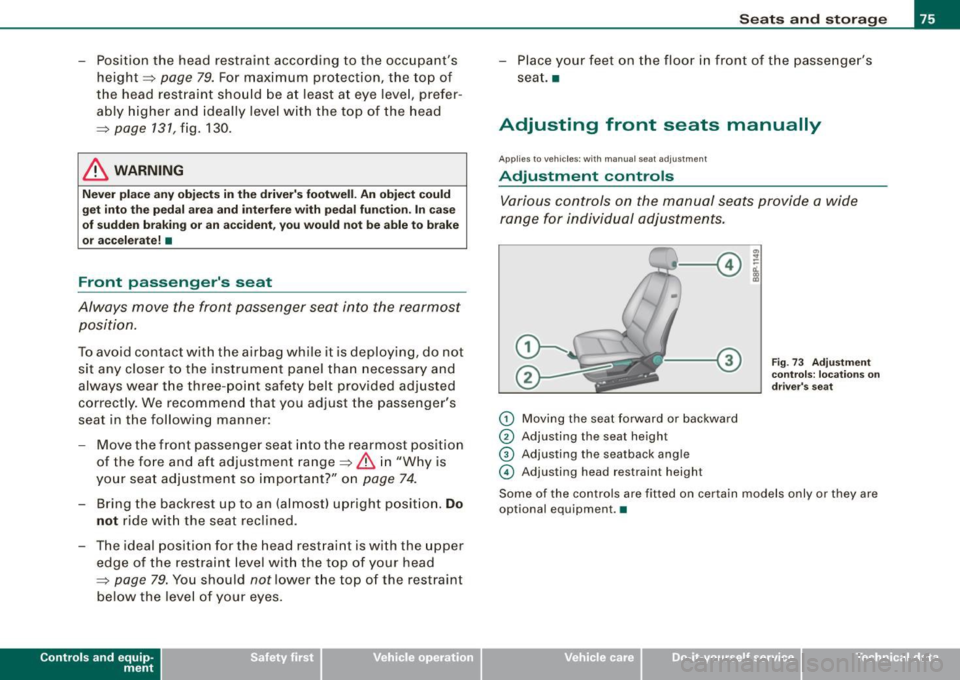
G) Moving the seat forward or backward
© Adjusting the seat height
© Adjusting the seatback angle
© Adjusting head restraint heigh t
Fig. 73 Adjustment
controls: locations on
driver's seat
Some of the controls are fitted on certain models only or they are
optional equipment. •
Vehicle care
I I irechnical data
Page 96 of 324
Seats and storage
-Plu g in ap plia n ce to be us ed.
The ou tlet may be used for 12-volt app liances with maximum
consumption of up to 100 watts, such as a flash light , smal l vacuum
cleaner, etc .
Before you purchase any accessories, always read and follow the
inf orm ati on i n
=> page 305 , "Addi tiona l ac cess ories and parts
replacement" .
& WARNING
The outlet plu s any appliances plugged into it remain functional
even if the ignition is switched off or the ignition key is removed .
Ne ver leave children inside the vehicle without supervi sion .
0 Note
To avoid damaging the socket, only use p lugs that fit properly .
[ i ] Tips
When the engine is off and accessories are sti ll plugged in and are
on, the vehicle batte ry can sti ll be d rained .•
Storage
General overview
There are numer ous pl aces to store items i n your ve hicle.
Storage in the front arm rest
Storage in t h e rear ar m res t
=> page 87
Glove compart ment (A ir v enti lati on i n t he ::::> page 95
glove compartment*, CD changer *) Cent
er console
Compartments in the door trims
S to ra ge in the f ootwe ll
=> page9 5
=> page96
=> page96
Compartments in luggage compartment => page 97
Some of the s torage locations are only found on specific veh icle
models or are optional equ ipment .
& WARNING
• Always remove obje cts from the in strument panel. Any items
not put away could slide around inside the vehicle while driving or
when a ccelerating or when applying the bra kes or when driving
around a corner .
• When you are driving make sure that anything you may have
placed in the center console or other storage locations cannot fall
out into the footwells . In case of sudden bra king you would not be
able to brake , depress the clut ch or accelerate .
• Any pie ces of clothing that you have hung up mu st not interfere
with the driver's view. The coat hooks are designed only for light
weight clothing . Never hang any clothing with hard , pointed or
heavy objects in the pockets on the coat hooks . During sudden
bra king or in an accident -especially if the airbag is deployed -
these obje cts could in jure any passengers inside the vehicle. •
Page 97 of 324
Glove compartment
The glove compa rtmen t is illumin ated an d can be Jocke d.
"' 10 ., ~ a:. ., 03
To open glove compartment
Fi g. 101 Glove
c ompartment
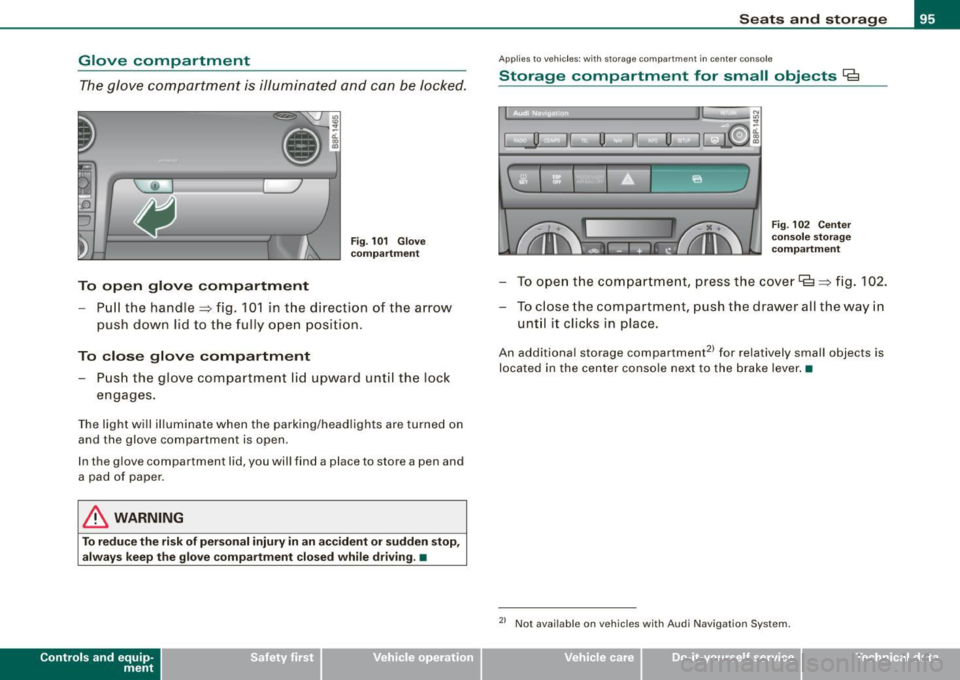
- Pull the handle => fig. 10 1 in t he direction of the a rrow
p ush do wn lid to the fully o pen p osition .
To close glove compartment - Push the glove compartment lid upward unt il the loc k
engages.
T he light will il luminate when the parking/head lights are turned on
and the glove compartme nt is ope n.
I n the g love compartment lid, you wil l find a place to store a pen and
a pad of paper.
& WARNING
To reduce the risk of per sonal injury in an accident or sudden stop ,
always keep th e glove compa rtment closed while driving . •
Con tro ls and eq uip
ment
Seats and storag e
Applie s to veh ic les : w it h stora ge co mpart ment in cente r co nsole
Storage compartment for small objects Ca
I, __] II 0
l
l
I~ u
I
' Fig . 102 Center
c o nso le st orag e
co mpartm ent
- T o open th e c om partm ent, pre ss t he c ove r lg => fig. 102.
- To c lose the compa rtment, push the drawe r all the way in
unt il it clic ks in place.
An additiona l storage compartment2 1 for relatively small objects is
located in the cen ter console ne xt to the brake lever .•
2> Not avai lab le on veh ic le s with Audi Nav igat ion System .
Vehicle care I I irechnical data
Page 111 of 324
___________________________________________________ O _n_ t_h _ e_ r_ o _ a_ d __ lfflll
Starting and stopping the engine
Starting the engine
The engine can only be started with on original Audi key
and the clutch pedal* depressed.
- Set the parking brake.
Move the selector lever to the neutral position (automatic
transmission): selector lever in P or N) =>
&.
- On vehicles with manual transmission, fully depress the
clutch pedal.
- Turn the ignition key to position@=>
page 108, fig. 113
- do not depress the gas pedal when starting the engine!
- Let go of the key as soon as the engine starts.
A cold engine may at first be loud after it has been started. This is
due to the hydraulic valves building up the oil pressure . This normal
and no need for concern.
If the engine does not star t immediately, stop trying after 10
seconds and then try to restart the engine about 30 seconds later.
& WARNING
Never start or let the engine run in a confined or enclosed area.
Exhaust fumes from the engine contain carbon monoxide, a color
less and odorless gas. Carbon monoxide can be fatal if inhaled .
• Never leave the engine idling unattended. An unattended
vehicle with a running engine poses a danger of personal injury or
theft.
Controls and equip
ment
0 Note
• Avoid high engine speeds, fast acceleration or heavy engine
loads while the engine is still cold. This could damage the engine!
• The engine cannot be started by pushing o r towing the vehicle.
~ For the sake of the environment
To avoid unnecessary engine wear and to reduce exhaust emis
sions, do not let your vehicle stand and warm up. Be ready to drive
off immediately after starting your vehicle. Maintain moderate
speed until the engine is completely warm. Remember, the engine
performs best at operating temperature. •
Stopping the engine
-Turn the ignition key to position@=> page 108 , fig. 113.
& WARNING
• Never turn off the engine until the vehicle has come to a
complete stop.
• The brake booster and servotronic only work when the engine
is running . With the ignition turned off, you have to apply more
force when steering or braking. Since you cannot steer and stop
normally, this can lead to accidents and serious injuries.
• The radiator fan can continue to run for up to 10 minutes even
after you have turned off the engine and removed the ignition key.
The radiator fan can also turn on again if the engine coolant heats
up because of intense sunlight or heat build-up in the engine
compartment. .,
I • •
Page 112 of 324

• ..__O_ n_ t_h _ e_ r_ o_ a_ d ____________________________________________________ _
0 Note
Do not stop the engine immediately after hard or extended driving.
Keep the engine running for approximately two minutes to prevent
excessive heat build-up. •
Parking brake
Parking brake
When the parking brake is set, it prevents the vehicle from
rolling away unintentionally.
Setting the parking brake
Fig . 114 Center
console: Parking brake
set
- Pull the parking brake lever all the way up.
Releasing the parking brake Pull the parking brake lever up slightly
and press the
release button at the same time=> fig. 114 -arrow-.
Keep the release button pressed and lower the parking
brake=>
& -
If you should drive off with the parking brake still set, a warning tone
will sound and the following will appear in the instrument cluster to remind you to release the parking brake:
Parking brake set
The parking brake warning comes on only after you have driven for longer than 3 seconds and faster than 5 mph (5 km/h).
The parking brake warning light Brake (USA)/
{CD) (CON) illuminates
when the parking brake is set and you switch on the ignition.
& WARNING
Always release the parking brake completely . A partially engaged
brake will overheat the rear brakes, reduce their effectiveness and
cause excessive wear. This could lead to brake failure and an acci
dent.
0 Note
Only after the vehicle has come to complete stop, should you firmly
set the parking brake and either move the gearshift lever into 1st .
gear (manual transmission) or move the selector lever into "P"
(Automatic transmission). •
Parking
To prevent a parked vehicle from rolling away, there are a
few things you should do.
When you park your vehicle, do the following:
- Stop the vehicle using the brake pedal.
- Set the parking brake firmly.
- Move the selector lever into the
P position (automatic
transmission)
or move the gearshift lever into 1st. gear
(manual transmission) => &. .,_
Page 113 of 324
On the road -
----------------
-Switch off the engine a nd rem ove the igni tion k ey from
t h e ign iti on loc k.
Wha t el se you should do when parking your vehic le on
a n in cline o r de cline
Turn the steering whee l so that if the vehicle shou ld start to rol l, it
wil l ro ll into the curb.
I f you are parking on a
de cline (the front of your vehic le facing
downh ill), turn the front wheels to the right so that they po int
toward the curb.
If you are parking on an
in cline (the fon t of your vehicle facing
uphill), turn the front whee ls to the left so that they point away from
the cu rb.
Move the selector lever into the
P pos it ion (a utomatic tran smiss ion )
or move the gearshift lever into 1st. gear (manual trans mission) .
& WARNING
This is how you can reduce the r isk of injury when leaving your
v ehi cle .
• Never p ark the vehicle where it can come in contact with dry
gr ass, s pilled fuel or any other fl ammable mater ial s.
• Never allow anyone -espec ially small ch ildren -to remain in the
v ehi cle when it i s loc ked . Lo cked door s make it more diffi cult f or
rescuer s to acce ss the pa ssenger compartm ent in the event of an
eme rgen cy. Dang er to life!
• Never l eave children un supervi sed in the vehicle. Children
c ould relea se the p ark ing br ake or move the ge ars h ift le ver out of
gear. The vehicle could start to roll away and cau se an a ccident.
• No matter wh at the se ason i s, the temperat ure in a p arked
vehicle can reach dangerou s levels. •
Controls and equip
ment
Ap plies to vehic les: with hill hol d ass is t
Starting on hills
Hi ll hold assist makes it easier t o sta rt on hills .
The system is activated when the brake pedal is depressed
for a fe w
s econds .
After re leas ing the brake peda l, the brake power is held for a brief
moment to prevent the vehic le from rolling back when starting . At
t his time, you can easily beg in to m ove your vehicle.
& WARNING
• If you did not begin mov ing immediately afte r relea sing the
brake pedal , unde r certain circumst ances , the v ehi cle would begin
to roll ba ckw ard . Depres s the brak e pedal immedi ately or engag e
the hand brake .
• Should the engi ne stall , depres s the brake ped al immedi ately
or eng age the hand bra ke.
• In order to pre vent the vehi cle from rolling ba ck unintentionally
when starting in stop-and-go traffic , ke ep th e brake pedal
depre ssed for a few second s before driving off .
[ i ] Tips
You can find out if your vehicle is equipped with "Hill hold assist" at
an authorized Audi dealership .•
I • •
Page 116 of 324

• .___O_ n_ t_h _e _ r_o _a_ d __________________________________________________ _
CRUISE (US model)/ r,,f (Canadian model) will also light up in the
instrument cluster.
& WARNING
• Always pay attention to traffic even when the cruise control is
switched on. You are always responsible for your speed and the
distance between your vehicle and other vehicles.
• For safety reasons, the cruise control should not be used in the
city, in stop-and-go traffic, on twisting roads and when road condi
tions are poor (such as ice, fog, gravel, heavy rain and hydro
planing) -risk of accident.
• Turn off the cruise control temporarily when entering turn
lanes, highway exit lanes or in construction zones.
• Please note that inadvertently "resting" your foot on the accel
erator pedal causes the cruise control not to brake. This is because
the cruise control is overridden by the driver's acceleration.
[ i J Tips
• Vehicles with manual transmission : You can attain the set speed
only if the currently engaged gear allows it and the engine is not
stressed. Shifting to a higher or lower gear promptly will allow the
engine to run smoothly.
• The cruise control cannot maintain a constant speed when
driving downhill. The vehicle will accelerate under its own weight.
Downshift to a lower gear or use the brakes to slow down. •
Changing speed
- Press lever in the 0 or Q direction~ page 113, fig. 116
to increase or decrease your speed.
Release the lever to save that speed .
Change speed in increments of 1 mph (1 km/h) by lightly pressing
the lever. If you keep the lever pressed down, you will alter your
speed in 5 mph (10 km/h) increments.
You can also press the accelerator pedal down to increase your
speed, e .g. if you want to pass someone. The speed you saved
earlier will resume as soon as you release the accelerator pedal.
If, however, you exceed your saved speed by 5 mph (10 km/h) for
longer than 5 minutes, the cruise control will turn off temporarily.
The symbol will go out but the saved speed will be retained. •
Presetting your sp eed
You can preset your desired speed while the vehicle is not
moving.
- Turn on the ignition.
Pull lever into position
G) ~ page 113, fig. 116.
Press the lever in the
0 or Q direction to increase or
decrease your speed.
- Release the lever to save that speed.
This function makes it possible, for example, to save the speed you
want before driving on the highway. Once on the highway, activate
the cruise control by pulling the lever toward
G) . •
Switching th e system off
Temporary deactivation
Press the brake pedal, or
- Keep the clutch pedal pressed down
longer, or
Press the lever into position
0 (not clicked into place)
~ page 113, fig. 116, or ._
Page 117 of 324

On th e road 1111
--------------~:.:..--J
- Drive for longer than 5 minutes at more than 5 mp h
(10 km/h) above the stored speed .
Switchin g o ff compl ete ly
- Press lever into position@ (clicked into place), or
- Switch the ign ition of f.
The system retains the saved speed if you deactivate the cruise
control temporarily. To resume the saved speed, release the brake or
clutch pedal and pull the lever to position
G) .
Switching the ignition off erases the saved speed.
& WARNING
You s hould only return t o th e sa ved sp ee d if it i s not to o fast fo r
the curre nt traff ic condi tio ns -ris k of an a ccident! •
Applies to ve hic les: with m agn etic r id e
Audi magnetic ride
Damping can be adjusted to the driver's preference and it
adapts automatically to the curren t driving situation.
t 9 1 ] J
Fi g. 11 8 Ce nte r
co nso le: Sw itc h for
A ud i m agn etic rid e
Press the switch ~ fig. 118 to turn sport setting on or off.
Con tro ls and eq uip
ment
Audi magnetic ride is an e lectronically control led damping system.
This chassis system assists the driver by adapt ing to the particular
s ituation through imperceptible control processes . The
dampin g
provides individua l modulation of damping forces . For example,
with damping characteristics set to provide greater comfort ,
damping is set somewhat harder for a brief period on ly as required,
when rounding a curve and when braking.
Standard settin g
Select the standard setting if you prefer a suspension setting
emphasizing comfort .
Sp or t setting
Select the sport setting if you prefer a sporty suspension setting .
The LE D in the switch comes on to indicate sport setting .
[ i ] Tip s
The warning/indicator light in the instrumen t cluster comes on in
the event of a malfunction. Drive to the closest authorized Audi
dea le r as soon as possible and have the malfunction repaired .•
Vehicle care I I irechnical data
Page 119 of 324

_______________________________________________________ T_ ra_ n_s_ m __ is_s_ io_ n __ ftllll
S tronic transmission
Ap plies to veh ic les: w ith S tronic®
Introduction
Your vehicle is equipped with a S tronic transmission, also called a
double -clutch system/transmission.
Power is transferred between the engine and the transmission by
means of two independent clutches. They replace the torque
~
converter of conventiona l automatic transmissions and allow the
vehic le to acce lerate without a noticeable break in the power flow.
With the aid of
tiptronic , the gears can optionally be shifted manu
ally => page 121. •
Ap plies to veh ic le s: w ith S troni c®
Selector lever positions
All the selector lever positions are explained in this
section.
Fig . 120 Display :
Selector lever posi
tion s
The se lector lever position is shown in the instrument cluster
display by highlighting the appropriate symbol.
Controls and equip
ment P
-Park lock
In this position the gears are mechanically locked .
The park lock must only be engaged with the veh icle
stationary
=> & .
To engage P and to remove the lever from this position, you must
depress the release button (button in the se lector lever handle)
and
simultaneously you must step on the brake pedal.
R -reverse
In this position, reverse is engaged.
Reverse gear must only be engaged with the vehicle
stationary and
the engine running at idle speed =>& .
To engage R, you have to depress the release button
and simulta
neously step on the brake pedal. In the R position, the back -up lights
illuminate with the ignition on.
N -Neutral
The transmission is in neutral in this position .
D -Normal position for driving forward
In this position, the forward gears are automatically shifted up and
down, depending on engine load and vehicle speed.
To engage S from N, the brake pedal must be depressed at speeds
below 5 km/h or when the vehicle is stationary=>& .
In certain circumstances (driving in the mountains for example) it
can be beneficial to switch temporarily to the manua l shift program
=> page 121 in order to adjust the gear ratios to driving conditions
manually .
S -Sport setting
The S setting should be selected for sporting driving . The power
reserves of the engine can be fully exploi ted through later upshifts.
To engage S from N, the brake pedal must be depressed at speeds
below 5 km/h or when the vehicle is stationary =>& .
~
I • •