ECO mode AUDI S3 2010 Owner's Guide
[x] Cancel search | Manufacturer: AUDI, Model Year: 2010, Model line: S3, Model: AUDI S3 2010Pages: 320, PDF Size: 75.34 MB
Page 249 of 320

________________________________________________ T_ i _r_e _s_ a_n_ d_ w_ h_ e_e _ l_s __ !II
•
vehicle at its maximum capacity weight and tires that were on your
vehicle at the time it was manufactured .
If yo u w is h to impr ove co mfort w hen op erati ng th e vehicle at
n or mal load (u p to 3 occup ants), y ou ca n adj us t t ire pr essures to
tho se spe cified for normal vehicle load. Before oper ating the vehicle
a t m aximum lo ad , you mu st in cre as e t he t ire pre ssure s to t hose
s pecified for ma ximum vehi cle load =>
&.
Bear in mind that the tire pressure monitoring system * can only
monitor the tire pressu res you have stored. The syste m does not
recognize the load condition of your vehicle .
The effectiveness of the tire pressure monitoring system * will be
impaired if you store normal load pressures but then operate the
vehicle at its maximum load=>& . See the
illustration=>
page 246, fig. 173 for the location of the label
either o n driver's side 8 -p illar or inside the fue l filler flap (color of
the actual label and exact location on the vehicle will vary slight ly).
Note that the following tab le is accurate at the time of going to
press and is subject to change . In the event of discrepancies, the t ire
pressure label (on USA vehicles, the tire pressure label is located on
driver's side 8-pillar; on Canada vehic les, the tire pressure label is
located either on the driver's side 8-pi llar or inside the fuel filler
flap.) always takes precedence .
The table below lists the recommended cold tire inflation pressures
for the Audi mode l covered by your Owner's Literature at the
vehic le's capacity weight and the tire sizes installed on the respec
tive models as original equipment, or as a factory option.
Engin e
(displ ace
ment in
liter )
Tire d es ig nation Tir e pr essur e front Tir e pr essur e rear
4-cylinde r
2 .0 TF SI (ga s
o line) 2
05 /55 R16 91H All Se aso n
225 /45 R17 91W High Performanc e
22 5/45 R1 7 94H XL All Season
2 2 5/45 R17 94V XL High Performan ce
2 25 /40 R18 92V XL High Performance
Comp act spare wheel T12 5/70 R18
norm al lo ad
condit ion (up to
3 o ccup ants )
36 250
35 240
38 260
35 240
38 260
60 420 full lo
ad
condition
PSI kPA
39 270
38 260 39 270
36 250
41 280
60 420
Vehicle care
norm
al lo a d
full load
condition (up
condition
to 3 o ccup ants )
kPA kPA
30 210
38 260
30 2 10 36 250
32 220 38 260
30 2
10
35 240
35 240 41 280
60 420
60 420
I t •
Page 257 of 320
Tires a nd wh eels -
----------------
•
0
-
©
®
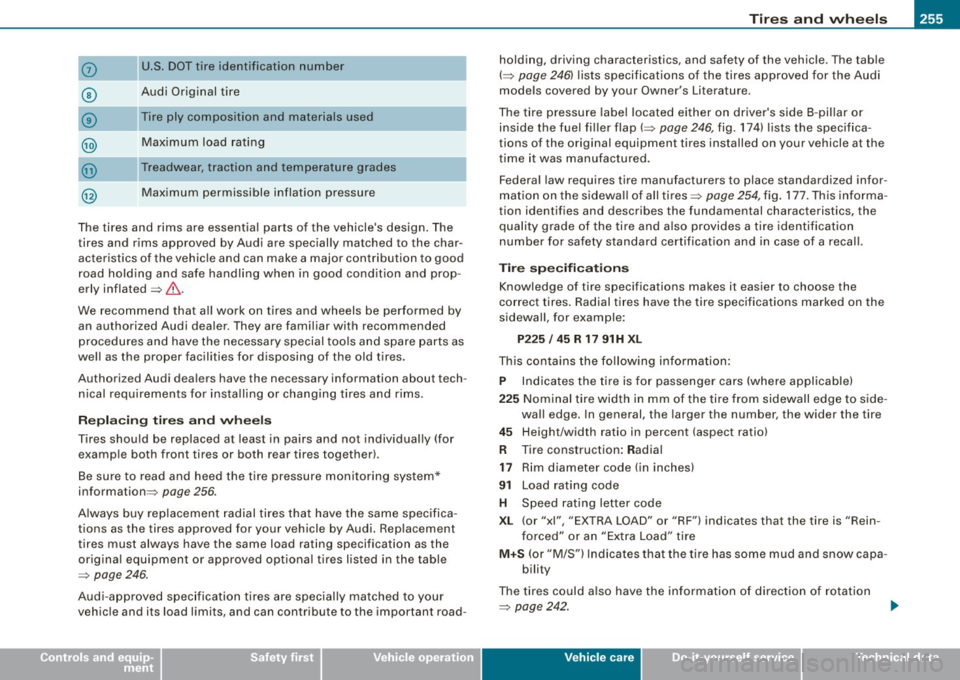
U.S. DOT tire identification number
Audi Original tire
Tire ply composition and materials used Maximum load rating
Treadwear, traction and temperature grades
@ Maximum permissible inflation pressure
The tires and rims are essential parts of the vehicle 's design. The
tires and rims approved by Audi are specially matched to the char
acteristics of the vehicle and can make a major contribution to good
road hold ing and safe handling when in good cond ition and prop
erly inflated =>& .
We recommend that a ll work on tires and wheels be performed by
an authorized Audi dealer. They are familiar with recommended
procedures and have the necessary special tools and spare parts as
well as the proper facilities for disposing of the old tires.
Authorized Audi dea lers have the necessary info rmation about tech
nical requirements for insta lling or changing tires and rims.
R epl ac ing tires and wheels
Tires shou ld be replaced at least in pairs and not individual ly (for
examp le both front tires or both rear tires together).
Be sure to read and heed the tire pressure monitoring sys tem*
information=>
page 256.
A lways buy replacement radial tires that have the same specifica
tions as the tires approved for your vehicle by Audi. Rep lacement
tires must always have the same load rating specification as the
origina l equipment or approved optional t ires listed in the table
=>
page 246.
Audi -appr oved spec ification tires are spec ially matched to your
vehicle and its load limits, and can contribute to the important road- holding, driving characteristics, and safety of the vehicle
. The table
( =>
page 246) lists specifications of the tires approved for the Audi
models covered by your Owner's Literature.
The tire pressure labe l located either on driver's side 8 -pi llar or
inside the fuel fi ller flap(=>
page 246, fig. 174) lists the specifica
tions of the original equipment tires installed on your vehicle at the
ti me it was manufactured.
Federa l law requires tire manufacturers to place standardized infor
mation on the sidewa ll of all tires =>
page 254, fig . 177. This informa
t ion identifies and describes the fundamental characteristics, the
qua lity grade of the ti re and also provides a tire identification
number for safety standard certificat ion and in case of a recal l.
Tire specificat ions
Knowledge of tire specifications makes it easier to choose the
co rrect t ires . Radial tires have the tire specifications marked on the
sidewall, for example :
P225 / 45 R 17 91H XL
This contains the fo llowing informa tion:
P Indicates the ti re is for passenger cars (where applicab le)
225 No minal tire width i n mm of the tire fro m sidewall edge to side -
wa ll edge. In general, the larger the number, the wider the tire
45 Height/width ratio in percent (aspect ratio)
R Tire construction: Radial
17 Rim diameter code (in inches)
91 Load rating code
H Speed rating lette r code
XL (or "xi", "EX TRA LOA D" or "RF") indicates that the tire is "Rein
forced" or an "Extra Load" ti re
M +S (o r "M/S") Indicates that the tire has some mud and snow capa
bility
The tires could a lso have the information of direct ion of rotation
=>
page 242.
Vehicle care I t •
Page 259 of 320
________________________________________________ T_ i _r_e _s_ a_n_ d_ w_ h_ e_e _ l_s __ !II
•
to ring s yst em * would not b e ab le to moni tor the tire pr essur e or
war n yo u if i t is nec essa ry.
• T he battery ins ide of the tire pressure s ensor has a l imited
service life.
• Always driv e with the va lv e stem caps s ecure ly m ounted. We
r e co mm end usi ng fact ory insta lled valve stem cap s. Ask y our a utho
rized Audi d ealer to replac e lost valve stem caps .
T he installat ion of replacement tires with steel cord body plies in
t he ti re s id ew all m ay ca use ma lfun ction o f th e tire press ure m oni
toring system *, and is not recommended (co rd mater ial information
i n mo lded on t he tire sid ewa ll).
Always check your t ire pressure mo nitoring system* indicator after
r eplaci ng o ne or more tir es o n you r veh ic le . If t he ti re p ressu re
mo nito ring syste m* in dicato r flashes o r is ill um in ated, your s ystem
is not working p rope rly . Yo ur replacement t ire might be inco mpat
i b le with you r tir e p ressure mon itori ng sys te m *, or so me comp o
nent of the tire pressure monitoring system * may be damaged .
& WARNING
• Using incorrect or unmatched tires and / or wheels or improper
tire and wheel combinations can lead to loss of control , collision
and serious personal injury .
• Always use tires , rims and wheel bolts that meet the specifica
tions of original factory-installed tires or other combinations that
have been specifically approved by the vehicle manufacturer .
• Tires age even if they are not being used and can fail suddenly,
espe cially at high speeds . Tires that are more than 6 years old can
only be used in an emergency and then with special care and at
lower speeds.
• Never mount used tires on your vehicle if you are not sure of
their "previous history. " Old used tires may have been damaged
even though the damage cannot be seen that can lead to sudden
tire failure and loss of vehicle control.
& WARNING (continued )
• All four wheels must be fitted with radial tires of the same type,
size {rolling circumference ) and the same tread pattern. Driving
with different tires reduces vehicle handling and can lead to a loss
of control.
• If the spare tire is not the same as the tires that are mounted
on the vehicle -for example with winter tires -only use the spare
tire for a short period of time and drive with extra care . Refit the
normal road wheel as soon as safely possible.
• Never drive faster than the maximum speed for which the tires
on your vehicle are rated because tires that are driven faster than
their rated speed can fail suddenly .
• Overloading tires cause heat build-up , sudden tire failure ,
including a blowout and sudden deflation and loss of control.
• Temperature grades apply to tires that are properly inflated and
not over or underinflated.
• For technical reasons it is not always possible to use wheels
from other vehicles -in some cases not even wheels from the
same vehicle model.
• If you install wheel trim discs on the vehicle wheels , make sure
that the air flow to the brakes is not blocked . Reduced airflow to
the brakes can them to overheat , increasing stopping distances
and causing a collision .
• Run flat tires may only be used on vehicles that were equipped
with them at the factory . The vehicle must have a chassis designed
for run flat tires and a factory-installed tire pressure monitoring
system* that indicates a loss of tire pressure . Incorrect use of run
flat tires can lead to vehicle damage or accidents . Check with an
authorized Audi dealer or tire specialist to see if your vehicle can
be equipped with run flat tires . If run flat tires are used , they must
be installed on all four wheels . Mi xing tire types is not permitted. _,.
Vehicle care
I t •
Page 308 of 320
___ A_l.:,. p _h_ a_ b_e _t _ic _ a_l _in _ d_e _x ____________________________________________ _
Centigrade
Switching between Centigrade and Fahrenheit ...... .... ........ ... 101
Central locking panoramic sliding sunroof closing .. . 50
Certification . . . . . . . . . . . . . . . . . . . 267, 302
Changing a flat tire ...... .... .... ... 270
Changing engine oi l .. ... ... .. .... ... 230
Chassis Undercoating . . . . . . . . . . . . . . . . . . . . 211
Checking Engine coolant level ...... .... .... 233
Checking tire pressure ............... 249
Child restraint
Danger of using child restraints in the
front seat . . . . . . . . . . . . . . . . . . . . . . 147
Child restraint system anchors ........ 180
Child restraints Where can I get additional information
about child restraints and their use? ...
185
Child safety .. .... .............. 167, 172
Convertible locking retractor . . . . . . . 177
Important safety instructions for using
child safety seats ............... 170
Important things to know when driving with chi ldren ..... ....... ....... 167
Installing a child restraint using the
LATCH system ... .... ........ ... 182
Mounting and releasing the anchorage hook ...... ...... ....... ....... 182
Te ther anchors .................. 183
T ether straps .. .... ....... ....... 183
Child safety lock ...... .... .... .... ... 45 Child safety seats
.... .... .... ...... . 172
Booster seats . . . . . . . . . . . . . . . . . . . . 175
Convertible chi ld seats ............ 173
Convertible locking retractor ... .... 177
How do I properly install a child safety
seat in my vehicle? .... .... ...... 170
Infant seats . . . . . . . . . . . . . . . . . . . . . 172
Installing ....................... 177
LATCH system . . . . . . . . . . . . . . . . . . . 182
Safety instructions .... .... ...... . 170
Child seats Lower anchorages . . . . . . . . . . . . . . . . 181
Cleaning Alcantara (synthetic suede) ... .. ... 214
Engine compartment ............. 215
Fabrics and fabric c ,overings ..... .. 211
Instrument panel .... ... .... .... .. 212
Interior ............ ... ........ .. 211
Leather ..... .. ... ... .. .... ..... . 213
Plastic and vinyl .. ..... ... .... ... 208
Plastic parts ... .. . ... .... ....... . 212
Safety belts . .................... 215
Trim strips ...................... 207
trim strips ..... ...... ..... .... ... 208
Cleaning and protection ...... .... ... 204
Climate controls ... .. .... .... .... .... 96
Addi tional heater . . . . . . . . . . . . . . . . 103
Air distribution . . . . . . . . . . . . . . . . . . 101
Air outlets . . . . . . . . . . . . . . . . . . . . . . . 102
Air recirculation .... .... .... ...... 101
Air recirculation mode (manual) .... 100
AU TO (standard setting) ............ 99
Automatic air recirculation ...... .. 100
Contro ls .. ....... ..... ..... .. .... 98 Defrosting
/defogging ...... .... .... 99
Description ... .. ... .... ...... ... .. 96
Fan .. ...... ... .. .... ........ ... 101
Key-coded setting ................ 103
Recommended settings ............ 96
Setting the temperature .... .... .... 99
Switching between Fahrenheit and
Centigrade ... ........ ...... .... 101
Switching the air conditioning on and off 99
Using the climate control economically . .
102
Warm and cold ... .... .... .... .... 96
Clock .................. ......... ..... 9
Coat hooks . . . . . . . . . . . . . . . . . . . . . . . . . . 95
Cold tire inflation pressure .. .... ..... 246
coming home ..... .. .... .... .... .... 54
Compartments in the door trims ... ... . 94
Compass mirror . ...... ... ... ........ 70
Comp liance .......... ....... .... ... 302
Consumer Information ........... 133, 298
Contacting NHTSA .................. 133
Convenience close/open feature
Windows .......... ....... .... .... 48
Convertible chi ld safety seats
Convertible locking retractor 173
Activating ....................... 179
Deactivating ................. .... 180
Using to secure a child safety seat .. 177,
179
Coolant system ........ .. ... . .... ... 232
Cooling System Expansion tank ... .. ...... .... ... 233