lock AUDI S3 2010 Manual PDF
[x] Cancel search | Manufacturer: AUDI, Model Year: 2010, Model line: S3, Model: AUDI S3 2010Pages: 320, PDF Size: 75.34 MB
Page 236 of 320

-~_C_ h_e _c _ k_ i_n ...:::g::;...._ a_n_ d_ f_ i_ll _in -'g:::;.._ ___________________________________________ _
tion and performance of your cooling system and could resu lt in
d am age not co vered by yo ur Ne w Vehicle Li mited Warranty .•
Adding coolant
B e very caref ul whe n addin g engine c oo lant.
Before you check a nything in the e ngine compartmen t,
always read and heed all WARNINGS=> & in "Work ing in
the en gine compartmen t" on
pa ge 224.
- Turn off the engine.
- Le t the engin e coo l down.
Place a thi ck ra g o ver th e c oolan t expansio n ta nk
=> pa ge 233, fi g. 1 69 an d carefully twi st th e cap coun te r
cl ockwi se
=> &.
- Add cool ant.
- Twist the cap on aga in
tightly.
Replacement engine coolant must conform to exact specifications
~ page 232, "Coolant". Even in a n eme rge ncy, if co olant add it ive
G 12++. G12+ or G 12 is not availab le, do
not use a diffe rent additive.
Use plain water instead unt il you ca n get the c orrect additive and
can restore the correct ratio . This should be done as soon as
possible.
If you have lost a considerable amount of coo lant, then you should
add co ld antifreeze and cold water only when the engine is cold.
A lways use
new e n gin e c oolan t wh en refi llin g.
Do not fi ll coo lant above the "MAX" mark . Excess coolant will be
f o rced ou t through the pressure re lief va lve in the cap when the
engine becomes hot.
& WARNING
• The cooling system is under pressure and can get very hot .
Redu ce the risk of scalding from hot coolant by following these
steps .
- Turn off the engine and allow it to cool down.
- Protect your face , hands and arms from e scaping fluid and
steam by covering the cap with a large, thick rag.
- Turn the cap slowly and very carefully in a counter -clockwise
direction while applying light , downward pressure on the top
of the cap.
- To avoid being burned , do not spill antifreeze or coolant on
the e xhaust system o r hot engine parts . Under certain condi
tions , the ethylene glycol in engine coolant can catch fire.
• Antifreeze is poisonous . Always store antifreeze in its original
container and well out of the rea ch of children.
• If you drain the coolant , it must be caught and safely stored in
a proper container clearly marked "poison".
0 Note
• Coo la n t po llutes t he environ ment and cou ld cause a n engine
fire . Excess coolant will be forced out through the pressure re lief
va lve in t he cap when t he eng in e b ecomes hot .
• I f, in an emergency, on ly water can be added, the correct ratio
be tween wa ter and antifree ze~
page 232 mus t be restore d as soon
as possib le .
'£> For the sake of the environment
D rained coolant should not be reused. Always d ispose of used
coo la nt whi le observing all e nvi ro n men tal reg ulat ions .•
Page 251 of 320
________________________________________________ T_ ir_e _s_ a_n_ d_ w_ h _e_e_ l_s __ lJlll
•
& WARNING
• Incorrect tire pressures and/or underinflation can lead to a
serious or fatal accident.
• Incorrect tire pressures and/or underinflation cause increased
tire wear and can affect the handling of the vehicle.
• Incorrect tire pressures and/or underinflation can also lead to
sudden tire failure, including a blowout and sudden deflation,
causing loss of vehicle control. •
Checking tire pressure
The correct tire pressure for the tires originally installed
on your vehicle is listed on the tire pressure label located
either on driver's side 8-pillar or inside the fuel filler flap.
The recommended tire pressures are on the tire pressure label and
in the table=> page
246, "Cold tire inflation pressure ". This means
that the pressure must be checked and adjusted when the tire has
not been driven for more than a couple of miles (kilometers) at low
speeds during the previous three hours. Air in the tires expands
when the tire heats up as a result of internal friction as it flexes in
use. The tire pressure is higher when the tire has warmed up than
when it is "cold."
It is the inflation pressure in a "cold" tire that counts. Therefore, you
should never let air out of a warm tire to match "Cold tire inflation
pressure" recommendations=>
page 246. The tires would then be
underinflated and could fail suddenly.
The tire pressure label on your Audi lists the recommended cold tire
inflation pressures for the new, original equipment tires that were
on your vehicle at the time it was manufactured. For the location of
the label =>
page 246, fig. 173.
Most tires lose air naturally over time. They can also lose some air if
you drive over a pothole or hit a curb while parking. It is usually not possible to see whether the radial tires used today are underinflated
just by looking at them.
Therefore, be sure to check tire pressures at least once a month and
always before going on a long trip. Make sure to take the number of
people and the amount of luggage into account when adjusting tire
pressure for a trip -even one that you would not consider to be
"long." See=>
page 250, "Tires and vehicle load limits" for more
important information .
Always use an accurate tire pressure gauge when checking and adjusting inflation pressures . Check all of the tires and be sure not
to forget the spare tire. If the pressure in any tire is too high when
the tire is "cold," let air out of the tire slowly with the edge of the tire
gauge and keep checking the pressure until you reach the pressure
that is correct for the load (passengers and luggage) and kind of
driving you plan to do .
If the pressure in any tire is too low, note the difference between the
pressure in the cold tire and the pressure you need and add the air
that you need to reach the correct pressure for the vehicle load
(passengers and luggage) for the tires on your vehicle as listed on
the on your vehicle and in this manual and the kind of driving you
plan to do.
Never exceed the maximum inflation pressure listed on the tire
sidewall for any reason.
Remember that the vehicle manufacturer, not the tire manufacturer ,
determines the correct tire pressure for the tires on your vehicle.
It is important to check the tire pressure when the tires are cold.
• Read the required tire pressure from the tire pressure label. On
USA vehicles, the tire pressure label is located on driver's side B
pillar. On Canada vehicles, the tire pressure label is located either on
the driver's side B -pillar or inside the fuel filler flap.
• Turn the valve stem cap counter-clockwise to remove it from the
tire valve.
• Place the air pressure gauge on the valve. ..,.
Vehicle care I t •
Page 259 of 320
________________________________________________ T_ i _r_e _s_ a_n_ d_ w_ h_ e_e _ l_s __ !II
•
to ring s yst em * would not b e ab le to moni tor the tire pr essur e or
war n yo u if i t is nec essa ry.
• T he battery ins ide of the tire pressure s ensor has a l imited
service life.
• Always driv e with the va lv e stem caps s ecure ly m ounted. We
r e co mm end usi ng fact ory insta lled valve stem cap s. Ask y our a utho
rized Audi d ealer to replac e lost valve stem caps .
T he installat ion of replacement tires with steel cord body plies in
t he ti re s id ew all m ay ca use ma lfun ction o f th e tire press ure m oni
toring system *, and is not recommended (co rd mater ial information
i n mo lded on t he tire sid ewa ll).
Always check your t ire pressure mo nitoring system* indicator after
r eplaci ng o ne or more tir es o n you r veh ic le . If t he ti re p ressu re
mo nito ring syste m* in dicato r flashes o r is ill um in ated, your s ystem
is not working p rope rly . Yo ur replacement t ire might be inco mpat
i b le with you r tir e p ressure mon itori ng sys te m *, or so me comp o
nent of the tire pressure monitoring system * may be damaged .
& WARNING
• Using incorrect or unmatched tires and / or wheels or improper
tire and wheel combinations can lead to loss of control , collision
and serious personal injury .
• Always use tires , rims and wheel bolts that meet the specifica
tions of original factory-installed tires or other combinations that
have been specifically approved by the vehicle manufacturer .
• Tires age even if they are not being used and can fail suddenly,
espe cially at high speeds . Tires that are more than 6 years old can
only be used in an emergency and then with special care and at
lower speeds.
• Never mount used tires on your vehicle if you are not sure of
their "previous history. " Old used tires may have been damaged
even though the damage cannot be seen that can lead to sudden
tire failure and loss of vehicle control.
& WARNING (continued )
• All four wheels must be fitted with radial tires of the same type,
size {rolling circumference ) and the same tread pattern. Driving
with different tires reduces vehicle handling and can lead to a loss
of control.
• If the spare tire is not the same as the tires that are mounted
on the vehicle -for example with winter tires -only use the spare
tire for a short period of time and drive with extra care . Refit the
normal road wheel as soon as safely possible.
• Never drive faster than the maximum speed for which the tires
on your vehicle are rated because tires that are driven faster than
their rated speed can fail suddenly .
• Overloading tires cause heat build-up , sudden tire failure ,
including a blowout and sudden deflation and loss of control.
• Temperature grades apply to tires that are properly inflated and
not over or underinflated.
• For technical reasons it is not always possible to use wheels
from other vehicles -in some cases not even wheels from the
same vehicle model.
• If you install wheel trim discs on the vehicle wheels , make sure
that the air flow to the brakes is not blocked . Reduced airflow to
the brakes can them to overheat , increasing stopping distances
and causing a collision .
• Run flat tires may only be used on vehicles that were equipped
with them at the factory . The vehicle must have a chassis designed
for run flat tires and a factory-installed tire pressure monitoring
system* that indicates a loss of tire pressure . Incorrect use of run
flat tires can lead to vehicle damage or accidents . Check with an
authorized Audi dealer or tire specialist to see if your vehicle can
be equipped with run flat tires . If run flat tires are used , they must
be installed on all four wheels . Mi xing tire types is not permitted. _,.
Vehicle care
I t •
Page 262 of 320

-~_T_ ir_e_ s_ a_ n_d _ w_ h_ e_e _l_s _________________________________________________ _
& WARN ING (continued )
personal injur ies . Have worn or damaged tires replaced immedi
ately.
• Winter tires have ma ximum speed rating that may be lower
than your vehicle' s maximum speed.
• Never drive faster than the speed for which th e winter or other
tire s installed on your vehi cle are rated.
& WARNING
Always adjust your driving to the road and traffic condit ions .
Never let the good acceleration of the winter tire s and all -wheel
d rive tempt you into taking extra risks. Always remember :
• When braking , an all -wheel drive vehicle handles in the same
way as a front drive vehicle .
• Drive carefully and reduce your speed on icy and slippery roads ,
even winter tires cannot help under black ice conditions.
<£> For the sake of the environment
Use summer tires when weather conditions permit. They are
quieter, d o not wear as quick ly a nd r educe fuel cons ump tion.•
Snow chains
Sn ow cha ins may be fitte d only to th e fron t whee ls, and o nly to
certain tire sizes . Ask your authorized Audi dealer on which tire
s iz es snow c hains can be used.
If you are going to use snow cha ins, then you must install them on
the front wheels at least.
The s now chains mus t have low-pro file l inks and must not be thicker
than 0. 53 inch ( 13.5 mm), including the lock. Remove wheel
center covers and trim discs before putting snow
chains on y our vehicle =>
(D. For safety reasons cove r caps mus t
then be fitted over the wheel bo lts . These are avai lable from autho
r ized Audi deale rs .
& WARNING
Using the wrong snow chain s for your vehi cle or in stalling them
incorre ctly can increase the risk of loss of control leading to
serious personal injury.
• Snow cha ins are available in different sizes . Alw ays make sure
to follow the instructions provided by the snow chain manufac
turer .
• When driving with snow chains never drive faster than the
speed permitted for your specific snow chains .
• Always observe local regulations .
0 Note
• Remove snow c ha ins before driving o n roads not covered with
snow to avoid damaging tires and wearing the snow cha ins down
u n n ecessa ri ly .
• Snow chains, which come into direct contact with the wheel rim,
ca n scratc h or da mage it . There fore, make sur e th at the sn ow cha ins
are suitab ly cove red . Check the position of the snow chains after
dr ivi ng a few yards a nd correct if ne cessary. Foll ow th e instruct io ns
from the snow chain manufacturer when doing so.
[ i ] Tips
Where snow chains are mandatory on certain roads, this norma lly
a lso ap plies to veh ic les wit h A ll Wheel Drive .•
Page 270 of 320

1111...__W_ h_ a _ t_d_ o_ l _d _o_ n_ o_ vv_ ? ______________________________________________ _
What do I do now?
Jack, tools and spare wheel
Jack and tools
The tools and jack are stored underneath the floor panel
in the luggage compartment.
Raise the floor panel with the loop.
Fig. 181 Floor panel
hung on the bottom of
the luggage compart
ment cover
Fig . 182 Vehicle tool
kit and jack
- Hang the loop on the underside of the luggage compart
ment cover ~ fig. 181.
Remove the tool kit or the jack.
The onboard tool kit includes:
• Hook for removing wheel covers*
• Plasti c hook to remove wheel bolt covers
• Wheel bolt wrench
• Alignment pin for changing wheels
• Screwdriver with reversible blade
• Towing eye
Before storing the jack, make sure it is wound back down as far as it
will go.
After use, the jack and tools must be put back in place underneath
the floor panel in the luggage compartment.
Note: some of the on-board items listed above are provided on
certain models only or are optional extras.
& WARNING
Improper use of the vehicle jack can cause serious personal inju
ries.
• Using a bumper jack to raise the vehicle will damage the
bumper system. The jack may slip, causing injury.
• Never support your vehicle on cinder blocks, bricks or other
objects. These may not be able to support the load and could
cause injury when they fail.
• Never start or run the engine while the vehicle is supported by
the jack.
• If you must work under the vehicle, always use safety stands
specifically designed for this purpose.
• Never try and use the hexagonal socket
in the handle of the
screwdriver to loosen or tighten the wheel bolts.
Page 273 of 320
What do I do now? -__________________ __;__:....:....:..:: __ _
•
-All passengers should leave the car and move to a safe
location (for instance, behind the guardrail)~& .
- Apply the
parking brake firmly ~& .
- Move
selector lever to position Pon an automatic trans-
miss ion; put manual transmission in
first gear ~& .
-If you are towing a trailer : unhitch the trailer from your
vehicle.
- Take the
tool and the spare tire~ page 268 out of the
luggage compartment.
& WARNING
You or your passengers could be injured while changing a wheel if
you do not follow these safety precautions:
• If you have a flat tire, move a safe distance off the road. Turn off
the engine, turn the emergency flasher on and use other warning
devices to alert other motorists.
• Make sure that passengers wait
in a safe place away from the
vehicle and well away from the roadway and traffic.
• To help prevent the vehicle from moving suddenly and possibly
slipping off the jack, always fully set the parking brake and block
the wheel diagonally opposite the wheel being changed. When one
front wheel is lifted off the ground, placing the automatic trans
mission in "P" (Park), or engaging a gear in a manual transmission
will
not prevent the vehicle from moving.
• Before you change a wheel, be sure the ground is level and firm.
If necessary, use a sturdy board under the jack.
• After installing the spare wheel, make sure that you remount
the flat tire/wheel in its storage area properly and tighten the
knurled retaining screw securely. •
Changing a wheel
When you change a wheel, follow the sequence described
below step-by-step and exactly in that order.
1. Remove the decorative wheel cover*. For more details
see also
~ page 272, "Decorative wheel covers" or
~ page 273, "Wheels with cap-covered wheel bolts".
2. Loosen the
wheel bolts~ page 274.
3. Locate the proper mounting point for the jack and align
the jack below that point~
page 274.
4. Lift the car with the jack~ page 274.
5. Take the flat wheel off and then put the spare on
~ page 276.
6. Tighten all wheel bolts lightly .
7.
Lower the vehicle with the jack .
8. Use the wheel bolt wrench and
firmly tighten all wheel
bolts ~
page 274.
9. Put the decorative wheel cover* back on.
& WARNING
Always read and head all WARNINGS and information ::} & in
"Raising the vehicle" on
page 274 and ~ page 277. •
After changing a wheel
A wheel change is not complete without the following
actions.
- Store and secure the replaced wheel in the spare wheel
well. .,._
Do-it-yourself service
Page 275 of 320
What do I do now ? -
------------------
Applies to vehicle s: with cap-covered wheel bolts
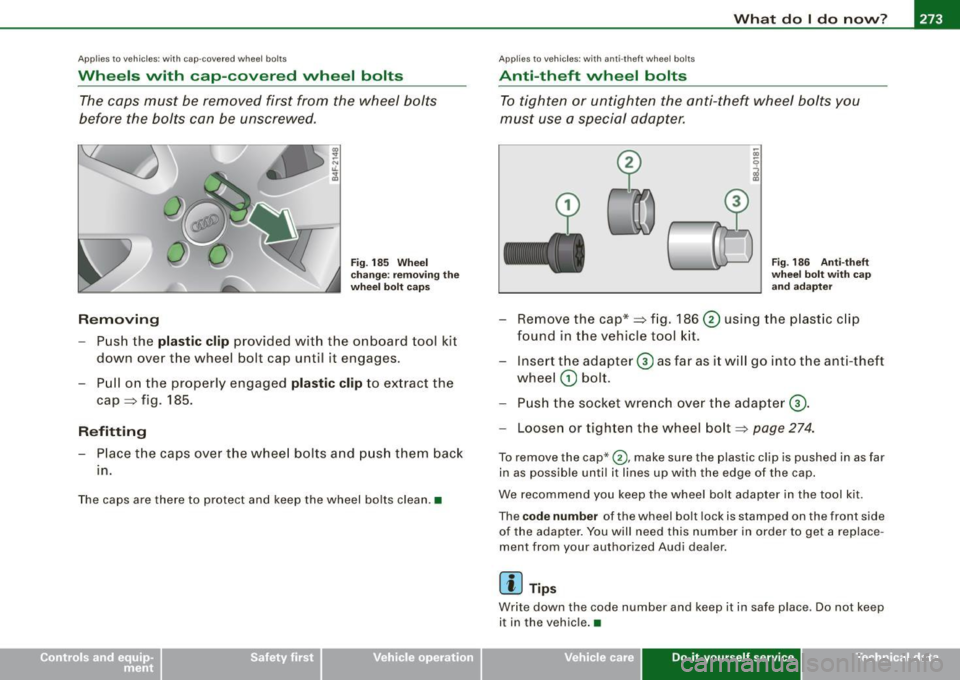
Wheels with cap-covered wheel bolts
The caps must be removed first from the wheel bolts
before the bolts can be unscrewed.
Rem ovin g
Fig. 185 W hee l
c h ange : removin g th e
whee l bolt ca ps
- Push the plastic clip provided with the onboard tool kit
down over the wheel bolt cap until it engages.
- Pull on the properly engaged plastic clip to extract the
cap
~ fig . 185.
R efitting
- Place the caps over the whee l bolts and p ush them back
1n.
The caps are there to protect and keep the wheel bo lts clean .•
Ap plies to vehicles: with anti-theft wheel bo lts
Anti-theft whee l bolts
To tighten or untighten the anti-theft wheel bolts you
must use a special adapter.
....
(
V"
..
Fi g. 18 6 An ti-t heft
whee l bolt wit h ca p
a n d ada pter
- Remove the cap*~ fig. 186 0 using the plastic clip
found in the vehicle tool kit.
- Insert the adapter
0 as far as i t wi ll go into the anti-theft
wheel
G) bolt.
- Push the socket wre nch over t he adap ter
G) .
- Loosen or tighten the wheel bolt~ page 274.
To remove the cap* 0, make sure the plastic clip is pushed in as far
in as possib le until it lines up wi th the edge of the cap .
We recommend you keep the wheel bolt adapter in the tool kit.
The
c od e numb er of the wheel bolt lock is stamped on the front side
of the adap ter. You will need this number in orde r to get a replace
ment from your author ized Audi dealer.
[ i ] Tip s
Write down the code number and keep it in safe place . Do not keep
it in the vehicle. •
Vehicle care Do-it-yourself service Technical data
Page 276 of 320
llffl.,___W_ h_ a _ t_d_ o_ l _d _o_ n_ o_ vv_ ? ______________________________________________ _
Loosening and tightening the wheel bolts
The wheel bolts must be loosened before raising the
vehicle.
~ a'.. ., m
Loosening
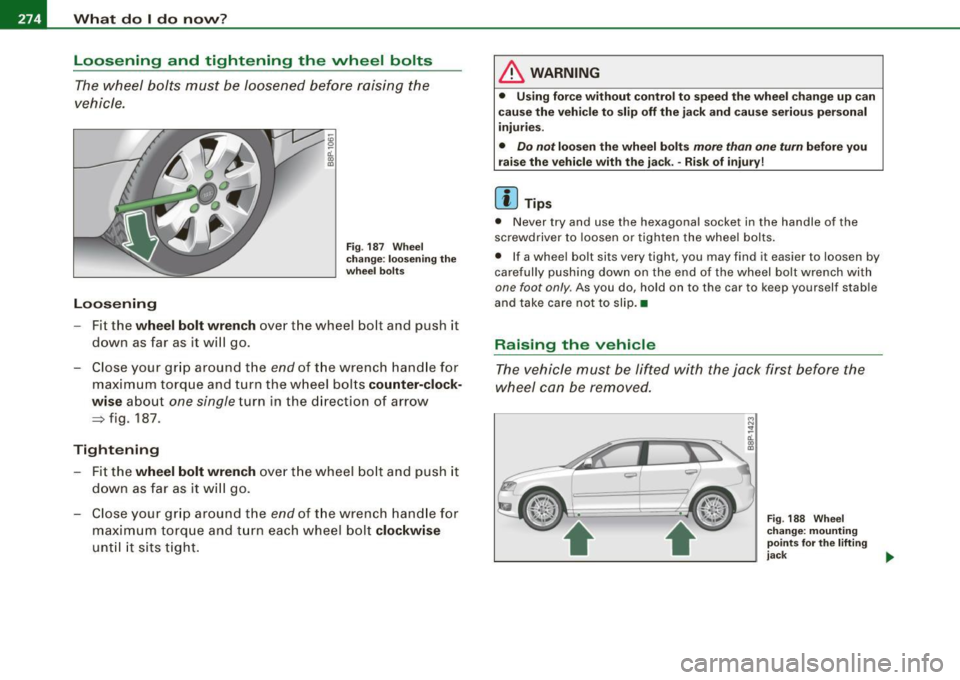
Fig . 187 Wheel
change: loosening the
wheel bolts
- Fit the wheel bolt wrench over the wheel bolt and push it
down as far as it will go .
- Close your grip around the
end of the wrench handle for
maximum torque and turn the wheel bolts
counter-clock
wise
about one single turn in the direction of arrow
~ fig. 187.
Tightening
-Fit the wheel bolt wrench over the wheel bolt and push it
down as far as it will go.
- Close your grip around the
end of the wrench handle for
maximum torque and turn each wheel bolt
clockwise
until it sits tight.
& WARNING
• Using force without control to speed the wheel change up can
cause the vehicle to slip off the jack and cause serious personal
injuries.
• Do not loosen the wheel bolts more than one turn before you
raise the vehicle with the jack. -Risk of injury!
[ i] Tips
• Never try and use the hexagonal socket in the handle of the
screwdriver to loosen or tighten the wheel bolts.
• If a wheel bolt sits very tight, you may find it easier to loosen by
carefully pushing down on the end of the wheel bolt wrench with
one foot only . As you do, hold on to the car to keep yourself stable
and take care not to slip.•
Raising the vehicle
The vehicle must be lifted with the jack first before the
wheel can be removed.
Fig. 188 Wheel
change: mounting
points
for the lifting
jack ..
Page 277 of 320
What do I do now? -
------------------
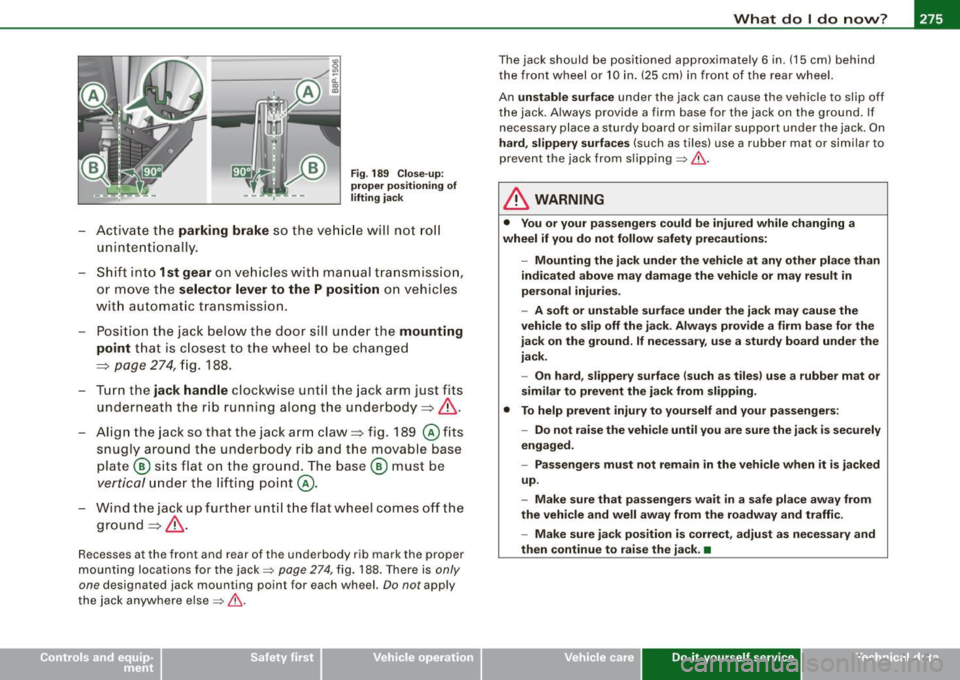
Fig. 189 Close-up:
proper positioning of
lifting jack
-Activate the parking brake so the vehicle will not roll
unintentionally.
- Shift into
1st gear on vehicles with manual transmission,
or move the
selector lever to the P position on vehicles
with automatic transmission.
- Position the jack below the door sill under the
mounting
point
that is closest to the wheel to be changed
=> page 274, fig. 188.
- Turn the
jack handle clockwise until the jack arm just fits
underneath the rib running along the underbody
=> &.
- Align the jack so that the jack arm claw => fig . 189 @ fits
snugly around the underbody rib and the movable base
plate @ sits flat on the ground. The base @ must be
vertical under the lifting point@.
- Wind the jack up further until the flat wheel comes off the
ground =>& .
Recesses at the front and rear of the underbody rib mark the proper
mounting locations for the jack ~
page 274, fig. 188. There is only
one
designated jack mounting point for each wheel. Do not apply
the jack anywhere else~& . The
jack should be positioned approximately 6 in. (15 cm) behind
the front wheel or 10 in. (25 cm) in front of the rear wheel.
An unstable surface under the jack can cause the vehicle to slip off
the jack. Always provide a firm base for the jack on the ground. If
necessary place a sturdy board or similar support under the jack. On
hard, slippery surfaces (such as tiles) use a rubber mat or similar to
prevent the jack from slipping ~& .
& WARNING
• You or your passengers could be injured while changing a
wheel if you do not follow safety precautions:
-Mounting the jack under the vehicle at any other place than
indicated above may damage the vehicle or may result in
personal injuries.
- A soft or unstable surface under the jack may cause the
vehicle to slip off the jack. Always provide a firm base for the
jack on the ground. If necessary, use a sturdy board under the
jack.
- On hard, slippery surface (such as tiles) use a rubber mat or
similar to prevent the jack from slipping.
• To help prevent injury to yourself and your passengers:
- Do not raise the vehicle until you are sure the jack is securely
engaged.
- Passengers must not remain in the vehicle when it is jacked
up.
- Make sure that passengers wait in a safe place away from
the vehicle and well away from the roadway and traffic.
- Make sure jack position is correct, adjust as necessary and
then continue to raise the jack. •
Vehicle care Do-it-yourself service irechnical data
Page 278 of 320

llffl.,___W_ h_ a _ t_d_ o_ l _d _o_ n_ o_ vv_ ? ______________________________________________ _
Taking the wheel off /putt ing the spare on
Follow these instructions step-by-step for changing the
wheel
M
"' ;;; u.
1li
Fig . 190 Wheel
change : using the
screwdriver handle
(with the blade
removed) to turn the
bolts
Fig . 191 Wheel
change: alignment pin
inside the top hole
After you have loosened all wheel bolts and jacked the
vehicle off the ground, perform the following steps to
remove and replace the wheel:
Removing the wheel
- Use the hexagonal socket in the screwdriver handle to
completely turn out the topmost wheel bolt and set it
aside on a
clean surface~ fig. 190. - Screw the threaded end of the
alignment pin from the
tool kit hand-tight into the now vacant bolt hole
~ fig.191.
- Then completely unscrew the other wheel bolts as
described above.
Take off the wheel leaving the alignment pin in the bolt
hole.
Putting on the spare
- Lift the spare wheel up and carefully slide it over the
alignment pin to guide it in place.
- Use the hexagonal socket in the screwdriver handle to
screw in and tighten all wheel bolts
slightly.
Unscrew the alignment pin and insert and tighten the
remaining wheel bolt slightly like the rest.
- Turn the handle on the jack counter-clockwise to lower
the vehicle until the jack is fully released.
- Use the wheel bolt wrench to tighten all wheel bolts firmly ~
page 274. Tighten them crosswise , from one
bolt to the (approximately) opposite one, to keep the
wheel centered.
[ i ] Tips
Never try and use the hexagonal socket in the handle of the screw
driver to loosen or tighten the wheel bolts.
• Pull the reversible blade from the screwdriver before you use the
hexagonal socket in the handle to turn the wheel bolts.
• When mounting tires with
unidirectional tread design make sure
the tread pattern is pointed the right way=>
page 277. ~