lock AUDI S3 2010 Workshop Manual
[x] Cancel search | Manufacturer: AUDI, Model Year: 2010, Model line: S3, Model: AUDI S3 2010Pages: 320, PDF Size: 75.34 MB
Page 179 of 320
Child Safety -
--------------------''----
& WARNING (continued )
• If you must install a booster seat on the front passenger seat
because of exceptional c ircumstances the PASSENGER AIR BAG
OFF light must come on and stay on , whenever the ignition is
switched on.
• If the PASSENGER AIR BAG OFF light does not come on and stay
on , perform the checks described=>
page 156, "Monitoring the
Advanced A irbag System ".
• Take the ch ild restraint off the front passenger seat and install
it properly at one of the rear seat positions if the PASSENGER AIR
BAG OFF light does not stay on wheneve r the ignition is switched
on .
• Always read and heed all WARNINGS whenever using a child
restrained in a vehicle is being used=>
page 135, "Safety belts",
=> page 145, "Airbag system " and => page 167 , "Important things
to know ".•
Installing a child safety seat
Securing a child safety seat using a safety
belt
S a fety belt s for the rea r sea ts and the front passenger con
b e lo cked with t he conver tible lo ckin g retr actor to p rop
e rly sec ure c hild saf ety sea ts.
T he s afe ty bel ts e merge ncy lo cking re trac to rs fo r th e rea r sea ts
safety belts and for the front pass enger's seat safety belt have a
c o nve rtible loc king re tr ac tor fo r child r estrai nts. The sa fe ty b elt
must be loc ked so that be lt webbin g cannot unr eel. The re trac tor
c an be activa te d to lock the safety be lt and prevent the safet y belt
w ebbi ng fr om l oos en ing up dur in g n orm al dr ivi ng . A chi ld sa fety
seat can only be properly insta lled when t he safety be lt is locked so
th at th e child and chil d sa fet y seat will sta y in p lace .
Controls and equip ment Safety first Vehicle operation A
lways remember: Even though your vehic le is equipped with an
A dva nce d Airb ag sys tem, all chi ld re n, e sp ec ially those 12 yea rs a nd
youn ger, should a lways ride in the back seat prop erly restrained for
t hei r age a nd size .
& WARNING
Improperly installed child safety seats increase the risk of serious
personal injury and death in a collision .
• Always make sure that the safety belt retractor is locked when
installing a child safety seat . An unlocked safety belt retractor
cannot hold the child safety seat in place during normal driving or
in a crash .
• Always buckle the child safety seat firmly in place even if a
child is not sitting in it . A loose child safety seat can fly around
during a sudden stop or in a collision .
• Always make sure that the rear seat backrest to which the
center rear safety belt is attached is securely latched whenever
the rear center safety belt is being used to secure a child restraint.
• If the backrest is not securely latched , the child and the child
restraint will be thrown forward together with the backrest and
will strike parts of the vehicle interior. The child can be seriously injured or killed.
• Never install rear -facing child safety seats or infant carriers on
the front passenger seat . A child will be seriously injured and can
be killed when the passenger airbag inflates .
• The inflating airbag will hit the child safety seat or infant
carrier with great force and will smash the child safety seat and
child against the backrest , center armrest , door or roof .
• Always install rear-facing child safety seats or infant carriers on
the rear seat .
• Forward-facing child safety seats or infant carriers installed on
the front passenger's seat may interfere with the deployment of
the airbag and cause serious injury to the child . ..
Vehicle care Do-it-yourself service Technical data
Page 181 of 320

_______________________________________________ C_h _ i_ld _ S_ a_ f_ e_ t..,:c y __ __
& WARNING (continued)
• Make sure that the PASSENGER AIR BAG OFF light comes on
and stays on all the time whenever the ignition is switched on.
• If the PASSENGER AIR BAG OFF light does not come on and stay
on, immediately install the rear-facing child safety seat in a rear
seating position and have the airbag system inspected by your
Audi dealer. •
Activating the convertible locking retractor
Use the convertible locking retractor to secure a child
restraint.
Always heed the child safety seat manufacturer 's instruc
tions when installing a child restraint in your vehicle. To
activate the convertible locking retractor:
- Place the child restraint on a seat, preferably on the rear
seat.
- Slowly pull the belt
all the way out.
- Route it around or through the child restraint belt path
=>& .
- Push the child safety seat down with your full weight to
get the safety belt really tight .
- Insert the belt tongue into the buckle for that seating
position.
- Gu ide the safety belt back into the retractor until the belt
lies flat and snug on the child safety seat.
Controls and equip
ment Safety first Vehicle operation
- You should
hear a "clicking" noise as the belt winds back
into the inertia reel. Test the convertible locking retractor
by pul ling on the belt. You should no longer be able to
pull the belt out of the retractor. The convertible locking
retractor is now activated .
- Make sure that the red release button is facing away from
the child restraint so that it can be unbuckled quickly.
- Pull on the belt to make sure the safety belt is properly
tight and fastened so that the seat cannot move forward
or sideways more than one inch (2.5 cm).
& WARNING
Using the wrong child restraint or an improperly installed child
restraint can cause serious personal injury or death in a crash.
• Always make sure that the safety belt retractor is locked when
installing a child safety seat. An unlocked safety belt retractor
cannot hold the child safety seat in place during normal driving or
in a crash.
• Always buckle the child safety seat firmly in place even if a
child is not sitting in it. A loose child safety seat can fly around
during a sudden stop or in a crash.
• Always make sure the seat backrest to which the child restraint
is installed is in an upright position and securely latched into place
and cannot fold forward. Otherwise, the seat back with the child
safety seat attached to it could fly forward in the event of an acci
dent or other emergency situation.
• Always read and heed all WARNINGS whenever using a child
restrained in a vehicle is being used=>
page 167 . Special precau
tions apply when installing a child safety seat on the front
passenger seat=>
page 147, "Child restraints on the front seat -
some important things to know". •
Vehicle care Do-it-yourself service Technical data
Page 182 of 320

_,___C_ h_il _d _ S_a_ f_ e _ t...:y ________________________________________________ _
Deactivating the convertible locking retractor The convertible locking retractor for child restraints will
be deactivated aut omatically when the belt is wound all
the way back into the retractor.
- Press the red button on the safety belt buckle . T he belt
tongue w ill pop out of the buckle .
- Guide t he safety belt a ll the way back into its stowed
position .
Always let the safety belt retract completely into its stowed position.
The safe ty belt can now be used as an ordinary safety belt without
the conv ertible locking retractor for child restraints.
If the conver tible locking ret ract or should be activa ted inadvert
ently, the safety belt must be unfastened and guided completely bac k into its stowed position to deactivate this feature. If the
convertible locking retractor is not deactivated , the safety belt will
gradually become tighter and uncomfortable to wear .
& WARNING
Improperly installed child safety seats increase the risk of seriou s
per sonal injury and death in a colli sion .
• Never unfa sten the safety belt to de activate the convertible
lock ing retra ctor for ch ild re straint s while the veh icle i s moving .
You would not be restrained and could be seriously injured in an
acc ident .
• Alway s read and heed all WARNINGS whenever using a child
rest rained in a vehi cle i s being used
=:> page 1 67. S pe cial pre cau
tions apply when installing a child safety seat on the front
pa ssenger seat =:>
pag e 147 , "Child restraint s on the front seat -
some important thing s to know ".•
LATCH Lower anchorages and
tethers for children
Child Restraint System anchors and how are
they related to child safety
T o prov ide a simpler and more practicable way to attach the child
restra int on the vehicle seat, Federa l regulations require spec ia l
lower anchorages in vehicles and devices on new child restraints to
attach to the vehicle anchorages .
The combination of the tether anchorages and the lower anchor
ages is now generally called the
LATCH system for " Lowe r Anchor
ages and Tethers for Children ."
Forward -facing child restraints manufactured after September 1,
1999, are required by U .S . federa l regu lations to comply with new
chi ld head movement performance requirements . These new
performance requiremen ts make a te ther necessary on most new
chi ld seats .
I nstalling a child restraint that requires a top tether without one can
seriously impair the performance o f the child restra int and its abi lity
to protect the child in a collision . Installing a child restraint that
r equires a top tethe r w ithout the top tether may be a v iolat ion o f
state law .
Ch ild restra int manufactu rers offer LATCH lower a nchorages on
their child seats with hook -on or push -on connectors attached to
adjustable straps .
I n addition to the LATCH lower anchorages, these ch ild restraint
systems usually require the use of tether straps to he lp keep the
chi ld restraint firmly in place .
& WARNING
Improper installatio n of child restraint s will increase the risk of
injury and death in a crash .
Page 185 of 320
- Attach both hook-on connectors with the spring catch release on the child safety seat onto the LATCH lower
anchorage so that the connectors lock into place
~ fig. 154.
- Pull on the connector attachments to make sure they are properly attached to the LATCH lower anchorage.
- Pull straps tight following the child restraint manufac
turer's instruct ions.
Releasing
- Loosen the tension on the straps following the child
restraint manufacturer's instructions .
- Depress the spring catches to release the anchorage
hooks from the lower anchorages.
Remember: Use tether straps to help keep the child restraint firmly
in place .
& WARNING
Improper use of the LATCH system can increase the risk of serious
personal injury and death in an accident.
• These anchors were developed only for child safety seats using
the "LATCH" system.
• Never attach other child safety seats, belts or other objects to
these anchors.
• Always make sure that you hear a click when latching the seat
in place. If you do not hear a click the seat is not secure and could
fly forward and hit the interior of the vehicle, or be ejected from
the vehicle.
Safety first
Child Safety
& WARNING
Improper installation of child restraints will increase the risk of
injury in an accident.
• Always follow the child restraint system manufacturer's
instructions for proper installation of the child restraint system
and proper use of tether straps as well as the lower anchorages or
safety belts in your vehicle.
• Always read and heed the important information and WARN
INGS about child safety and the installation of child restraint
systems~
page 167, "Child Safety" .•
Tether anchors and tether straps
Fig . 155 Tether
anchors: attachment
hook locations behind
the rear seatbacks
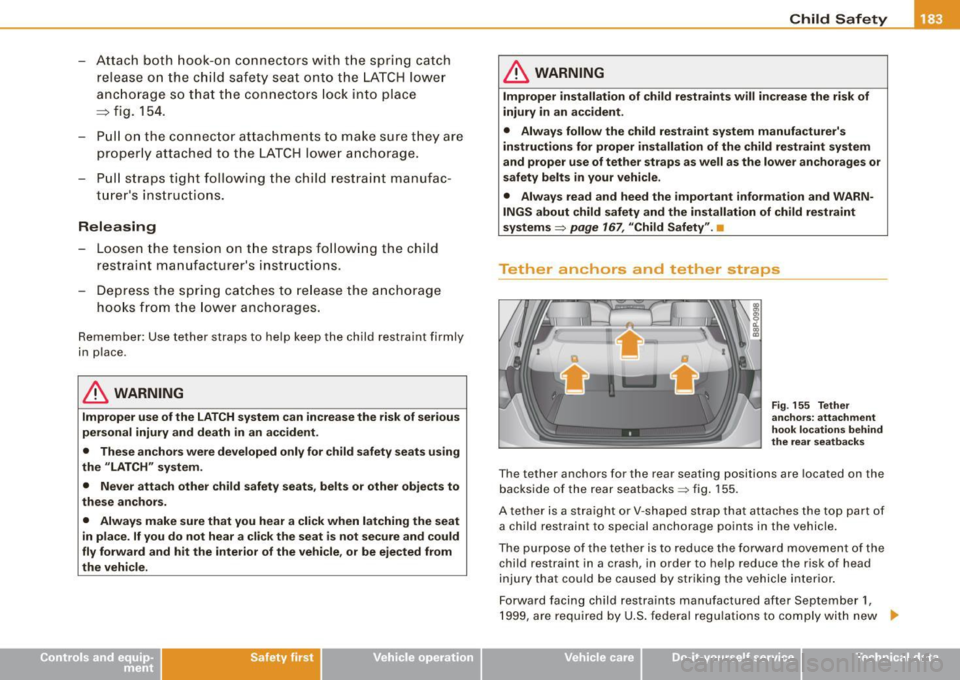
The tether anchors for the rear seating positions are located on the
backside of the rear seatbacks
~ fig. 155.
A tether is a straight or V-shaped strap that attaches the top part of
a child restraint to special anchorage points in the vehicle.
The purpose of the tether is to reduce the forward movement of the child res traint in a crash , in order to help reduce the risk of head
injury that could be caused by striking the vehicle interior.
Forward facing child restraints manufactured after September 1,
1999, are required by U.S. federal regulations to comply with new ..
Vehicle care I I irechnical data
Page 190 of 320

_1--_l_ n _t _ e _ll _,ig ,_,_ e_n _t _ t_ e_ c_ h_n _o_ l_ o ~g""- y.e- __________________________________________ _
Intelligent technology
Notice about data recorded by
vehicle control modules
Your vehicle is not equipped with an Event Data Recorder (EDR),
installed by some manufacturers for the express purpose of
capturing data for retrieval after an accident or crash event . EDR's
are sometimes called "crash recorders".
Some state laws restrict the retrieval or downloading of data stored
by EDR's that were insta lled in a vehicle for the express purpose of
retrieving data after an accident or crash event without the owner's
consent .
Although your vehicle is not equipped with an EDR, it is equipped
with a number of electronic control modules for various vehicle systems such as, for example, eng ine function, emission control, as
well as for the airbags and safety belts.
These electronic control modules also record vehic le -related data
during norma l vehicle operation for diagnostic and repair purposes .
The recording capacity of the electronic cont rol modules is limited
to data (no sound is recorded) and only a small amount of data is
actually recorded over a very limited period of time and stored when
a system fault or other condition is sensed by a control unit . Some
of the data then stored may relate to vehic le speed, direction,
braking as we ll as restraint system use and performance in the
event of a crash or other condition. Stored data can only be read and
downloaded with special equip men t.
Electronic Stabilization Program (ESP)
General
The Electronic Stabili ty Program increases driving
stability.
co ::,
_1, _ __ J"u. __ 11 ... _ ,.....u.,___,lli u.. _ .x,u _ _, r-u ~~ ~!' js:..~&c:',I
I
'
1 J
F ig . 15 8 Cente r
cons ole with E SP
sw itch
With ESP, control over the veh ic le is increased in situations when
the vehicle is close to the limits of grip, such as during acce leration
and in curves. ESP reduces the risk of skidding a nd improves vehicle
stability under all road conditions . It operates at all speeds .
The Anti-Lock Brake System (ABS), E lec tronic Differentia l Lock (EDS)
and Anti-Slip Regulation System (ASR) are integrated in the Elec
tronic Stability Program .
How ESP work s
The ESP control unit processes the fo llowing data from high-sensi
tive sensors : the rotational speed of the vehicle about its vertica l
axis, fore -and -aft and lateral acceleration forces, brake pressure and
steering angle.
Using steering ang le and vehicle speed, the direction the driver
wishes to travel is determined and continuously compared with
t,.
Page 191 of 320
actual vehicle behavior. If the two do not match, for example when
th e vehicle begins to skid, ESP brakes the appropriate wheel auto
matical ly .
The vehicle is stabilized again by the forces acting on the wheel
during braking. With an oversteering vehicle (tendency for the rear
end to skid out of the curve), the brake application is mainly at the
front wheel on the outside of the curve, with an
understeering
vehicle (tendency to run wide in the curve) at the rear wheel on the
inside of the curve or additionally at the other wheels as needed.
This brake application is accompanied by noises.
ESP works in conjunction with ABS=>
page 192. If there is malfunc
tion in the ABS, ESP is also inoperative.
Activating
The ESP is automatica lly activated when the engine is started, and
it performs a self-test. As soon as the test is completed, the system
is in normal operating mode. With ASR deactivated, or with ESP/ASR
deactivated, pressing the button=>
page 188, fig. 158 returns the
system to normal operation.
Deactivating
ESP should normally be activated at all times because this ensures
optimum vehicle stability. Only in certain exceptional cases it does
make sense to deactivate Anti-Slip Regulation (ASR) or the Elec
tronic Stability Program (ESP) by pressing the button =>
page 188,
fig. 158. Both deactivation stages can only be activated from normal
mode .
Deactivating ASR
Tap the switch. Deactivation is indicated by slow flashing of the ESP
lamp in the instrument cluster. In certain situations (e .g. driving
with snow chains, in deep snow or on loose ground, or when
rocking the car free), it may be necessary to deactivate ASR.
Deactivating ESP/ASR
Press the button for more than 3 seconds. Deactivation is indicated
by the ESP lamp in the ins trument cluster staying on permanently.
Controls and equip
ment Safety first Vehicle operation
Intelligent technology
This
deactivates the Electronic Stability Program (ESP) in addition to
ASR. No Elec tronic Stability System operation and no Anti -Slip
Regulation is available across the entire speed range; ASR and ESP
are activated only when the brakes are used for the duration of the
braking action and remain active until a stable vehicle condition has
been reached. There is no driving situation which requires ESP to be
deactivated, so this should only be done if the driver's skill and the
traffic situation permit.
& WARNING
• The limits of physics cannot be suspended by ESP. Even in vehi
cles with ESP. you should always adapt your driving to road and
traffic conditions. This is particularly true on a slippery and wet
road . Do not be tempted by the increased safety provided to take
risks -danger of an accident!
• Please note that when ASR or ESP /ASR is deactivated , the drive
wheels can spin on icy and slippery roads and the vehicle can
break away -danger of skidding!
Electronic differential lock CED1
.)
The electronic differential lock monitors the rotational
speed of the drive wheels.
General notes
The elect ronic differential lock (EDU helps the car to start moving,
accelerate and c limb a gradient on surfaces providing poor or
a lmost no grip. Without EDL, this would be difficult, if not impos
s ible.
How the system works
The EDL operates automatical ly. It monitors the rotationa l speed of
the drive wheels on an axle with the help of the ABS sensors
=>
page 192. If a noticeable difference in rotational speed between
the drive wheels on one axle is detected (e.g. on slippery ground
on
one side),
the spinning wheel is braked, thereby transferring power
Vehicle care Do-it-yourself service Technical data
Page 192 of 320

-Intelligent technology
----'""------- ~---------------------------------------
to the other drive wheel or wheels (all-whee l drivel. This is done up
to a speed of about 60 mph (100 km/h). Noises from the brake
system signal that wheel spin is being controlled.
Driving off
When driving off, always be sure to keep road conditions in mind as
you accelerate. If one drive wheel spins because it is on a surface
with less grip, gradually increase the pressure on the accelerator
pedal until the car starts to move. The wheel less able to transfer
power spins .
Overheating of brakes
To prevent the disc brake of the braked wheel from overheating if
subjected to excessive loads, the EDL cuts out temporarily. The
vehicle remains operational and behaves in the same way as a
vehicle without EDL.
As soon as the brake has cooled down, EDL switches on again auto
matically.
& WARNING
• When accelerating on slippery surfaces, such as on ice or snow,
always be careful when depressing the accelerator pedal. Even
with the EDL working, the drive wheels can spin and reduce your
ability to control your car. -Risk of crash!
• The increased safety afforded by EDL does not mean that you
can take safety risks. Always adapt your driving style to the road
conditions and traffic situation.
[ i] Tips
If a fault occurs in the ABS, the EDL is also not functioning. This is
indicated by the ABS warning light=>
page 16. •
Anti-Slip Regulat ion System (ASR)
The Anti-Slip Regulation System prevents the driven
wheels from spinning when the car is accelerating.
General notes
The Anti-Slip Regulation System (ASR) is integrated in the electronic
stabilization program (ESP) . When the vehicle starts up and acceler
ates, the wheels are prevented from spinning by adjusting the
engine power to match the amount of grip available from the road
surface.
How the system works
ASR performs automatically, i.e. without the driver's intervention.
With the aid of the ABS sensors=>
page 192, ASR monitors the
speed of the driven wheels. If the wheels start to spin, the engine
torque is reduced automatically until the tires find enough grip to
lock onto the road surface. The system is active across the entire
speed range.
Th e ASR works in conjunction with the ABS. If a malfunction should
occur in the ABS, the ASR will also be out of action.
Activating
The ESP is automatically activated when the engine is started and it
performs a self -test. You can activate a deactivated ASR if required
by pressing the=>
page 188, fig. 158 button. When it is activated,
the message
ESP/ASR on appears briefly in the display.
Deactivating
You can deactivate the ASR if required by pressing the button (for
less than 3 seconds)=>
page 188, fig . 158. With the ASR deactivated,
the ESP check light comes on, see=>
page 13. The message ASR off
appears in the display as well.
The ASR should normally be activated all the time . Only in certain
exceptional situations when some slip is desirable does it make
sense to deactivate the ASR. Examples:
• when driving with tire chains
Page 194 of 320

-Intelligent technology
---""'------------ ....::....:...:~---------------------------
Brake lining wear status
Brake lining wear may be checked by visual inspection of the condi
tion of the brake pads through the openings in the wheel. If neces sary, the wheel may be removed for this inspection=> page
270,
"Wheel change" .
L1}. WARNING
• You should perform braking maneuvers for the purpose of
cleaning the brake system only if road conditions permit. Other
road users must not be put at risk -you may cause an accident!
• Before descending a steep grade, reduce speed and shift trans
mission into a lower gear or lower driving range. Do not ride the
brakes or hold the pedal down too long or too often. This could
cause the brakes to get hot and diminish braking efficiency.
• Do not "ride the brakes" by resting your foot on the pedal when
you do not intend to brake. This may cause the brakes to overheat,
premature wear and increased stopping distance.
• Under certain climatic and operating conditions such as
passing through water, driving in heavy rain or after washing the
vehicle, the effectiveness of the brakes can be reduced. In winter,
ice can accumulate on the brake pads, linings, discs and drums.
Carefully apply brakes for a test. Brakes will dry and ice coatings
will be cleaned off after a few careful brake applications.
• Driving for an extended period of time on salt-covered roads
without using your brakes can also affect braking efficiency. Clean
off accumulated salt coating from brake discs and pads with a few
careful brake applications.
• If you damage the front spoiler, or if you install a different
spoiler, be sure the air flow to the front brakes is not obstructed.
Otherwise the brake system could overheat reducing the effective
ness of the entire brake system.
• Failure of one brake circuit will impair the braking capability
resulting in an increased stopping distance. Avoid driving the
& WARNING (continued)
vehicle and have it towed to the nearest authorized Audi dealer or
qualified workshop. •
Brake booster
The brake booster adds extra braking power.
The brake booster works with vacuum pressure which is created
only when the engine is running=>& .
L1}. WARNING
• Never let the vehicle roll to a stop with the engine shut off.
• If the brake booster is not working, for example when towing
your vehicle, or because the brake booster has somehow been
damaged, the brake pedal must be pressed considerably harder to
make up for the lack of booster assistance. •
Func ... ion=ng of Anti-Lock Brake System (ABS)
ABS prevents the wheels from locking up under braking.
The ABS contributes effectively to vehicle control since it prevents
the wheels from locking when the brakes are applied. This means
that the vehicle remains steerable and is less likely to skid.
With ABS you do not need to pump the brake. Just hold the brake
pedal down.
However, do not expect that the ABS shortens braking distance
under
all circumstances . When driving on gravel or on newly fallen
snow on top of icy surfaces, braking distance may be even longer,
therefore, under these circumstances, it is especially important that
you drive slowly and with great care. .,_
Page 195 of 320
How the ABS system works
An aut omatic check is made whe n a speed of ab out 4 mph (6 km/h)
is reached. When this happens, a pumping noise can be heard.
I f an individua l wheel begins to rotate too slowly in relation to
ve hicle speed and ten ds to lock, the A BS automatical ly reduces
brake pressure to prevent that wheel from locking.
T his auto matic adjust ment p rocess wil l cause a
slight vibration o f
the brake peda l and some noises to alert you that veh ic le speed
must be ada pted to e xisting roa d and traff ic c onditions.
& WARNING
Although the ABS is very effective , always remember that braking
c apability is limited by tire tra ction . Always adjust your driving
speed according to the road and traffic conditions. Do not let the
extra safety afforded by the ABS tempt you into taking e xtra risks .
The ABS cannot overcome the laws of physics.
[ i ) Tips
• I f ABS is not functioning properly, a warning light wil l come on.
See
=> page 16.
• I f a fau lt occurs in the ABS, the E DL is als o not fu ncti onin g. This
is indicated by the ABS warning light. •
Brake assistant
The brake a ssi st ant is de sig ned to a chieve th e opti mum
b ra kin g eff ec t.
The brake assistant helps to increase the effective braking power
and thus to ac hieve a s horte r stop ping dis tance. If the drive r
presses the brake pedal very quick ly, the brake assistant automati
ca lly b oosts the braki ng force to the maximu m level, up to th e point
where the anti -loc k brake function (A BS) intervenes to stop the
whee ls from loc king. You should then keep the brake pedal pressed
Controls and equip
ment Safety first Vehicle operation
Intelligent technology
until
the vehicle has braked to the required speed . The brake assis
t an t swi tc h es itse lf o ff as s oon as you r eleas e the b rake pe dal.
The brake assistant wi ll not be operative if there is a malfunction in
the ABS .
& WARNING
Please remember that the accident risk always increases if you
drive too fast , espe cially in corners or on a slippery road , or if you
follow the vehicle ahead of you too closely . An increased accident
risk cannot be compensated even by the brake assistant , so
always maintain a safe speed. •
ciectro-mechanical power assist
Th e e le ctr o-me ch anic al pow er assis t helps the driv e r
w hen steerin g.
The degree of powe r ass ist is electronically matched to veh icle
speed .
The power steering system assists the driver so that he can steer the
ve hicle with re d uced p hysi ca l eff ort.
Power steering w ill not work if the eng ine is off . As a result, the
stee ring whee l wi ll be ha rd to turn .
& WARNING
If the system develops a problem , you must seek qualified profe s
sional assistance .
0 Note
If there is an electronic ma lfunction, servotronic will still function
like a conventi onal power s teer ing sy stem , pr ovi din g a constant
steerin g support force that is no longer proportionate to the vehicle
Vehicle care Do-it-yourself service Technical data
Page 196 of 320

__ _:_:ln..:..t::.: e::.: l~ li :.;:g t:e::..: n..:.. t:...::. te::::..:: c~h :.:.n .:..: o:::.: l:.: o :.;g~ yL- ________________________________________ _
speed. This is most noticeable when turning the steering wheel at
low speeds (for example when parking), -more effort will be
required than usual.
• Be aware of the different than usual steering response and
adjust your steering force accordingly.
• Have the problem checked and set right by an authorized Audi
dealer as soon as possible.
• If a steering malfunction occurs, this is signaled with the or.
@ indicator lights and a warning tone, see.
[ i) Tips
• If the power steering system should fail, or if the engine is not
running (for example, while being towed), you will still be able to
steer the vehicle. However, more effort will be required to do so.
• If the power steering system is not functioning properly, contact
your authorized Audi dealer immediately.
Applies to vehicles: with All Wheel Drive
Driving with your quattro®
With All Wheel Drive, all four wheels are driven.
General information
With All Wheel Drive, power is distributed to all four wheels. This
happens automatically depending on your driving style and the
road conditions at the time. See also::::,
page 189, "Electronic differ
ential lock (EDU".
Winter tires
When driving in the winter, your vehicle with All Wheel Drive has an
advantage, even with regular tires. In winter road conditions it may
be advisable to mount winter tires (or all -season tires) for improved
driveability and braking: these tires must be mounted on
all four
wheels.
See also ::::, page 259, "Winter ti res".
Snow chains
Where snow chains are mandatory on certain roads, this normally
also applies to vehicles with all-wheel drive:::::,
page 260, "Snow
chains".
Replacing wheels/tires
Vehicles with All Wheel Drive must always have tires of the same
size. Also avoid tires with different tread depths. For details see
page ::::,
page 254, "New tires and replacing tires and wheels".
Off-Road driving?
Your Audi does not have enough ground clearance to be used as an
off-road vehicle. It is therefore best to avoid rough tracks and
uneven terrain as much as possible. Also refer to::::,
page 198.
& WARNING
Always adjust your driving to road and traffic conditions. Do not
let the extra safety afforded by the all-wheel drive tempt you into
taking extra risks.
• Although the quattro ®all-wheel drive is very effective, always
remember that braking capacity is limited by tire traction. You
should therefore not drive at excessive speeds on icy or slippery
road surfaces.
• On wet road surfaces, be careful not to drive too fast because
the front wheels could begin to slide on top of the water (hydro planing). If this should occur, you will have no warning from a
sudden increase in engine speed as with a front-wheel drive
vehicle. Always drive at speeds which are adjusted to the road
conditions -risk of crash!
n