lock AUDI S3 2010 Manual Online
[x] Cancel search | Manufacturer: AUDI, Model Year: 2010, Model line: S3, Model: AUDI S3 2010Pages: 320, PDF Size: 75.34 MB
Page 282 of 320

1111.___F_ u_ s _ e_s _ a_n _ d_ b_ u_lb _ s _______________________________________________ _
Equipment Amps No. Equipment Amps
Manual headlight beam adjustment, automatic
14 Electronic Stabilization Program (ESP) (control 10
1
headlight beam adjustment, AFS control mod-10
module), shift gate automatic transmission
ule, engine components, light switch (switch
15 Interior lights, reading lights 10
lighting/illumination), diagnosis socket
Diagnostic connector, rain sensor, air condition-
Automatic transmission, control module for
16 ing (control module), tire pressure monitor dis-10
CAN data transfer (gateway), electro -mechanical
play (control module)
2 steering, shift gate automatic transmission, 10 17 Anti-theft alarm warning system 5 engine relay, fuel tank control unit, engine con -
trol unit, brakes control (ABS), Electronic Stabili-
18 Diagnose Starter 5
zation Program (ESP), Anti -Slip Regulation (ASR) 19 All Wheel Drive 10
3
Airbag 5 20 Not used
!! Air-conditioning (pressure sensor, air quality
sensor), button for Electronic Stabilization Pro -
21 Not used
gram (ESP), Anti-Slip Regulat ion (ASR), tire pres-
22 Blower fan 40
sure monitor display, oil level sensor, back -up 23 Driver's side power window, front 30
4 light switch, front seat heating , parking aid, 5
seat-occupancy recognition (on USA vehicles), 24 Power outlet front 20
garage door opener, automatic mirror dimming, 25 Rear window defogger 30
headlight assistant, heated windshield washer
26 Power outlet in luggage compartment 20 nozzles, air conditioning (control module)
-27 Fuel tank control module, fuel pump 15
5 AFS headlights (left side) 5
AFS headlights (right side) 5 28 Power window, rear 30
7
Not used 29 Not used
Not used
30 Not used
9 Navigation system, radio system 15 31 Not used
10 digital
radio, cell phone, TV equipment 7,5 32 Not used
11 Automa tic mirror dimming, headlight assistan t 10 33 Sliding/pop-up roof 20
Central locking (front doors) 10 34 Not used
13 Central locking (rear doors) 10 35 Not used
36 Lumbar support 10
Page 283 of 320

_________________________________________________ F_ u_ s_ e_s _ a_n _d_ b_ u _ lb_ s_--J _
No. Equipm ent
37 Heated seats, front
38 Passenger s ide power window, front
39 Special function interface
Starter
41 Rear window wiper
42 Not used
43 Body control module
44 Not use
d
45 Not used
Not used
47 Cell phone package (VOA
interface)
48 Not used
49 Not used
Autom atic cir cuit br eake rs: Amps
20
30
5
4
0
15
20
5
The electric power windows and the electric seat adjusters are protected with circuit breakers which reset automatically after the
circu it overload has been corrected.
[ i J Tip s
• Whenever replacing a fuse, always consult the sticker on the
inside of the fuse panel cover. It contains the most up-to-date infor
mation regarding the fuse arrangement. If in doubt, ask your autho
rized Audi Service advisor.
• Some of the equipment items listed are optiona l or on ly avail
able on certain model configurations. •
Fuse location , left side of engine
compartment
N M N
~ (X) 0)
Fig . 195 F use ass ign
m ent in th e e ngin e
co mpar tment in th e
e xampl e wit h
54 p lu g
in fu ses
Please check your car's fuse layout, there are two different layouts.
Check the fuse layout with the fuse panel cover removed
~ page 278, "Fuse cover in engine compartment" .
Some of the equipment items listed are optional or on ly available on
certain model configurations.
Please note that the preceding table was accurate at the time of
printing and is subject to change . In the event of discrepancies, the
label on the inside of the cover a lways takes precedence.
V ariation (1 ) with 30 Plu g-in F uses
No . Equipm ent Amps
F1 Terminal 30 40
E ngine components
20
F3 Battery voltage 5
F4 ESP valves, Anti -lock brake system (ABS) valves 20/30
F5 Transmission control module
15
Vehicle care Do-it-yourself service Technical data
Page 284 of 320

IIIJl1.--___;;F...; u::. s .::..:: e~s :.....:: a..:..n .:..; d::....; b.:..:. u..:..lb ;:..:: s _______________________________________________ _
No. UEquipment Amps I No. Equipment
Amps
F6 Steering wheel electronics
5 F28
Not used
F7 Not used F29 Fuse assignment in the
left-side instrument
50
F8 Not used panel (special equipment)
F9 Not used F30 Power supply relay terminal
15 50
F10 Engine control module, main relay 5/10
Variation
(2) with 54 Plug-in Fuses
F11 Not used No. Equipment Amps
F12 Control module for CAN data
transfer (gateway)
5
Body control module (right)
F1 30
F13 Engine control module 15/25/30
20/30
F2 ESP valves, Anti-lock brake system (ABS) valves
F14 Ignition coils, engine components (diesel
20 F3 Terminal 30 40
engine)
Preheating control module/engine component, F4
Battery voltage
5
F15 tank diagnosis, oxygen sensor 5/10
F5 Horn 15
F16 Body control module (right)
30 F6 Not used
F17 Horn 15
F7 Not used
Audio amplifier 30 F8 Not used
F19 Front windshield wiper system 30
F9 Engine components 10
F20 Water pump, volume regulator valve 10/20
F10 Fuel tank control, mass air flow sensor
10
F21 Oxygen sensor, vacuum pump 10/15
F11 Oxygen sensors, in front of catalytic converter 10
F22 Clutch pedal switch, brake light switch 5
F12 Oxygen sensors, behind catalytic converter 10
F23 engine components, water pump 5/10/15
F13 Automatic transmission 15
Engine components, water pump 10 F14 Not used
F25 Pump (ESP/ABS), ABS valve
40
F15 Water pump 10
F26 Body control module (left) 30
F16 Volume control valve 20
F27 Secondary air pump, preheating control module 40 F17 Steering wheel electronics 5
F18 Audio amplifier 30
F19 Not used
Page 288 of 320

IIII.___E_ m_ e_r -=g :...e_ n _ c-=y _ s_ i_t _u _a _t_ i_o _n_ s _______________________________________________ _
& WARN ING (continued )
• Before you check anything in the engine compartment , always
read and heed all WARNINGS=>
page 215, "Engine compa rt m ent" .
0 Note
• Applying a higher voltage booster battery wil l cause expensive
damage to sensitive electronic components, such as contro l units,
relays, rad io, etc.
• There must be no electrical contact between the vehicles as
otherwise current cou ld already star t to flow as soon as th e positive
(+ ) termina ls are connected .
• Improperly connected jumper cab les can cause substantia l
damage to the electrica l system of the vehic le.
[ i ] Tips
• The disc harged battery must be p ro per ly connected to the
ve hicle's elec trica l system .•
General information of starting
assistance
P lease observe tha t the p rocedure described below for conn ecti ng
jumper cab les is intended to provide a jump start for your vehicle.
M ake sure that the connected c la mp s have s ufficien t metal cont act.
& WARNING
Improper handling of the jumper cables can lead to an explosion
of the battery and severe inju ries . To reduce the r isk of injury, note
the following:
& WARNING (continued )
• The sections of the terminal clamps that are not insulated
must not touch each other. In addition , the cable clamped to the
battery's positive terminal must not come in contact with electri
cally connected parts of the vehicle -danger of short circuit!
• Route the jumper cable so that it cannot catch in any rotating
part s in the engine compartment .
• Do not bend over the batteries -danger of chemical burns!
• The battery cell locking screws must be t ightened securely .
• Keep ignition sources (open flame, burning cigarettes, etc .)
away from the batteries -danger of explosion!
• Do not clamp the minus cable to parts of the fuel system or the
brake lines .
0 Note
If you provide start assistance for others with your vehicle, you
s h ould not c lamp t he min us ca ble(-) to t he negat ive ter min al o f the
discharged battery=> fig. 196
© but to a solid meta l part screwed
f ir m ly to the eng ine bloc k, or to the engi ne b loc k it sel f. In ca se of a n
inadequately v entilated battery of the veh ic le receiving power, there
i s a danger of expl osio n due to deto nating gas !•
Page 290 of 320

11111.___E_ m _ e _r-==g :...e_ n_ c...:y _ s_ i_t _u _a _t_ i_o _n_ s _______________________________________________ _
13. Disconnect the cable while the engine is running exactly
in
reverse order to that described in~ page 287,
11Connecting/disconnecting the jumper cable.11
• When
doing so, make sure that the cable cannot contact rotating engine parts.
14. Turn the heater blower and the rear window heating off again.
The battery is vented to the outside to prevent gases from entering
the vehicle interior.
Make sure that the jumper clamps are well connected with their
metal ports in full contact with the battery terminals .
& WARNING
To avoid serious personal injury and damage to the vehicle, heed
all warnings and instructions of the jumper cable manufacturer. If
in doubt, call for road service.
• Jumper cables must be long enough so that the vehicles do not
touch .
• When connecting jumper cables, make sure that they cannot
get caught in any moving parts in the engine compartment.
• Before you check anything in the engine compartment, always
read and heed all WARNINGS =>
page 215, "Engine compartment" .
0 Note
Improperly connected jumper cables can damage or destroy the
generator.
• Do not use the battery negative terminal for jump starting or a
malfunction could occur in the vehicle electrical system.
• Always connect POSITIVE(+) to POSITIVE(+), and NEGATIVE( -) to
NEGATIVE (-l terminal. •
Check that all screw plugs on the battery cells are screwed in
firmly. If not, tighten plugs prior to connecting clamp on negative battery terminal.
• Please note that the procedure for connecting a jumper cable as
described above applies specifically to the case of your vehicle
being jump started. When you are giving a jump start to another
vehicle, do
not connect the minus(-) cable to the minus 1-l terminal
on the discharged battery@=>
page 287, fig. 196. Instead, securely
connect the minus(-) cable to either a massive metal component
that is firmly bolted to the engine block or to the engine block itself.
If the battery that is being charged does not vent to the outside,
escaping battery gas could ignite and explode! •
Emergency towing with commercial
tow truck
General hints
Your Audi requires special handling for towing.
The following information is to be used by commercial tow truck
operators who know how to operate their equipment safely.
• Never tow your Audi, towing will cause damage to the engine
and transmission.
• Never wrap the safety chains or winch cables around the brake
lines.
• To prevent unnecessary damage, your Audi must be transported
with a car carrier (flat bed truck).
• To load the vehicle on to the flat bed, use the towing loop found
in the vehicle tools and attach to the front or rear anchorage
=>
page 289 and => page 289 . .,_
Page 293 of 320
________________________________________________ E_ m_ e_r .::g :...e_ n _ c_,y'-- s_ i_t _u _a_ t_ i_o _n_ s _---J_
Lifting the vehicle
Important safety precautions
Be aware of the following hazards before lifting the vehicle with a
workshop hoist or floor jack:
• The vehicle should never be lifted or jacked up from underneath
the engine oil pan, the transmission housing, the front or rear axle
or the body side members. This could lead to serious damage.
• Use lifting equipment with padded contact surfaces to avoid
damage to the underbody or chassis frame.
• Alternatively, cover the contact surfaces on workshop hoist or
floor jack with rubber pads before lifting .
• Before driving over a workshop hoist, check that the vehicle
weight does not exceed the permissible lifting capacity of the hoist .
• Before driving over a workshop hoist, ensure that there is suffi
cient clearance between the hoist and low parts of the vehicle .
& WARNING
To reduce the risk of serious injury and vehicle damage:
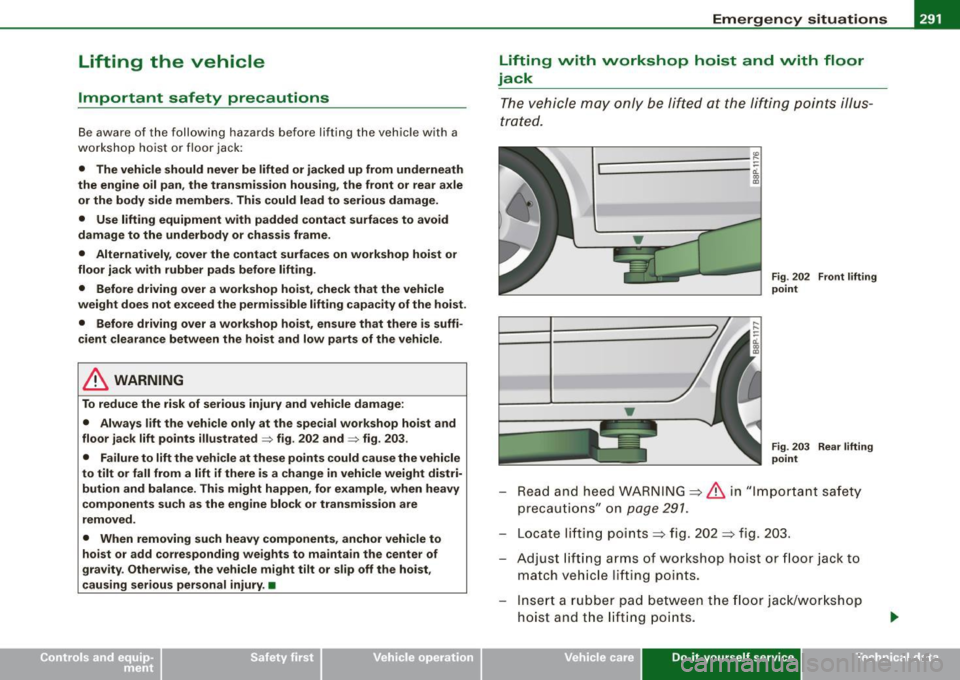
• Always lift the vehicle only at the special workshop hoist and
floor jack lift points illustrated
=> fig. 202 and => fig. 203 .
• Failure to lift the vehicle at these points could cause the vehicle
to tilt or fall from a lift if there is a change in vehicle weight distri
bution and balance. This might happen, for example, when heavy
components such as the engine block or transmission are
removed .
• When removing such heavy components, anchor vehicle to
hoist or add corresponding weights to maintain the center of
gravity . Otherwise , the vehicle might tilt or slip off the hoist,
causing serious personal injury. •
Lifting with workshop hoist and with floor
jack
The vehicle may only be lifted at the lifting points illus
trated.
.... L===========::::==:: ~ 0:.
Fig . 202 Front lifting
point
Fig . 203 Rear lifting
point
Read and heed WARNING ~ & in "Important safety
precautions " on
page 291.
Locate lifting points~ fig. 202 ~ fig. 203.
Adjust lift ing arms of workshop hoist or floor jack to
match vehicle lifting points.
Inse rt a rubber pad between the floo r jack/workshop
hoist and the lifting poin ts.
Vehicle care Do-it-yourself service irechnical data
Page 297 of 320
_________________________________________________ G_ e_ n_ e_r _a _l_ i_n _f_o _ r_ m_ a_ t _i _o _ n __ _
left door jamb. It shows the month and year of production and the
vehicle identification number of your vehicle (perforation) as well as
the Gross Vehicle Weight Rating (GVWR) and the Gross Axle Weight
Rating (GAWR).
The high voltage warning label
is located on the lock carrier.
The spark ignition system complies with the Canadian
standard ICES-002. •
Weights
Gross Vehicle Weight Rating
The Gross Vehicle Weight Rating (GVWR), and the Gross Axle Weight
Rating (GAWR) for front and rear are listed on a sticker on the left
door jamb.
The Gross Vehicle Weight Rating includes the weight of the basic
vehicle plus full fuel tank, oil and coolant, plus maximum load,
which includes passenger weight (150 lbs/68 kg per designated
seating position) and luggage weight.
Gross Axle Weight Rating
The Gross Axle Weight Rating is the maximum load that can be
applied at each axle of the vehicle ~& .
Vehicle capacity weight
The vehicle capacity weight (max. load) is listed either on the
driver's side B-pillar or inside the fuel filler flap .
Roof weight
The maximum permissible roof weight is 165 lb (75 kgl. The roof
weight is made up of the weight of the roof rack system and the
weight of the object being transported~
page 89, "Loading the
roof rack".
Controls and equip ment Safety first Vehicle operation
& WARNING
•
The actual Gross Axle Weight Rating at the front and rear axles
should not exceed the permissible weights, and their combination
must not exceed the Gross Vehicle Weight Rating.
• Exceeding permissible weight ratings can result in vehicle
damage, accidents and personal injury.
0 Note
• The vehicle capacity weight figures apply when the load is
distributed evenly in the vehicle (passengers and luggage). When
transporting a heavy load in the luggage compartment, carry the
load as near to the rear axle as possible so that the vehicle's
handling is not impaired.
• Do not exceed the maximum permissible axle loads or the
maximum gross vehicle weight. Always remember that the vehicle's
handling will be affected by the extra load. Therefore, adjust your
speed accordingly.
• Always observe local regulations.•
Dimensions
The specifications refer to the basic model. Differences may occur
depending on the model type and options ordered, for example, tire
sizes.
0 Note
When driving up steep ramps, on rough roads, over curbs, etc. it is
important to remember that some parts of your vehicle, such as
spoilers or exhaust system components, may be close to the
ground. Be careful not to damage them. •
Vehicle care Do-it-yourself service Tec hn ica l da ta
Page 302 of 320
___ C_ o_n_ s_ u_m _ e_ r_ ln_ f_o _r_m _ a_ t_ i_o _n ______________________________________________ _
& WARN ING (continued )
• Always be extremely careful when working on the vehicle.
Alway s follow commonly a ccepted safety practices and general
c ommon sen se . Never risk per sonal injury .
• Do not attempt any of the maintenance, checks or repairs
described on the following pages if you are not fully familiar with
the se or other procedures with re spect to the vehicle , or are uncer
tain how to proceed .
• Do not do any work without the proper tools and equipment.
Have the necessary work done by your authorized Audi dealer or
another properly equipped and qualified work shop .
• The engine compartment of any motor vehicle is a potentially
hazardous area . Never reach into the a rea around or touch the
radiator fan. It is temperature controlled and can switch on
suddenly · even when the engine is off and the ignition key has
been removed . The radiator fan switches on automatically when
the coolant reaches a certain temperature and will continue to run
until the coolant temperature drops .
• Always remove the ign ition key before anyone gets under the
vehicle .
• Always support your vehicle with safety stands if it is neces
sary to work underneath the vehicle. The jack supplied with the
vehicle is not adequate for this purpose and could collap se
c ausing serious personal injury .
• If you must work underneath the vehicle with the wheel s on
the ground , always make sure the vehicle is on level ground , that
the wheels are always securely blocked and that the engine c annot be started .
• Always make sure the tr ansmission selecto r lever (automatic
transmission ) is in "P" (Park position ) (automatic transmission ) or
Neutral (manual transmi ssion) and the hand brake is firmly
applied .
W For the sake of the environment
• Cha nging t he en gine setti ngs will adversely a ffec t emi ssio n
l evels. This is detrimenta l to the environment and increases fuel
consumptio n.
• Always o bse rve enviro nmenta l regu lations when dis posing of
o ld eng ine o il, used brake flu id, d irty eng ine coola nt, spe nt batter ies
or worn out tires .
• Undeployed airbag modules and pretensioners might be classi
fied as Pe rchlorate Mate rial -specia l handl ing may apply, see
www .dtsc.ca.gov/ hazardouswaste/perchlora te. W hen t he veh icle or
parts of the restraint system including airbag modu les safety belts
w ith pretens ione rs are sc rapped, all appl icab le laws and regu la
tions must be observed. Your authorized Audi dea ler is familiar with
th ese requi reme nts a nd we reco mme nd t hat you have your dealer
perform this service for you. •
Additional accessories,
modifications and parts replacement
Additional accessories and parts
replacement
A lways co ns ult an author ized Audi d eal er befor e
purc hasing accessorie s.
Your vehicle incorporates the latest safety design features ensuring
a h igh s tanda rd of act ive and pass ive sa fety.
T his safety could be compromised by non -approved changes to the
veh ic le . Fo r thi s reason, if pa rts have to be re place d, please o bserve
the fo llowing points w hen insta lli ng additional accessories:
Approved Audi accessories and genuine Audi parts are avai lable
from autho rized Aud i dea lers.
~
Page 306 of 320

-Alphabetical index
----=----------------------------
A
ABS
See Anti-lock brake system . . . . . . . . 192
ABS (An ti-lock brake system)
Wa rning/indicato r lights .. ... .... .. 16
AC (air conditioner) . . . . . . . . . . . . . . . . . . 98
A . ccessones ....... ...... .... ...... .
Adapt er for anti-theft wheel bolts .... . 300
273 Air conditioner ...
... .... ...... ..... . 99
See also Clim ate co111trols .... .. .... . 96
Air conditioning Swi tching on and off . ....... .... .. 99
Air distribution Climate controls
Air outlets Adjusting the outlets for rapid
defrosting/defogging .... .... ... .
Clima te controls ...... ..... .. ... . 101
102
102 How
many airbags does my vehicle have?
152
Important things to know ...... .... 145
Indicator light ................. .. 156
Moni toring . .. ... ........ .... ... .
Repairs ..... .. ... .. .... .. .... .. .
Side airbags ... ... ... ... .. ... ... . 156
159
161
Side curtain airbags .... ... .... ... 164
When must the system be inspected? ...
156
Adaptive Light
defective
. .... .... .... ........ ... 34 Air quality sensor . . . . . . . . . . . . . . . . . . .
100 All Wheel
Drive ... .... ............. . 194
210
Adaptive light .. .. ... ... .... .... .... . 55 Air reci
rculation . .... ..... ... .... ... 101 Alloy wheels .... ... ..... .... .... .. .
Climate controls .. ..... ...... .... 100 A ll-whee l drive
Adding
Engine coo lant .. ... ...... ... .... 234
Engine oil .......... ....... ...... 230
Windshield washer fluid ...... .... 240
Additiona l accessories . ....... .... ... 300
Addi tiona l heater
Climate controls . ...... ..... ..... 103
Additives Engine oil .... .. .. .... ...... . .. .. 230
Adjustable steering wheel column ..... 105
Adjusting Steering wheel co lumn ....... .... 105
Adjusting front seats . .... ..... .. ... .. 72
Advanced Airbag System Components ...... .... ......... . 152
F . b ront air ags . .... .... .... ... ... . 150
How the components work together 153
Monitoring .... .... .... ... .... .. . 156
PASSENGER AIR BAG OFF light ... . . 157 When should I use the air recircu
lation?
100
Air recirculation mode
Climate controls .... .. .... ....... 100
Airbag Warning/indicator lights ........... 14
Airbag System Weight-sensing mat ...... ... .... . 168
A' b
Ir ag system . . . . . . . . . . . . . . . . . . 145, 162
Advanced Airbag System .......... 149
Care . . . . . . . . . . . . . . . . . . . . . . . . . . . . 159
Child restraints . ... .... .... .... .. 169
Children ...... ..... ... ... .... ... 168
Components (front airbags) .. ... ... 152
Danger of fitting a chi ld safety seat on the
front passenger seat . . . . . . . . . . . . 147
Disposal . . . . . . . . . . . . . . . . . . . . . . . . 159
Front airbags .. ... ........ .... ... 149
How do the front airbags work? . . . . 154 Winter
tires ........... .. .. .... .. 259
A lternator
See Generator . . . . . . . . . . . . . . . . . . . . 14
Aluminum alloy wheels .... .. . .. .. ... 210
Ambient lighting ......... .... .... .. . . 60
Anti-glare inside day-night mirror .... .. 67
Anti -lock brake system
How the ABS system works . . . . . . . . 192
Anti -lock brake system (ABS)
Warning/indicator lights . ...... .... . 16
Anti-Slip Regulation System (ASR)
How the system works . . . . . . . . . . . . 190
An ti- theft sys tems
An ti-Theft Alarm System ....... .... 46
Anti -theft wheel bolts ..... .... .... ... 273
Armrest Center armrest ....... .. .. .. ..... .. 80
Rear armrest ............. .... .. .. 81
Page 307 of 320
______________________________________________ A_ l:.!: p :...:h..:. a= b..:e :...: t:..:..i c.::....:.: a..:..l ..:.in :....:..:: d:.:e :.: x-=---•
Ashtray
Rear . ........ .... ....... ...... ... 91
ASR How the Anti -Slip Regulation System
works .. .... .... .... ... .... .... 190
Ast erisk
Wha t does it m ean wh en something is
marked with an asterisk? ... .. .... .. 5
Audi Service Repair Manuals and Literature 298
AUTO Climate controls .. .... .... ... .... .. 99
Switching on . ... .... .... .. . .. .. .. 99
When should I use AUTO? ... ..... .. 99
Auto Safety Hotline ... .. .. .. .... .... . 133
Automatic air recircu lation ..... .. .... 100
Automatic belt retractor .. .... .... .... 139
Automatic car wash
See Washing .. ..... ... ..... .. .... 205
Automatic headlights defective ... .. .... .... ... .... .... . 34
Automatic Transmission Automa tic Transm ission . .... .. .... 117
Automat ic transmission .. .... .... .... 114
Driving Notes . . . . . . . . . . . . . . . . . . . . 116
Emergency program . ............. 120
Emergency release ..... .. .... 120, 12 1
Ign ition key safety lock ... .... .... . 106
Kick -down ... .... .... .... ... .... . 119
L aunch Control Program ...... .... . 119
Se lector lever lock .. ...... .. . .... . 1 15
Selec tor lever positions .. ...... ... 114
Controls and equip
ment Safety first
Tiptronic .
... ... . .. .. .... .. .. .... 118
Tiptronic controls on the s teering whee l
119
Average fuel mileage .......... .... ... 22
Average sp eed ... .... .... .... .... ... . 22
Avo id damaging the v ehicle .... .. .... . 198
B
Battery ... .. .... ... .... .... .... .... 236
chargi ng ..... .... .... .... .... ... 239
Disconnecting and c onnecting . ... . 237
I mportant warnings when work ing o n the
battery . .... .... .... ...... ..... 238
Replacing the battery .. ... .... .... 237
Winter operation . ..... ... .... .... 237
Working on the battery .... .... .... 238
Battery vo ltage ....... .... ........... 33
Before driving . .... . .. .. .... .... .... 125
Blended gasoline . ..... .. ...... ...... 217
Body cavity sealing .. .... ...... ..... . 21
O
Booster seats .... .... .... .... .... ... 175
Brake assistant ..... .... .... .. .. .... 1 93
Brake booster .. ...... .... .... ... .... 192
Brake fluid
Changing the brake fluid ...... .... 236
Checking the bra ke fl uid leve l ...... 235
Reservoir .. ...... ... .... .... .... . 235
What is the correct brake f luid level? 235
What should I do if the brake fluid warning
light comes on? . .... ...... .... .. 235
Brake pads .. ..... ... .... .... .... ... 196 Brake system
..... .. .. .. .... .... .... 235
Anti -lock brake system (ABS) .. .. .. .. 16
Brake fluid ............ .... ..... .. 235
Brake f luid specif ications for re fill and
replacement ... .. .... .... ... .. .. 236
Brake light defective ... ...... .... .. 34
General information . ........ ... .. 191
How does moistur e or road salt aff ect the
br akes? ..... .... .... .. .. ... .. . . 1 91
Ma lfunct ion ... .. .... .... .... .. . .. 30
Warning /indica tor lights .. .. .... ... . 15
Worn brake pads symbo l ...... .... . 33
Break -in period .. ...... ...... .... ... 195
Brake pads . ...... .... ... .... .. .. 196
Tires ... .. .... .... .... ... .. .... .. 1 95
Bu lbs ...... ........ ... .. ...... .... . 283
C
California Proposition 65 Warning . .... 225
Battery specific ... .... .... .... .... 239
Capacities .. ... ... ... .... ... .... .... 296
Car care ... . .... .. .. .... .... .... .. . . 204
In ter ior . ...... .... .... ... .... .. .. 211
P last ic a nd vinyl . ...... .... .... ... 208
Weathers trips ... .. .... .. . .... .. .. 209
Care of exterior . .... ..... ... .... .... 204
Cargo area
See Loading the luggage compartm ent .
13 1
Cargo net .. ... ... .. .. .. .... .... ..... 83
Catalytic converter ...... .... .... ... . 196
Center armrest ......... .... ... .. ..... 80
Vehicle operation Vehicle care Do-it-yourself service Technical data