warning light AUDI S3 2015 Owners Manual
[x] Cancel search | Manufacturer: AUDI, Model Year: 2015, Model line: S3, Model: AUDI S3 2015Pages: 310, PDF Size: 76.15 MB
Page 231 of 310
Winter operati on
During the winter months, it is common for
the battery capacity to decrease as the tem
peratures become lower. This is because more
pow er is n eeded to start the vehicle and com
ponents such as the headlights and the rear
window defogger are used more frequently.
Avoid using power unnecessarily, especially in
city driving or on short trips . Have your a u
thorized Audi dealer or authorized Audi Serv
ice Facility check the battery capac ity before
the start of winter ¢
page 230 . A well-charg
ed battery will not only reduce starting prob
l ems in cold weather, but it wi ll also last lon
ge r.
A WARNING
- Wor k on the battery requires expert
knowledge. Con tact your au thori zed Audi
dealer q ua lified repai r fac ility for infor
mation regarding the vehicle battery.
The re is a risk for chemical burns or ex
plos ions.
- Never open the vehicle battery. Do not
try to change the battery e lectrolyte lev
el. Otherwise explosive gas will escape
from the battery and increase the risk of an exp losion .
@ Tips
If your vehicle is not driven for severa l
weeks in very cold temperatures, remove
the battery and store it in a place where it
w ill no t freeze . This prevents the battery
from being damaged and need ing to be re
placed.
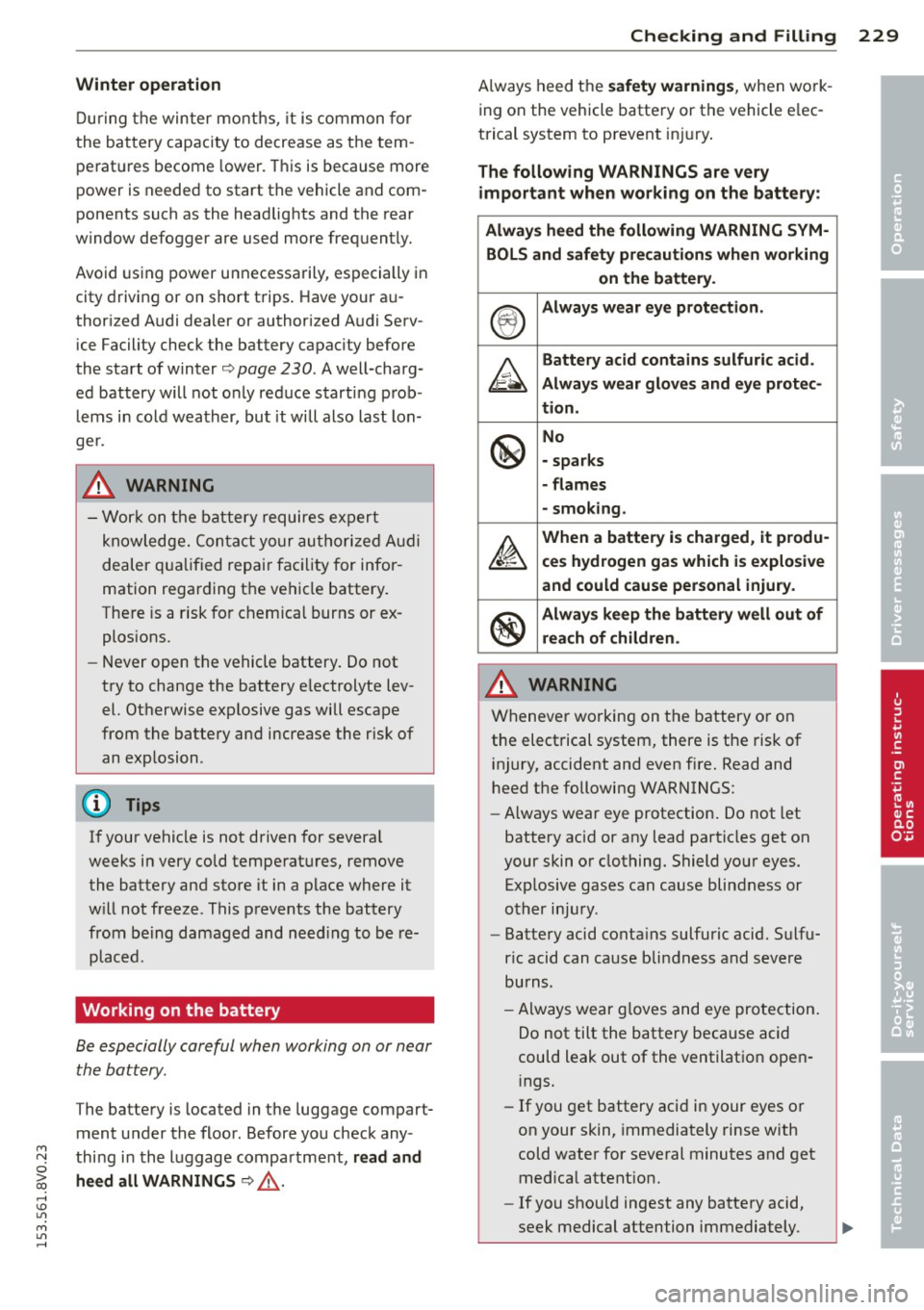
Working on the battery
Be especially careful when working on or near the battery .
The battery is located in the lugg age compart
ment under the floor. Before you check any -
"' N thing in the luggage compartment, read and 0
iii heed all WARNINGS ¢ _&.
Checking and Fillin g 229
Always heed the safety warning s, when work
ing on the vehicle battery or the vehicle e lec
trical system to prevent in jury.
The following WARNINGS are very
important wh en working on the batte ry :
Alway s heed th e following WARNING SYM -
BOLS and safety pre caution s when working
on the battery .
®
Always wear eye p rotection .
A
Battery acid contain s sulfuric acid .
Always wear glov es and eye protec -
tion .
@
No
- sparks
- flames
- smoking .
~
When a battery is charged, it produ-
ce s hydrogen g as wh ich i s ex plo sive
and could c au se per sonal injury .
®
Always keep the battery well out of
re ac h of children .
A WARNING
Whenever working on the battery o r on
the elect rical system, there is the risk of
injury, accident and even fire. Read and
heed the following WARNINGS :
- Always wear eye protection. Do not let
-
battery ac id or any lead particles get on
your skin or clothing. Shield your eyes.
Exp losive gases can cause blindness or
other inju ry.
- Battery acid conta ins sulfuric acid. Sulfu
ric acid can cause blindness and severe
bu rns.
- Always wear g loves and eye protection.
Do not tilt the battery because acid
could leak out of the ventilat ion open
i ngs.
- If you get battery aci d in your eyes or
on your skin, immediately rinse with
cold water for several minutes and get med ica l attent ion.
- If you should ingest any battery acid,
seek medical attention immediately . •
•
•
Page 232 of 310
230 Checking and Filling
-Do not expose the battery to an open
flame, electric sparks or an open light.
- Do not smoke.
- Do not interchange the positive and neg-
ative cables.
- When working on the battery, be sure
not to short-circuit the terminals with
tools or other metal objects. This would
cause the battery to heat up very quickly,
which could lead to damage or explosion
and personal injury.
- When a battery is charged, it produces
hydrogen gas which is explosive and
could cause personal injury.
- Always keep the battery well out of the
reach of children.
- Before work is done on the electrical sys
tem, disconnect the negative ground ca ble.
- Before performing any work on the elec
trical system, switch off the engine and ignition as well as any electrical equip
ment . The negative cable on the battery
must be disconnected . If you are just go
ing to replace a light bulb, then it is
enough to switch off the lights.
- Before disconnecting the battery, switch
off the anti-theft alarm system! Other
wise you will set off the alarm.
- When disconnecting the battery, first
disconnect the negative cable and then
the positive cable .
- Before reconnecting the battery, make
sure all electrical consumers are switch
ed off. Reconnect the positive cable first
and then the negative cable. Never inter
change the cables -this could start a fire!
- Never charge a frozen or a thawed-out
battery. It could explode! If a battery has
frozen, then it must be replaced. A dead battery can free ze over at 32°F (O°C).
- Make sure the vent hose is always attach
ed to the opening on the side of the bat
tery.
- Never use batteries which are damaged.
There is the danger of an explosion! Al
ways replace a damaged battery . A WARNING
-California Proposition 65 Warning:
- Battery posts, terminals and related ac
cessories contain lead and lead com
pounds, chemicals known to the State of
California to cause cancer and reproduc
tive problems . Wash hands after han
dling.
(D Note
- Do not disconnect the vehicle battery
when the ignition is on or when the en
gine is running, otherwise, you will dam
age electronic components in the electri
cal system.
- If your vehicle is going to stand for a
long period of time without being driven,
protect the battery from "freezing", oth
erwise it will be damaged and will then
have to be replaced.
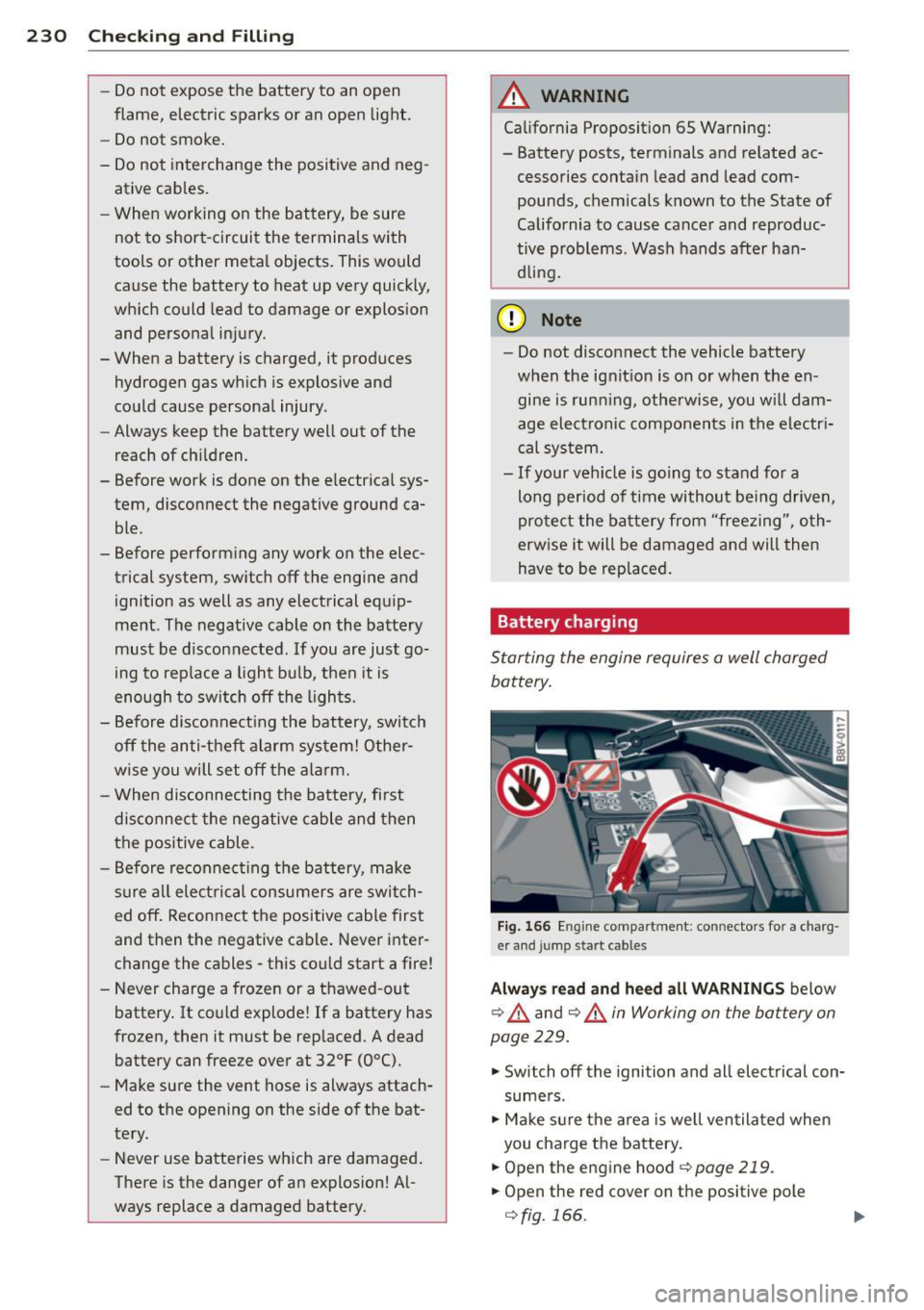
Battery charging
Starting the engine requires a well charged
battery.
Fig. 166 E ngin e compart men t: co nnecto rs for a charg
e r and jump st art ca bles
Always read and heed all WARNINGS below
~ .&_ and q .&_ in Working on the battery on
page 229.
~ Switch off the ignition and all electrical con
sumers.
~ Make sure the area is well ventilated when
you charge the battery.
~ Open the engine hood q page 219 .
~ Open the red cover on the positive pole
qfig. 166 .
Page 249 of 310
Tires and wheels 24 7
It is important to check the tire sure for the spare wheel
pressure when the tires are
¢page 268.
cold.
When should I adjust the
-Read the required tire pres-tire pressures?
'
sure from the tire pressure la-
Adjust the tire pressure to the •
•
bel. The tire pressure label is load you are carrying. After
located on the driver's side B- changing a wheel
or replacing
pillar. wheels you have to adjust the
-Turn the valve stem cap coun- tire pressures on all wheels. In
ter-clockwise to remove it addition, you must then store
from the tire valve. the new tire pressures in the
-Place the air pressure gauge tire pressure monitoring sys-
on the valve. tern
¢ page 264.
-The tire pressures should only
A WARNING
be checked and adjusted when
Incorrect tire pressures and/
the tires are cold . The slightly
or underinflation can lead
raised pressures of warm tires
sudden tire failure, loss of
must not be reduced.
control, collision, serious per-
-Adjust the tire pressure to the
sonal injury or even death.
load you are carrying.
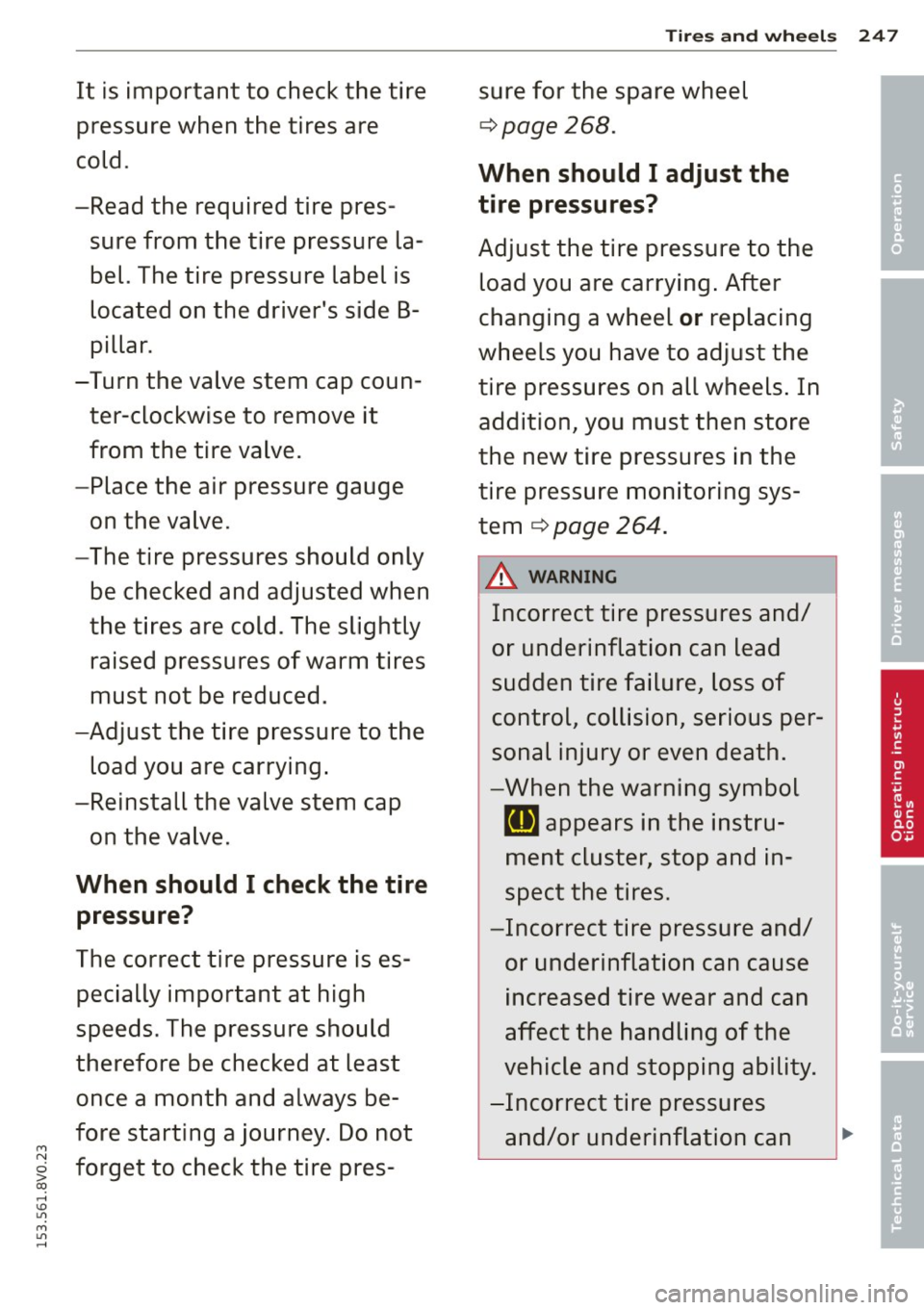
-When the warning symbol
-Reinstall the valve stem cap
RI] appears in the instru-
on the valve.
ment cluster, stop and in-
When should I check the tire spect the tires.
pressure? -Incorrect tire pressure and/
The correct tire pressure is es- or underinflation can cause
pecially important at high increased tire wear and can
speeds. The pressure should affect the handling of the
therefore be checked at least vehicle and stopping ability.
once a month and always be- -Incorrect tire pressures
fore start ing a journey. Do not
and/or underinflation can
' • M N
forget to check the tire pres-0 > co .... \!) 1.1'1
M 1.1'1 ....
Page 267 of 310
M N
0 > co ,...., \!) 1.1"1
M 1.1"1 ,....,
reached the level to trigger illumination of the
TPMS low tire pressure telltale.
Your veh icle has also been equ ipped with a
TPMS malfunction indicato r to indica te when
the system is not operating properly . The
TPMS malfunction indicator is combined with
the low tire pressure tellta le . When the sys
tem detects a malfunct ion, the telltale will
flash for approximately one minute and then
remain cont inuous ly illuminated. This se
quence will continue upon subsequent vehicle
start-ups as long as the ma lfunction ex ists .
When the malfunct ion indicator is illuminat
ed, the system may not be able to detect or
sig nal low t ire pressure as intended . TPMS
malfunct ions may occur for a variety of rea
sons, including the installa tio n of replace
ment or a lternate tires or whee ls on the veh i
cle that prevent the TPMS from funct ion ing
properly. Always check the TPMS malfunction
tellta le after replacing one or more tires or
wheels on your veh icle to ensure that the re
placement or alternate tires and wheels allow
the
TPMS to continue to function properly.
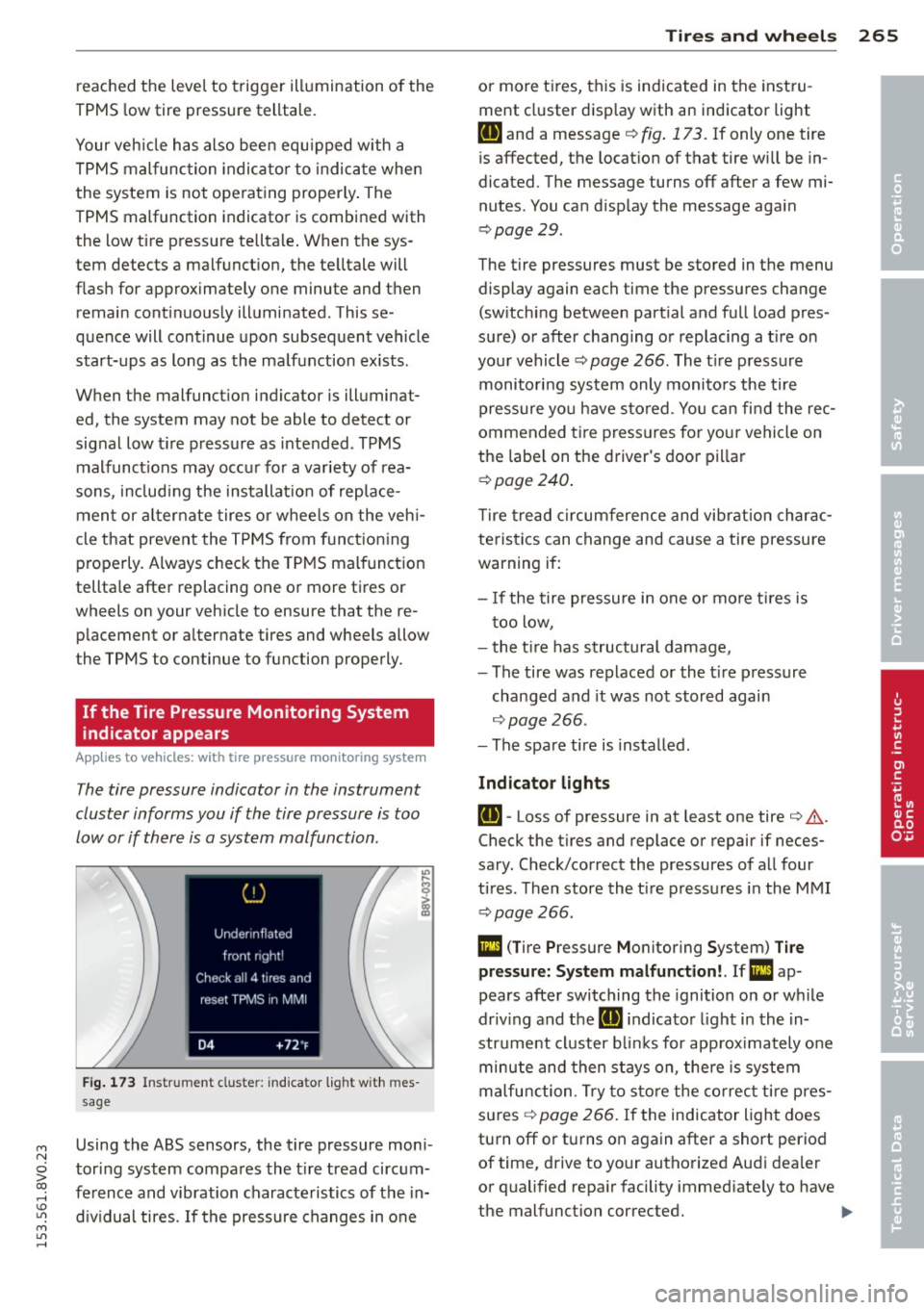
If the Tire Pressure Monitoring System
indicator appears
Applies to vehicles: with tire pressure monito ring system
The tire pressure indicator in the instrument
cluster informs you if the tire pressure is too
low or if there is a system malfunction .
Fig . 173 In strum ent clus te r: indica tor l igh t w ith mes
sage
Using the ABS sensors, the tire pressure moni
toring system compares the t ire tread circum
ference and vibration characteristics of the in
d iv idual tires . If the pressure changes in one
Tire s an d wheel s 265
or more tires, this is indicated in the instru
ment cluster disp lay with an indicator light
ti] and a message c:::> fig . 17 3. If only one tire
is affected, the locat ion of that tire will be in
dicated. The message turns off after a few mi
nutes . You can d isplay the message aga in
c:::> page 2 9 .
The tire pressures must be stored in the menu
display again each time the pressures change
(sw itching between partial and full load pres
sure) or after chang ing or replacing a t ire on
your vehicle
c:::> page 266 . The t ire press ure
monitori ng system only monito rs the tire
pressure yo u have stored . Yo u can find the rec
ommended t ire press ures for your vehicle on
the labe l on the driver 's doo r pillar
c:::> page240 .
Tire t read circumference and vib rat ion charac
teristics can change and cause a tire pressu re
warning if :
- I f the tire pressure in one or mo re tires is
t oo low,
- the t ire has structural damage,
-The tire was replaced or the t ire p ressure
changed and it was not stored again
c:::> page 266 .
- The spare tire is installed .
Indicator light s
ti]-Loss of pressure in at least one tire c:::> &.
Check the tires and replace or repair if neces
sary. Check/correct the pressures of all four
tires . Then store the t ire pressures in the MMI
c:::> page 266 .
DI (T ire Pressure Monitoring System) T ir e
press ure: S ystem malfunct ion!. If Ill ap
pears afte r switching the ignition on or while
driv ing and the
ti] indicator l ight in the in
str ume nt cluster b links for app rox imately one
minute and then stays on , the re is system
malfunction. Try to s to re the co rrec t ti re pres
s u res
c:::> page 266. If the indicator ligh t does
turn off or tu rns on again after a short period
of time, drive to yo ur authorized Aud i dea ler
or qualified repa ir facility immed iate ly to have
the malfunction corrected. .,..
•
•
•
Page 268 of 310
![AUDI S3 2015 Owners Manual 266 Tire s and wheels
& WARNING
-If the tire pressure warning light ti] in
the instrument cluster turns on, the
pressure in one or more tires is too low.
Reduce the vehicle speed](/img/6/57541/w960_57541-267.png "AUDI S3 2015 Owners Manual 266 Tire s and wheels
& WARNING
-If the tire pressure warning light ti] in
the instrument cluster turns on, the
pressure in one or more tires is too low.
Reduce the vehicle speed")
266 Tire s and wheels
& WARNING
-If the tire pressure warning light ti] in
the instrument cluster turns on, the
pressure in one or more tires is too low.
Reduce the vehicle speed immediately
and avoid any hard steering or braking
maneuvers . Stop as soon as possible,
check the t ire and inflate the tire to the
correct pressure, which is specified on
the tire pressu re label on the veh icle
¢ page 240. Driving with a t ire with low
pressure causes the tire to overheat and
can result in failure of the tire . Low pres
sure can a lso have a negative effect on
the driving and braking behavior of the
vehicle.
- The driver is responsible for maintaining
the correct tire pressures. You must
check the t ire pressures regularly.
- Under certain conditions (such as a spor
ty driving style, winter conditions or un
paved roads), the pressure monitor ind i
cator may be delayed .
- Ask your author ized dealer if run-flat
t ires may be used on your vehicle.
- The tire pressure monitoring system can
also stop work ing when there is an ESC
malfunction.
- Using snow chains may result in a system
malfunction.
- The tires with the identification "AO" or
"RO" ¢ page 254 have been matched
with your Audi tire pressure monitoring
system. We recommend that you use
these tires.
- The tire pressure monitoring system can
only mon itor the t ire pressure of the
driving tires . Check the tire pressure of
the spare wheel in the luggage compart ment so that if necessary it is ready for
us e.
-
Storing tire pressures
Applies to vehicles: wit h tire press ure mo nitor ing system
A change in tire pressure or a change in tires
must be stored in the system.
The tire pressure is stored in the MMI.
.. Make sure before storing that the tire pres
sures of a ll four tires meet the specified va l
ues and are adapted to the load. Otherwise
the system could malfunction
¢ page 240.
.. Switch on the ignition.
.. Select: the
I MENU I button >Car > Systems*
control button > Service & control > Tire
pressure monitor > Store tire pre ssure >
Yes, store now.
(D Tips
Do not store the tire pressures if snow
chains are installed. Otherwise the system
could malfunction.
Page 281 of 310
M N
0 > co ,...., \!) ..,.,
M ..,., ,....,
@ Tips
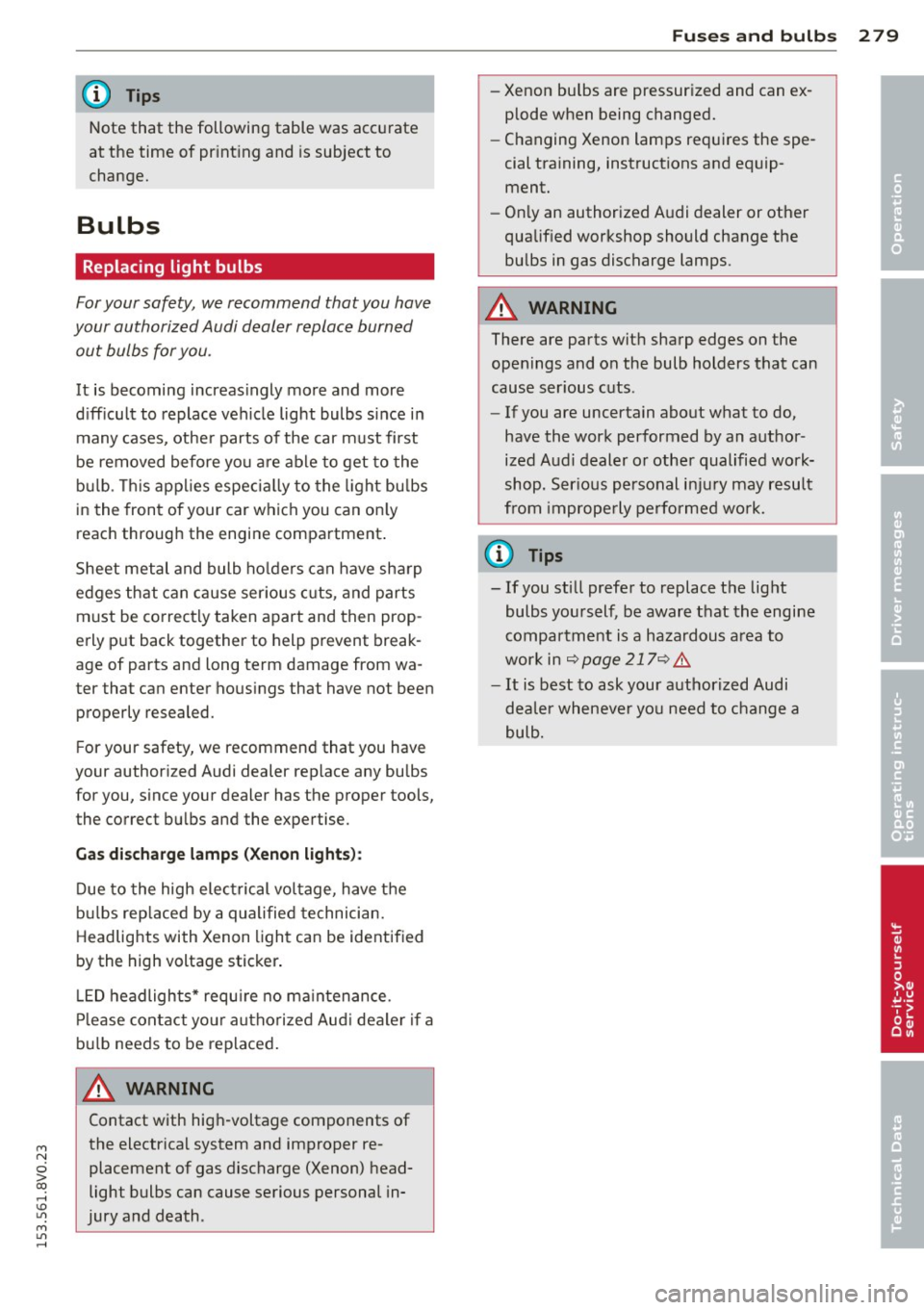
Note that the following table was accurate
at the time of pr int ing and is subject to
change.
Bulbs
Replacing light bulbs
For your safety, we recommend that you have
your authorized Audi dealer replace burned out bulbs for you.
It is becoming increas ingly more and more
d ifficult to replace veh icle light bulbs since in
many cases, other parts of the car must first
be removed before you a re able to get to the
bu lb. This app lies especia lly to the light bu lbs
in the front of your car which you can on ly
reach through the engine compartment .
Sheet metal and bulb ho lders can have sha rp
edges that can cause ser ious c uts, and parts
must be co rrectly taken apart and then prop
erly put back together to help prevent break
age of parts and long term damage from wa
ter that can enter hous ings that have not been
properly resealed.
F or your safety, we recommend that you have
your authorized Audi dealer rep lace any bulbs
for you, since your dealer has the proper tools,
the correct bulbs and the expertise.
G as discha rge l amps (Xenon light s):
Due to the high elect rical voltage, have the
bu lbs rep laced by a qualified technician.
Headlights wi th Xenon light can be identified
by the high voltage sticker .
L ED headlights* requ ire no ma intenance .
Pl ease contact yo ur a uthorized Aud i dealer if a
bu lb needs to be replaced.
A WARNING
Contact with high-voltage components of
the electrica l system and improper re
placement of gas discharge (Xenon) head
light bulbs can cause serious personal in
jury and death .
Fuses and bulb s 2 79
- Xenon bu lbs are pressur ized and can ex
plode when being changed.
- Changing Xenon lamps requires the spe
cial tra ining, instructions and equip
ment.
- On ly an authorized A udi dealer or other
qualified workshop should change the bulbs in gas discharge lamps.
A WARNING
There are parts with sharp edges on the
openings and on the bulb holders that can
cause ser ious cuts .
- If you are uncertain about what to do,
have the work performed by an author
ized Audi dealer or othe r qualified work
shop. Ser ious personal inju ry may result
from imprope rly performed wo rk.
(D Tips
- If you still prefer to replace the light
bulbs you rself, be aware that the engine
compartment is a hazardous area to
work in
c:::> page 21 lc:::> &
- It is best to ask your authorized Audi
dealer whenever you need to change a
bulb.
-
•
•
•
Page 282 of 310
280 Emergency situations
Emergency situations
General
This chapter is intended for trained emer
gency crews and working personnel who
have the necessary tools and equipment to
perform these ope rations.
Starting by pushing or
towing
Q;) Note
Vehicles w ith an automatic transmission
cannot be started by pus hing o r tow ing.
Starting with jumper
cables
If necessary, the engine can be started by
connecting it to the battery of another vehi
cle.
If the engine should fail to start because of a
discharged or weak battery, the battery can be
connected to the battery of
another vehicle,
using a
pair of jumpe r cables to start the en
g ine .
Jumper cables
Use only jumper cables of sufficiently large
cross section to carry the starter current safe
ly. Refer to the manufacturer's specif ications.
Use only jumper cables with
insulated termi
na l clamps which are distinctly marked:
plus(+) cable in most cases colored red
minu s(-) cable
in most cases colored black .
A WARNING
Batteries contain electricity, acid, and gas.
Any of these can cause very serious or fatal
inju ry. Follow the instructions below for
safe handling of your veh icle's battery.
- Always shield you r eyes and avoid lean
ing over the battery whenever possible.
- A discharged battery can freeze at tem
peratures just be low 32 °F (0 °C). Before connecting a
jumper cable, you must
thaw the frozen battery complete ly, oth
erwise it could explode.
- Do not allow battery acid to contact eyes
or skin . Flush any contacted area with
water immediately .
- Improper use of a booster battery to start a vehicle may cause an explosion.
- Vehicle batteries generate explosive gas
es. Keep sparks, flame and lighted ciga
rettes away from batteries.
- Do not try to jump start any vehicle with a low acid level in the battery.
- The vo ltage of the booster battery must
also have a 12-volt rating. The capacity
(Ah) of the booster battery should not be
lower than that of the discharged bat
tery . Use of batteries of d ifferent voltage
or substantially different "Ah" rating
may cause an exp losion and personal in
jury.
- Never charge a frozen batte ry. Gas trap
ped in the ice may cause an explosion.
- Never charge or use a battery that has
been frozen. The battery case may have
be weakened.
- Use of batter ies of different voltage or
substantially different capacity (Ah) rat
ing may cause an exp losion and injury.
The capacity (Ah) of the booster battery
should not be lower than that of the dis
charged battery.
- Before you check anything in the engine
compartment, always read and heed a ll
WARNINGS
¢page 217.
(D Note
-App lying a higher voltage booster bat
tery will cause expensive damage to sen
sitive electronic components, such as
contro l units, relays, radio, etc .
- Th ere must be no electrical contact be
tween the vehicles as otherwise current cou ld already start to f low as soon as the
positive(+) terminals are connected. .,.
Page 295 of 310
M N
0 > co ,...., \!) 1.1'1
M 1.1'1 ,....,
A
A/C (automatic climate control system) .. 70
A/C (manual cl imate control system) .. .. 69
Accessories . . . . . . . . . . . . . . . . . . . . 60, 291
Active lane ass ist . . . . . . . . . . . . . . . . . . . . 98
Ac tiva ting vibration warning .. .. .. .. . 100
Adj usting steering time . ... .. .. .. .. . 100
C leaning the camera area . ... .. .. .. . 206
Driver messages . . . . . . . . . . . . . . . . . . . . 99
Indicator light . . . . . . . . . . . . . . . . . . . . . 99
switch ing on and
off ...... .. .. .. .. .. 99
Adapt ive cruise control . . . . . . . . . . . . . . . . 86
Automatic transmission . . . . . . . . . . . . . 90
C lean ing the sensor .... ... .. .. .... . 206
Driver messages .......... .... .. .... 92
General Informa tion . . . . . . . . . . . . . . . . 86
Request fo r driver intervention . . . . . . . . 92
Stop-and-go traffic .......... .... ... 90
Adaptive dampe rs . . . . . . . . . . . . . . . . . . . 106
Indicator light . . . . . . . . . . . . . . . . . . . . . 26
Adapt ive light . . . . . . . . . . . . . . . . . . 47, 106
I ndicator light . . . . . . . . . . . . . . . . . . . . . 25
AdBlue .. .. .. .. ........ ... .. ... ... . 215
F il ling . .. .. .......... ... .... .. .. . 216
M essages .. ............. .. .. .. .. . 215
Adding W indshield washer fluid ....... ... .. 232
Adj usting a ir distribution (Climate control
system) ... .. ................. .. .... 71
Ad justing air vents ......... .. .. .. .. .. 7 2
Adjusting a ir vents (manual climate con-
trol system) . . . . . . . . . . . . . . . . . . . . . . . . . 69
Ad justing a utomatic headlights . ... .. .. 48
Ad justing the cen ter conso le lighting .. .. 50
Ad justing the temperat ure
manual climate control system . . . . . . . . 69
advanced key
refer to Convenience key . . . . . . . . . . . . . 77
A irbag .... .. ................. .. ... 1 44
I ndica tor ligh t . . . . . . . . . . . . . . . . . . . . . 21
Ai rbag system ................ .... .. 165
Advanced Airbag System ... .. .. .. .. . 148
Advanced Airbag System compone nts . 15 2
Ca re ..... .. .... ........... .. .. .. . 160
C hi ld ren . .. ............. .... .. ... 17 2
C hi ld restra ints . .. ..... ... .. .. .. ... 172
Inde x 293
Components (front airbags) .. ... .. .. 152
Danger of fitting a ch ild seat o n the front
passenger seat ... .. . .. ... .... ... .. 146
Disposa l .. .. .. .. ................. 160
Front a irbags . . . . . . . . . . . . . . . . 148, 150
How do the front airbags work? ...... 154
How many a irbags does my vehicle
have? ....... ... .. ..... .......... 152
How the Advanced Airbag System com-
ponent s work togethe r ......... .. .. 15 4
Im portant sa fe ty instructions on the
knee airbag system .. .. ..... ... .. .. 163
Impo rtant t hings to know .... ... .. .. 144
Knee a irbags . .. .. ................. 161
Monitoring .. .. .. ................. 156
PASSENGER AIR BAG OFF light ..... .. 157
Repairs ......... .. ............... 160
Safety i nstr uctions .. . .. .. .. ... ... .. 159
S ide a irbags . .. .... ... .. ..... ..... 163
S ide cur tain airbags . ........... .... 166
Wa rning/Indicato r lights ....... .. .. 156
When must the system be inspected? . 156
Ala rm system
re fer to Anti-theft alarm system ....... 35
A lignment pin (changing the whee l) .. .. 268
A ll- wea ther lights ( LED headlights) ... .. . 46
A ll-wheel d rive
Winter tires . .. .. .. .......... ..... 261
A ll wheel drive .. .. ................. 193
Altern ator
refer to Alternator (indicator light) 20
Alternato r (indicato r light) ...... .... .. 20
Amb ient lighting . ... .. .. .. .... ... .. . 49
A nti- freeze
refer to Eng ine coolan t ......... .. .. 225
Anti -lock braking system ............. 189
Ind icator light ... .. . .. .... .... .. .. . 22
Anti-slip regu lation .. ........... .... 189
Ind icator light . .. .... ........... .. . 22
An ti-theft a larm system ....... ... .. .. . 35
Anti-theft protection Electronic immob ilizer ............. .. 40
Audi active lane assist
refer to Active lane ass ist ......... .. . 98
Audi drive selec t ..... . .. .. ..... ... .. 106
Ind icator light ..... . .. .. ..... ... .. . 26
•
•
•
Page 296 of 310
29 4 Index
Audi magnetic ride
refer to Adaptive dampers 106
Aud i Service Repa ir Ma nuals and Litera -
ture .. .. .... ............. .. .. .. .. . 289
AUTO Automatic climate control system ..... 70
Automatic headlights ......... .. .... 46
Auto Lock (centra l locking system) .... .. 36
Automatic belt retractor ............. 138
Automatic climate control system
refer to Climate control system (auto-
mat ic) ............................ 70
Automatic headlights ................. 46
Automatic post-collision braking system 190
Automatic transmission .............. 109
Driving t ips . .................. .... 111
E mergency mode .................. 115
H ill descent control ................ 113
I gnition key safety in terlock .. .. .... .. 74
Kick -down . .... . ...... ... ... ..... . 114
L aunch Contro l-Program ... .. .. .. .. . 1 15
malfunction . .. . ...... ... .. .. .... . 110
Selector lever emergency release . . . . . 116
Selector lever lock . . . . . . . . . . . . . . . . . 110
Selector lever posit ions ............. 109
Shifting manually . . . . . . . . . . . . . . . . . . 114
Steer ing whee l w ith shift paddles ..... 114
S t ron ic .. .. ..... ........ .. .. .. .. . 109
tiptronic . .. ............. .. .. .. .. . 114
Automatic wipe/wash system . . . . . . . . . . 50
Auto Safety Hotline ..... ... .. .. .... . 133
Auxiliary heater (vehicles w ith d iese l en-
g ines) .. .. .... ............. ...... .. 73
Average consumption ................. 28
Average speed . . . . . . . . . . . . . . . . . . . . . . . 28
B
Battery . .. .. ............. .. .. .. .. . 228
Charge level ... ... .... ... .. .. .... . 194
Charging . . . . . . . . . . . . . . . . . . . . . 20, 230
Energy management . ... .. .. .. .. .. . 194
Important warnings ............... 229
Indicator light . . . . . . . . . . . . . . . . . . . . . 20
Jump starting ............ .. .. .. .. . 280
Locat ion ... ... .... ...... ... ... .. . 229
Replacing the battery .............. 231 Winter operation
.... .. ..... .... . .. 228
Working on the battery . ..... ... .. .. 229
Before driving ..... ............. .... 125
Blended gasoline .. ............. .... 210
B lower
automatic Climate control system . ... . 71
Manua l climate control system ... .. .. . 69
Boos t .............................. 29
Booster seats . . . . . . . . . . . . . . . . . . . . . . 179
Boost p ressure indicator . ..... ... .. .. . 29
Brake fluid Changi ng the b ra ke fluid ........ .. .. 22 7
Checking the b rake fluid level ........ 22 7
What is the co rrect b rake fluid level? .. 2 2 7
What shou ld I do if the brake fluid warn -
ing light comes on? ..... .... ... .. .. 227
B rakes ..... .... .. .. ........... .... 191
B rake assist system . ........... .. .. 189
B rake booster ..................... 191
Indicator light ... .. ... ..... ... .. .. . 25
New brake pads . .... .. ..... ... .. .. 191
Brake system Brake fluid .... .. ............. .... 22 7
B rake fluid specifications fo r refill and re -
placement .... .. ... .. ..... ... .. .. 227
B rake pads . ..... .. .... .... ... .. .. 197
Fl uid reservoir ... .. ... ..... ... .. .. 227
Worn brake pads symbo l . . . . . . . . . . . . . 22
B rak ing
Emergency brak ing funct ion ... .. .. .. . 82
Indicator light ... ... .. ..... .... . .. . 18
Parking brake .... .. ... ..... ... .. .. . 80
Starting on inclines ............ .... . 82
B reak-in per iod ..................... 197
Brake pads . ..... ... .. ..... ... .. .. 197
T ires ... .. .... .. .. ... ..... ... .. .. 197
Bu lbs ......... ... .. .............. . 279
C
California Proposition 65 Warn ing .... . 218
Battery specific .................. . 230
Capacities AdBl ue ... .... .. ............. .... 215
Fuel tank .. .. .. .. ............. .. .. 288
Washe r fluid reservo ir .. ....... ... .. 288
Care ... .. .. .... .. .. .... . ..... ... .. 205
also refer to Cleaning .......... .. .. 205
Page 299 of 310
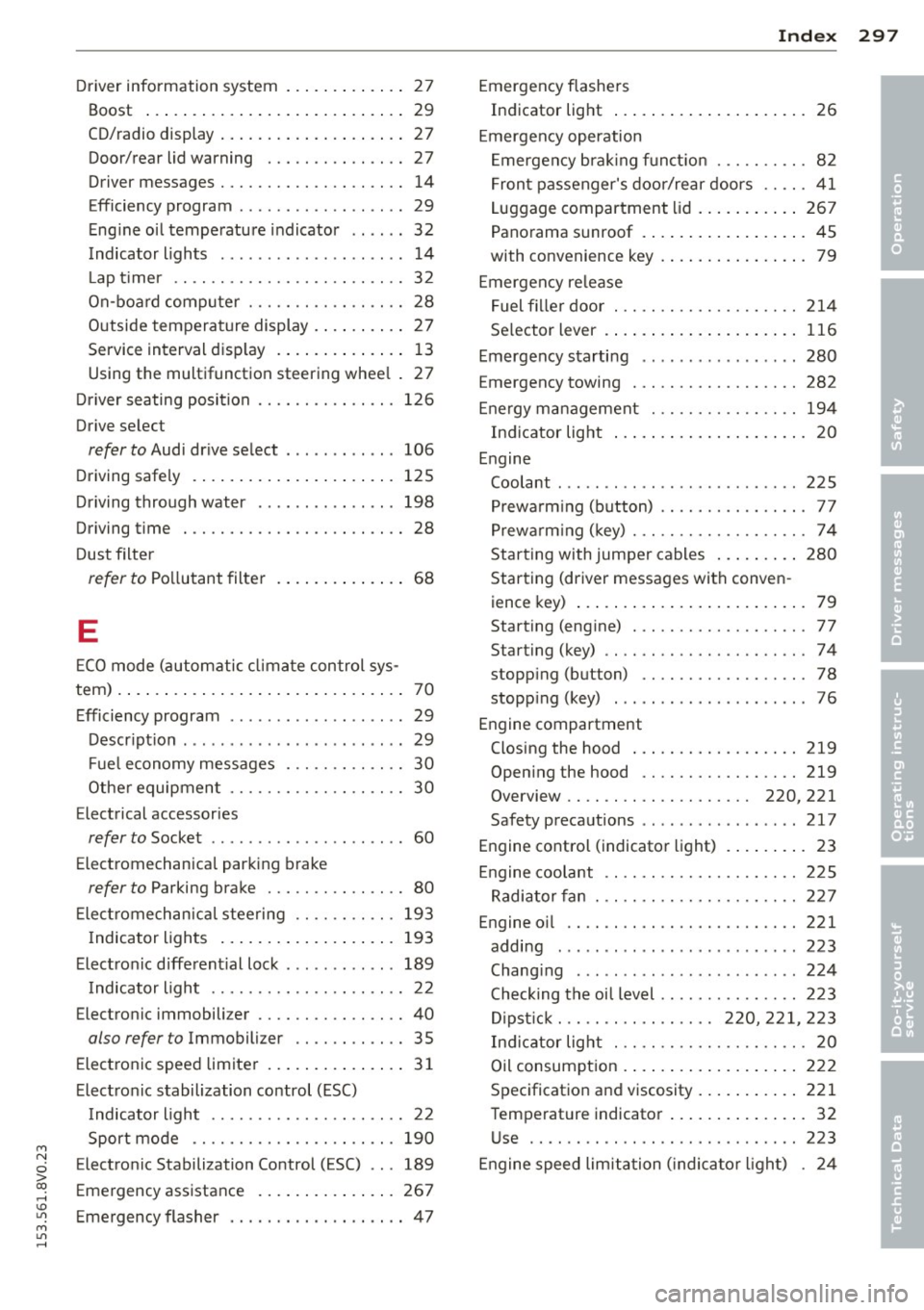
M N
0 > co ,...., \!) 1.1'1
M 1.1'1 ,....,
Driver information system ... .. .. .. .. .. 27
Boost ..... .. .. .. .. .... ... .. .. .... 29
CD/radio display ....... ... .. .. .. .. .. 27
Door/rear lid warning ..... .. .. .. .. .. 27
Driver messages . . . . . . . . . . . . . . . . . . . . 14
Efficiency program . . . . . . . . . . . . . . . . . . 29
E ng ine o il temperature indicator .. .. .. 32
I ndicator lights . . . . . . . . . . . . . . . . . . . . 14
L ap time r .. ............... .. .. .. .. 3 2
On- boa rd comp ute r . . . . . . . . . . . . . . . . . 28
Outside tempera ture display . ... .. .. .. 27
Service interval disp lay . ... .. .. .. .. .. 13
Using the multifunction steer ing whee l . 27
Dr iver sea ting posi tion ...... .. .. .. .. . 126
Drive se lect
refer to Audi dr ive se lect . ...... ... .. 106
D riving safe ly . .. .. ..... ... .. .. .. .. . 125
D riving through water . . . . . . . . . . . . . . . 198
Driving time . . . . . . . . . . . . . . . . . . . . . . . . 28
D ust filter
refer to Po llutant filte r . . . . . . . . . . . . . . 68
E
EC O mode ( autom atic clima te control sys -
tem) . ..... .. .. ... .. ..... ... .. .. .... 70
E fficiency program . . . . . . . . . . . . . . . . . . . 29
D escr ipt io n ................. ... ... . 29
Fu el economy messages . . . . . . . . . . . . . 30
O the r equipmen t . . . . . . . . . . . . . . . . . . . 30
Elect rical accessories
refer to Socket . . . . . . . . . . . . . . . . . . . . . 60
Elect romechanical par king brake
refer to Parking brake ..... .. .. .. .. .. 80
E lect romechan ic a l steering .. .. .. .. .. . 193
I ndica tor ligh ts .. ..... ... .. .. .. .. . 193
E lect ron ic diffe rent ial loc k ... .. .. .. .. . 189
I ndicator light . . . . . . . . . . . . . . . . . . . . . 2 2
Electronic immobili zer ...... .. .. .. .. .. 40
also refer to Immobilizer .. .. .. .. .. .. 35
E lect ro nic spee d limiter .. ... .. .. .. .. .. 31
E lect ronic stabilization control (ESC)
I ndicator light . . . . . . . . . . . . . . . . . . . . . 2 2
Sport mode .. ........... .. .. .. .. . 190
Electro nic Stabilization Control (ESC) .. . 189
Eme rgency ass istance ... ... .. .. .. .. . 26 7
E mergency flasher ...... ... .... .. .. .. 47
Inde x 297
Emergency flashe rs
Indicator light ... .. . ... ...... ... .. . 26
Emergency operation Emergen cy bra king f unct ion ..... .. .. . 82
F ron t passenger's door/rear doors .. .. . 41
L uggage compartment lid .... ... .. .. 2 67
Pano rama sunroof . .. .. ..... ... .. .. . 4S
with convenience key . . . . . . . . . . . . . . . . 79
E mergency re lease
F uel fi ller doo r ... .. . .............. 214
S e lector lever . . . . . . . . . . . . . . . . . . . . . 116
Emergency starting ................. 280
Emergency towing . ................. 282
E nergy m anagement ............ .. .. 19 4
Ind icator lig ht ... .. .. .. ...... ... .. . 2 0
E ngine
Coolant ......... .. ............... 225
Pr ewa rm ing (butto n) ............... . 77
P rewarm ing ( key) . .... ........... .. . 74
Star ting with jumper cables .. ... .. .. 2 80
S tar ting (driver messages with conven -
ience key) . . . . . . . . . . . . . . . . . . . . . . . . . 79
Starting (eng ine) . .. ............... . 77
Starting
(key) . . . . . . . . . . . . . . . . . . . . . . 7 4
stopp ing (button) .................. 78
stopp ing (key) . ......... ........... 76
Engine compartment Closing the hood ..... ............. 219
Open ing the ho od ............. .. .. 219
Overview.. .. .. .. ............ 220,221
Safety precautions ... . .. ...... .... . 217
Engine co ntrol (indicato r light) . . . . . . . . . 23
En gine coolant .. .. ................. 225
Radiator fan . .. .. .... ............. 227
Engine o il .. .. .. .. .. . .. .. ..... ... .. 221
adding ......... .. ............... 223
Changi ng ... .. .. .. . .. .... .... .. .. 224
Checking the oi l level ............. .. 22 3
Dip stic k ... .... .. .. . ..... 2 20, 22 1,22 3
Ind icator lig ht . .. .... ........... .. . 20
Oil consumpt ion . ... . .. .. ..... ... .. 2 22
Specificatio n and viscosity .... ... .. .. 221
T emperature indicato r ... .... ... .. .. . 32
U se ...... .. .. .. ................. 223
Engine speed lim itation ( indica to r li gh t) . 24
•
•
•