tire pressure AUDI S3 2015 Owner's Manual
[x] Cancel search | Manufacturer: AUDI, Model Year: 2015, Model line: S3, Model: AUDI S3 2015Pages: 310, PDF Size: 76.15 MB
Page 253 of 310
M N
0 > co ,...., \!) 1.1'1
M 1.1'1 ,....,
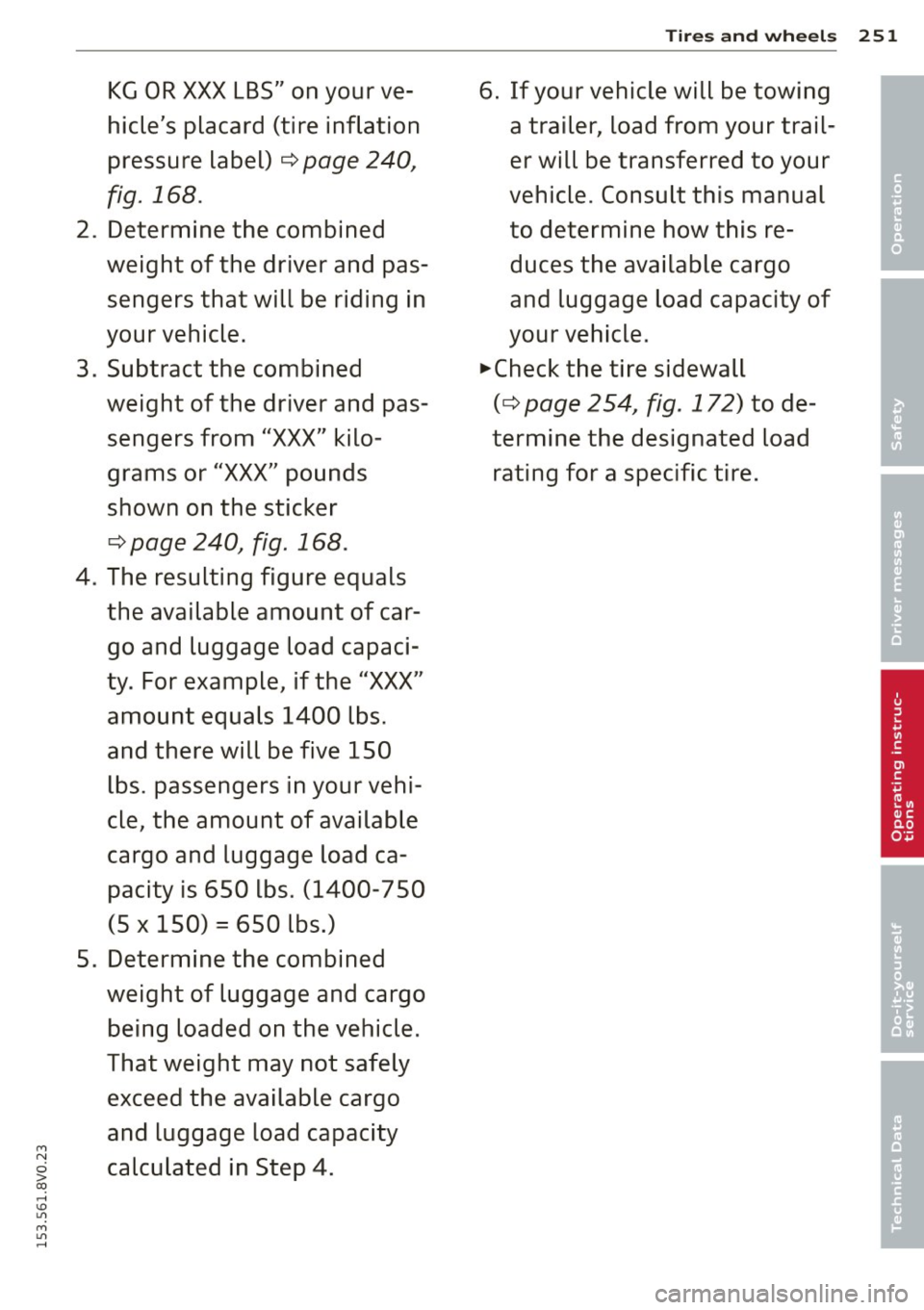
KG OR XXX LBS" on your ve
hicle's placard (tire inflation
pressure label)
c:> page 240,
fig. 168.
2. Determine the combined
weight of the driver and pas sengers that will be riding in
your vehicle.
3 . Subtract the combined
weight of the driver and pas sengers from
"XXX" kilo
grams or
"XXX" pounds
shown on the sticker
c:> page 240 , fig. 168.
4. The resulting figure equals
the available amount of car
go and luggage load capaci
ty. For example, if the "XXX"
amount equals 1400 lbs.
and there will be five 150 lbs. passengers in your vehi
cle, the amount of available
cargo and luggage load ca
pacity is 650 lbs. (1400-750 (5
X 150) = 650 lbs.)
5. Determine the combined weight of luggage and cargo being loaded on the vehicle.
That weight may not safely
exceed the available cargo
and luggage load capacity
calculated in Step 4.
Tires and wheels 251
6. If your vehicle will be towing a trailer, load from your trail
er will be transferred to your
vehicle. Consult this manual
to determine how this re
duces the available cargo
and luggage load capacity of
your vehicle.
~check the tire sidewall
(¢ page 254, fig . 172) to de
termine the designated load rating for a specific tire.
' •
•
' •
Page 254 of 310
252 Tires and wheels
Tire service life
The service life of tires depends
on a lot of different things in
cluding proper installation and
balancing, correct tire pressure
and driving style.
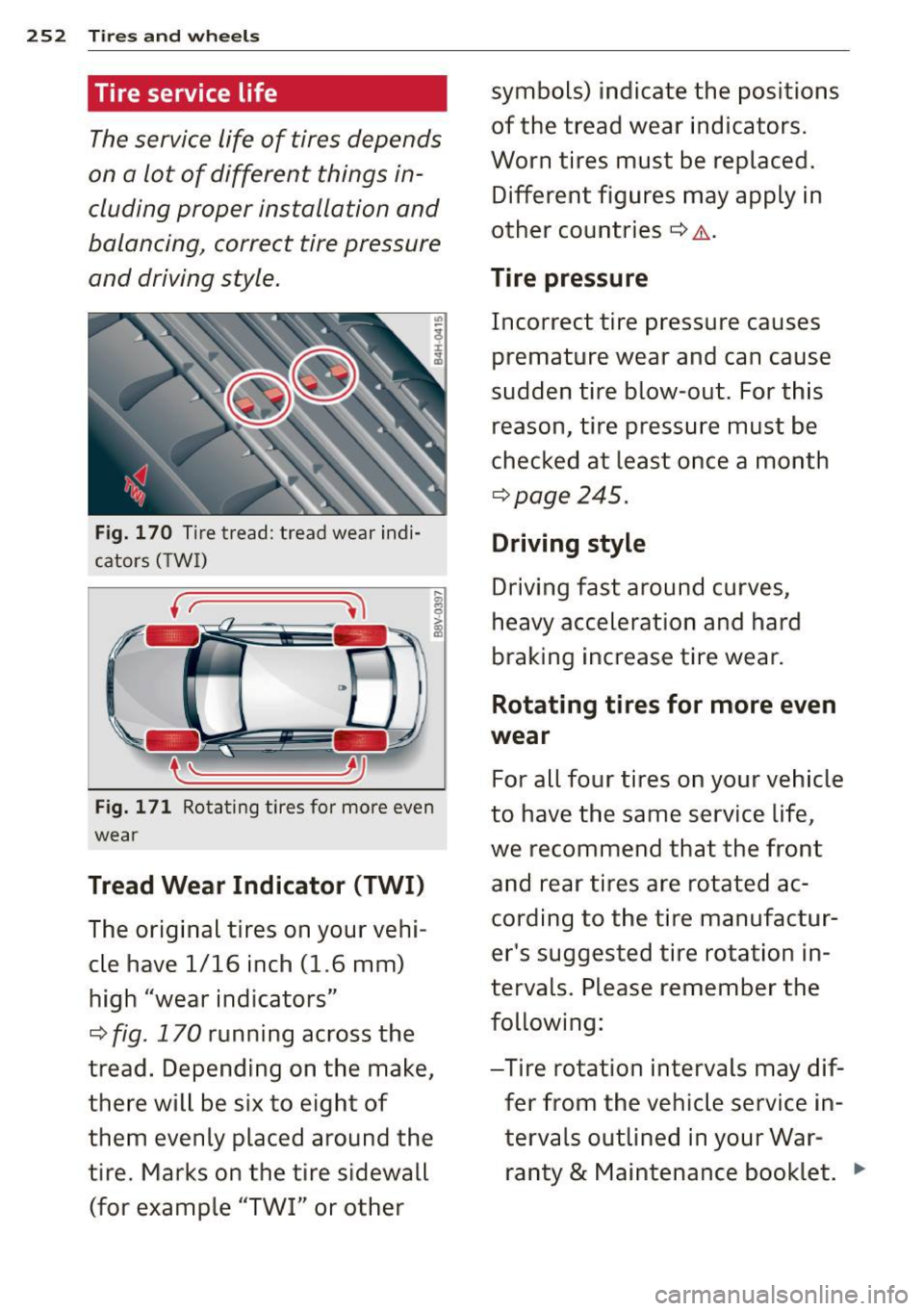
Fig. 170 Tire tread: tread wear indi
cators (TWI)
Fig. 171 Rotating tires for more even
wear
Tread Wear Indicator (TWI)
The original tires on your vehi
cle have 1/16 inch (1.6 mm)
high "wear indicators"
¢ fig. 170 running across the
tread. Depending on the make,
there will be six to eight of
them evenly placed around the
tire. Marks on the tire sidewall (for example "TWI" or other symbols)
indicate the positions
of the tread wear indicators.
Worn tires must be replaced.
Different figures may apply in
other countries
¢ ..1.. .
Tire pressure
Incorrect tire pressure causes
premature wear and can cause
sudden tire blow-out. For this
reason, tire pressure must be
checked at least once a month
¢page 245.
Driving style
Driving fast around curves,
heavy acceleration and hard
braking increase tire wear.
Rotating tires for more even
wear
For all four tires on your vehicle
to have the same service life,
we recommend that the front and rear tires are rotated ac
cording to the tire manufactur
er's suggested tire rotation in
tervals. Please remember the
following:
-Tire rotation intervals may dif
fer from the vehicle service in
tervals outlined in your War
ranty
& Maintenance booklet. ""
Page 257 of 310
M N
0 > co ,...., \!) 1.1'1
M 1.1'1 ,....,
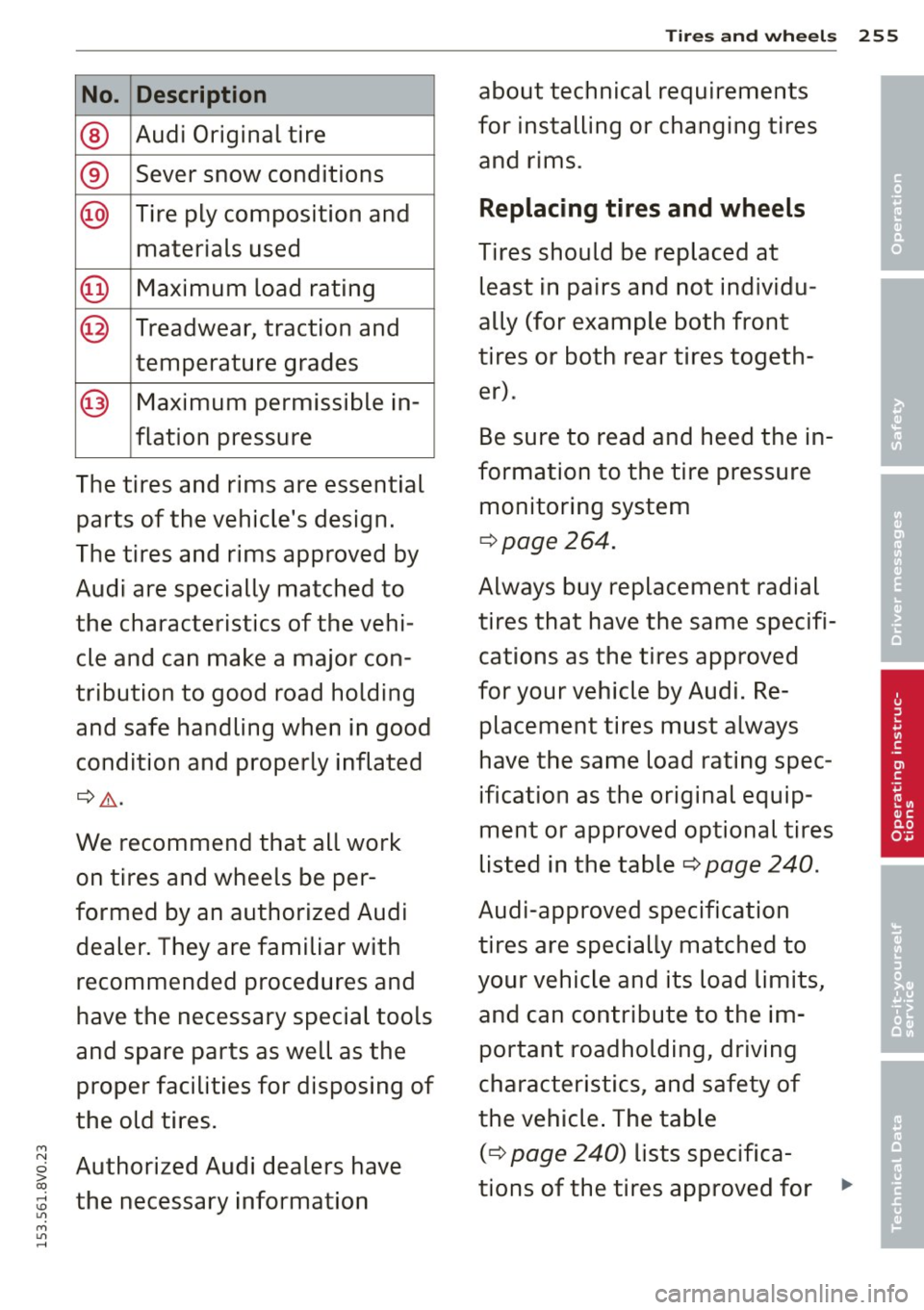
No. Description
® Audi Original tire
® Sever snow conditions
@ Tire ply composition and materials used
@ Maximum load rating
@ Treadwear, traction and
temperature grades
@ Maximum permissible in-
flation pressure
The tires and rims are essential parts of the vehicle's design.
The tires and rims approved by
Audi are specially matched to
the characteristics of the vehi
cle and can make a major con
tribution to good road holding
and safe handling when in good
condition and properly inflated
¢ ,&.
We recommend that all work
on tires and wheels be per
formed by an authorized Audi dealer. They are familiar with
recommended procedures and
have the necessary special tools
and spare parts as well as the
proper facilities for disposing of
the old tires.
Authorized Audi dealers have
the necessary information
Tires and wheels 255
about technical requirements
for installing or changing tires and rims.
Replacing tires and wheels
Tires should be replaced at least in pairs and not individu
ally (for example both front
tires or both rear tires togeth er).
Be sure to read and heed the in
formation to the tire pressure monitoring system
i=> page 264.
Always buy replacement radial
tires that have the same specifi
cations as the tires approved
for your vehicle by Audi. Re
placement tires must always
have the same load rating spec
ification as the original equip
ment or approved optional tires
listed in the table
c> page 240.
Audi-approved specification
tires are specially matched to
your vehicle and its load limits, and can contribute to the important roadholding, driving
characteristics, and safety of
the vehicle. The table
{ c> page 240) lists specifica
tions of the tires approved for
' •
•
' •
Page 258 of 310
256 Tires and wheels
the Audi models covered by
your Owner's Literature.
The tire pressure label located
on driver's side B-pillar
(¢ page 240, fig . 169) lists the
specifications of the original
equipment tires installed on
your vehicle at the time it was
manufactured .
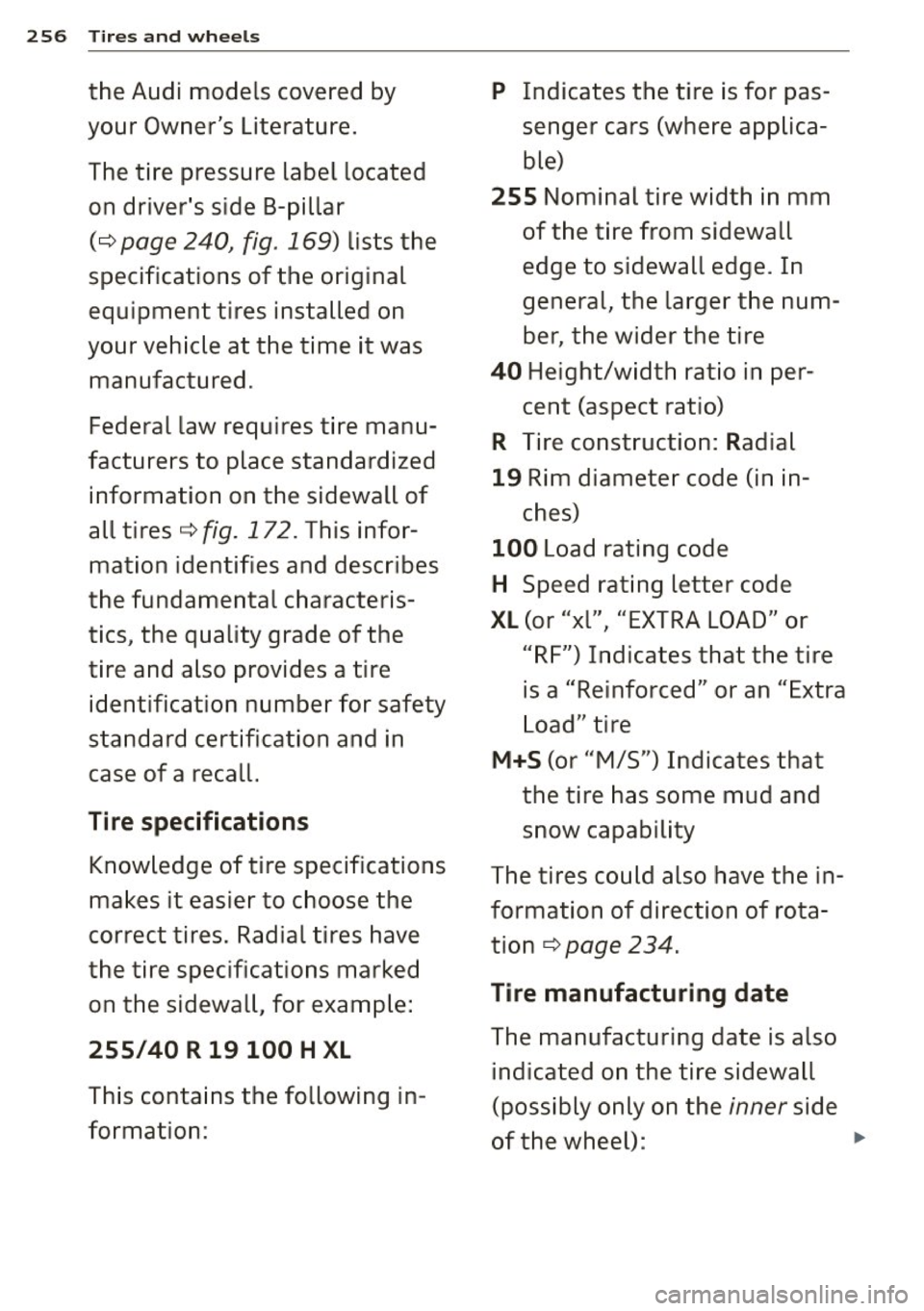
Federal law requires tire manu
facturers to place standardized
information on the sidewall of
all tires
¢ fig. 172. This infor
mation identifies and describes
the fundamental characteris
tics, the quality grade of the
tire and also provides a tire identification number for safety
standard certification and in
case of a recall.
Tire specifications
Knowledge of tire specifications
makes it easier to choose the
correct tires . Radial tires have
the tire specifications marked
on the sidewall, for example:
255/40 R 19 100 H XL
This contains the following in
formation :
P Indicates the tire is for pas
senger cars (where applica
ble)
255 Nominal tire width in mm
of the tire from sidewall
edge to sidewall edge. In
general, the larger the num
ber, the wider the tire
40 Height/width ratio in per
cent (aspect ratio)
R Tire construction: Radial
19 Rim diameter code (in in-
ches)
100 Load rating code
H Speed rating letter code
XL (or "xl", "EXTRA LOAD" or
"RF") Indicates that the tire
is a "Reinforced" or an "Extra
Load" tire
M+S (or "M/5 ") Indicates that
the tire has some mud and
snow capability
The tires could also have the in
formation of direction of rota
tion
¢ page 234.
Tire manufacturing date
The manufacturing date is also
indicated on the tire sidewall
(possibly only on the
inner side
of the wheel) : .,..
Page 260 of 310
258 Tires an d whee ls
tires because they meet the
h ighest standards regarding
safety and driving characteris
tics when used correctly. Your
authorized Audi dealer w ill
g ladly provide you with more
information.
Tire ply composition and materials used
T he number of plies indicates
the number of layers of rubber
coated fabric in the tire. In gen
eral, the greater the number of
plies , the more weight a tire
can support . Tire manufactur
ers also must indicate the ma
ter ia ls in the tire, wh ich include
steel, nylon, polyester, and oth
ers .
Maximum Load Rating
This number indicates the max
imum load in kilograms and
pounds that can be carried by
the tire.
Tire quality grading for
treadwear, traction, and
temperature resistance
Tread wear, trac tion and tem
perature grades
¢ page 260.
Maximum Permissible
Inflation Pressure
T his number is the g reatest
amount of air pressure that should ever be put in the tire
under normal driv ing condi
tions.
A WARNING
-Using incorrect or unmatch ed tires and/or wheels or
improper t ire and wheel
combinations can lead to loss of control , collision and
ser ious personal injury.
-Always use tires, rims and
wheel bolts that meet the
specifications of original
factory-installed tires o r
other combinations that
have been specifically ap
proved by the vehicle manu
facturer.
- Tires age even if they a re
not being used and can fail
sudden ly, especially at high
speeds. Tires that a re more
than 6 years old can on ly be
used in an eme rgency and
then with special care and
at lower speeds.
-Never mount used tires on
your vehicle if you are no t
Page 265 of 310
M N
0 > co ,...., \!) 1.1'1
M 1.1'1 ,....,
In certain circumstances, you may not use
wheel bo lts from a different vehicle -
even if it
i s the same mode l
Q page 291.
A WARNING
Improperly tightened or maintained wheel
bolts can become loose caus ing loss of
control, a collision and ser ious personal in
jury .
- Always keep the wheel bolts and the
threads in the wheel hubs clean so the
wheel bolts can turn easily and be prop
erly t ightened.
- Never grease or oil the wheel bolts and
the threads in the wheel hubs. They can
become loose w hile d riving if greased or
o iled,
even if tightened to the spec ified
torq ue.
- Only use wheel bo lts that belong to the
rim being ins talled.
- Never use different whee ls bolts on your
vehicle .
- Always maintain the correct tightening
torque fo r the wheel bolts to reduce the
risk of a wheel loss. If the tigh teni ng tor
que of the wheel bolts is too low, they
can loosen and come out when the vehi
cle is moving . If the tightening torque is
too high, the whee l bolts and threads
can be damaged and the wheel ca n be
come loose .
(D Note
The specified torque for the wheel bo lts is
90 ft lb (120 Nm) w ith a tolerance of
± 7,4 ft lb(± 10 Nm). Torque whee l bolts
diagonally. After changing a wheel, the
torque must be checked as soon as possi
b le with a torque wrench -prefe rably by an
author ized Audi dealer or qualified wo rk
shop.
Low aspect ratio tires
Your Audi is factory-equipped with low aspect
ratio tires . These tires have been thorough ly
tested and been selected spec ifically for your
model for the ir superb performance, road feel
Tire s an d wheel s 263
and handling under a variety o f driving condi
tions. Ask your authorized A udi dealer for
more details .
T he low aspec t ratio of these tires is ind icate d
by a numera l of
55 or le ss in the tire's size
designation. The numera l represents the ratio
of the t ire's sidewa ll height in relation to its
tread width expressed in percentage.
Conven
tiona l tires have a he ight/w idth rat io of 60 or
more .
The performance of low-a spect-ratio tire s is
particularl y sens it iv e to improper inflation
pressure. It is therefore important that low
a spect ratio tir es are inflated to the specified
pre ssure and that the inflation pr essure i s
regularly checked and ma intain ed . Tire pr es
s ure s should be checked at lea st on ce a
month and alway s bef ore a long trip
~ page 245 , Checking tire pressure .
A Word about Low Aspect Ratio and High
Performance Ti res
Hig h pe rformance tires are des igned for bet
ter performance and handling in warm cli
mates. When driving in cold, snowy or icy
weather, you sho uld equ ip your vehicle w it h
four all-season or winter tires, which
offer
better traction under those condit ions. We
suggest you use the Audi recommended win
te r or a ll-season tires specified for you r Audi.
High performance tires a lso have a lower as
pect ratio that aids performance and han
dling . Driving over rough or damaged road
surfaces, as well as debr is, cu rbs and other
obstacles can cause serious damage to
whee ls, tires, vehicle body, and suspens ion
parts . B e carefu l to avo id road hazards and re
du ce your speed , espec ia lly if your vehicle is
equipped wi th low prof ile tires .
Please a lso remember when making your se
lection that, wh ile these tires deliver respon
s ive handling, t hey m ay ride less comfo rtably
and make more noise than o thers . Finally,
these tires may wear more quickly than other
c h oices.
IJJ>
•
•
•
Page 266 of 310
264 Tire s and wheel s
It is important that the inflation pressu re is
regularly checked and maintained at recom
mended levels .
F or more informat ion p lease ask your A udi
deale r for more details .
What you can do to avoid tire and rim
damage
Low aspect ratio t ires can be damaged more
easi ly by impact with potho les, curbs, gu llies
or ridges on the road, part icularly if the t ire is
underinflated .
I n o rder to m inim ize the o ccu rrence of impact
damage to the tires of your vehicle, we recom
mend that you observe the following precau
tions:
- Always mainta in recommended inflat ion
pressures. Check your tire pressure every
2,000 miles (3,000 km) and add air if neces
sary .
- Drive carefu lly on roads with potholes, deep
gullies or ridges. The impact from driving
thro ugh or over such obstacles can damage
your t ires. Impact with a curb may also
cause damage to your tires.
- After any impact, immediately inspect your
t ires or have them inspected by the neares t
authorized Aud i dealer . Replace a damaged
t ire as soon as possible .
- Inspect your t ires every 2,000 miles (3,000
km) for damage and wear . Damage is not al
ways easy to see . Damage can lead to loss of
air and unde rinflat ion, wh ich could eventu
ally cause t ire fail ure.
If you be lieve that a
t ire may have been damaged, replace the
tire as soon as possible.
- T hese tires may wea r more quick ly than oth
ers.
- Please a lso remember that, whi le these t ires
deliver respons ive handling, they may ride
less comfortably and make mo re noise than
other c hoices.
Reduced performance in winter /cold
s eason condition s
All tires are designed for certain pu rposes .
The low aspect ratio, u ltra hig h performance t
ir es or iginally insta lled on yo ur vehicle a re in
tended for maximum dry and wet road per
formance and handling . They are not suitable
for cold, snowy or icy weather conditions. If
you drive under those c ircumstances, you
shou ld equ ip your vehicle w ith all -season or
winter tires, which offer bette r traction unde r
those conditions . We suggest you use the rec
ommended snow o r all-season t ires specified
for yo ur vehicle , or thei r equivalent .
Refer to~ page
261 for more detailed infor
mation regard ing winter tires .
Tire pressure
monitoring system
ill General notes
E ach tire, including the spare ( if provided),
shou ld be checked monthly wh en co ld and in
flated to t he inflat io n pressure recommended
by the veh icle man ufact urer on t he veh icle
placard or tire inf lation pressure labe l. (If your
vehicle has tires of a different size than the
size indicated on the vehicle placard or tire in
flat ion pressure labe l, you should determine
the proper t ire inflation press ure for those
t i res).
As an added safety feature, your ve hicle has
been equipped with a tire pressure monitoring
system (TPMS) that illum inates a low tire
pressure tell tale when one or more of your
t ires is s ignificantly under-inflated . According
ly, when the low tire pressure telltale illumi
nates, you shou ld stop and check you r tires as
soon as possib le, and inflate them to the
proper p ress ure. Driving on a sig nifican tly u n
der -inflated t ire causes the tire to overhea t
and can lead to tire fa ilure . Under-inflation al
so reduces fuel eff iciency and tire tread life,
and may affect the vehicle's hand ling and
stopp ing ability.
Please note that the TPMS is not a substit ute
for proper tire maintenance, and it is the driv
er 's respons ibility to maintain correct tire
pressure, even if under-inflation has not
Page 267 of 310
M N
0 > co ,...., \!) 1.1"1
M 1.1"1 ,....,
reached the level to trigger illumination of the
TPMS low tire pressure telltale.
Your veh icle has also been equ ipped with a
TPMS malfunction indicato r to indica te when
the system is not operating properly . The
TPMS malfunction indicator is combined with
the low tire pressure tellta le . When the sys
tem detects a malfunct ion, the telltale will
flash for approximately one minute and then
remain cont inuous ly illuminated. This se
quence will continue upon subsequent vehicle
start-ups as long as the ma lfunction ex ists .
When the malfunct ion indicator is illuminat
ed, the system may not be able to detect or
sig nal low t ire pressure as intended . TPMS
malfunct ions may occur for a variety of rea
sons, including the installa tio n of replace
ment or a lternate tires or whee ls on the veh i
cle that prevent the TPMS from funct ion ing
properly. Always check the TPMS malfunction
tellta le after replacing one or more tires or
wheels on your veh icle to ensure that the re
placement or alternate tires and wheels allow
the
TPMS to continue to function properly.
If the Tire Pressure Monitoring System
indicator appears
Applies to vehicles: with tire pressure monito ring system
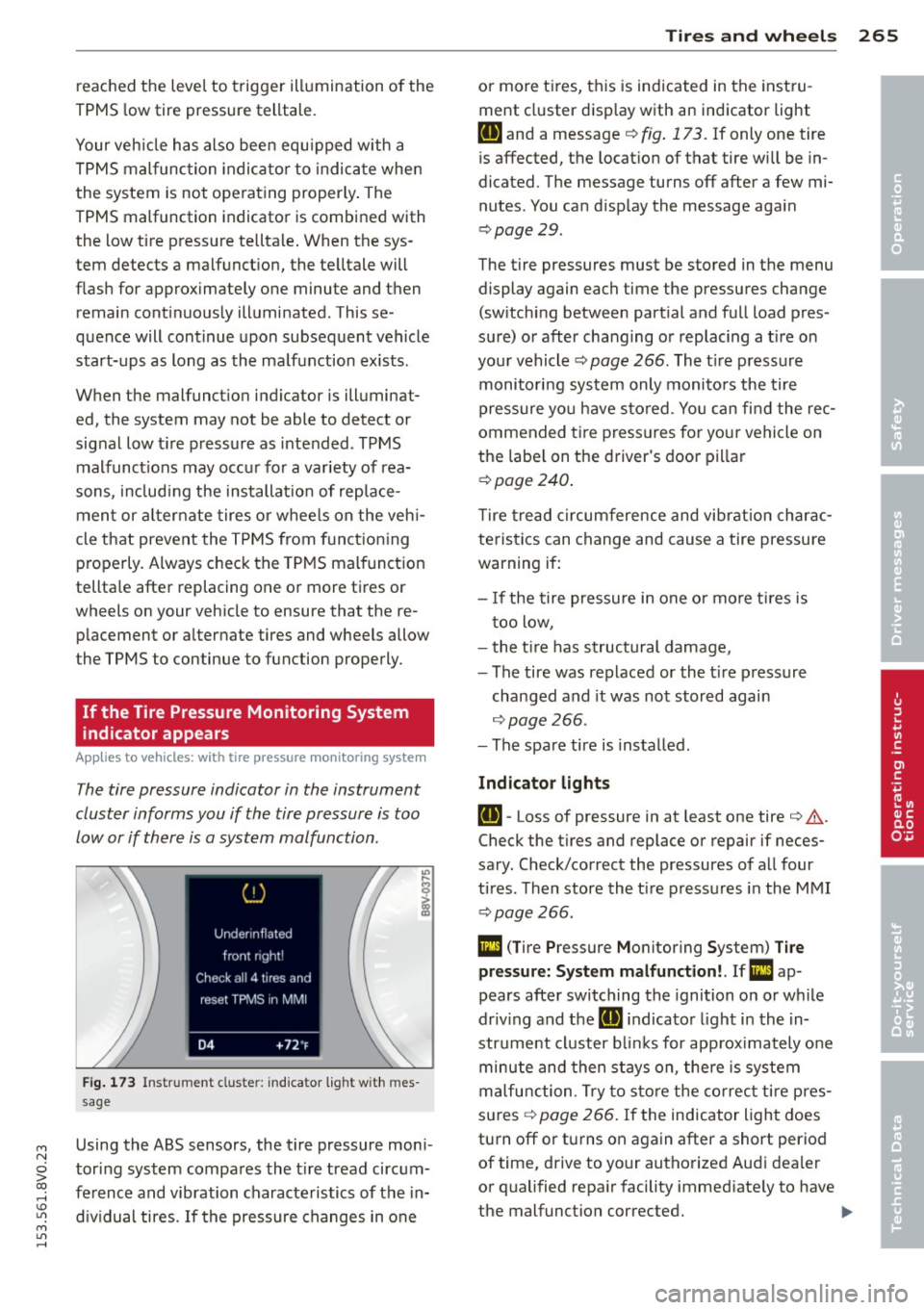
The tire pressure indicator in the instrument
cluster informs you if the tire pressure is too
low or if there is a system malfunction .
Fig . 173 In strum ent clus te r: indica tor l igh t w ith mes
sage
Using the ABS sensors, the tire pressure moni
toring system compares the t ire tread circum
ference and vibration characteristics of the in
d iv idual tires . If the pressure changes in one
Tire s an d wheel s 265
or more tires, this is indicated in the instru
ment cluster disp lay with an indicator light
ti] and a message c:::> fig . 17 3. If only one tire
is affected, the locat ion of that tire will be in
dicated. The message turns off after a few mi
nutes . You can d isplay the message aga in
c:::> page 2 9 .
The tire pressures must be stored in the menu
display again each time the pressures change
(sw itching between partial and full load pres
sure) or after chang ing or replacing a t ire on
your vehicle
c:::> page 266 . The t ire press ure
monitori ng system only monito rs the tire
pressure yo u have stored . Yo u can find the rec
ommended t ire press ures for your vehicle on
the labe l on the driver 's doo r pillar
c:::> page240 .
Tire t read circumference and vib rat ion charac
teristics can change and cause a tire pressu re
warning if :
- I f the tire pressure in one or mo re tires is
t oo low,
- the t ire has structural damage,
-The tire was replaced or the t ire p ressure
changed and it was not stored again
c:::> page 266 .
- The spare tire is installed .
Indicator light s
ti]-Loss of pressure in at least one tire c:::> &.
Check the tires and replace or repair if neces
sary. Check/correct the pressures of all four
tires . Then store the t ire pressures in the MMI
c:::> page 266 .
DI (T ire Pressure Monitoring System) T ir e
press ure: S ystem malfunct ion!. If Ill ap
pears afte r switching the ignition on or while
driv ing and the
ti] indicator l ight in the in
str ume nt cluster b links for app rox imately one
minute and then stays on , the re is system
malfunction. Try to s to re the co rrec t ti re pres
s u res
c:::> page 266. If the indicator ligh t does
turn off or tu rns on again after a short period
of time, drive to yo ur authorized Aud i dea ler
or qualified repa ir facility immed iate ly to have
the malfunction corrected. .,..
•
•
•
Page 268 of 310
![AUDI S3 2015 Owners Manual 266 Tire s and wheels
& WARNING
-If the tire pressure warning light ti] in
the instrument cluster turns on, the
pressure in one or more tires is too low.
Reduce the vehicle speed](/img/6/57541/w960_57541-267.png "AUDI S3 2015 Owners Manual 266 Tire s and wheels
& WARNING
-If the tire pressure warning light ti] in
the instrument cluster turns on, the
pressure in one or more tires is too low.
Reduce the vehicle speed")
266 Tire s and wheels
& WARNING
-If the tire pressure warning light ti] in
the instrument cluster turns on, the
pressure in one or more tires is too low.
Reduce the vehicle speed immediately
and avoid any hard steering or braking
maneuvers . Stop as soon as possible,
check the t ire and inflate the tire to the
correct pressure, which is specified on
the tire pressu re label on the veh icle
¢ page 240. Driving with a t ire with low
pressure causes the tire to overheat and
can result in failure of the tire . Low pres
sure can a lso have a negative effect on
the driving and braking behavior of the
vehicle.
- The driver is responsible for maintaining
the correct tire pressures. You must
check the t ire pressures regularly.
- Under certain conditions (such as a spor
ty driving style, winter conditions or un
paved roads), the pressure monitor ind i
cator may be delayed .
- Ask your author ized dealer if run-flat
t ires may be used on your vehicle.
- The tire pressure monitoring system can
also stop work ing when there is an ESC
malfunction.
- Using snow chains may result in a system
malfunction.
- The tires with the identification "AO" or
"RO" ¢ page 254 have been matched
with your Audi tire pressure monitoring
system. We recommend that you use
these tires.
- The tire pressure monitoring system can
only mon itor the t ire pressure of the
driving tires . Check the tire pressure of
the spare wheel in the luggage compart ment so that if necessary it is ready for
us e.
-
Storing tire pressures
Applies to vehicles: wit h tire press ure mo nitor ing system
A change in tire pressure or a change in tires
must be stored in the system.
The tire pressure is stored in the MMI.
.. Make sure before storing that the tire pres
sures of a ll four tires meet the specified va l
ues and are adapted to the load. Otherwise
the system could malfunction
¢ page 240.
.. Switch on the ignition.
.. Select: the
I MENU I button >Car > Systems*
control button > Service & control > Tire
pressure monitor > Store tire pre ssure >
Yes, store now.
(D Tips
Do not store the tire pressures if snow
chains are installed. Otherwise the system
could malfunction.
Page 270 of 310
268 What do I do n ow ?
Equipment
Vehicle tool kit
Applies to vehicles: with vehicle tool kit
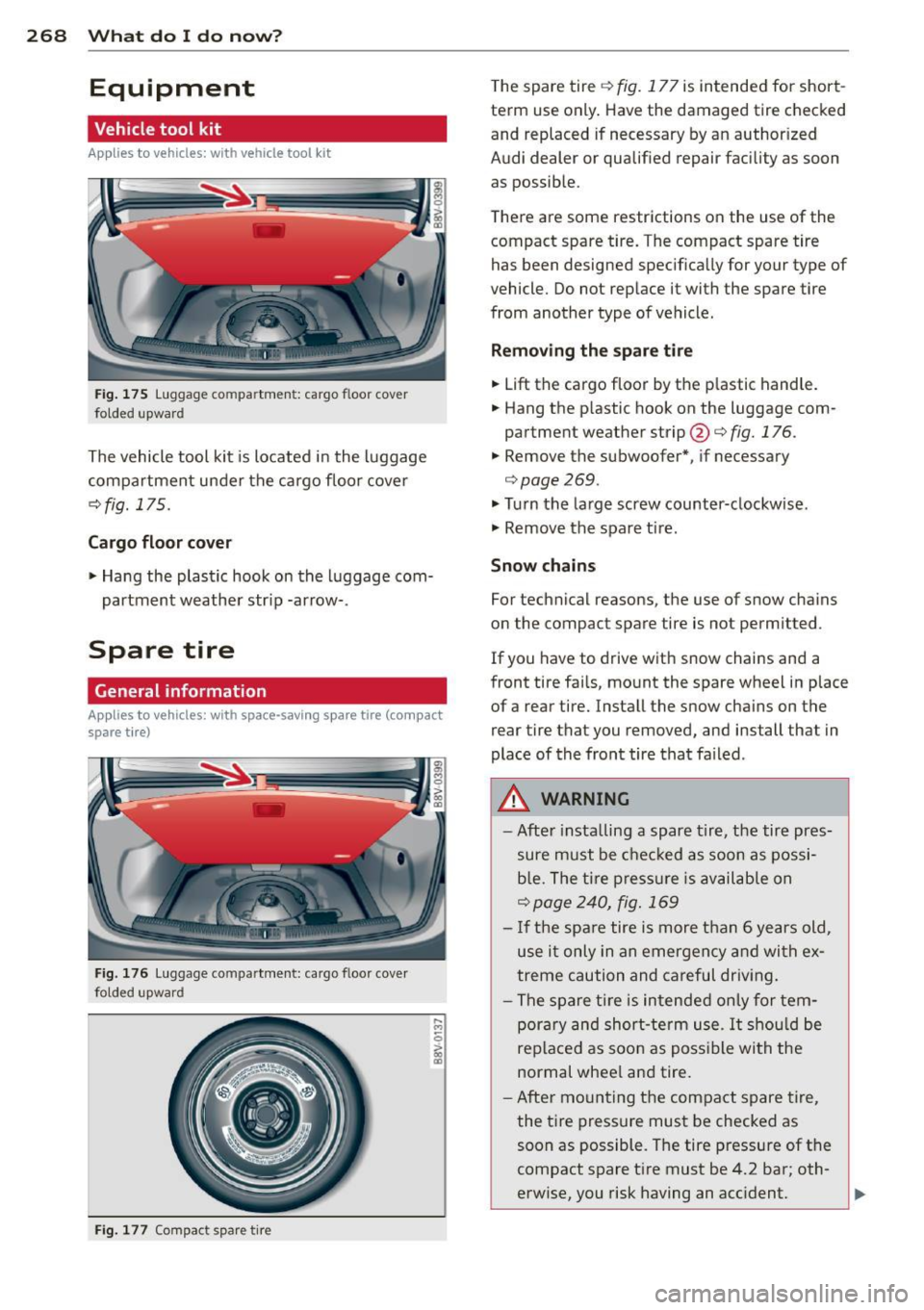
Fig . 175 Luggage compart ment: cargo floor cover
folded upward
The vehicle tool kit is located in the luggage
compartment under the cargo floor cover
¢fig. 175 .
Carg o flo or c over
.. Hang the plastic hook on the luggage com
partment weather str ip -arrow-.
Spare tire
General information
Applies to vehicles: with space-saving spa re tire (compact
spare tire)
Fig. 176 Luggage compartment: cargo floor cove r
fo lded upward
Fi g. 177 Compact spare tire
The spare tire~ fig. 177 is intended for short
term use only. Have the damaged tire checked
and replaced if necessary by an author ized
Audi dealer or qualified repair facility as soon
as possible.
There are some restrictions on the use of the
compact spare tire. The compact spare tire
has been designed specifically for your type of
vehicle. Do not replace it with the spare tire
from another type of vehicle.
Rem ovi ng the sp are tir e
.. Lift the cargo floor by the plastic handle.
.. Hang the p lastic hook on the luggage com
partment weather strip@¢
fig. 176 .
.. Remove the subwoofer*, if necessary
¢page 269.
.. Turn the large screw counter-clockwise.
.. Remove the spare tire.
Snow ch ain s
For technical reasons, the use of snow chains
on the compact spare tire is not permitted.
If you have to drive with snow chains and a
front tire fails, mount the spare wheel in place
of a rear tire. Install the snow chains on the
rear tire that you removed, and install that in
place of the front tire that failed .
A WARNING
--After installing a spare tire, the tire pres-
sure must be c hec ked as soon as possi
b le. The tire p ress ure is available on
¢ page 240, fig. 169
- If the spa re tire is more t han 6 years old,
use it only in an emergency and with ex
treme caution and careful driving.
- The spare ti re is intended only for tem
pora ry and short-term use.
It shou ld be
replaced as soon as poss ible with the
normal wheel and tire.
- After mounting the compact spare tire, the tire pressure must be checked as
soon as possible . The tire pressure of the
compact spare tire must be 4.2 bar; oth
erwise, you risk having an accident.