service AUDI S3 2015 Service Manual
[x] Cancel search | Manufacturer: AUDI, Model Year: 2015, Model line: S3, Model: AUDI S3 2015Pages: 310, PDF Size: 76.15 MB
Page 213 of 310
Many gasoline grades are blended to perform
especially well for winter or summer driving. During seasonal change-over, we suggest that
you fill up at busy gas stations where the sea sonal adjustment is more likely to be made in
time.
Q;) Note
- Methanol fuels which do not meet these requirements may cause corrosion and
damage to plastic and rubber compo nents in the fuel system .
- Do not use fuels that fail to meet the
specified criteria in this chapter .
- If you are unable to determine whether
or not a particular fuel blend meets the
specificat ions, ask your service station or
i ts fuel supp lier.
- Do not use fuel for which the contents cannot be identified.
- Fuel system damage and performance
problems resulting from the use of fuels
different from those specified are not
the responsibility of Audi and are not
covered under the New Vehicle or the
Emission Control System Warranties.
- If you experience a loss of fuel economy
or driveability and performance prob
lems due to the use of one of these fuel
blends, we recommend that you switch
to unblended fuel.
Gasoline additives
A major concern among many auto manufac
turers is carbon deposit build-up caused by
the type of gasoline you use .
Although gasoline grades differ from one manufacturer to another, they have certain
things in common. All gasoline grades contain substances that can cause deposits to collect
on vital engine parts, such as fuel injectors
and intake valves. Although most gasoline
brands include additives to keep engine and
M
N fuel systems clean, they are not equally effec-o
iii tive. ,...., \!) ..,.,
M ..,., ,....,
Checking and Filling 211
Audi recommends using TOP TIER Detergent
Gasoline . For more information on TOP TIER
Detergent Gasoline, please go to the official
website (www.toptiergas .com).
After an extended period of using inadequate
fuels, carbon deposit build-ups can rob your engine of peak performance.
CJ) Note
Damage or malfunction due to poor fuel
quality is not covered by the Audi New Ve
hicle Limited Warranty.
Diesel fuel
App lies to vehicles : wit h diese l eng ine
Always use ULSD (Ultra Low Sulfur Diesel)
No. 2 . The ULSD No. 2 meets the ASTM D975.
Diesel fuel with concentrations of biodiesel
higher than 5
% such as B11, B2O or B1OO are
strictly prohibited.
Service station fuel pumps are labeled with
the correct fuel information for easy recogni
tion by the user.
If the diesel fuel pump is not
labeled ask the station operator what fuel is
being dispensed before filling up your vehicle.
ULSD No. 2 may not be available outside the
USA and Canada. Be sure to check before trav
eling to other countries.
ULSD No. 2 can become thicker in very cold
temperatures, and this can impair the en
gine's starting and running. Depending on the
season, gas stations provide ULSD No . 2 that
flows better in cold temperatures so that you
can continue operating your vehicle as usual.
(D Note
- Your vehicle's diesel engine was de
signed solely for use with ULSD No. 2.
Therefore, never use gasoline, heating
oil, other fuels or flow improvers. These
contain substances that will severely
damage the fuel system and the engine.
Such damage will not be covered by your
New Vehicle Limited Warranty.
ll>
•
•
•
Page 214 of 310
212 Checking and Fill in g
- If you put any amount of incorrect fue l in
the fue l tank, do not start the engine un
der any circumstances. Immediately con
tact the nearest authorized Audi dealer
or authorized Audi Service Facility for as
sistance. These fuels contain substances
that can severely damage the fuel sys
tem and the engine if the engine is start
ed.
- If the diesel fuel quality is poor, it may
be necessary to have the water drained
from the water sepa rator in the
f ue l fi l
te r
more often than specified in the
maintenance schedu le . This can help re
duce engine ma lfunctions
Q page 24.
Fuel tank
Fuel filler neck
The fuel filler neck is located on the right rear
side panel behind the fuel fi ller flap.
If the power locking system should fail, you
can st ill open the flap manually- for detailed
instructions
seer:::.> page 214.
You can find the fuel tank capacity of your ve
hicle in
Qpage 288.
The label on the inside of the fuel filler flap
tells you the correct fuel for your vehicle. For
more information about fuel specifications,
see
c;,page 210.
Your veh icle fuel tank has an onboard refue l
ling vapor recovery system . This feature helps
to prevent fuel vapors from escaping from the
tank and polluting the environment while you refuel your vehicle . In order to fill the tank
properly while protect ing the env ironment,
p lease follow t his refueling procedure careful
ly.
.&_ WARNING
Under norma l operating conditions, neve r
carry additiona l fuel containers in your car .
Gas can isters and other containers used to
transport fue l can be dangerous. Such con
tainers, full or empty, may leak and cou ld
cause a f ire in a collision. If you must transpo
rt fuel to use for your lawn mower,
snow b lower, etc., be very careful and al
ways observe local and state laws regard ing the use, transportation and storage of
such fuel containers. Make certa in the con
tainer meets industry standa rds (ANSI/
ASTM F8S2 -86).
(D Note
Neve r drive your veh icle until the fue l tank
i s completely empty. The irregular supply
of fue l can cause misfir ing. Gasoline cou ld
enter the exhaust system and damage the
catalytic converter.
Fueling procedure
F ig. 15 1 Righ t rear side of the vehicle: opening the
fuel filler flap
Fig . 1 52 Fue l filler door w ith attached fuel cap
Read and follow the information and warn
ings when filling Ad B lue
c;, page 215.
T he fue l filler door is u nlocked or locked by
the centra l locking sys tem.
Openin g the fuel c ap
" Press the left side of the fuel f iller door to
open it -arrow-
Q fig. 151.
"Unscrew the tank cap counterclockw ise .
-;:;
> a, a,
Page 217 of 310
....,
N
0 > co
rl I.O
"' ....,
"' rl
Selective catalytic reduction
General information
Applies to vehicles: with diesel e ngine
In vehicles with se lective cata lytic reduction, a
urea solut ion (Ad Blue) is injected into the ex
haust system before a nitrogen oxide catalytic
converter to reduce nitrogen -emissions .
Ad Blue is the marketing name for Diese l Ex
ha ust Fluid (DEF) .
The AdBlue is carried in a separa te tank in t he
vehicle . The AdBl ue usage accounts for ap
proximately 0.5% to 1.2% of the diese l fuel
that is used .
When a message abo ut refil ling the Ad Blue
appears in the inst rume nt cl uste r dis play, you
must refi ll the Ad B lue yourse lf or have it refil
l ed by an authorized Audi dealer or aut horized
Aud i Service Facility
Q page 216.
A WARNING
Failure to heed Ad Blue refill information in
the inst rume nt cluste r can p revent the
ve
hicle from being started and driven . If the
veh icle cannot be driven and an eme rgency
ar ises, perso na l inju ry can occur.
- Always have the Ad Blue tank refilled well
before the tank r uns d ry.
(!) Tips
- The instrument cluster display indicates
the d istance remaining that ca n be dr iv
en
Q page 215. If the AdBlue tank is
complete ly empty, the engi ne will not
sta rt again after the ign ition is switched
o ff.
- Ad B lue is requ ired by law to operate this
vehicle.
Che cking and Fillin g 215
Indicators in the instrument cluster
d isplay
Appl ies to vehicles: with diesel engine
Th e display indicates if th e Ad Blue lev el is low
or if there is a system malfunction.
Fi g. 1 54 Ins trum ent cluster : indicator in the display
AdBlue level low
You w ill be informed if t he AdBlue in the ta nk
drops below a certain leve l.
Ad Blue /9 Please refill Ad B lu e. Range
1500 mi (2400 km)
T his ind icator appea rs whe n there is only
eno ugh Ad Bl ue left to d rive the distance i ndi
cated in the driver information system. F ill
the Ad Blue .
AdBlue /9 Refill AdBlue! No re start in
600 mile s (1000 km )! See owner' s manual
This indicator appears when there is only
enough AdBlue left to drive the distance indi
cated in the dr iver information syst em. F ill
the Ad Blue. Otherwise the eng ine will not
star t again if you s top it o nce the dis tance in
dicated has been drive n. As long as the
AdBlue /9 ind icator light is on, yo u can
check the remaining range in the trip comput
er* .
Refill AdBlue! Engine start not
po ssible! See owner' s manual
This message appears w hen the Ad Blue tank
i s emp ty. Fill the AdB lue. Othe rw ise you w ill
not be able to sta rt the engine ag ain on ce you
stop it .
T he Ad Blu e mu st be refilled when the amount
i n the tank has rea ched t he minim um level
Q poge 216.
Page 219 of 310
M N
0 > co ,...., \!) 1.1"1
M 1.1"1 ,....,
~ If there was no Ad Blue left in the tank and a
range of
O mi (0 km) was displayed in the
instrument cluster, switch the ignition on
for about 15 seconds before starting the en gine.
_& WARNING
Ad Blue can irritate the skin, eyes and respiratory system. If there is contact with
the fluid, flush immediately with plenty of
water. Consult a physician if necessary.
(D Note
- Only use Ad Blue that conforms to the standard ISO 22241-1. Do not mix any
additives with the Ad Blue and do not dilute it with water .
- Do not add Ad Blue to the diesel tank or
add diesel fuel to the Ad Blue tank. Mix
ing can lead to damage to the engine
and the Ad Blue tank system. Warranty
does not cover damage caused by this.
- AdBlue attacks surfaces such as painted
vehicle components, plastic and carpet.
Remove the fluid as quickly as possible
with a damp cloth and plenty of cold wa
ter. If the Ad Blue has already crystal lized, use warm water and a sponge .
AdBlue residue that is not removed will
crystallize and can damage the affected
surface .
- Do not store the refill bottle in the vehi cle. If it leaks, the escaping Ad Blue could
damage the vehicle interior.
- Do not allow AdBlue to come into con
tact with clothing . If there is contact
with the fluid, flush immediately with
plenty of water.
@ Tips
- You can obtain refill bottles from an au
thorized Audi dealer or authorized Audi
Service Facility.
- Follow the AdBlue manufacturer's in
structions for use and storage.
Checking and Filling 217
Hood
Working in the engine compartment
Special care is required if you are working in
the engine compartment
For work in the engine compartment such as
checking and filling fluids, there is a risk of
injury, scalding, accidents, and burns. For
this reason, follow all the following listed
warnings and general safety precautions.
The engine compartment is a dangerous
area.
c::> .&. .
_8 WARNING
To reduce the risk of injuries, complete the
following steps before opening the hood:
- Turn the engine off.
- Switch the ignition off.
- Set the parking brake.
- Place the selector lever in the P position.
- Let the engine cool down.
- Never open the hood when you see that
steam or coolant drips from the engine
compartment- there is a danger of burns! Wait until no steam or coolant
flows out .
- Keep children away from the engine com
partment.
- Never spill fluids on a hot engine . These
fluids (such as the freeze protection con
tained in the coolant) can catch fire .
- Avoid short circuits in the electrical sys
tem, especially the battery .
- When working in the engine compart
ment, remember that the radiator fan
can switch on even if the ignition is
switched off, which increases the risk of
personal injury.
- Never open the cap on the coolant ex
pansion tank when the engine is warm.
The cooling system is under pressure.
- To protect your face, hands, and arms
from hot steam or coolant, cover the cap
with a large cloth when opening.
II>-
•
•
•
Page 223 of 310
....,
N
0 > co
rl I.O
"' ....,
"' rl
Checking and Fillin g 221
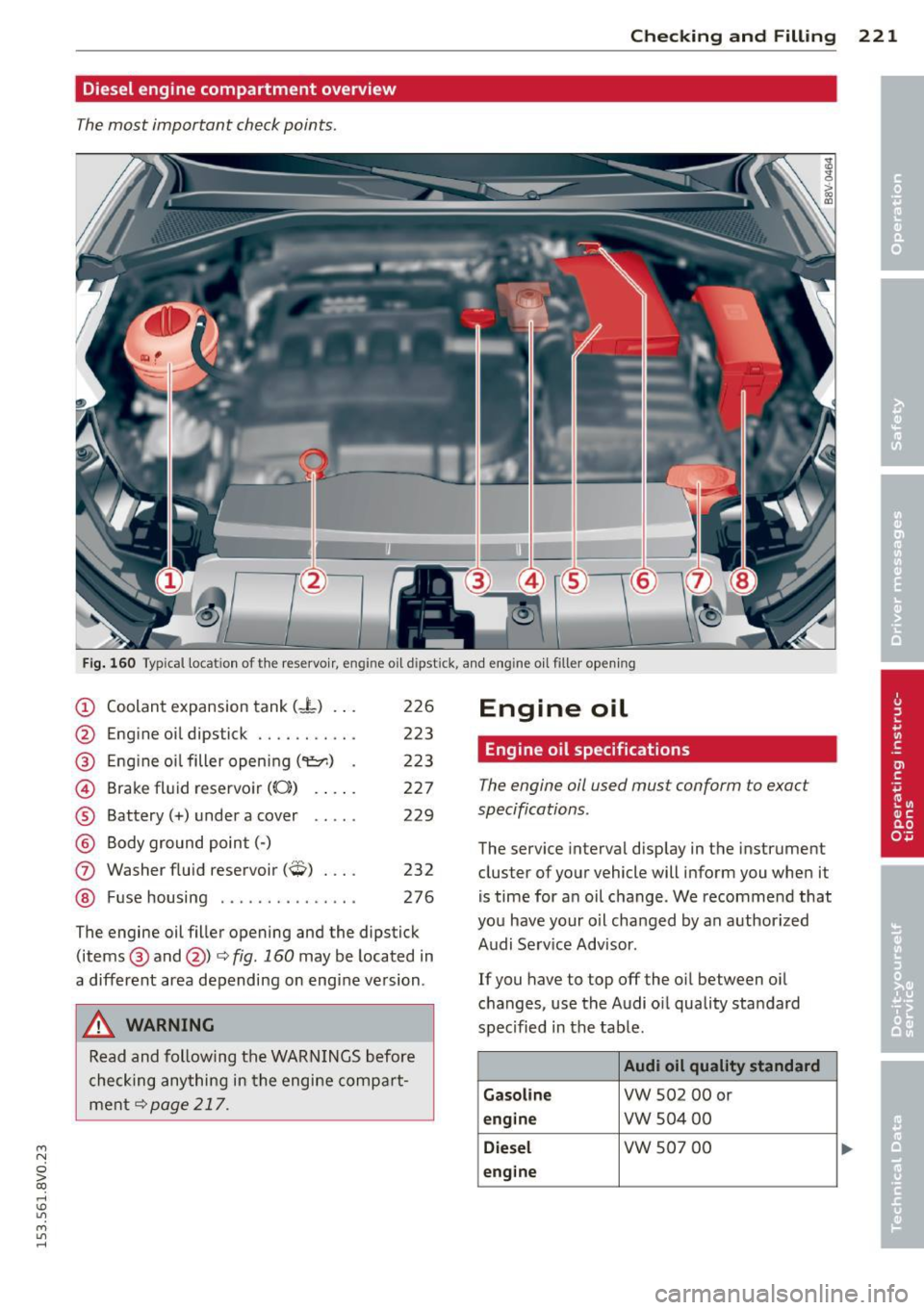
Diesel engine compartment overview
The most important check points .
Fig. 160 Typical locat ion of th e reservo ir, engine oil dip stick, and engine oil filler opening
(D Coolant expansion tank (J-) .. .
@
®
©
®
®
0
®
Eng ine oi l dipstick .......... .
E ng ine o il filler opening
('!=r.) .
Brake fluid reservoir ((0))
Battery(+) under a cover .....
B ody ground point(-)
Washer f luid reservoir(~)
F use housing .............. .
226
223
223
227
229
232
276
The engine oil filler opening and the dipstick
(items @ and @)¢
fig. 160 may be located in
a different area depending on eng ine ve rsion .
A WARNING
Read and following the WARN INGS before
checking anything in the engine compa rt
ment
¢page 217.
Engine oil
Engine oil specifications
The engine oil used must conform to exact
specifications .
The service interva l disp lay in the instrument
cluster of yo ur vehicle will inform you when it
is time for a n oil change . We recomme nd that
you have your oil changed by an author ized
Audi Se rv ice Advisor .
If you have to top off the o il between oi l
c hanges, use the Audi o il quality sta ndard
spec ified in the tab le .
Audi oil quality standard
Gasoline
VW 502 00 or
engine vw 504 00
Diesel vw 507 00
eng ine
...
Page 224 of 310
222 Check ing and F illin g
Using the proper engine o il is important for
the functionality and service life of the en
g ine. Your engine was factory-filled with a
high-quality oil which can usua lly be used
throughout the entire year.
0 Note
Your L imited New Vehicle Warranty does
not cover damage or ma lfunctions due to
fai lure to follow recommended mainte
nance and use requ irements as set forth in
the Audi Owner's Manual and Warranty
&
Ma intenance booklet.
- Use only a high quality eng ine oil that ex
pressly complies w ith the Audi o il quality
standard spec ified for your veh icle's en
gine. Using any other oil can cause seri
ous eng ine damage.
- Do not mix any lubricants o r othe r addi
tives into the eng ine o il. Doing so can
ca use engine damage.
If you need to add oi l and there is no ne
availab le tha t mee ts the Audi oil qua lity
s tandard your engine requires, yo u may
add a tota l of no more than 0 .5 quart/liter
of a high-quality "synthetic"oil that meets
the following specifications.
- Vehicles with gaso line engine: ACEA A3
or API SM with a viscosity grade of
SAE 0W-30, SAE SW-30 or SAE SW-40.
- Vehicles with diesel engine: ACEA C3 or
API CF with a v iscosity grade of
SAE 0W-30 or SAE SW-30.
- For more information abo ut eng ine oil
that has been approved for your vehicle, please contact either your a uthorized
Audi dealer or Audi Customer Relations
at 1 (800) 822-2834 or visit our web site
at www.audiusa .com or
www.aud icanada.ca.
Engine oil consumption
The engine in your vehicle depends on on ade
quate amount of oil to lubricate and cool all
of its moving ports .
In order to provide effective lubricat ion and
cooling of interna l eng ine components, all in
ternal combust ion e ngines consume a certain
amount of oil. Oil consumpt ion va ries from
engi ne to engine and may change sig nifican tly
over the life of the engine. Typically, engines
with a spec ified break -in period (see
¢ page 197) consume more oil during the
break-in period than they cons ume after oi l
consumption has stabilized.
U nder normal cond itions, the rate o f oi l con
s u mption depends on the q uality and viscos ity
of the oil, the RPM (revolutions per minute) at
which the engine is operated, the ambient
temperature and road conditions. Further fac
tors are the amount of oil dilut ion from water
condensation or fue l residue a nd the oxida
t ion level of the oil. As any eng ine is subject to
wea r as m ileage builds up, t he oil co nsump
t ion may increase over time until replacemen t
of worn components may be come necessary.
With a ll these variab les coming into play, no
standard rate of oil consumpt io n can be es
tabl ished o r spe cified . There i s no alte rnative
to regu lar and frequent che ck ing of the o il lev
el , see
Note.
If the yellow engine oil leve l wa rning symbo l
Ill in the inst rument cl uste r lights up, you
sho uld check the oil leve l as soon as possib le
i=> page 223 . Top off the oil at your earliest
convenience
i=> page 223 .
A WARNING
--
Before you check anything in the engine
compartment, always read and heed a ll
WARNINGS¢ page 217.
(D Note
Driving wit h an insufficient o il level is like -
l y to cause severe damage to the engine.
liJJ,
Page 226 of 310
224 Check ing and F illin g
• Unscrew the engine oil fi ller opening cap
~ ¢ fig. 163, ¢page 220, fig . 159.
• Carefu lly add 0 .5 quart (0.5 liter) of the ap
propr iate oil¢
page 221.
• Check the oil level again after two minutes
¢ page 223, Checking the engine oil level.
• Add o il, if necessary .
• Close the engine oil filler cap and push the
dipstick all the way in.
.&_ WARNING
- When add ing o il, do not le t oi l dr ip onto
hot engine components . There could be
risk of a fire .
- You must sec ure the cap on the oil filler
opening correctly so that oil does not
leak out onto the hot engine and exhaust
system when the engine is running, be
cause this is a fire hazard.
- Always clean skin thoroughly if it comes
into contact w ith eng ine oil.
([) Note
- Applies to vehicles with gasoline en
gines: The oil level cannot be above the
(!) range¢
page 223, fig. 161, because
th is can ca use damage to the cata lytic
converter or the engine. Contact your au
thorized Audi dealer or qua lified repair
facil ity to have excess o il extracted if
necessary.
-Applies to vehicles with diesel engines: The oil level must not be in the
0 range
¢
page 223, fig. 162 -The oil must not
be extracted, because this can damage
the engine. Drive to an au thorized A udi
dealer or authorized A udi Service Facility
immediately.
- Do not mix any additiona l lubricants into
the engine o il. Damage cause by such ad
ditives is not covered by the war ranty.
@) For the sake of the environment
- Oil should never enter the sewer system
or come into contact with the ground .
- Pay a tte ntion to leg al req uirements
when disposing of empty oil containers .
Changing the engine oil
We recommend that have your oil changed by
an authorized Audi dealer or a qualified serv
ice station.
Before you check anyth ing in the engine com
partment,
always read and h eed all WARN
INGS
¢ page 217.
The engine oil must be changed according to
the interva ls specified in your Warranty
&
Maintenance booklet . This is very important
because the lubricat ing propert ies of o il di
min ish g radually du ring normal vehicle use.
Under some circumstances the engine oil
should be changed more frequently. Change o il more often if you drive mostly short d is
tances, operate the ve hicle in dusty a reas or
under p redo min ant ly stop-and-go traffic con
di tions, or have yo ur vehicle where tempera
tures remain below freezing for extended pe
riods .
De te rgent additives in the oil will make fresh
o il look dark after the engine has been run
ning for a sho rt time. This is normal and is not
a reason to change the oil more often than
recommended.
Beca use of the p roblem of proper disposal,
along wi th the specia l tools and necessary ex
pertise req uired, we st rongly recommend that
you have your oil changed by an a uthorized
Audi deale r or a qualified service station.
If you choo se to chan ge your oil your self ,
please note the fo llowing important informa
tion:
.&_ WARNING
To reduce the risk of personal in jury if you
must change the eng ine oil in your vehicle
yourself:
- Wear eye protect ion.
- To reduce the risk of burns from hot en-
g ine oi l, let the engine cool down to the
touch.
- When removing the o il drain p lug with
your fingers, stay as far away as possible. ..,
Page 228 of 310
226 Checking and Fill in g
- Do not add any type of radiator leak sea l
ant to your ve hicle's engine coolant.
Adding rad iator repair fluid may adverse
ly affect the function and performance of
your cooling system and could result in damage not covered by your New Vehicle
Limited Warranty.
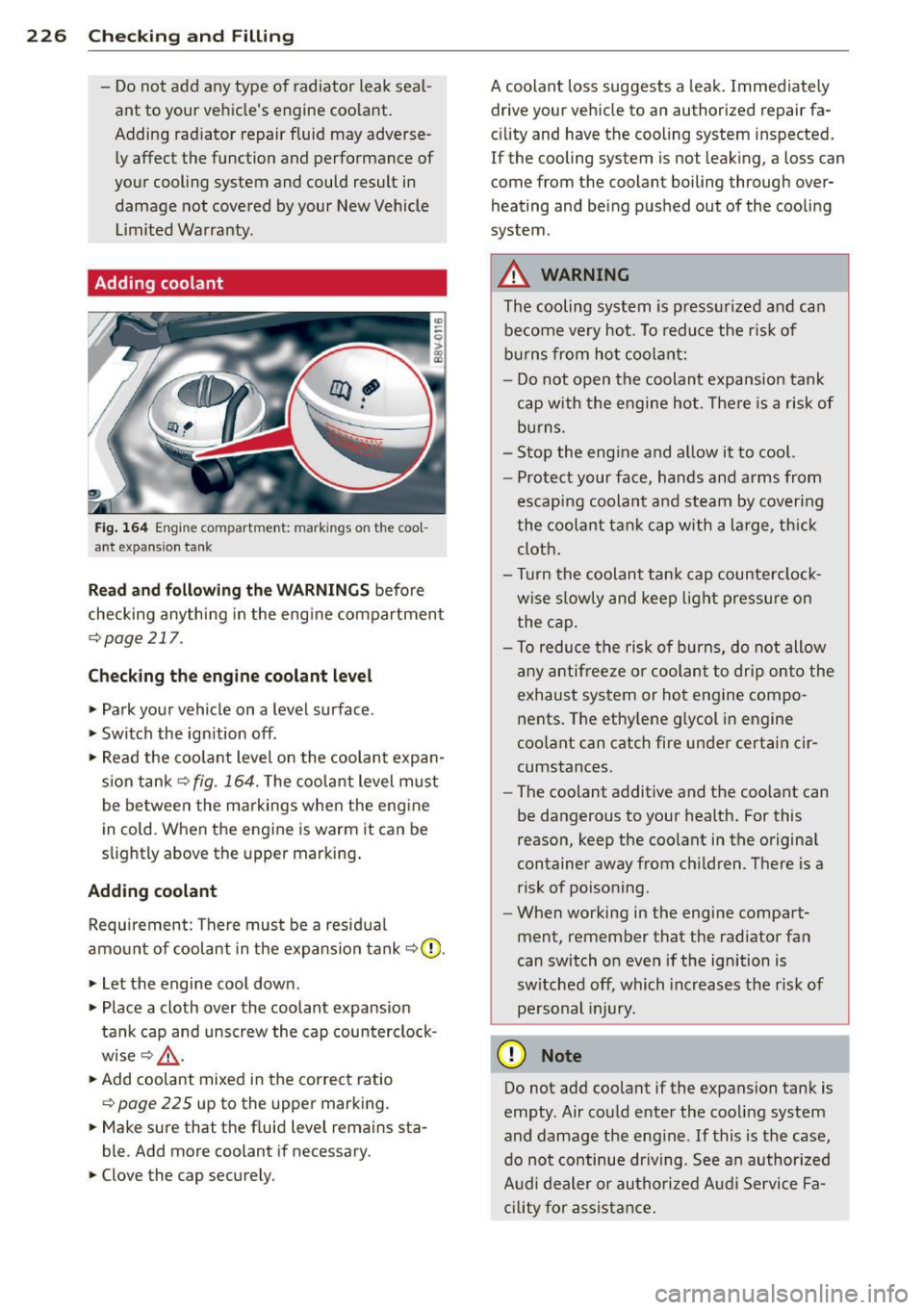
Adding coolant
Fig . 164 Engine co mpa rtment: mark in gs on the coo l
ant expans ion tank
R ea d a nd f ollow ing th e W ARNING S before
checking anything in the eng ine compartment
¢ page 217.
Ch eck ing t he e ngi ne coolant level
"Park your vehicle on a level surface .
.. Switch the ign ition off .
" Read the coo lant level on the coolant expan
s ion tank ¢
fig. 164. The coo lant level must
be between the markings when the eng ine
in cold. When the engine is warm it can be
sl ightly above the upper marking .
Adding coolan t
Requirement : There must be a residual
amount of coolant in the expansion tank ¢(D .
.. Let the engine cool down.
" Place a cloth over the coolant expansion
tank cap and unscrew the cap counterclock
wise ¢&_ .
.. Add coolant mixed in the correct ratio
¢ page 225 up to the upper marking.
.. Make sure that the fluid level remains sta
ble. Add more coolant if necessary.
" Clove the cap securely. A coolant loss suggests a
leak. Immediately
drive your vehicle to an authorized repair fa
c ility and have the cooling system inspected.
If the cooling system is not leaking, a loss can
come from the coolant boiling through over
heating and being pushed out of the cooling
system.
A WARNING
The cooling system is press urized and can
become very hot. To reduce the r isk of
b urns from hot coolant:
- Do not open the coolant expansion tank
cap with the engine ho t. T here is a risk of
burns.
- Stop the eng ine and a llow it to cool.
- Protect your face, hands and arms from
escaping coolant and steam by covering
the coolant tan k cap with a large, th ick
cloth.
- Turn the coolan t tank cap counterclock
wise slowly and keep light pressure on
the cap .
- To reduce the risk of burns, do not allow
any antifreeze or coolant to drip onto the
exhaust system or hot engine compo
nents. The ethy lene g lycol in engine
coo lant can catch fire under certain cir
cumstances.
- The coolant additive and the coolant can
be dangerous to your health . For this
reason, keep the coo lant in the origina l
container away from ch ildren . There is a
risk of poisoning.
- When working in the engine compart
ment, remember that the rad iator fan
can switch on even if the ignition is
sw itched off, which increases the risk of
pe rsonal injury.
(D Note
Do not add coolant if the expansion tank is
empty . Air could enter the cooling system
and damage the eng ine .
If this is the case,
do no t continue dr iving. See a n author ized
A udi dealer or authori zed Aud i Service Fa
cility for assist ance.
Page 250 of 310
248 Tires and wheels
also lead to sudden tire failure, including a blowout
and sudden deflation, caus ing loss of vehicle control.
-The driver is responsible for the correct tire pressures for
all tires on the vehicle. The
applicable pressure values
are located on a sticker on
the driver's side B-pillar.
-Only when all tires on the vehicle are filled to the cor
rect pressure, the tire pres
sure monitoring system can
work correctly.
-The use of incorrect tire
pressure values can lead to
accidents or other damage.
Therefore it is essential that
the driver observe the speci
fied tire pressure values for
the tires and the correct
pressures for the function of
the tire pressure monitoring
system.
-Always inflate tires to the recommended and correct
tire pressure before driving off.
- Driving with underinflated
tires bend more, letting
them get too hot resulting
in tread separation, sudden tire failure and loss of con
trol.
-Excessive speed and/over
loading can cause heat
build-up, sudden tire failure
and loss of control.
-If the tire pressure is too
low or too high, the tires
will wear prematurely and the vehicle will not handle
well.
-If the tire is not flat and you
do not have to change a
wheel immediately, drive at
reduced speed to the near
est service station to check
the tire pressure and add air
as required.
(D Note
Driving without valve stem
caps can cause damage to
the tire valves . To prevent
this, always make sure that
factory installed valve stem caps on all wheels are securely mounted on the valve.
@ For the sake of the environment
Underinflated tires will also
increase the fuel consump
tion .
Page 254 of 310
252 Tires and wheels
Tire service life
The service life of tires depends
on a lot of different things in
cluding proper installation and
balancing, correct tire pressure
and driving style.
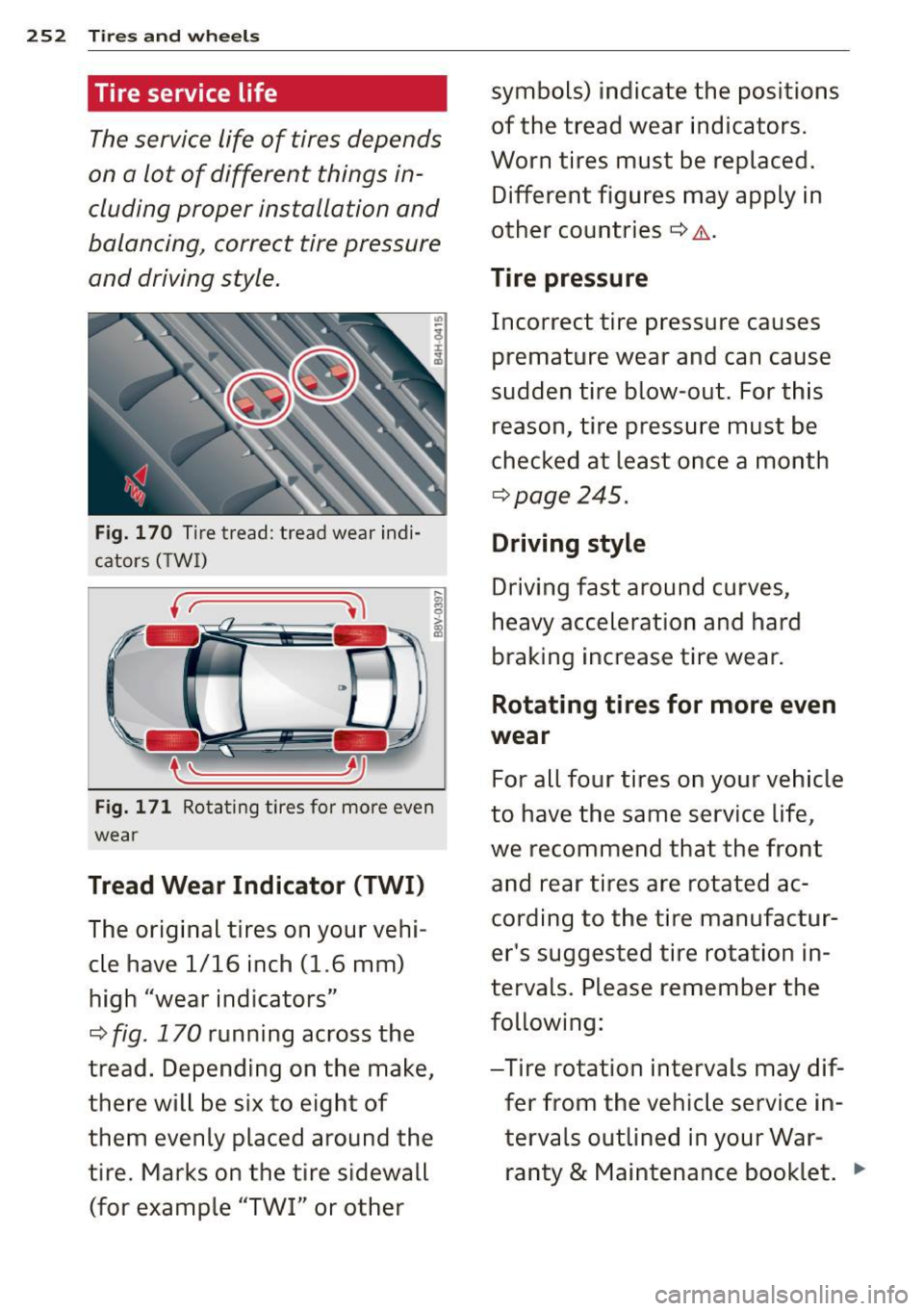
Fig. 170 Tire tread: tread wear indi
cators (TWI)
Fig. 171 Rotating tires for more even
wear
Tread Wear Indicator (TWI)
The original tires on your vehi
cle have 1/16 inch (1.6 mm)
high "wear indicators"
¢ fig. 170 running across the
tread. Depending on the make,
there will be six to eight of
them evenly placed around the
tire. Marks on the tire sidewall (for example "TWI" or other symbols)
indicate the positions
of the tread wear indicators.
Worn tires must be replaced.
Different figures may apply in
other countries
¢ ..1.. .
Tire pressure
Incorrect tire pressure causes
premature wear and can cause
sudden tire blow-out. For this
reason, tire pressure must be
checked at least once a month
¢page 245.
Driving style
Driving fast around curves,
heavy acceleration and hard
braking increase tire wear.
Rotating tires for more even
wear
For all four tires on your vehicle
to have the same service life,
we recommend that the front and rear tires are rotated ac
cording to the tire manufactur
er's suggested tire rotation in
tervals. Please remember the
following:
-Tire rotation intervals may dif
fer from the vehicle service in
tervals outlined in your War
ranty
& Maintenance booklet. ""