change wheel AUDI S3 SEDAN 2015 User Guide
[x] Cancel search | Manufacturer: AUDI, Model Year: 2015, Model line: S3 SEDAN, Model: AUDI S3 SEDAN 2015Pages: 282, PDF Size: 71.14 MB
Page 166 of 282
Airb ag syst em
entered in your Audi Warranty & Mainte
nance booklet under
AIRBAG REPLACEMENT
RECORD.
- For safety reasons in severe accidents, the
alternator and starter are separated from
the vehicle battery with a pyrotechnic circuit interrupter .
- Work on the pyrotechnic circ uit inter rupt
er must only be performed by a qualified
technicians w ho have the experience, in
formation and special tools necessary to perform the work safely.
- If the veh icle or the circuit interrupter is
scrapped, a ll applicable safety precautions
must be followed.
@ For the sake of the environment
Undep loyed airbag modu les and pretension
ers might be classified as Perchlorate Materia l
- specia l hand ling may apply, see
www.dtsc.ca.gov/hazardouswaste/perchlo rate. W hen the veh icle or parts of the re
straint system including a irbag modules and
safety belts with prete nsioners are scrapped ,
all applicable laws and regulat ions must be
observed. Your authorized A udi dealer is fa
m iliar with the se requirements a nd we recom
mend that you have your dealer perform this
service for yo u.
Other things that can affect Advanced
Airbag performance
Changing the vehicle's suspension system ca n
change the way that the Advanced A irbag System
performs in a crash. For example, using t ire- rim
combinat ions not approved by Audi, lower ing the
ve hicl e, chang ing the stiffness of the suspension,
includ ing the spr ings, suspension s truts, shoc k
absorbers etc. can change the forces that are
measured by the a irbag sensors and sent to the
e lectronic control unit. Some suspension changes
can, for example, increase the force levels meas
ured by the sensors and make the a irbag system
deploy in c rashes in which it wou ld not deploy if
the changes had not been made. Other ki nds of
changes may reduce the force levels measured by
164
the sensors and p revent the airbag from dep loy
ing when it shou ld .
A WARNING
Changing the vehicle's suspension including
use of unapproved tire-rim combinations can
change Advanced Airbag performance and in
crease the risk of serious personal injury in a
crash.
- Never install suspension components that
do not have the same performance charac
ter istics as the components origina lly instal
led on you r vehicle.
- Never use tire-rim combinations that have
not been approved by Audi.
Knee airbags
Description of knee airbag s
Applies to vehicles: with knee airbags
The knee airbag system can provide supplemen
tal protection to properly restrained front seat
occupants .
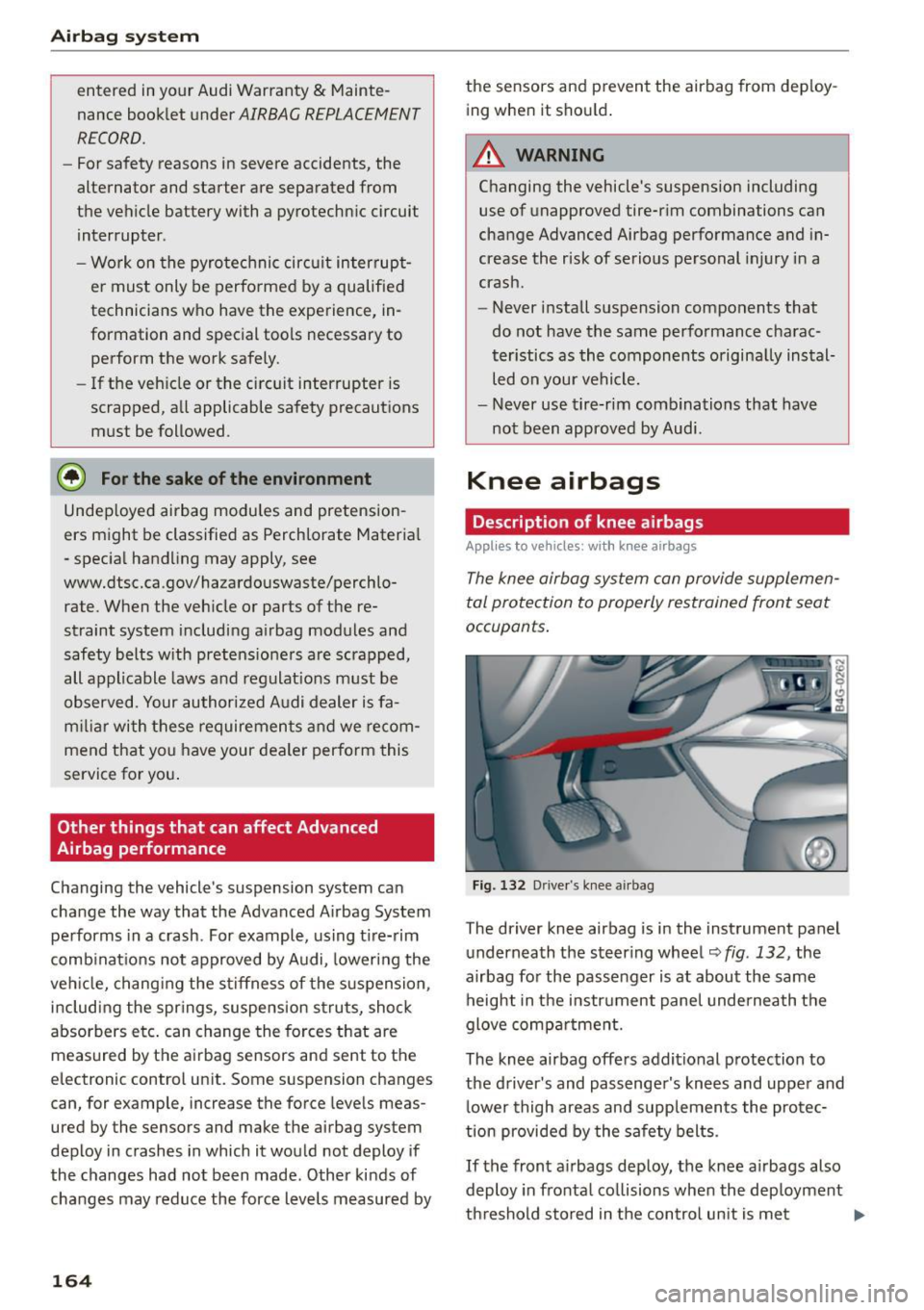
Fig. 132 Driver 's knee a irbag
The driver knee airbag is i n the instrument panel
u nderneath the steer ing wheel ~
fig. 132 , the
airbag fo r the passenger is at abou t the same
height in the i nstr ument panel underneath the
glove comp artment.
The knee airbag offers additional protection to
the d river's and passenge r's kn ees and uppe r and
lower thigh areas and supplements the protec
tion provided by the safety belts.
If the front a irbags deploy, the knee a irbags also
deploy in fronta l co llisions when the dep loyment
th reshold stored in the con trol un it is met
II>-
Page 176 of 282
Child safety
Advanced front airbag system and children
Your vehicle is equipped with a front "Advanced
Airbag System" in compliance with United States Federal Motor Vehicle Safety Standard (FMVSS)
208 as applicable at the time your vehicle was
manufactured.
The Advanced Airbag system in your vehicle has
been certified to meet the "low-risk" require
ments for 3- and 6-year old children on the pas
senger side and small adults on the driver side.
The low risk deployment criteria are intended to
reduce the risk of injury through interaction with
the airbag that can occur, for example, by being
too close to the steering wheel and instrument panel when the airbag inflates. In addition, the
system has been certified to comply with the
"suppression " requirements of the Safety Stand
ard, to turn off the front airbag for infants up to
12 months who are restrained on the front pas
senger seat in child restraints that are listed in
the Standard.
Even though your vehicle is equipped with an Ad
vanced Airbag system, all children, especially
those 12 years and younger, should always ride in
the back seat properly restrained for their age
and size. The airbag on the passenger side makes
the front seat a potentially dangerous place for a
child to ride. The front seat is not the safest place
for a child in a forward-facing child safety seat .
It
can be a very dangerous place for an infant or a
larger child in a rearward-facing seat .
The vehicle's Advanced Airbag System has a ca
pacitive passenger detection system in the front
passenger seat cushion that can detect the pres
ence of a baby or a child in a child restraint sys
tem on this seat.
The capacitive passenger detection system regis
ters the changes that result in an electrical field
when a child, a child restraint, and a baby blanket
are on the front passenger seat. The change in
the measured capacitance due to the presence of
a child, a child restraint, and a baby blanket on
the front passenger seat is related to the child re
straint system resting on the seat. The measured
capacitance of a child restraint system varies de-
174 pending
on the type of system and specific make
and model.
The electrical capacitance of the various types, makes, and models of child restraints specified
by the U.S.National Highway Traffic Safety Ad
ministration (NHTSA) in the relevant safety
standard are stored in the Advanced Airbag Sys
tem control unit together with the capacitances
typical of infants and a 1-year old child. When a
child restraint is used on the front passenger seat
with a typical 1 year-old infant, the Advanced Air
bag System compares the capacitance measured
by the capacitive passenger detection system
with the data stored in the electronic control
unit.
Child restraints and Advanced front airbag
system
Regardless of the child restraint that you use,
make sure that it has been certified to meet Unit
ed States Federal Motor Vehicle Safety Standards
and has been certified by its manufacturer for
use with an airbag. Always be sure that the child
restraint is properly installed at one of the rear
seating positions. If in exceptional circumstances
you must use it on the front passenger seat, care
fully read all of the information on child safety
and Advanced Airbags and heed all of the appli cable WARNINGS. Make certain that the child
and child restraint are correctly recognized by the
capacitive passenger detection system in the
front passenger seat, that the front passenger airbag is turned off, and that the airbag status is
always correctly signaled by the
PASSENGER AIR
BAG OFF
light .
Many types and models of child restraints have
been available over the years, new models are in
troduced regularly incorporating new and im
proved designs and older models are taken out of
production. Child restraints are not standardized.
Child restraints of the same type typically have
different weights and sizes and different "foot
prints", the size and shape of the bottom of the
child restraint that sits on the seat, when they
are installed on a vehicle seat . These differences
make it virtually impossible to certify compliance
with the requirements for advanced airbags with ..,.
Page 221 of 282
"XL" "xl" "EXTRA LOAD" or "RF" , , ,
on the sidewall.
Rim
means a metal support for a tire
or a tire and tube assembly upon
which the tire beads are seated.
Rim di ameter
means nominal diameter of the
bead seat. If you change your
wheel size, you will have to pur
chase new tires to match the new rim diameter .
Rim size de signation
means rim diameter and width.
Rim width
means nominal distance between
rim flanges.
Side wall
means that portion of a tire be
tween the tread and bead.
Speed rating (letter code )
means the speed at which a t ire is
designed to be driven for extend
ed periods of time . The ratings
range from 93 mph ( 150 km/h)
to 186 mph (298 km/h)¢
table
on page 215.
You may not find
this information on all tires be
cause it is not required by law .
Tires and wheels
The speed rating letter code,
where applicable, is molded on
the tire sidewall and indicates the
maximum permissible road
speeds
¢ .& in Winter tires on
page 229 .
Tire pressure mon itoring
system *
means a system that detects
when one or more of a vehicle's
tires are underinflated and illumi
nates a low tire pressure warning
telltale .
Tread
means that portion of a tire that
comes into contact with the road .
Tread separation
means pulling away of the tread
from the tire carcass .
Treadwear indicators (TWI )
means the projections w ithin the
principal grooves designed to give
a visual indication of the degrees of wear of the tread. See
¢ page 223, Treadwear indicator
for more information on measur
ing tire wear .
219
...
Page 227 of 282
-Overloading can lead to loss of
vehicle control and increase the risk of an accident. Read
and follow the important
safety precautions in
¢ page 22 7, Tires and vehicle
load limits.
-The tire must flex more if the
tire pressure is too low or if the vehicle speed or load are
too high. This heats the tire up
too much. This increases the risk of an accident because it
can cause the tire to burst and result in loss of vehicle con
trol.
-Incorrect tire pressure increas
es tire wear and has a negative
Tire pressure table
Please note that the information
contained in the following table
was correct at the time of print ing, and the information is sub
ject to change. If there are differ ences between this information
and the tire pressures specified on the label on the driver's side B
pillar, always follow the specifica
tion on the B-pillar label
¢ page 224, fig. 170.
Tires and wheels
effect on driving and braking
behavior, which increases the
risk of an accident.
Replace lost valve caps to re
duce the risk of damage to the
tire valves .
@ For the sake of the environment
Tire pressure that is too low in
creases fuel consumption.
(1) Tips
Audi recommends using the
tire pressure specified for a normal load
¢ table on page 226
or for a full load when the vehi
cle is partially loaded.
Make sure that the tire designa
tion on your tire matches the des ignation on the tire pressure label
and the tire pressure table .
The following table lists recom mended tire pressures in cold
tires according to the load and
the size of the tires installed.
225
Page 235 of 282
....,
N
0 > co
rl I.O
"'
"'
"'
rl
If the Tire Pressure Monitoring System
indicator appears
Applies to vehicles: with t ire p ressure monitoring syste m
The tire pressure indicator in the instrument
cluster informs you if the tire pressure is too low
or if there is a system malfunction.
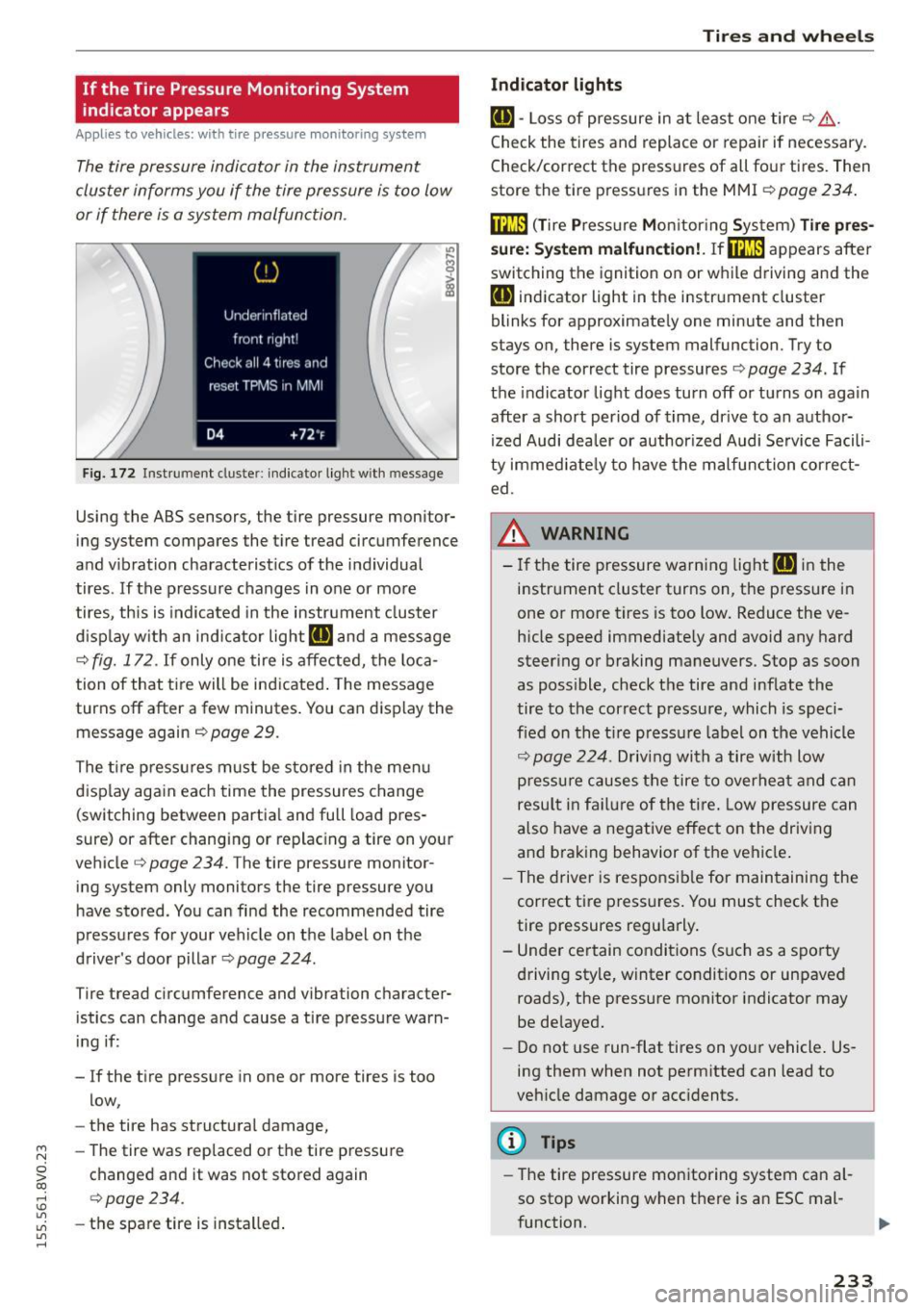
F ig. 172 Instrument cluster: in dicator light w ith message
Using the ABS sensors, the tire pressure monitor
ing system compares the tire tread circumference
and v ibration characterist ics of the ind ividual
tires.
If the pressure changes in one or mo re
tires, th is is indicated in the instrument cluster
d isp lay w ith an ind icator light
RE and a message
¢
fig. 172. If only o ne tire is affected, the loca
tion of that ti re will be indicated . The message
turns off after a few minutes . You can display the
message again
r::;,page 29.
The tire p ressu res m ust be stored in the menu
disp lay aga in each time the pressures change
(switching between partia l and full load pres
sure) or after changing or replac ing a tire on your
ve hicle¢
page 234. The tire pressure monitor
ing system only monitors the tire pressure you
have stored. You can find the recommended tire
pressures for your vehicle on the label on the
driver's door pillar¢
page 224.
Tire tread circumference and vibration character
istics can change and cause a tire pressure warn
in g if:
- If the tire pressure in one or more tires is too
low,
- the tire has structural damage,
- The tire was replaced or the tire pressure
changed and it was not stored again
¢ page 234.
-the spare tire is insta lled .
Tires and wheels
Indicator lights
RE -Loss of pressure in a t least one tire ¢ ,&.
Check the tires and replace or repair if necessary.
Check/correct the pressures of all four t ires. Then
store the tire p ressu res in the MMI ¢
page 234.
film (T ire Pressure Mon itor ing Sys tem) Tire pres
s ure: Sy stem malfunction!. If@m
appears after
switching the ignition on or while driving and the
RE ind icator light in the instr ument cluster
blinks for approximate ly one minute and then
stays on, there is system malfunction. Try to
store the correct tire pressures ¢
page 234. If
the indicator light does turn off or turns on aga in
after a short period of time, dr ive to an author
i zed Audi dea ler or author ized Audi Serv ice Facili
ty immed iate ly to have the malfunction corre ct
ed.
,&. WARNING
- If the tire pressure warning light RE in the
i n str ument cluster turns on, the pressure in
one or more tires is too low . Reduce the ve
h icle speed immediate ly and avoid any hard
steer ing or braking maneuvers. Stop as soon
as poss ible, check the tire and inf late the
tire to the correct pressure, which is speci
fied on the t ire p ress ure label on the vehicle
r::;, page 224. Driv ing with a tire with Low
p ressu re causes the tire to overhea t and c an
resul t in fa il ur e of the tire . Low pressure can
a lso have a negative effect on the driving
and b rak ing behavior of t he vehicle .
- T he drive r is respons ib le for main taining the
correct ti re press ures . You must check the
tire pressures regu larly .
- Under certain conditions (such as a sporty
driving style, winter conditions or unpaved
roads), the pressure monitor indicator may
be de layed.
- Do not use run-flat tires on yo ur vehicle . Us
ing them when not permitted can lead to
veh icle damage or acc idents.
(D Tips
- The tire pressure monitoring system can al
so stop working when t here is an ESC mal-
function. ..,.
233
Page 236 of 282
Tires and wheel s
-Using snow chains may result in a system
malfunction.
- The t ires wi th the ident ificat ion "AO" or
"RO"¢
page 221 have been matche d with
your A udi tire pressure monitoring system.
We recommend that you use these t ires.
- The tire pressure monitoring system can on
l y mon itor the ti re p ress ure of the dr iv ing
tires. Check the tire pressure of the spare
whee l in the luggage compartment so that
i f necessary it is ready for use.
Storing tire pressures
Applies to vehicles: w ith tire pressure monitoring system
A change in tire pressure or a change in tires
must be stored in the system .
The tire p ressu re is stored in the MMI.
.., Make sure befo re stori ng th at t he tire pressures
of all fo ur t ires meet the specified va lues and
are adapted to the load . Otherwise the system
cou ld ma lf u nction
¢ page 224 .
.., Switc h on the ignition .
.,. Se lect : the IMENU! button> Car> Systems *
control button > Service & control > Tire pres
sure monitor > Stor e tire pressure > Yes, store
now .
(]} Tips
Do not store the t ire press ures if snow cha ins
are i nstalled . Otherwise the system could
malf unct io n.
234
Page 243 of 282
....,
N
0 > co
rl I.O
"'
"'
"'
rl
Equipment
Vehicle tool kit
Applies to vehicles: with vehicle tool kit
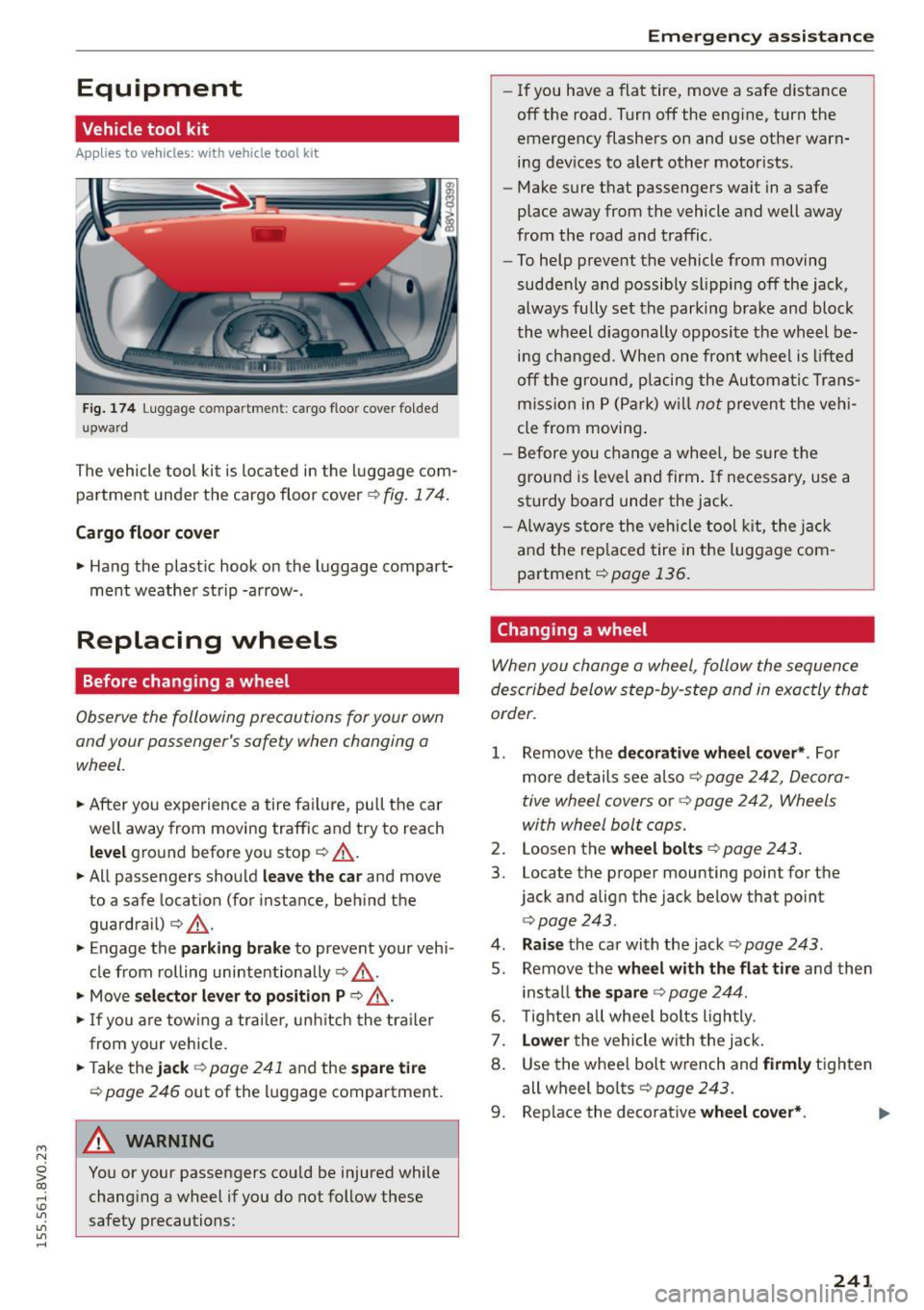
Fig. 174 Luggage co mpa rtmen t: ca rgo floo r cover folded
up ward
The vehicle tool kit is located in the luggage com
partment under the cargo floor cove r
r::!;> fig. 174.
Cargo floor cover
• Hang the plastic hook on the luggage compart
ment weather strip -arrow- .
Replacing wheels
Before changing a wheel
Observe the following precautions for your own
and your passenger's safety when changing a
wheel.
• After you experience a tire fa ilure, pu ll the car
well away from moving traffic and try to reach
le vel ground before you stop r::!;> _A .
• All passengers should leav e the ca r and move
to a safe location (for instance, beh ind the
guardrail) c:>
_A.
• Engage the parking b ra ke to prevent your vehi
cle from rolling unintentionally c:> ,& .
• Move
se le cto r le ver to p osition P c:> ,& .
• If you are tow ing a tra iler, unh itch the tra iler
from your vehicle.
• Take the
jack c:> pag e 241 and the sp ar e tire
c:> page 246 out of the l uggage compartment .
A WARNING
You or your passengers cou ld be injured while
chang ing a wheel if you do not follow these
safety precautions:
Em erg en cy ass is tan ce
-If you have a flat tire, move a safe d istance
off the road. Turn off the eng ine, turn the
emergency flashers on and use other warn
ing dev ices to alert other motor ists .
- Make sure that passengers wait in a safe
place away from the vehicle and well away
from the road and traffic.
- To help prevent the vehicle from moving
suddenly and possibly slipping
off the jack,
always fully set the parking brake and block
the wheel diagonally opposite the wheel be ing changed . When one front wheel is lifted
off the g round, placing the Automatic Trans
miss ion in P (Pa rk) w ill
not prevent the veh i
cle from moving .
- B efore you change a wheel, be sure the
ground is level and firm . If necessary, use a
sturdy board under the jack.
- Always s tore the veh icle tool kit, t he jack
a nd the rep laced tire in the luggage com
partment
r::!;> page 136.
Changing a wheel
When you change a wheel, follow the sequence
described below step-by -step and in exactly that
order.
1. Remove the dec orative whe el co ve r*. For
more details see also
c:> page 242, Decora
tive wheel covers
or c:> page 242, Wheels
with wheel bolt caps .
2. Loosen the wheel bolts r::!;>page 243.
3. Locate the proper mounting point for the
jack and align the jack below that point
r::!;> page 243.
4. Rai se the car with the jack~ page 243 .
5. Remove the wheel wit h th e fla t tir e and then
i ns tall
th e s pare c:> page 244.
6. Tighte n all whee l bolts lightly.
7.
L o wer the vehicle with the jack.
8 . Use the wheel bolt wrench and
firml y tighten
all wheel bo lts
c:> page 243.
9. Replace the decorative w hee l co ve r* . ..,.
241
Page 244 of 282
Emergency assistance
_& WARNING
Always read and follow all WARNINGS and in
formation
c:> & in Raising the vehicle on
page 244
and c:> page 245.
After changing a wheel
A wheel change is not complete without the do
ing the following .
.. Always store the vehicle tool kit, the jack* and
the replaced tire in the luggage compartment
c:> page 136 .
.. Check the tire pressure on the spare wheel im
med iate ly after mounting it .
.. As soon as possible, have the
tightening tor
ques
on all wheel bolts checked with a torque
wrench. The correct tightening torque is 90 ft
lb
(120 Nm) .
.. Have the flat tire
replaced as soon as possible.
@ Tips
-If you notice that the wheel bolts are cor
roded and difficult to turn while changing a
tire, they should be replaced before you
check the tightening torque.
- Drive at reduced speed until you have the
tightening torques checked.
- After changing a wheel, the tire pressure in
all four tires must be checked/corrected and
the tire pressure mon itoring indicator must
be stored in the MMI
c:> page 234.
Decorative wheel covers
Applies to vehicles: with decorative wheel covers
The decorative wheel covers must be removed
first to access the wheel bolts .
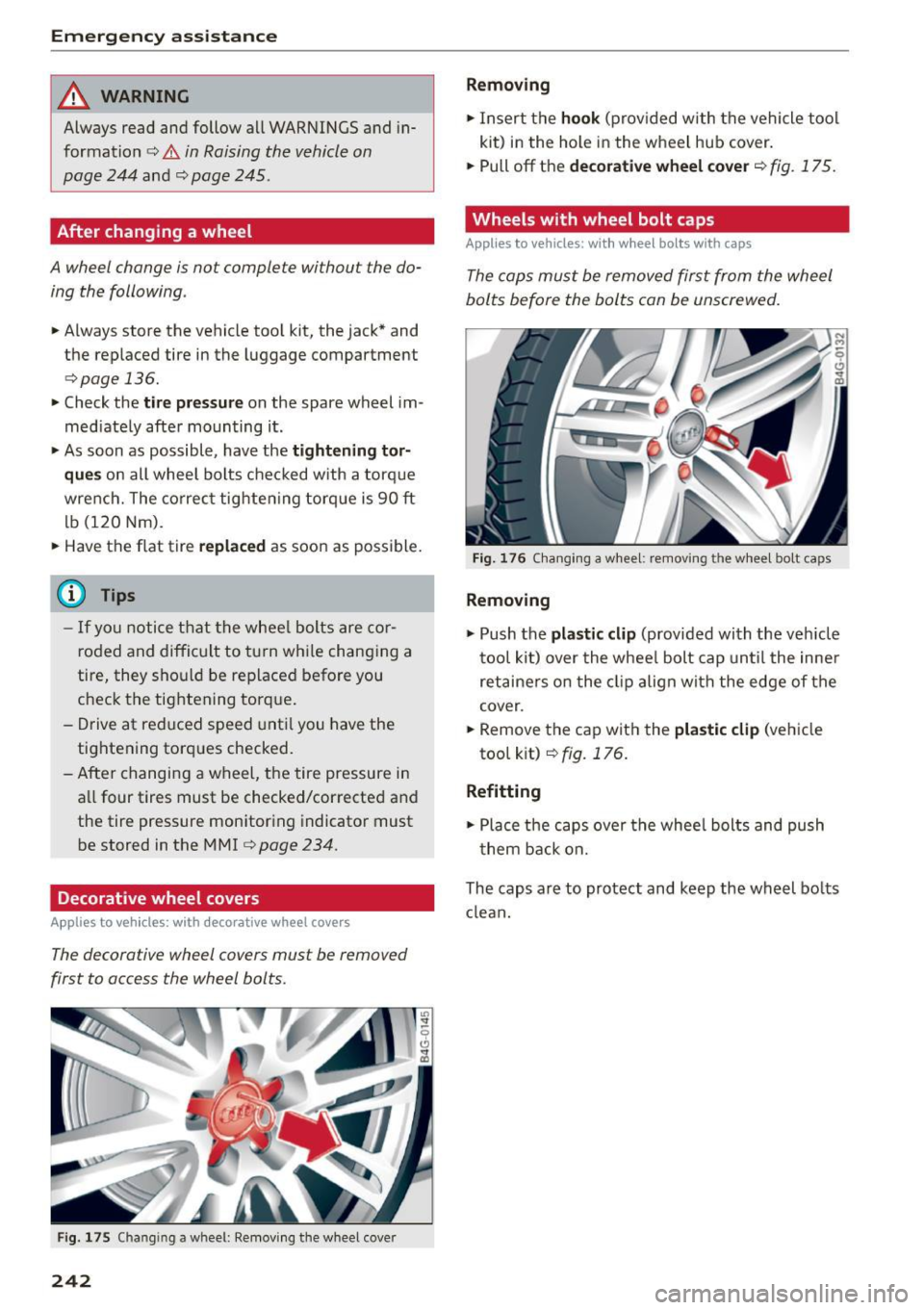
Fig. 175 Chan gin g a w hee l: Removing the wheel cover
242
Removing
.. Insert the hook (provided with the vehicle tool
kit) in the hole in the wheel hub cover.
.. Pull off the
decorative wheel cover c:> fig. 175.
Wheels with wheel bolt caps
Applies to vehicles: with wheel bolts with caps
The cops must be removed first from the wheel
bolts before the bolts con be unscrewed .
Fig. 176 Changing a wheel: removing th e whee l b olt caps
Removing
.. Push the plastic clip (provided with the veh icle
tool kit) over the wheel bolt cap until the inner
retaine rs on the clip align with the edge of the
cover .
.. Remove the cap with the
plastic clip (vehicle
tool k it)
c:> fig. 176.
Refitting
.. Place the caps over the wheel bolts and push
them back on.
The caps are to protect and keep the wheel bolts
clean.
Page 245 of 282
....,
N
0 > co
rl I.O
"'
"'
"'
rl
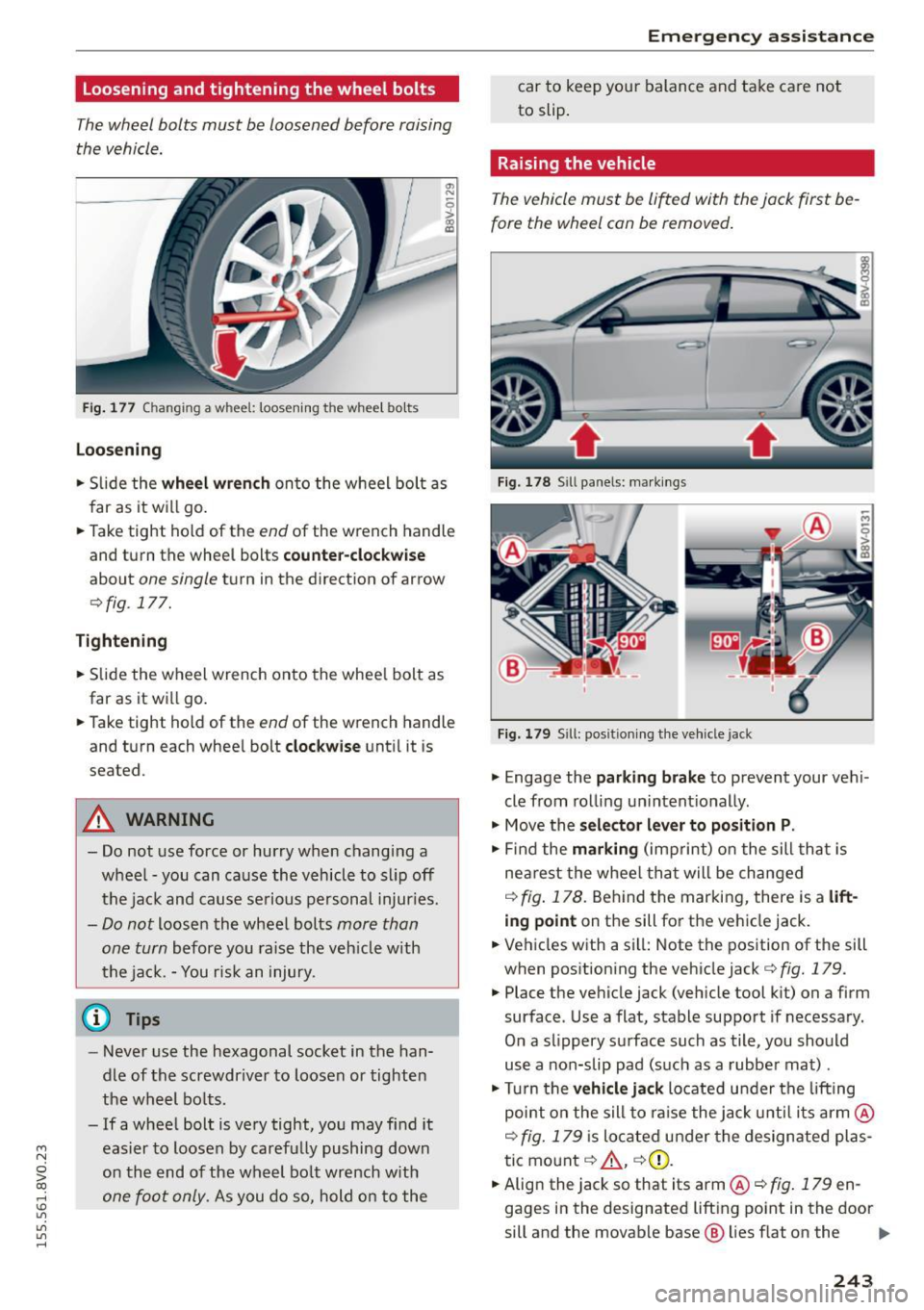
Loosening and tightening the wheel bolts
The wheel bolts must be loosened before raising
the vehicle.
Fig . 177 Changing a wheel: loosening the whee l bo lts
Loosening
... Slid e the wheel wren ch onto the wheel bolt as
far as it will go .
... Take tight hold of the
end of the wrench handle
and turn the wheel bolts
counter-clockwise
about one single turn in the direction of arrow
r:=>fig. 177.
Tightening
... Slide the wheel wrench onto the whee l bolt as
far as it will go .
... Take tight hold of the
end of the wrench handle
and turn each whee l bolt
clockwise until it is
seated.
A WARNING
- Do not use force or hurry when changing a
wheel -you can ca use the vehicle to sl ip off
the jack and cause serious personal injuries.
-Do not loose n the wheel bolts more than
one turn
before you raise the vehicle with
the jack. -You risk an injury.
(D Tips
-Never use the hexagonal socket in the han
dle of the screwdriver to loosen or tighten
the wheel bolts.
- If a whee l bolt is very tight, you may find it
easier to loosen by carefully pushing down
on the end of the wheel bolt wrench with
one foot only . As you do so, hold on to the
Emergen cy assistance
car to keep your balance and take ca re not
to slip .
Raising the vehicle
The vehicle must be lifted with the jack first be
fore the wheel can be removed .
Fig. 178 Sill panels: marking s
Fig. 179 Sill: pos itio ning the vehicle jack
... Engage the parking brake to prevent your vehi
cle from rolling unintent ionally .
... Move the
selector lever to position P .
... Find the marking (imprint) on the sill that is
nea rest the wheel that will be changed
q fig. 178. Behind the marking, there is a lift
ing point on the sill for the vehicle jack.
... Vehicles with a si ll: Note the position of the sill
when position ing the vehicle jack
q fig. 179.
... Place the vehicle jack (vehicle tool k it) on a firm
surface. Use a flat, stable support if necessary.
On a slippery surface such as tile, you should
use a non-slip pad (such as a rubber mat) .
... Turn the
vehicle jack located under the lifting
point on the sill to ra is e the jack u ntil its arm@
Q fig. 179 is located under the designated plas
tic mount
q .&., q(j) _
... Align the jack so that its arm @ c:::> fig. 179 en
gages in the designated lifting point in the door
sill and the movable base @ lies flat on the ..,.
243
Page 246 of 282
Eme rge ncy ass ista nce
ground. The base @ must be vertical under the
lifting point @.
.. Wind the jack up further until the flat tire
comes off the ground
c> .&_.
Position the vehicle jack onl y under the designat
ed lifting points on the sill
c> fig. 178. There is ex
actly
one location for each wheel. The jack must
not be positioned at any other location
c> &c>Q) .
An uns table s urfac e under the jack can cause the
vehicle to slip off the jack. Always provide a firm
base for the jack on the ground . If necessary
place a sturdy board or similar support under the
jack. On
har d, sli ppery su rfaces (such as tiles)
use a rubber mat or similar to prevent the jack
from slipping
c> & .
A WARNING
-
-You or your passengers could be injured
wh ile chang ing a wheel if you do not follow
these safety precautions:
- Position the vehicle jack only at the desig
nated lifting points and align the jack.
Otherwise, the vehicle jack could slip and
cause an injury if it does not have suff i
cient hold on the vehicle.
-A soft or unstable surface under the jack may cause the vehicle to slip off the jack.
Always provide a firm base for the jack on
the ground. If necessa ry, use a sturdy
board under the jack.
- On ha rd, slippery surface (such as tiles)
use a rubber mat o r similar to prevent the
jack from slipping .
- On ly raise your vehicle with the vehicle
jack provided by the factory . If you use a
vehicle jack for another vehicle, your vehi
cle can slide and cause injury.
- Changes in temperature or load can affec t
the height o f the vehicle .
- Never start the engine when the vehicle is
raised, which could cause an accident.
- Support the vehicle securely with appro
priate stands if work is to be performed
underneath the vehicle; otherwise, there
is a potentia l risk for injury .
244
-To help prevent injury to yourself and your
passengers :
- Do not ra ise the vehicle until you are su re
the jack is securely engaged.
- Passengers must not remain in the veh icle
when it is jacked up.
- Make sure that passengers wait in a safe place away from the veh icle and we ll away
from the road and traffic.
- Make sure jack position is correct, adjust
as necessary and then continue to raise
the jack.
- Changes in temperature or load can affect
the height of the vehicle.
(D Note
Do not lift the vehicle by the sill. Position the
vehicle jack only at the des ignated lifting
po ints on the sill. Otherwise, your vehicle will
be damaged.
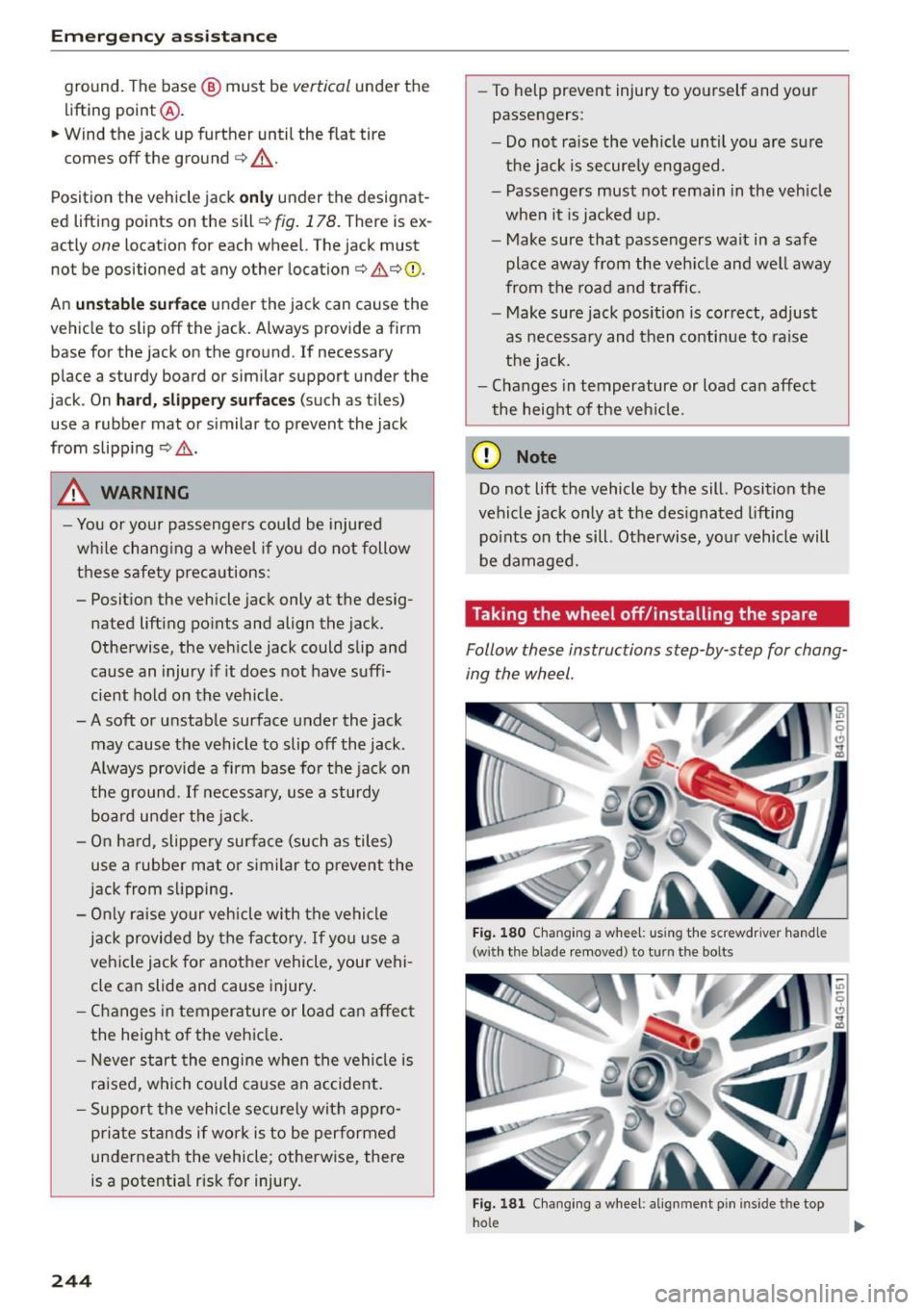
Taking the wheel off /installing the spare
Follow these instructions step-by-step for chang
ing the wheel.
Fig. 180 Chang ing a whee l: us ing the screwdriver hand le
(w ith the blade removed) to turn the bolts
Fig. 181 Changing a w heel: alignment pin inside the top
hole