fuel cap AUDI S3 SEDAN 2015 Owners Manual
[x] Cancel search | Manufacturer: AUDI, Model Year: 2015, Model line: S3 SEDAN, Model: AUDI S3 SEDAN 2015Pages: 282, PDF Size: 71.14 MB
Page 14 of 282
Instruments and indicator lights
reached the reserve mark, the bottom LED will
turn red and the
ljJ indicator light turns on
¢
page 23. The bottom LED blinks red when
the fuel level is very low.
The on-board computer shows the range based
on the fuel level¢
page 28, On-board comput
er display.
For the tank capacity in your vehicle, refer to the
Technical Data
¢ page 260.
(D Note
Never drive until the tank is completely emp
ty. The irregular supply of fuel that results
from that can cause engine misfires. Uncom
busted fuel will then enter the exhaust sys
tem. This can cause overheating and damage
to the catalytic converter.
Coolant temperature indicator
In vehicles without a coolant temperature indica
tor, an indicator light. will turn on when the
coolant temperature is too high ¢
page 19. Re
fer to ¢(1) .
The coolant temperature indicator @c:>
page 10,
fig . 3 only works when the ignition is switched
on . To prevent engine damage, please observe
the following notes about the temperature rang
es.
Cold range
If only the LEDs at the bottom of the gauge turn
on, the engine has not reached operating tem perature yet. Avoid high engine speeds, full accel
erating and heavy engine loads.
Normal range
The engine has reached its operating tempera
ture once the LEDs up to the center of the gauge
turn on under normal driving conditions . The
LEDs higher up may turn on if the engine is under
heavy load or the outside temperature is high.
This is no cause for concern as long as the. in
dicator light in the instrument cluster does not
turn on.
12
Hot range
If the LEDs in the upper area of the display and
the . indicator light in the instrument cluster
display turn on, the coolant temperature is too
high
c:> page 19 .
A WARNING
-Never open the hood if you can see or hear
steam or coolant escaping from the engine
compartment. This increases the risk of
burns. Wait until you no longer see or hear
steam or coolant escaping.
- The engine compartment in any vehicle can
be a dangerous area . Stop the engine and al
low it to cool before working in the engine
compartment. Always follow the informa
tion found in ¢
page 198, Working in the
engine compartment.
(D Note
- In vehicles with a boost pressure indicator* ,
this indicator replaces the temperature dis
play. To promote a long engine service life,
avoiding high engine speeds, full accelera
tion and heavy engine loads during approxi
mately the first 15 minutes when the en
gine is cold is recommended . The amount of
time until the engine is warm depends on
the outside temperature . Check the engine
oil temperature* if necessary .
c:> page 30
-Auxiliary headlights and other accessories in
front of the cooling-air intake impair the
cooling effect of the coolant. This increases
the risk of the engine overheating during
high outside temperatures and heavy engine
load.
- The front spoiler also helps to distribute
cooling air correctly while driving. If the
spoiler is damaged, the cooling effect will
be impaired and the risk of the engine over
heating will increase. See an authorized
Audi dealer or authorized Audi Service Fa
cility for assistance.
Page 27 of 282
....,
N
0 > co
rl I.O
"'
"'
"'
rl
continue to turn the lights on and off using the
light switch. You can still contro l all wiper func
tions that are independent of the rain sensor .
Drive to an autho rized Aud i dea le r or authorized
Audi Service Facility immediate ly to have the
malfunction corrected.
; Adaptive dampers
Applies to vehicles: with Audi drive select
R Suspension: system fault!
There is an adaptive damper ma lfunction.
D rive to an authorized Aud i dea ler or a uthorized
Aud i Service Facility immediate ly to have the
malfunction corrected.
¢¢Turn signals
If the B or DI indicator light blinks, a turn sig
na l is turned on. If both indicator lig hts are blink
ing, the emergency flashers are on.
I n an indicator light blinks twice as fast as usual
then a blinker bulb has failed. Carefully drive to
your authorized Audi dealer immed iate ly to have
the ma lfunction corrected.
(D Tips
For more information on the turn signals, re
fer to
q page 45.
On-Board Diagnostic
system (OBD)
System indicator light (MIL)
The system indicator light (MIL) ¢4 in the instru
ment cluster is part of the On Board Diagnostic
System (OBD II).
The warning/indicator light turns on when the ig nition is switched on and turns off once the en
gine is started and is running in idle at a stab le
speed. Th is ind icates that the MIL is funct ion ing
correctly .
If the light does not turn off after starting the
engine
or turns on while driving, this may indi
cate there is a ma lfunction in the engine. If the
Instruments and indicator lights
indicator turns on, the cata lytic conve rter may be
damaged.
Drive
with reduced engine performance (avoid
high speeds for extended per iods of time and/or
f ast acceleration) and have the malfunction cor
rected . See an authorized Audi dealer or author
ized Audi Serv ice Facility.
T he indicator may turn on if the e lectronic speed
limiter is faulty. For add itiona l information, refer
to
¢ page 94, Electronic speed limiter*.
The MIL may also turn on if the fuel filler cap is
not closed correctly ¢
page 192.
On-Board Diagnostics
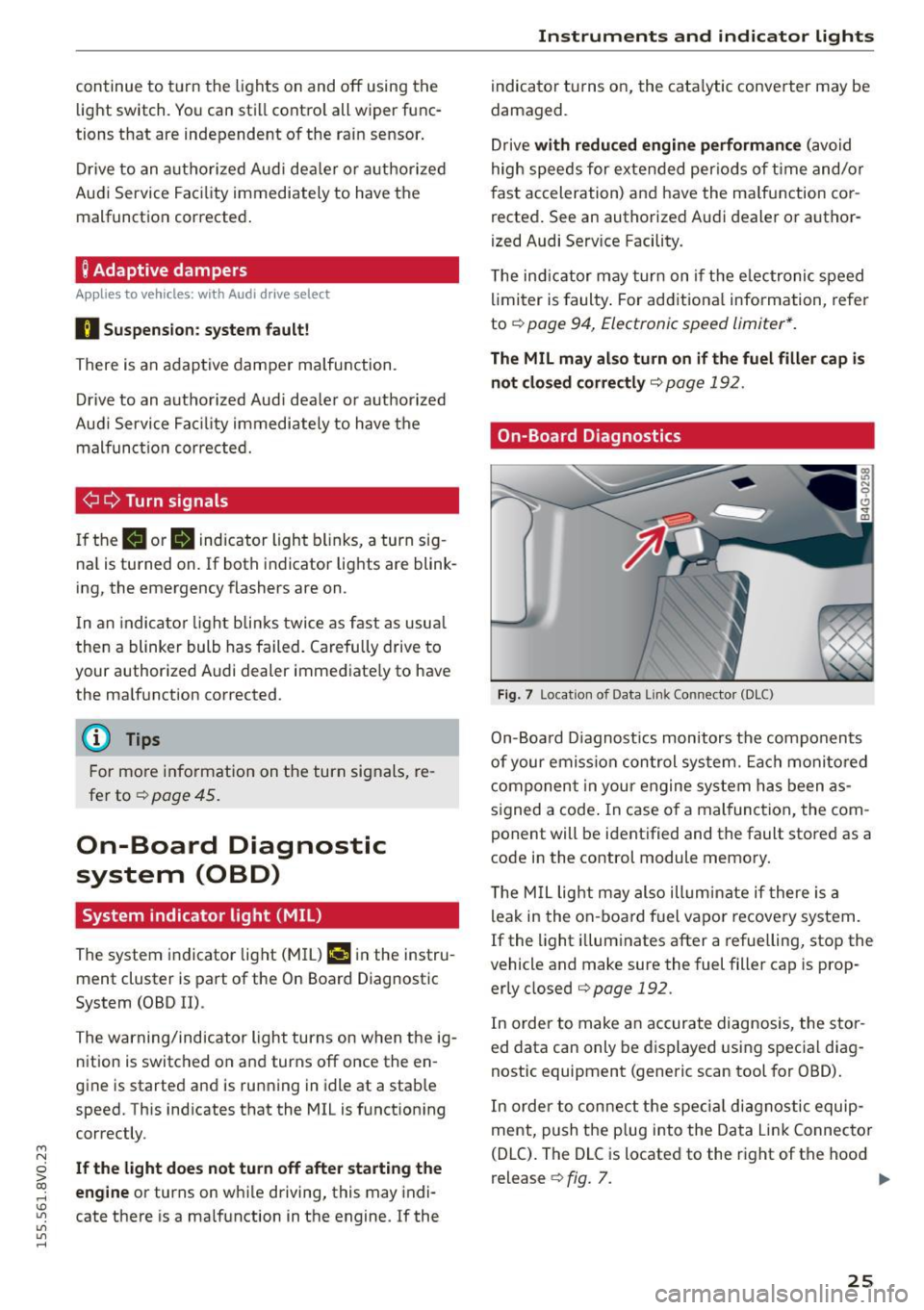
Fig. 7 Location of Data Link Connector (DLC)
On-Board Diagnostics monitors the components
of your emission control system. Each monitored
component in your engine system has been as
s igned a code . In case of a mal function, the com
ponent will be identified and the fault stored as a
code in the control module memory.
T he M IL light may also illuminate if there is a
leak in the on-board fuel vapor recove ry system.
If the light illuminates after a refuelling, stop the
vehicle and make sure the fuel filler cap is prop
erly closed
qpage 192.
In order to make an accurate diagnosis, the stor
ed data can only be displayed using special diag
nostic equipment (generic scan tool for OBD).
In order to connect the special diagnostic equip
ment, push the plug into the Data Link Connector
(DLC). The DLC is located to the right of the hood
release
¢ fig. 7. ..,.
25
Page 65 of 282
M N
0 > co ,...., \!) ..,.,
..,.,
..,., ,....,
tightened. If necessary, retighten the mountings and check the entire system
from t ime to t ime.
- After mounting a roof rack system, or when
you transport objects on the roof of your ve
hicle, the height of the veh icle is naturally
increased. Be careful when driving under
l ow bridges or in parking garages for exam
ple. This could cause damage to the load
and even the vehicle itself.
- Make sure the open rear lid and the sun
roof* do not come into contact with the roof
rac k.
Loading the roof rack
Always distribute loads evenly . Make sure any
thing on the roof rack is securely tied down .
... Always distribute the loads on the roof rack
evenly .
... Always attach items to the roof rack securely
before you d rive off .
The maximum perm iss ible roof weight is
165 lb
( 75 kg ). The roof weight is the total of the
weight of the roof rack, the attachments and the
cargo you a re ca rrying . You must also not exceed
the maximum load weight fo r the roof rack you
a re using.
When using a roof rack system wh ich has a lower
l oad carrying capacity, you must not use up the
tota l maxim um permissible load car ry ing capac i
ty specified above. Inste ad , you shou ld load t he
roof rack system only to the maximum capacity
specified by the manufact urer of the roof rack
system .
A WARNING
Weak, damaged or improper straps used to
secure items to the roof rack can fa il during
hard brak ing or in a collision and cause seri
ous personal injury.
- Make sure the roof rack is insta lled exactly
as spec ified above
¢ page 62.
- Always use suitable mounting straps for se
curing items to the roof rack to help prevent
items from shift ing or f ly ing fo rward.
-
S eat s and stor age
- Items on the roof rac k must always be se
curely mounted.
- The use of a roof rack can negatively affect
the way a vehicle handles. Cargo that is
large, heavy, bulky, long or flat will have a
greater negative inf luence on the vehicle's
ae rodynamics, center of gravity and overall
h a ndling. Always drive slowly, avoid sudden
b rak ing and maneuvers when transpor ting
cargo on the roof of your veh icle.
- Never exceed the maxim um permissible
load carrying capacity of the roof of your ve
h icle, the permiss ible axle weights and the
perm issib le tota l we igh t of your vehicle
¢ page 258, Weights .
@ For the sake of the environment
As a result of the increased wind resistance
created by a roof ra ck , your vehicle is using
fuel unnecessarily. So remove the roof rac k af
ter using it.
63
Page 194 of 282
Checking and Fill in g
These fuels contain substances that can se
verely damage the fuel system and the en
gine if the engine is started .
- If the diesel f uel quality is poor, it may be
necessary to have the water d rained from
the water separator in the
fuel filter more
often than specified in the maintenance
schedule. This can help reduce engine ma l
funct ions
c:> page 2 3.
Refueling
Fuel filler neck
The fuel filler neck is located on the right rear
side pane l behind the fuel f iller flap.
If the power locking sys tem should fail, you can
still open the flap manua lly -for detai led instruc
tions see
c:> page 194.
You can find the fue l tank capacity of you r vehicle
in
c:> page 260.
The label on the inside of the fue l filler flap te lls
you t he cor rect fuel for your vehicle. For more in
form ation abo ut fue l specifications, see
c:> page 190 .
Your vehicle fuel tank has an on board refue lling
vapor re cove ry system . This feature helps to p re
ve nt fuel vapors from escaping from the tank and
pollut ing t he environment w hile you refue l yo ur
ve hicle. In orde r to fill the tank p roperly whi le
protecting the environment, please follow this
refueling procedure carefully.
A WARNING
Under normal operating conditions, never ca r
ry additional fuel containers in your car . Gas
canisters and ot her conta iners used to trans
port fuel can be dangerous . Such contai ners,
full or empty, may leak and could cause a fire
in a collision. If yo u m ust t ransport fue l to
use fo r yo ur l awn m owe r, snow b lower, etc.,
be very ca re ful and a lways observe loca l and
state laws rega rding the use, transportation
and sto rage of such fuel containe rs . Make cer
tain the container meets industry standards (ANSI/ASTM F852 - 86).
192
(D Note
Never drive your vehicle until the fue l tank is
complete ly empty . The irregular supply of
f u el can cause misfiring. Gasoline could enter
the exhaust system and damage the catalytic converter.
Fueling procedure
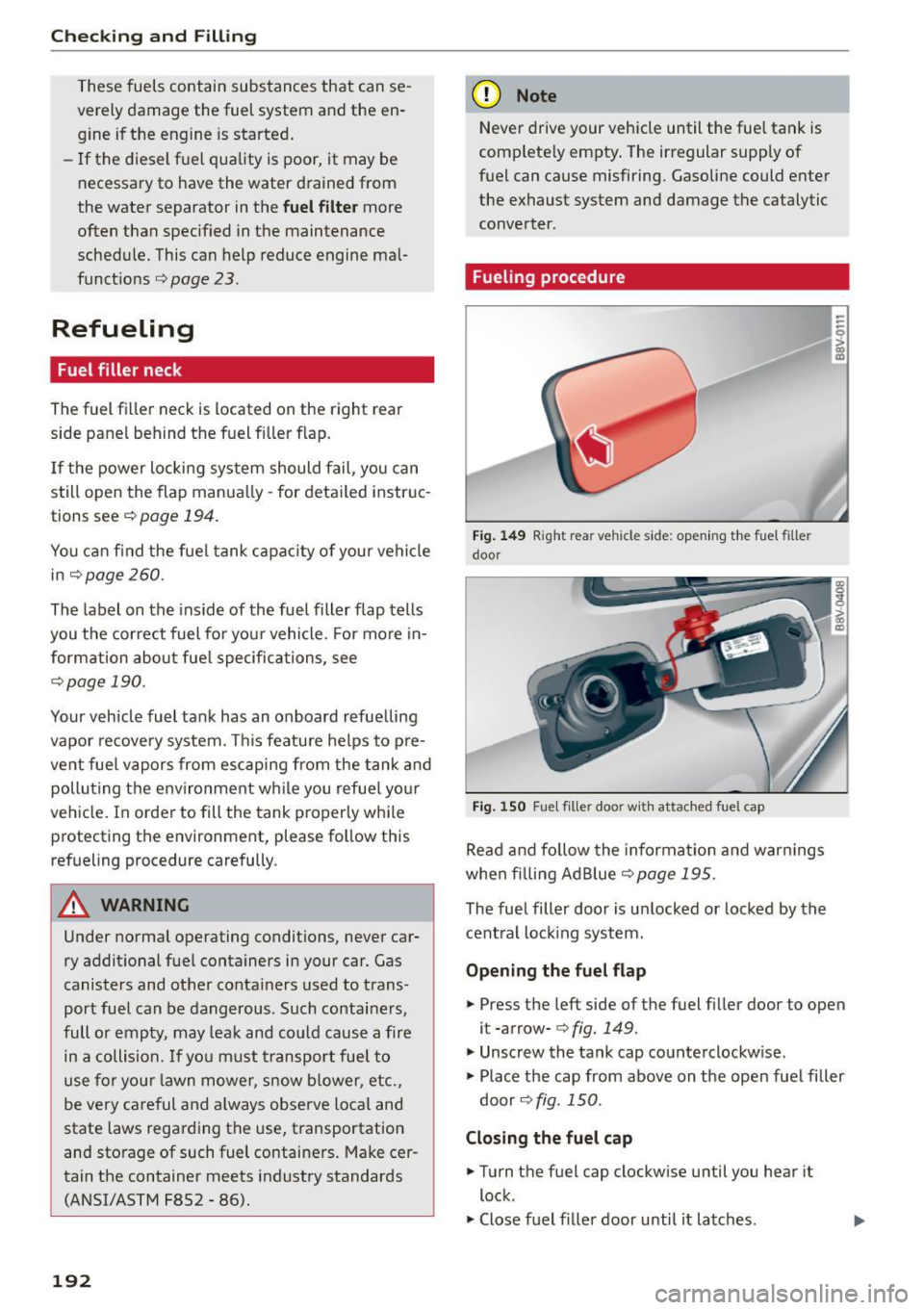
F ig . 149 Righ t rea r ve hicle s ide: open ing t he fuel filler
door
Fi g. 15 0 Fuel fill er doo r wit h attac hed fuel cap
Re ad a nd fo llow the informa tion and war ning s
whe n filling AdB lue
c:> page 195 .
The fuel filler doo r is u nlocked or locked by the
cent ral lock ing system.
Opening the fuel flap
--0 ~
ffl
.,.. Press the left side of the fuel f iller door to open
it -arrow-
c:> fig. 149 .
.,.. Unscrew the tank cap counterclockw ise .
.,.. Place the cap from above on the open fue l filler
door
c:> fig . 150.
Closing the fuel cap
.,.. Turn the f uel cap clockwise until you hear it
lock .
.,.. Close fuel fi ller door until it latches.
Page 195 of 282
M N
0 > co ,...., \!) 1.1'1
1.1'1
1.1'1
,....,
Once the pump nozzle switches off, the fuel tank is "full". Do not fill the tank more. Otherwise the
expansion space in the tank will be filled.
The correct fuel type for your vehicle can be
found on a label located on the inside of the fuel
filler door. For additional information on fuel , re
fer to ¢
page 190.
The fuel tank capacity of your vehicle is in the
Technical Data ¢ page 260.
To avoid fuel spilling or evaporating from the fuel
tank always close fuel filler cap properly and
completely. An improperly closed fuel filler cap
may also cause the MIL lamp ¢
page 25 to come
on.
A WARNING
Not paying attention when fueling or han
dling fuel incorrectly can lead to fires, explo
sions or serious injuries.
- Fuel ignites easily and can cause serious burns and other injuries.
- If you do not switch the engine off when fu
eling and/or do not insert the fuel no zzle
completely into the tank opening, fuel can
leak out or run over . Leaked fuel can ignite
and start a fire.
- Do no t use the telephone while fueling. The
electromagnetic rays can cause sparks,
which can ignite fuel vapors and start a fire .
- Do not sit in your vehicle while fueling . If
you must make an exception and enter your
vehicle again while fueling , close the door
and touch metal to discharge static electric
ity before touching the fuel nozzle. Static
electricity can create sparks, which can ig
nite vapors when fueling.
- Do not smoke or have an open flame in the
area when fueling your vehicle or filling a
fuel container because this increases the
risk of an explosion.
- For your safety, carrying fuel containers in
your vehicle is not recommended. Whether
full or empty, the container can leak and
cause a fire in the event of an accident .
-If you must make an exception and trans
port a fuel container, note the following:
Checking and Filling
- Never fill the fuel container with fuel
while it is in or on the vehicle . Static elec
tricity is discharged when filling which can cause the fuel vapors to ignite and increas
es the risk of an explosion .
- Always place a fuel container on the
ground before filling .
- Always hold the fuel nozzle completely in
the fuel container when filling .
-If the fuel container is made of metal, the
fuel nozzle must always be in contact with
the container when filling it with fuel. This prevents static electricity from discharg
ing .
- Never spill fuel in the vehicle or the lug
gage compartment . Evaporated fuel is ex
plosive and increases the risk of serious in
jury or death.
- Follow legal requirements when using,
storing and transporting fuel containers .
- Make sure the fuel container conforms to
industry standards (ANSI/ASTM F852-86).
Q) Note
-Remove spilled fuel from vehicle paint im
mediately , because it can damage paint .
- Never drive until the fuel tank is completely
empty. The irregular supply of fuel that re
sults from that can cause engine misfires .
Uncombusted fuel will enter the exhaust
system and increase the risk of damage to
the catalytic converter.
- If the fuel tank runs completely empty in a
vehicle with a
diesel engine, the ignition
must remain switched on for at least 30
seconds after refueling before starting the
engine. It may take longer than usual for
the engine to start, even up to a minute.
This is because the air must first bleed out of the fuel system when starting the engine .
@ For the sake of the environment
- If
the fuel nozzle is used correctly, it will in
dicate that the tank is full the first time it
switches off automatically. Do not try to add
more fuel, because it can spill over. Also, "'
193
Page 196 of 282
Checking and Fill in g
the expansion space in the tank will fi ll,
which can result in fuel spilling out when it
becomes warm and polluting the environ
ment.
(D Tips
- If
the engine is running while fueling, va
pors can escape or the fuel can spill over.
Because of th is, the fuel nozz le switches off
before th e tank is full.
- Do not fue l the vehicle when the ignition is
switc hed on. Otherwise, the fuel gauge may
not show the correct level after fueling the
vehicle.
- Diesel vehicles are equipped with a diesel
misfueling guard
l). It allows the vehicle to
be fueled on ly w ith a diesel fuel p ump noz
zle .
- A worn o r damaged nozzle or a nozz le that
i s too sma ll may not be able to open the die
se l m isfue ling protector. If this is the case,
try turning the no zzle before inser ting it in
the fue l filler neck, use a different fuel
p ump or see an a uthorized Audi dea le r or
a uthorized Audi Service Facility for assis
tance .
- The misfueling guard does not o pen whe n
adding fue l from a fuel contai ne r. Yo u can
bypass it by adding the diese l fuel s low ly .
- The fuel filler door on your vehicle does not
l ock when you lock the vehicle from the in
side.
l l Market -spec ifi c
194
Fuel filler door emergency release
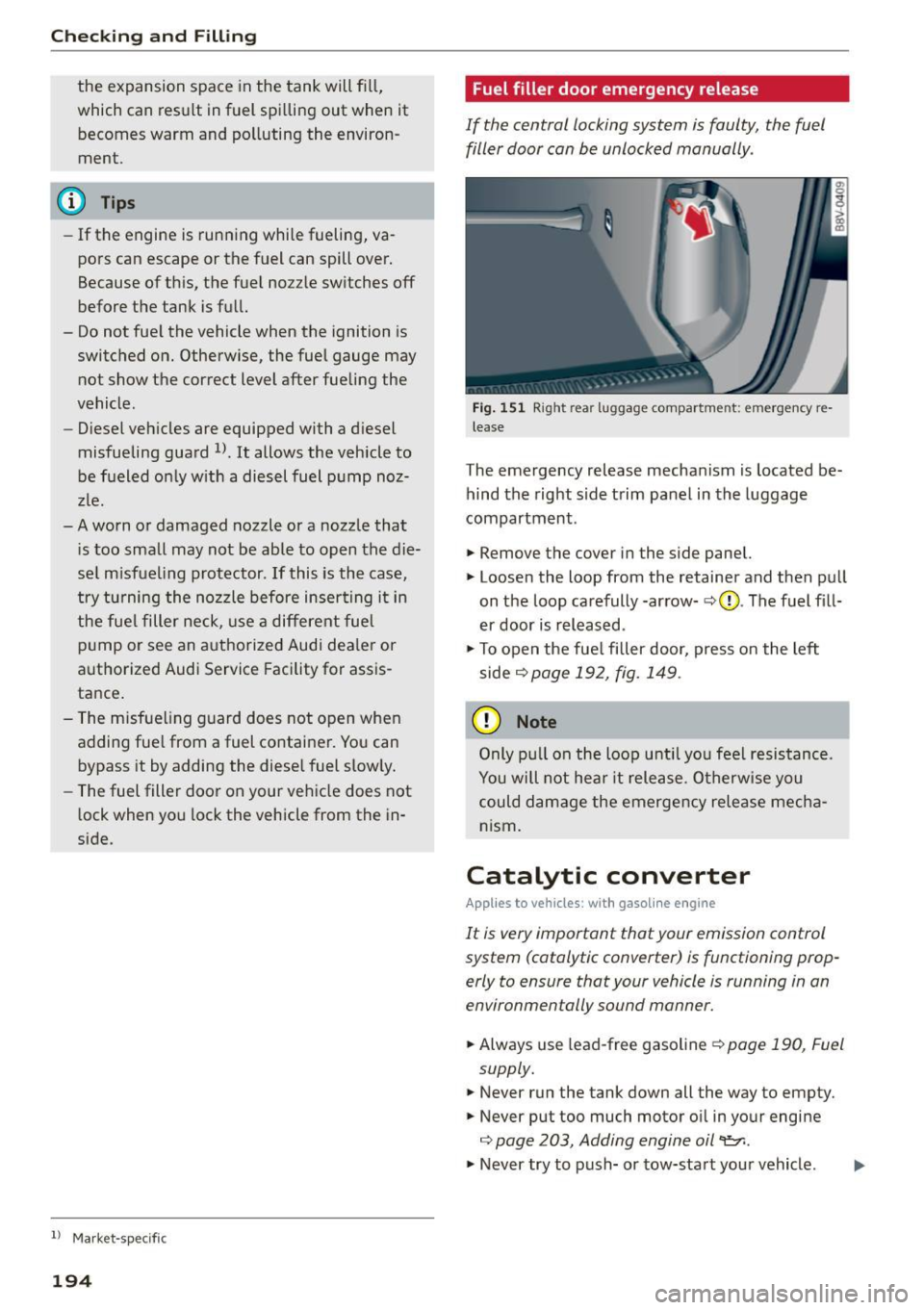
If the central locking system is faulty, the fuel
filler door can be unlocked manually .
Fig. 15 1 Rig ht rear luggage compartme nt: emergency re
lease
The emergency release mechanism is located be
hind the right side trim panel in the luggage
compartment.
.,. Remove the cover in the side panel.
.,. Loosen the loop from the retainer and then pull
on the loop ca refully-ar row-
c::> 0 . The fuel fill
er door is released .
.,. To open the fue l filler door, press o n the left
side
opage 192, fig. 149 .
(D Note
Only pull on t he loop u ntil yo u feel resistance.
You will not he ar it release. O therwise you
could damage the emergency rele ase mecha
nism.
Catalytic converter
App lies to vehicles: with gasoline e ngine
It is very important that your emission control
system (catalytic converter) is functioning prop
erly to ensure that your vehicle is running in an
environmentally sound manner .
.,. Always use lead-free gasoline c::> page 190, Fuel
supply .
.,. Never run the tank down all the way to empty .
.,. Never put too much motor o il in yo ur engine
o page 203, Adding engine oil 'l:::11 .
.,. Never try to push- or tow-sta rt you r vehicle .
Page 199 of 282
....,
N
0 > co
rl I.O
"'
"'
"'
rl
This message appears if the system has detected
that the tank was filled incorrectly or that there
is a malfunction. Drive immediately to the near
est authori zed Aud i dealer or authori zed Audi
Service Facility to have the malfunction correct
ed . Otherwise you will not be able to start the en
g in e again once you stop it.
Filling the Ad Blue
Applies to vehicles: with selective catalyt ic red uctio n
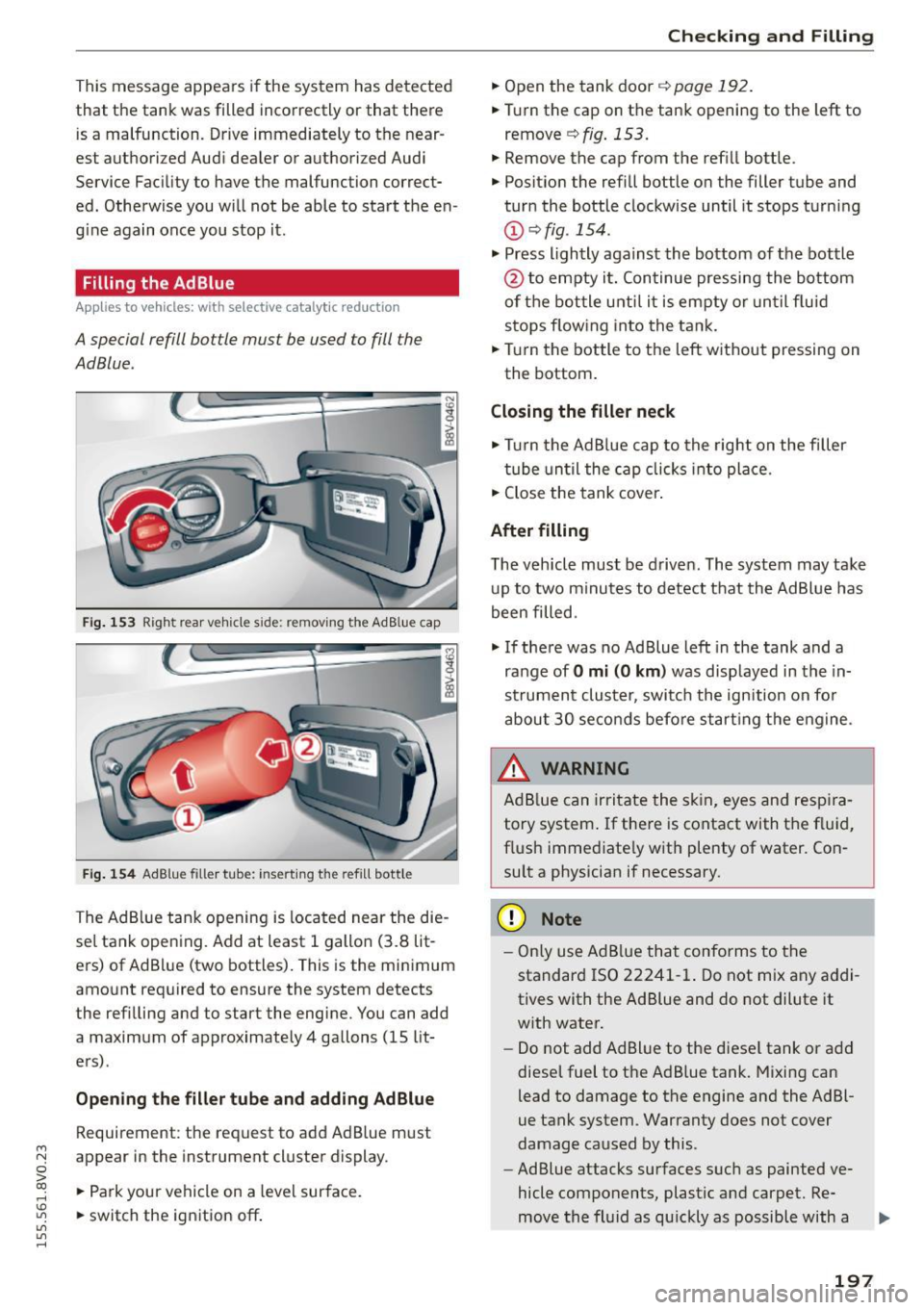
A special refill bottle must be used to fill the
AdBlue.
Fig. 153 Right rear vehicle s ide: removing the Ad B lue cap
Fig. 154 Ad Blue filler tube: inserting the refi ll bott le
The Ad Blue tank opening is located near the die
sel tank opening. Add at least 1 gallon (3.8 lit
ers) of AdBlue (two bottles). This is the minimum
amount required to ensure the system detects
the refilling and to start the engine. You can add
a maximum of approximately 4 gallons (15 lit
ers) .
Opening the filler tube and adding AdBlue
Requirement: the request to add Ad Blue must
appear in the instrument cluster display.
• Park your vehicle on a level surface.
• switch the ignition off .
Checking and Filling
• Open the tank door q page 192.
• Tur n the cap on the tank opening to the left to
remove
q fig. 153.
• Remove the cap from the refill bottle.
• Position the refill bottle on the filler tube and
turn the bottle clockwise until it stops turning
@ qfig. 154.
• Press lightly against the bottom of the bottle
@ to empty it. Con tinue pressing the bottom
of the bottle unti l it is empty or until flu id
stops flowing into the tank.
• Turn the bottle to the left without pressing on
the bottom.
Closing the filler neck
• Turn the Ad Blue cap to the right on the filler
tube until the cap clicks into place.
• Close the tank cover.
After filling
The vehicle must be driven. The system may take
up to two minutes to detect that the AdBlue has
been filled.
• If there was no Ad Blue left in the tank and a
range of
O mi (0 km ) was displayed in the in
strument cluster, switch the ignition on fo r
about 30 seconds before start ing the engine.
_& WARNING
=
Ad Blue can irritate the skin, eyes and respira-
tory system . If there is contact with the fluid,
flush immediate ly with plenty of water. Con
sult a physician if necessary.
(D Note
- Only use Ad Blue that conforms to the
standard ISO 22241-1. Do not mix any addi
tives with the Ad Blue and do not dilute it
with water.
- Do not add AdBlue to the diese l tank or add
diesel fuel to the Ad B lue tank. Mixing can
lead to damage to the engine and the Ad Bl
ue tank system. Warranty does not cover
damage caused by this .
- Ad Blue attacks surfaces such as painted ve
hicle components, plastic and carpet. Re-
move the fluid as quickly as possible with a ..,.
197
Page 205 of 282
....,
N
0 > co
rl I.O
"'
"'
"'
rl
-If you have the impression your engine con
sumes excessive amounts of oi l, we recom
mend that you consult an authorized Audi
dealer to have the cause of your concern
properly diagnosed. Keep in mind that the
accurate measurement of oil consumption
requires great care and may take some time.
An authorized Audi dealer has instr uctions
about how to measure oil consumption ac
curately.
Checking the engine oil level
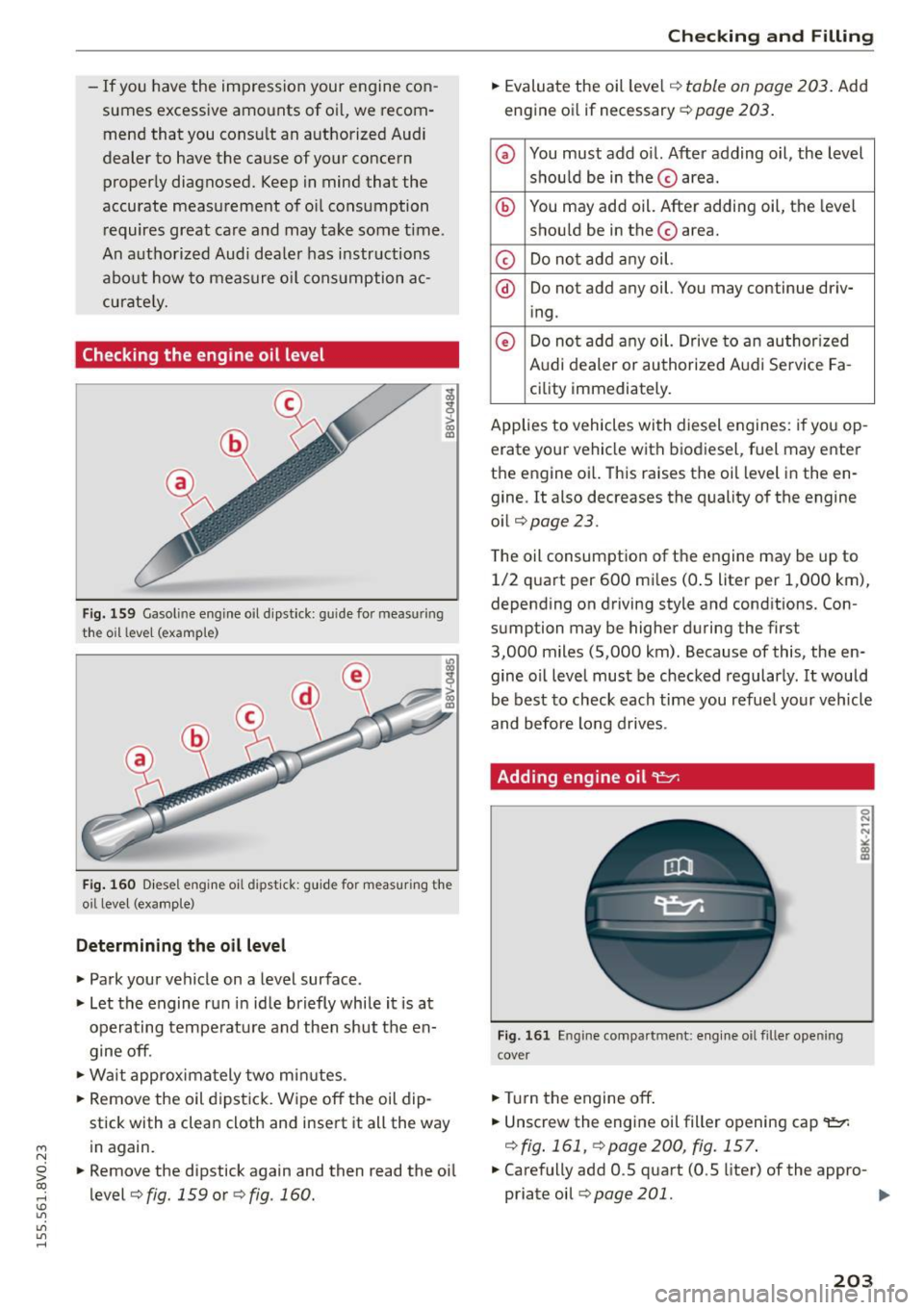
Fig. 159 Gasoline engine oil dipstick: guide for measuring
t h e oil leve l (example)
F ig . 160 Diesel engine oil dipstick : g ui de for measuring the
oil level (example)
Determining the oil level
• Park your vehicle on a level surface.
• Let the engine run in idle briefly while it is at
operating temperature and then shut the en gine off.
• Wait approximately two minutes.
• Remove the oil dipstick. Wipe off the oil dip
stick with a clean cloth and insert it all the way
in again .
• Remove the dipstick again and then read the oil
level¢
fig. 159 or ¢ fig. 160.
Checking and Filling
• Evaluate the oil leve l c;, table on page 203. Add
engine oi l if necessary
¢ page 203.
0 You must add o il. After adding oil, the level
shou ld be in the@ area.
@ You may add oil. After adding oil, the leve l
shou ld be in the@ area.
0 Do not add any oil.
@ Do not add any oil. You may continue driv-
ing.
0 Do not add any oil. Drive to an author ized
A udi dealer or authorized A udi Service Fa-
cility immediately.
Applies to vehicles with diesel engines: if you op
erate your vehicle with biodiesel, fuel may enter
the engine oil. This raises the oi l level in the en
gine. It also decreases the quality of the engine
oil ¢page23.
The oil consumption of the engine may be up to
1/2 quart per 600 mi les (0 .5 liter per 1,000 km),
depending on driving style and cond itions. Con
s umption may be higher during the first
3,000 miles (5,000 km). Because of this, the en
gine oil level must be checked regularly. It would
be best to check each time you refue l your vehicle
and before long drives.
Adding engine oil 't::7:
Fig. 161 Engine compa rtment: e ngine oil fille r opening
cover
• Tur n the engine off .
• Unscrew the engine oil filler opening cap
• Carefully add 0.5 quart (0.S liter) of the appro-
priate oil
c;, page 201. .,..
203
Page 219 of 282
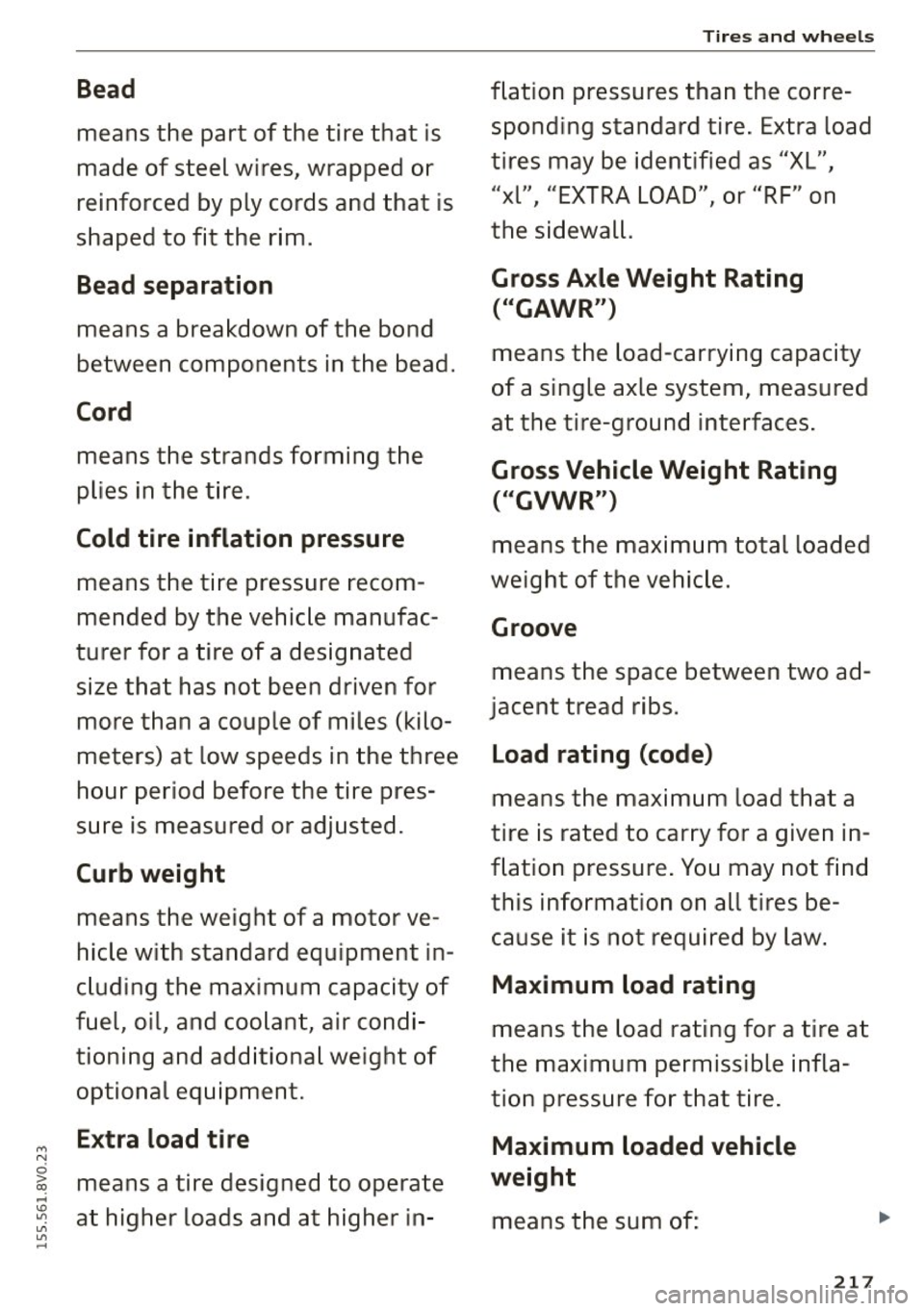
Bead
means the part of the tire that is
made of steel wires, wrapped or
reinforced by ply cords and that is
shaped to fit the rim.
Bead separation
means a breakdown of the bond
between components in the bead.
Cord
means the strands forming the
plies in the tire .
Cold tire inflation pressure
means the tire pressure recom
mended by the vehicle manufac
turer for a tire of a designated
size that has not been driven for
more than a couple of miles (kilo
meters) at low speeds in the three
hour period before the tire pres
sure is measured or adjusted.
Curb weight
means the weight of a motor ve
hicle with standard equipment in
c luding the maximum capacity of
fuel, oil, and coolant, air condi
tioning and add itional weight of
optional equipment.
E xtra load t ire
means a tire designed to operate
at higher loads and at higher in -
Tires a nd whe els
flation pressures than the corre
spond ing standard tire. Extra load
tires may be identified as "XL",
" xl", "EXTRA LOAD", or "RF" on
the sidewall.
Gross A xle Weight R ating
( " GAWR")
means the load -carrying capacity
of a single axle system, measured
at the tire-ground interfaces .
Gross Vehicle Weight Rating
(" GVWR ")
means the maximum total loaded
weight of the vehicle.
Groove
means the space between two ad
jacent tread ribs.
Load rating (code )
means the maximum load that a
tire is rated to carry for a given in
flation pressure . You may not find
this information on all tires be cause it is not required by law.
Ma ximum load rating
means the load rating for a tire at
the maximum permissible infla
tion pressure for that tire.
Ma ximum loaded vehicle
weight
means the sum of:
217
...
Page 227 of 282
-Overloading can lead to loss of
vehicle control and increase the risk of an accident. Read
and follow the important
safety precautions in
¢ page 22 7, Tires and vehicle
load limits.
-The tire must flex more if the
tire pressure is too low or if the vehicle speed or load are
too high. This heats the tire up
too much. This increases the risk of an accident because it
can cause the tire to burst and result in loss of vehicle con
trol.
-Incorrect tire pressure increas
es tire wear and has a negative
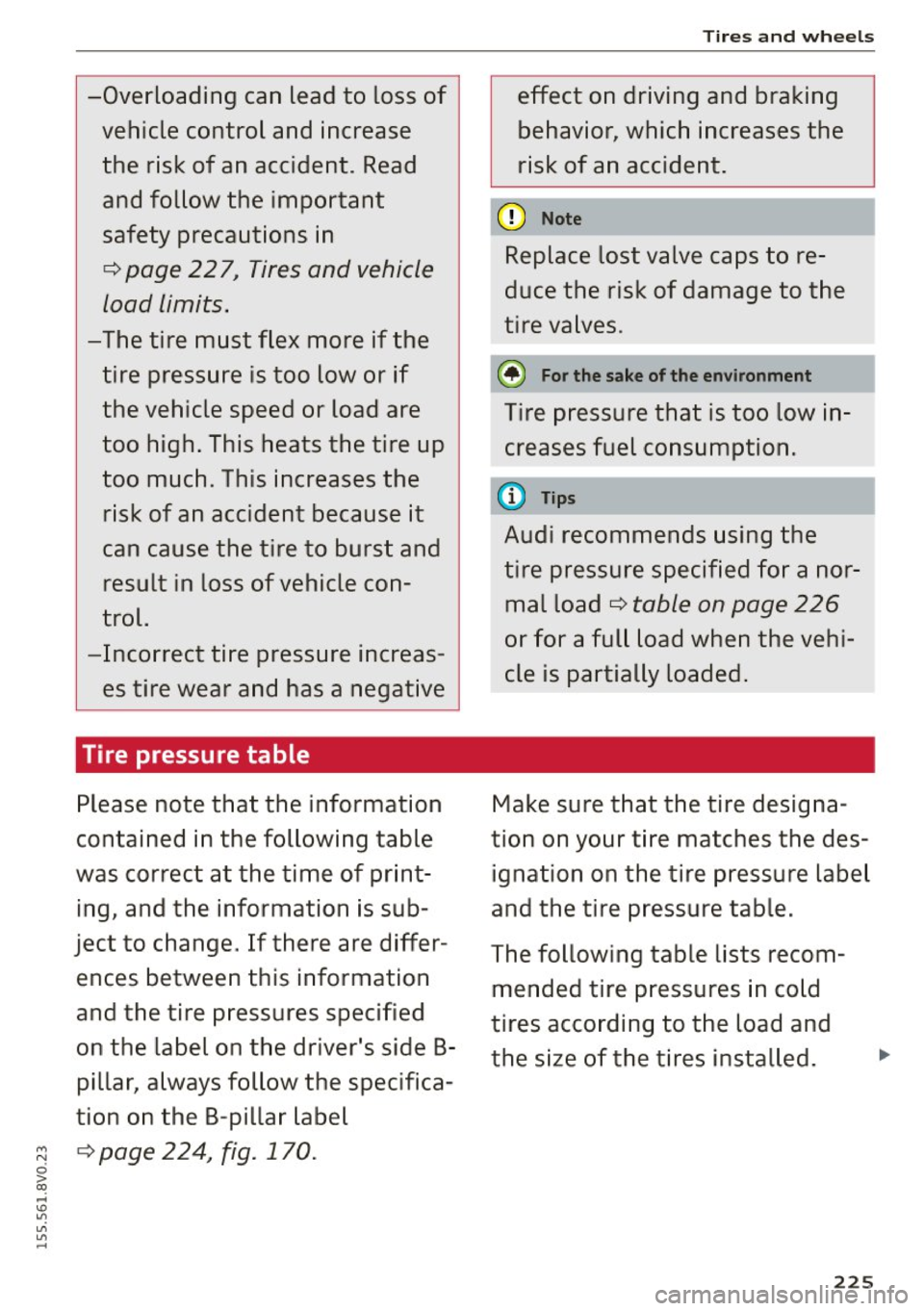
Tire pressure table
Please note that the information
contained in the following table
was correct at the time of print ing, and the information is sub
ject to change. If there are differ ences between this information
and the tire pressures specified on the label on the driver's side B
pillar, always follow the specifica
tion on the B-pillar label
¢ page 224, fig. 170.
Tires and wheels
effect on driving and braking
behavior, which increases the
risk of an accident.
Replace lost valve caps to re
duce the risk of damage to the
tire valves .
@ For the sake of the environment
Tire pressure that is too low in
creases fuel consumption.
(1) Tips
Audi recommends using the
tire pressure specified for a normal load
¢ table on page 226
or for a full load when the vehi
cle is partially loaded.
Make sure that the tire designa
tion on your tire matches the des ignation on the tire pressure label
and the tire pressure table .
The following table lists recom mended tire pressures in cold
tires according to the load and
the size of the tires installed.
225