ECU AUDI S3 SEDAN 2017 User Guide
[x] Cancel search | Manufacturer: AUDI, Model Year: 2017, Model line: S3 SEDAN, Model: AUDI S3 SEDAN 2017Pages: 400, PDF Size: 67.32 MB
Page 67 of 400
a, a, ..... N
" N ..... 0 N > 00
Storing
Cup holders
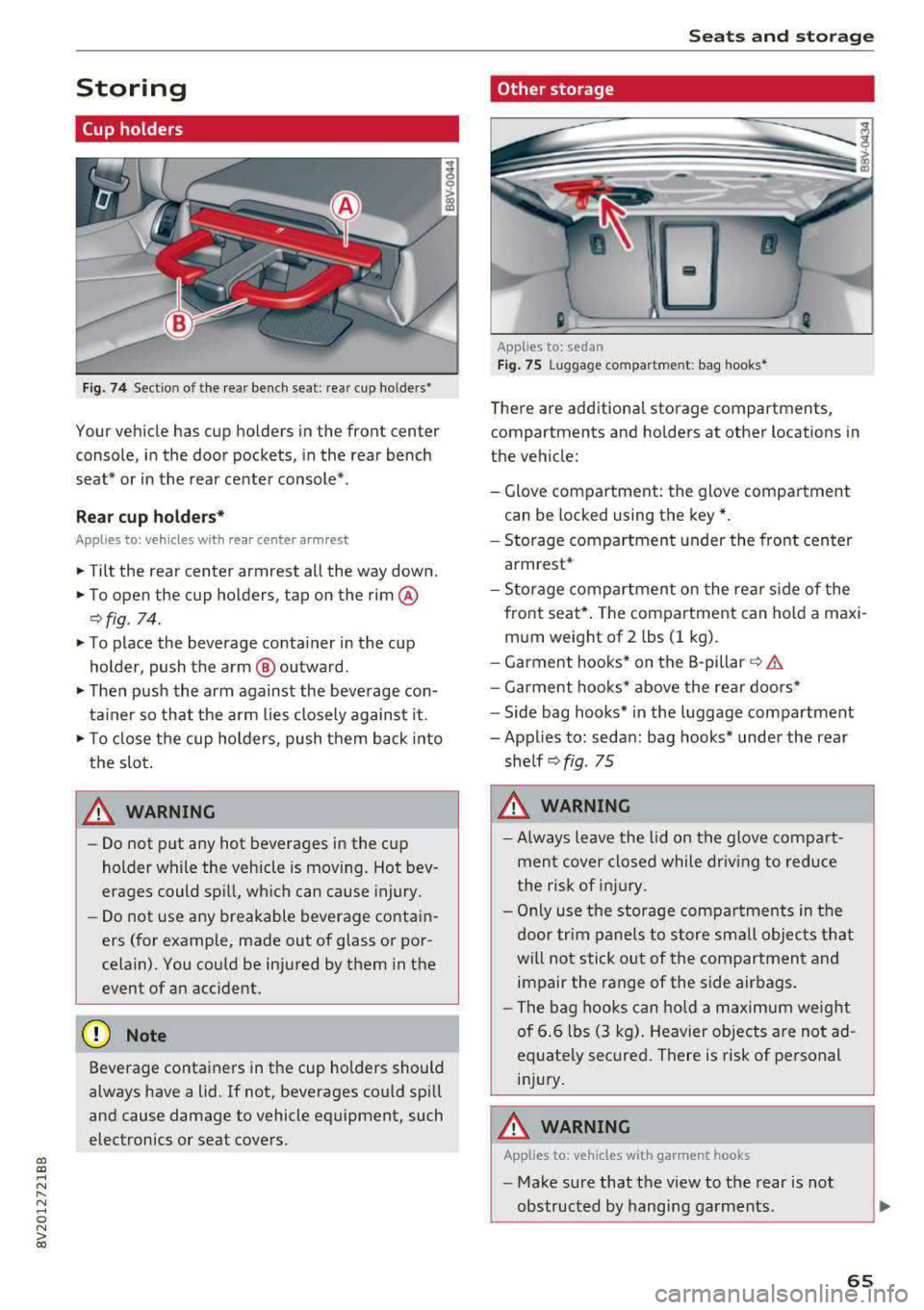
Fig. 74 Sectio n of the rear bench seat : rea r cup ho lders•
Your vehicle has cup holders in the front center
console, in the door pockets, in the rear bench
seat* or in the rear center console*.
Re ar cup ho lders*
Applies to: ve hicles with rear center arm rest
.,. Tilt the rear center armrest all the way down.
.,. To open the cup holders, tap on the rim @
r:=>fig . 74.
.,. To place the beverage co nta iner in the cup
holder , push the arm @ outward .
.,. Then push the arm against the beve rage con
ta iner so that the a rm lies closely against it .
.,. To close the cup holders, push t hem back into
the slot .
A WARNING -
-Do not put any hot beverages in the cup
holder while the vehicle is moving. Hot bev
erages could spill, wh ic h can cause injury.
- Do not use any breakable beverage contai n
ers (for example, made out of glass or por
celain). You co uld be injured by them in the
event of a n accident .
(D Note
Beverage containers in the cup holders should
always have a lid. If not, beverages cou ld sp ill
and cause damage to vehicle equipment, such
electronics or seat covers .
Seats and storage
Other storage
Applies to: sedan
Fig. 75 Lu gga ge compar tm en t: bag hooks *
There are add itiona l storage compartments,
compartments and holders at other locations in
the vehicle:
- Glove compartment: the glove compa rtme nt
can be locked using the key* .
- Storage compartment under the front cen ter
armrest*
- Storage compartment o n the re ar side of the
front seat*. The com partment can hold a maxi
m um weight of 2 lbs (1 kg) .
- Garment hooks* on the B -pillar
r=> &.
- Garment hoo ks* above the rea r doo rs *
- Side bag hooks* in the luggage compartment
- Applies to: sedan : bag hooks* under the rear
she lf
r=> fig . 75
A WARNING
-Always leave the lid on the glove compa rt
men t cover closed while driv ing to red uce
t he risk of injury .
- Onl y use t he storage compa rtme nts in the
door trim panel s to sto re sm all obje cts th at
will not sti ck ou t of the compartmen t and
impair the range of the side air bags .
- Th e bag hoo ks c an ho ld a m aximum weight
of 6.6 lbs (3 kg) . Heavier objects are no t ad
equate ly secured . There is risk of pe rsonal
inj ury.
A WARNING
-App lies to: ve hicles with garment hooks
- Make sure that the view to the rear is not
obs tructed by hangi ng garments .
-
65
Page 68 of 400
Sea ts and stor age
-Hang only lightweight cloth ing and be s ure
that there are no heavy or sharp-edged ob
jects in the pockets.
-Do not use coat hangers to hang garments,
because th is could reduce the effectiveness
of the side curtain airbags.
Luggage compartment
General information
A WARNING
Read and follow the important safety p recau
tions in
¢ page 253, Storing cargo correctly.
Luggage compartment cover
A pp lies to: ve hicles with luggage compart men t cover
The luggage comportment cover blocks the view
into the luggage comportment.
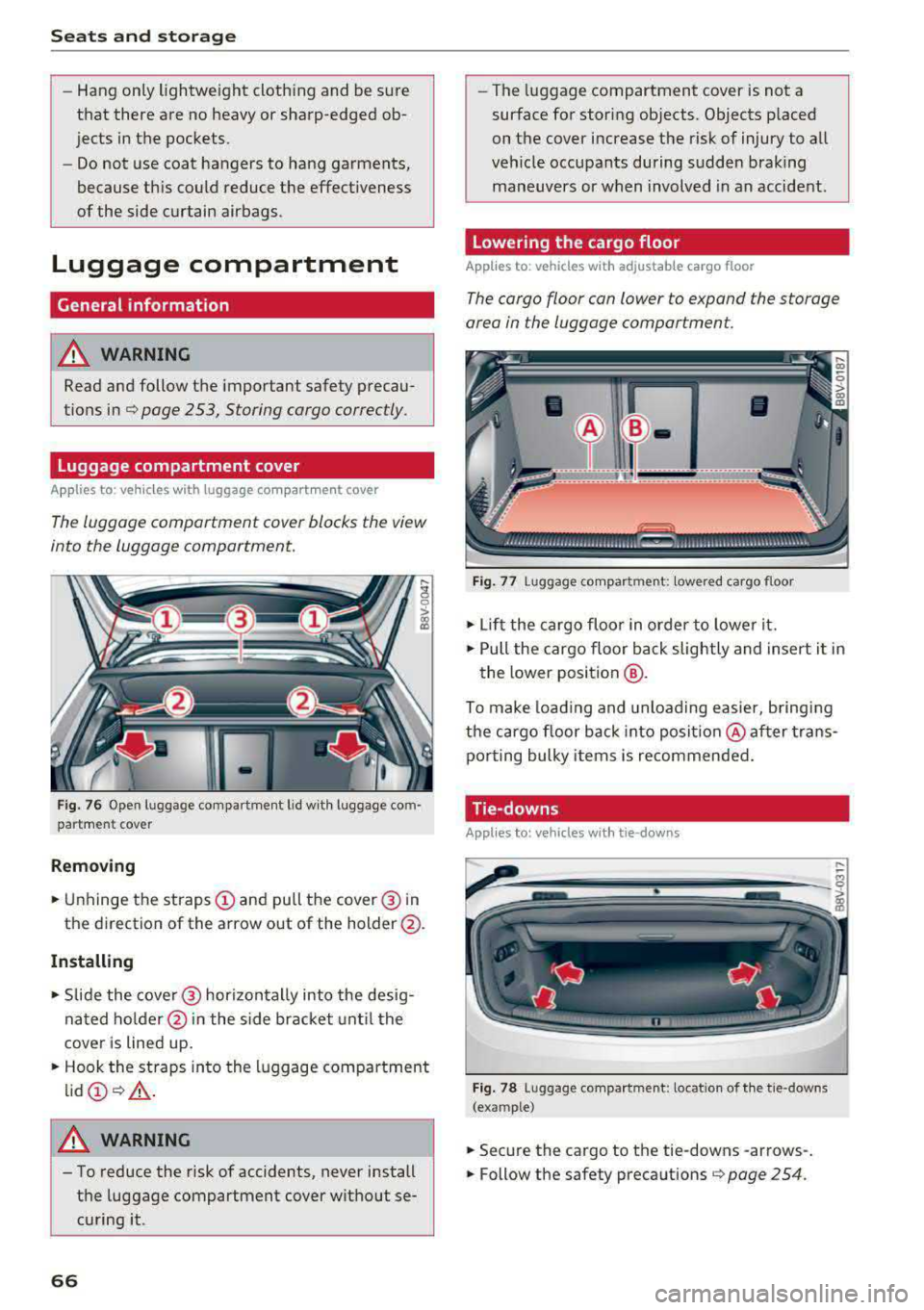
F ig . 76 Open luggage com pa rtment l id w ith luggage com
partment cover
Remov ing
... U nhinge the straps (D and pull the cover @ in
the d irection of the arrow out of the holder @.
Installing
... Slide the cove r@ horizontally into the desig
nated ho lder @in the s ide bracket until t he
cove r is lined up .
... Hook the st raps into the luggage compartment
lid @ ¢,& .
A WARNING
-To reduce the risk of accidents, never install
t h e luggage compartment c over wit hout se
cu ring it.
66
-The luggage compartment cover is not a
surface for storing objects. Objects p laced
on the cover increase the risk of injury to all
veh icle occupants during sudden braking
maneuvers or when involved in an accident.
Lowering the cargo floor
App lies to: vehicles with adjustable cargo floor
The cargo floor con lower to expand the storage
area in the luggage comportment.
Fi g. 7 7 Luggage co mpa rt ment: lowe re d cargo floor
... Lif t the cargo floo r in o rder to lowe r it .
... Pull the cargo floor ba ck slightly and insert i t in
the lower position
@ .
To make load ing and unloading easier, b ringi ng
the cargo floor back into posit io n @ aft er trans
po rting bulky item s is recommended.
Tie-downs
Appl ies to: vehicles with tie-downs
- ------- --
Fig. 7 8 Luggage compa rtment: locat io n of t he t ie-downs
(example)
... Secure the cargo to the tie-downs -arrows-.
... Follow the safety preca utions ¢ page 254.
Page 69 of 400
a, a, ..... N
" N ..... 0 N > 00
Cargo net/cargo bag
Applies to: vehicles with luggage compartment cargo net/car
go bag
The cargo net prevents light objects from sliding,
and it can also be used as a cargo bog.
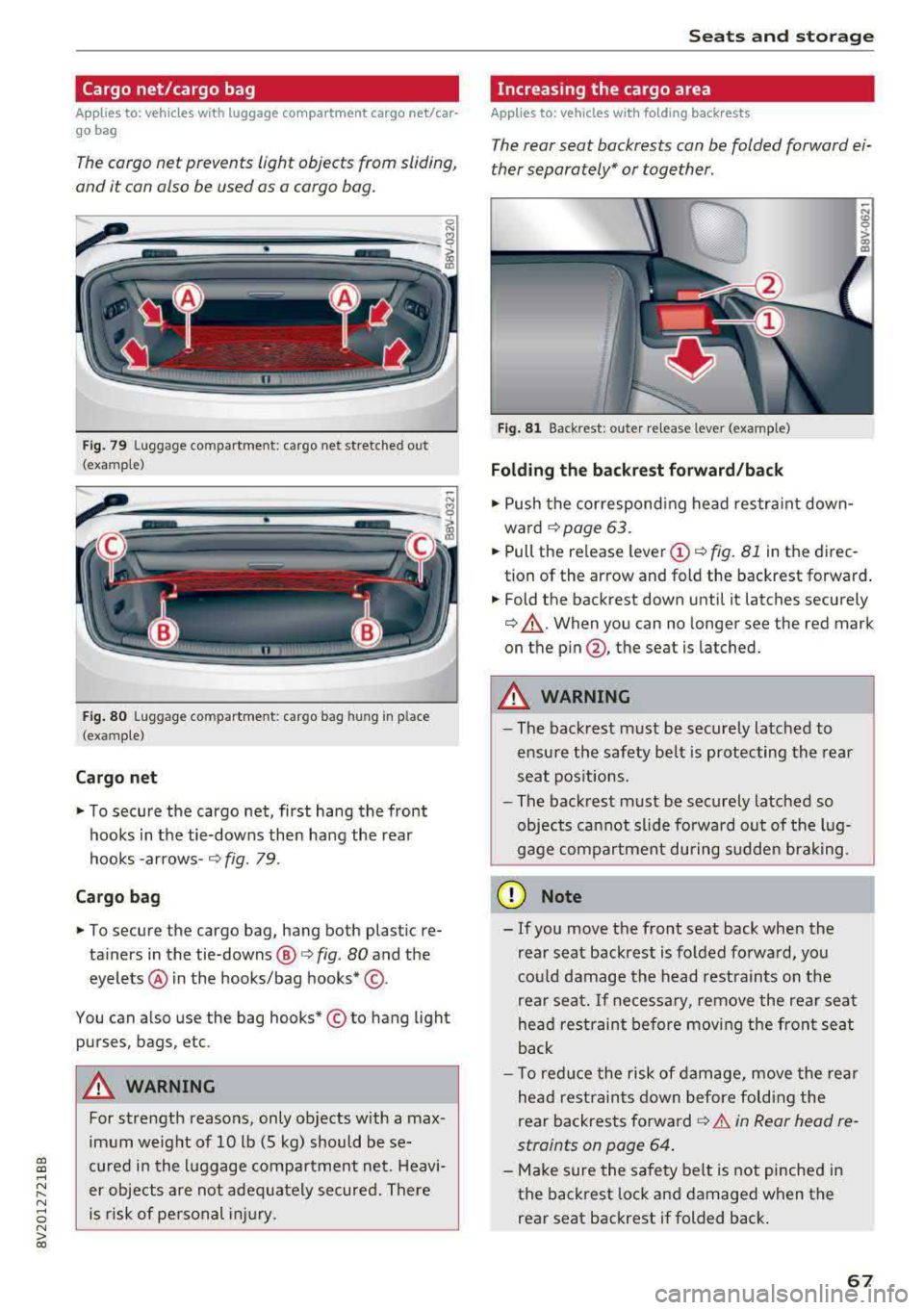
Fig. 79 Luggage compartment: cargo net stretched out
(examp le)
F ig . 80 Luggage compartme nt: cargo bag hung in place
(examp le)
Cargo net
.. To secure the cargo net, first hang the front
hooks in the tie-downs then hang the rear
hooks
-arrows-¢ fig. 79.
Ca rgo b ag
.. To secure the cargo bag, hang both plastic re
tainers in the tie-downs @
c> fig. 80 and the
eyelets @ in the hooks/bag
hooks* @.
You can also use the bag hooks* © to hang light
purses, bags, etc .
&_ WARNING
For strength reasons, only objects with a max
imum weight of 10 lb (5 kg) should be se
cured in the l uggage compartment net. Heavi
er objects are not adeq uately secured. There
is risk of personal injury .
Seats and storag e
Increasing the cargo area
Applies to: vehicles with folding backrests
The rear seat backrests con be folded forward ei
ther separately" or together .
n
Fig. 81 Backrest: outer re lease lever (example)
Folding the b ackrest forward /back
.. Push the correspond ing head restraint down
ward
¢page 63 .
.. Pull the release lever (D ¢ fig. 81 in th e direc
tion of the arrow and fold the backrest forward .
.. Fold the backrest down until it latches securely
¢ .,&.. When you can no longer see the red mark
on the
pin @ , the seat is latched.
&_ WARNING
~ -
-The backrest must be sec urely latched to
ensu re the safety belt is protecting the rear
seat pos it ions.
- The back rest must be securely latched so
objects ca nnot slide fo rwa rd out of the lug
gage compartment during sudden brak ing.
(D Note
- If you move the front seat back when the
rear seat backrest is folded fo rwa rd, you
co uld damage the head restrain ts on t he
rear seat.
If ne cessary, remove the rea r seat
he ad restraint before mov ing the front seat
back
- T o red uce the risk of damage, move the rea r
he ad rest raints down before fo ldi ng the
rear backrests
forward¢ .&. in Rear head re
straints on page 64 .
-Make sure the safety belt is not pinched in
the back rest lock a nd damaged when the
rear seat backrest if folded back .
67
Page 70 of 400
Sea ts and stor age
Pass-through
Applies to: vehicles with pass-through
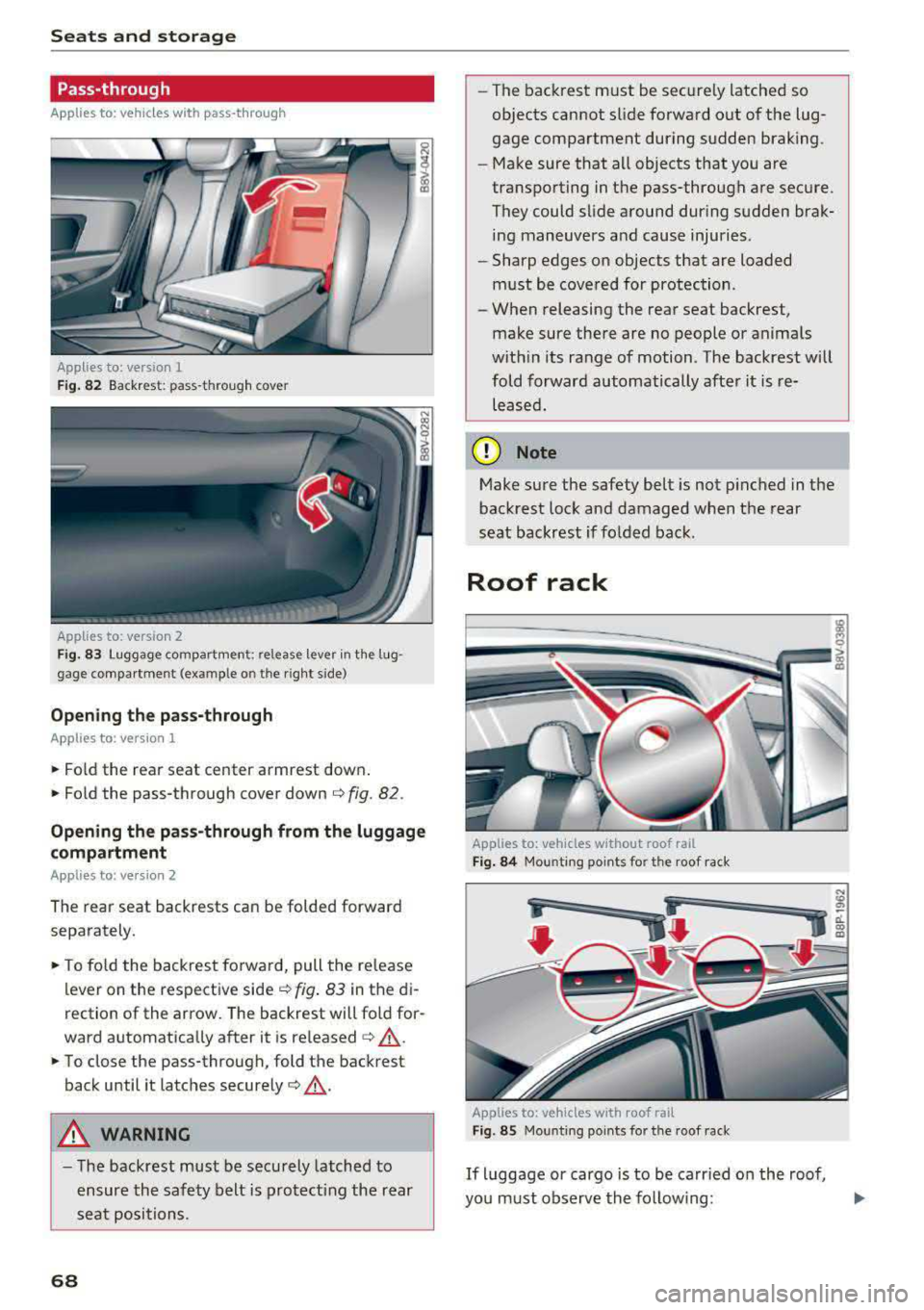
Applies to: version
1
F ig . 82 Backrest : pass-throug h cover
App lies to: version 2
Fig. 83 Luggage compart ment: release lever in th e lug
gage compartme nt (ex am ple o n the r ight s ide)
Opening th e pass -through
Applies to : vers ion 1
.. Fo ld the rear seat center armrest down .
.. Fold the pass -through cover down¢ fig. 82 .
0 N
i (D
Opening the pas s-through from the luggage
compa rtment
Applies to : version 2
The rear seat backrests can be folded forward
separately .
.. To fo ld the backrest forward, pull the re lease
lever on the respective side
¢ fig . 83 in the di
rection of the arrow. The backrest will fo ld for
ward automatically after it is
released ¢,&. .
.. To close the pass-through, fold the backrest
back until it latches
securely ¢,&. .
A WARNING
-The backrest must be securely latched to
ensure the safety belt is protect ing the rear
seat positions.
68
- The backrest must be securely latched so
objects cannot slide forward o ut of the lug
gage compartment during sudden brak ing.
- Make sure that all objects that you are
transporting in the pass-through are secure.
They could slide around dur ing sudden brak
ing maneuvers and cause injuries .
- Sharp edges on objects that are loaded
must be covered for protection .
- When releasing the rear seat backrest,
make sure there are no people or animals
with in its range of motion . The backrest will
fold forward automatically after it is re leased.
(D Note
Make sure the safety be lt is not p inched in the
backrest lock and damaged when the rear
seat backrest if folded bac k.
Roof rack
Applies to: vehicles w ithout roof rail
F ig . 84 Mou nti ng po ints for the roof rack
Applies to: vehicles with roof rail
F ig. 85 Mou nting po ints fo r the roof rack
If luggage or cargo is to be carr ied on the roof,
you must observe the fo llow ing:
Page 78 of 400
Driving
other damage to the vehicle or other property .
-Have your vehicle maintained properly and
in accordance with the service recommenda
tions in your Warranty
& Maintenance book
let . Lack of proper maintenance as well as
improper use of the vehicle will impair the
function of the emission control system and
could lead to damage.
- Do not alter or remove any component of
the Emission Control System unless ap
proved by the manufacturer .
- Do not alter or remove any device, such as
heat shields, switches, ignition wires,
valves, which are designed to protect your
vehicle's Emission Control System and other
important vehicle components.
(I) Tips
The consumption estimates as published by
ENVIRONMENTAL PROTECTION AGENCY
(EPA) and Transport Canada may not corre
spond to your actual consumption on the
road, which will vary depending upon vehicle
load and speed, road and weather conditions,
trip length, etc .
Steering
Adjusting the steering wheel position
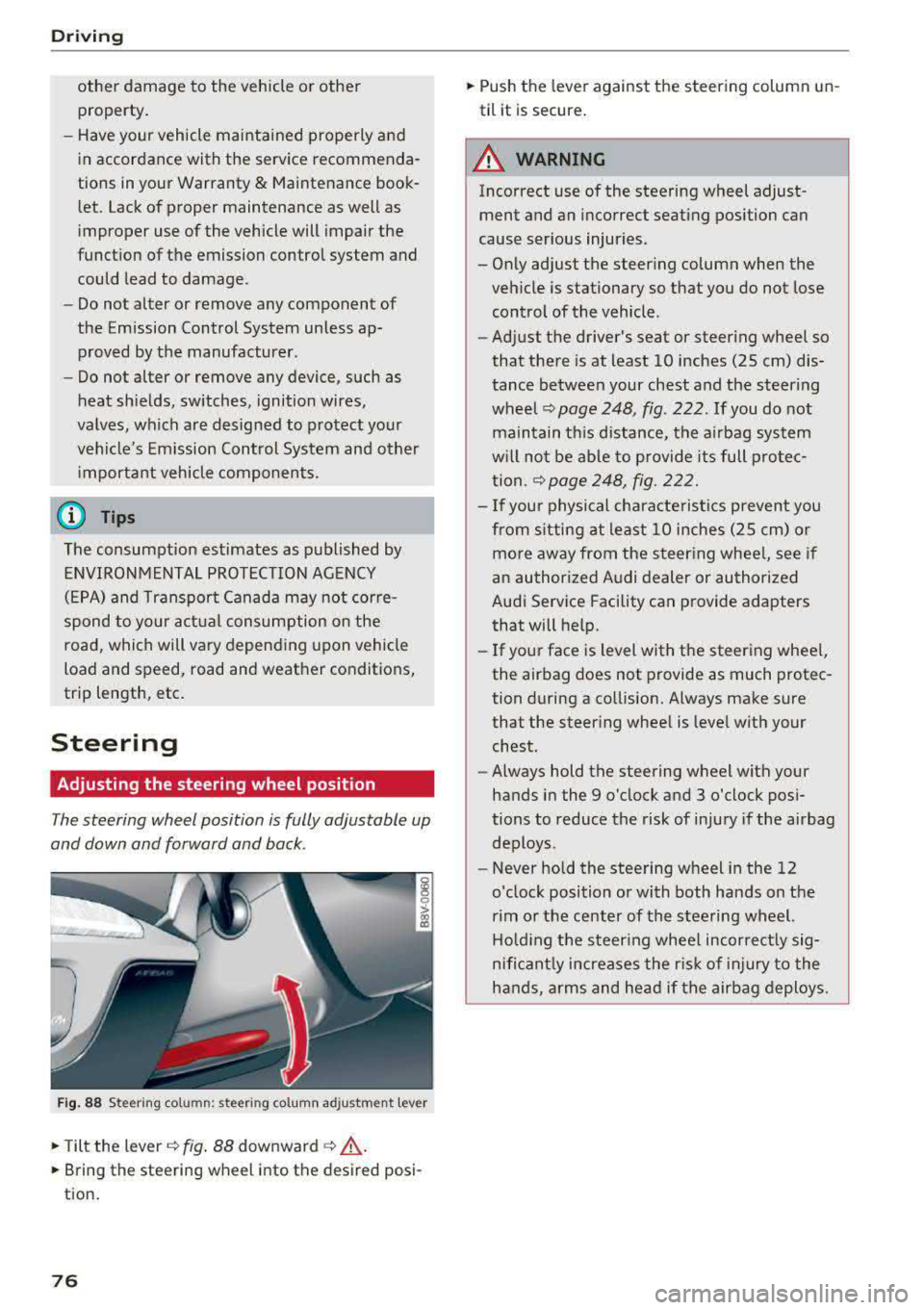
The steering wheel position is fully adjustable up
and down and forward and back .
Fig. 88 Steering column: steering col umn adjustment lever
.,. Tilt the lever c:::;, fig. 88 downward c:::;, ,& .
.,. Bring the steering wheel into the desired posi
tion.
76
.,. Push the lever against the steering column un
til it is secure.
A WARNING
Incorrect use of the steering wheel adjust ment and an incorrect seating position can
cause serious injuries.
- Only adjust the steering column when the
vehicle is stationary so that you do not lose control of the vehicle .
-
-Adjust the driver's seat or steering wheel so
that there is at least 10 inches (25 cm) dis
tance between your chest and the steering
wheel
c:::;, page 248, fig. 222 . If you do not
maintain this distance, the airbag system
will not be able to provide its full protec
tion .
c:::;,page248, fig. 222.
- If your physical characte ristics prevent you
from s itting at least 10 inches (25 cm) or
more away from the steering whee l, see if
an authorized Audi dealer or authorized
Audi Service Facility can provide adapters
that will help.
- If your face is level with the steering whee l,
the airbag does not provide as much protec
tion during a collision. Always make sure
that the steer ing wheel is level with your
chest.
- Always hold the steering wheel with your
hands in the 9 o'clock and 3 o'clock posi
tions to reduce the risk of injury if the airbag
deploys.
- Never hold the steering wheel in the 12
o'clock position or with both hands on the
rim or the center of the steering wheel.
Holding the steer ing wheel incorrect ly sig
nificant ly increases the r isk of injury to the
hands, arms and head if the airbag deploys.
Page 86 of 400
Driving
"'To start driving and release the parking brake
automatically, press the accelerator pedal as
usual.
In addition to releasing the parking brake auto
matically, other convenience and safety functions
are available when you start driving
¢ page 85,
Starting from a stop.
Preventing the automatic parking brake
release
The vehicle could begin rolling unintentionally,
dep ending on the hill or if towing a trailer.
"'To prevent the parking brake from releasing au
tomatically, pull and hold
the®> switch and
press the accelerator pedal. The parking brake
remains set and prevents the vehicle from roll
ing backward.
"'You can release the(®) switch again once you
are sure that you are giving enough driving
force to the wheels by pressing the accelerator pedal.
Emergency braking function
You can use the emergency braking function in an emergency situation, or if the standard brake op
eration malfunctions or is disabled .
"'Pull and hold the(®) switch.
"' As soon as you release the ®> switch or acceler-
ate, the braking stops .
Pulling and holding
the®> switch while driving
the vehicle activates the emergency braking func
tion . The vehicle is braked at all four wheels by
activating the hydraulic brake system. The brak ing effect is similar to heavy
braking ¢,&. .
To reduce the risk of activating the emergency
braking by mistake, a warning tone (bu zzer)
sounds when
the(®) switch is pulled. Emergency
braking stops as soon as
the(®) switch is released
or the accelerator pedal is pressed .
Parking
"' Press the brake pedal to stop the vehicle.
"'Pull the®> switch to set the parking brake.
"'Place the selector lever in the P position.
"'Turn the engine off ¢,&. .
84
"'Turn the steering wheel when parking on in
clines so that the wheels will roll into the curb
if the vehicle starts moving.
A WARNING
- Do not press the accelerator pedal inadver
tently if a gear is selected when the vehicle
is stationary and the engine is running . Oth
erwise, the vehicle will start to move imme
diately and this could result in an accident.
- Emergency braking should only be used in
an emergency, when the normal brake pedal has failed or the brake pedal is obstructed.
During emergency braking, your vehicle will
brake similar to heavy braking. ESC and the
associated components (ABS, ASR, EDL)
cannot overcome the laws of physics. In cor
ners and when road or weather conditions
are bad, a full brake application can cause
the vehicle to skid or the rear end to swerve,
which increases the risk of an accident.
- If the power supply fails, you cannot set the
parking brake if it is released . In this case,
park the vehicle on level ground and secure
it by placing the selector lever in the P posi
tion. See an authorized Audi dealer or au
thorized Audi Service Facility for assistance.
-Always take the vehicle key with you when
leaving your vehicle, even for a short period
of time . This applies particularly when chil
dren remain in the vehicle. Otherwise chil
dren could start the engine, release the
parking brake or operate electrical equip
ment such as power windows, which in
creases the risk of an accident.
- No one should remain in the vehicle when it
is locked - especially children. Locked doors
make it more difficult for emergency work
ers to get into the vehicle, which puts lives
at risk .
(D Tips
When stopping at a traffic signal or stopping
in city traffic, you can set the parking brake
manually . The vehicle does not have to be
held with the brake pedal. The parking brake
eliminates the tendency to creep when a se lector lever position is engaged . As soon as
Page 93 of 400
CXl CXl .... N ,.__
N
Requirement: the engine must be at operating
temperature and the steering whee l must not be
turned.
.,. Deact ivate ll the Start/Stop system*
¢ page 83. The LED in the ~ button turns on.
.,. With the engine running, press the l.t, O FFj but
ton briefly one time .
.,. Pull the selector lever back out of the D/S posi
t ion briefly to select the S posit ion, or press it
toward the right into the tiptronic pos ition or
select the
D ynamic driving mode in drive se
lect*
¢ page 143 .
.,. Press the b rake peda l firmly with you r left foot
and hold it all the way down for at least one
second .
.,. At the same time, press the gas pedal all the
way down with your right foot unti l the engine
reaches and stays at a high RPM level.
.,. Remove your left foot from the brake.
A WARNING
- Always adapt yo ur driv ing to the traffic flow .
- Only use Launch Control when road and traf-
fic cond itions allow it and other dr ivers will
not be endangered or impacted by your driv
ing and the vehicle's acceleration .
- Please note that the drive whee ls can sp in
and the vehicle can break away when sport
mode is switched on, especially when the
road is s lippery.
- Once the vehicle has started moving, press
the
I ~ OFF j button briefly to tu rn the sport
mode off.
@ Tips
-The transmiss ion temperature may increase
s ignificantly after us ing the launch cont rol
program.
If that happens, the program may
not be available for a few m inutes. It w ill be
available again after a cool-down pe riod.
-When accelerating using the la unch control
program, all veh icle parts are subject to
heavy loads. Th is can lead to increased
wear .
8 1
> It is not pos sib le to deact iv a te t he system w it h all vers io n s N iii of th e tran sm is s ion.
D riv ing
Emergency mode
Applies to: vehicles with automatic transmissions
In the event of a system malfunction, there is an
emergency program .
If all of the selector lever positions are highlight
ed with a light background in the instrument
cluster display, there is a system malfunct ion and
the transmission is running i n the emergency
program. The veh icle can sti ll be driven in emer
gency mode, but only with red uced speed and
not in all gears . In some cases, the vehicle
can
not d riv e in revers e .
([) Note
If the transm ission runs in eme rgency mode,
drive to a n author ized A udi dealer or author
i zed Audi Se rvice Facility immed iate ly to have
the malfunction corrected .
Transmission malfunction
Applies to: vehicles with automatic transmissions
• Tran smission: malfunction! Please stop ve
hicle and shift t o P
There is a ma lfunction in the transm ission. Park
the vehicle secure ly and do not continue driving.
See an author ized Audi dealer or authorized Audi
Service Facility for assistance .
• Transmis sion overheat ing! Plea se stop the
ve hicle!
The tra nsmission is too hot and can become dam
aged. Stop and le t the transmiss ion cool w ith the
engine r unning (at idle) in the P se lector lever po
sition . Then the indicator light and the message
turn off, drive to an authorized A udi dealer or au
thori zed Audi Serv ice Facility immediately to have
the malfunction corrected. If the indicator light
and the driver message do not turn off, do not
continue driving . See an authorized Aud i dealer
or authorized Audi Serv ice Facility for ass istance.
[!l Tran smiss ion malfunction : you can continu e
driving
.,,.
91
Page 94 of 400
Driving
Drive to an a uth o rized Audi dea ler or authorized
Audi Service Facility immediately to have the
malfunct ion corrected .
rm Transmis sion malfunction : no reverse ge ar
( you can continue driving )
Drive to an a uthorized Aud i dea le r or aut horized
Aud i Serv ice Facility immediately to have the
malfunct io n corrected.
[O] Tran smis sion malfunction: You can continue
driving in D until engine off
Drive the vehicle away from moving traffic and
park. See an authorized Audi dealer or autho rized
Aud i Serv ice Facility for assistance .
rm Transmission : too hot. Pleas e adapt d riving
style
Continue driving mode rately. When the indicator
light turns off , you can continue driving normal
ly .
rm Transmis sion : please p ress brake pedal and
select gear ag ain
If the transmission malfu nctions be ca u se the
temperature is too high, a message appears
when the transmission is cooled.
Selector lever emergency release
Applies to: vehicles with automatic transmissions
If the vehicle's power supply fails, the selector
lever can be released in an emergency .
Fig. 100 Selecto r leve r: remov ing the s hifter boot
92
Fig . 101 Se lector leve r: u si ng the eme rgency release to
mov e out of the Park pos iti on
To maneuver or tow the vehicle, the emergency
release must be used to
move the selector lever
from the P position.
The emergency release mechanism is located in
the right area unde r the selector lever shift gate .
Using the emergency release can be complicated .
We recommend contacting an authorized Audi
dealer or author ized Audi Service Fac ility for as
s ista nce, if necessary .
The screwdr iver from the vehicle tool kit located
i n the luggage compartment is needed to for the
emergency re lease
r::;, page 353 . Use the flat side
of the reversible sc rewdriver blade .
Removing the shifter boot
.. Set the park ing brake <®> r::;, .&. to secure your
vehicle from ro lling. If th is is not possible, se
cure your vehicle from rolling using another
method.
.,. Sw itch the ignit ion off .
.,. To loosen the shifter boot, carefully inse rt the
fla t side of the s crewd river si deways in to the
slit nea r the sh ifte r boot
r::;, fig. 100 .
.,. Care fully p ry t he sh ifter boot o ut w ith t he
screwdriver wh ile gripping the boot at the fold
and pulling it upward and out -arrow -unti l all
four corne rs are re leased .
.. Fold the shifter boot up around the sh ifter knob
¢fig. 101.
Selector lever emergency release
.. Press and hold the ye llow release b utton with
the screwdriver
¢ fig. 101 .
.. Press the release button in the selector lever @
and move the lever into the N position .
II>
Page 95 of 400
CXl CXl .... N ,.__
N .... 0 N > 00
~ Clip the shift cover back into the shift gate after
using the emergency release.
A WARNING
Only move the selector lever out of the P posi
tion when the parking brake is set. If it is not
functioning, secure the vehicle from rolling using the brake pedal or other suitable means
and block ing a front and a rear wheel. The ve
hicle can ro ll away if it is not secured and
cause a crash.
Driving
93
Page 97 of 400
CXl CXl .... N ,.__
N .... 0 N > 00
injuries. When the vehicle enters drive ready
mode, the status message
e-"'1 o I r.-.Al"'Y ap
pears briefly in the instrument cluster d isplay
and the needle in the power meter points to
READY ¢ page 9 7.
-Make sure that the selector lever is in the P
posit ion and the ignition is switched off
when leav ing t he veh icle.
([) Note
- The high-voltage system can be damaged if
the veh icle underbody comes into contact
with the ground. Immed iately drive your ve
hicle to a n author ized repair facility and
have it inspected.
- The electric drive motor can become very hot dur ing operation . Do not stop the veh i
cle if there is o il, fuel residue or other flam
mable s ubstances under or next to the vehi
cl e.
Special considerations for the high-voltage
battery
Appl ies to: vehicl es with plug- in hybrid drive
Please first read and note the introductory infor
mat ion and heed the
warn ings ¢ page 94.
All batteries age with use and over time. There
are things you should know about the care of the
h igh-vo ltage battery that will he lp it keep giving
you good service and reliab ility over t ime . Please
read and keep the following informat ion in m ind
while you enjoy the performance and economy of
your ve hicle .
- Be sure to charge the high-voltage battery be
fore leaving the vehicle parked and unused for a l onger period of time . Ideally the high-vol tage
batte ry sho uld have a charge leve l between
40
% and 60 % when par ked for a long t ime.
- If the batte ry charge level is below 3
%, never
park the vehicle for more than 21 days without
charg ing the high-vo ltage battery. Sho uld you
have to par k the vehicle fo r a long time, m ake
s u re that the charge leve l is sufficien t to help
prevent the battery from aging premature ly.
- Freq uent and consecutive charging of the high
vo ltage battery when the cha rge level is above
e-tron
98 % can also decrease the capacity o f the
highvo ltage battery . Make sure the charge leve l
is below 98
% when you start the charging
process.
- Should the vehicle be parked for longer than
2 days at temperatures below
-13 °F (-25 °C),
the high-voltage battery could free ze and not
be ab le to prov ide energy to the electric motor.
The battery will start working again, once it
warms up. The battery can be warmed up when
the outside temperature rises or when the vehi
cle is garaged app ropr iate ly. Th e battery w ill al
so warm up when bei ng used (sw itchi ng on the
air conditioner, the heater or by driving the ve
hicle) . Shou ld you have to park your vehicle at
very low temperatures for longer than 1 day, make sure that the h igh-vo ltage battery does
not freeze by parking the vehicle in a garage
that is heated or protected from the outside
temperature .
- The high-voltage battery can be damaged and
the capacity can be decreased when the vehicle
is parked for longer than 24 ho urs when the
ambient temperature is h igher than 118 °F
(48 °C). Always ma ke sure that the h igh-vo lt
age battery is not exposed to temperat ures
above 118 °F (48 °C) for a long time .
- Never pa rk the veh icle in areas that a re l ikely to
be flooded, s uch as beaches or rive r banks, and
never drive the vehicle in WA TER, on flooded
roads or through water that is higher than the
bottom of the vehicle body . The high -voltage
battery, along with other vehicle components,
can be damaged severe ly if the high-voltage
battery is exposed to open water especially for
a longer t ime . However, you ca n drive through
wate r o n roads under certain condi tions
~ page 74.
Failure to heed any of these requ irements can
age the battery prematurely and lead to a perma
nent decrease of the h igh-vo ltage battery's ca
pacity.
(D Tips
Always make sure that the high-voltage bat
tery is not exposed to extreme ly low and high
temperatu res as well as to water espec ia lly
fo r a longe r time. Fail ure to protec t and c are
IJ-
95