drive mode AUDI S3 SEDAN 2018 Workshop Manual
[x] Cancel search | Manufacturer: AUDI, Model Year: 2018, Model line: S3 SEDAN, Model: AUDI S3 SEDAN 2018Pages: 404, PDF Size: 62.3 MB
Page 342 of 404
Wheels
front and rear axles are the same
size¢&.
Rotating the tires regularly is rec
ommended to ensure the tires
wear evenly . To rotate the tires,
install the tires from the rear axle
on the front axle and vice versa.
This will allow the tires to have
approximately the same length of
service life.
For unidirectional tires, make
sure the tires are installed accord
ing to the running direction indi
cated on the tire sidewall
¢page 368.
Hidden damage
Damage to tires and rims can of
ten occur in locations that are hidden . Unusual vibrations in the
vehicle or pulling to one side may
indicate that there is tire damage.
Reduce your speed immediately.
Check the tires for damage. If no
damage is visible from the out
side, drive slowly and carefully to
the nearest authorized Audi deal
er or authorized Audi Service Fa
cility to have the vehicle inspect
ed .
340
.&_ WARNING
-Tread that has worn too low or
different tread depths on the
tires can reduce driving safety.
This can increase the risk of an
accident because it has a neg
ative effect on handling, driv
ing through curves, and brak
ing, and because it increases
the risk of hydroplaning when
driving through deep puddles.
- Applies to: RS models: de
pending on the equipment,
the widths of the standard
summer tires may be different
on the front and rear axles.
The wider tires are mounted
on the front axle. The tires
must not be rotated .
Page 343 of 404
Tire pressure
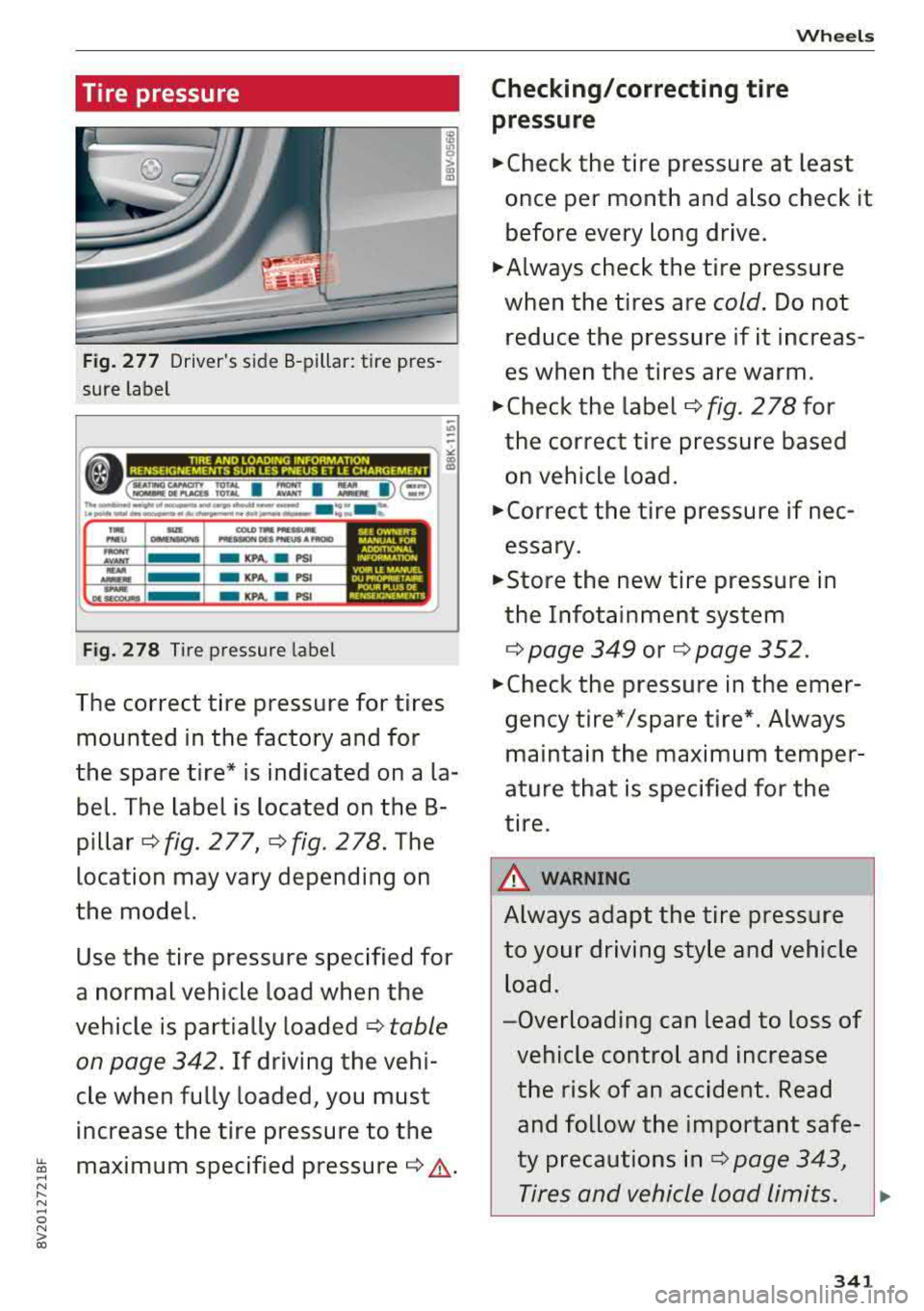
Fig. 277 Driver's side B-pillar: tire pres
sure label
"' -,------------~ ,::
9c:==. ~: I :.:: I :.. I ) @ l8 n. _____________ ....., _ _. . ... _ ..
vi ................ ~--"""""' ..... .... ..
TR IIZl 00lO '1111. NaSIUl'll ,,._U DNlNIIONS .......,,.DUftillUSAAIOIJ
-KPA. -PSI
Fig. 278 Tire pressure label
The correct tire pressure for tires
mounted in the factory and for
the spare tire* is indicated on a la bel. The label is located on the
8-
pi llar ¢ fig. 2 77, ¢ fig. 2 78. The
location may vary depending on
the model.
Use the tire pressure specified for
a normal vehicle load when the
vehicle is partially loaded
¢ table
on page 342.
If driving the vehi
cle when fully loaded, you must
increase the tire pressure to the
~ maximum specified pressure ¢,&. .
N
" N ... 0 N > co
Checking/correcting tire
pressure
Wheels
11>(heck the tire pressure at least
once per month and also check it
before every long drive.
11>Always check the tire pressure
when the tires are
cold. Do not
reduce the pressure if it increas
es when the tires are warm.
11>(heck the label¢ fig. 2 78 for
the correct tire pressure based on vehicle load.
11>(orrect the tire pressure if nec
essary.
11>Store the new tire pressure in
the Infotainment system
¢ page 349 or ¢page 352.
11>(heck the pressure in the emer
gency tire* /spare tire*. Always
maintain the maximum temper
ature that is specified for the
tire.
A WARNING
Always adapt the tire pressure
to your driving style and vehicle load.
-Overloading can lead to loss of vehicle control and increase
the risk of an accident. Read and follow the important safe
ty precautions
inc:::> page 343,
Tires and vehicle load limits.
341
Page 344 of 404
Wheels
-The tire must flex more if the
tire pressure is too low or if
the vehicle speed or load are
too high. This heats the tire up
too much. This increases the
risk of an accident because it
can cause the tire to burst and
result in loss of vehicle con
trol.
-Incorrect tire pressure in creases tire wear and has a
Tire pressure table
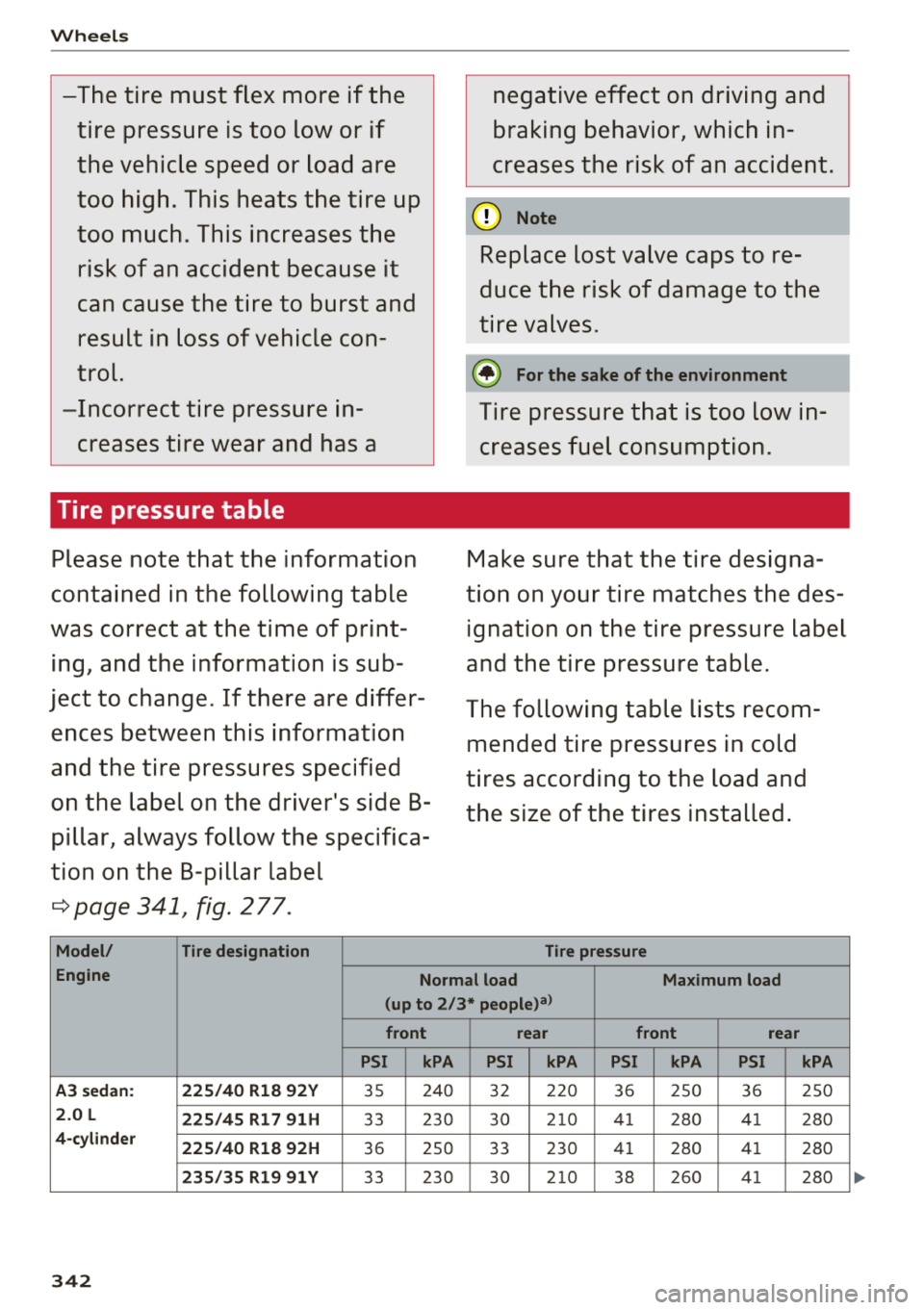
Please note that the information
contained in the following table
was correct at the time of print
ing, and the information is sub
ject to change. If there are differ
ences between this information
and the tire pressures specified
on the label on the driver's side B
pillar, always follow the specifica
tion on the B-pillar label
c> page 341 , fig. 2 77.
Model/ Tire designation
negative effect on driving and
braking behavior, which in
creases the risk of an accident.
@ Note
Replace lost valve caps to re
duce the risk of damage to the
tire valves.
@ For the sake of the environment
Tire pressure that is too low in creases fuel consumption.
Make sure that the tire designa
tion on your tire matches the des
ignation on the tire pressure label
and the tire pressure table.
The following table lists recom mended tire pressures in cold
tires according to the load and
the size of the tires installed.
Tire pressure
Engine Normal load Maximum load
(up to 2/3*
people)al
front rear front rear
PSI kPA PSI kPA PSI kPA PSI kPA
A3 sedan: 225/40 R18 92Y 35 240 32 220 36 250 36 250
2.0 L
225/45 R17 91H 33 230 30 210 41 280 41
280
4-cylinder
225/40 R18 92H 36 250 33 230 41
280 41 280
235/35 R19 91 Y 33 230 30 210 38 260 41 280
342
Page 349 of 404
u. 00 .-< N l' N .-< 0 N > 00
A WARNING
Using incorrect snow chains or installing snow
chains incorrectly can result in loss of vehicle
control, which increases the risk of an acci
dent.
@ Note
Snow chains can damage the rims/wheel cov
ers* if the chains come into direct contact
with them. Remove the wheel covers* first .
Use coated snow chains.
(D Tips
When using snow chains, it may be useful to
switch on sport mode
¢page 149.
Low-profile tires
App lies to: ve hicles with low -profi le tires
Compared to other tire/rim combinations, low
profile tires offer a wider tread surface and a
la rger r im diameter with shorter tire sidewalls.
This results in an agile driving style. However, it
may reduce the level of comfort and increase
road noise when driving on roads in poor condi
tion.
L ow -profile tires can become damaged more
quickly than standard tires when driving over
large bumps, potholes, manhole
covers, and
curbs. Therefore, it is particularly important to
maintain the correct tire
pressure¢ page 341.
To reduce the risk of damage to the tires and rims, drive very carefully on poor roads.
Check your wheels regularly
every 2,000 mi
(3,000 km) for damage. For example, check for
bulges/cracks on the tires or deformations/
cracks on the rims.
After a heavy impact or damage, have the tires
and rims inspected or replaced immediately by
an authorized Audi dealer or authorized Audi
Service Facility .
L ow -profile tires can wear out faster than stand
ard tires.
Wheels
Uniform tire quality grading
- Tread wear
- Traction AA ABC
- Temperature ABC
Quality grades can be found where applicable on
the tire side wall between tread shoulder and
maximum section width
¢ page 331, fig. 275.
For example: Tread wear 200 , Traction AA, Tem
perature
A.
All passenger car tires must conform to Federal
Safety Requirements in addition to these grades.
Tread wear
The tread wear grade is a comparative rating
based on the wear rate of the tire when tested
under controlled cond it ion s on a specified
gov
ernment test course.
For example, a tire graded 150 would wear one
and one half (1 1/2) times as well on the govern
ment course as a tire graded 100.
The relative performance of tires depends upon
the actual conditions of their use, however, and
may depart significantly from the norm due to
variations in driv ing habits, service practices and
differences in road characteristics and climate.
Traction
The traction grades, from highest to lowest, are
AA , A, Band
C. Those grades represent the tire's
ability to stop on wet pavement as measured un
der controlled conditions on specified govern
ment test surfaces of asphalt and concrete. A tire
marked C may have poor traction performance
¢,& .
Temperature
The temperature grades are A (the highest), B,
and C, representing the tire's resistance to the
generation of heat and its ability to dissipate
heat when tested under controlled conditions on
a specified indoor laboratory test wheel.
Sustained high temperature can cause the mate
rial of the tire to degenerate and reduce tire life,
and excessive temperature can lead to sudden
tire
failure ¢,& .
347
Page 353 of 404
u. 00 .-< N l' N .-< 0 N > 00
A WARNING
-The tire pressure monitoring system assists
the driver in monitoring tire pressures . The
driver is responsible for having the tires in
flated to the correct pressure.
- Do not change the tire pressure when the
temperature of the tire is extremely high.
This could result in serious damage to the
tire and even cause the tire to burst, in
creasing the risk of an accident.
- A tire with low pressure flexes more. This
heats the tire up too much. This could cause
the tread to separate and even cause the
tire to burst, increasing the risk of an acci
dent.
- The tire pressure monitoring system does
not warn about damage or defects in the
tire construction that could cause the tire to burst, for example . Inspect your tires regu
larly .
(D Tips
-If tires are replaced, the sensors/valves do
not need to be removed or replaced. Just re
placed the valve stem and, if necessary, the
valve and the wheel electronics. If you have
questions, see an authorized Audi dealer or
authorized Audi Service Facility .
- An incorrect display or a malfunction in the
tire pressure monitoring system can occur
after using the tire mobility kit . Have the
sensors replaced by an authorized Audi
dealer or authorized Audi Service Facility.
- For an explanation on conformity with the
FCC regulations in the United States and the
Industry Canada regulations, see
r=;,page 386.
Displaying tire pressures/temperatures
Applies to: vehicles with tire pressure mo nito ring system
Requirement: you must be driving the vehicle.
"'Select in the Infotainment system: the I MENU I
button > Vehicle > left control button > Service
& checks > Tire pressure monitoring > Display
tire pressures.
Wheels
The current tire pressures are shown in green,
yellow or red numbers in the Infotainment sys
tem:
- Green: the current tire pressure and the speci
fied tire pressure are approximately the same.
- Yellow: the current tire pressure is too low
compared to the specified tire pressure.
-Red: the current tire pressure is extremely low
compared to the specified tire pressure .
The specified tire pressure is the last tire pres
sure that was stored
r=;, page 352.
Note that the tire pressure also depends on the
temperature of the tire. The tire pressure in
creases as the engine becomes warmer while
driving.
A WARNING
Read and follow the important information
and notes
"*page 350.
(D Tips
The tire pressure or temperature is not dis
played while the vehicle is stationary and in
adaptation mode. Dashes--.-- are shown in
place of the pressure and temperature.
ill Tire pressure loss
Applies to: vehicles with tire press ure mo nito ring system
-
If the [tE indicator light turns on, the pressure in
at least one tire is too low or new sensors were
not adapted:
RE Indicator light turns on after turning the
ignition on
The tire pressure is too low compared to the
specified pressure .
.,. Check and store the tire pressure(s) the next
time it is possible
"*page 352.
RE Indicator light turns on while driving
Wheels with new sensors were not adapted or
the tire pressure has reached a critical level com
pared to the specified pressure.
"'Avoid unnecessary steering and braking maneu-
vers.
..,_
351
Page 356 of 404
Care and cl eaning
Care and cleaning
General information
Applies to: vehicles with plug-in hybrid drive: for
additiona l cleaning and care information, see
¢ page 117.
Reg ula r, prope r ca re helps to maintai n your veh i
cle's value. It can a lso be a requirement when
submitting warranty claims for corrosion damage
and paint defects on the body.
The ne cessary care prod ucts c an be ob tained
from an authorized Aud i dea ler o r authorized
Audi Service Facility. Read and follow the instruc
tions fo r use on the packaging.
A WARNING
- Us ing clean ing and ca re products incorrectly
can be dangero us to your hea lth.
- Always store clean ing and ca re products out
of reach of children to reduce the r is k of po i
so ning.
@ For the sake of the environment
- Prefe rab ly purchase environmenta lly-friend
l y cleaning products.
- Do not dispose of leftove r cleaning and ca re
p roducts wit h house hold trash.
Car washes
The longer that deposits s uch as insects, bird
droppings, tree sap or road salt remain on the ve
h icle, the more the surface can be damaged. High
temperatures such as those caused by sunlight increase the damaging effect .
Before washing, rinse
off heavy deposits with
p lenty of water.
S tu bborn deposits s uch as bird d roppings or tree
sap are best removed with plenty of water and a
microfiber cloth.
A lso, wash t he u nderside of yo ur vehicle once
road sa lt stops being used for the season .
354
Pressure washers
When was hing yo ur vehicle wi th a press ure was h
er, always follow the operat ing instruct ions pro
vided with the pressure washer . This is especia lly
important in regard to the pressure and spraying
distance. Do not aim the spray direct ly at sea ls on
s ide windows, doors, the hood, the luggage com
partment lid or the panorama g lass roof * or at
tires, rubbe r hoses, insula ting material, the pow
e r top*, senso rs* o r camera lenses* . Keep a d is
tance of at least 16 in (40 cm).
Do not remove snow and ice with a p ressure
washer.
Never use cone nozzles o r high press ure nozzles.
The wate r temperatu re must not be above 140 °F
(60 °C).
Automatic car washes
Sp ray off the ve hicle befo re wash ing.
Make su re t hat the wi ndows, the pa norama g lass
roof* and the power top* are closed and the
winds hield wipers a re
off. Fo llow instructions
from the ca r was h operator, espec ia lly if there
a re acc esso ries attached to your ve hicle.
If possible, use car washes that do not have
brushes.
Applies to: RS models
Only use car washes where the veh icle remains
stationary and the washing equipment moves around the vehicle when wash ing and dry ing . Car
washes that move the veh icle t hrough the ca r
wash using a c ha in a re not re commended .
Washing by hand
Clean the ve hicle starting from t he top and work
i ng down using a soft sponge or cleaning brus h.
U se solvent-free cleaning prod ucts .
Washing vehicles with matte finish paint by
hand
To avo id damaging the paint when washing, fi rs t
r emove d ust and la rge pa rt icles from your vehi
cl e. Insects, grease spots a nd fingerpr ints are
best re moved w ith a spe cial cleane r fo r m atte
finish pai nt.
Page 363 of 404
LL co ..... N
" N ..... 0 N > co
"To open the side panel, turn the lock and re
move the cover
unt il the cargo floor engages beh ind the tabs
@ in both s ide panels¢ fig. 281 (upper im
age) .
" Fold the cargo floor back befo re closing the
luggage compartment lid .
Veh icle tool kit and cargo floor co ve r
App lies to: ve hicles with vers ion 2
The vehicle tool kit, tire mobility kit* and com
pressor* are stored in the luggage compartment
u nder the cargo floor
cover @¢ fig. 280.
"Engage the plastic hook ® in the luggage com-
partment
seal ¢ fig. 281.
" Fold the cargo floor back before closing the
luggage compartment lid .
..&, WARNING
Applies to: vehicles w ith jack
Improper use of the vehicle jac k can ca use se
rious personal injuries.
- Never use the screw drive r hex head to
t ighten whee l bolts, since the bolts cannot
attain the necessary tightening torque if you
use the hex head, potentially causing an ac
cident.
-The factory -supplied jack is intended only
for your vehicle model. Under no circum
stances should it be used to lift heavy
vehicles or other loads; you r isk injuring
yourself.
-Never start the engine when the vehicle is
ra ised, which could cause a n accident.
-Support the veh icle secure ly with appropri
ate stands if work is to be performed under
neath the vehicle; otherwise, there is a po
tent ial risk for injury .
-Never use the jack supplied with your Audi
on another vehicle, particularly on a heav ier
one . The jack is only suitable for use on the
vehicl e it came w ith.
@ Tips
The vehicle jack* in your vehicle is mainte
nance-free.
Em ergen cy as sis tanc e
Tire mobility kit
Preparation
Applies to: veh icles w it h tire mob ility kit
" Read and follow the important safety precau-
tions i n
¢page 360.
"Se t the park ing brake.
" Move the selector lever into the P position .
"Check if a repair with the tire mobi lity kit is pos -
sible
¢ page 361.
Using the tire mobility kit
Applies to: veh icles w it h tire mob ility kit
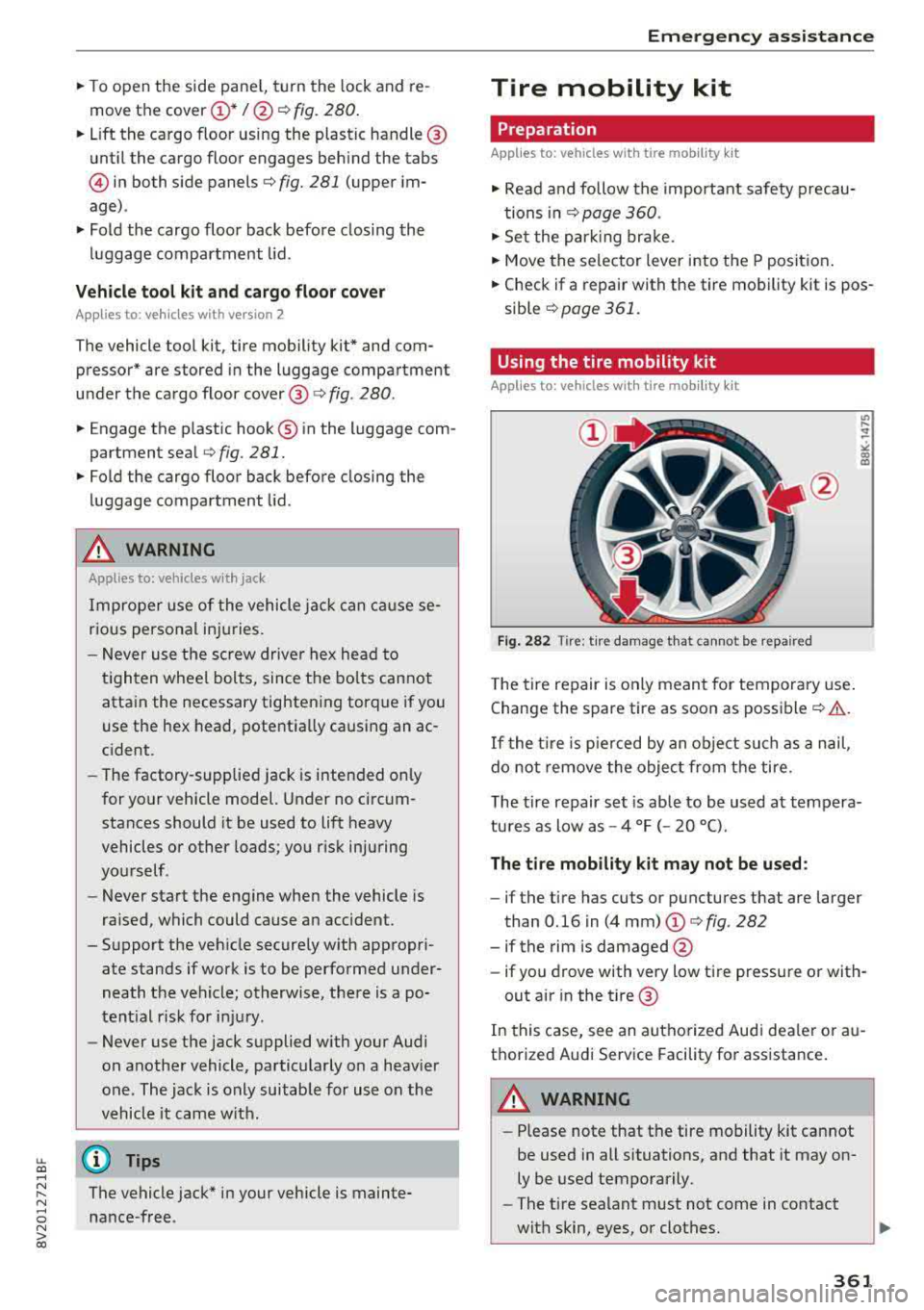
Fig. 282 Tire : tire damage t hat cannot be repaired
The tire repair is only meant for temporary use .
Change the spare tire as soon as
possible¢ &.
If the t ire is p ie rced by an object su ch as a nail,
do not remove the objec t from t he tire.
The tire repair set is able to be used at tempera
tures as low as -4 °F ( -20 °C) .
The tire mobility kit may not be us ed :
-if the t ire has cuts or punctures that are larger
than 0.16 in (4 mm)
(D ¢ fig. 282
-if the rim is damaged @
-if you drove with very low tire pressure or with-
out air in the tire @
In this case, see an authorized Aud i dea ler o r au
thorized Audi Serv ice Facility for ass istance.
.&_ WARNING
-Please note that the tire mobility kit cannot
be used in all situations, and that it may on
ly be used temporarily .
-The tire sealant must not come in contact
with skin, eyes, or clothes.
361
Page 378 of 404
Emergency situations
flowing when connecting the positive termi
nals and the vehicle battery in the vehicle
providing the jump start cou ld be drained.
- Jump start cables can cause considerab le
damage to the vehicle electrical system if
they are connected incorrectly.
- The drained vehicle battery must be con
nected correctly to the electrical system.
- P lease note that the connecting process de
scribed below for the jump start cables is in
tended for when your vehicle is being jump
started. If you are jump starting another ve
hicle, do not connect the negative cable to
the negat ive terminal( -) on the drained ve
hicle battery, but rather connect it to a large
metal component that is bolted securely to
the engine block, or to the engine block it
se lf. If the vehicle battery in the vehicle be
ing jump started is not vented to the out
side, there is a risk of explosion due to hy
drogen gas.
@ Tips
If a car phone is installed, switch it off or
check the operating guide for what to do in
this situation.
A3 models: starting the engine
Both jump start cables must be connected in the
correct order!
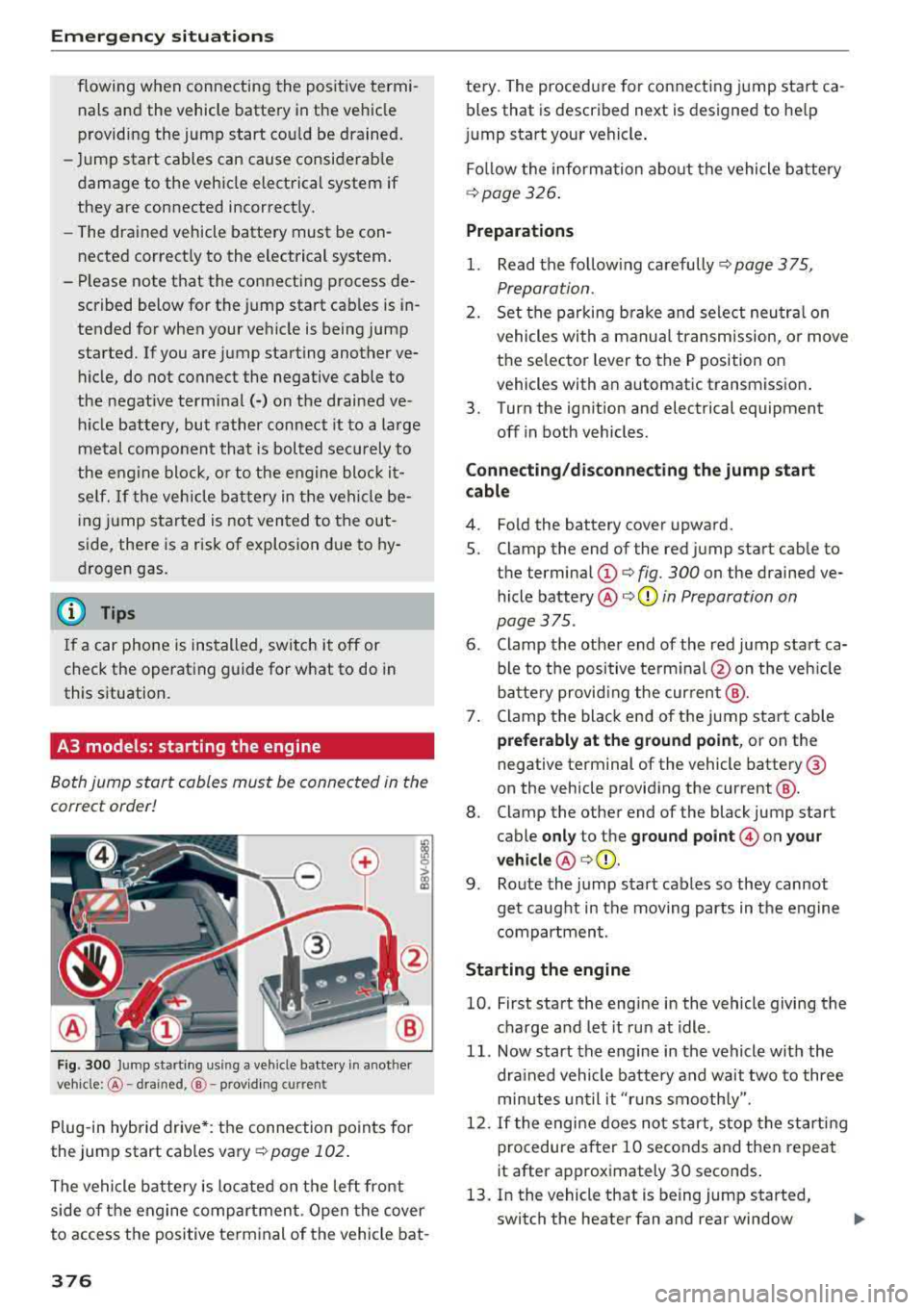
F ig. 300 Ju mp starting using a vehicle batte ry in anot her
vehicle :@ - dra ined, @- providing cu rrent
Plug-in hybrid drive *: the connection points for
the jump start cables vary Q
page 102.
The vehicle battery is located on the left front
side of the engine compartment . Open the cover
to access the positive terminal of the vehicle bat-
376
tery. The procedure for connecting jump start ca
bles that is described next is designed to help
j ump start your vehicle .
Follow the information about the vehicle battery
Qpage 326 .
Preparations
1. Read the following carefully ¢ page 375,
Preparation.
2. Set the parking brake and select neutral on
vehicles with a manual transmission, or move
the selector lever to the P position on
vehicles with an automatic transmission .
3. Turn the ignition and electrical equipment
off in both vehicles.
Connecting/disconnecting the jump start
cable
4. Fold the battery cover upward.
5. Clamp the end of the red jump start cable to
the termina l
(D ¢ fig. 300 on the drained ve
hicle
battery @Q(D in Preparation on
page
375 .
6. Clamp the other end of the red jump start ca
ble to the positive terminal @on the vehicle
battery providing the current @.
7. Clamp the black end of the jump start cab le
preferably at the ground point, or on the
negative terminal of the vehicle battery@
on the vehicle providing the current @.
8. Clamp the other end of the black jump start
cable
only to the ground point © on your
vehicle @Q(D .
9. Route the jump start cables so they cannot
get caught in the moving parts in the engine
compartment.
Starting the engine
10. First start the engine in the vehicle giving the
charge and let it run at idle.
11. Now start the engine in the vehicle with the
dra ined vehicle battery and wait two to three
minutes until it "r uns smoothly".
12. If the engi ne does not start, stop the starting
procedure after 10 seconds and then repeat
it after approximately 30 seconds .
13. In the vehicle that is being jump started, switch the heater fan and rear window
..,,
Page 384 of 404
Technical data
Capacities
Fuel tank, front wheel drive
Fuel tank, all wheel drive
Plug-in hybrid drive fuel tank
Windshield washer system
Windshield and headlight washer system*
Windshield and headlight washer system*,
S models
Windshield and headlight washer system*,
RS model.s
Weights
"'
~=Cf)== ~== ~= ~~ ~i
=I= = I= = I= c:m>
-
Aud i
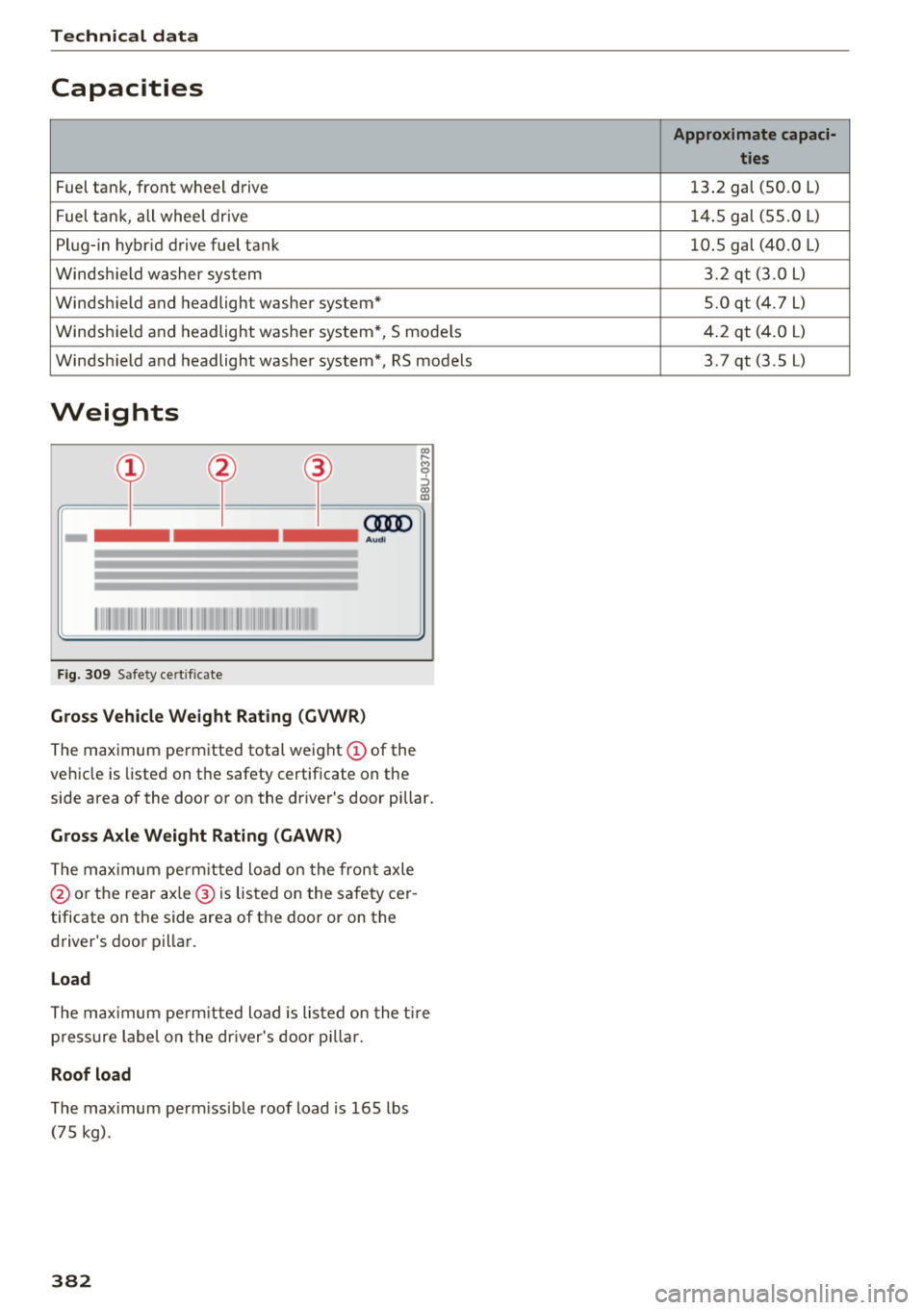
Fig. 309 Safety cert ificate
Gross Vehicle Weight Rating (GVWR)
The maximum permitted total weight (D of the
vehicle is listed on the safety certificate on the
side area of the door or on the driver's door pillar.
Gross Axle Weight Rating (GAWR)
The maximum permitt ed load on the front axle
@ or the rear ax le ® is listed on the safety cer
tificate on the side area of the door or on the
driver's door pillar.
Load
The maximum permitt ed load is listed on the tir e
p ressure labe l on the driver's door pillar .
Roof load
The max imum perm issible roof load is 165 lbs
(75 kg).
382
Approximate capaci- ties
13.2 gal (50.0 L)
14.5 gal (55.0
L)
10.5 gal (40.0 L)
3.2 qt (3.0 L)
5.0 qt (4.7 L)
4.2 qt (4.0
L)
3.7 qt (3.5 L)
Page 392 of 404
Index
Compass in the mirror . . . . . . . . . . . . . . . . . . 57
Compl iance . . . . . . . . . . . . . . . . . . . . . . . . . . 386
connect e-tron services ......... .... .. .
Connection manager
Connections 199
244
refer to Med ia . . . . . . . . . . . . . . . . . . 223, 232
Consumer I nformat ion . . . . . . . . . . . . . 258, 383
Consumpt ion (f uel) . . . . . . . . . . . . . . . . . 17 , 18
Contact ing NHT5A . . . . . . . . . . . . . . . . . . . . 258
Contacts . . . . . . . . . . . . . . . . . . . . . . . . . . . . 186
Additional directory . . . . . . . . . . . . . . . . . . 245
Impo rt ing/exporting . . . . . . . . . . . . . . . . . 187
Memory capacity . . . . . . . . . . . . . . . . . . . . 188
Storing as dest ination . . . . . . . . . . . . . . . . 208
Control buttons (operating the M MI) . . . . . 156
Contro l knob with joystick f unction (MMI op
e ration) . . . . . . . . . . . . . . . . . . . . . . . . . . . . . 159
Convenience key Emergency operat ion . . . . . . . . . . . . . . . . . . 79
Starting/stopping the engine . . . . . . . . . . . 76
Unlock ing/ lock ing . . . . . . . . . . . . . . . . . . . . 34
Convenience opening/closing . . . . . . . . . . . . 40
Conve rtible ch ild safety sea ts . . . . . . . . . . . 302
Convert ible locking retractor
Activating . . . . . . . . . . . . . . . . . . . . . . . . . . 307
D eactivating . . . . . . . . . . . . . . . . . . . . . . . . 308
Using to secure a child safety seat . . . . . . 307
Cooling down . . . . . . . . . . . . . . . . . . . . . . . . . 72
Cooling mode Automatic climate control system . . . . . . . 69
Cooling system Add ing coolant . . . . . . . . . . . . . . . . . . . . . . 325
Coolan t . . . . . . . . . . . . . . . . . . . . . . . . . . . . 324
Coolant leve l checking . . . . . . . . . . . . . . . . 325
Coolant temperature indicator . . . . . . . . . . 11
C ru ise contro l system . . . . . . . . . . . . . . . . . . 120
Cup holders . . . . . . . . . . . . . . . . . . . . . . . . . . . 62
Curre nt cons umption . .. ..... ... .. .. . 17 , 18
D
Data co nnect ion . . . . . . . . . . . . . . . . . . . . . . 196
Data pro tec tio n . . . . . . . . . . . . . . . . . . . . . . . 197
D ata recorder . . . . . . . . . . . . . . . . . . . . . . . . 152
D ate ..... ... .. .. ................ ... . 24 3
Date display . . . . . . . . . . . . . . . . . . . . . . . . . 243
Daytime runni ng lights . . . . . . . . . . . . . . . . . 49
390
Decla ration of compliance . . . . . . . . . . . . . . 386
Defrosting (windows) Automat ic cl imate cont ro l system . . . . . . . 70
DEF (instrument cluster) . . . . . . . . . . . . . . . . 12
De luxe automa tic climate contro l
refer to Climate control system
(automatic) . . . . . . . . . . . . . . . . . . . . . . 68, 69
De mo mode
refer to Pr esen ta ti on mode . . . . . . . . . . . . 209
Determ ining correct load lim it . . . . . . . . . . 345
Digital compass . . . . . . . . . . . . . . . . . . . . . . . 57
D igital R ights Ma nagement . . . . . . . . . . . . . 223
D imensions . . . . . . . . . . . . . . . . . . . . . . . . . . 381
D imm ing t he exterior mi rro rs . . . . . . . . . . . . 5 4
D imm ing t he rearv iew m irror . . . . . . . . . . . . 54
D irecto ry
refer to Contacts . . . . . . . . . . . . . . . . . . . . 186
D isplay . . . . . . . . . . . . . . . . . . . . . . . . . . . . . . 13
Cleaning . . . . . . . . . . . . . . . . . . . . . . . . . . . 357
Infotainment system disp lay . . . . . . 155, 244
Instrument cluster . . . . . . . . . . . . . . . . . . . . 16
Mult ifunct ion steer ing whee l . . . . . . . . . . . 13
D ista nce . . . . . . . . . . . . . . . . . . . . . . . . . . 17 , 18
Doors Child safety lock . . . . . . . . . . . . . . . . . . . . . . 39
Door con tact sw itch . . . . . . . . . . . . . . . . . . . 52
E mergency release . . . . . . . . . . . . . . . . . . . . 36
also refer to Unl ocking/locking .... 3 1, 33 , 34
Driver informat ion system
Chang ing v iews . . . . . . . . . . . . . . . . . . . . . . 13
E conomy tips (analog instrument cluster) . 19
E ffic iency program . . . . . . . . . . . . . . . . . . . . 19
E ne rgy cons ume rs (Aud i v ir tu al co ckpit) . . 18
Ou tside temperat ure display. . . . . . . . . . . . 12
Service interva l display . . . . . . . . . . . . . . . 328
T rip computer (analog instrument cl uster . 18
Tr ip comp uter (A udi v irtual cockpit) . . . . . . 17
V iew . . . . . . . . . . . . . . . . . . . . . . . . . . . . . . . 14
Drive r seating position . . . . . . . . . . . . . . . . . 250
Drives
refer to M edia . . . . . . . . . . . . . . . . . . 223, 232
D rive select
refer to Aud i drive select . . . . . . . . . . . . . . 140
Drivi ng econom ica lly . . . . . . . . . . . . . . . . . . . 73
D rivi ng safely . . . . . . . . . . . . . . . . . . . . . . . . 249
Driving thro ugh water . . . . . . . . . . . . . . . . . . 72