ABS AUDI S4 2017 User Guide
[x] Cancel search | Manufacturer: AUDI, Model Year: 2017, Model line: S4, Model: AUDI S4 2017Pages: 386, PDF Size: 96.32 MB
Page 136 of 386

Intelligent Technology
Intelligent Technology
Electronic Stabilization
Control (ESC)
Description
Elect ronic Stabilization Control (ESC) suppo rts
driver safety.
It red uces the risk of slipping and
improves dr iving stability. ESC detects crit ica l sit
uations such as when the vehicle is oversteering
a nd understeering or the wheels are spinning.
The vehicle is stabilized by applying the brakes or reducing eng ine torq ue. When the ESC engages,
the
Ji) i n d icator light blinks in the instrument
cluste r.
The fo llow ing systems are integrated in the ESC :
Anti-lock braking system (ABS)
ABS p revents the whee ls from locking whe n brak
ing. The vehicle can sti ll be steered even during
hard brak ing. Apply steady press ure to the brake
pedal. Do not pump the pedal. A puls ing in t he
b rake pedal indicates that the system is acting to
s tabilize the vehicle .
Brake assist system
The brake assist system can decrease brak ing dis
tance . It increases brak ing power when the d river
presses the brake pedal q uick ly in emergency sit
uations . You must press and hold t he b rake pedal
until the dangerous sit uat io n is over . In veh icles
with adapt ive c ruise control*, the bra ke as sist
sy stem is more sensitive if t he di sta nce detec ted
t o the vehicle dr iv ing ahead is too small.
Anti-slip regulation (ASR)
ASR reduces eng ine power when the drive wheels
beg in sp inning a nd adapts the force to the road
conditions . T his makes it easie r to sta rt, acceler
a te and dr ive up h ills.
Electronic differential lock (EDL)
The EDL brakes w heels that a re spinning and
transfers the drive power to the other drive
wheel or whee ls if t he ve hicle is equipped with a ll
wheel drive*) . T his funct ion is no t av ail able at
h igher spee ds.
134
In extreme cases, EDL automat ically switches off
to keep the b rake on the bra ked whee l from over
heating. The veh icle is still working correct ly. ED L
will switc h on again automatically when condi
tions have returned to normal.
Steering recommendation
The E SC he lps to stabili ze the vehicle by changing
the steer ing torque.
I n veh icles with dyn amic steer ing *, ES C also
helps to sta bilize the s teer ing in cr it ic al situa
tions.
Selective wheel torque control
Se lective wheel to rque cont rol is used when d riv
i ng on curves. The fron t whee l on the ins ide of
t h e curve or both wheels on t he i nsi de of the
curve are braked se lective ly as needed. This al
l ows mo re precise driving in c urves.
Automatic post -collision braking system
The "a utomat ic post-collis io n braking system"
c a n help to reduce t he risk of sliding and of addi
tiona l co llisions after an acc ident. If th e airbag
contro l modu le de te cts a collision, t he ve hicle is
bra ked by the ESC.
The veh icle does not br ake automatically if:
- the dr iver presses the acce lera tor pedal, or
- the ESC, the brake system or the veh icle electri-
cal system are not functioning.
&_ WARNING
- The ESC and i ts integ ra ted systems cannot
overcome the lim its imposed by natura l
phys ical laws. This is es pec ially impo rtan t
o n s lippery or we t road s. If the sy stems be
gin ac ting to s tabilize yo ur vehicle, you
should immediately a lter your speed to
match the road and traffic conditions . Do
not let t he inc reased safety provided tempt
you into taking risks. This could increase
your r isk of a coll is ion.
- Please note the r is k of a coll is ion increases
when dr iv ing fast, especially t hrough c urves
and on sli ppery or wet roads, and when dr iv
ing too close to objects ahead . T he ESC a nd
its integrated systems cannot always
Page 137 of 386

prevent collisions -there is still a risk of ac
cidents!
- Press the accelerator pedal carefully when
accelerating on smooth, slippery surfaces
such as ice and snow. The drive wheels can spin even when these control systems are
installed and this can affect driving stability
and increase the risk of a coll ision.
Switching on /off
Intelligent Technology
(D Tips
- The ABS and ASR only function correctly
when all four wheels have a sim ilar wear
condition. Different tire sizes can lead to a
reduction in engine power.
- You may hear noises when the systems de
scribed are working.
£SC turns on automatically when you start the engine.
--- --function of the ESC is limited or switched off . The
amount of stabilization control wi ll differ de
pending on the level.
--~
· :.__r" ,? .:'~~
,; ~ ... ,1
·· ----- ~
Fig. 138 Center co nso le w it h button ~ OFF
The following examples are unusua l situations
where it may make sense to switch sport mode on in order to allow the wheels to spin:
- Rocking the vehicle to free it when it is stuck
- Driving in deep snow or on loose ground
- Dr iving with snow chains
E SC is designed to function in levels. Depending
on the level that is selected, the stabilization
ESC levels
Sport mode on
Behavior
The ESC and ASR stabiliza-
tion funct ions are limited
~ .&. .
Operation Press the lfl OFFI button
briefly .
Indicator II turns on.
lights
Messages Stabilization control (ESC):
sport. Warning! Reduced
stability
A WARNING
You should only switch sport mode on or
switch ESC/ ASR off if your driving abilities and road conditions permit.
ESC/ASR off Sport mode off or
ESC/ASR on
The stabilization function is The full stabilization func-
no longer available ~.&. . tion of the ESC and ASR is
ESC and ASR are switched available again.
off.
Press and hold the
! fl O FFI Press the lfl OFFI button
button longer than 3 sec- again.
onds.
II and lf'tl•U~ turn on. fl turns off or fl and
lf'tl•l~~ turn off.
Stabilization control (ESC):
Stabilization control
off. Warning! Reduced sta- (ESC): on
bil ity
-The stabilization function is limited when
sport mode is switched on. The driving
wheels could spin and the vehicle could swerve, especially on slick or slippery road
surfaces.
135
Page 217 of 386

-Audi AG simply makes the access to online
media services possible through the MMI
and does not take any respons ibility for the
contents of the online media services.
- Always read the chapter
c;, page 178, Audi
connect (Infotainment ) information .
-Depending on the mobile device being used,
interruptions in media playback can occur.
To avoid interruptions when using a mobile
device, do not lock the screen on your mo
bile device and keep the
Audi MMI connect
app in the foreground .
- Contact your authorized Audi dealer or au
thorized Audi Service Facility for additional
information about online media .
Multimedia connections
USB adapter for Audi music interface
You con connect your mobile devices (such as o
smortphone or MP3 player) to the Audi music in
terface and charge them using o special
USB
adopt er.
Fig. 194 Audi USB adapt ers
CD USB adapter for devices with a micro USB con
nect ion
@ USB adapter for devices with an Apple Light
ning connection
@ USB adapter for devices with an Apple Dock
connector
You can purchase the USB adapter from an au
thor ized Audi dealer or at spec ialty stores .
Use the USB adapter for the
Audi music interface
,=;,page 215.
Media
(D Note
Handle the USB adapter carefully . Do not al
l ow it to be pinched .
Audi music interface
Connect your mobil e devices to the Audi music
interfac e in order to operate them through the
MMI and charge the battery.
Fig. 195 Conn ect ing mob ile device s
The Audi music interface is located under the
armrest in the center console @,=;,
page 8, fig. 2.
-Connecting a mobile device using a USB
adapter:
connect the applicable USB adapter @
c;, fig. 195 to the port on the Audi music inter
face @ and then connect the adapter to the
mobile device
CD (such as an iPod).
- Charging a mobile device using a USB adapter :
when you connect a mobile device to the Audi
mus ic interface @ using the applicable USB
adapter @,=;,
fig. 195 , the battery will auto
matically charge .
-Disconnecting a mobile device from the Audi
music interface :
remove the USB adapter@
c;, fig. 195 from the Aud i music interface .
-Disconnecting mobile devices with an Apple
Dock connector :
remove the Apple Dock con
nector from the Apple device with the release
tabs pressed in@ ¢poge
215 , fig. 194.
The media are started and operated through the
mobile device or the MMI, depending on the de
vice being used ¢
page 217.
Connecting two mobile devices : if two mobile
dev ices (for example iPod and smartphone) are
connected at the same time , then both devices
can be used as playback sources.
IJl.
215
Page 244 of 386

Driving safety
Storing cargo correctly
Loading the luggage compartment
All Luggage and other objects must be properly
stowed and secured in the Luggage compart
ment.
Fig. 207 Safe load positio ning: place heavy objects as low
and as far forwar d as possible.
Loose items in the luggage compartment can
shift suddenly, changing vehicle handling charac
teristics . Loose items can also increase the risk of
serious personal injury in a sudden vehicle ma
neuver or in a collision.
• Distribute the load evenly in the luggage com
partment.
• Always place and properly secure heavy items in
the luggage compartment as low and as far for
ward as possible
¢ fig. 207.
• Secure luggage using the tie-downs provided
¢ page 66.
• Make sure that the rear seatback is securely
latched in place .
A WARNING
Improperly stored luggage or other items can
fly through the vehicle causing serious per sonal injury in the event of hard braking or an
accident . To help reduce the risk of serious
personal injury:
- Always put objects, for example, luggage or
other heavy items in the luggage compart
ment.
- Always secure objects in the luggage com
partment using the tie-down eyelets and
suitable straps.
242
A WARNING
Heavy loads will influence the way your vehi
cle handles. To help reduce the risk of a loss
of control leading to serious personal injury:
- Always keep in mind when transporting
heavy objects, that a change in the center of
gravity can also cause changes in vehicle
handling:
- Always distribute the load as evenly as
possible.
- Place heavy objects as far forward in the
luggage compartment as possible.
- Never exceed the Gross Axle Weight Rating or the Gross Vehicle Weight Rating specified
on the safety compliance sticker on the
front end of the driver's door. Exceeding
permissible weight standards can cause the
vehicle to slide and handle differently.
- Please observe information on safe driving
¢page 236.
A WARNING
To help prevent poisonous exhaust gas from
being drawn into the vehicle, always keep the
rear lid closed while driving.
- Never transport objects larger than those
fitting completely into the luggage area be
cause the rear lid cannot be fully closed.
- If you absolutely must drive with the rear lid
open, observe the following notes to reduce
the risk of poisoning:
- Close all windows,
- Close the sliding sunroof*,
- Open all air outlets in the instrument pan-
el,
- Switch off the air recirculation,
- Set the fresh air fan to the highest speed.
A WARNING
-
Always make sure that the doors, all win
dows, the sliding sunroof* and the rear lid are
securely closed and locked to reduce the risk
of injury when the vehicle is not being used.
- After closing the rear lid, always make sure
that it is properly closed and locked.
Page 248 of 386

Safety belts
Why use safety belts?
Frontal collisions and the law of physics
Frontal crashes create very strong forces for peo
ple riding in vehicles .
Fig. 209 Unbelted occupants in a veh icle headi ng fo r a wall
Fig. 210 T he vehicle c rashes into the wall
The physical principles are simple. Both the vehi
cle and the passengers possess energy which var ies w ith vehicle speed and body weight . Engi
neers call this energy "k inetic energy."
The higher the speed of the vehicle and the
greater the vehicle's weight, the more energy
that has to be "absorbed" in the crash.
Vehicle speed is the most significant factor .
If
the speed doubles from 15 to 30 mph (25 to 50
km/h), the energy increases 4 times!
Because the passengers of this vehicle are not us
ing safety belts
r:!) fig. 209, they will keep moving
at the same speed the vehicle was moving just
before the crash, unti l something stops them -
here, the wall
r:!) fig . 210.
The same principles apply to people sitting in a
vehicle that is involved in a frontal collision . Even
at c ity speeds of 20 to 30 mph (30 to 50 km/h),
the forces acting on the body can reach one ton
246
(2,000 lbs. or 1,000 kg) or more . At greater
speeds, these forces are even higher.
People who do not use safety belts are also not
attached to their vehicle. In a frontal collision
they will also keep moving forward at the speed
their vehicle was travelling just before the crash.
Of course, the laws of physics don't just apply to
frontal collisions, they determine what happens in all kinds of accidents and collisions .
What happens to occupants not wearing
safety belts?
In crashes unbelted occupants cannot stop
themselves from flying forward and being in
jured or killed . Always wear your safety belts!
Fig. 211 A drive r not wea ring a safety belt is vio len tly
t hrow n forward
Fig. 212 A rear passe nge r not wear ing a sa fety belt will f ly
forward an d str ike the driver
Unbelted occupants a re not able to res ist the tre
mendous forces of impact by holding tight or
bracing themselves. Without the benefit of safe
ty restraint systems, the unrestra ined occupant
will slam violently into the steering wheel, in
strument panel, windshield, or whatever e lse is
in the way
r:!) fig . 211. T h is impact with the vehi
cle interior has all the energy they had just be-
fore the crash.
liJJ,-
Page 249 of 386

Never rely on airbags alone for protection. Even
when they deploy, airbags provide on ly additional
protection. Airbags are not supposed to dep loy in
all kinds of accidents. A lthough your Audi is
equipped with airbags, all vehicle occupants, in
cluding the dr iver, must wear safety belts cor
rectly in order to minimize the risk of severe in
jury or death in a crash .
Remember too, that airbags will deploy only
once and that your safety belts are always there
to offer protect ion in those accidents in w hich
a ir bags are not supposed to deploy or when they
have already deployed. Unbelted occupants can
also be thrown o ut of the vehicle where even
more severe or fatal injur ies can occur.
It is also important for the rear passengers to
wear safety belts correctly . Unbelted passengers
in the rear seats endanger not only themse lves
but also the driver and other passengers
¢fig . 212. In a frontal collision they will be
thrown forward violently, where they can hit and
injure the driver and/or front seat passenger .
Safety belts protect
People think it's possible to use the hands to
brace the body in a minor collision. It 's simply
not true!
Fig. 213 Driver is correct ly restra ined in a sudden b rak ing
maneuver
Safety belts used properly can make a big differ
ence. Safety belts he lp to keep passengers in
thei r seats, gradually reduce energy leve ls ap
plied to the body in an acciden t, and help prevent
the uncontrolled movement that can cause seri
ous injuries. In addition, safety belts reduce the
danger of being thrown out of the vehicle.
Safety belts
Safety belts attach passengers to the car and give
them the benefit of being slowed down more
gently or "softly" through the "give" in the safety
belts, crush zones and other safety features engi
neered into today's vehicles. By "absorbing" the
kinetic ene rgy over a longer period of time, the
safety belts make the forces on the body more
"tolerab le" and less likely to ca use injury .
Although these examples are based on a frontal collision, safety be lts can also substantially re
duce the r isk of injury in other k inds of crashes.
So, whether you're on a long trip or just go ing to
the corner store, always buckle up and make sure
others do, too. Acc iden t statist ics show that vehi
cle occupants properly wearing safety belts have
a lower risk of being injured and a much better
chance of surviving an accident . Properly using
safety belts also greatly increases the ability of
the supp lemental airbags to do their job in a col
lision. For this reason, wearing a safety belt is le
gally required in most count ries including much
of the United States and Canada .
Although your Aud i is equipped with airbags, you
still have to wear the safety belts provided. Front
airbags, for example, are activated only in some
frontal collisions. The front airbags are not act i
vated in all frontal collisions, in side and rear col
lisions , in rollovers or in cases where there is not
enough deceleration through impact to the front
of the vehicle. The same goes for the other air bag
systems in your Audi . So, always wear your safety
belt and make sure everybody in your vehicle is
properly restrained!
Important safety instructions about safety
belts
Safety belts must always be correctly positioned
across the strongest bones of your body.
.,. Always wear safety belts as illustrated and de
scribed in this chapter.
.,. Make sure that your safety belts are always
ready for use and are not damaged.
247
Page 260 of 386
Airbag system
-Therefore, always wear your safety belts and
make sure that everybody in your vehicle is
properly restrained.
- Always hold the steering wheel with both
hands on the outside of the steering wheel
rim at the 9:00 o 'clock and 3 :00 o'clock po
sitions to help reduce the risk of personal in
jury if the driver's airbag inflates .
- Never hold the steering wheel at the 12
o'clock position or with your hands any
where inside the steering wheel or on the steering wheel hub. Holding the steering
wheel the wrong way increases the risk of
severe injury to the arms, hands, and head if
the driver airbag deploys.
A WARNING
Objects between you and the airbag will in
crease the risk of injury in a crash by interfer
ing with the way the airbag unfolds and/or by
being pushed into you as the airbag inflates.
- Always make sure nothing is in the front air-
-
bag deployment zone that could be struck
by the airbag when it inflates.
- Objects in the zone of a deploying airbag
can become projectiles when the airbag de
ploys and cause serious personal injury.
- Never hold things in your hands or on your lap when the vehicle is in use .
- Never place accessories or other objects
(such as cup holders, telephone brackets,
note pads, navigation systems, or things
that are large, heavy, or bulky) on the doors;
never attach then to the doors or the wind
shield; never place them over or near or at
tach them to the area marked ,.AIRBAG" on
the steering wheel, instrument panel or the
seat backrests; never place them between
these areas and you or any other person in
the vehicle.
- Never attach objects to the windshield
above the passenger front airbag, such as
accessory GPS navigation units or music
players. Such objects could cause serious in
jury in a collision, especially when the air bags inflate .
258
-Never recline the front passenger seat to
transport objects. Items can also move into
the deployment area of the side airbags or
the front airbag during breaking or in a sud
den maneuver . Objects near the airbags can
fly dangerously through the passenger com
partment and cause injury, particularly
when the seat is reclined and the airbags in
flate.
A WARNING
A person on the front passenger seat, espe
cially infants and small children, will receive
serious injuries and can even be killed by be ing too close to the airbag when it inflates .
- Although the Advanced Airbag System in
-
your vehicle is designed to turn off the front
passenger airbag if an infant or a small child
is on the front passenger seat, nobody can
absolutely guarantee that deployment un
der these special conditions is impossible in
all conceivable situations that may happen
during the useful life of your vehicle.
- The Advanced Airbag System can deploy in
accordance with the .,low risk" option for 3-
and 6-year-old children under the U.S . Fed
eral Standard if a child with electrical capac
itance greater than the combined capaci
tance of a typical one-year old infant re
strained in one of the forward facing or rear
ward-facing child seats with which your ve
hicle was certified is on the front passenger
seat and the other conditions for airbag de
ployment are met.
- Accident statistics have shown that children
are generally safer in the rear seat area than
in the front seating position.
- For their own safety, all children, especially
12 years and younger, should always ride in
the back properly restrained for their age and size.
Advanced front airbag system
Your vehicle is equipped with a front Advanced
Airbag System in compliance with United States
Federal Motor Vehicle Safety Standard (FMVSS)
208 , as well as Canada Motor Vehicle Safety ..,.
Page 262 of 386

Airbag syste m
seat. Please be sure to read the important infor
mation in the sections that follow and be sure to
heed all of the WARNINGS.
A WARNING
To reduce the risk of injury when an airbag in
flates, always wear safety belts properly.
- If you are unrestrained, leaning forward, sit ting s ideways or out of position in any way,
your risk of injury is much h igher.
- You will also receive serious injuries and could even be killed if you are up aga inst the
airbag or too close to it when it inflates -
even with an Advanced Airbag
r:::;, page 253 .
A WARNING
A child in a rearward-facing chi ld safety seat
installed on the front passenge r seat w ill be
ser iously injured and can be killed i f the front
airbag inflates -even w ith an Advanced Ai rbag
System.
- Although the Advanced A irbag System in
yo ur vehicle is designed to tu rn off the front
airbag when a rearwa rd -facing child re
straint has been insta lled on the front pas
senger seat, nobody can absolutely guaran
tee that deployment is impossible in all con
ceivable s ituations that may happen during
the useful life of your vehicle .
- The inflating a irbag w ill hit the child safety
seat or infant carrier with great force and
will smash the chi ld safety seat and child
against the backrest, center armrest , door,
o r roof .
- Always install rearward -facing ch ild re
straints on the rear seat .
- If you must install a rearward fac ing ch ild
safety seat on the front passenger seat be
cause of exceptiona l circumstances and the
PASSENGER AIR BAG OFF~; light does not
c ome on and stay on, immed iate ly install
the rear-fac ing ch ild safety seat in a rear
seating position and have the airbag system
inspected by your authorized Audi dea ler.
260
A WARNING ,_
If, in exceptional circumstances, you must in
stall a forward-facing child restraint on the
front passenger's seat:
- Always make sure the forward-facing seat
has been des igned and certified by its man
ufacturer for use on a front seat with a pas
senger front and side airbag.
- Never put the forwa rd-facing child restraint
up against or very nea r the instrument pan
el.
- Always move the front passenge r seat to
the highest posit ion in the up and down ad
justmen t range and move it back to the
rearmost posit io n in the seat's fo re and aft
adjustment range, as far away from the a ir
bag as poss ible, before install ing the for
ward-facing chi ld restraint.
- Always make sure that the safety be lt upper
anchorage is behind the chi ld rest raint and
not next to o r in front of the c hild restraint
so that the safety be lt will be p roper ly posi
tioned.
- Always make sure that there is noth ing on
the front passenger seat that will cause the
capacitive passenger detection system in
the seat to signal to the Airbag System that
the seat is occup ied by a person when it is
no t, or to signal that it is occupied by some
one who is heavier than the person ac tually
si tting on the sea t. T he presence of addi
tional objects could cause the passenger
front airbag to be turned on when it should
be
off, or could cause the airbag to work in a
way that is d ifferent from the way it wou ld
have worked without the object on the seat.
- Make sure that the
PASSENGER AIR BAG
OFF ~;
light comes on and stays on all the
time whenever the ign it ion is switched on.
Advanced Airbag System components
T he front passenger seat in your veh icle has a lot
of ve ry important parts of the Advanced A irbag
System i n it. These parts incl ude the capacitive
passenger detection system, wir ing , b rackets,
and more. The control uni t moni tors the system
on the front passenge r seat when t he ignit ion is ..,.
Page 271 of 386
-For safety reasons in severe accidents, the
alternator and starter are separated from
the vehicle battery with a pyrotechn ic circuit
interrupter.
- Work on the pyrotechnic circ uit interrupt
er must only be performed by a qualified
technicians who have the experience, in
formation and special tools necessary to
perform the work safely.
- If the vehicle or the circuit interrupter is
scrapped, all app licab le safety precautions
must be followed .
@) For the sake of the environment
Undeployed airbag modu les a nd pretension
ers might be classified as Perch lorate Materi
al -special handling may apply, see
www.dtsc .ca.gov/hazardouswaste/perchlo
rate. When the vehicle or parts of the re
straint system including airbag modules and
safety belts with pretensioners are scrapped,
all applicable laws and regulations must be
observed. Your authorized Audi dealer is fa
m iliar with these requi rements a nd we recom
mend t hat you have you r dealer perform this
service for you.
Other things that can affect Advanced
Airbag performance
Changing the vehicle's suspension system can
change the way that the Advanced Airbag System
performs in a crash . For example, using tire-r im
comb inat ions not approved by Audi, lowering the
ve hicl e, chang ing the stiffness of the suspens io n,
in clud ing the spr ings, suspens ion str uts, shock
absorbers et c. can change the forces that are
measured by the airbag sensors and sent to the
e lectronic contro l unit. Some suspension changes
can, for example, increase the force levels meas
ured by the sensors and make the airbag system
deploy in crashes in wh ich it would not deploy if
the changes had not been made. Other ki nds of
changes may reduce the fo rce levels meas ured by
the sensors and prevent the airbag from deploy
in g when i t should .
Airbag sys tem
A WARNING
-Changing the vehicle's suspension including
use of unapproved tire-rim combinations can
change Advanced Airbag performance and in
crease the risk of serious persona l injury in a
crash.
- Never install suspension components that
do not have the same pe rformance charac
teristics as the components o rigina lly ins tal
led on your vehicle.
- Never use tire-rim combinations t hat have
not been approved by Audi.
Knee airbags
Description of knee airbags
The knee airbag system can provide supplemen
tal protection to prop erly restrained front sea t
occupants.
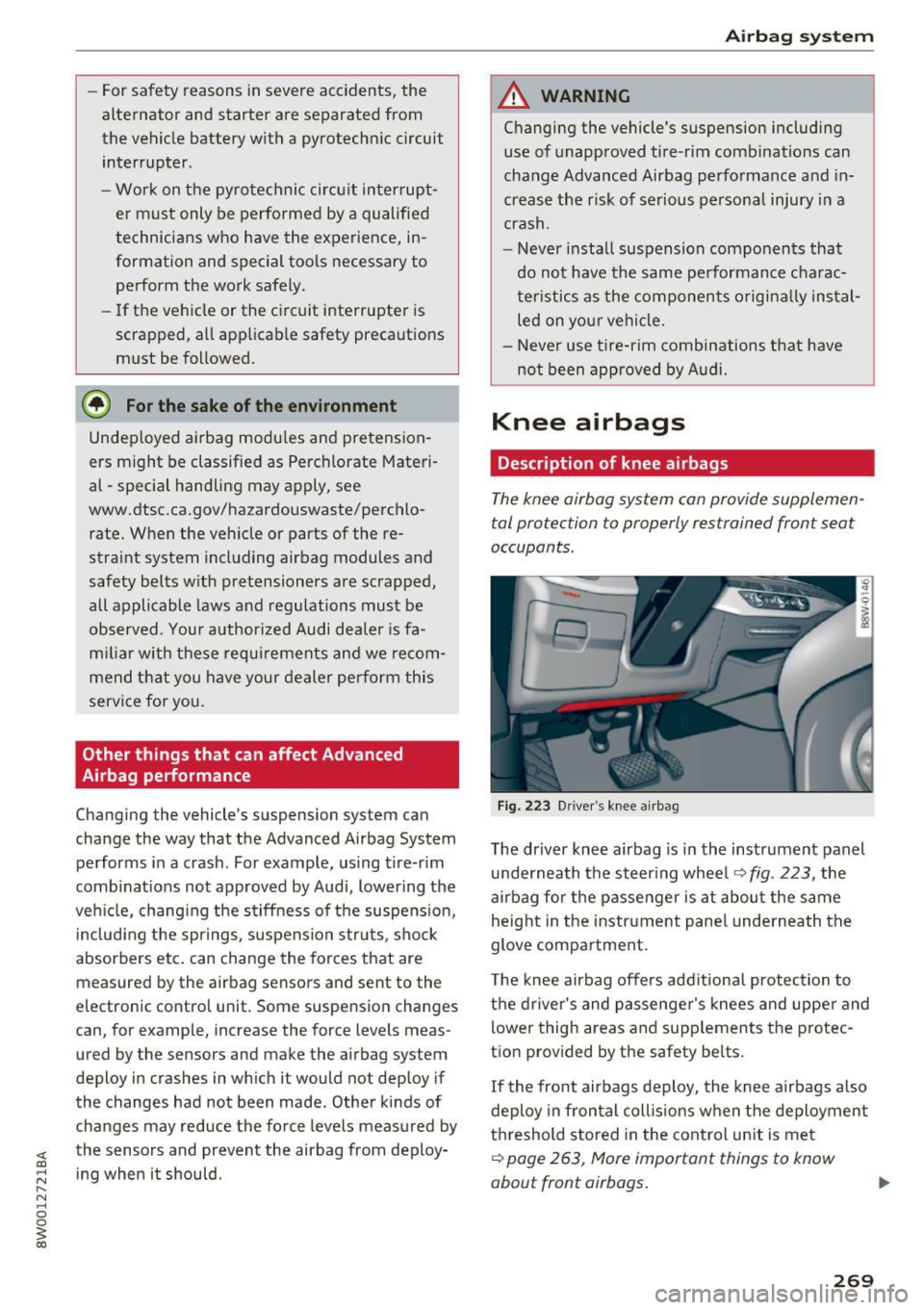
F ig. 223 D river 's knee a irbag
The driver knee airbag is in the instrument panel
u nderneath the steering whee l
~fig. 223, the
airbag fo r the p asse nger is at about the same
height in the instr ument pane l underneath the
glove compa rtment.
T he knee airbag offers add itiona l protection to
the driver's and passenge r's knees and uppe r and
lower thigh areas and supp lements the protec
tion provided by the safety be lts .
If the front airbags deploy, the knee airbags a lso
deploy in fron tal coll is ions when the deploymen t
threshold stored in the cont rol un it is me t
~ page 263, More important things to know
about front airbags.
269
Page 289 of 386

Booster seats and safety belts
Properly used booster seats can help protect
children weighing between about 40 lbs. and 80
lbs. (18 kg and 36 kg) who are less than 4
ft. 9
in. (57 inches/1.45 meters) tall.
Fig. 233 Rear seat: child p roper ly restrained in a booster
seat
The vehicle's safety belts alone will not fit most
children until they are at least 4
ft. 9 in. (57 in
ches/1.45 meters) tall and weigh about 80 lbs.
(36 kg). Booster seats raise these ch ildren up so
that the safety belt will pass properly over the
stronger parts of their bodies and the safety belt
can help protect them in a crash.
.,. Do not use the convertible locking retractor
when using the vehicle's safety belt to restrain
a chi ld on a booster seat .
.. The shoulder belt must lie as close to the cen
ter of the child's collar bone as possible and must lie flat and snug on the upper body. It
must never lie across the throat or neck. The
lap belt must lie across the pelvis and never
across the stomach or abdomen. Make sure the
belt lies flat and snug. Pull on the belt to tight
en if necessary .
.,. If you must transport an older chi ld in a boos
ter seat on the front passenger seat, you can
use the safety belt height adjustment to help
adjust the shoulder portion properly .
.. Secure unused safety belts on the rear seat
r:=>page 283.
Children up to at least 8 years old (over 40 lbs. or
18 kg) are best protected in child safety seats de
signed for their age and we ight. Experts say that
the skeletal structure, part icularly the pelvis, of
these children is not fully developed, and they
Child safety
must not use the vehicle safety belts without a
suitable child restraint.
It is usually best to put these children in appro
priate booster seats. Be sure the booster seat
meets all applicab le safety standards .
Booster seats raise the seating position of the
child and reposition both the lap and shoulder
parts of the safety belt so that they pass across
the child's body in the right places. The routing of
the be lt over the chi ld's body is very important
for the ch ild's protection, whether or not a boos
ter seat is used. Children age 12 and under must
always ride in the rear seat.
Children who are at least 4
ft. 9 in. (57 inches/
1.45 meters) tall can generally use the vehicle's
three point lap and shoulder belts . Never use the
lap belt portion of the vehicle's safety belt alone
to restrain any ch ild, regard less of how big the
ch ild is. Always remember that child ren do not
have the pronounced pelvic structure required for
the proper function of lap be lt portion of the ve
hicle's three point lap and shoulder belts. The
child's safety absolutely requires that a lap belt
portion of the safety belt be fastened snug ly and
as low as possible around the pe lvis. Never let
the lap belt portion of the safety belt pass over
the child's stomach or abdomen .
In a crash, airbags must inflate within a blink of
an eye and with considerab le force. In order to do
its job, the airbag needs room to inflate so that it
will be there to protect the occupant as the occu
pant moves forward into the airbag .
A vehicle occ upant who is out of position and too
close to the a irbag gets in the way of an inflating
airbag. When an occupant is too close , he or she
will be struck violently and w ill receive serious or
possibly even fata l injury .
In order for the airbag to offer protect ion, it is
important that all vehicle occupants, especially
any children , who must be in the front seat be
cause of exceptiona l circumstances, be properly
restrained and as far away from t he airbag as
poss ible. By keeping room between the child's ..,_
287