ESP AUDI S6 2008 Owners Manual
[x] Cancel search | Manufacturer: AUDI, Model Year: 2008, Model line: S6, Model: AUDI S6 2008Pages: 390, PDF Size: 88.42 MB
Page 331 of 390
________________________________________________ T_ i _r_e _s_ a_n_ d_ w_ h_ e_e _ l_s __ llll
•
Quality grades can be found where applicable on the tire side wall
between tread shoulder and maximum section width =>
page 325,
fig. 244.
For example: Tread wear 200, Traction AA, Temperature A.
All passenger car tires must conform to Federal Safety Require
ments in addition to these grades .
Tread wear
The tread wear grade is a comparative rating based on the wear rate
of the tire when tested under controlled conditions on a specified
government test course.
For example, a tire graded 150 would wear one and one half (1 1/2)
times as well on the government course as a tire graded 100.
The relative performance of tires depends upon the actual condi
tions of the ir use, however, and may depart significantly from the
norm due to variations in driving habits, service practices and differ
ences in road characteristics and c limate .
Traction
The traction grades, from highest to lowest , are AA, A, Band C .
Those grades represent the tire 's ability to stop on wet pavement as
measured under controlled conditions on specified government
test surfaces of asphalt and concrete. A tire marked C may have
poor traction performance =>& .
Temperature
The temperature grades are A (the highest), B, and C, representing
the tire 's resistance to the generation of heat and its ability to dissi
pate heat when tested under controlled conditions on a specified
indoor laboratory test wheel.
Sustained high temperature can cause the material of the tire to
degenerate and reduce tire life, and excessive temperature can lead
to sudden tire failure =>& .
The grade C corresponds to a level of performance which all
passenger car tires must meet under the Federal Motor Vehicle Safety
Standard No. 109. Grades Band A represent higher leve ls of
performance on the laboratory test wheel than the minimum
required by law.
& WARNING
The traction grade assigned to this tire is based on straight-ahead
braking traction tests, and does not include acceleration,
cornering, hydroplaning or peak traction characteristics.
& WARNING
The temperature grade for this tire is established for a tire that is
properly inflated and not overloaded. Excessive speed, underinfla
tion, or excess ive loading, either separately or in combination, can
cause heat buildup and possible tire failure . •
Winter tires
Winter tires can improve vehicle handling on snow and
ice. At temperatures below 45 °F (7 °C) we recommend
changing to winter tires.
In some heavy snow areas, local governments may require true
winter or "snow" tires, those with very deeply cut tread. These tires
should only be used in pairs and be installed on all four wheels .
Make sure you purchase snow tires that are the same size and
construction type as the other tires on your vehicle.
If your vehicle is equipped with al l-wheel drive *, this will improve
traction during winter dr iving, even with the standard tires.
However, we strongly recommend that you always equip all four
wheels on your vehicle with correctly fi tted winter tires or all-season
tires, when winter road conditions are expected . T his also improves
the vehicle 's braking performance and reduces stopping distances.
Summer tires provide less grip on ice and snow.
Vehicle care I t •
Page 334 of 390
-Tires and wheels
PW-------------------
possible with a torque wrench -preferably by an authorized Audi
dealer or qualified workshop. •
Low aspect ratio tires
Your Audi is factory-equipped with low aspect ratio tires . These tires
have been thoroughly tested and been selected specifically for your
model for their superb performance, road feel and hand ling under
a variety of driving conditions . Ask your authorized Audi dealer for
more details.
The low aspect ratio of these tires is indicated by a numeral of
55 or
less
in the tire's size designation. The numeral represents the ratio
of the tire's sidewa ll height in relat ion to its tread width expressed
in percentage. Conventional tires have a height/width ratio of 60 or
more.
The performan ce of low -aspect-ratio tires is particularly sensitive to
improper inflation pressure. It is therefore important that low
aspect ratio tires are inflated to the specified pressure and that the
inflation pressure is regularly checked and maintained. T ire pres
s ures should be checked at least once a month and always before a
long trip => page 379,
"Checking tire pressure".
What you can do to avoid tire and rim damage
Low aspect ratio tires can be damaged more easily by impact with
potho les, curbs, gullies or ridges on the road, particularly if the tire
is underinflated.
In order to minimize the occurrence of impact damage to the tires
of your vehicle, we recommend that you observe the following precautions:
• Always ma inta in recommended inflation pressures. Check your
tire pressure every 2,000 miles (3,000 km) and add air if necessary.
• Drive carefully on roads with potholes, deep gu llies or ridges.
The impact from driving through or over such obstacles can
damage your tires. Impact with a curb may also cause damage to
your tires . •
After any impact, immediately inspect your tires or have them
inspected by the nearest authorized Audi dealer. Replace a
damaged tire as soon as possible.
• Inspect your tires every 2,000 miles (3,000 km) for damage and
wear. Damage is not always easy to see. Damage can lead to loss of
air and underinflation, which could eventually cause tire failure. If
you believe that a tire may have been damaged, replace the tire as
soon as possib le.
• T hese tires may wear more quickly than others .
• Please also remember that, whi le these tires deliver respons ive
handling, they may ride less comfortably and make more noise than
other choices .
Reduced performance in winter /cold season
conditions
A ll tires are designed for certain purposes. The low aspect ratio,
u ltr a high performance tires originally installed on your vehic le are
intended for maximum dry and wet road performance and handling.
They are not suitable for cold, snowy or icy weather conditions. If
you drive under those circumstances, you should equip your vehic le
with all -season or winter tires , wh ich offer better traction under
those conditions. We suggest you use the recommended snow or all -season tires specified for your vehicle, or their equivalent .
Refer to=>
page 329for more detailed information regarding winter
tires. •
Page 347 of 390
_________________________________________________ F_ u_ s_ e_s _ a_n _d_ b_ u _ lb_ s _ __.1111
Fuses and bulbs
Fuses
Replacing a fuse
A problem in the electrical system may be caused by a
blown fuse.
Fig . 256 Ins trumen t
pa nel left: Face c over
F ig . 257 I nst rume nt
pa nel left: Co ntent
F ac e cover
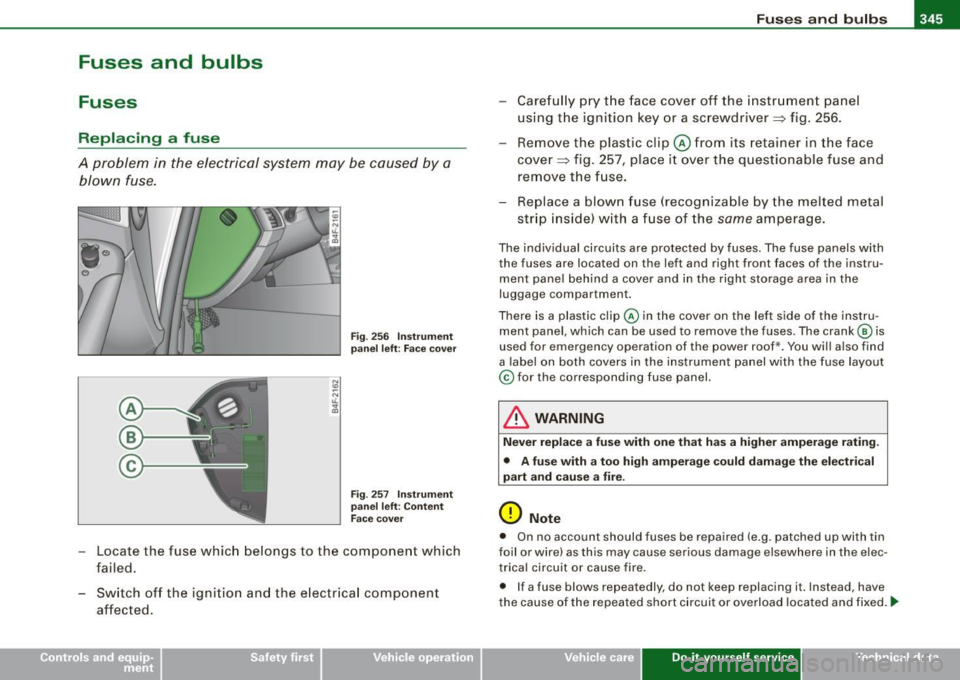
- Locate the fuse which belongs to the component which
failed.
- Switch off the ignition and the e lectr ica l component
affected. - Carefully p
ry t he face cover off the instr umen t pane l
using the ignition key or a screwdriver~ fig. 256.
- Rem ove the plastic clip @ from i ts retainer in the face
cove r~ fig. 257, p lace i t over the questionable fuse and
remove the fuse.
- Replace a blown fuse (recognizable by the melted metal
str ip inside) wi th a f use of the
same amperage.
The individual circuits are protected by fuses. T he fuse panels with
the fuses are located on the left and right front faces of the instru
ment pane l behind a cover and in the right storage area in the
luggage compartment.
There is a plastic clip @ in the cover on the lef t side of the instru
ment pane l, which can be used to remove the fuses . The crank © is
used for emergency operation of the power roof*. You will also find
a label on both covers in the instrument panel with the fuse layout
© for the corresponding fuse panel.
& WARNING
Nev er r eplac e a fuse with one that ha s a high er amperag e rati ng.
• A fu se w ith a to o high ampe rage co uld d amag e the ele ctr ical
pa rt a nd cau se a fire .
0 Note
• On no account should fuses be repaired (e .g. patched up wi th tin
foil or wire) as this may cause serious damage elsewhere in the e lec
trica l circuit o r cause fire.
• If a fuse blows repeatedly, do not keep replacing it. Instead , have
the cause of the repea ted short circuit or overload located and fixed.
ti>
Vehicle care Do-it-yourself service Technical data
Page 348 of 390
llft!I Fuses and bulbs ..._ __________________________________________ _
[ i J Tip s
You are wel l advised to keep a supply of spare fuses in your vehicle .
Fuses with the proper ampere ratings are availab le at your Audi
dea ler. •
Fuse Location , Instrument Panel left
Fig . 258 Fuse pa nel
l ayo ut
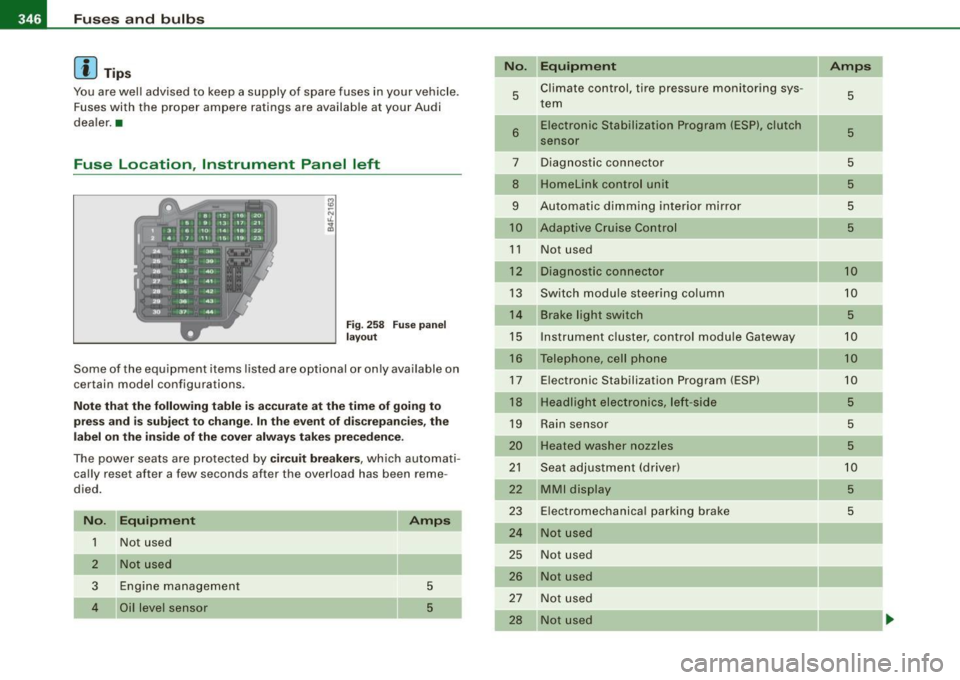
Some of the equipment items listed are optional or only ava ilable on
certain model configurations .
Note th at t he fo llo wi ng t able i s acc urat e at th e time of goin g to
pr ess and is subject t o ch ang e. In th e eve nt of d iscrep ancie s, th e
labe l on th e in side of th e cover always ta kes prece de nce .
The power seats are protected by cir cuit br eaker s, which automati
cally reset after a few seconds after the overload has been reme
died.
N o. Equipm ent
1 Not used
2
3
4
Not used
Engine management
Oil level sensor Amps
5
5
No
.
5
6
..
7
8
9
10
1 1
12
13
14
15
16
17
18
19
20
21
22
23
24
25
26
27
28
Equipm ent
Climate cont rol , tire pressure monitoring sys
tem
Electronic Stabilization Program (ESP), clutch
sensor
Diagnostic connector
Homelink control unit
Automa tic dimming interior mirror
Adaptive Cruise Control
Not used
Diagnostic connector
Switch modu le steering column
Brake light switch
I nstrument c luster, control module Ga teway
Telephone, cell phone E lectronic Stabilization Program (ESP)
Headlight electronics, left -side
Rain sensor
Heated washer nozzles
Seat adjustment (driver)
MMI display
E lectromechanica l parking brake
Not used
Not used
Not used
N ot used
Not used Amps
5
5
5
5
5
5
10
10
5
10
10
10
5
5
5
10
5
5
-
Page 349 of 390
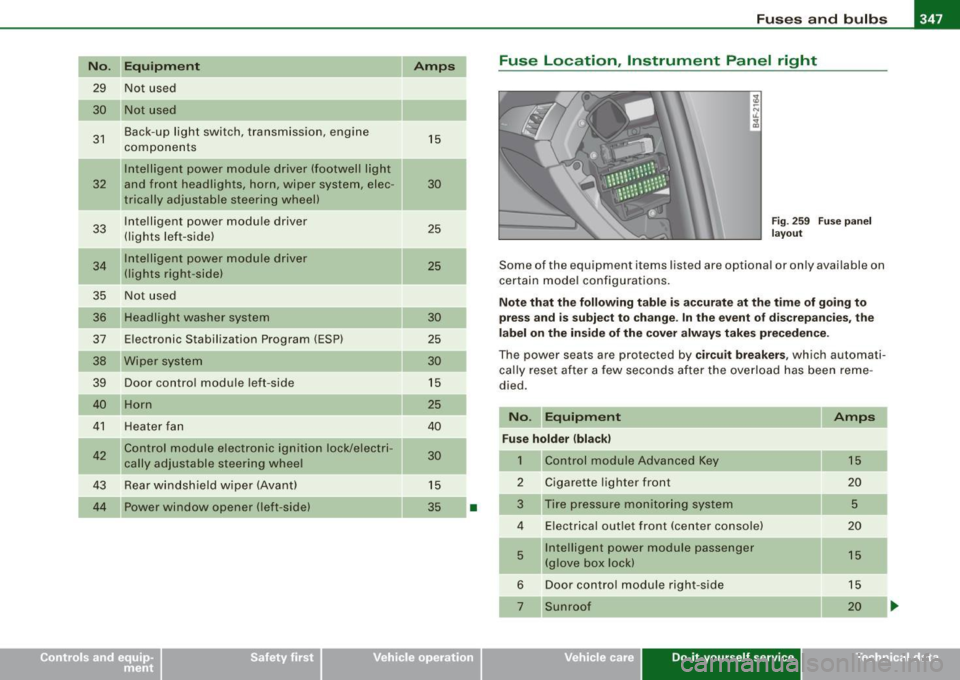
_______________________________________________ F_ u_ s...:....... e...;.s _ a_ n_d :.:.....:.: b:...: u:...: l:.:.: b :...:s:...___,J
No . Equipm ent
29 Not used
30 Not used
31 Back-up light swi
tch, transmission , engine
components
Intelligent power mo dule driver (footwell l ight
32 and front headlights , horn, wiper system, elec
tr ically adjusta ble steering wheel)
33 I
ntelligent power modu le driver
(lights left -side)
---,--
34
35
36
37
38
39 I
nte lligent power modu le driver
(lights right -side)
Not used
Headlight washer system
E lectronic Stabilization Program (ESP)
Wip er system
Door control module left -side
Horn
41 Heater fan
42 Control module electronic ignition lock/electri
cally adjustable steering wheel
43 Rear windsh iel d wiper (Avant)
4 4 Power window opener (left-side)
Amps
15
30
25
25
30 25
30
15
25
40
30
15
35
-
•
Fuse Location , Instrument Panel right
Fig . 2 59 F use p an el
la yo ut
Some of the equipm ent items lis ted are op tional or on ly available on
certain m ode l configu rations.
Note that the following table is ac curate at the time of g oing to
press and is subject t o change . In the ev ent of d iscrepan cies , th e
l a b el on t he in side of the cover alw ay s take s prec eden ce.
Th e power seats are pr otected by circuit breaker s, which automa ti
ca lly reset after a few seconds a fter the ove rload has been reme
died .
No. Equipment Amps
Fu se holder (bla ck )
1 Control module Advanced Key 15
2 Cigarette
lighter front
20
3 Tire pressure moni tor ing system
5
4 E lectrica l outlet front (center conso le) 20
5 Intellige
nt power module passenger
15
(glove box lock)
6 Door control module right -side 15
Sunroof 20
Vehicle care Do-it-yourself service irechnical data
Page 359 of 390
________________________________________________ E _m_ e_r.:g :;,. e_ n_c ...: y:.- s_ i_ t _u _a_ t_ i_ o _ n_ s __ lll
•
& WARNING
• To reduce the risk of serious injury and vehicle damage.
-Always lift the vehicle only at the special workshop hoist and
floor jack lift points illustrated
=> page 356, fig. 267 and
=> page 356, fig. 268.
- Failure to lift the vehicle at these points could cause the
vehicle to tilt or fall from a lift if there is a change in vehicle
weight distribution and balance. This might happen, for
example, when heavy components such as the engine block or
transmission are removed.
• When removing heavy components like these, anchor vehicle
to hoist or add corresponding weights to maintain the center of
gravity. Otherwise, the vehicle might tilt or slip off the hoist,
causing serious personal injury.
0 Note
• Be aware of the following points before lifting the vehicle:
- The vehicle should never be lifted or jacked up from under
neath the engine oil pan, the transmission housing, the front or
rear axle or the body side members . This could lead to serious
damage.
- To avoid damage to the underbody or chassis frame, a rubber
pad must be inserted between the floor jack and the lift points.
- Before driving over a workshop hoist, check that the vehicle
weight does not exceed the permissible lifting capacity of the hoist .
- Before driving over a workshop hoist, ensure that there is
sufficient clearance between the hoist and low parts of the
vehicle. •
Do-it-yourself service
Page 368 of 390
___ C_ o_n_ s_ u_m _ e_ r_ ln_ f_ o _r _m _ a_ t_ i_o _n ______________________________________________ _
standards. Therefore, vehicles built for the U.S .A. and Canada differ
from vehicles sold in other countries.
If you plan to take your vehicle outside the continental limits of the
United States or Canada, there is the possibility that
• unleaded fuels for vehicles with catalytic converter may not be
available;
• fuel may have a considerably lower octane rating. Improper fuel
may cause engine damage;
• service may be inadequate due to lack of proper service facilities,
tools or testing equipment;
• replacement parts may not be readily available .
• Navigation systems for vehicles built for the U.S.A. and Canada
will not necessarily work in Europe , and may not work in other coun
tries outside of North America.
0 Note
Audi cannot be responsible for mechanical damage that could
result from inadequate fuel , service or parts availability .•
Audi Service Repair Manuals and
Literature
Audi Official Factory Service Manuals are published as soon as
possible after model introduction. Service manuals are available
from :
Audi Technical Literature Ordering Center
Call toll -free:
Tel.: 1 (800) 544-8021
(from 8:00 AM to 8:00 PM, EST, Monday through Friday)
or access their website www.audi.ddsltd.com on the Internet to
order repair manuals and other Audi literature. •
Maintenance
General
Your vehicle has been designed to help keep maintenance require
ments to a minimum. However, a certain amount of regular mainte
nance is still necessary to assure your vehicle 's safety, economy and
reliability. For detailed vehicle maintenance consult your Mainte
nance & Warranty booklet .
Under difficult operating conditions, for example at extremely low
outside temperatures, in very dusty regions, when towing a trailer
very frequently, etc., some service work should be performed
between the intervals specified. This applies particularly to:
• oil changes , and
• cleaning or replacing the air filter.
~ For the sake of the environment
By regularly maintaining your vehicle, you help make sure that emis
sion standards are maintained, thus minimizing adverse effects on
the environment. •
Important considerations for you and your
vehicle
The increasing use of electronics, sophisticated fuel injection and
emission control systems, and the generally increasing technical
complexity of today's automobiles, have steadily reduced the scope
of maintenance and repairs which can be carried out by vehicle
owners. Also, safety and environmental concerns place very strict
limits on the nature of repairs and adjustments to engine and trans
mission parts which an owner can perform.
Maintenance, adjustments and repairs usually require special tools,
testing devices and other equipment available to specially trained .,_
Page 369 of 390
_______________________________________________ C _o_ n _ s_u _ m_ e_ r_l_n _f_o _ r_ m_ a_ t _i _o _ n __ PII
workshop personne l in order to assure proper performance, reli
abil ity and sa fe ty of the vehicle a nd i ts many sys te m s.
I mproper maintenance, adjustments and repairs can impair the
operation and reliabil ity of your vehicle and even void your vehicle
war ra nty. T here fore, proof o f serv ic ing in accorda nce with the main
tenance schedule may be a condition for uphold ing a possible
war ra nty claim made withi n th e warranty per iod .
Above all, operat ional safety can be adverse ly affected, creating
unnece ssary risks fo r you and you r passengers .
If in doubt about a ny servici ng, have it do ne by your authorized Aud i
dea ler or any other properly equipped and qua lified workshop. We
str ongly u rge you to give your auth orized Audi dealer the oppo rtu
nity to perform al l scheduled maintenance and necessary repairs.
You r deale r has the facil ities, origi nal par ts and trained special is ts
to keep your vehic le running proper ly.
Performing limited maintenance yourself
T he fo llow ing pages describe a limited numbe r of procedures which
can be perfo rme d on you r vehicle wi th ordi nary too ls, should the
need arise and trained personne l be unavailab le. Before performing
any of these proced ures, always thor oug hly read a ll of th e appli
cable text and carefu lly fo llow the instructions given. Always rigor
ously observe the WARNINGS provided.
Before you check anything in the engine compartment , alway s read
and heed all WARNINGS:::>
& and:::> & in "Wo rking in the engine
compartment" on
page 297.
& WARNING
• Ser ious persona l injury may occur as a result of improperly
performed maintenance , adjustments or repairs.
• Always be e xtremely careful when working on the vehicle .
Always follow commonly accepted safety practices and general
c ommon sense . Never ri sk per sonal injury .
Controls and equip ment Safety first
Vehicle operation
& WARNING (continued )
• Do not attempt any of the maintenance , checks or repairs
described on the following pages if you are not fully familiar with
these or other pro cedures with respect to the vehicle , or are uncer
tain how to proceed.
• Do not do any work without the proper tools and equipment.
Have the necessary work done by your autho rized Audi dealer or
another properly equipped and qualified workshop .
• The engine compartment of any motor vehicle is a potentially
hazardous area . Never reach into the area around or touch the
radiator fan . It i s temperature controlled and can switch on
suddenly - even when the engine is off and the ignition key has
been removed . The radiator fan switche s on automatically when
the coolant reaches a certain tempe rature and will continue to run
until the coolant temperature drops .
• Always remove the ignition key before anyone gets under the
vehicle.
• Always support your vehicle with safety stands if it is neces
sary to work underneath the vehicle. The jack supplied with the
vehicle is not adequate for this purpose and could collapse
causing serious personal injury .
• If you must work underneath the vehicle with the wheels on
the ground, always make sure the vehicle is on level ground , that
the wheels are always securely blocked and that the engine
cannot be started .
• Always make sure the transmission selector lever (automatic
transmission) is in "P " (Park position) and the park br ake is firmly
appl ied .
ffi For the sake of the environment
• Changing the engine settings wi ll adverse ly affect emission
leve ls. T his is detrimenta l to the envi ro nmen t and i ncreas es fu el
consumption.
Vehicle care Do-it-yourself service Tec hn ica l da ta
Page 378 of 390
llffl __ A_l.:,. p _h_ a_ b_e _t _ic _ a_l _in _ d_e _x ____________________________________________ _
Driver seat
See Seating position . . . . . . . . . . . . . . 194
Driver's seat . . . . . . . . . . . . . . . . . . . . . . . . 88
Driver's seat memory . . . . . . . . . . . . . . . . . 91
Activating remote control key .. ... .. 92
Recalling a seat posit ion ...... .... . 91
Storing a seat position . ........ .... 91
Driving messages ...... .... .... .... .. 30
Driving safely .... .... .... ...... .... 192
Driving time . ...... .. .... .... .... .... 40
Dup licate key ........... .... ... .... .. 48
DVD player for navigation system . . . . . . 99
Dynamic shift program .............. 163
E
Easy entry feature 124
Electric seat adjustment
S ee Power seat . . . . . . . . . . . . . . . . . . . 88
Electromechanica l parking brake
Emergency braking .. ...... ...... . 131
Malfunction ...... .... .... ....... 131
Operation . . . . . . . . . . . . . . . . . . . . . . . 129
Parking . . . . . . . . . . . . . . . . . . . . . . . . . 130
Rel easing and app lying .... ... .... 129
Starting off with a trailer ... ..... .. 131
Warning /indicator ligh ts ... .... .... 23
Electronic differential lock (EDU
How the system works . . . . . . . . . . . . 259
Warning /indicator lights ....... .... 22
Electronic immobilizer . ... .... .. . .. 15, 51
Electronic power contro l
(EPC) warning/indicator light ...... .. 19 Electronic stabili
zation program (ESP)
How the system works . ...... ..... 258
Wa rning/indicator lights ......... .. 19
Emergency braking . . . . . . . . . . . . . . . . . 131
Emergency closing Power sunroof ......... .... ... . 68, 69
Emergency flasher . . . . . . . . . . . . . . . . . . . 73
Wa rning/indicator lights ..... ...... 20
Emergency locking of doors ....... ... . 57
Emergency starting .. ... .... .... .... 351
Emergency towing ..... .... .... ... .. 354
Energy management ... .. .... .... ... 265
Battery power . . . . . . . . . . . . . . . . . . . 266
Driver notification 266
Engine Compartment . .... .... .... .... .. 298
Coolant ......................... 303
Hood ... .. .... .... .... .... .... .. 296
Starting ...... ........ .... .. 124, 125
Starting with jumper cables .. ..... 351
Stopping ........................ 126
Engine compartment Safety instructions .... ...... ..... 297
Working the engine compartment .. 297
Engine coolant system ........ .... ... 303
Adding coolan t ..... ........ .... . 305
Checking coo lant level .. ....... ... 304
Check ing the engine coolant level .. 304
Malfunction ......... .... .. .. .... . 33
Radiator fan ...... .. .. .... .... ... 306
Engine coolant temper .ature
Temperature gauge ...... ...... ... 13
Engine data .. ... ... .. .... .... ...... 363 Engine hood
Clos ing ... .... ... ... ... .. .... ... 297
How to release the hood . . . . . . . . . . 296
Engine oi l ..... ... .... .... .. .. ..... . 299
Adding ... .... .... .... .... ... ... 302
Additiv es .. ...... ..... .. .. .... ... 302
Changing . ....... .... ... .. ...... 302
Checking the engine oil level . .... .. 301
Indications and conditions requiring extra
checking .. ...... .... .......... 301
Oil consumption ... .... .... .... .. 300
Oil grades . ...... ... ... .... ..... . 299
Recommended oil che ck in tervals .. 301
Specif ication and viscosity .. .. .. ... 299
Engine oil leve l ... .... .... .. .. ..... .. 37
Engine oil pressure Malfunction .. .. .. .... .... .... .... 34
Eng ine oi l sensor defective .... .... .... 37
Environment Break -in period ........ ..... ..... 267
Catalytic converter .... .... ..... .. 268
Disposing of your vehicle battery .. . 311
Driving a t high speeds ............ 269
Driv ing to minimize pollution and noise .
269
Fuel .... .. .... .... .............. 293
Fuel economy ...... .... .. .. .... .. 269
Leaks under your vehicle ....... ... 297
Letting the vehicle stand and warm up ..
270
Proper disposal of drained brake fluid 307
P roper disposal o f drained engine
coo lant ..... .. .. .... .... ....... 305
Page 379 of 390
______________________________________________ A_ l_,_ p _h_ a_ b_e _t_i c_ a _ l _in _ d_e _ x __ ftllll
Proper disposal of drained engine oil 302
Recycling used engine oil ..... ..... 302
Un leaded fuel ..... ....... .... ... . 291
What should I do with an old battery?
311
EPC
See Electronic power control . .... ... 19
ESP
See Electronic stabilization program
(ESP) ..... ... .. .... .... ...... ... 19
Event Data Recorder (EDR) ... .... ..... 258
Expansion tank ...... ....... ........ 304
Exterior lighting in the mirror housing ... 73
Eyeglasses compartment ............. 108
F
Fan
Radiator .............. .......... 306
Fastening eyelets ...... .... .......... 97
Flat tire Changing ... ... ... .. .... ...... .. 338
Floor mats . . . . . . . . . . . . . . . . . . . . . . . . . 198
Fog lights .... .... .... ... .. .... .... .. 72
Fo lding master key with remote contro l . 48
Foot pedals ...... .. .... .... ..... ... 198
For the sake of the environment Gasoline fumes and the environment 293
Letting you r engine warm up ...... . 125
Reducing engine noise by early
upshifting .. ...... ..... .... ... .. 13
Refuel ing .... .... ....... .... .... 293
Controls and equip
ment Safety first
Saving
fuel by early upshifting .... .. 13
Usingtherearwindowdefogger .. .. 117
Front airbags
Description ......... .... .... .... . 216
How they work .... ........ ....... 221
Front arm rest adjusting . ...... .... .... ... .... ... 96
Storage compartment ... .... ..... .. 96
Front ashtray .... .... .... ........ ... 104
Front fog lights ..... ........ .... .... . 72
Front seats .. ............ .... ....... . 87
Adjusting ... ....... .... .... .... . 195
Child restraints in the front seat ... . 214
Fronta l collisions and the laws of physics
203
Fuel Additives ... .. ...... .... ..... .... 291
Blended gasoline .... ....... .... .. 291
Consumption ....... .... .... .... .. 40
Fi ller neck ......... .. ... .... .... . 292
Fuel gauge ... .. .... .... ...... .... 15
Gasoline .. .... ... .... .... .... ... 291
Gasoline additives ................ 292
Low fuel level .............. .... 15, 36
Octane rating .................... 291
Recommendation ....... ... ... ... 291
Refuel ling .............. ...... ... 293
Reserve .......................... 15
Tank capacity .... .... ... .... .... . 363
Un locking the fue l f iller flap by hand 295
Fuse arrangement ............. ...... 345 G
Garage door opener (HomeLink®) . .... . 186
Gas discharge lamps . .... ........... . 349
Gauges Engine coolant temperature .. .. .. . .. 13
Fuel gauge ..... .... .. .. . ... ...... 15
Speedometer ... .... ... .. .... ..... 15
Tachometer . .... .... .... .... ...... 14
Trip odometer ... .. .... .... ... .. .. . 15
General illustration Instruments and controls ... .. .... .. 11
Generator Warning/indicator lights ............ 19
G lossary of tire and loading terminology .. .
314
G love compartment ......... .... .... 107
cd changer ... .... .... .... .... ... 107
Valet key function .... .... .... ... .. 51
G love compartment -emergency unlocking
108
Gross Vehicle Weight Rating (GVWR) ... 361
H
Head restraints ... .... ..... ... ... ... 197
Adjusting .. .... .... ... .... .... ... 197
Front seats ... .... .... ... .... ..... 93
Installation and removal ............ 94
Rear seats .... .... .... .... ..... 94, 95
Headlight washer reservoir .. .... .... . 312
Vehicle operation Vehicle care Do-it-yourself service Technical data