ESP AUDI S6 2008 Repair Manual
[x] Cancel search | Manufacturer: AUDI, Model Year: 2008, Model line: S6, Model: AUDI S6 2008Pages: 390, PDF Size: 88.42 MB
Page 225 of 390
Airbag system -----------------=~-
& WARNING (continued )
airbag dur ing braking or in a sudden maneuver . Objects ne ar the
airbags can become proje ctile s and cau se injury , particularly when
the seat is reclined .
& WARNING
The fine dust created when airbags deploy can cause breathing
p roblems for people with a history of asthma or other breathing
c onditions .
• To reduce the risk of breathing problems , those with asthma or
other respir atory cond itions should get fresh air right away by
getting out of the vehicle or opening windows or doors.
• If you are in a collision in which airbags deploy, wash your
hands and face with mild soap and water before eating.
• Be careful not to get the dust into your eyes, or into any cuts or
scratches.
• If the residue should get into your eyes , flush them with
water .•
Monitoring the Advanced Airbag
System
Airbag monitoring indicator light t~
Tw o separate indicators monitor th e funct ion of the
Adva nced A irbag Syst em : the a ir b ag mon itor in g i ndicator
l ig ht an d the
PASSENGER AIR BAG OFF light.
The Advanced Airbag System (including the electronic control unit,
s en sor cir cu its a nd sys tem wiring) is mon itored co ntinuous ly to
make sure that it is functioning properly whenever the ignition is on.
E ac h tim e you turn on th e ig niti on, the ai rbag monito ring ind icator
light
t~ w ill come on for a few seconds (se lf diagnostics) .
Controls and equip ment Safety first Vehicle operation
The system must be inspected wh
en the indicator
light ~:
• does not come on when the ignition is switched on,
• does not go ou t a few sec ond s a fter you have swi tc hed on the
ignition, or
• comes on while d riv in g.
I f an airbag system malfunction is detected, the indicator light will
fi rst sta rt fla sh ing to catch the d rive r's atten tion an d t hen stay on
cont inuously to serve as a constant reminder to have the syst em
inspected i mmedia tely.
If a mal funct ion occurs that tu rns the fro nt a irbag o n th e passe nger
side off, the PASSENGER AIR BAG OFF light will come on and stay on
whe neve r the ig nit ion is on.
& WARNING
An airbag system that is not functioning properly cannot provide
supplemental protection in a frontal crash .
• If the airbag indicator light comes on , it means that there may
be something wrong with the Advanced Airbag System. It is
possible that the airbag will inflate when it is not supposed to , or
will not inflate when it should .
• Have the airbag system inspected immediately by your Audi
dealer .•
Vehicle care Do-it-yourself service Technical data
Page 229 of 390
__________________________________________________ A_ i_ r _b _a...; g::- s_ y=--- s_t _e _m __ lll
& W ARNING (continued )
• Always make sure that the side airbag can inflate without inter
ference :
- Never install seat covers or replacement upholstery over the
front seatbacks that have not been specifically approved by
Audi.
- Never use additional seat cushions that cover the areas
where the side airbags inflate.
- Damage to the or iginal seat covers or to the seam in the area
of the side airbag module must always be repaired immedi
ately by an authorized Audi dealer.
• The airbag system can be activated only once. After an airbag
has inf lated , it must be replaced by an authorized Audi dealer or
qualified technician who has the technical information , training
and special equipment necessary .
• The airbag system can be deployed only once . After an airbag
has been deployed, it must be replaced with new replacement
parts designed and approved especially for your Audi model
version. Replacement of complete airbag systems or airbag
components must be performed by qualified workshops only .
Make sure that any airbag service action is entered in you r Audi
Maintenance
& Warranty booklet under AIRBAG REPLACEMENT
RECORD .
• In accidents when an airbag is deployed , the vehicle battery
separates the alternator and the starter from the vehicle electrical
system for safety reasons with a pyrotechnic circuit interrupter.
-Work on the pyrotechnic circuit interrupter must only be
performed by a qualified dealer -risk of an accident!
- If the vehi cle or the circuit interrupter is scrapped, all appli
c able safety precautions must be followed . •
Controls and equip ment Safety first
Vehicle operation
Other things that can affect Advanced Airbag
performance
Changing the veh ic le 's suspen sion system can change the way that
the Adva n ced Air bag Syst em perfor ms in a crash . For e xamp le,
u sing tire -r im co mbinations not ap proved by Audi , lowering the
v ehi cle, c hang ing the s tiff ness of the susp ens ion, inclu d in g t he
springs, s uspension struts, shock absorbers etc. can change the
fo rce s t hat ar e meas ured by t he airbag sens ors and sent t o the e lec
tronic control unit. Some suspens ion changes can, for example,
i nc rease t he for ce leve ls mea sured by th e sen sors and make th e
airbag system dep loy in crash es in wh ich it wou ld not deploy if the
ch anges had no t been m ade. O th er ki nds of change s may red uce
the force levels measured by t he sensors and prevent t he airba g
fr om d eploying when it shoul d.
T he se nso rs in t he safety b elt b uckle for the driver a nd front
passenger seat te ll the electronic control module if the safety belt is
l a tc h e d or n ot. If t he safet y bel t is bei ng use d, the front ai rbag w ill
dep lo y at a s lightly hig her rate of veh ic le dece leration than
if the
safe ty belt i s not be ing used . The re fo re, in a pa rticu la r colli sion, i t is
poss ible that an airbag will not deploy at a s eating position where
t he safe ty be lt is b ein g us ed b ut will infl ate a t th e po siti on where the
safety belt is not being used. It is important that nothi ng int erfer e
with the safety belt b uckl es so that the sens ors can send the correct
i n formation about safety belt use to the electronic control u nit.
& WARNING
Chang ing the vehicle's suspension includ ing use of unapproved
tire -rim combinations can change Advanced Airbag performance
and increase the risk of serious personal injury in a crash.
• Never install suspension components that do not have the
same performance characteristics as the components originally
installed on your vehicle.
• Never use tire-rim combinations that have not been approved
by Audi. ...
Vehicle care Do-it-yourself service Technical data
Page 232 of 390
___ A_ ir_ b_ a- g_ s_y _s_ t_ e_ m _________________________________________________ _
When the system is triggered, the airbag is fi lled with propel lant gas
and brea ks t hroug h a sea m in th e sea t surface a rea marked
"A IRBAG" . It expands between the side trim pane l and the
pas senge r. In orde r to he lp provide this add itional p rotec tio n, the
side airbag must inflate within a fraction of a second at very high
speed and with great force . The supplemental sid e ai rbag cou ld
in ju re you i f you r seat ing posit io n is no t proper or upr ig ht or if items
are located in the a rea where the su pplementa l side airbag expands.
Th is app lies especia lly to children~
page 23 4, "Child Safety".
Supp lemental side airbags inflate between the occupant and the
door panel on t he side of the ve hicle tha t is struck in cer tai n side
collision
~ fig . 208.
Altho ug h they a re no t a soft pi llow, they can "c ushion" t he im pac t
and in this way t hey can he lp to reduce the risk of injury to t he uppe r
par t of t he bo dy.
A fine dust may dev elop when t he airba g deploys. Th is is n ormal
and does not mean there is a fire in the vehicle .•
Important safety instructions on the side
airbag system
A irbags are only sup plemen tal res trai nts . A lwa ys prop
erly wear safety bel ts and ride in a pro per se ating posi
t io n.
There is a lo t that yo u a nd y our p assenge rs must know a nd act
according ly to help the safety belts and airbags do their job to
pr ovide su pple m ental pro tec tion .
& WARNING
An inflating side airbag can cause serious or fatal injury . Improp
erly wearing safety belts and improper seating positions increase
the risk of serious personal injury and death whenever a vehicle is
being used .
& WARNING (continued )
• In order to reduce the risk of injury when the supplemental side
airbag inflate s:
- Always sit in an upright position and never lean against the
area where the supplemental side airbag is located .
- Never let a child or anyone else rest their head against the
side trim panel in the area where the supplemental side airbag
inflates.
- Always make sure that safety belts are worn correctly ,
- Do not let anyone sitting in the front seat put their hand or
any othe r parts of their body out of the window .
• Always make sure that the side airbag can inflate without inter
ference .
- Never install seat covers or repla cement upholste ry over the
front seat backs that have not been specifically approved by
Audi .
- Never use additional seat cushions that cover the areas
whe re the side airbags deploy .
- Damage to the original seat covers or to the seam in the area
of the side airbag module must always be repaired immedi
ately by an authorized Audi dealer .
• Obje cts between you and the airbag can increase the risk of
injury in an accident by interfering with the way the airbag unfolds
or by be ing pushed into you as the airbag inflates .
- Never place or attach acce ssories or other objects (such as
cupholders , telephone brackets , or even large , bulky objects )
on the doors , over or near the area marked "AIRBAG" on the
seat backrests .
- Such objects and acces sories can become dangerous projec
tiles and cause injury when the supplemental side airbag
deploys.
~
Page 235 of 390
Airbag system -----------------=~-
When the system is triggered, the side curtain airbag is filled with
propellant gas and breaks through a seam above the front and rear
side windows identified by the AIRBAG label. In order to help
provide this additional protection, the side curtain airbag must
inflate within the blink of an eye at very high speed and with grea t
force. The side curtain airbag could injure you if your seating posi
tion is not proper or upright or if items are located in the area where
the supplemental side curtain airbag inflates. This applies espe
cially to children =>
page 234.
Although they are not a soft pillow , side curtain airbags can
"cushion" the impact and in this way they can help to reduce the risk
of injury to the head and the upper part of the body .
A fine dust may develop when the airbag deploys. This is quite normal and does not mean there is a fire in the vehicle. •
Important safety instructions on the side
curtain airbag system
Airbags are only supplemental restraints. Always prop
erly wear safety belts and ride in a proper seating posi
tion.
There is a lot that you and your passengers must know and do to
help the safety belts and airbags do their job to provide supple
mental prot ection.
& WARNING
Improperly wearing safety belts and improper seating positions
increase the risk of serious personal injury and death whenever a
vehicle is being used.
• Never let occupants place any parts of their bodies in the area
from which the side curtain airbags inflate.
• Always make sure that the side curtain airbags can inflate
without interference. Unsuitable accessories fitted inside the
Controls and equip ment Safety first
Vehicle operation
& WARNING (continued)
expansion range of a SIDEGUARD head airbag can dangerously
interfere with its function. A deploying head airbag develops
enough force to catapult any piece of add-on component out of its
path of inflation and into the passenger compartment. An occu
pant hit by such a projectile can suffer serious injury or death
=>
page 368 , "Technical Modifications".
• Do not swivel the sun visors to the side if you have any objects
clipped onto them (for example pens!. If the airbag should deploy,
you could be injured by these objects .
• Use the built-in coat hooks only for lightweight clothing. Never
leave any heavy or sharp-edged objects in the pockets that may
interfere with airbag deployment and can cause personal injury in
an accident.
• Never use hangers to hang clothing from the hooks.
• Only use factory-installed sun shades or, in the case of shades
installed after the vehicle leaves the factory, only Audi roll-up
sunscreens may be used => page 368, "Additional accessories and
parts replacement".
• Always sit in proper seating position and wear safety belts
while traveling so that the side curtain airbags can help provide
protection .
• The airbag system can only be triggered once. If the airbag has
been triggered, the system must be replaced by an authorized
Audi dealer or qualified workshop.
• Always have work involving the side curtain airbag system,
removal and installation of the airbag components, or other
repairs performed by a qualified dealership. Otherwise the airbag
system may not work correctly.
• Never attempt to modify any components of the airbag system
in any way.•
Vehicle care Do-it-yourself service Technical data
Page 236 of 390
llffll __ C_h_ i_ ld _ S_ a_ f_ e_ t_y ____________________________________________ _
Child Safety
Important things to know
Introduction
The rear seat is generally the safest place in a collision.
The physica l pri ncip les of wha t happe ns when your veh ic le is in a
crash apply also to children:::::,
page 204, "What happens to occu
pa nts not wearing safety bel ts?" . But un like adu lts and teenagers,
their musc les and bones are not fully developed. In many respects
children are at g reate r ris k of ser ious injury in crashes than ad ults .
Because chi ldren's bodies a re not fully deve loped, they require
restraint systems especial ly designed for their size, weight, and
body structu re. Many countries a nd all states of the U nited States
and provinces of Canada have laws requiring the use of approved
chi ld restrai nt sys te m s for i nfants and sma ll children.
In a frontal crash at a speed of 20 -35 mph (30 -56 km/h) the forces
acting on a 13 -p o und (6 kg) infant wil l be m ore tha n 20 times the
weight of the child. This means the weight of the child wou ld
sudden ly be more than 260 pounds (120 kg). Under these condi
tions, on ly an appropriate child restraint prop erly used can reduce
the risk of serious injury. Child restraints, like adult safety belts,
must be used prope rly to b e effective. Used i mprope rly, they can
increase the risk of serious injury in an accident .
Co nsu lt the c hild safety seat manu fac turer's ins truc tions to be su re
the seat is right for your child's size:::::,
page 237, "Important safety
instructions for using child safety seats" . Please be sure to read and
heed a ll of the important information and WARN INGS about chi ld
safety, Advanced Airbags, and the installation of child restraints in
th is chapter.
There is a lot you need to know about the Advanced Airbags in your
ve hicle and how they work when infants a nd c hil d ren i n child
restraints are on the front passenger seat. Because of the large amount of important information, we cannot repeat it all here. We
urge you
to read the detai led information in this owner's manua l
about a irbags and the Adva nced Ai rbag Sys tem i n your ve hic le an d
the very important information about transporting chi ldren on the
fron t passe nger seat . P lease be sure to heed the WAR NINGS -they
are extreme ly important for your safety and the safety of your
p assengers, es pecia lly in fa nt s and s mall chil dren .
& WARNING
• Accident stati stic s have shown that children are generally safer
i n the rear seat area than in the front seat ing posit ion. Always
restrain any child age 12 and under in the rear .
• All vehicle o cc u pants and especi ally children must be
restrained properly whenever riding in a vehicle . An unrestrained
or improperly restrained child could be injured by striking the inte
rior or by being ejected from the vehicle during a sudden
maneuver or impact . An unrestrained or improperly restrained
child is also at greater risk of injury or death through contact with
an inflating a irbag .
• A suitable child restraint properly installed and used at one of
the re ar seat ing positions provides the highest degree of protec
tion for infants and small children in most accident situations.
& WARNING
Children on the front seat of any car even with Advanced Airbags
can be seriously injured or even killed when an airbag inflates . A
child in a rearward -fa cing child safety seat in stalled on the front
passenger seat will be seriously injured and can be killed if the
front airbag inflate s.
• The inflating airbag will hit the child safety seat or infant
carrier with great force and will smash the child safety seat and
child against the backrest , center arm rest , or door .
IJll,
Page 237 of 390
Child Safety -
--------------------''---
& WARNIN G (continu ed )
• Always install rear-facing child safety seat s on the rear seat.
• If you mu st in stall a re arw ard fa cing child safety sea t on the
front pa ssenger seat in exceptional cir cum stances and the
PASSENGER AIR BAG OFF light doe s not come on and stay on,
immediate ly in sta ll the re ar-facing child safety seat in a rear
s eating po sition and h ave the airbag sy stem inspected immedi
atel y by your Audi dea ler .
& WARNING
If, in exceptional circum stance s, you mu st install a forward -facing
c hild re st raint on the fro nt p ass enger's seat :
• Alway s make sure the forward -facing seat has been de signed
and cert ified by it s manufa cturer f or use on a front se at with a
p assenger front and side airbag .
• Always follow the manufacturer's instructions provided with
the child safety seat or carrier.
• Always mov e the passenger sea t into it s rea rmo st p osition in
the seat' s fore and aft adju stment r ange , as far away from the
airb ag as possible before in stalling the ch ild r estr aint . The b ack
r es t must be adju sted to an upr ight po sition.
• Alway s ma ke sure th at the PASSENGER AIR BAG OFF l ight
c ome s on and stay s on all the time whenever the ignition is
s witched on. •
Advanced front airbag system and children
Your vehicle is equipped with a dual -stage front "Advanced Airbag
System" in comp liance with United States Federal Motor Vehicle
Safety Standard ( FMVSS) 208 as applicab le at the time your vehic le
was manufactured.
Controls and equip ment Safety first Vehicle operation
The Advanced Airbag system in your vehicle has been certified to
meet the " low -risk" requirements for 3 and 6 year -old children on
the passenger side and small adu lts on the driver side. The low risk
deployment crite ria are intended to reduce the risk of injury th rough
interaction with the airbag that can occur, for example, by being too
close to the steering wheel and instrument panel when the airbag
inf lates . In addit ion, the system has been cert ified to comply with
the "suppression" requirements of the Safety Standard, to turn off
the front airbag for infants up to 12 months who are restrained on
the front passenger seat in child restraints that are listed in the
Standard.
Even though your vehic le is equipped with an Advanced Airbag
system, all children, especially those 12 years and younger, should
a lways ride in the back seat properly restrained for their age and
s ize . The airbag on the passenger side makes the front seat a poten
tia lly dangerous p lace for a chi ld to ride. The front seat is not the
safest p lace for a child in a forward -facing child safety seat. It can be
a very dangerous place for an infant or a larger child in a rearward
facing seat. •
Advanced Airbags and the weight-sensing
mat in the front seat
The Advanced Airbag System in your vehicle detects the presence
of an infant or child in a chi ld restraint on the front passenger seat
using the weight -sensing mat in the seat cushion and the sensor
below the safety belt latch on the front passenger seat that
measures the tension on the safety be lt .
The weight -sensing mat measures t otal weight of the child and the
child safety seat and a chi ld blanket on the front passenger seat. The
we ight o n the front passenger seat is related to the design of the
child restraint and its "footprint" , the size and shape of the bottom
of the child restraint as it sits on the seat. The weight of a child
restraint and its "footprint" vary for different kinds of child
~
Vehicle care Do-it-yourself service Technical data
Page 239 of 390
Child Safety ---------------------='----
C. Forward-facing convertible child restraint systems,
manufactured on or after September 1, 2004:
• Britax Roundabout 161
• Britax Expressway
• Century Encore 4612
• Century STE 1000 4416
• Cosco Olympian 02803
• Cosco Touriva 02519
• Evenflo Horizon V 425
• Evenflo Medallion 254
• Safety First Comfort Ride 22-400
& WARNING
To reduce the risk of serious injury, make sure that the PASSENGER
AIR BAG OFF light comes on and stays on whenever a child
restraint is installed on the front passenger seat and the ignition
is switched on.
• Take the child restraint off the front passenger seat and install
it properly at one of the rear seat positions if the PASSENGER AIR
BAG OFF light does not stay on.
• Have the airbag system inspected by your authorized Audi
dealer immediately.
[ i] Tips
The child seats listed in categories A to C have been tested by Audi
only for the Advanced Airbag function. •
Controls and equip
ment Safety first Vehicle operation
Important safety instructions for using child
safety seats
Correct use of child safety seats substantially reduces the
risk of injury in an accident!
As the driver, you are responsible for the safety of every
body in the vehicle, especially children:
- Always use the right child safety seat for each child and
always use it properly~ page 239.
- Always carefully follow the child safety seat manufac
turer's instructions on how to route the safety belt prop
erly through the child safety seat.
- When using the vehicle safety belt to install a child safety
seat , you must first activate the convertible locking
retractor on the safety belt to prevent the child safety
seat from moving~ page
244 .
-Push the child safety seat down with your full weight to
get the safety belt really tight so that the seat cannot move forward or sideways more than one inch (2.5 cm).
- If a strap or tether is being used to tie the child safety
seat to the front passenger seat, make sure that it is not
so tight that it causes the weight-sensing mat to
measure more weight than is actually on the seat.
Always remember: Even though your vehicle is equipped with an
Advanced Airbag system, all children, especially those 12 years and
younger, should always ride in the back seat properly restrained for
their age and size. ..,
Vehicle care Do-it-yourself service Technical data
Page 240 of 390
___ C_h_ i_ ld _ S_ a_ f_ e_ t_y ____________________________________________ _
& WARNING
Not using a child safety seat, using the wrong child safety seat or
improperly installing a child restraint increases the risk of serious
personal injury and death.
• All vehicle occupants and especially children must always be
restrained properly whenever riding in a vehicle .
- An unrestrained or improperly restrained child can be injured or killed by being thrown against the inside of the vehicle or by
being ejected from it during a sudden maneuver or impact.
- An unrestrained or improperly restrained child is at much
greater risk of injury or death by being struck by an inflating
airbag.
• Commercially available child safety seats are required to
comply with U.S . Federal Motor Vehicle Safety Standard (FMVSSI
213 (in Canada CMVSS 2131.
-When buying a child restraint , select one that fits your child
and the vehicle.
- Only use child restraint systems that fully contact the flat
portion of the seat cushion . The child restraint must not tip or
lean to either side . Audi does not recommend using child safety
seats that rest on legs or tube-like frames. They do not provide
adequate contact with the seat .
- Always heed all legal requirements pertaining to the installa
tion and use of child safety seats and carefully follow the
instructions provided by the manufacturer of the seat you are
using .
• Never allow children under 57 inches (1 .5 meters) to wear a
normal safety belt. They must always be restrained by a proper
child restraint system. Otherwise, they could sustain injuries to
the abdomen and neck areas during sudden braking maneuvers or
accidents.
• Never let more than one child occupy a child safety seat .
& WARNING (continued)
• Never let babies or older children ride in a vehicle while sitting
on the lap of another passenger.
- Holding a child in your arms is never a substitute for a child
restraint system .
- The strongest person could not hold the child with the forces
that exist in an accident. The child will strike the interior of the
vehicle and can also be struck by the passenger.
- The child and the passenger can also injure each another in
an accident.
• Never install rear-facing child safety seats or infant carriers on
the front passenger seat . A child will be seriously injured and can
be killed when the passenger airbag inflates - even with an
Advanced Airbag System .
• The inflating airbag will hit the child safety seat or infant
carrier with great force and will smash the child safety seat and
child against the backrest , center arm rest, door or roof .
• Always install rear -facing child safety seats or infant carriers on
the rear seat.
• Forward -facing child safety seats installed on the front
passenger's seat can interfere with the airbag when it inflates and
cause serious injury to the child . Always install forward -facing
child safety seats on the rear seat .
• If exceptional circumstances require the use of a forward
facing child restraint on the front passenger's seat , the child's
safety and well -being require that the following special precau
tions be taken:
- Make sure the forward -facing seat has been designed and
certified by its manufacturer for use on a front seat with a
passenger front and side airbag .
- Always carefully follow the manufacturer's instructions
provided with the child safety seat or carrier .
Page 244 of 390
___ C_h_ i_ld _ S_ a_ f_ e_ t-= y'------------------------------------------------
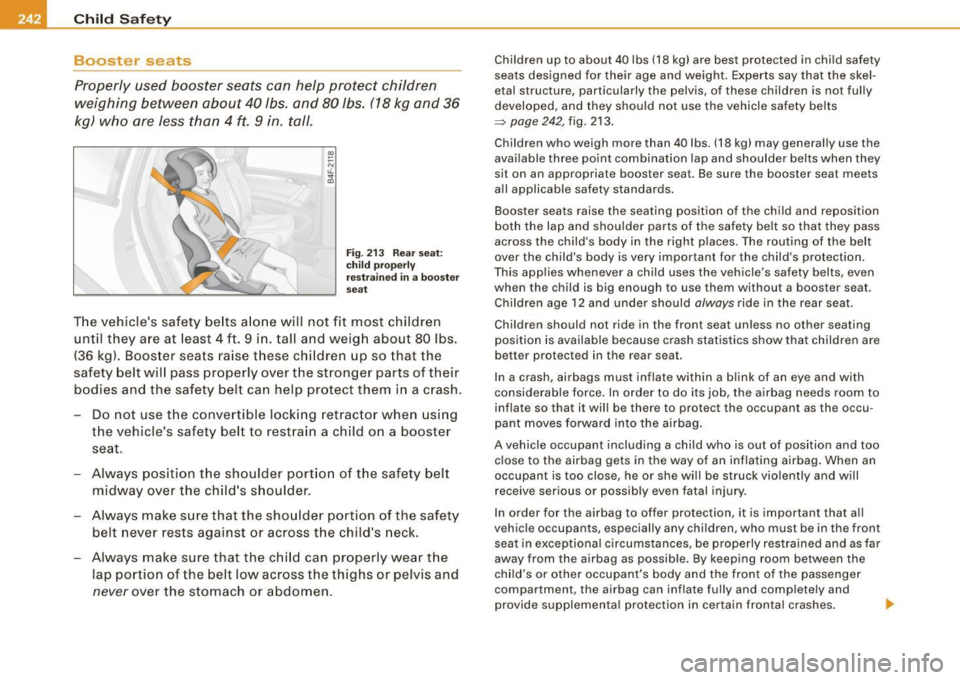
Booster seats
Properly used booster seats can help protect children
weighing between about 40 lbs . and 80 lbs. (18 kg and 36
kg) who are less than 4
ft. 9 in. tall.
Fig. 213 Rear seat:
child properly
restrained in a booster
seat
The vehicle's safety belts a lone will not fit most children
until they are at least 4 ft. 9 in. tall and weigh about 80 lbs.
(36 kg). Booster seats raise these children up so that the
safety belt will pass properly over the stronger parts of their bodies and the safety belt can help protect them in a crash .
- Do not use the convertible locking retractor when using
the vehicle's safety belt to restrain a child on a booster
seat.
- Always position the shoulder portion of the safety belt
midway over the child's shoulder.
- Always make sure that the shoulder portion of the safety
belt never rests against or across the child's neck.
Always make sure that the child can properly wear the
lap portion of the belt low across the thighs or pelvis and
never over the stomach or abdomen.
Children up to about 40 lbs (18 kg) are best protected in child safety
seats designed for their age and weight. Experts say that the skel
etal structure, particularly the pelvis, of these children is not fully
developed, and they should not use the vehicle safety belts
=> page 242, fig . 213.
Children who weigh more than 40 lbs. (18 kg) may generally use the
available three point combination lap and shoulder belts when they
sit on an appropriate booster seat . Be sure the booster seat meets
all applicable safety standards.
Booster seats raise the seating position of the child and reposition
both the lap and shoulder parts of the safety belt so that they pass
across the child's body in the right places. The routing of the belt
over the child's body is very important for the child's protection.
This app lies whenever a chi ld uses the vehicle's safety belts, even
when the child is big enough to use them without a booster seat.
Children age 12 and under should
always ride in the rear seat .
Children should not ride in the front seat unless no other seating
position is available because crash statistics show that children are
better protected in the rear seat.
In a crash, airbags must inflate within a blink of an eye and with
considerable force. In order to do its job, the airbag needs room to
inflate so that it will be there to protect the occupant as the occu
pant moves forward into the airbag.
A vehicle occupant including a child who is out of position and too close to the airbag gets in the way of an inflating airbag . When an
occupant is too close, he or she will be struck violently and will
receive serious or possibly even fatal injury .
In order for the airbag to offer protection, it is important that all
vehic le occupants, especially any children, who must be in the front
seat in exceptional circumstances, be properly restrained and as far
away from the airbag as possible. By keeping room between the
child's or other occupant's body and the front of the passenger
compartment, the airbag can inflate fully and completely and
provide supplemental protection in certain frontal crashes . ..
Page 246 of 390
___ C_h_ i_ ld _ S_ a_ f_ e_ t_y ____________________________________________ _
child is available. In these exceptional situations, the use of a lap
belt is better than permitting the child to remain total ly unre
strained . But remember: a lap belt cannot provide the same level of
protection as a proper child restraint or a three -point lap and
shoulder belt if the child is big enough . Also, using a lap belt for
younger child ren, who should be using a chi ld restraint, may violate
laws in your state or Province.
Never use a lap belt a lone to restrain a chi ld that weighs less than
about 80 lbs (36 kg) and who is less than 4'9" tall. A lways remembe r
that chi ldren do not have the pronounced pelvic structure required
for the proper function of lap belts. If a lap belt is only res traint
system available , then the child's safety absolutely requires that the
lap be lt be fastened snug ly and as low as possible around the pe lvis
let a lap belt pass over the chi ld's stomach or abdomen .
& WARNING
Using wrong child re straints or improperly in stalled child
restr aint s can cause serious personal injury or death in a cr ash .
• Failure to properly route safety belts over a child's body will
c au se severe injurie s in a crash . The lap belt portion of the three
point belt as well as any lap belt alone must alway s pass as low as
p os sible acros s the pelvis, n ever ov er the stoma ch or abdomen.
• An impr ope rly worn s afet y belt will not pr ovide the best prote c
tion in a cra sh and may cau se seriou s personal injury . Alway s
make sure that children and other veh icle o ccupant s properl y
wear available r estraint system s. Carefully follow the in struction s
p ro vi ded by the manufa cturer s of child re straint s.•
Installing a child safety seat
Securing a child safety seat using a safety
belt
S afety belts for the rear seats and the fr ont passenger can
be locked with the c onvertible locking retr actor to pr op
erly secure child safety seats.
The safety belts emergency locking retractors for the rear seats
safety be lts and for the front passenge r's seat safety belt have a
convertible locking retractor for child restraints . The safety belt
must be locked so that belt webbing cannot unreel. The retractor
can be activated to lock the safety be lt and prevent the safety belt
webbing from loosen ing up dur ing normal driving. A child safety
seat can only b e properly instal led when the safety belt is locked so
t hat the child and chi ld safety seat w ill stay i n place .
Always remember: Even though your vehicle is equipped with an
Advanced Airbag system, al l children, especially those 12 years and
younger , shou ld always ride in the back seat proper ly restrained for
their age and size.
& WARNING
Improperly in stalled child safety seat s increa se the risk of serious
pe rsonal injury and death in a collision.
• Alway s ma ke sure that the safety belt retractor is locked when
i nstall ing a child safety seat . An unlo cked safety be lt retra ctor
cannot hold the child safety seat in pla ce during normal driving or
in a cra sh .
• Alway s buckle the child saf ety seat firml y in pl ace even if a
c hild i s not s itting in it. A loo se child saf ety seat can fl y around
during a sudden stop or in a colli sion
• Alway s make sure th at the rear se at backre st to which the
center rear s afety belt i s attached is securely latched whenever
the rear cent er safety belt is being u sed to se cur e a ch ild re straint . .,_