ESP AUDI S6 2008 Owners Manual
[x] Cancel search | Manufacturer: AUDI, Model Year: 2008, Model line: S6, Model: AUDI S6 2008Pages: 390, PDF Size: 88.42 MB
Page 310 of 390
lffl __ C _h_ e_ c_k _in --== g'-- a_n _d_ f_il _li _n ..:::g:::..- ___________________________________________ _
With certain types of airbag deployment, the battery is discon
nected from the vehicle electrical system for safety reasons=>&. in
"Repair, care and disposal of the airbags" on
page 226.
Di sc o nnect ing the b attery t ermin als
Some vehic le functions (power window regulators, for example) are
lost if the battery terminals are disconnected. These func tions have
to be relearned after the battery terminals are connected again . To
prevent this, the battery should only be disconnected from the
vehic le electrical system when absolute ly necessary for repairs.
V ehicle s not driven for long period s
If you do not drive your vehicle over a period of several days or
weeks, electrical components are gradually cut back or switched off .
This reduces energy consumption and maintains starting capability
over a longer period =>
page 265.
Take into consideration that when you un lock your vehicle, some
convenience functions, such as the master key remote function or
power seat adjustment, may not be available. The convenience
functions will be availab le again when you turn on the ignition and
start the engine .
Winter oper ation
During the w inter months, battery capacity tends to decrease as
temperatures drop. This is because more power is also consumed
while s tarti ng, an d the headlights, rear wi ndow defogger, etc ., are
used more often.
Avoid unnecessary p ow er consumption, particularly in ci ty traffic or
when trave ling only short distances. Let your authorized Audi dea ler
check the capacity of the vehicle battery before winter sets in
=> page 310. A we ll charged battery wil l not on ly prevent starting
problems when the weather is cold, but wi ll also last longer.
[ i J Tips
If your vehicle is left standing for severa l weeks at extremely low
t empera tures, the vehicle ba ttery should be r emoved and stored where it will not freeze
. This will prevent it from being damaged and
having to be replaced .•
Working on the battery
B e espec ially caref ul when working on or near the battery.
Fi g. 23 7 Lugg age
compartm ent : B attery
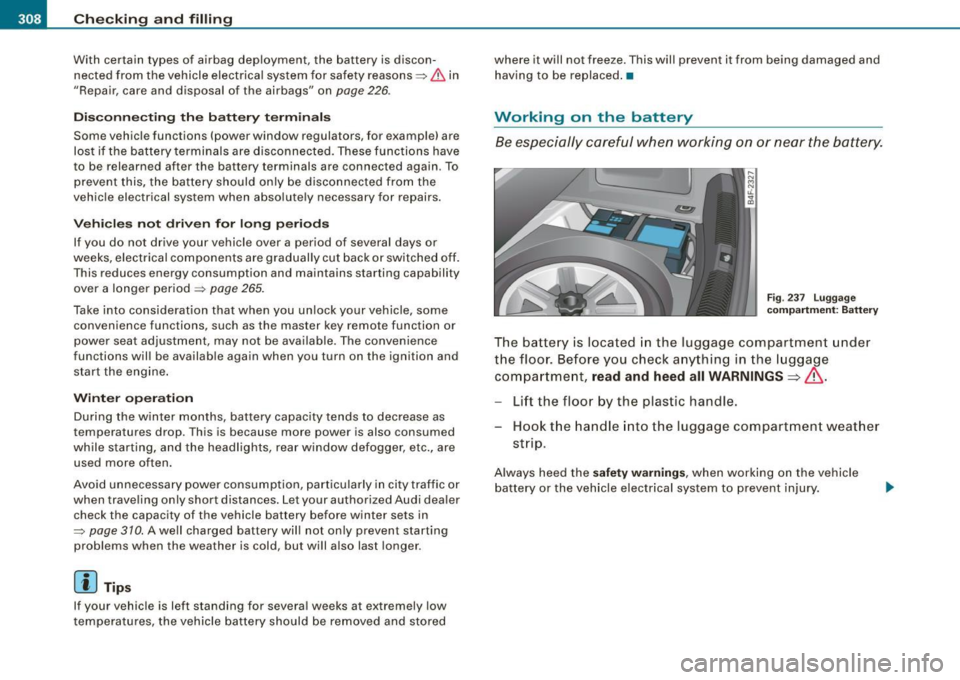
The battery is located in the luggage compartment under
the floor. Before you check a nything in the l uggage
com partme nt,
read and heed all WARNINGS=>& .
-Lift the floor by the plastic handle.
Hook t he hand le in to the luggage compartment weather
st rip.
Always heed the safety warnings , when working on the vehicle
ba ttery or the vehicle e lectrical system to prevent injury.
Page 313 of 390
Checking and filling Ill
--------------~-
•
-Now remove the clamps for the charging equipment.
- Close the red cover on the positive pole.
- Close the hood
~ page 297.
A discharged battery can freeze at temperatures of only O °C. Allow
a frozen battery to thaw completely before attempting to charge it
~ & .However, we recommend not using a thawed battery again
because the battery casing can be cracked due to ice formation and
can leak battery acid.
Battery charging (Maximum charging rate of 30
amps/14.8 Volt)
When charging at /ow voltages (e.g. with a trickle charger), the
battery cables do not have to be disconnected first. The battery caps
should
not be opened when charging a battery.
I t is not necessary to remove the battery from the luggage compart
ment.
Fast charging the battery (charging rate above 14.8
Volts)
For technical reasons do not use a battery charger that uses voltage
greater than 14.8 Volts to charge your vehicle's battery.
& WARNING
Charging a battery can be dangerous.
• Always follow the operating instructions provided by the
battery charger manufacturer when charging your battery.
• Never charge a frozen battery. It may explode because of gas
trapped in the ice. Allow a frozen battery to thaw out first.
• Do not reuse batteries which were frozen. The battery housing
may have cracked and weakened when the battery froze .
• Charge the battery in a well ventilated area. Keep away from
open flame or electrical spark. Do not smoke. Hydrogen gas gener
ated by the battery is explosive.
&_ WARNING (continued)
• To reduce the danger of explosion, never connect or disconnect
charger cables while the charger is operating.
• Battery acid that may spill during charging should be washed
off with a solution of warm water and baking soda to neutralize
the acid.
0 Note
Never use a fast charger as a booster to start the engine. This will
seriously damage sensitive electronic components, such as control
units, relays, radio, etc., as well as the battery charger. •
Battery replacement
The new battery must have the same specifications and
dimensions as the original equipment battery.
Intelligent energy management in your vehicle is responsible for
distributing the electrical energy throughout your vehicle
~ page 265. The intelligent energy management system will keep
the engine battery charged better then vehicles without this system.
To make sure the additional electrical energy is available once again
after you have changed the battery, we recommend that you install
batteries of the same type and manufacture only (the same as those
installed at the time your vehicle was delivered). Specifications are
listed on the battery housing. Your authorized Audi dealer will then
code the battery management control unit.
If it is not possible to use a battery of this type, the new battery must
have the same capacity, voltage (12 volts), amperage, construction
and plug sealing .
When installing the battery, make sure the ignition and all electrical
consumers are turned off.
~
Vehicle care I t •
Page 316 of 390
-~_T_ ir_e_ s_ a_ n_d _ w_ h_ e_e _l_s _________________________________________________ _
& WARNING (continued)
crashes and serious personal injuries . Have worn or damaged tires
replaced immediately.
• Tires age even if they are not being used and can fail suddenly,
especially at high speeds. Tires that are more than 6 years old can
only be used in an emergency and then with special care and at
low speed.
Glossary of tire and loading terminology
Accessory weight
means the combined weight (in excess of those standard items
which may be replaced) of automatic transmission, power steering,
power brakes, power windows, power seats, radio, and heater, to
the extent that these items are available as factory-installed equip
ment (whether installed or not).
Aspect ratio means the ratio of the height to the width of the tire in percent.
Numb ers of 55 or lower indicate a low sidewall for improved
steering response and better overall handling on dry pavement.
Bead
means the part of the tire that is made of steel wires, wrapped or reinforced by ply cords and that is shaped to fit the rim.
Bead separation means a breakdown of the bond between components in the bead.
Cord
means the strands forming the plies in the tire.
& WARNING (continued)
• Never mount used tires on your vehicle if you are not sure of
their "previous history." Old used tires may have been damaged
even though the damage cannot be seen that can lead to sudden
tire failure and loss of vehicle control.
• If you notice unusual vibration or if the vehicle pulls to one side
when driving, always stop as soon as it is safe to do so and check
the wheels and tires for damage . •
Cold tire inflation pressure
means the tire pressure recommended by the vehicle manufacturer
for a tire of a designated size that has not been driven for more than
a couple of miles (kilometers) at low speeds in the three hour period
before the tire pressure is measured or adjusted .
Curb weight means the weight of a motor vehicle with standard equipment
including the maximum capacity of fuel, oil, and coolant, air condi
tioning and additional weight of optional equipment.
Extra load tire
means a tire designed to operate at higher loads and at higher infla
tion pressures than the corresponding standard tire . Extra load tires
my be identified as "XL",
"xi", "EXTRA LOAD", or "RF" on the side
wall.
Gross Axle Weight Rating ("GAWR")
means the load-carrying capacity of a single axle system, measured
at the tire -ground interfaces .
Gross Vehicle Weight Rating ("GVWR"l
means the maximum total loaded weight of the vehicle.
Page 317 of 390
Tires a nd wh eels -
----------------
•
Groove
means the space between two adjacent tread ribs.
Load ra ting (code)
means the maximum load that a tire is rated to carry for a given
inflation pressure. You may not find this information on all tires
because it is not required by law.
M ax im um l oad ra tin g
means the load rating for a tire at the maximum permissib le infla
tion pressure for that tire.
Ma ximum l oaded v ehi cle weigh t
means the sum of:
(a) Curb weight
(b) Accessory weight
(c) Vehic le capacity weight, and
(ct) Production options weight
M ax im um (p er mi ssibl e) infl ati on pr essur e
means the maximum cold inflation pressure to wh ich a tire may be
inflated. Also ca lled "maximum inflation pressure."
Normal occ upa nt wei ght
means 150 lbs. (68 kilograms) times the number of occupants
seated in the vehicle up to the to tal seating capacity of your vehicle.
O ccupant di stributi on
means distribution of occupants in a vehicle .
Outer di am eter
means the overall diameter of an inflated new tire.
O ve rall wi dth
means the linear distance between the exteriors of the sidewa lls of
an inflated tire, includ ing elevations due to labeling, decorations, or
protective bands or ribs.
Pl y
means a layer of rubber -coated para lle l cords.
P rodu ction opt io ns wei ght
means the combined weight of those installed regular production
options weighing over 5 lbs . (2.3 kg) in excess of those standard
i t ems wh ich they replace, not previously considered in curb weigh t
or accessory weight, including heavy duty brakes, ride levelers, roof
rack, heavy duty battery, and specia l trim .
Radi al p ly tire
means a pneumatic tire in which the ply cords that extend to the
beads are laid at substantially 90 degrees to the centerline of the
tread .
Reco mm ended infl ati on pr essu re
see => page 314, "Cold tire inflation pressure".
Rein force d tir e
means a tire designed to operate at higher loads and at higher infla
tion pressures than the corresponding standard tire. Reinforced
t ires my be identified as "XL", "xi", "EXTRA LOAD", or "RF" on the
sidewall.
R im
means a metal support for a tire or a tire and tube assembly upon
wh ich the t ire beads are seated.
Rim di amet er
means nominal diameter of the bead seat. If you change your whee l
size, you wi ll have to purchase new tires to match the new rim diam
eter .
Rim siz e de sig nation
means rim diameter and width.
Rim wid th
means nominal distance between rim flanges.
Vehicle care I t •
Page 319 of 390
Tires and wheels -_______________ _____.
Occ up ant loading and di stribution fo r vehicle no rmal load for various d esignated seating capa cities
Designated seating capacity, num
ber of occupants Vehicle normal load
, numb er of
occupants Occupant distribution in a normally
load
ed vehicle
5 3 2 in front,
1 in bac k seat •
Cold tire inflation pressure
Tire pressure affects the overall handling, performa nce and safe ty of a vehicle .
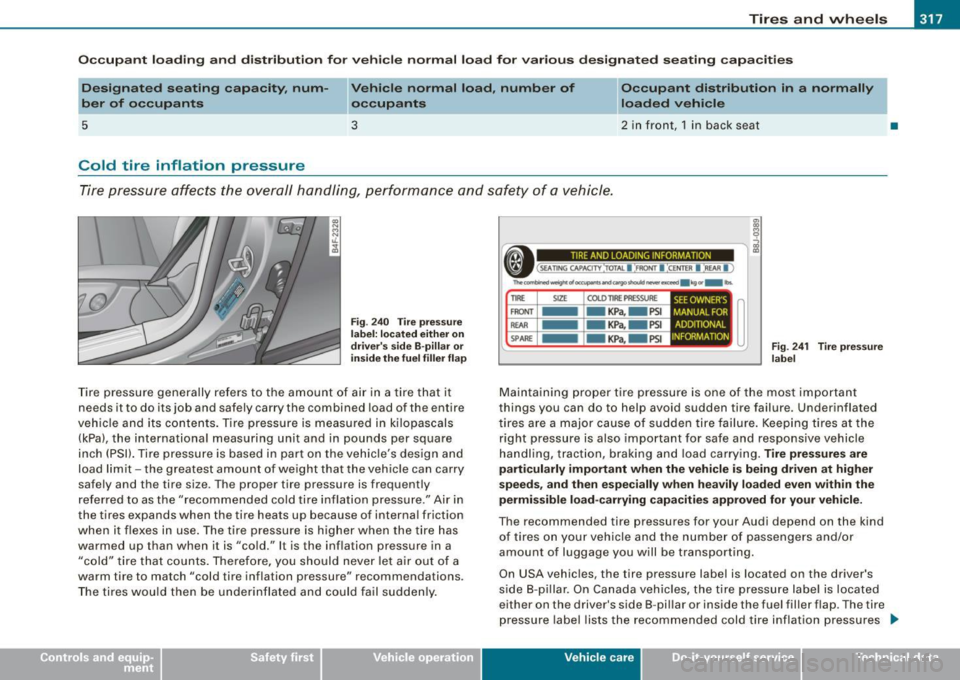
Fig. 2 40 Tire pre ssure
label: located either on
driver' s side B -pill ar or
in sid e the fuel filler flap
Ti re pressure ge nerally refe rs to the am ount of air in a tire tha t it
needs it to do its job and safely carry the combined load of the entire
veh icle and i ts contents. Tire pressu re is measured in kilopascals
(kPa ), the internationa l measuring uni t and in pounds per square
i nc h (PSI) . Tir e p ressu re is based in par t on the vehic le's design and
load l im it - the g reatest amoun t of wei ght that the vehic le ca n carry
safe ly and the tire size . The proper tire pressure is frequently
re ferr ed to as the "recommended cold t ire i nflation pressu re ." Air i n
the tires expands when the tire heats up because of internal friction
whe n it flexes i n use . The tire pres sure is h ig her whe n the tire has
wa rmed up than when it is "co ld." It is the inflation pressure in a
"c old" tire t hat co unts. The ref ore, y ou sho uld neve r let air out of a
warm tire to match "co ld tire inflation pressure" recommendations .
T he tires wo uld then be under inflated a nd cou ld fa il s ud den ly .
i
,,-, ~ ---------------- ixl
• (SEATING CAPAC ITY :roTAL I :FRO NT I :cENTER I :REAR I ) al
Thecombh,d""'91wclo«U,,..,.andco,-goshoulcl.......,""""' •1cg., -b.
TIRE AND LOADING INFORMATION
TIRE SIZE COLO TIRE PRESSURE
F RONT -KPa, -PSI
REAR -KPa, -PSI
SPARE -KPa, - PSI
MANUAL FOR
INFORMATION SEE OWNER'S I
ADDITIONAL
Fig . 241 Tire pr essure
label
M ain tain ing pr op er tire pressure i s one of th e m ost im portant
things you can do to help avoid sudden tire failure. Underinflated
t ires are a major cause of s udden tir e fail ure . K eeping tires at the
ri ght press ure is also impor tant for sa fe and r esponsive v ehicle
han dling, trac tion, b raki ng a nd l oad carryi ng .
Tire pressures are
particularly important when the vehicle is being driven at higher
speeds , and then especially when heavily loaded even within the
permissible load -carrying capacities approved for your vehicle.
T he recommended tire pressures for your Audi depend on the kind
of tires on your vehicle a nd the n umber of passengers an d/o r
amount of luggage you w ill be transporting.
On USA vehic les, the tire pressure label is located on the driver's
s id e B- pilla r. On Cana da v ehic les, the tire pressu re labe l is loca ted
either on the driver's side 8 -pillar or inside the fuel filler flap. The tire
pre ssure label lists the rec omm ended cold tire i nflatio n pre ssures _,,,
Vehic le care I I irechnical data
Page 320 of 390
-~_T_ ir_e_ s_ a_ n_d _ w_ h_ e_e _l_s _________________________________________________ _
for the vehicle at its maximum capacity weight and tires that were
on your vehic le at the time it was manufactured.
If you w is h t o improve co mfort w hen opera ting the vehicle a t
n ormal lo ad (up t o 3 o ccupant s), you can a djust ti re pre ss ure s to
tho se s pecified for norm al v ehi cle load . B efore operating the vehi cle
at m aximum lo ad , y ou must i ncreas e the t ire p re ss ure s to tho se
s pe cifi ed for m axim um vehicle lo ad
=> & .
Bear in mind that the tire pressure monitoring system can only
monitor the tire pressures you have stored. The system does not
recognize the load condition of your vehic le.
The effectiveness of the tire pressure monitoring system will be impaired if you store normal load pressures but then operate the
vehic le at its maximum load=>&. See the
illustration=>
page 317, fig. 240 for the location of the label
either on driver's side B -p illar or inside the fuel fi ller flap (color of
the actual label and exact location on the vehicle will vary slight ly).
Note that the fol lowing tab le is accurate at the time of going to
press and is subject to change . In the event of discrepanc ies, the tire
pressure label (on USA vehicles, the tire pressure label is located on
the dr iver's side B-pi llar; on Canada vehicles, the tire pressure labe l
is located either on the driver's side B-pillar or inside the fue l fi ller
fl ap) always takes precedence.
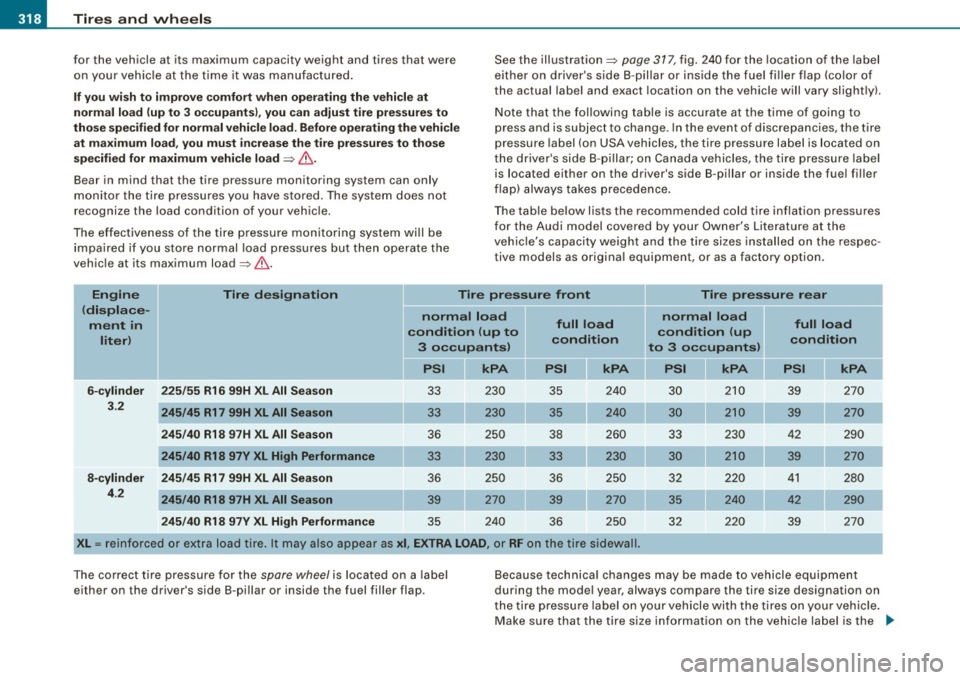
T he table below lists the recommended cold tire inflation pressures
for the Audi model covered by your Owner's Literature at the
vehic le's capacity weight and the tire sizes installed on the respec
tive models as origina l equipment, or as a factory option.
En gin e Tire des ig nation Tir e pr essur e fro nt Tir e p re ssur e rea r
( di spl ac e-
no rm al l oa d no rm al l oa d
m ent in
conditi on (up t o full lo
ad
condition (u p full lo
ad
lit er)
condition condition 3 occupants ) to 3 occ upant s)
PSI kPA kPA kPA
6-cylinder 225/5 5 R16 99H XL All Sea son 33 230 35 240
30 210
39 270
3.2
245 /45 R17 99H XL All Season 33 230 35 240 30 2 10 39 270
2 45 /40 R1 8 97 H XL All Season 36 250
38 260 33 230 42 290
245
/40 R18 97V XL Hi gh Performan ce 33 230 33 230 30 210
39 270
8
-c ylind er 245 /45 R17 99H XL All Sea son 36 250 36 250 32 220 41 280
4.2
245/40 R18 97 H XL All S eason 39 270 39 270 35 240 42 290
2
45 /40 R18 97V XL High Perf orma nce 35 240
36 250 32 220 39 270
X
L = reinforced or extra load t ire . It may also appea r as xi, EX TRA LOAD , or RF on the tire sidewall.
The correct t ire pressure for the
spare wheel is located on a label
either on the driver's side B-pillar or inside the fuel fil ler flap. Because technica
l changes may be made to vehicle equipment
during the mode l year, always compare the tire size designation on
the tire pressure label on your vehicle with the tires on your vehic le .
Make sure that the tire size information on the vehic le label is the _.,
Page 321 of 390
________________________________________________ T_ i _r_e _s_ a_n_ d_ w_ h_ e_e _ l_s __ lftlll
•
same as the size of the tires on the vehicle. This is especially impor
tant if the vehicle belongs to someone else or you bought the
vehicle with different rims/tires or you bought the vehicle as a previ
ously owned vehicle.
Remember, your safety and that of your passengers also depends
on making sure that load limits are not exceeded. Vehicle load
includes everybody and everything in and on the vehicle . These load
limits are technical ly referred to as the vehicle's Gross Vehicle
Weight Rating ("GVWR"l. The Gross Axle Weight Rating ("GAWR") is
the maximum load that can be applied at each of the vehicle's two
axles . The Gross Vehicle Weight Rating and the Gross Axle Weight
Rating are listed on the safety compliance sticker labe l located
either on the driver's side 8 -pillar or on the inside of the fuel fi ller
flap. The tire pressure labe l on your Audi lists the maximum
combined weight of a ll of the occupants and luggage or other cargo
that the vehic le can carry. For the location of the tire pressure label
~ page 317, fig . 240.
& WARNING
O verlo ading a vehicle can c ause los s of vehicle control , a crash or
o ther a ccident , seriou s pe rsonal inju ry, and e ven d eath .
• Carrying more weight than your v ehi cle wa s des igned to carr y
w ill p re v ent the veh icle fr om handli ng properly and in crea se the
ri sk of a lo ss of ve hicle control .
• The br ake s on a vehicle that h as been o verloa ded m ay not be
able to stop the veh icle with in a safe di sta nce .
• Tir es o n a veh icle th at ha s bee n ov erlo aded can fail sudd enl y
c au sin g loss of cont rol a nd a cra sh.
• Always mak e sure th at the total lo ad being tr ansported -
includin g the weight of a tra iler hit ch an d th e tongue weight of a
lo aded tr ailer -doe s not m ake the vehi cle he avier tha n the
v ehicle 's Gro ss V ehicle W eigh t Rating.
& WARNING
• Incorre ct t ire pre ssu re s a nd/o r unde rinflat ion can le ad to a
seriou s or fatal a ccident.
• Incorre ct t ire pr essure s and/or u nderi nflat ion cause in creased
tire wear and can affec t th e handling of the vehicl e.
• Inco rre ct t ire pr essur es and /or underinfl atio n ca n als o lead to
s udden tire failure , including a b lowout and sudden deflation ,
ca usin g lo ss of vehi cle co ntrol. •
Checking tire pressure
The correct tire pressure for the tires originally installed
on your vehicle is listed on the tire pressure label located
either on driver's side B-pillar or inside the fuel filler flap .
The recommended tire pressures are on the tire pressure label and
in the table~ page 317, "Cold tire inflation pressure". This means
that the pressure must be checked and adjusted when the tire has
not been driven for more than a couple of mi les (kilometers) at low
speeds during the previous three hours . Air in the tires expands
when the tire heats up as a result of internal fric tion as it flexes in
use. The tire pressure is higher when the tire has warmed up than
when it is "cold ."
It is the inflation pressure in a "cold" tire that counts . Therefore, you
should never let air ou t of a warm tire to match "Co ld tire inflation
pressure" recommendations~
page 317. The tires wou ld then be
underinflated and could fa il suddenly .
The tire pressure label on your Audi lists the recommended cold tire
inflation pressures for the new, original equipment tires that were
on your vehic le at the time it was manufactu red. For the location of
the labe l~
page 317, fig . 240.
Most tires lose air natural ly over time . They can a lso lose some air if
you drive over a pothole or hit a curb while parking. It is usually not ..,
Vehicle care I t •
Page 322 of 390
-~_T_ ir_e_ s_ a_ n_d _ w_ h_ e_e _l_s _________________________________________________ _
possible to see whether the radial tires used today are underinflated
just by looking at them.
Therefore, be sure to check tire pressures at least once a month and
always before going on a long trip. Make sure to take the number of
people and the amount of luggage into account when adjusting tire
pressure for a trip -even one that you would not consider to be
"long." See=>
page 321, "Tires and vehicle load limits" for more
important information.
Always use an accurate tire pressure gauge when checking and
adjusting inflation pressures . Check all of the tires and be sure not
to forget the spare tire. If the pressure in any tire is too high when
the tire is "cold," let air out of the tire slowly with the edge of the tire
gauge and keep checking the pressure until you reach the pressure
that is correct for the load (passengers and luggage) and kind of
driving you plan to do.
If the pressure in any tire is too low, note the difference between the
pressure in the cold tire and the pressure you need and add the air
that you need to reach the correct pressure for the vehicle load
(passengers and luggage) for the tires on your vehicle as listed on
the on your vehicle and in this manual and the kind of driving you
plan to do.
Never exceed the maximum inflation pressure listed on the tire
sidewall for any reason.
Remember that the vehicle manufacturer, not the tire manufacturer,
determines the correct tire pressure for the tires on your vehicle.
It is important to check the tire pressure when the tires are cold.
• Read the required tire pressure from the tire pressure label. On
USA vehicles, the tire pressure label is located on the driver's side
8-pillar . On Canada vehicles, the tire pressure label is located either
on the driver's side 8-pillar or inside the fuel filler flap.
• Turn the valve stem cap counter-clockwise to remove it from the
tire valve.
• Place the air pressure gauge on the valve. • The
tire pressures should only be checked and adjusted when
the tires are cold. The slightly raised pressures of warm tires must
not be reduced .
• Adjust the tire pressure to the load you are carrying.
• Reinstall the valve stem cap on the valve.
When should I check the tire pressure?
The correct tire pressure is especially important at high speeds. The
pressure should therefore be checked at least once a month and
always before starting a journey. Do not forget to check the tire pres
sure for the spare wheel =>
page 337.
When should I adjust the tire pressures?
Adjust the tire pressure to the load you are carrying. After changing
a wheel
or replacing wheels you have to adjust the tire pressures on
all wheels. In addition, you must then initialize the new tire pres
sures in the tire pressure monitoring system=>
page 42.
& WARNING
Incorrect tire pressures and/or underinflation can lead sudden tire
failure, loss of control, collision, serious personal injury or even
death.
• When the warning symbol I appears in the instrument
cluster, stop and inspect the tires.
• Incorrect tire pressure and/or underinflation can cause
increased tire wear and can affect the handling of the vehicle and
stopping ability .
• Incorrect tire pressures and/or underinflation can also lead to
sudden tire failure, including a blowout and sudden deflation,
causing loss of vehicle control.
• The driver is responsible for the correct tire pressures for all
tires on the vehicle. The applicable pressure values are located on a sticker on the driver's side 8-pillar or on the inside of the fuel
filler flap. .,_
Page 326 of 390
--~_T_ ir_e_ s_ a_ n_d _ w_ h_ e_e _l_s _________________________________________________ _
Tire pressure
Incorrect tire pressure causes premature wear and can cause
sudden tire blow-out. For this reason, tire pressure must be checked
at least once a month~
page 319.
Driving style
Driving fast around curves, heavy acceleration and hard braking
increase tire wear.
Rotating tires for more even wear
For all four tires on your vehicle to have the same service life, we
recommend that the front and rear tires are rotated according to the
tire manufacturer's suggested tire rotation intervals. Please remember the following:
• Tire rotation intervals may differ from the vehicle service inter
vals outlined in your Maintenance and Warranty Booklet.
• The longer one tire is used in one location on the vehicle, the
more it wears at certain points; therefore, we recommend that you
follow the tire manufacturer's suggested tire rotation intervals.
• Vehicles with front-wheel drive experience more tread wear on
the front wheels compared to all-wheel drive (quattro®l .
• Please rotate tires as shown ~
page 323, fig. 243.
• Extra care must be taken when rotating direction -specific tires
~ page 344.
Wheel balancing
The wheels on new vehicles are balanced. However, various situa
tions during everyday driving can cause them to become unbal
anced, resulting in vibrations you can usually feel through the
steering wheel.
Unbalanced wheels must be rebalanced to avoid excessive wear on
steering, suspension and tires. A wheel must also be rebalanced
when a new tire is installed.
Incorrect wheel alignment
Incorrect wheel alignment can cause excessive tire wear, impairing
the safety of the vehicle. If tires show excessive wear, have the
wheel alignment checked by an authorized Audi dealer or qualified
workshop.
All Wheel Drive
Vehicles with quattro® must always have tires of the same size, construction and tread type. For details see~
page 264.
& WARNING
Sudden tire failure can lead to loss of control, a crash and serious
personal injury!
• Never drive a vehicle when the tread on any tire is worn down
to the wear indicators.
• Worn tires are a safety hazard, they do not grip well on wet
roads and increase your risk of "hydroplaning" and loss of control.
• Always keep chemicals that can cause tire damage, such as
grease, oil, gasoline and brake fluid away from tires.
• Tires age even if they are not being used and can fail suddenly,
especially at high speeds. Tires that are more than 6 years old can
only be used in an emergency and then with special care and at
lower speeds.
• Never mount used tires on your vehicle if you are not sure of
their "previous history." Old used tires may have been damaged
even though the damage cannot be seen that can lead to sudden
tire failure and loss of vehicle control. •
Page 329 of 390
________________________________________________ T_ i _r_e _s_ a_n_ d_ w_ h_ e_e _ l_s __ ,n
•
ture . For example, the numbers 2207 mean that the tire was
produced in the 22th week of 2007. The other numbers are
marketing codes that may or may not be used by the tire manufac
turer. This information is used to contact consumers if a tire defect
requires a recall.
Tire ply composition and materials used
The number of plies indicates the number of layers of rubber-coated
fabric in the tire. In general, the greater the number of plies, the
more weight a tire can support . Tire manufacturers also must indi
cate the materials in the tire, which include steel, nylon, polyester,
and others .
Maximum Load Rating
This number indicates the maximum load in kilograms and pounds
that can be carried by the tire.
Tire quality grading for treadwear, traction, and
temperature resistance
Tread wear, traction and temperature grades~ page 328.
Maximum Permissible Inflation Pressure
This number is the greatest amount of air pressure that should ever
be put in the tire under normal driving conditions.
Replacing tires or rims on vehicles equipped with tire
pressure monitoring system
The wheels on your vehicle are equipped with a sensor which
constantly monitors the air pressure inside the tire, and then trans
mits this information to the tire pressure monitoring system. If you
are going to replace the wheel rims on your vehicle, make sure the
new rims also have these sensors . The sensors must be compatible
with the tire pressure monitoring system on your vehicle.
If you install rims, which do not have the sensors, or have sensors
which are not compatible, then the tire pressure monitoring system
will not work properly. In this case, the tire pressure monitoring system would not be able to monitor the
tire pressure or warn you
if it is necessary.
• The battery inside of the tire pressure sensor has a limited
service life.
• Always drive with the valve stem caps securely mounted. We
recommend using factory installed valve stem caps. Ask your autho
rized Audi dealer to replace lost valve stem caps .
The installation of replacement tires with steel cord body plies in
the tire sidewall may cause malfunction of the tire pressure moni
toring system, and is not recommended (cord material information
in molded on the tire sidewall).
Always check your tire pressure monitoring system indicator after replacing one or more tires on your vehicle. If the tire pressure
monitoring system indicator flashes, or is on, your system is not
working properly. Your replacement tire might be incompatible with
your tire pressure monitoring system, or some component of the
tire pressure monitoring system may be damaged.
& WARNING
• Using incorrect or unmatched tires and/ or wheels or improper
tire and wheel combinations can lead to loss of control, collision
and serious personal injury.
• Always use tires, rims and wheel bolts that meet the specifica
tions of original factory-installed tires or other combinations that
have been specifically approved by the vehicle manufacturer.
• Tires age even if they are not being used and can fail suddenly,
especially at high speeds. Tires that are more than 6 years old can
only be used in an emergency and then with special care and at
lower speeds.
• Never mount used tires on your vehicle if you are not sure of
their "previous history." Old used tires may have been damaged
even though the damage cannot be seen that can lead to sudden
tire failure and loss of vehicle control.
~
Vehicle care I t •