lock AUDI S6 2009 Owners Manual
[x] Cancel search | Manufacturer: AUDI, Model Year: 2009, Model line: S6, Model: AUDI S6 2009Pages: 398, PDF Size: 43 MB
Page 326 of 398
--~_T_ ir_e_ s_ a_ n_d _ w_ h_ e_e _l_s _________________________________________________ _
The tire pressure label on your Audi lists the recommended cold tire
in flatio n press ures f or the new, original equipment tires that were
on your vehic le at the time it was manufactured. For the location of
the label =>
page 321, fig. 247.
Most tires lose air natural ly over time. They can a lso lose some air if
you drive over a pothole or hit a curb while parking. It is usually not
possible to see whether the radial t ires used today are underinflated
just by looking at them.
Therefore, be sure to check tire pressures at least once a month and always before going on a long trip. Make sure to take the number of
people and the amount of luggage into account when adjusting tire
pressure for a trip - even one that you would not consider to be
"long." See =>
page 325, "Tires and vehicle load limits" for more
important information .
Always use an accurate tire pressure gauge when checking and adjusting inflation pressures. Check a ll of the tires and be sure not
to forget the spare tire . If the pressure in any tire is too high when
the tire is "cold," let air out of the tire s lowly with the edge of the tire
gauge and keep checking the pressure until you reach the pressure
that is correct for the load (passengers and luggage) and kind of
driving you p lan to do.
If the pressure in any tire is too low, note the difference between the
press ure in the cold t ire and the pressure you need and add the air
that you need to reach the correct pressure for the vehicle load
(passengers and luggage) for the tires on your vehicle as listed on
the on your vehicle and in this manual and the kind of driving you p lan to do .
Nev er e xce ed the m aximum i nflation pr essure listed on the tir e
s ide wall for any rea so n .
Remember that the veh ic le manufacturer, not the tire manufacturer,
determines the correct tire pressure for the tires on your vehicle .
It is important to check the tire pressure when the tires are cold.
• Read the required tire pressure from the tire pressure label. The
tire pressure label is located on the driver's side B -pillar. • T
urn the valve stem cap counter -clockwise to remove it from the
t ire valve .
• Place the air pressure gauge on the valve.
• T he tire pressures should only be checked and adjus ted when
the tires are cold. The s lightly raised pressures of warm tires must
not be reduced.
• Adjust the tire pressure to the load you are carrying.
• Reinstall the valve stem cap on the valve .
When should I check the tir e pre ssure?
The correct tire pressure is especially important at high speeds . T he
p ressure should therefore be checked at least once a month and
always before starting a journey. Do not forget to check the tire pres
sure for the spare whee l =>
page 343.
Wh en shoul d I adj us t th e tir e pre ssu res?
Adjust the tire pressure to the load you are ca rrying . Af ter changing
a wheel
o r replacing wheels you have to adjust the tire pressures on
a ll whee ls . In add ition, you must then store the new tire pressures
in the tire pressure monitoring system=>
page 338 .
& WARNING
Incor re ct t ire pre ssure s and /or und erinf latio n can le ad sudden t ire
failure , los s of control , collision , seriou s per son al injury or even
death .
• When the warning symbol
t appe ars in the in strumen t
c luste r, sto p a nd in spe ct the tire s.
• Incor rect tire pre ssure and /or underi nflati on can cause
i ncrea sed tire wear and can affe ct the h andl ing of the veh icle an d
s topping abil ity .
• Incorre ct t ire pres sur es a nd/or und erinflat ion c an a lso lead to
s udden tir e failure , including a blowout and sudden deflat ion ,
ca usin g lo ss of vehicle control . .,_
Page 333 of 398
Tires and wheels -________________ w-.
•
ture. For exam ple , t he numbers 2 208 mean that the tire was
pr od uce d in the 22nd w eek o f 20 08 . T he ot her num bers a re
marketing cod es that may or may not b e used by the tire manufac
tu rer. This inf or ma tion is use d to conta ct consum ers if a tir e defec t
requires a recall.
Audi Original tire
Ti res with the identification "AO" or "R O" hav e been specia lly
m atc h ed wi th you r A ud i. We re comm end u sing on ly these tire s
becaus e they meet the highest standards re garding safety and
dri ving c haracter istic s when used correctly . You r aut horized Audi
d ealer w ill glad ly prov ide you with mor e information .
Tire ply composition and materials used
The number of p li e s indicates the numb er of layers of rubber -coat ed
fabric i n the tir e . In genera l, the grea te r the number of pl ies, th e
mo re we ig ht a t ire can suppo rt. T ire ma nufactu rers also must ind i
cate the materia ls in the tire, which include steel, ny lon, polyester,
and oth ers .
Maximum Load Rating
This numb er ind icat es the maximum load in kil ograms and pou nds
th at ca n be ca rried by t he tire.
Tire qual ity grading for treadvvear , traction , and
temperature resistance
T read wear , traction and temperature grades::::;, page 332.
Maximum Permissible Inflation Pressure
This number is the greatest amount of air pressure that should ever
be put in the t ir e u nder nor mal d riving co nd it ion s.
& WARNING
• Using incorrect or unmatched tires and / or wheels or improper
tire and wheel combinations can lead to loss of control , collision
and serious personal injury .
& WARNING (continued )
• Always use tires, rims and wheel bolts that meet the specifica
tions of original factory -installed tires or other combinations that
have been spec ifically approved by the veh icle manufacturer .
• Tires age even if they are not being used and can fail suddenly,
especially at high speeds . Tires that are more than 6 years old can
only be used in an emergency and then with special care and at
lower speeds .
• Never mount used tires on your vehicle if you are not sure of
their "previous history." Old used tires may have been damaged
even though the damage cannot be seen that can lead to sudden
tire failure and loss of vehicle control.
• All four wheels must be fitted with radial tires of the same type ,
size (rolling circumference ) and the same tread pattern. Driving
with different tires reduces vehicle handling and can lead to a loss of control.
• If the spare tire is not the same as the tires that are mounted
on the vehicle - for example with winter tires - only use the spare
tire for a short period of time and drive with extra care . Refit the
normal road wheel as soon as safely possible.
• Never drive faster than the maximum speed for which the tires
on your vehicle are rated because tires that are driven faster than
their rated speed can fail suddenly.
• Overloading tires cause heat build -up, sudden tire failure ,
includ ing a blowout and sudden deflation and loss of control.
• Temperature grades apply to tires that are properly inflated and
not over or underinflated .
• For technical reasons it is not always possible to use wheels
from other vehicles -in some cases not even wheels from the
same vehicle model.
• If you install wheel trim discs on the vehicle wheels , make sure
that the air flow to the brakes is not blocked. Reduced airflow to
the brakes can them to overheat , increasing stopping distances
and causing a collision.
~
Vehicle care I t •
Page 336 of 398
-~_T_ ir_e_ s_ a_ n_d _ w_ h_ e_e _l_s _________________________________________________ _
& WARNING
Always adjust your driving to the road and t raffic condit ions .
Never let the good a cceleration of the winter tires and all -wheel
dri ve tempt you into tak ing extra ri sk s. Always remember :
• When braking, an all -wheel drive vehicle handles in the same
way as a front drive vehicle .
• Drive carefully and redu ce your speed on icy and sli ppery roads ,
even winter tires cannot help unde r bla ck ice conditions.
c£> For the sake of the environment
Use summer tires when weather conditions permit. They are
quieter, d o no t wear as quick ly a nd re duce fuel consump tio n.•
Snow chains
Snow cha ins may be fitte d o nly to the fron t whee ls, and o nly to
certain tire sizes . Ask your authorized Audi dealer on which tire
s iz es snow c hains can be used.
If you are going to use snow chains, then you must install them on
the front wheels at least.
The snow cha ins must have low -profile l inks and must not be thicker
than 0 .53 inch ( 13.5 mm), including the lock.
Remove wheel center c overs and trim discs before putt ing snow
chains on your vehicle~
0 . For safety reasons cover caps must
then be fitted ove r the wheel bo lts . These are avai lable from autho
r ized Aud i dealers.
& WARNING
Using the wrong sno w chains for your vehi cle or installing them
incorre ctly can in crease the risk of loss of control leading to
serious personal injury .
& WARNING (continued )
• Snow chains are available in different sizes. Alw ay s make sure
to follo w the instructions provided by the snow chain m anufac
turer .
• When driving with snow cha ins never drive faster than the
s peed permitted for your specific snow chains .
• Alway s observe lo cal regu lations.
0 Note
• Remove snow c hains before driving on roads not covered with
snow t o av oid da maging tires a nd wea ring the snow cha in s dow n
unnecessari ly.
• Sno w cha in s, w hich come in to direc t contact wi th th e wheel ri m,
can scratch or damage it. Therefore, make sure that the snow chains
a re sui tab ly cove red. Check the position of t he snow cha ins a fter
driving a few yards and correct if necessary . Follow the instructions
from the snow chain manufacture r when doing so .
• I f the Adaptive Air Suspension * shou ld malfunction, do not
mo unt or use snow chains because the veh icle w ill be ext remely
l ow . If you do drive with snow chains on while the vehicle is at this
l evel, the snow chains might severe ly damage the wheelhouse and
other parts of the vehicle.
[ i ] Tips
Where snow c hains a re ma ndatory on ce rtai n roa ds, th is norma lly
a lso app lies to veh ic les with A ll Wheel Drive. •
Page 344 of 398
lllftl.,___W_ h_ a _ t_d_ o_ l _d _o_ n_ o_ vv_ ? ______________________________________________ _
What do I do now?
Trunk escape handle
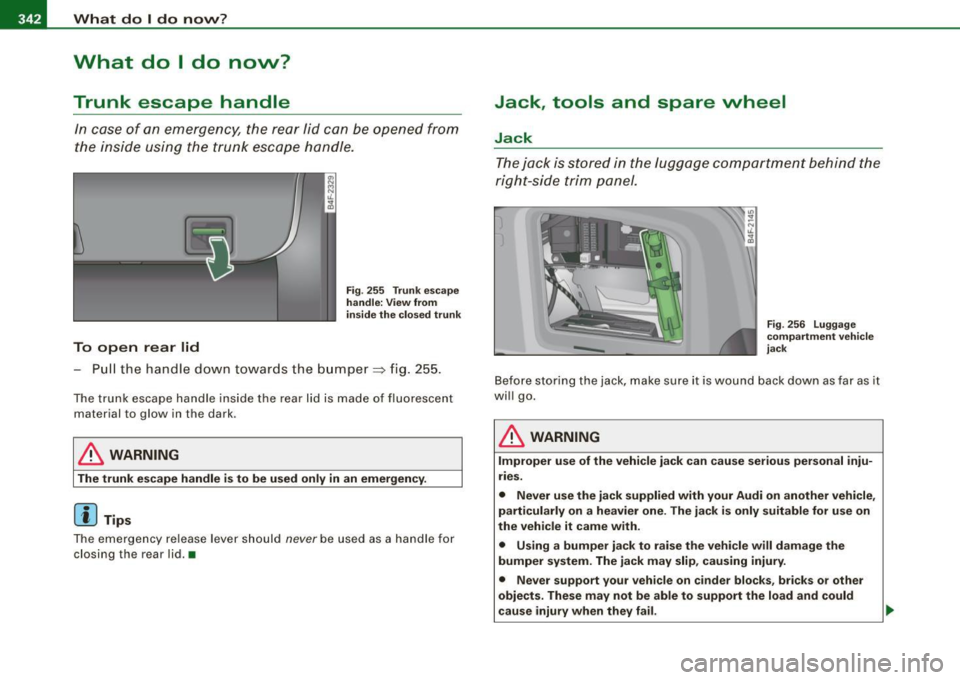
In case of an emergency, the rear lid can be opened from
the inside using the trunk escape handle.
To open rear lid
Fig. 255 Trunk escape
handle: View from
inside the closed trunk
- Pull the handle down towards the bumper ::} fig. 255.
The trunk escape handle inside the rear lid is made of fluorescent
material to glow in the dark.
& WARNING
The trunk escape handle is to be used only in an emergency.
[ i ] Tips
The emergency release lever should never be used as a handle for
closing the rear lid. •
Jack, tools and spare wheel
Jack
The jack is stored in the luggage compartment behind the
right-side trim panel.
--
Fig . 256 Luggage
compartment vehicle
jack
Before storing the jack, make sure it is wound back down as far as it
will go.
& WARNING
Improper use of the vehicle jack can cause serious personal inju
ries.
• Never use the jack supplied with your Audi on another vehicle,
particularly on a heavier one. The jack is only suitable for use on
the vehicle it came with.
• Using a bumper jack to raise the vehicle will damage the
bumper system. The jack may slip , causing injury.
• Never support your vehicle on cinder blocks, bricks or other
objects. These may not be able to support the load and could
cause injury when they fail.
Page 345 of 398
What do I do now? 111111 _______________________________ ....:..:..:..:..:.:..:--=.:..::....:.....:.:...::..___;__ _ __,J
& WARNING !continued)
• Never start or run the engine while the vehicle is supported by
the jack.
• If you must work under the vehicle, always use safety stands
specifically designed for this purpose.
• Never use the hexagonal socket in the handle of the screw
driver to loosen or tighten the wheel bolts.
• Always make sure the spare tire and even a flat tire are secured
in place and not loose, otherwise they could fly forward, causing
personal injury to passengers in the vehicle in an accident or
sudden maneuver. •
Tools
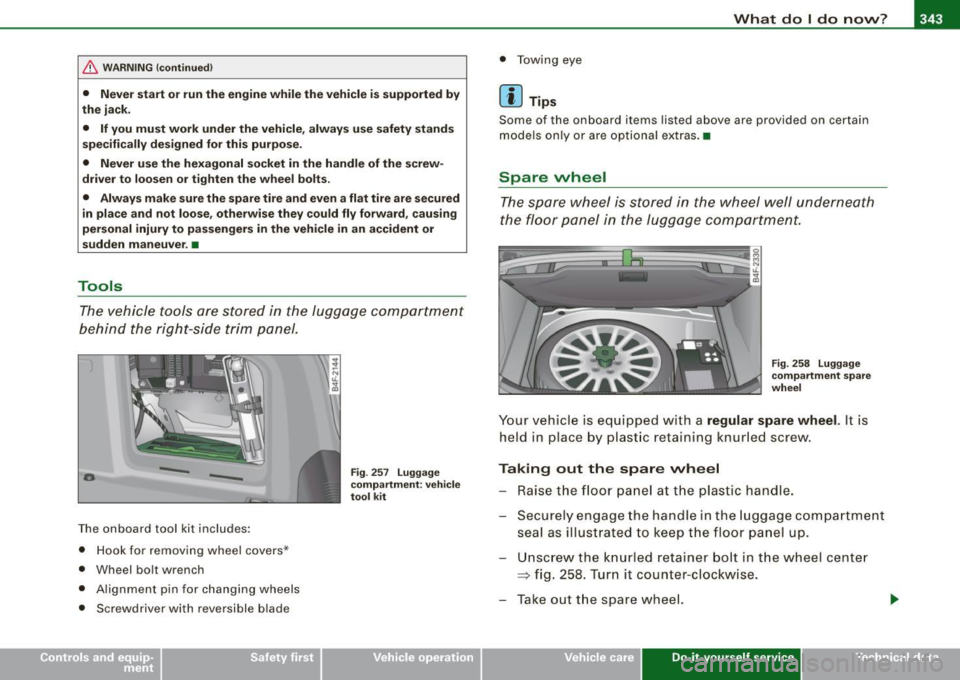
The vehicle tools are stored in the luggage compartment
behind the right-side trim panel.
-
-
The onboard tool kit includes:
• Hook for removing wheel covers *
• Wheel bolt wrench
• Alignment pin for changing wheels
• Screwdriver with reversible blade
Fig. 257 Luggage
compartment: vehicle
tool kit
• Towing eye
[ i] Tips
Some of the on board items listed above are provided on certain
models only or are optional extras.•
Spare wheel
The spare wheel is stored in the wheel well underneath
the floor panel in the luggage compartment.
Fig. 258 Luggage
compartment spare
wheel
Your vehicle is equipped with a regular spare wheel. It is
held in place by plastic retaining knurled screw.
Taking out the spare wheel
- Raise the floor panel at the plastic handle.
- Securely engage the handle in the luggage compartment
seal as illustrated to keep the floor panel up.
Unscrew the knurled retainer bolt in the wheel center
=> fig. 258. Turn it counter-clockwise.
- Take out the spare wheel.
Vehicle care Do-it-yourself service irechnical data
Page 346 of 398
1111!1.___W_ h_ a_ t_ d_o_ l_ d_ o _ n_ o_w _ ? ____________________________________________ _
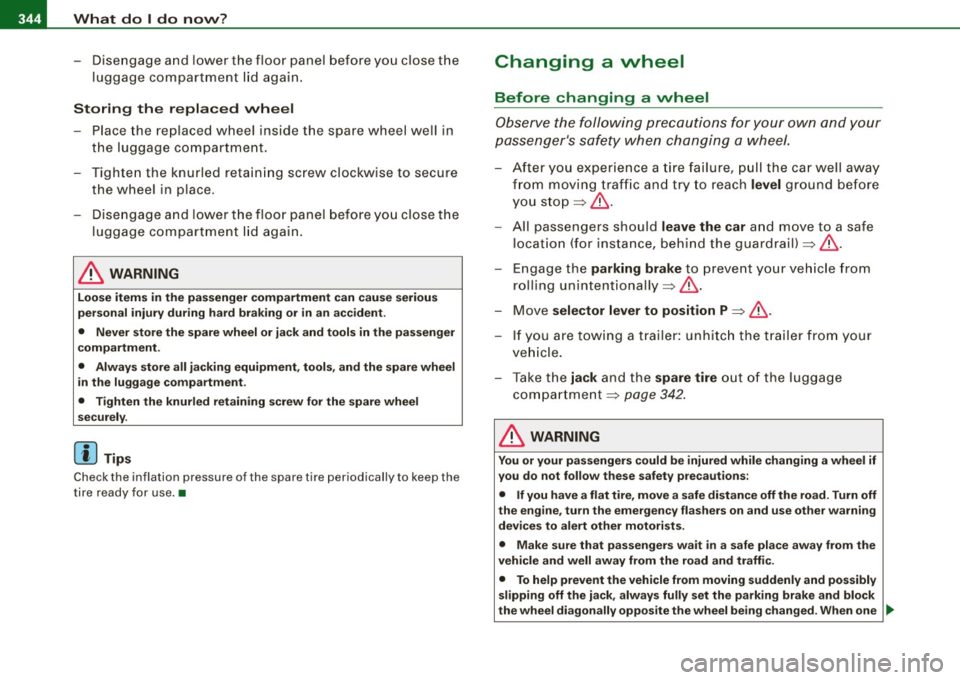
- Disengage and lower the floor panel before you close the
luggage compartment lid again.
Storing the replaced wheel
- Place the replaced wheel inside the spare wheel well in
the luggage compartment .
Tighten the knurled retaining screw clockwise to secure the wheel in place.
- Disengage and lower the floor panel before you close the
luggage compartment lid again.
& WARNING
Loose items in the passenger compartment can cause serious
personal injury during hard braking or in an accident .
• Never store the spare wheel or jack and tools in the passenger
compartment.
• Always store all jacking equipment, tools, and the spare wheel
in the luggage compartment.
• Tighten the knurled retaining screw for the spare wheel
securely.
[ i] Tips
Check the inflation pressure of the spare tire periodically to keep the
tire ready for use. •
Changing a wheel
Before changing a wheel
Observe the following precautions for your own and your
passenger's safety when changing a wheel.
- After you experience a tire failure, pull the car well away
from moving traffic and try to reach level ground before
you stop :::;. & .
- All passengers should leave the car and move to a safe
location (for instance, behind the guardrail) :::;,& .
- Engage the parking brake to prevent your vehicle from
rol ling unintentionally :::;.& .
- Move selector lever to position P :::;. & .
-If you are towing a trailer: unhitch the trailer from your
vehicle.
- Take the jack and the spare tire out of the luggage
compartment:::;.
page 342.
& WARNING
You or your passengers could be injured while changing a wheel if
you do not follow these safety precautions:
• If you have a flat tire, move a safe distance off the road. Turn off
the engine, turn the emergency flashers on and use other warning
devices to alert other motorists.
• Make sure that passengers wait
in a safe place away from the
vehicle and well away from the road and traffic.
• To help prevent the vehicle from moving suddenly and possibly
slipping off the jack, always fully set the parking brake and block
the wheel diagonally opposite the wheel being changed. When one ...
Page 348 of 398
-L--____:W:...:....:. h.:..: a::.. t:....: d.:..:o:....:. l...: d::.. o ..:.... n:..:..:: o...:vv ...:...;. ? ____________________________________________ _
Applies to veh ic les : with decorative wheel covers
Decorative wheel covers
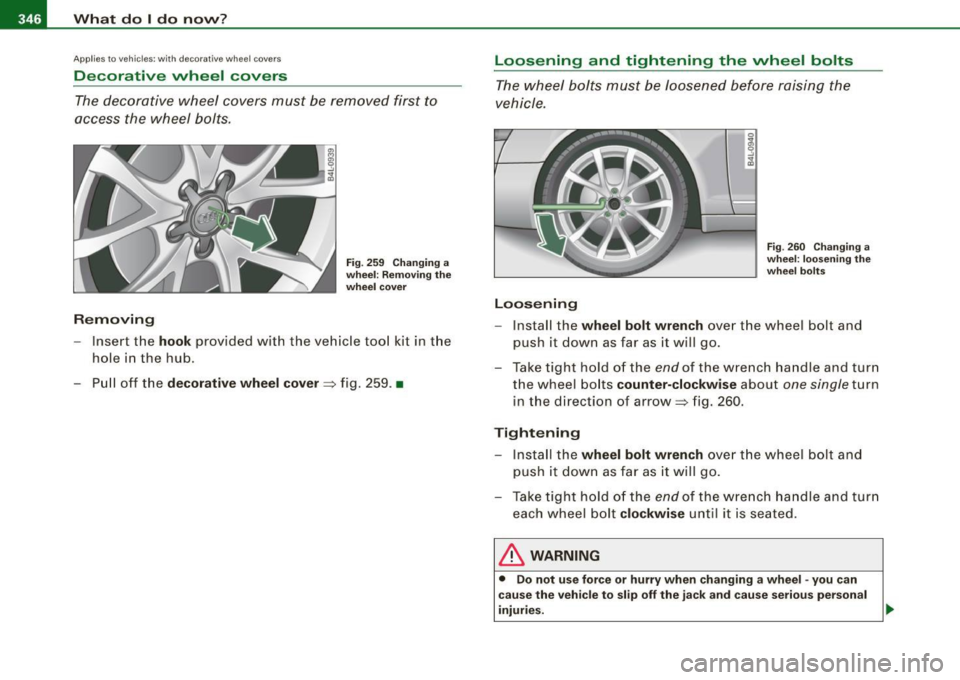
The decorative wheel covers must be removed first to
access the wheel bolts.
Removing
Fig. 259 Changing a
wheel: Removing the
wheel cover
- Insert the hook provided with the vehicle tool kit in the
hole in the hub.
- Pull off the decorative wheel cover=> fig. 259. •
Loosening and tightening the wheel bolts
The wheel bolts must be loosened before raising the
vehicle.
Loosening
Fig. 260 Changing a
wheel: loosening the
wheel bolts
- Install the wheel bolt wrench over the wheel bolt and
push it down as far as it will go.
- Take tight hold of the
end of the wrench handle and turn
the wheel bolts counter-clockwise about
one single turn
in the direction of arrow~ fig. 260.
Tightening
- Install the wheel bolt wrench over the wheel bolt and
push it down as far as it will go.
- Take tight hold of the
end of the wrench handle and turn
each wheel bolt clockwise until it is seated.
& WARNING
• Do not use force or hurry when changing a wheel · you can
cause the vehicle to slip off the jack and cause serious personal
injuries.
Page 351 of 398
_______________________________________________ W_ h_ a_t _ d_ o_ l _d _o_ n_ o _ w_ ? __ ffllll
•
- Screw the th readed end of the a lignment pin from the
tool k it hand-tight into the em pty bolt hole~ page 348,
fig. 264 .
- Then remove the other w heel bolts as described above.
- Take off the wheel leaving the al ignment pin in the bolt
hole.
Putting on the spar e wheel
- Lift the spare whee l and carefully slide it over t he align
ment pin to g uide it in place .
- Use the hexagonal socket in the screw drive r ha ndle t o
screw in a nd tighten a ll w heel bol ts slightly .
- Remove the alignment p in and insert and tighten the
remaini ng wheel bol t slightly like the rest.
- Turn the jack hand le counter -clockwise to lower the
ve hicle until the jack is fully released .
- Use the wheel bolt wrench to tighten all wheel bolts
firmly ~ page 346 . Tighten them crosswise, from one
bolt to the (approximately) opposite one, to keep the
wheel centered .
[ i J Tip s
Never use the hexagonal socke t in the hand le of the screwdriver to
loosen or tighten the wheel bolts .
• Pull the reversible blade from the screwdriver before you use the
hexagonal socket in the hand le to turn the wheel bo lts .
• When mounting tires with
unidire ctional tre ad de sign make sure
t he tread pattern is po inted the right way~
page 349.
• T he wh ee l bolts should b e clean and easy to turn . Check for dirt
and corrosion on the mating surfaces of both the wheel and the hub
. Remove all dirt from these surfaces before remounting the
wheel. •
Tires with unidirectional tread design
Tires with unidirectional tread design must be mounted
with their tread pa ttern pointed in the right dire ction .
Using a spare tire with a tread patte rn intended f or use
in a s pec ific direc tio n
When using a spare tire with a t read pattern intended for use in a
specific direction, please note the following :
• The direction of rotation is marked by an arrow on the side of the
tire .
• I f the spare tire has to be insta lled in the incorrect direction, use
the spare t ire only temporarily since the tire will not be ab le to
achieve its optimum performance characteristics wi th regard to
aquaplaning , noise and wear.
• We recommend that you pay particular attention to this fact
dur ing wet weather and that you ad just your speed to match road
conditions .
• Replace the flat tire with a new one and have it installed on your
vehicle as soon as p ossible to res tore the handling advantages of a
unidirectional tire. •
Notes on wheel changing
Please read the information~ page 329, "New tires and replacing
tires and whee ls" if you are going to use a spare tire which is
different from the tires on your vehic le.
Aft er you change a tire :
• Check the tire pre ssure on the spare im mediat ely a fter in stalla -
tion . _,,,
Do-it -yourself service
Page 355 of 398
Fuses and bul bs -_____________ -----=----.;....:..::.:....:.::;______J
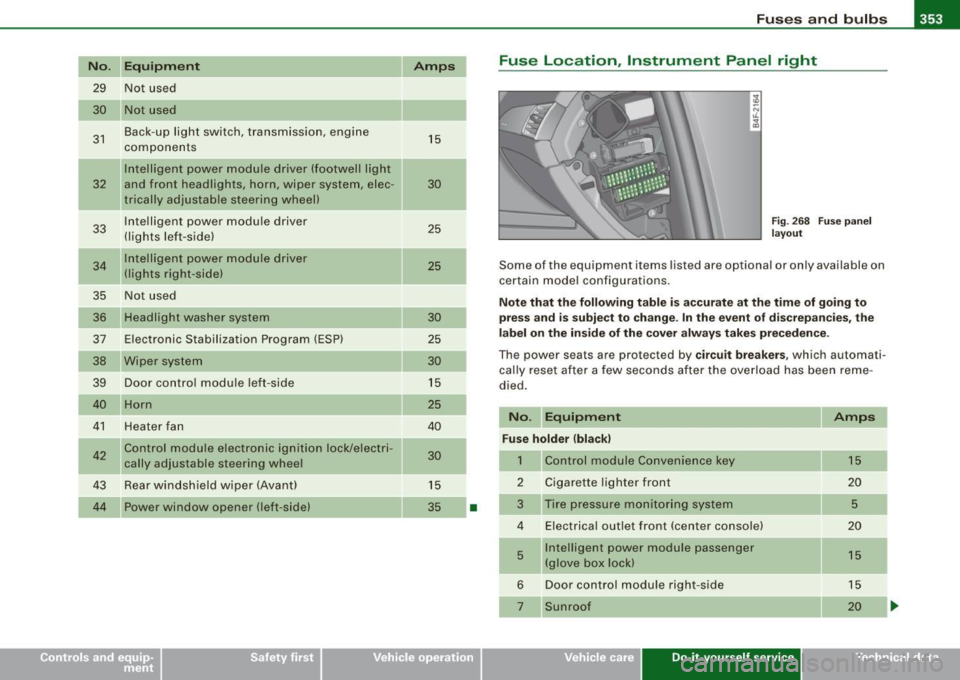
No. Equipm ent
29 Not used
30 Not used
31 Back-up light switch, transmission, engine
components
Intelligent power mo dule driver (footwell l ight
32 and front headlights, horn, wiper system, elec
trically adjusta ble steering wheel)
33 Intelligent power modu le driver
(lights left-side)
---,--
34
35
36
37
38
39
I nte lligent power module driver
(lights right-side)
Not used
Headlight washer system
E lectronic Stabilization Program (ESP)
Wip er system
Door control module left -side
Horn
41 Heater fan
42 Control module electronic ignition lock/electri
cally adjustable steering wheel
43 Rear windsh iel d wiper (Avant)
44 Power window opener (left-side) Amps
15
30
25
25
30 25
30
15
25
40
30
15
35
-
•
Fuse Location , Instrument Panel right
Fig. 2 68 F use pan el
la yo ut
Some of the equipment items listed are optional or on ly available on
certain model configu rations.
Note that the following table is ac curate at the time of g oing to
press and is subject t o change . In the eve nt of d iscrepan cies , th e
l a b el on t he in side of the cover alw ay s take s prec eden ce.
The power seats are protected by cir cuit breaker s, which automati
ca lly reset after a few seconds a fter the ove rload has been reme
died.
No . Equipment Amps
Fu se holder (bla ck )
1 Control module Convenience key 15
2
Cigarette lighter front 20
3
Tire pressure moni tor ing system 5
4 E lectrica l outlet front (center conso le) 20
5
Intelligent power module passenger 15 (glove box lock)
6 Door control module right -side 15
Sunroof 20
Vehicle care Do-it-yourself service irechnical data
Page 361 of 398
________________________________________________ E _m_ e_r.:g :;,. e_ n_c ...: y:.- s_ i_ t _u _a_ t_ i_ o _ n_ s __ ffllll
•
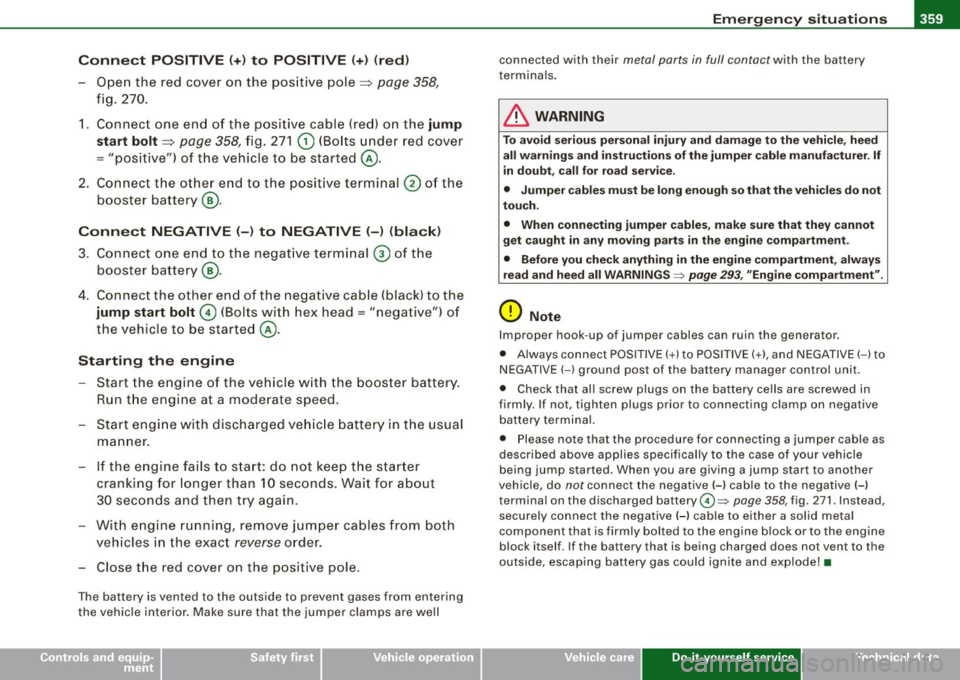
Conn ect POSITIVE (+ ) to PO SITIVE (+ ) (r ed )
- Open the red cover on the pos itive pole => page 358,
fig. 270.
1. Connect one end of the positive cable (red) on the
jump
start bolt=>
page 358, fig. 27 1 G) (Bolts under red cover
= "positive") of the vehicle to be started @.
2. Connect the other end to the positive terminal@ of the
booster battery ®·
Conn ect NEGATIVE (- ) to NEGATIVE (-) (black )
3. Connect one end to the negat ive termi nal 0 of t he
boos ter battery ®·
4 . Connect the other end of the negative cable (black) to the
jump sta rt bolt 0 (Bolts with hex head = "n egative") of
the vehicle to be s tarted @.
Startin g th e e ngin e
-Start the engine of the veh icle w ith the booster battery .
Run t he engine at a moderate speed .
- Start engine with discharged ve hicle battery in the usual
ma nner.
- If the engine fails to s tart: do not keep the star ter
cranking for longer than 10 seconds. Wait f or about
30 seconds and then try again.
- With engine running, remove jumper cables from both
vehicles in the exact reverse order.
- Close the red cover on the positive pole.
The battery is vented to the outside to prevent gases from entering
the vehic le interior . Make sure that the jumper clamps are well connected with their
metal parts in full contact with the battery
t erminals .
& WARNING
To avoid seriou s per sonal in jur y a nd d amage to the vehicle , heed
a ll wa rning s and in stru ction s o f th e jum per ca ble man ufa cturer . If
in doubt , call for ro ad serv ice.
• Jump er c able s must b e lo ng eno ugh so that the vehi cle s d o not
touch .
• When conne cting jumpe r cable s, ma ke sure th at the y cann ot
g et caught in an y mo ving p arts i n the engine comp art m ent .
• Before you che ck anyth ing in the en gin e com partm ent , a lwa ys
r ea d and h eed all W ARNIN GS~ pag e 293, "E ngine compa rtm ent ".
0 Note
Improper hook -up of jumper cables can ruin the generato r.
• Always connect POSITIVE(+) to POS ITIVE( +), and NEGATIVE( -) to
NEGATIVE( -) ground post of the battery manager control unit.
• Check that al l screw p lugs on the battery ce lls are screwed in
firm ly . If not, tighten plugs prior to connecting clamp on negative
battery termi nal.
• Please note that the procedure for connecting a jumper cab le as
described above applies specifical ly to the case of your vehicle
being jump started. When you are giving a jump start to another
vehicle, do
not connect the negative(-) cable to the negative (-1
terminal on the discharged battery©~
page 358, fig. 271. Instead,
securely connect the negative ( -1 cable to either a solid metal
component that is firmly bolted to the engine b lock or to the engine
block itself . If the battery that is being charged does not vent to the
outside, escap ing battery gas could ignite and exp lode! •
Do-it-yourself service