weight AUDI S6 2009 Owner's Manual
[x] Cancel search | Manufacturer: AUDI, Model Year: 2009, Model line: S6, Model: AUDI S6 2009Pages: 398, PDF Size: 43 MB
Page 231 of 398
__________________________________________________ A_ i_ r _b _a...; g::- s_ y=--- s_t _e _m __ fllll
& W ARNING (continued )
seating position and have the airbag system inspected by your
Audi dealer .
• A tight tether or other str ap on a rearward-fac ing child restr aint
attached to the front pas senger seat can put too much pressure
on the weight-sensing mat in the seat and reg ister more weight
than i s actually on the seat. The heavier weight registered can
make the system work as though an adult were on the seat and
deploy the Advanced Airbag when it must be suppressed causing
s erious or even fatal injury to the child .
• If, in exceptional circumstance s, you mu st in stall a forward
fac ing child restra int on the front passenger seat , always move the
seat into its rearmost position in the seat 's fore and aft ad just
ment range , as far away from the airbag a s possible . The backrest
must be adjusted to an upright position . Make sure that the
PASSENGER AIR BAG OFF light comes on and stay s on all the time
whenever the ignition is switched on .
& WARNING
• If the PASSENGER AIR BAG OFF light does not go out when an
adult is sitting on the front passenger seat after taking the steps
described above, make sure the adult is properly seated and
restrained at one of the rear seating positions .
• Have the airbag system inspected by your Audi dealer before
transporting anyone on the front passenger seat .
[ i ] Tips
If the weight -sensing mat in the front passenger seat detects an
e mp ty seat, the fro nt air b ag on the pa ssenge r sid e will be t urned
off, and the PASSENGER AIR BAG OFF l ight will stay on .
a
Controls and equip
ment Safety first
Vehicle operation
Repair, care and disposal of the airbags
Parts of the airbag system are insta lled at many different places on
your Au di. In sta ll in g, re moving, ser vic in g or re pair in g a part in an
area of the vehicle can damage a part of an a irbag system and
pre ven t that system fro m wo rki ng p rope rly in a co llision .
There are some important things you have to know to make sure
that the effectiveness of the system will not be impai red an d that
d iscarded components do not cause inju ry or po llute t he e nv iron
ment .
& WARNING
Improper care , servicing and repair procedures can increase the
risk of personal injury and death by preventing an airbag from
deploying when needed or deploying an airbag unexpectedly:
• Never cover , obstruct , or change the steering wheel horn pad
or airbag cover or the instrument panel or modify them in any way .
• Never attach any objects such as cupholders or telephone
mountings to the surfaces covering the airbag units.
• For cleaning the horn pad or instrument panel, use only a soft ,
dry cloth or one moi stened with plain water . Solvents or cleaners
c ould damage the airbag cover or change the stiffness or strength
of the material so that the airbag cannot deploy and protect prop
erly .
• Never repair , adjust , or change any parts of the airbag system.
• All work on the steering wheel , instrument panel , front seats or
electrical system (including the installation of audio equipment ,
c ellular telephones and CB radios , etc .I must be performed by a
qualified technician who has the training and special equipment
necessary .
• For any work on the airbag system , we strongly recommend
that you see your authorized Audi dealer or qualified workshop .
• Never modify the front bumper or parts of the vehicle body .
Vehicle care Do-it-yourself service Technical data
Page 236 of 398
___ A_ ir_b _a_ g;:::;_ s--:.. y_s _t _e _m _________________________________________________ _
& WARNING (continued)
-Never carry any objects or pets in the deployment space
between them and the airbags or allow children or other
passengers to travel in this position .
• Always use the built-in coat hooks only for lightweight
clothing. Never leave any heavy or sharp-edged objects in the
pockets that may interfere with side airbag deployment and can
cause personal injury in an accident .
• Always prevent the side airbags from being damaged by heavy
objects knocking against or hitting the sides of the seatbacks.
• The airbag system can only be triggered once . If the airbag has
been triggered, the system must be replaced by an authorized
Audi dealership .
• Damage (cracks, deep scratches etc.) to the original seat covers
or to the seam in the area of the side airbag module must always
be repaired immediately by an authorized Audi dealer.
• If chi ldren are seated improperly, their risk of injury increases
in the case of an accident:::::,
page 238, "Child Safety".
• Never attempt to modify any components of the airbag system
in any way.
• In a side collision , side airbags will not function properly if
sensors cannot correctly measure increasing air pressure inside
the doors when air escapes through larger, unclosed openings in
the door panel.
-Never drive with interior door trim panels removed.
- Never drive when parts have been removed from the inside
door panel and the openings they leave have not been properly
closed.
- Never drive when loudspeakers in the doors have been
removed unless the speaker holes have been properly closed .
- Always make certain that openings are covered or filled if
additional speakers or other equipment is installed in the
inside door panels .
& WARNING (continued)
-Always have work on the doors done by an authorized Audi
dealer or qualified workshop . •
Side curtain airbags
Description of side curtain airbags
The side curtain airbag system can provide supplemental
protection to properly restrained occupants.
B
Fig. 216 Side curtain
airbags , driver 's side:
location
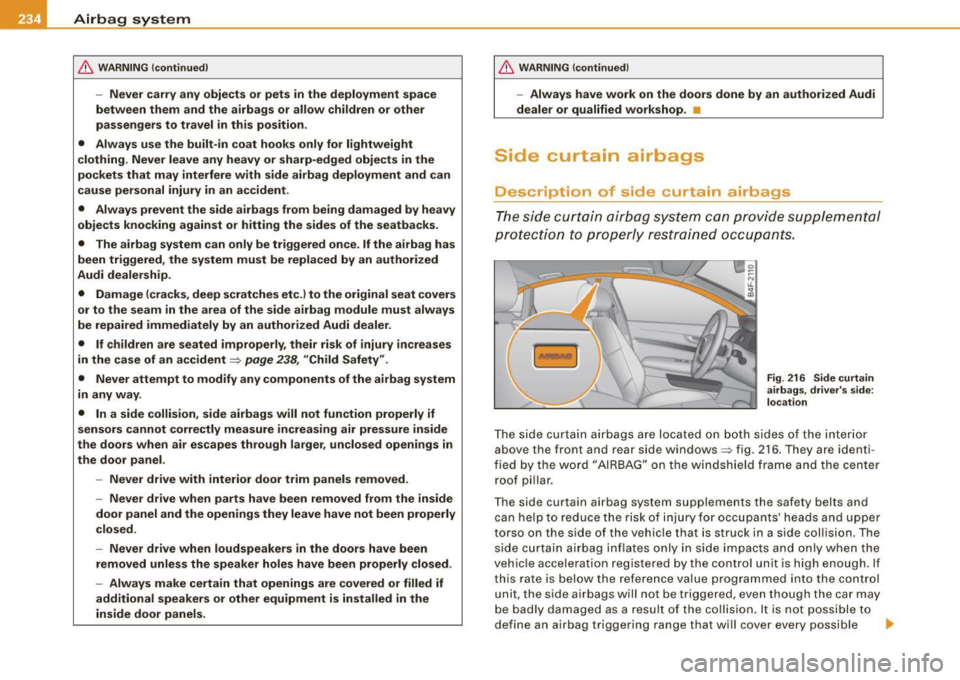
The side curtain airbags are located on both sides of the interior
above the front and rear side windows:::::, fig. 216. They are identi
fied by the word "AIRBAG" on the windshield frame and the center
roof pillar.
The side curtain airbag system supplements the safety belts and can help to reduce the risk of injury for occupants' heads and upper
torso on the side of the vehicle that is struck in a side collision. The
side curtain airbag inflates only in side impacts and only when the
vehicle acceleration registered by the control unit is high enough. If
this rate is below the reference value programmed into the control
unit, the side airbags will not be triggered, even though the car may
be badly damaged as a result of the collision. It is not possible to
define an airbag triggering range that will cover every possible ..,
Page 238 of 398
___ A_ ir_ b_ a-g _ s_y _s_ t_ e_ m _________________________________________________ _
The side curtain airbags inflate between the occupant and the
windows on the side of the vehic le that is struck in a side co llis ion
=> fig. 2 17.
When the system is triggered, the side curtain airbag is filled with propellant gas and brea ks through a seam above the fron t and rear
side windows identified by the A IRBAG label. In order to help
provide th is additiona l protection, the side curtain a irbag must
inflate within the b link of an eye at very high speed and with great
f orce . The side curtai n airbag could i njure you i f your seating pos i
tion is not proper or upright or if items are located in the area where
t he supplementa l side cu rtai n airbag inflates . This applies espe
cia lly to children=>
page 238.
Although they a re not a soft pi llow, side curta in airbags can
"cus hion" the impact and in this way they can help to reduce the risk
of injury to the head and the upper part of the body .
A fine dust may develop wh en the airbag depl oys. Thi s is qu ite
normal and does not mean there is a fire in the veh ic le. •
Important safety instructions on the side
curtain airbag system
A irbags are on ly s upp le men ta l r estraints . Alwa ys prop
erly wea r saf ety belt s and ride in a proper seating po si
ti on.
T here is a lo t tha t you and y our pa ssengers mus t kn ow and d o to
help the safety belts and airbags do their job to provide supple
men tal pro tection .
& WARNING
Improperly wearing safety belts and improper seating positions
increase the risk of serious personal injury and death whenever a
vehicle is being used.
& WARNING (continued )
• Never let occupants pla ce any parts of their bodies in the area
from wh ich the side curtain airbags inflate .
• Always make sure that the side curtain airbags can inflate
without interference . Unsuitable accessories fitted inside the
expansion range of a side curtain airbag can dangerously interfere
with it s function. A deploying head airbag develops enough for ce
to catapult any p ie ce of add-on component out of its path of infla
tion and into the pas senger compartment. An occupant hit by
such a projectile can suffer serious injury or death =>
page 375,
"Techni cal Modifications" .
• Do not swivel the sun visors to the side if you have any objects
clipped onto them (for example pens) . If the airbag should deploy ,
you could be in jured by these objects .
• Use the built -in coat hooks only for lightweight clothing . Never
leave any heavy or sharp-edged ob je cts in the pocket s that may
interfere with airbag deployment and can cause personal injury in
an accident .
• Never use hanger s to hang c lothing from the hook s.
• Only use fa ctory -installed sun shades or , in the case of shades
installed after the vehicle leaves the factory , only Audi roll-up
s unscreens may be used =>
page 374, "Additional acce ssories and
part s replacement ".
• Always sit in proper seating position and wear safety belts
while traveling so that the side cu rtain airbags can help provide
protection .
• The ai rbag system can only be triggered on ce . If the airbag has
been triggered, the system must be replaced by an authori zed
Audi de aler or qualified workshop.
• Always have work involving the side curtain airbag system ,
removal and installation of the airbag components , or other
repairs performed by a qualified dealership. Otherwise the airbag
system may not work correctly.
ti,
Page 240 of 398
___ C_h_ i_ ld _ S_ a_ f_ e_ t_y ____________________________________________ _
Child Safety
Important things to know
Introduction
The rear seat is generally the safest place in a collision.
The physica l pri ncip les of wha t happe ns when your veh ic le is in a
crash apply also to children:::::,
page 207, "What happens to occu
pa nts not wearing safety bel ts?" . But un like adu lts and teenagers,
their musc les and bones are not fully developed. In many respects
children are at g reate r ris k of ser ious injury in crashes than ad ults .
Because chi ldren's bodies a re not fully deve loped, they require
restraint systems especial ly designed for their size, weight, and
body structu re. Many countries a nd all states of the U nited States
and provinces of Canada have laws requiring the use of approved
chi ld restrai nt sys te m s for i nfants and sma ll children.
In a frontal crash at a speed of 20 -35 mph (30 -56 km/h) the forces
acting on a 13 -p o und (6 kg) infant wil l be m ore tha n 20 times the
weight of the child. This means the weight of the child wou ld
sudden ly be more than 260 pounds (120 kg). Under these condi
tions, on ly an appropriate child restraint prop erly used can reduce
the risk of serious injury. Child restraints, like adult safety belts,
must be used prope rly to b e effective. Used i mprope rly, they can
increase the risk of serious injury in an accident .
Co nsu lt the c hild safety seat manu fac turer's ins truc tions to be su re
the seat is right for your child's size:::::,
page 241, "Important safety
instructions for using child safety seats" . Please be sure to read and
heed a ll of the important information and WARN INGS about chi ld
safety, Advanced Airbags, and the installation of child restraints in
th is chapter.
There is a lot you need to know about the Advanced Airbags in your
ve hicle and how they work when infants a nd c hil d ren i n child
restraints are on the front passenger seat. Because of the large amount of important information, we cannot repeat it all here. We
urge you
to read the detai led information in this owner's manua l
about a irbags and the Adva nced Ai rbag Sys tem i n your ve hic le an d
the very important information about transporting chi ldren on the
fron t passe nger seat . P lease be sure to heed the WAR NINGS -they
are extreme ly important for your safety and the safety of your
p assengers, es pecia lly in fa nt s and s mall chil dren .
& WARNING
• Accident stati stic s have shown that children are generally safer
i n the rear seat area than in the front seat ing posit ion. Always
restrain any child age 12 and under in the rear .
• All vehicle o cc u pants and especi ally children must be
restrained properly whenever riding in a vehicle . An unrestrained
or improperly restrained child could be injured by striking the inte
rior or by being ejected from the vehicle during a sudden
maneuver or impact . An unrestrained or improperly restrained
child is also at greater risk of injury or death through contact with
an inflating a irbag .
• A suitable child restraint properly installed and used at one of
the re ar seat ing positions provides the highest degree of protec
tion for infants and small children in most accident situations.
& WARNING
Children on the front seat of any car even with Advanced Airbags
can be seriously injured or even killed when an airbag inflates . A
child in a rearward -fa cing child safety seat in stalled on the front
passenger seat will be seriously injured and can be killed if the
front airbag inflate s.
• The inflating airbag will hit the child safety seat or infant
carrier with great force and will smash the child safety seat and
child against the backrest , center arm rest , or door .
IJll,
Page 241 of 398
-------------------------------------------~C:::.'. h~ i~ ld :::.....:: S~ a~ f~e ~t .!.y __ l!ftlll
& WA RNIN G (continu ed )
• Always install rear-facing child safety seat s on the rear seat.
• If you mu st in stall a re arw ard fa cing child safety sea t on the
front pa ssenger seat in exceptional cir cum stances and the
PASSENGER AIR BAG OFF light doe s not come on and stay on,
immediate ly in sta ll the re ar-facing child safety seat in a rear
s eating po sition and h ave the airbag sy stem inspected immedi
atel y by your Audi dea ler .
& WARNING
If, in exceptional circum stance s, you mu st install a forward -facing
c hild re st raint on the fro nt p ass enger's seat :
• Alway s make sure the forward -facing seat has been de signed
and cert ified by it s manufa cturer f or use on a front se at with a
p assenger front and side airbag .
• Always follow the manufacturer's instructions provided with
the child safety seat or carrier.
• Always mov e the passenger sea t into it s rea rmo st p osition in
the seat' s fore and aft adju stment r ange , as far away from the
airb ag as possible before in stalling the ch ild r estr aint . The b ack
r es t must be adju sted to an upr ight po sition.
• Alway s ma ke sure th at the PASSENGER AIR BAG OFF l ight
c ome s on and stay s on all the time whenever the ignition is
s witched on. •
Advanced front airbag system and children
Your vehicle is equipped with an "Advanced Airbag System" in
compliance with United States Federal Motor Veh icle Sa fety Stan
dard ( FMVSS) 208 as applicable at the time your vehicle was manu
f actured .
Controls and equip ment Safety first Vehicle operation The Advanced Airbag system in your vehicle has been certified to
meet the " low -risk" requirements for 3 and 6 year -old children on
the passenger side and small adu lts on the driver side. The low risk
deployment crite ria are intended to reduce the risk of injury th rough
interaction with the airbag that can occur, for example, by being too
close to the steering wheel and instrument panel when the airbag
inf lates . In addit ion, the system has been cert ified to comply with
the "suppression" requirements of the Safety Standard, to turn off
the front airbag for infants up to 12 months who are restrained on
the front passenger seat in child restraints that are listed in the
Standard.
Even though your vehic le is equipped with an Advanced Airbag
system, all children, especially those 12 years and younger, should
a lways ride in the back seat properly restrained for their age and
s ize . The airbag on the passenger side makes the front seat a poten
tia lly dangerous p lace for a chi ld to ride. The front seat is not the
safest p lace for a child in a forward -facing child safety seat. It can be
a very dangerous place for an infant or a larger child in a rearward
facing seat. •
Advanced Airbags and the weight-sensing
mat in the front seat
The Advanced Airbag System in your vehicle detects the presence
of an infant or child in a chi ld restraint on the front passenger seat
using the weight -sensing mat in the seat cushion and the sensor
below the safety belt latch on the front passenger seat that
measures the tension on the safety be lt .
The weight -sensing mat measures t otal weight of the child and the
child safety seat and a chi ld blanket on the front passenger seat. The
we ight o n the front passenger seat is related to the design of the
child restraint and its "footprint" , the size and shape of the bottom
of the child restraint as it sits on the seat. The weight of a child
restraint and its "footprint" vary for different kinds of child
~
Vehicle care Do-it-yourself service Technical data
Page 242 of 398
-Child Safety -----<------------------------------
restraints and for the different models of the same kind of child
restraint offered by child restraint manufacturers.
The weight ranges for the individual types, makes and models of
child restraints that the NHTSA has specified in the Safety Standard
together with the weight ranges of typical infants and typical 1 year old child have been stored in the control unit of the Advanced
Airbag System. When a child restraint is being used on the front passenger seat with a typical 1 year-old child, the Advanced Airbag
System compares the weight measured by the weight sensing mat
with the information stored in the electronic control unit.
The electronic control unit also registers the tension on the front
passenger safety belt. The tension on the safety belt for the front
passenger seat will be different for an adult who is properly using
the safety belt as compared to the tension on the belt when it is
used to attach a child restraint to the seat. The sensor below the
latch for the safety belt for the front seat passenger measures the
tension on the belt . Th e input from this sensor is then used with the
weight to "decide" , whether there is a chi ld restraint with a typica l 1
year-old child on the front passenger seat and whether or not the
airbag must be turned off.•
Child restraints and Advanced Airbags
Regard less of the child restraint that you use, make sure that it has
been certified to meet United States Federal Motor Vehicle Safety
Standards and has been certified by its manufacturer for use with
an airbag. Always be sure that the child restraint is properly
installed at one of the rear seating positions. If in exceptional
circumstances you must use it on the front passenger seat, carefully read all of the information on child safety and Advanced Airbags
and heed all of the applicable WARNINGS. Make certain that the
child restraint is correctly recognized by the weight -sensing mat
inside the front passenger seat, that the front passenger airbag is
turned off and that the airbag status is always correctly signaled by
the
PASSENGER AIR BAG OFF light . Many
types and models of child restraints have been available over
the years, new mode ls are introduced regularly incorporating new
and improved designs and older models are taken out of produc
tion. Child restraints are not standardized. Child restraints of the
same type typically have different weights and sizes and different
'footprints,' the size and shape of the bottom of the child restraint
that sits on the seat, when they are installed on a vehicle seat. These
differences make it virtually impossible to certify compliance with
the requirements for advanced airbags with each and every child
restraint that has ever been sold in the past or will be sold over the
course of the usefu l life of your vehicle.
For this reason, the United States National Highway Traffic Safety
Administration has pub lished a list of specific type, makes and
models of child restraints that must be used to certify compliance
of the Advanced Airbag System in your vehicle with the suppression
requirements of Federal Motor Vehicle Safety Standard 208. These
child restraints are:
A. Car beds, manufactured on or after September 1,
2004:
• Cosco Dream Ride 02-719
B. Rear facing child restraint systems, manufactured
on or after September 1, 2004:
(When the restraint system comes equipped with a removable base,
compliance has to be certified with or without the basel.
• Britax Handle with Care 191
• Century Assura 4553
• Century Smart Fit 4543
• Cosco Arriva 02727
• Evenflo Discovery Adjust Right 212
• Evenflo First Choice 204
• Graco Infant 8457
Page 243 of 398
_______________________________________________ C_h _ i_ld _ S_ a_ f_ e_ t..,:c y __ __
C. Forward-facing convertible child restraint systems,
manufactured on or after September 1, 2004:
• Britax Roundabout 161
• Britax Expressway
• Century Encore 4612
• Century STE 1000 4416
• Cosco Olympian 02803
• Cosco Touriva 02519
• Evenflo Horizon V 425
• Evenflo Medallion 254
• Safety First Comfort Ride 22-400
& WARNING
To reduce the risk of serious injury, make sure that the PASSENGER
AIR BAG OFF light comes on and stays on whenever a child
restraint is installed on the front passenger seat and the ignition
is switched on.
• Take the child restraint off the front passenger seat and install
it properly at one of the rear seat positions if the PASSENGER AIR
BAG OFF light does not stay on.
• Have the airbag system inspected by your authorized Audi
dealer immediately.
[ i] Tips
The child seats listed in categories A to C have been tested by Audi
only for the Advanced Airbag function. •
Controls and equip
ment Safety first Vehicle operation
Important safety instructions for using child
safety seats
Correct use of child safety seats substantially reduces the
risk of injury in an accident!
As the driver, you are responsible for the safety of every
body in the vehicle, especially children:
- Always use the right child safety seat for each child and
always use it properly~
page 243.
-Always carefully follow the child safety seat manufac
turer's instructions on how to route the safety belt prop
erly through the child safety seat.
- When using the vehicle safety belt to install a child safety
seat , you must first activate the convertible locking
retractor on the safety belt to prevent the child safety
seat from moving~
page 248.
-Push the child safety seat down with your full weight to
get the safety belt really tight so that the seat cannot move forward or sideways more than one inch (2.5 cm).
- If a strap or tether is being used to tie the child safety
seat to the front passenger seat, make sure that it is not
so tight that it causes the weight-sensing mat to
measure more weight than is actually on the seat.
Always remember: Even though your vehicle is equipped with an
Advanced Airbag system, all children, especially those 12 years and
younger, should always ride in the back seat properly restrained for
their age and size. ..,
Vehicle care Do-it-yourself service Technical data
Page 245 of 398
& WARNING !continued)
-Always move the front passenger seat into the rearmost
position of the passenger seat's fore and aft adjustment range,
and as far away from the airbag as possible before installing
the child restraint.
- Always make sure that nothing prevents the front
passenger's seat from being moved to the rearmost position in
its fore and aft adjustment range.
- Always make sure that the backrest is in the upright posi
tion.
• Always buckle the child safety seat firmly in place even if a
child is not sitting in it. A loose child safety seat can fly around
during a sudden stop or in a collision.
• Always read and heed all WARNINGS whenever using a child
restrained in a vehicle is being used
=> page 205, "Safety belts",
~ page 215, "Airbag system" and~ page 238, "Child Safety".
& WARNING
To reduce the risk of serious injury, make sure that the PASSENGER
AIR BAG OFF light comes on and stays on whenever a child
restraint is installed on the front passenger seat and the ignition
is switched on.
• Take the child restraint off the front passenger seat and install
it properly at one of the rear seat positions if the PASSENGER AIR
BAG OFF light does not stay on.
• Have the airbag system inspected by your authorized Audi
dealer immediately. •
Safety first
Child Safety
Child safety seats
tnfant seats
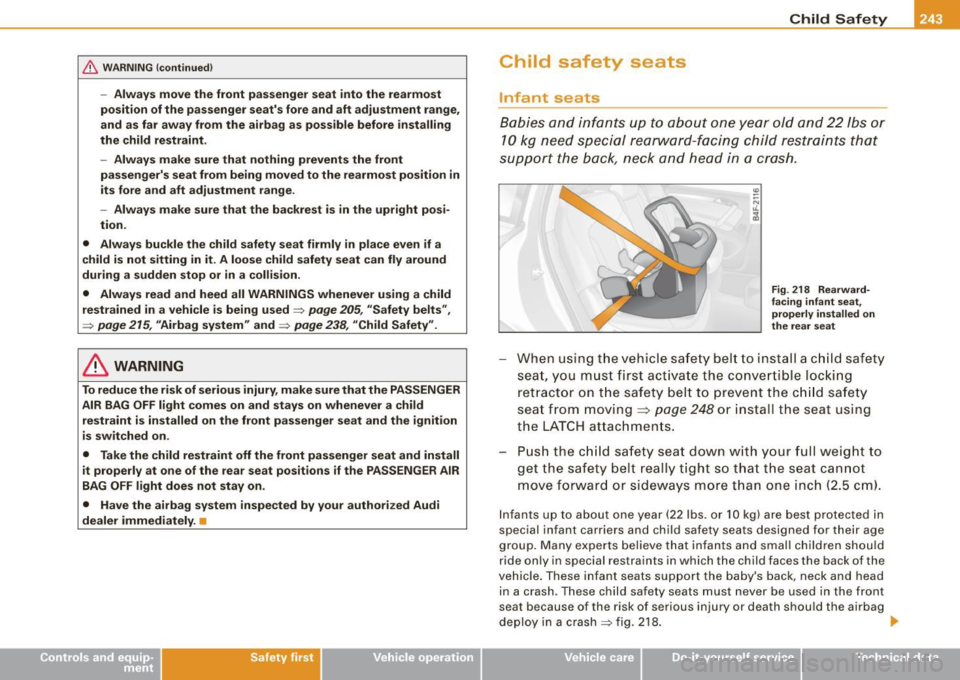
Babies and infants up to about one year old and 22 lbs or
10 kg need special rearward-facing child restraints that
support the back, neck and head in a crash.
Fig . 218 Rearward
facing infant seat,
properly installed on
the rear seat
-When using the vehicle safety belt to install a child safety
seat, you must first activate the convertible locking retractor on the safety belt to prevent the child safety
seat from moving
~ page 248 or install the seat using
the LATCH attachments.
- Push the child safety seat down with your full weight to
get the safety belt really tight so that the seat cannot
move forward or sideways more than one inch (2.5 cm).
Infants up to about one year (22 lbs. or 10 kg) are best protected in
special infant carriers and child safety sea ts designed for their age
group. Many experts believe that infants and small children should
ride only in special restraints in which the child faces the back of the
vehicle. These infant seats support the baby's back, neck and head
in a crash. These child safety seats must never be used in the front
seat because of the risk of serious injury or death should the airbag
deploy in a crash
=> fig. 218. ._
Vehicle care I I irechnical data
Page 246 of 398
___ C_h_ i_ ld _ S_ a_ f_ e_ t--= y'------------------------------------------------
& WARNING
Not using a child safety seat, using the wrong child safety seat or
improperly installing a child restraint increases the risk of serious
personal injury and death in a crash.
• Never install rear-facing child safety seats or infant carriers on
the front passenger seat -even with an Advanced Airbag System.
A child will be seriously injured and can be killed when the
inflating airbag hits the child safety seat or infant carrier with
great force and smashes the child safety seat and child against the
backrest, center arm rest, or door=>
page 217, "Child restraints on
the front seat -some important things to know".
• Always install rear-facing child safety seats or infant carriers on
the rear seat.
• Never install a rear-facing child restraint
in the forward-facing
direction. Such restraints are designed for the special needs of
infants and very small children and cannot protect them properly
if the seat is forward-facing.
• If you must install a rearward facing child safety seat on the
front passenger seat because of exceptional circumstances and
the PASSENGER AIR BAG OFF light does not come on and stay on,
immediately install the rear-facing child safety seat in a rear
seating position and have the airbag system inspected by your
Audi dealer.
• Always read and heed all WARNINGS whenever using a child
restrained in a vehicle is being used =>
page 205, "Safety belts",
=> page 215, "Airbag system" and=> page 238, "Important things
to know". •
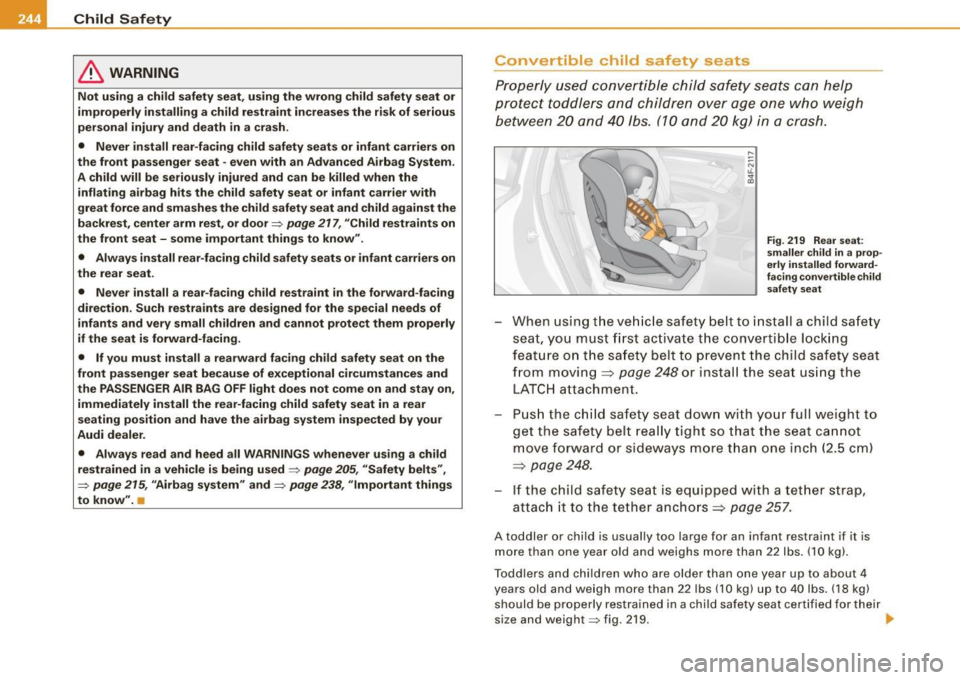
Convertible chi ld safety seats
Properly used convertible child safety seats can help
protect toddlers and children over age one who weigh between 20 and 40 lbs. (10 and 20 kg) in a crash.
Fig . 219 Rear seat:
smaller child
in a prop
erly installed forward
facing convertible chi Id
safety seat
- When using the vehicle safety belt to install a child safety
seat, you must first activate the convertible locking
feature on the safety belt to prevent the child safety seat
from moving =>
page 248 or insta ll the seat using the
LATC H attachment.
- Push the child safety seat down with your full weight to
get the safety belt really tight so that the seat cannot
move forward or sideways more than one inch (2.5 cm)
=> page 248.
-If the child safety seat is equipped with a tether strap,
attach it to the tether anchors =>
page 257.
A toddler or chi ld is usually too large for an infant restraint if it is
more than one year old and weighs more than 22 lbs. (10 kg).
Toddlers and children who are older than one year up to about 4
years old and weigh more than 22 lbs (10 kg) up to 40 lbs . (18 kg)
should be properly restrained in a child safety seat certified for their
size and weight=> fig. 219 . ..,_
Page 248 of 398
___ C_h_ i_ld _ S_ a_ f_ e_ t-= y'------------------------------------------------
Booster seats
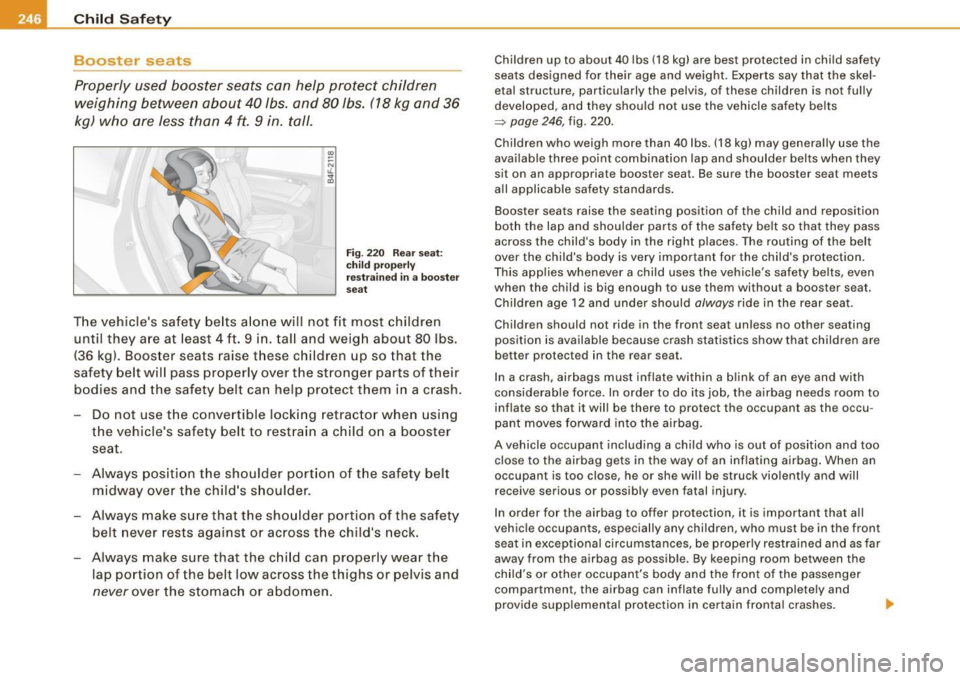
Properly used booster seats can help protect children
weighing between about 40 lbs . and 80 lbs. (18 kg and 36
kg) who are less than 4
ft. 9 in. tall.
Fig. 220 Rear seat:
chi ld properly
restrained in a booster
seat
The vehicle's safety belts a lone will not fit most children
until they are at least 4 ft. 9 in. tall and weigh about 80 lbs.
(36 kg). Booster seats raise these children up so that the
safety belt will pass properly over the stronger parts of their bodies and the safety belt can help protect them in a crash .
- Do not use the convertible locking retractor when using
the vehicle's safety belt to restrain a child on a booster
seat.
- Always position the shoulder portion of the safety belt
midway over the child's shoulder.
- Always make sure that the shoulder portion of the safety
belt never rests against or across the child's neck.
Always make sure that the child can properly wear the
lap portion of the belt low across the thighs or pelvis and
never over the stomach or abdomen.
Children up to about 40 lbs (18 kg) are best protected in child safety
seats designed for their age and weight. Experts say that the skel
etal structure, particularly the pelvis, of these children is not fully
developed, and they should not use the vehicle safety belts
=> page 246 , fig. 220.
Children who weigh more than 40 lbs. (18 kg) may generally use the
available three point combination lap and shoulder belts when they
sit on an appropriate booster seat . Be sure the booster seat meets
all applicable safety standards.
Booster seats raise the seating position of the child and reposition
both the lap and shoulder parts of the safety belt so that they pass
across the child's body in the right places. The routing of the belt
over the child's body is very important for the child's protection.
This applies whenever a chi ld uses the vehicle's safety belts, even
when the child is big enough to use them without a booster seat.
Children age 12 and under should
always ride in the rear seat .
Children should not ride in the front seat unless no other seating
position is available because crash statistics show that children are
better protected in the rear seat.
In a crash, airbags must inflate within a blink of an eye and with
considerable force. In order to do its job, the airbag needs room to
inflate so that it will be there to protect the occupant as the occu
pant moves forward into the airbag.
A vehicle occupant including a child who is out of position and too close to the airbag gets in the way of an inflating airbag . When an
occupant is too close, he or she will be struck violently and will
receive serious or possibly even fatal injury .
In order for the airbag to offer protection, it is important that all
vehic le occupants, especially any children, who must be in the front
seat in exceptional circumstances, be properly restrained and as far
away from the airbag as possible. By keeping room between the
child's or other occupant's body and the front of the passenger
compartment, the airbag can inflate fully and completely and
provide supplemental protection in certain frontal crashes . ..