belt AUDI S6 2009 Owner's Guide
[x] Cancel search | Manufacturer: AUDI, Model Year: 2009, Model line: S6, Model: AUDI S6 2009Pages: 398, PDF Size: 43 MB
Page 218 of 398
___ A_ ir_ b_ a-g _ s_y _s_ t_ e_ m _________________________________________________ _
repair costs or even the lack of vehicle dama ge is not necessa rily an
in dic ati on of wh ether a n airb ag s hould infl ate or not.
S inc e th e circumsta nces w ill vary considerably b etw een one colli
s ion and anothe r, it is not po ssib le to define a range of vehic le
speeds t hat w ill cover eve ry po ssib le kin d a nd a ngle of im pact tha t
wi ll a lwa ys trigger the airbags . Impo rtant facto rs include, fo r
e xa mpl e, the natu re (ha rd o r sof t) o f th e object whic h th e car h its,
the ang le of impact, vehic le speed, etc. The front airbags will also
n o t in flate in s id e or rear co ll is ions, o r in ro ll-ov ers.
Always remember : Airba gs will d ep loy only once, and on ly in c ertain
k inds o f co llision s. Yo ur s afe ty bel ts are a lways the re t o offe r protec
ti on i n th ose si tuat io n s in whic h airba gs a re not suppose d to deploy,
or when they have a lready dep loyed; f or examp le, when yo ur veh ic le
str ikes o r is struc k by anot her ve hicle a fte r th e fir st coll isio n.
T his is just one of the reasons why an airbag is a supplementary
res train t an d is not a su bstit u te fo r a sa fe ty belt. T he ai rbag system
works most effectively when used with the safety be lts . T herefore,
a lw ays pro per ly wea r your safe ty be lts ~
page 205 .
& WARNING
Sitting too close to the steering wheel or instrument panel will
decrease the effectiveness of the airbags and will increase the risk
of personal injury in a collision.
• Never sit closer than 10 inches (25 cm) to the steering wheel or
instrument panel .
• If you cannot sit more than 10 inches (25 cm ) from the steering
wheel , investigate whether adaptive equipment may be available
to held you reach the pedals and increase your seating distance
from the steering wheel.
• If you are unrestrained , leaning forward, sitting sideways or out
of position in any way, your risk of injury is much higher.
• You will also receive serious injuries and could even be killed if
you are up against the airbag or too close to it when it inflates -
even with an Advanced Airbag .
& WARNING (continued)
• To reduce the risk of injury when an airbag inflates , always
wear safety belts properly=:>
page 209, "Safety belts".
• Always make certain that children age 12 or younger always
ride in the rear seat. If children are not properly restrained , they
may be severely injured or killed when an airbag inflates.
• Never let children ride unrestrained or improperly restrained in
the vehicle. Adjust the front seats properly .
• Never ride with the backrest reclined.
• Always sit as far as possible from the steering wheel or the
instrument panel=:>
page 196.
• Always sit upright with your back against the backrest of your
seat .
• Never place your feet on the instrument panel or on the seat.
Always keep both feet on the floor in front of the seat to help
prevent serious injuries to the legs and hips if the airbag inflates.
• Never recline the front passenger's seat to transport objects.
Items can also move into the area of the side airbag or the front
airbag during braking or in a sudden maneuver. Objects near the
airbags can become projectiles and cause injury when an airbag
i nflates .
& WARNING
Airbags that have deployed in a crash must be replaced .
• Use only original equipment airbags approved by Audi and
installed by a trained technician who has the necessary tools and
diagnostic equipment to properly repla ce any ai rbag in your
vehicle and assure system effectiveness in a crash .
• Never permit salvaged or recycled airbags to be installed in
your vehicle. •
Page 221 of 398
& WARNING !continued)
• Improper installation of child restraints can reduce their effec
tiveness or even prevent them from providing any protection .
• An improperly installed child restraint can interfere with the
airbag as it deploys and seriously injure or even kill the child -
even with an Advanced Airbag System.
• Always carefully follow the manufacturer's instructions
provided with the child safety seat or carrier.
• Never place additional items on the seat that can increase the
total weight registered by the weight-sensing mat and can cause injury in a crash. •
Front airbags
Description of front airbags
The airbag system can provide supplemental protection
to properly restrained front seat occupants.
Safety first
Fig . 210 Location of
driver airbag: in
steering wheel
(
Airbag system
Fig. 211 Location of
front passenger's
airbag: in the instru
ment panel
Your vehicle is equipped with an "Advanced Airbag System" in
compliance with United States Federal Motor Vehicle Safety Stan
dard (FMVSS) 208 as applicable at the time your vehicle was manu
factured. The safety belts for the seats have "pretensioners" that
help to take slack out of the belt system . The pretensioners are also
activated by the electronic control unit for the airbag system .
The front safety belts also have load limiters to help reduce the
forces applied to the body in a crash.
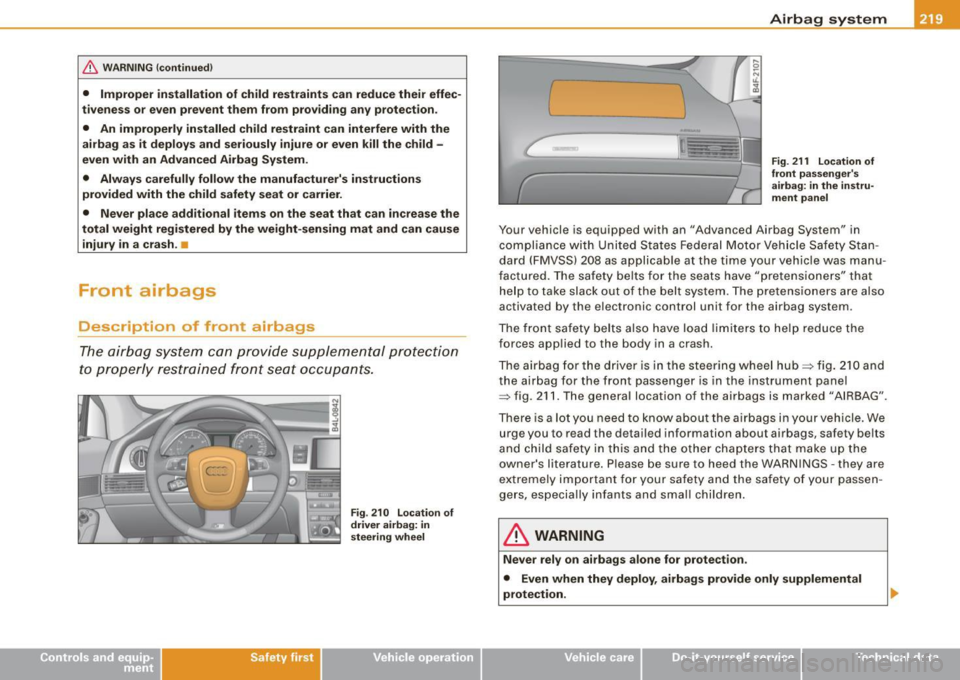
The airbag for the driver is in the steering wheel hub~ fig. 210 and
the airbag for the front passenger is in the instrument panel
~ fig. 211. The general location of the airbags is marked "AIRBAG".
There is a lot you need to know about the airbags in your vehicle. We
urg e you to read the detailed information about airbags, safety belts
and child safety in this and the other chapters that make up the
owner's literature. Please be sure to heed the WARNINGS -they are
extremely important for your safety and the safety of your passen
gers, especially infants and small children.
& WARNING
Never rely on airbags alone for protection .
• Even when they deploy, airbags provide only supplemental
protection.
Vehicle care I I irechnical data
Page 222 of 398
___ A_ i_r _b _a _ g~ s_ y_ s_t _e _m ___________________________________________________ _
& WARNING (continued)
• Airbag work most effectively when used with properly worn
safety belts .
• Therefore, always wear your safety belts and make sure that
everybody in your vehicle is properly restrained .
& WARNING
A person on the front passenger seat, especially infants and small
children, will receive serious injuries and can even be killed by
being too close to the airbag when it inflates .
• Although the Advanced Airbag System in your vehicle is
designed to turn off the front passenger airbag if an infant or a
small child is on the front passenger seat, nobody can absolutely
guarantee that deployment under these special conditions is
impossible in all conceivable situations that may happen during
the useful life of your vehicle.
• The Advanced Airbag System can deploy in accordance with
the "low risk" option under the U.S. Federal Standard if a child that
is heavier than the typical one-year old child is on the front
passenger seat and the other conditions for airbag deployment
are met.
• Accident statistics have shown that children are generally safer
in the rear seat area than in the front seating position.
• For their own safety, all children, especially 12 years and
younger, should always ride in the back properly restrained for
their age and size . •
Advanced front airbag system
Your vehicle is equipped with a front Advanced Airbag System in
compliance with United States Federal Motor Vehicle Safety Stan
dard 208 as applicable at the time your vehicle was manufactured. The
front Advanced Airbag System supplements the safety belts to
provide additional protection for the driver's and front passenger's
heads and upper bodies in frontal crashes . The airbags inflate only
in frontal impacts when the vehicle deceleration is high enough.
The front Advanced Airbag System for the front seat occupants is
not a substitute for your safety belts . Rather, it is part of the overall
occupant restraint system in your vehicle. Always remember that
the airbag system can only help to protect you, if you are sitting
upright, wearing your safety belt and wearing it properly. This is why
you and your passengers must always be properly restrained, not
just because the law requires you to be.
The Advanced Airbag System in your vehicle has been certified to
meet the "low risk" requirements for 3 and 6 year -old children on the
passenger side and very small adults on the driver side. The low risk
deployment criteria are intended to help reduce the risk of injury
through interaction with the front airbag that can occur, for
example, by being too close to the steering wheel and instrument
panel when the airbag inflates.
In addition, the system has been certified to comply with the
"suppression" requirements of the Safety Standard, to turn off the
front airbag for infants 12 months old and younger who are
restrained on the front passenger seat in child restraints that are
listed in the Standard=>
page 240, "Child restraints and Advanced
Airbags" .
"Suppression" requires the front airbag on the passenger side to be
turned off if:
• a child up to about one year of age is restrained on the front
passenger seat in one of the rear-facing or forward-facing infant
restraints listed in Federal Motor Vehicle Safety Standard 208 with
which the Advanced Airbag System in your vehicle was certified. For
a listing of the child restraints that were used to certify your
vehicle's compliance with the US Safety Standard=>
page 240,
• weight less than a threshold level stored in the control unit is
detected on the front passenger seat. .,
Page 223 of 398
Airbag syst em -----------------=~-
When a person is detected on the front passenger seat, weighing
more than the to tal weight of a child t hat is about 1 year old
restrained in one of the rear-facing or forward -facing infant
restraints (listed in Federa l Motor Vehicle Safety Standard
208 with
which the Advanced Airbag System in your vehicle was certified), the front airbag on the passenger side may or may not deploy .
The
PA SSENGER AIR BAG OFF light comes on when the e lectronic
control unit detects a total weight on the front passenger seat that
requires the front a irbag to be turned off . If the
PA SSENGER AIR BAG
O FF
light does not come on, the front airbag on the passenger side
has not been tu rned off by the contro l u nit and can dep loy if the
control unit senses an impact that meets the conditions stored in its
memory .
I f the total weight on the front passenger seat is more than that o f
a typical
1 year -old, but less than the we ight of a small adult, the
front airbag on the passenger side may dep loy (the
PA SS ENGER AIR
BAG OFF
l ight does not come on).
For example , the airbag may deploy if :
• a small ch ild that is heavier than a typ ical 1 year-o ld child is on
the front passenger seat (regardless of whether the child is in one
of the child sa fety seats listed ~
page 240),
• a child who has outgrown child res traints is on the front
passenger seat.
I f the front passenger airbag is turned off, the
PASSENGER AIR BAG
O FF
light in the cen ter of the instrument panel wi ll co me on and stay
on .
T he front airbag on the passenge r side may
not deploy (the
PAS SEN GER AIR BAG OFF light does not illuminate and stay lit) if:
• a small adult or teenager is on the front passenger seat
• a passenger who is not sitting upright with their back against a
non -reclined backrest with their feet on the vehicle floor in front of
the seat is on the front passenger seat.
I f the front passenger airbag dep loys, the Federal Standard requires
the airbag t o meet the "low risk" deployment criteria to help reduce
Controls and equip
ment Safety first Vehicle operation
the risk of injury through interaction with the airbag
. "Low risk"
dep loyment occurs in those crashes that ta ke place at l ower decel
erations as defined in the electronic contro l unit .~
page 226
Al way s remembe r:
Even though your vehicle is equipped with
Advanced Airbags, the safes t place for chi ldren is properly
restrained on the back seat. Please be sure to read the important
informat ion in t he sections tha t follow a nd be sure to heed a ll of the
WARNINGS.
& WARNING
To reduce the risk of injury when an airbag inflates , always wear
s afety belts prope rly.
• If you are unrestrained , leaning forward , sitt ing s ideways or out
of position in any w ay, your risk of injury i s mu ch higher .
• You will al so receive se riou s injurie s and could even be killed if
you are up against the airbag or too clo se t o it when it inflate s -
even with an Advanced Airbag=>
page 215 .
& WARNING
A child in a rearward -facing child safety seat in stalled on the front
pa ssenge r seat will be ser iou sly injured and can be killed if the
front airb ag inflate s -even with an Advanced Airbag System .
• Although the Advan ced Airbag S ystem in your vehicle is
de signed to turn off the front airbag when a rearward -fa cing child
restraint h as been in stalled on the front pa ssenger seat , nobod y
c an ab solutely guarantee that deployment i s impo ssible in all
c onceivable situations that may happen during the useful life of
your vehicle .
• The inflating airbag will hit the ch ild s afety seat or inf ant
c arrier with great force and will smash the chi ld safety seat and
c hild ag ain st the ba ckre st, center a rm re st, door , or roof .
• Alway s in stall rearward -facing child re straint s on the b ack
seat .
Vehicle care Do-it-yourself service Technical data
Page 224 of 398
-Airbag system P'll:f _______________ _
& WARNING (continued)
• If you must install a rearward facing child safety seat on the
front passenger seat because of exceptional circumstances and
the PASSENGER AIR BAG OFF light does not come on and stay on,
immediately install the rear-facing child safety seat in a rear
seating position and have the airbag system inspected by your
Audi dealer.
& WARNING
If, in exceptional circumstances, you must install a forward-facing
child restraint on the front passenger's seat:
• Always make sure the forward -facing seat has been designed
and certified by its manufacturer for use on a front seat with a
passenger front and side airbag.
• Never put the forward-facing child restraint up against or very
near the instrument panel.
• Always move the passenger seat into its rearmost position in
the seat's fore and aft adjustment range, as far away from the
airbag as possible, before installing the forward-facing child
restraint . The backrest must be adjusted to an upright position.
• Make sure that the PASSENGER AIR BAG OFF light comes on
and stays on all the time whenever the ignition is switched on. •
Advanced Airbag System components
The front passenger seat in your vehicle has a lot of very important
parts of the Advanced Airbag System in it. These parts include the
weight-sensing mat, sensors, wiring, brackets, and more. The func
tion of the system in the front passenger seat is checked by the elec
tronic control unit when the ignition is on. The control unit monitors
the Advanced Airbag System and turns the airbag indicator light on
when a malfunction in the system components is detected. The
function of the airbag indicator light is described in greater detail below
. Because the front passenger seat contains important parts
of the Advanced Airbag System, you must take care to prevent it
from being damaged. Damage to the seat may prevent the
Advanced Airbag for the front passenger seat from doing its job in
a crash .
The front Advanced Airbag System consists of the
following:
• Crash sensors in the front of the vehicle that measure vehicle
acceleration/deceleration to provide information to the Advanced
Airbag System about the severity of the crash.
• An electronic control unit, with integrated crash sensors for front
and side impacts. The control unit "decides" whether to fire the
front airbags based on the information received from the crash
sensors. The control unit also "decides" whether the safety belt
pretensioners should be activated.
• An Advanced Airbag with gas generator for the driver inside the
steering wheel hub .
• An Advanced Airbag with gas generator inside the instrument
panel for the front passenger.
• A weight-sensing mat under the upholstery padding of the front
passenger seat cushion that measures the total weight on the seat.
The information registered is sent continuously to the electronic
control unit to regulate deployment of the front Advanced Airbag on
the passenger side.
• An airbag monitoring system and indicator light in the instru
ment cluster ~
page 226.
• The PASSENGER AIR BAG OFF light comes on and stays on in the
center of the instrument panel~
page 227, fig. 213 and tells you
when the front Advanced Airbag on the passenger side has been
turned off.
• A sensor below the safety belt latch for the front seat passenger
to measure the tension on the safety belt. The tension on the safety
belt and the weight registered by the weight -sensing mat help the
control unit "decide" whether the front airbag for the front ..
Page 225 of 398
Airbag system -----------------=--=--------
passenger seat should be turned off or not~ page 217, "Child
res traints o n the fr ont sea t - som e impo rtant t hin gs t o know".
• A sensor in the safety belt latch fo r the drive r and for the front
s e at passe nger that s enses wh ether th at safe ty belt i s la tch ed o r not
and transmits this information to the e lectronic contro l unit.
& WARNING
Damage to the front passenger seat can prevent the front airbag
from working properly .
• Improper repair or disassembly of the front passenger and
driver seat will prevent the Advanced Airbag System from func
tioning properly .
• Repairs to the front passenger seat must be performed by qual
ified and properly trained workshop personnel .
• Never remove the front passenger or dr iver seat from the
vehicle.
• Never remove the upholstery from the front passenger seat .
• Never disa ssemble or remove parts from the seat or disconnect
wires from it.
• Never carry sharp objects in your pockets or place them on the
seat . If the weight-sensing mat in the passenger seat is punctured
it cannot work properly.
• Never carry things on your lap or carry objects on the
passenger seat . Such items can increase the weight registered by
the weight-sensing mat and send the wrong information to the
airbag control unit .
• Never store items under the front passenger seat . Parts of the
Advanced Airbag System under the pa ssenger seat could be
damaged , preventing them and the airbag system from work ing
properly.
• Never place seat covers or replacement upholstery that have
not been specifically approved by Audi on the front seats.
Controls and equip ment Safety first
Vehicle operation
& WARNING (continued )
• Seat covers can prevent the Advanced Airbag System from
recognizing child restraints or occupants on the front passenger
seat and prevent the side airb ag in the seat backrest from
deploying properly.
• Never use cushions, pillows, blankets or similar items on the
front passenger seat. The additional padding will prevent the
weight-sens ing mat in the seat from accurately registering the
child re straint or person on the seat and prevent the Advanced
Airbag System from functioning properly .
• If you must use a child restraint on the front passenger seat
and the child restraint manufa cturer's instru ctions requ ire the use
of a towel , foam cushion or something else to properly position
the child restraint, make certain that the PASSENGER AIR BAG OFF
light comes on and stays on whenever the child restraint is
installed on the front passenger seat.
• If the PASSENGER AIR BAG OFF light does not come on and stay
on , immediately install child restraint in a rear seating position
and have the airbag system inspected by your Audi dealer. •
How the Advanced Airbag System
components
work together
The front Advanced Airbag System and the side airbags supplement
the protection offered by the front t hree -point safety belts with
pretens ioners and load limiters and the adjustable head restraints
to help reduce the risk of in jury in a wide range of accident and
c ras h situati ons . Be sure to read t he impo rtant informatio n abou t
safety and heed the WARNI NGS in th is chapter.
Dep loyme nt of the A dva nced Ai rbag Sys tem a nd the activati on of
the safety be lt pretensioners depend on the deceleration measured
by the c ra s h sens ors and regis te red by the electronic control unit.
Crash severity depends on speed and deceleration as we ll as the
mass and s tiff ness of the veh ic le or object invo lved in the crash.
9J.
Vehicle care Do-it-yourself service Technical data
Page 226 of 398
___ A_ ir_b _a_ g;:::;_ s--:.. y_s _t _e _m _________________________________________________ _
When the electronic control unit registers a low severity crash and
th e safety belt is being used, the airbag will not deploy. If the safety
belt is not being used, the first stage deploys, followed by the
second stage after a much later time in the crash sequence.
If the electronic contro l unit registers a crash of medium severity,
the first stage of the airbag deploys followed by the second stage at
a much later time in the crash sequence -regardless of whether the
safety belt is being used or not . In higher severity crashes as regis
tered by the e lectronic contro l unit, both the first and second stages
deploy almost at the same time.
On the passenger side, regardless of safety belt use, the airbag will
be turned off if the weight on the passenger seat is less than the
amount programmed in the electronic control unit . The front airbag
on the passenger side will also be turned off if one of the child
safety seats that has been certified under Federal Motor Vehicle
Safety Standard 208 has been recognized on the seat. The
PASSENGER AIR BAG OFF light comes on and stays on to tel l you
when the front Advanced Airbag on the passenger side has been
turned off~
page 217, "Child restraints on the front seat -some
important things to know".
& WARNING
To reduce the risk of injury when an airbag inflates, always wear
safety belts properly .
• If you are unrestrained , leaning forward , sitting sideways or out
of position in any way, your risk of injury is much higher .
• You will also receive serious injuries and could even be killed if
you are up against the airbag or too close to it when it inflates -
even with an Advanced Airbag~
page 215. •
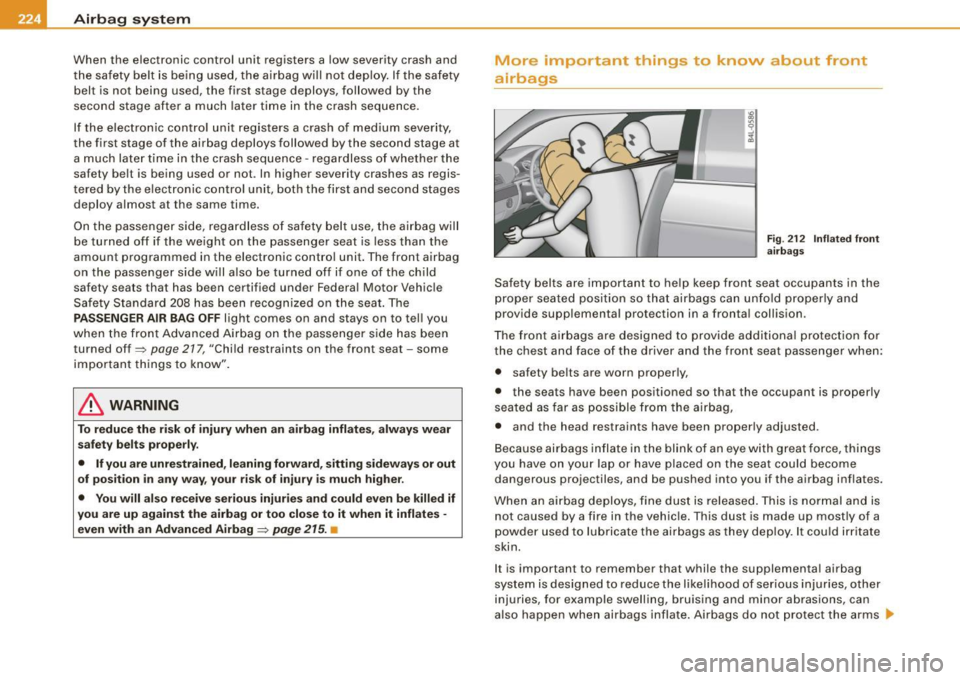
More important things to knovv about front
airbags
Fig . 212 Inflated front
airbags
Safety belts are important to help keep front seat occupants in the
proper seated position so that airbags can unfold properly and
provide supp lemental protection in a fronta l collision.
The front airbags are designed to provide additional protection for
the chest and face of the driver and the front seat passenger when:
• safety be lts are worn properly,
• the seats have been positioned so that the occupant is properly
seated as far as possible from the airbag,
• and the head restraints have been properly adjusted.
Because airbags inflate in the blink of an eye with great force, things
you have on your lap or have placed on the seat cou ld become
dangerous projectiles, and be pushed into you if the airbag inflates .
When an airbag deploys, fine dust is released. This is normal and is
not caused by a fire in the vehic le. This dust is made up most ly of a
powder used to lubricate the airbags as they deploy. It could irritate
skin.
It is important to remember that while the supplemental airbag
system is designed to reduce the likelihood of serious injuries, other
injuries, for example swelling, bruising and minor abrasions, can
also happen when airbags inflate . Airbags do not protect the arms ._,
Page 227 of 398
Airbag system -----------------=---=---
or the lower parts of the body. Front airbags suppl em ent the three
poi nt s afet y be lts o nly in s ome fro ntal c oll isi ons i n whi ch the v ehicl e
deceleration is hi gh enough to d eploy the airbags .
Front airbags will not deploy:
• if the ignition is switched off when a crash occurs,
• i n sid e collisi ons,
• in r ear- e nd collisions ,
• in ro llovers,
• when the cras h de celer ation me asured b y th e a ir bag sy stem i s
l ess than the minimum threshold nee ded for airbag dep loyment as
r egi stere d by t he ele ctronic control un it.
The front passenger airbag also will not deploy :
• when the front pa ssen ger s eat i s not o cc up ied,
• wh en the weig ht on th e front pass enger seat as se nsed by t he
Advan ced A irb ag System indi cate s that the fr ont air b ag on the
p as se n ge r sid e h as to be turned off b y the e lectronic cont rol unit
(the PASSENGER AIR BAG OFF l ig ht co me s on and sta y s on ).
& WARNING
Sitting in the wrong position can increase the risk of serious injury
in crashes .
• To reduce the risk of injury when the airbags inflate , the driver
and passengers must always sit in an upright position , must not
lean against or place any part of their body too close to the area
where the airbags are located .
• Occupants who are unbelted , out of position or too close to the
airbag can be seriously injured by an airbag as it unfolds with
great force in the blink of an eye
~ page 217.
Controls and equip ment Safety first
Vehicle operation
& WARNING
A child in a rearward-facing child safety seat installed on the front
passenger seat will be seriously injured and can be killed if the
front airbag inflates - even with an Advanced Airbag System .
• The inflating airbag will hit the child safety seat or infant
carrier with great force and will smash the child safety seat and
child against the backrest , center arm rest , door or roof.
• Always install rear-facing child safety seats on the rear seat .
• If you must install a rearward facing child safety seat on the
front passenger seat because of exceptional circumstances and
the PASSENGER AIR BAG OFF light does not come on and stay on, immediately install the rear-facing child safety seat in a rear
seating position and have the airbag system inspected by your
Audi dealer .
& WARNING
Objects between you and the airbag will in crease the risk of injury
in a crash by interfering with the way the airbag unfolds or by
being pushed into you as the airbag inflates .
• Never hold things in your hands or on your lap when the vehicle
is in use.
• Never transport items on or in the area of the front passenger
seat. Objects could move into the area of the front airbags during
braking or other sudden maneuvers and become dangerous
projectiles that can cause serious personal injury if the airbags
inflate .
• Never place or attach accessories or other objects (such as
cupholders , telephone brackets, large, heavy or bulky objects) on
the doors, over or near the area marked "AIRBAG " on the steering
wheel , instrument panel , seat backrests or between those areas
and yourself . These objects could cause injury in a crash , espe-
cially when the airbags inflate . ...
Vehicle care Do-it-yourself service Technical data
Page 229 of 398
__________________________________________________ A_ i_ r _b _a...; g::- s_ y=--- s_t _e _m __ lll
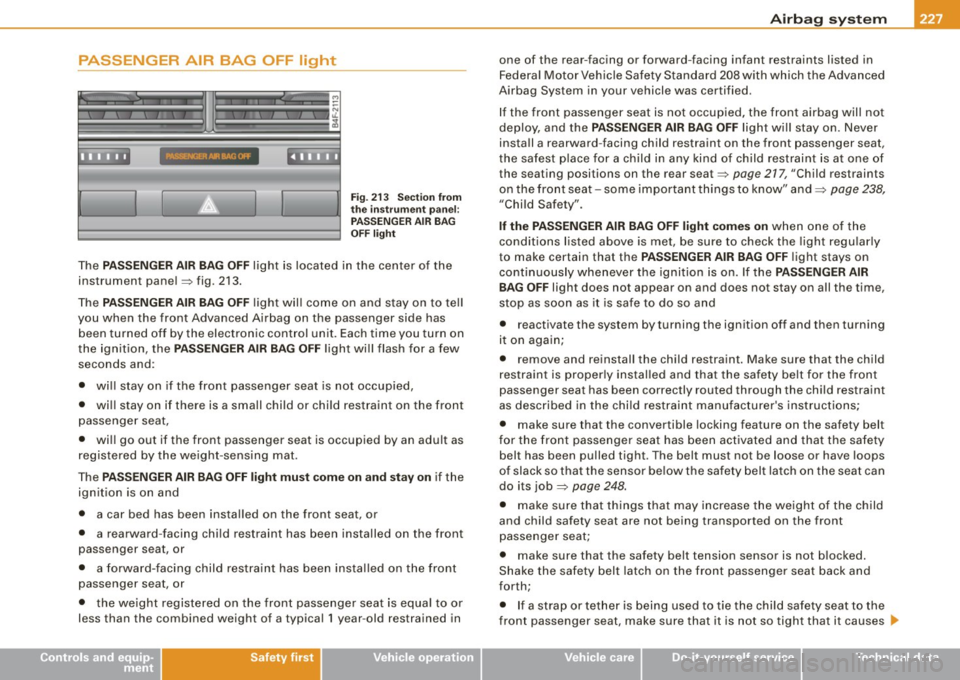
PASSENGER AIR BAG OFF light
Fig. 21 3 S ectio n from
th e in str ume nt pane l:
PA SS ENGER AIR B AG
O FF light
The PA SS ENGER AIR BAG OFF light is located in the center of the
instrument pane l
~ fig. 213.
The
PA SSENGER AIR BAG OFF light wil l come on and stay on to te ll
you when the front Advanced Airbag on the passenger side has been turned off by the electron ic control unit. Each time you turn on
the ign it ion, the
PA SSEN GER AIR BA G OFF light wi ll flash for a few
seconds and:
• will stay on if the front passenger seat is not occupied,
• will stay on if there is a small child or chi ld restraint on the front
passenge r seat,
• will go out if the front passenger seat is occupied by an adult as
registered by the we ight-sensing mat .
T he
PA SS ENGER AIR BAG OFF light mu st come on and stay on if the
ign ition is on and
• a car bed has been insta lled on the front seat, or
• a rearward -f acing chi ld restraint has been installed on the front
passenger seat, or
• a forwa rd-facing child restra int has been installed on the front
passenger seat, or
• t he we ight registered on the front passenger seat is equa l to or
less than the combined weight of a typica l 1 year -old restrained in
Controls and equip
ment Safety first
Vehicle operation
one of the rear-facing or forward -facing infant restraints listed in
Federa l Motor Veh icle Safe ty S tandard 208 with which the Advanced
Airbag System in your vehicle was certified.
I f the front passenger seat is not occupied, the front airbag will not
deploy, and the
PA SS ENGER AIR BAG OFF light will stay on . Never
insta ll a rearward -facing child restraint on the front passenger seat,
the sa fest place for a child in any kind of child restraint is at one of
the seating positions on the rear seat~
page 217, "Child restraints
on the front seat -so me important things to know" and~
page 238,
"Chi ld Safety" .
If the PASSENGER AIR BAG OFF light com es on when one of the
conditions listed above is met, be sure to check the light regu lar ly
to make certa in that the
PA SS ENGER AIR BAG OFF light stays on
continuously whenever the ignition is on. If the
PA SSENGER AIR
BAG OFF
light does not appear on and does not stay on all the time,
stop as soon as it is safe to do so and
• reactivate the system by turning the ignition off and then turning
it on aga in;
• remove and reinstall the child restraint. Make sure that the child
restrain t is proper ly installed and t hat the safety be lt for the front
passenger seat has been correctly routed through the child restraint
as described in the chi ld restraint manufacturer's instructions;
• make sure that the convertible locking feature on the safety belt
for the front passenger sea t has been activated a nd that the safety
belt has been pulled tight . The belt must not be loose or have loops
of slack so that the sensor be low t he safety belt latch on the sea t can
do its job
~ page 248.
• make su re that things that may inc rease the we ight of the child
and child safety seat are not being transported on the front
passenger seat;
• make sure that the safety belt tension sensor is not blocked.
Shake the safety belt latch on the front passenger seat back and
forth;
• I f a strap or te ther is being used to tie the child sa fety seat to the
front passenger seat, make sure that it is not so tight that it causes .,
Vehicle care Do-it-yourself service Technical data
Page 232 of 398
-Airbag system ----=--a.---------------------------------------
& WARN ING (continued )
• Always make sure that the side airbag can inflate without inter
fe rence :
- Never install seat covers or replacement upholstery over the
front seatback s that have not been spe cifically approved by
Audi.
- Never use additional seat cushions that cover the areas
where the side airbags inflate .
- Damage to the original seat covers or to the seam in the area
of the side airbag module must always be repaired immedi
ately by an authorized Audi dealer .
• The airbag system can be activated only once. After an airbag
ha s inflated , it must be replaced by an authorized Audi de aler or
qualified technician who has the technical information , training
and special equipment necessary .
• The airbag system can be deployed only once. After an airbag
has been deployed , it must be repla ced with new repla cement
parts designed and approved especially for your Audi model
version . Replacement of complete airbag systems or airbag
components must be performed by qualified workshops only .
Make sure that any airbag service action is entered in your Audi
Warranty
& Maintenance booklet under AIRBAG REPLACEMENT
RECORD .
• For safety reasons in severe accidents , the alternator and
starter are separated from the vehicle battery with a pyrotechn ic
circuit interrupter.
-Work on the pyrotechni c circuit interrupter must only be
performed by a qualified dealer -risk of an accident!
- If the vehi cle or the circuit inte rrupter is scrapped , all appli
cable safety precautions must be followed.
W For the sake of the environment
Undeployed a irba g mo dules and prete nsioners might be c lass if ied
as Perchlorate Material -special handling may apply, see
www.dtsc.ca.gov/hazardouswaste/p erc hlo ra te. W hen t he ve hicle or
parts of the restraint system inc luding airbag modules and safety
b elts wi th pre tens io ners a re s crappe d, all ap plicab le laws a nd reg u
l ations must be observed . Your authorized Audi dealer is fam iliar
wit h these req uire ments an d we rec ommend th at yo u have your
dea ler perform this service for you. •
Other things that can affect Advanced Airbag
performance
Changing the vehic le 's suspension system can change the way that
t h e Adva nced Ai rbag Syste m performs in a c rash. Fo r example,
using tire -rim combinations not approved by Audi, lowering the
ve hicle, c hang ing the s tif fne ss of the su spe nsio n, in cl ud in g th e
springs, suspens ion struts, shoc k absorbers etc. can change the
f o rce s tha t are m eas ure d b y the air bag senso rs and se nt to the e lec
tronic control unit. Some suspension changes can, for example,
increa se the fo rce levels measured by the senso rs and ma ke the
airbag system dep loy in crashes in which it wou ld not deploy if the
changes had not been made . Othe r kinds of changes may reduce
t h e force lev els measured by the sensors and preve nt the airbag
from dep loying when it sho uld.
T he s ensors i n the safet y be lt buc kle for the driver a nd fr ont
passenger seat tell the e lectronic contro l modu le if the safety belt is
l a tc h ed or not. If the sa fety belt is b eing use d, th e front airbag wi ll
deploy at a slightly higher rate of v ehic le dece leration than if the
safety be lt is n ot be ing use d. T herefo re, i n a partic ular collision, it i s
possible that an air bag wi ll not deploy at a seating position where
the safety be lt i s being used but wi ll inflate at the position whe re the
sa fety be lt is not bei ng used. It is important tha t noth ing i nte rfer e
with the safety belt buckles so that the sensors can send the correct
i nfo rmati on about saf ety belt use to the e lectr onic co ntrol unit. .,.