seats AUDI S6 2009 Owner's Guide
[x] Cancel search | Manufacturer: AUDI, Model Year: 2009, Model line: S6, Model: AUDI S6 2009Pages: 398, PDF Size: 43 MB
Page 202 of 398
_,___D_ r_iv _i_ n...: g=- S_ a_f _e _ly =-- -------------------------------------------------
position. A driver is responsible for the safety of all vehicle
occupants and especially for children. Therefore:
Never allow anyone to assume an incorrect seating posi
tion when the vehicle is being used=>& .
The following bulletins list only some sample positions that will
increase the risk of serious injury and death. Our hope is that these
examples will make you more aware of seating positions that are
dangerous.
Therefore, whenever the vehicle is moving:
• never stand up in the vehicle
• never stand on the seats
• never kneel on the seats
• never ride with the seatback reclined
• never lie down on the rear seat
• never lean up against the instrument panel
• never sit on the edge of the seat
• never sit sideways
• never lean out the window
• never put your feet out the window
• never put your feet on the instrument panel
• never rest your feet on the seat cushion or back of the seat
• never ride in the footwell
• never ride in the cargo area
& WARNING
Improper seating positions increase the risk of serious personal
injury and death whenever a vehicle is being used.
• Always make sure that all vehicle occupants stay in a proper
seating position and are properly restrained whenever the vehicle
is being used. •
Pedal area
Pedals
The pedals must always be free to move and must never
be interfered with by a floor mat or any other object.
Make sure that all pedals move freely without interference and that
nothing prevents them from returning to their original positions.
Only use floor mats that leave the pedal area free and can be
secured with floor mat fasteners.
If a brake circuit fails, increased brake pedal travel is required to
bring the vehicle to a full stop.
& WARNING
Pedals that cannot move freely can cause loss of vehicle control
and increase the risk of serious injury.
• Never place any objects in the driver's footwell. An object could
get into the pedal area and interfere with pedal function. In case
of sudden braking or an accident, you would not be able to brake
or accelerate!
• Always make sure that nothing can fall or move into the
driver's footwell. •
Floor mats on the dr iver side
Always use floor mats that can be securely attached to
the floor mat fasteners and do not interfere with the free
movement of the pedals.
Make sure that the floor mats are properly secured and
cannot move and interfere with the pedals=>& . .,
Page 207 of 398
_________________________________________________ S_ a_f _e _t .:..y _ b_ e_lt_ s __ lffllll
Safety belts
General notes
Always wear safety belts!
Wearing safety belts correctly saves lives!
This chapter explains why safety belts are necessary, how
they work and how to adjust and wear them correctly.
- Read all the information that follows and heed all of the
instruct ions and WARNINGS.
& WARNING
Not wearing safety belts or wearing them improperly increases
the risk of serious personal injury and death.
• Safety belts are the single most effective means available to
reduce the risk of serious injury and death in automobile acci
dents . For your protection and that of your passengers , always
correctly wear safety belts when the vehicle is moving.
• Pregnant women, injured, or physically impaired persons must
also use safety belts . Like all vehicle occupants, they are more
likely to be seriously injured if they do not wear safety belts . The
best way to protect a fetus is to protect the mother -throughout
the entire pregnancy. •
Number of seats
Your Audi has a total of five seating positions: two in the front and
three in the rear. Each seating position has a safety belt.
Controls and equip ment Safety first
Vehicle operation
& WARNING
Not wearing safety belts or wearing them improperly increases
the risk of serious personal injury and death .
• Never strap more than one person, including small children,
into any belt. It is especially dangerous to place a safety belt over
a child sitting on your lap.
• Never let more people ride in the vehicle than there are safety
belts available.
• Be sure everyone riding in the vehicle is properly restrained
with a separate safety belt or child restraint. •
Safety belt warning light ~
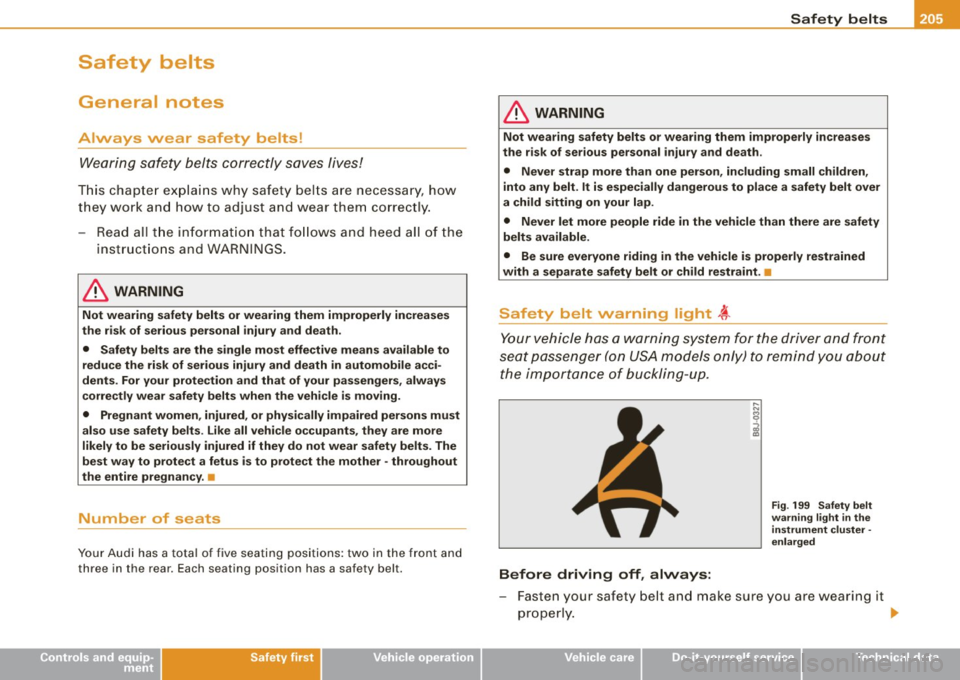
Your vehicle has a warning system for the driver and front
seat passenger (on USA models only) to remind you about
t he importance of buckling-up.
Before driving off, always:
Fig. 199 Safety belt
warning light in the
instrument cluster -
enlarged
- Fasten your safety belt and make sure you are wearing it
properly.
1J,,
Vehicle care Do-it-yourself service Technical data
Page 209 of 398
Because the passengers of this vehicle are not using safety belts
=:> page 206, fig. 200, they will keep moving at the same speed the
vehicle was moving just before the crash, until something stops
them -here, the wall
=:> page 206, fig. 201.
The same principles apply to people sitting in a vehicle that is involved in a frontal collision. Even at city speeds of 20 to 30 mph
(30 to 50 km/h), the forces acting on the body can reach one ton
(2,000 lbs. or 1,000 kg) or more . At greater speeds, these forces are
even higher.
People who do not use safety belts are also not attached to their
vehicle. In a frontal collision they will also keep moving forward at
the speed their vehicle was travelling just before the crash. Of course, the laws of physics don't just apply to frontal collisions, they
determine what happens in all kinds of accidents and collisions. •
What happens to occupants not wearing
safety belts?
In crashes unbelted occupants cannot stop themselves
from flying forward and being injured or killed. Always
wear your safety belts!
Safety first
Fig . 202 A driver not
wearing a safety belt is
violently thrown
forward
Safety belts
Fig . 203 A rear
passenger not wearing
a safety belt will fly
forward and strike the
driver
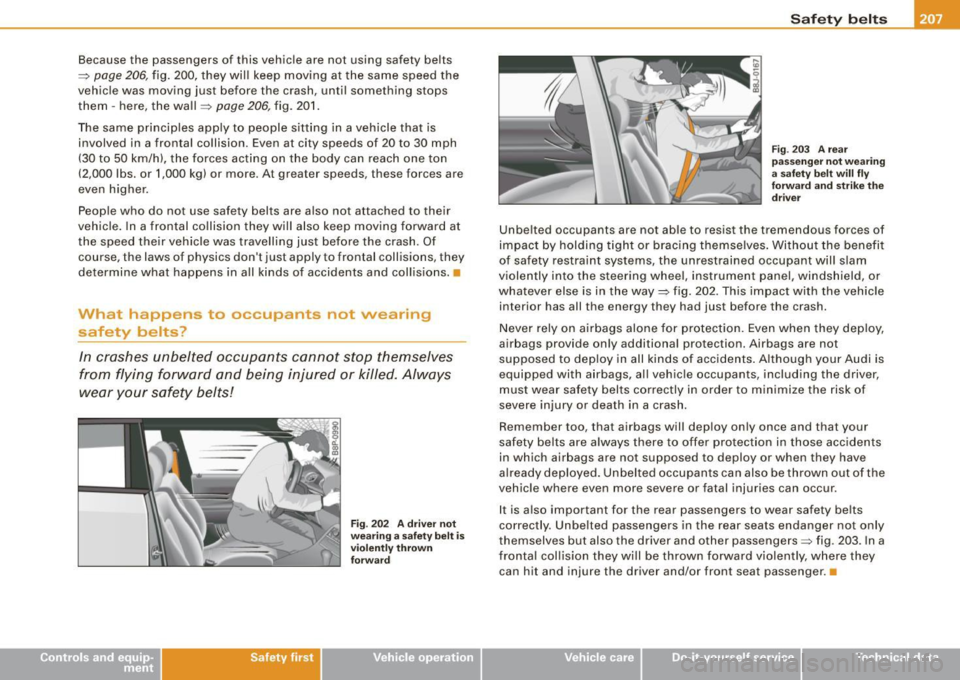
Unbelted occupants are not able to resist the tremendous forces of
impact by holding tight or bracing themselves. Without the benefit
of safety restraint systems, the unrestrained occupant will slam
violently into the steering wheel, instrument panel, windshield, or
whatever else is in the way=:> fig. 202 . This impact with the vehicle
interior has all the energy they had just before the crash.
Never rely on airbags alone for protection. Even when they deploy,
airbags provide only additional protection. Airbags are not
supposed to deploy in all kinds of accidents. Although your Audi is
equipped with airbags, all vehicle occupants, including the driver,
must wear safety belts correctly in order to minimize the risk of
severe injury or death in a crash.
Remember too, that airbags will deploy only once and that your
safety belts are always there to offer protection in those accidents
in which airbags are not supposed to deploy or when they have
already deployed. Unbelted occupants can also be thrown out of the
vehicle where even more severe or fatal injuries can occur .
It is also important for the rear passengers to wear safety belts
correctly . Unbelted passengers in the rear seats endanger not only
themselves but also the driver and other passengers=:> fig. 203. In a
frontal collision they will be thrown forward violently, where they can hit and injure the driver and/or front seat passenger. •
Vehicle care I I Technical data
Page 210 of 398
IIJl_....::S~a ~f ~e ~ty ~ b~ e~ l~ t ~s ____________________________________________ _
Safety belts protect
People think it's possible to use the hands to brace the
body in a minor collision. It's simply not true!
Fig . 20 4 Driv er is
cor rec tly r estrai ned in
a su dden b raking
m an euver
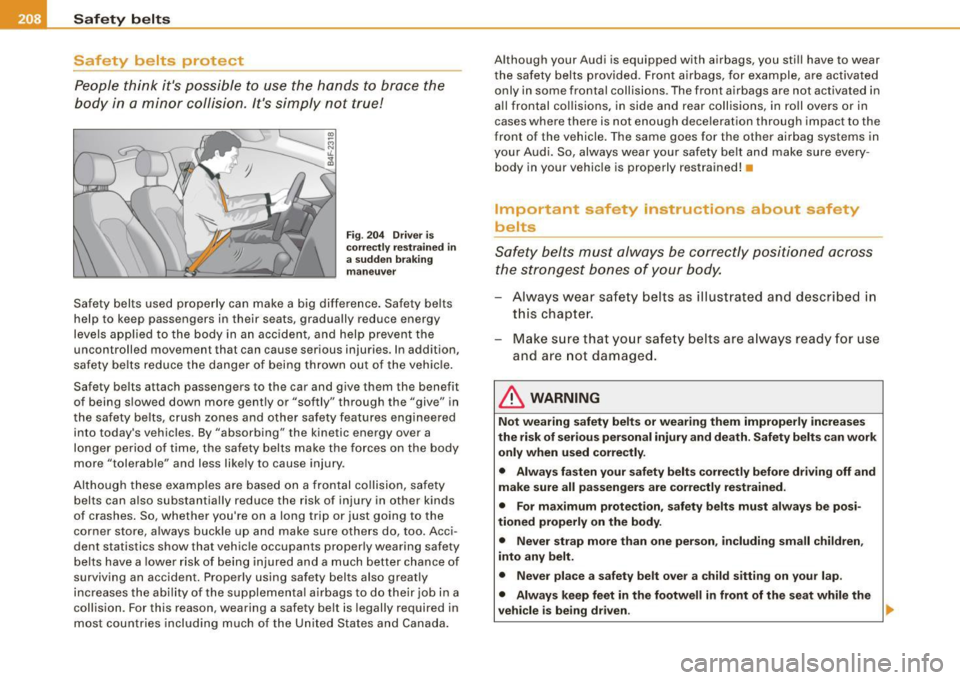
Safety belts used properly can make a big difference. Sa fety belts
help to keep passengers in their seats, gradually reduce energy
levels app lied to the body in an accident, and help prevent the
uncontrolled movement that can cause serious injuries. In addition,
safety be lts reduce the danger of being thrown out of the vehic le .
Safety belts attach passengers to the car and give them the benefit
of being s lowed down more gently or "softly" through the "give" in
the safety belts, crush zones and other safety features engineered
into today's vehicles. By "absorbing" the kinetic energy over a longer period of time, the safety belts make the forces on the body
more "tolerable" and less likely to cause injury .
Altho ugh these examples are based on a frontal co llision, safety
belts can a lso substantially reduce the risk of injury in other kinds
of crashes . So, whether you're on a long trip or just going to the
corner store, a lways buckle up and make sure others do, too. Acci
dent statistics show that vehicle occupants properly wearing safety
belts have a lower ris k of being injured and a much better chance of
surviving an accident. Properly using safety belts also greatly
increases the abi lity o f the supplementa l airbags to do their job in a
collision . For th is reason , wearing a safety belt is legally required in
most countries including much of the United States and Canada. Although your Audi is equipped with airbags, you sti
ll have to wear
the safety belts provided . Fron t airbags, for example, are activated
only in some frontal collisions . T he front airbags are not activated in
a ll frontal col lisions, in side and rear collisions, in roll ove rs or in
cases where there is not enough dece leration through impact to the
front of the vehicle . The same goes for the other airbag systems in
your Audi . So, always wear your safety belt and make sure every
body in your vehic le is properly restrained! •
Important safety instructions about safety
belts
Safety belts must always be co rrectly positioned across
t he strongest bones of your body.
Always wear safety belts as illustrated and described in
th is chapter.
Make s ure tha t your safe ty belts ar e always ready for use
and are not damaged .
& WARNING
Not wearing safety belts or w earing them improperl y increase s
the risk of seriou s per sonal injury and death . S afe ty belt s can work
onl y when used corre ctl y.
• Alway s fa sten your s afety belt s correctl y before dri ving off and
make sure all p assenger s ar e correctly restrain ed.
• For m aximum protect ion , safet y belt s must always be po si
ti oned properly on the body .
• Never strap more th an one person , includi ng sm all children ,
into any belt.
• Never pla ce a s afety belt ove r a child sitting on your lap .
• Alway s keep feet in t he foot well
in front of the seat while the
vehicle is being driven .
~
Page 212 of 398
___ S_a_ f_ e_ t-= y_ b_e_ l_ t _s _______________________________________________ _
-Insert t he tongue into the correct b uckle of y our seat
unt il you h ea r it la tc h securely~ fig. 205.
Pull on t he belt to make sure that it is securely latched in
the buckle.
Aut om ati c sa fe ty belt re tra cto rs
Eve ry safety be lt is equipped with an automatic belt retractor on the
shoulder belt. This feature locks the belt when the belt is pulled out
fast, during hard braking and in an accident. The belt may a lso lock
when you drive up or down a steep hill or through a sharp curve .
During normal driving the belt lets you move free ly.
Safety belt prete nsi oners
The safety belts are equipped with a be lt pretensioner that he lps to
tighten the sa fety be lt and remove slack when the pretensioner is
activated. The function of the pretensioner is monitored by a
warning light=>
page 18 .
Swit chable locking fe ature
Every safety belt except the one on the driver sea t is equipped with
a switchab le locking feature that
must be used when the safety belt
is used to a ttach a chi ld safe ty sea t. Be sure to read the important
information about this feature=>
page 248.
& WARNING
Improper ly positioned safet y belts can cause seriou s inj ury in an
accident =>
page 210 , "S afety belt po sitio n".
• Safet y belts offer opt imum protection on ly when the seat back
i s upright and belt s are properly po sition ed on t he bod y.
• Always make sure that the rear seat backrest to whi ch the
c enter r ear sa fet y belt i s atta ched i s sec ure ly lat ched whe nev er
the rear center saf ety belt i s being us ed. If the ba ckrest is not
s ecu rely lat ched, the pas senge r will mo ve fo rward with the back
rest dur ing sudden braking , in a sudden maneu ver and e spec iall y
in a cra sh.
& W AR N ING (continu ed )
• Never attach the safety belt to the buck le for anothe r seat .
Atta ch ing th e be lt to the wrong buckle will reduce safety belt
e ffe cti venes s and can ca use seriou s per son al injur y.
• A p assenger who i s not prope rly re str ained can be s eriousl y
injured by the saf ety belt it self wh en it m ove s from the stronger
p art s of the body into criti ca l area s like the abd omen .
• Alway s lock the convert ible lo ck ing retractor when you are
s ecu ring a ch ild safety se at in the v ehi cle
=> page 2 50. •
Safety belt position
Correct belt posi ti o n is the key to getting maximum
protecti on f rom safety be lts.
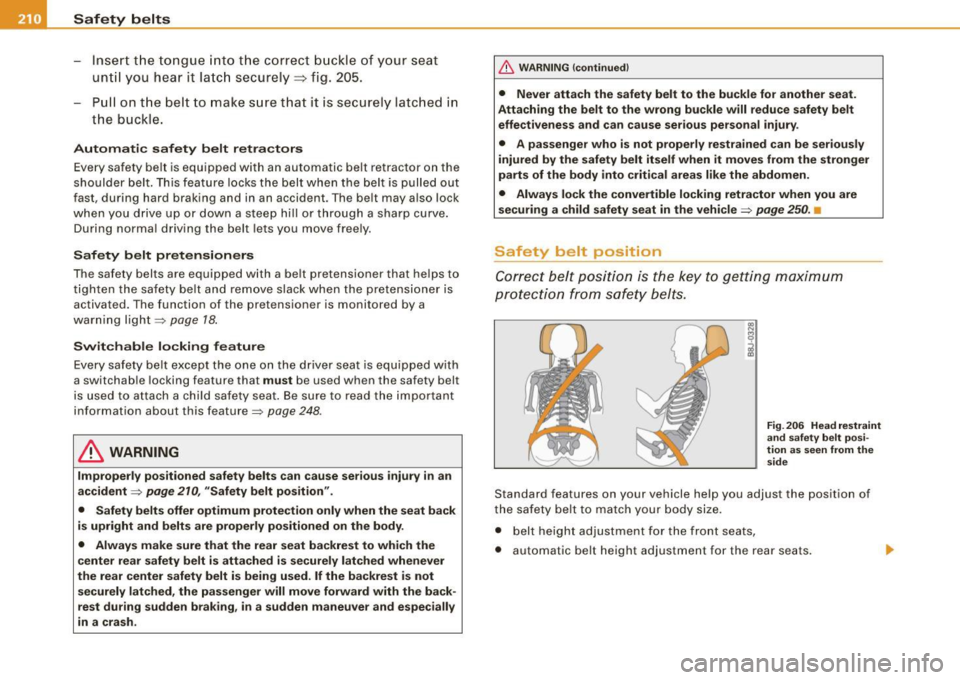
Fig . 2 06 He ad r est ra in t
an d sa fe ty b elt p osi
tion a s seen from th e
sid e
Standard features on your vehicle help you adjust the position of
the safety belt to match your body size .
• belt height adjustment for the front seats,
• automatic belt height adjustment for the rear seats.
Page 214 of 398
-Safety belts ----=-----------------
& WARNING
Improperly positioned
safety belts can cause serious personal
injury in an accident.
• Expectant mothers must always wear the lap portion of the
safety belt as low as possible across the pelvis and below the
rounding of the abdomen.
• Always read and heed all WARNINGS and other important infor
mation
~ & in "Fastening safety belts" on page 209. •
Unfastening safety belts
Unbuckle the safety belt with the red release button only
after the vehicle has stopped.
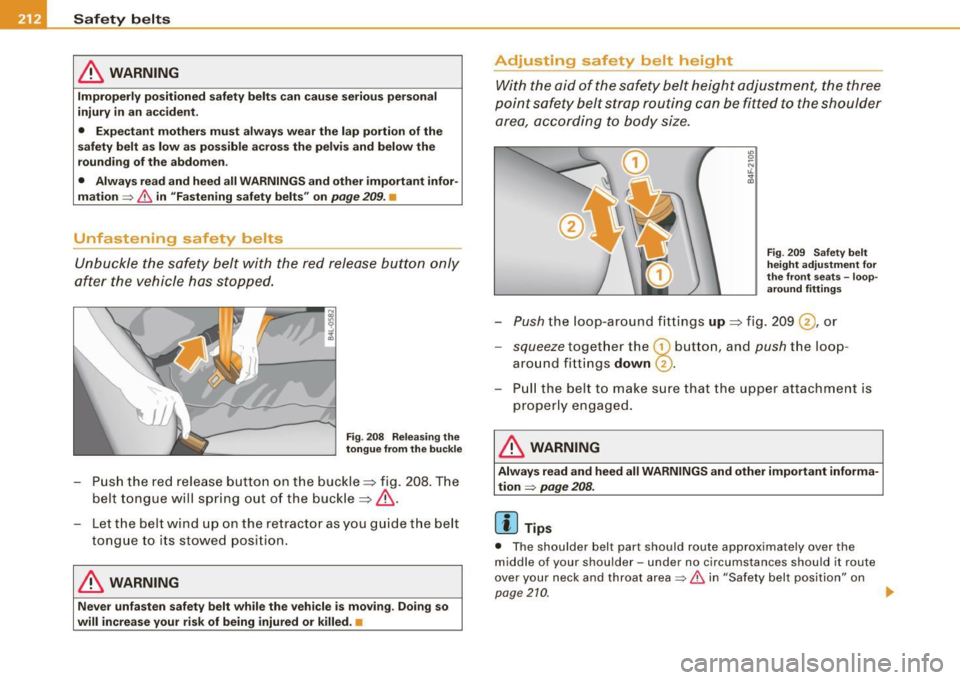
Fig . 208 Releasing the
tongue from the buckle
-Push the red release button on the buckle=> fig. 208. The
belt tongue will spring out of the buckle=>& .
- Let the be lt wind up on the retractor as you guide the belt
tongue to its stowed pos ition.
& WARNING
Never unfasten safety belt while the vehicle is moving. Doing so
will increase your risk of being injured or killed .•
Adjusting safety belt height
With the aid of the safety belt height adjustment, the three
point safety belt strap routing can be fitted to the shoulder area, according to body size.
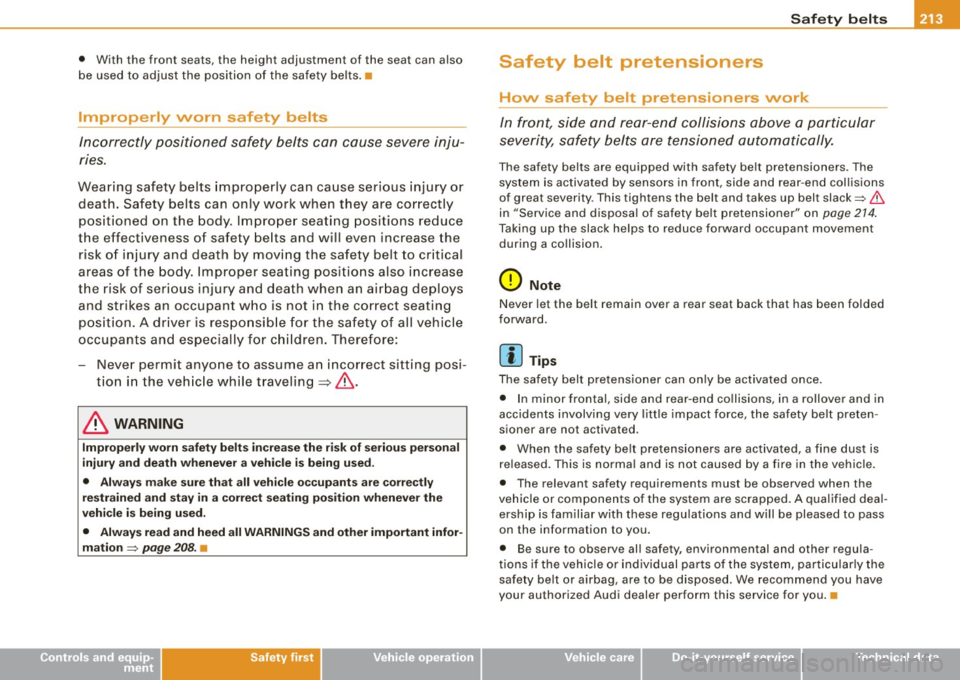
Fig . 209 Safety belt
height adjustment for
the front seats -loop
around fittings
Push the loop -around fittings up => fig. 209 @ , or
- squeeze together the G) button , and push the loop
around f ittings
down @.
- Pull the belt to make sure that the upper attachment is
properly e ngaged .
& WARNING
Always read and heed all WARNINGS and other important informa
tion
~ page 208.
[ i ] Tips
• The shoulder belt part should route approximately over the
middle of you r shoulder -und er no circu mstanc es should it route
over your neck and throat area
~ & in "Safety belt position" on
pag e21Q
~
Page 215 of 398
Safety belts -----------------=------
• With the front seats, the height adjustment of the seat can also
be used to adjust the position of the safety belts. •
Improperly worn safety belts
Incorrectly positioned safety belts can cause severe inju
ries.
Wearing safety belts improperly can cause serious injury or
death. Safety belts can only work when they are correctly positioned on the body. Improper seating posit ions reduce
the effectiveness of safety belts and w ill even increase the
risk of injury and death by moving the safety belt to critical
areas of the body . Improper seating positions also increase
the r isk of serious injury and death when an airbag deploys
and strikes an occupant who is not in the correct seating position. A driver is responsible for the safety of all vehicle
occupants and especially for children. Therefore:
-Never permit anyone to assume an incorrect sitting posi
tion in the vehicle while traveling~& .
& WARNING
Improperly worn safety belts increase the risk of serious personal
injury and death whenever a vehicle is being used.
• Always make sure that all vehicle occupants are correctly
restrained and stay in a correct seating position whenever the
vehicle is being used.
• Always read and heed all WARNINGS and other important infor
mation ::::;,
page 208. •
Controls and equip
ment Safety first Vehicle operation
Safety be
lt pretensioners
How safety belt pretensioners work
In front, side and rear -end collisions above a particular
severity, safety belts are tensioned automatically.
The safety belts are equipped with safety belt pretensioners . The
system is activated by sensors in front, side and rear -end collisions
of great severity . This tightens the belt and takes up belt slack::::;,
6
in "Service and disposal of safety belt pretensioner" on page 214.
Taking up the slack helps to reduce forward occupant movement
during a collision.
0 Note
Never let the belt remain over a rear seat back that has been folded
forward.
[ i] Tips
The safety belt pretensioner can only be activated once.
• In minor frontal, side and rear -end collisions, in a rollover and in
accidents involving very little impact force, the safety belt preten
sioner are not activated .
• When the safety belt pretensioners are activated, a fine dust is
released. This is normal and is not caused by a fire in the vehicle.
• The relevant safety requirements must be observed when the
vehicle or components of the system are scrapped . A qualified deal
ership is familiar with these regulations and will be pleased to pass
on the information to you.
• Be sure to observe all safety, environmental and other regula
tions if the vehicle or individual parts of the system, particularly the
safety belt or airbag, are to be disposed . We recommend you have
your authorized Audi dealer perform this service for you. •
Vehicle care Do-it-yourself service Technical data
Page 218 of 398
___ A_ ir_ b_ a-g _ s_y _s_ t_ e_ m _________________________________________________ _
repair costs or even the lack of vehicle dama ge is not necessa rily an
in dic ati on of wh ether a n airb ag s hould infl ate or not.
S inc e th e circumsta nces w ill vary considerably b etw een one colli
s ion and anothe r, it is not po ssib le to define a range of vehic le
speeds t hat w ill cover eve ry po ssib le kin d a nd a ngle of im pact tha t
wi ll a lwa ys trigger the airbags . Impo rtant facto rs include, fo r
e xa mpl e, the natu re (ha rd o r sof t) o f th e object whic h th e car h its,
the ang le of impact, vehic le speed, etc. The front airbags will also
n o t in flate in s id e or rear co ll is ions, o r in ro ll-ov ers.
Always remember : Airba gs will d ep loy only once, and on ly in c ertain
k inds o f co llision s. Yo ur s afe ty bel ts are a lways the re t o offe r protec
ti on i n th ose si tuat io n s in whic h airba gs a re not suppose d to deploy,
or when they have a lready dep loyed; f or examp le, when yo ur veh ic le
str ikes o r is struc k by anot her ve hicle a fte r th e fir st coll isio n.
T his is just one of the reasons why an airbag is a supplementary
res train t an d is not a su bstit u te fo r a sa fe ty belt. T he ai rbag system
works most effectively when used with the safety be lts . T herefore,
a lw ays pro per ly wea r your safe ty be lts ~
page 205 .
& WARNING
Sitting too close to the steering wheel or instrument panel will
decrease the effectiveness of the airbags and will increase the risk
of personal injury in a collision.
• Never sit closer than 10 inches (25 cm) to the steering wheel or
instrument panel .
• If you cannot sit more than 10 inches (25 cm ) from the steering
wheel , investigate whether adaptive equipment may be available
to held you reach the pedals and increase your seating distance
from the steering wheel.
• If you are unrestrained , leaning forward, sitting sideways or out
of position in any way, your risk of injury is much higher.
• You will also receive serious injuries and could even be killed if
you are up against the airbag or too close to it when it inflates -
even with an Advanced Airbag .
& WARNING (continued)
• To reduce the risk of injury when an airbag inflates , always
wear safety belts properly=:>
page 209, "Safety belts".
• Always make certain that children age 12 or younger always
ride in the rear seat. If children are not properly restrained , they
may be severely injured or killed when an airbag inflates.
• Never let children ride unrestrained or improperly restrained in
the vehicle. Adjust the front seats properly .
• Never ride with the backrest reclined.
• Always sit as far as possible from the steering wheel or the
instrument panel=:>
page 196.
• Always sit upright with your back against the backrest of your
seat .
• Never place your feet on the instrument panel or on the seat.
Always keep both feet on the floor in front of the seat to help
prevent serious injuries to the legs and hips if the airbag inflates.
• Never recline the front passenger's seat to transport objects.
Items can also move into the area of the side airbag or the front
airbag during braking or in a sudden maneuver. Objects near the
airbags can become projectiles and cause injury when an airbag
i nflates .
& WARNING
Airbags that have deployed in a crash must be replaced .
• Use only original equipment airbags approved by Audi and
installed by a trained technician who has the necessary tools and
diagnostic equipment to properly repla ce any ai rbag in your
vehicle and assure system effectiveness in a crash .
• Never permit salvaged or recycled airbags to be installed in
your vehicle. •
Page 219 of 398
__________________________________________________ A_ i_ r _b _a...; g::- s_ y=--- s_t _e _m __ fflllll
Child restraints on the front seat -some
important things to know
- Be sure to read the important information and head the
WARNINGS for important details about children and
Advanced Airbags :=>
page 238.
Even though your vehicle is equipped with an Advanced Airbag
System, make certain that all children, especially those 12 years and
younger, always ride in the back seat properly restrained for their age and size . The airbag on the passenger side makes the front seat
a potentially dangerous place for a child to ride . The front seat is not
the safest place for a child in a forward -facing child safety seat. It
can be a very dangerous place for an infant or a child in a rearward
facing seat.
The Advanced Airbag System in your vehicle has been certified to
comply with the requirements of United States Federal Motor
Vehicle Safety Standard 208 as applicable at the time your vehicle
was manufactured.
The Standard requires the front airbag on the passenger side to be
turned off ("suppressed") if a child up to about one year of age
restrained in one of the rear-facing or forward-facing infant
restraints listed in Federal Motor Vehicle Safety Standard 208 with
which the Advanced Airbag System in your vehicle was certified has been installed on the front passenger seat. For a listing of the child
restraints that were used to certify compliance with the US Safety
Standard =>
page 240.
The PASSENGER AIR BAG OFF light in the instrument panel tells you
when the front Advanced Airbag on the passenger side has been
turned off by the electronic control unit.
Each time you turn on the ignition, the
PASSENGER AIR BAG OFF
light will come on for a few seconds and:
• will stay on if the front passenger seat is not occupied,
Controls and equip
ment Safety first Vehicle operation
•
will stay on if there is a small child or child restraint on the front
passenger seat,
• will go off if the front passenger seat is occupied by an adult as
registered by the weight-sensing mat=>
page 226, "Monitoring the
Advanced Airbag System" .
The
PASSENGER AIR BAG OFF light comes on when the control unit
detects a total weight on the front passenger seat that requires the
front airbag to be turned off.
If the total weight on the front passenger seat is more than that of
a typical 1 year-old child but less than the weight of a small adult,
the front airbag on the passenger side can deploy (the
PASSENGER
AIR BAG OFF
light does not come on). If the PASSENGER AIR BAG
OFF
light does not come on, the front airbag on the passenger side
has not been turned off by the electronic control unit and can
deploy if the control unit senses an impact that meets the condi
tions stored in its memory.
For example, the airbag may deploy if:
• a small child that is heavier than a typical 1 year -old child is on
the front passenger seat (regardless of whether the child is in one
of the child safety seats listed=>
page 240), or
• a child who has outgrown child restraints is on the front
passenger seat.
If the front passenger airbag is turned off, the
PASSENGER AIR BAG
OFF
light comes on in the instrument cluster and stays on.
The front airbag on the passenger side may
not deploy (the
PASSENGER AIR BAG OFF light does not illuminate and stay lit) even
if a small adult or teenager, or a passenger who is not sitting upright
with their back against a non-reclined backrest with their feet on the
vehicle floor in front of the seat is on the front passenger seat
=>
page 196, "Proper seating position for the driver".
If the front passenger airbag deploys, the Federal Standard requires
the airbag to meet the "low risk" deployment criteria to reduce the risk of injury through interaction with the airbag . "Low risk" deploy
ment occurs in those crashes that take place at lower decelerations
I),
Vehicle care Do-it-yourself service Technical data
Page 220 of 398
___ A_ ir_ b_ a-g _ s_y _s_ t_ e_ m _________________________________________________ _
as defin ed i n th e el ectron ic contro l u n it=> page 227, "PASSE NGER
AI R BAG OFF lig ht".
A lwa ys rem em ber, a c hild safet y se at or infant carr ier installe d on
the front seat may be str uck and k nocked o ut of po sition by t he
rap id ly in fla ting passe nger's air bag in a fron tal colli sion . The airb ag
cou ld great ly re duce the effectivene ss of the ch ild restrain t and
e ve n seri ous ly injure the chi ld dur ing in flatio n.
For th is reason, and beca use the bac k seat is the safest plac e for
chi ldren -wh en prop erly rest rained acc ording to th eir age and size
- we strong ly recommend that ch ildren a lways sit in the bac k se at
=> p age 238, "Ch ild Safe ty ".
& WARNING
A child in a rearward -facing child safety seat installed on the front
passenger seat will be ser iously injured and can be killed if the
front airbag inflates - even with an Advanced Airbag System .
• The inflating airbag will hit the child safety seat or infant
carrier with great force and will smash the child safety seat and
child against the backrest , center arm rest , door or roof .
• Always install rear -facing child safety seats on the rear seat .
• If you must install a rearward facing child safety seat on the
front passenger seat because of exceptional circumstances and
the PASSENGER AIR BAG OFF light does not come on and stay on ,
immediately install the rear-facing child safety seat in a rear
seating position and have the airbag system inspected by your
Audi dealer .
• Forward-facing child safety seats installed on the front
passenger's seat may interfere with the deployment of the airbag
and cause serious personal injury to the child .
& WARNING
If, in exceptional circumstances, you must install a forward-facing
child restraint on the front passenger's seat:
& WARNING (continued)
• Always make sure the forward-facing seat has been designed
and certified by its manufacturer for use on a front seat with a
passenger front and side airbag .
• Never put the forward-facing child restraint up against or very
near the instrument panel.
• Always move the passenger seat into its rearmost position in
the seat's fore and aft adjustment range, as far away from the
airbag as possible before installing the forward-facing child
restraint. The backrest must be adjusted to an upright position .
• Make sure that the PASSENGER AIR BAG OFF light comes on
and stays on all the time whenever the ignition is switched on.
& WARNING
To reduce the risk of serious injury , make sure that the PASSENGER
AIR BAG OFF light will be displayed whenever a child restraint is
installed on the front passenger seat and the ignition is switched
on.
• If the PASSENGER AIR BAG OFF light does not stay on , perform
the checks described
=> page 226, "Monitoring the Advanced
Airbag System" .
• Take the child restraint off the front passenger seat and install
it properly at one of the rear seat positions if the PASSENGER AIR
BAG OFF light does not stay on.
• Have the airbag system inspected by your Audi dealer immedi
ately .
• Always carefully follow instructions from child restraint manu
facturers when installing child restraints .
& WARNING
If, in exceptional circumstances, you must install a forward or
rearward-facing child restraint on the front passenger's seat :