seats AUDI S6 2009 Service Manual
[x] Cancel search | Manufacturer: AUDI, Model Year: 2009, Model line: S6, Model: AUDI S6 2009Pages: 398, PDF Size: 43 MB
Page 221 of 398
& WARNING !continued)
• Improper installation of child restraints can reduce their effec
tiveness or even prevent them from providing any protection .
• An improperly installed child restraint can interfere with the
airbag as it deploys and seriously injure or even kill the child -
even with an Advanced Airbag System.
• Always carefully follow the manufacturer's instructions
provided with the child safety seat or carrier.
• Never place additional items on the seat that can increase the
total weight registered by the weight-sensing mat and can cause injury in a crash. •
Front airbags
Description of front airbags
The airbag system can provide supplemental protection
to properly restrained front seat occupants.
Safety first
Fig . 210 Location of
driver airbag: in
steering wheel
(
Airbag system
Fig. 211 Location of
front passenger's
airbag: in the instru
ment panel
Your vehicle is equipped with an "Advanced Airbag System" in
compliance with United States Federal Motor Vehicle Safety Stan
dard (FMVSS) 208 as applicable at the time your vehicle was manu
factured. The safety belts for the seats have "pretensioners" that
help to take slack out of the belt system . The pretensioners are also
activated by the electronic control unit for the airbag system .
The front safety belts also have load limiters to help reduce the
forces applied to the body in a crash.
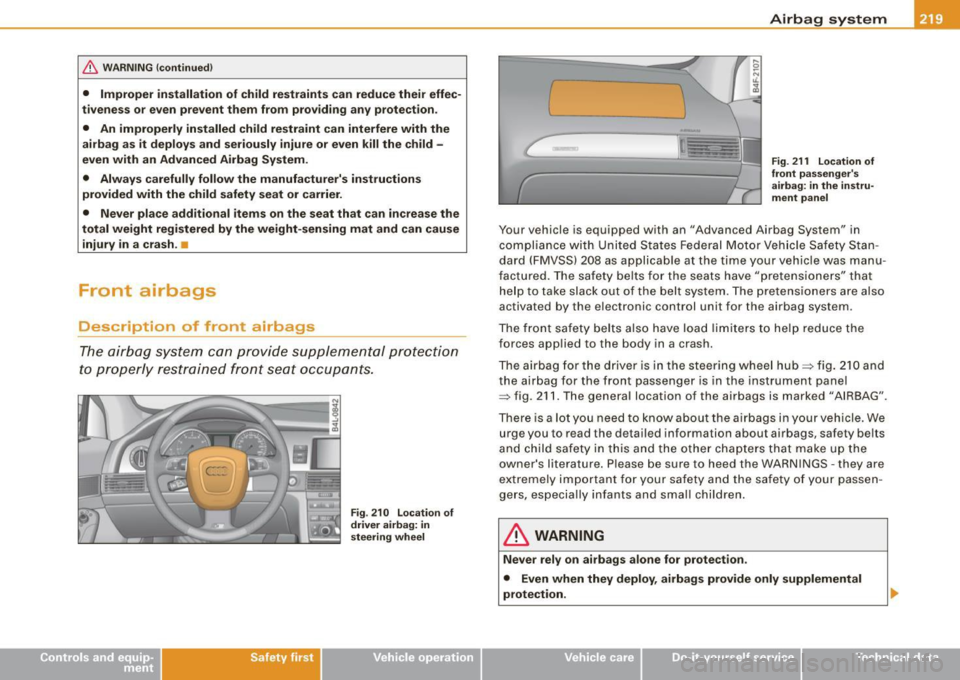
The airbag for the driver is in the steering wheel hub~ fig. 210 and
the airbag for the front passenger is in the instrument panel
~ fig. 211. The general location of the airbags is marked "AIRBAG".
There is a lot you need to know about the airbags in your vehicle. We
urg e you to read the detailed information about airbags, safety belts
and child safety in this and the other chapters that make up the
owner's literature. Please be sure to heed the WARNINGS -they are
extremely important for your safety and the safety of your passen
gers, especially infants and small children.
& WARNING
Never rely on airbags alone for protection .
• Even when they deploy, airbags provide only supplemental
protection.
Vehicle care I I irechnical data
Page 223 of 398
Airbag syst em -----------------=~-
When a person is detected on the front passenger seat, weighing
more than the to tal weight of a child t hat is about 1 year old
restrained in one of the rear-facing or forward -facing infant
restraints (listed in Federa l Motor Vehicle Safety Standard
208 with
which the Advanced Airbag System in your vehicle was certified), the front airbag on the passenger side may or may not deploy .
The
PA SSENGER AIR BAG OFF light comes on when the e lectronic
control unit detects a total weight on the front passenger seat that
requires the front a irbag to be turned off . If the
PA SSENGER AIR BAG
O FF
light does not come on, the front airbag on the passenger side
has not been tu rned off by the contro l u nit and can dep loy if the
control unit senses an impact that meets the conditions stored in its
memory .
I f the total weight on the front passenger seat is more than that o f
a typical
1 year -old, but less than the we ight of a small adult, the
front airbag on the passenger side may dep loy (the
PA SS ENGER AIR
BAG OFF
l ight does not come on).
For example , the airbag may deploy if :
• a small ch ild that is heavier than a typ ical 1 year-o ld child is on
the front passenger seat (regardless of whether the child is in one
of the child sa fety seats listed ~
page 240),
• a child who has outgrown child res traints is on the front
passenger seat.
I f the front passenger airbag is turned off, the
PASSENGER AIR BAG
O FF
light in the cen ter of the instrument panel wi ll co me on and stay
on .
T he front airbag on the passenge r side may
not deploy (the
PAS SEN GER AIR BAG OFF light does not illuminate and stay lit) if:
• a small adult or teenager is on the front passenger seat
• a passenger who is not sitting upright with their back against a
non -reclined backrest with their feet on the vehicle floor in front of
the seat is on the front passenger seat.
I f the front passenger airbag dep loys, the Federal Standard requires
the airbag t o meet the "low risk" deployment criteria to help reduce
Controls and equip
ment Safety first Vehicle operation
the risk of injury through interaction with the airbag
. "Low risk"
dep loyment occurs in those crashes that ta ke place at l ower decel
erations as defined in the electronic contro l unit .~
page 226
Al way s remembe r:
Even though your vehicle is equipped with
Advanced Airbags, the safes t place for chi ldren is properly
restrained on the back seat. Please be sure to read the important
informat ion in t he sections tha t follow a nd be sure to heed a ll of the
WARNINGS.
& WARNING
To reduce the risk of injury when an airbag inflates , always wear
s afety belts prope rly.
• If you are unrestrained , leaning forward , sitt ing s ideways or out
of position in any w ay, your risk of injury i s mu ch higher .
• You will al so receive se riou s injurie s and could even be killed if
you are up against the airbag or too clo se t o it when it inflate s -
even with an Advanced Airbag=>
page 215 .
& WARNING
A child in a rearward -facing child safety seat in stalled on the front
pa ssenge r seat will be ser iou sly injured and can be killed if the
front airb ag inflate s -even with an Advanced Airbag System .
• Although the Advan ced Airbag S ystem in your vehicle is
de signed to turn off the front airbag when a rearward -fa cing child
restraint h as been in stalled on the front pa ssenger seat , nobod y
c an ab solutely guarantee that deployment i s impo ssible in all
c onceivable situations that may happen during the useful life of
your vehicle .
• The inflating airbag will hit the ch ild s afety seat or inf ant
c arrier with great force and will smash the chi ld safety seat and
c hild ag ain st the ba ckre st, center a rm re st, door , or roof .
• Alway s in stall rearward -facing child re straint s on the b ack
seat .
Vehicle care Do-it-yourself service Technical data
Page 225 of 398
Airbag system -----------------=--=--------
passenger seat should be turned off or not~ page 217, "Child
res traints o n the fr ont sea t - som e impo rtant t hin gs t o know".
• A sensor in the safety belt latch fo r the drive r and for the front
s e at passe nger that s enses wh ether th at safe ty belt i s la tch ed o r not
and transmits this information to the e lectronic contro l unit.
& WARNING
Damage to the front passenger seat can prevent the front airbag
from working properly .
• Improper repair or disassembly of the front passenger and
driver seat will prevent the Advanced Airbag System from func
tioning properly .
• Repairs to the front passenger seat must be performed by qual
ified and properly trained workshop personnel .
• Never remove the front passenger or dr iver seat from the
vehicle.
• Never remove the upholstery from the front passenger seat .
• Never disa ssemble or remove parts from the seat or disconnect
wires from it.
• Never carry sharp objects in your pockets or place them on the
seat . If the weight-sensing mat in the passenger seat is punctured
it cannot work properly.
• Never carry things on your lap or carry objects on the
passenger seat . Such items can increase the weight registered by
the weight-sensing mat and send the wrong information to the
airbag control unit .
• Never store items under the front passenger seat . Parts of the
Advanced Airbag System under the pa ssenger seat could be
damaged , preventing them and the airbag system from work ing
properly.
• Never place seat covers or replacement upholstery that have
not been specifically approved by Audi on the front seats.
Controls and equip ment Safety first
Vehicle operation
& WARNING (continued )
• Seat covers can prevent the Advanced Airbag System from
recognizing child restraints or occupants on the front passenger
seat and prevent the side airb ag in the seat backrest from
deploying properly.
• Never use cushions, pillows, blankets or similar items on the
front passenger seat. The additional padding will prevent the
weight-sens ing mat in the seat from accurately registering the
child re straint or person on the seat and prevent the Advanced
Airbag System from functioning properly .
• If you must use a child restraint on the front passenger seat
and the child restraint manufa cturer's instru ctions requ ire the use
of a towel , foam cushion or something else to properly position
the child restraint, make certain that the PASSENGER AIR BAG OFF
light comes on and stays on whenever the child restraint is
installed on the front passenger seat.
• If the PASSENGER AIR BAG OFF light does not come on and stay
on , immediately install child restraint in a rear seating position
and have the airbag system inspected by your Audi dealer. •
How the Advanced Airbag System
components
work together
The front Advanced Airbag System and the side airbags supplement
the protection offered by the front t hree -point safety belts with
pretens ioners and load limiters and the adjustable head restraints
to help reduce the risk of in jury in a wide range of accident and
c ras h situati ons . Be sure to read t he impo rtant informatio n abou t
safety and heed the WARNI NGS in th is chapter.
Dep loyme nt of the A dva nced Ai rbag Sys tem a nd the activati on of
the safety be lt pretensioners depend on the deceleration measured
by the c ra s h sens ors and regis te red by the electronic control unit.
Crash severity depends on speed and deceleration as we ll as the
mass and s tiff ness of the veh ic le or object invo lved in the crash.
9J.
Vehicle care Do-it-yourself service Technical data
Page 226 of 398
___ A_ ir_b _a_ g;:::;_ s--:.. y_s _t _e _m _________________________________________________ _
When the electronic control unit registers a low severity crash and
th e safety belt is being used, the airbag will not deploy. If the safety
belt is not being used, the first stage deploys, followed by the
second stage after a much later time in the crash sequence.
If the electronic contro l unit registers a crash of medium severity,
the first stage of the airbag deploys followed by the second stage at
a much later time in the crash sequence -regardless of whether the
safety belt is being used or not . In higher severity crashes as regis
tered by the e lectronic contro l unit, both the first and second stages
deploy almost at the same time.
On the passenger side, regardless of safety belt use, the airbag will
be turned off if the weight on the passenger seat is less than the
amount programmed in the electronic control unit . The front airbag
on the passenger side will also be turned off if one of the child
safety seats that has been certified under Federal Motor Vehicle
Safety Standard 208 has been recognized on the seat. The
PASSENGER AIR BAG OFF light comes on and stays on to tel l you
when the front Advanced Airbag on the passenger side has been
turned off~
page 217, "Child restraints on the front seat -some
important things to know".
& WARNING
To reduce the risk of injury when an airbag inflates, always wear
safety belts properly .
• If you are unrestrained , leaning forward , sitting sideways or out
of position in any way, your risk of injury is much higher .
• You will also receive serious injuries and could even be killed if
you are up against the airbag or too close to it when it inflates -
even with an Advanced Airbag~
page 215. •
More important things to knovv about front
airbags
Fig . 212 Inflated front
airbags
Safety belts are important to help keep front seat occupants in the
proper seated position so that airbags can unfold properly and
provide supp lemental protection in a fronta l collision.
The front airbags are designed to provide additional protection for
the chest and face of the driver and the front seat passenger when:
• safety be lts are worn properly,
• the seats have been positioned so that the occupant is properly
seated as far as possible from the airbag,
• and the head restraints have been properly adjusted.
Because airbags inflate in the blink of an eye with great force, things
you have on your lap or have placed on the seat cou ld become
dangerous projectiles, and be pushed into you if the airbag inflates .
When an airbag deploys, fine dust is released. This is normal and is
not caused by a fire in the vehic le. This dust is made up most ly of a
powder used to lubricate the airbags as they deploy. It could irritate
skin.
It is important to remember that while the supplemental airbag
system is designed to reduce the likelihood of serious injuries, other
injuries, for example swelling, bruising and minor abrasions, can
also happen when airbags inflate . Airbags do not protect the arms ._,
Page 227 of 398
Airbag system -----------------=---=---
or the lower parts of the body. Front airbags suppl em ent the three
poi nt s afet y be lts o nly in s ome fro ntal c oll isi ons i n whi ch the v ehicl e
deceleration is hi gh enough to d eploy the airbags .
Front airbags will not deploy:
• if the ignition is switched off when a crash occurs,
• i n sid e collisi ons,
• in r ear- e nd collisions ,
• in ro llovers,
• when the cras h de celer ation me asured b y th e a ir bag sy stem i s
l ess than the minimum threshold nee ded for airbag dep loyment as
r egi stere d by t he ele ctronic control un it.
The front passenger airbag also will not deploy :
• when the front pa ssen ger s eat i s not o cc up ied,
• wh en the weig ht on th e front pass enger seat as se nsed by t he
Advan ced A irb ag System indi cate s that the fr ont air b ag on the
p as se n ge r sid e h as to be turned off b y the e lectronic cont rol unit
(the PASSENGER AIR BAG OFF l ig ht co me s on and sta y s on ).
& WARNING
Sitting in the wrong position can increase the risk of serious injury
in crashes .
• To reduce the risk of injury when the airbags inflate , the driver
and passengers must always sit in an upright position , must not
lean against or place any part of their body too close to the area
where the airbags are located .
• Occupants who are unbelted , out of position or too close to the
airbag can be seriously injured by an airbag as it unfolds with
great force in the blink of an eye
~ page 217.
Controls and equip ment Safety first
Vehicle operation
& WARNING
A child in a rearward-facing child safety seat installed on the front
passenger seat will be seriously injured and can be killed if the
front airbag inflates - even with an Advanced Airbag System .
• The inflating airbag will hit the child safety seat or infant
carrier with great force and will smash the child safety seat and
child against the backrest , center arm rest , door or roof.
• Always install rear-facing child safety seats on the rear seat .
• If you must install a rearward facing child safety seat on the
front passenger seat because of exceptional circumstances and
the PASSENGER AIR BAG OFF light does not come on and stay on, immediately install the rear-facing child safety seat in a rear
seating position and have the airbag system inspected by your
Audi dealer .
& WARNING
Objects between you and the airbag will in crease the risk of injury
in a crash by interfering with the way the airbag unfolds or by
being pushed into you as the airbag inflates .
• Never hold things in your hands or on your lap when the vehicle
is in use.
• Never transport items on or in the area of the front passenger
seat. Objects could move into the area of the front airbags during
braking or other sudden maneuvers and become dangerous
projectiles that can cause serious personal injury if the airbags
inflate .
• Never place or attach accessories or other objects (such as
cupholders , telephone brackets, large, heavy or bulky objects) on
the doors, over or near the area marked "AIRBAG " on the steering
wheel , instrument panel , seat backrests or between those areas
and yourself . These objects could cause injury in a crash , espe-
cially when the airbags inflate . ...
Vehicle care Do-it-yourself service Technical data
Page 230 of 398
___ A_ ir_ b_ a-g _ s_y _s_ t_ e_ m _________________________________________________ _
the weight-sensing mat to measure more weight than is actual ly on
th e seat .
If the PASSENGER AIR BAG OFF light still does not come on and does
not stay on continuous ly (when the ignition is switched on),
• t ake the c hild res traint off t he front passe ng er seat a nd ins tall it
properly at one of the rear seat pos it ions. Have the a irbag system
insp ect ed by y our A udi deal er immedia tely .
• move the chi ld to a rear seat position and make sure that the
c h ild is pro pe rly restrai ned in a c hild restraint that is app ropriat e for
its size and age.
The
PASSENGER AIR BAG OFF l igh t sho uld NOT come on when the
ignition is on and an adult is sitt ing in a proper seating position on
the front passenge r seat . If the
PASSENGER AIR BAG OFF light
comes on a nd s tays o n or fl ashes for about 5 seco nds whi le d riving,
under these ci rcumstances, make sure that:
• the adult on the fron t pass enger sea t is pro perly s eate d on the
cent er of the seat cushion with his or her back up against the back
rest and the backrest is not reclined => page 196, "Proper occ upant
seating positions",
• t he ad ult is not ta king w eig ht o ff the sea t by hol ding o n to the
passenger assist hand le above the front passenger door or
su ppo rting their w eigh t on the arm res t,
• the safety be lt is being proper ly worn and that there is not a lot
o f sla c k in the sa fe ty b elt web bin g,
• accessory seat covers or cushions or other things that may cause
an incorrect read ing o r impression on t he w eight -s e nsi ng m at
under the upho lstery of the seat have been removed from the front
pass enger seat,
• a safety be lt extender has not been left in the safety be lt latc h for
th e fro nt passenger sea t.
In addition to the
PASSENGER AIR BAG OFF l ight in the center of the
instrument pane l, the mes sage
PASSENGER AIR BAG OFF o r
PASSENGER AIR BAG ON will br iefly appear in the instrument cluster display. This is to inform the driver of the curren
t front passenger
air bag status .•
Important safety instructions on monitoring
the Advanced Airbag System
& WARNING
An airbag system that is not functioning properly cannot provide
supplemental protect ion in a frontal crash.
• If the airbag indicator light comes on , it means that there may
be something wrong with the Advanced Airbag System . It is
possible that the airbag will inflate when it is not supposed to, or
will not inflate when it should .
• Have the airbag system inspected immediately by your Audi
dealer .
& WARNING
• If the front airbag inflates , a child without a child restraint , or
in a rearward-facing child safety seat , or in a forward-facing child
restraint that has not been properly installed will be seriously
injured and can be killed .
• Even though your vehicle is equipped with an Advanced Airbag
System , make certain that all children , espec ially 12 years and
younger, always ride on the back seat properly restrained for their
age and size .
• Always install forward or rear -facing child safety seats on the
rear seat -even with an Advanced Airbag System .
• If you must install a rearward -facing child safety seat on the
front passenger seat be cause of exceptional cir cumstances and
the PASSENGER AIR BAG O FF light does not appear and stay on ,
immediately install the rear -facing child safety seat in a rear
~
Page 231 of 398
__________________________________________________ A_ i_ r _b _a...; g::- s_ y=--- s_t _e _m __ fllll
& W ARNING (continued )
seating position and have the airbag system inspected by your
Audi dealer .
• A tight tether or other str ap on a rearward-fac ing child restr aint
attached to the front pas senger seat can put too much pressure
on the weight-sensing mat in the seat and reg ister more weight
than i s actually on the seat. The heavier weight registered can
make the system work as though an adult were on the seat and
deploy the Advanced Airbag when it must be suppressed causing
s erious or even fatal injury to the child .
• If, in exceptional circumstance s, you mu st in stall a forward
fac ing child restra int on the front passenger seat , always move the
seat into its rearmost position in the seat 's fore and aft ad just
ment range , as far away from the airbag a s possible . The backrest
must be adjusted to an upright position . Make sure that the
PASSENGER AIR BAG OFF light comes on and stay s on all the time
whenever the ignition is switched on .
& WARNING
• If the PASSENGER AIR BAG OFF light does not go out when an
adult is sitting on the front passenger seat after taking the steps
described above, make sure the adult is properly seated and
restrained at one of the rear seating positions .
• Have the airbag system inspected by your Audi dealer before
transporting anyone on the front passenger seat .
[ i ] Tips
If the weight -sensing mat in the front passenger seat detects an
e mp ty seat, the fro nt air b ag on the pa ssenge r sid e will be t urned
off, and the PASSENGER AIR BAG OFF l ight will stay on .
a
Controls and equip
ment Safety first
Vehicle operation
Repair, care and disposal of the airbags
Parts of the airbag system are insta lled at many different places on
your Au di. In sta ll in g, re moving, ser vic in g or re pair in g a part in an
area of the vehicle can damage a part of an a irbag system and
pre ven t that system fro m wo rki ng p rope rly in a co llision .
There are some important things you have to know to make sure
that the effectiveness of the system will not be impai red an d that
d iscarded components do not cause inju ry or po llute t he e nv iron
ment .
& WARNING
Improper care , servicing and repair procedures can increase the
risk of personal injury and death by preventing an airbag from
deploying when needed or deploying an airbag unexpectedly:
• Never cover , obstruct , or change the steering wheel horn pad
or airbag cover or the instrument panel or modify them in any way .
• Never attach any objects such as cupholders or telephone
mountings to the surfaces covering the airbag units.
• For cleaning the horn pad or instrument panel, use only a soft ,
dry cloth or one moi stened with plain water . Solvents or cleaners
c ould damage the airbag cover or change the stiffness or strength
of the material so that the airbag cannot deploy and protect prop
erly .
• Never repair , adjust , or change any parts of the airbag system.
• All work on the steering wheel , instrument panel , front seats or
electrical system (including the installation of audio equipment ,
c ellular telephones and CB radios , etc .I must be performed by a
qualified technician who has the training and special equipment
necessary .
• For any work on the airbag system , we strongly recommend
that you see your authorized Audi dealer or qualified workshop .
• Never modify the front bumper or parts of the vehicle body .
Vehicle care Do-it-yourself service Technical data
Page 240 of 398
___ C_h_ i_ ld _ S_ a_ f_ e_ t_y ____________________________________________ _
Child Safety
Important things to know
Introduction
The rear seat is generally the safest place in a collision.
The physica l pri ncip les of wha t happe ns when your veh ic le is in a
crash apply also to children:::::,
page 207, "What happens to occu
pa nts not wearing safety bel ts?" . But un like adu lts and teenagers,
their musc les and bones are not fully developed. In many respects
children are at g reate r ris k of ser ious injury in crashes than ad ults .
Because chi ldren's bodies a re not fully deve loped, they require
restraint systems especial ly designed for their size, weight, and
body structu re. Many countries a nd all states of the U nited States
and provinces of Canada have laws requiring the use of approved
chi ld restrai nt sys te m s for i nfants and sma ll children.
In a frontal crash at a speed of 20 -35 mph (30 -56 km/h) the forces
acting on a 13 -p o und (6 kg) infant wil l be m ore tha n 20 times the
weight of the child. This means the weight of the child wou ld
sudden ly be more than 260 pounds (120 kg). Under these condi
tions, on ly an appropriate child restraint prop erly used can reduce
the risk of serious injury. Child restraints, like adult safety belts,
must be used prope rly to b e effective. Used i mprope rly, they can
increase the risk of serious injury in an accident .
Co nsu lt the c hild safety seat manu fac turer's ins truc tions to be su re
the seat is right for your child's size:::::,
page 241, "Important safety
instructions for using child safety seats" . Please be sure to read and
heed a ll of the important information and WARN INGS about chi ld
safety, Advanced Airbags, and the installation of child restraints in
th is chapter.
There is a lot you need to know about the Advanced Airbags in your
ve hicle and how they work when infants a nd c hil d ren i n child
restraints are on the front passenger seat. Because of the large amount of important information, we cannot repeat it all here. We
urge you
to read the detai led information in this owner's manua l
about a irbags and the Adva nced Ai rbag Sys tem i n your ve hic le an d
the very important information about transporting chi ldren on the
fron t passe nger seat . P lease be sure to heed the WAR NINGS -they
are extreme ly important for your safety and the safety of your
p assengers, es pecia lly in fa nt s and s mall chil dren .
& WARNING
• Accident stati stic s have shown that children are generally safer
i n the rear seat area than in the front seat ing posit ion. Always
restrain any child age 12 and under in the rear .
• All vehicle o cc u pants and especi ally children must be
restrained properly whenever riding in a vehicle . An unrestrained
or improperly restrained child could be injured by striking the inte
rior or by being ejected from the vehicle during a sudden
maneuver or impact . An unrestrained or improperly restrained
child is also at greater risk of injury or death through contact with
an inflating a irbag .
• A suitable child restraint properly installed and used at one of
the re ar seat ing positions provides the highest degree of protec
tion for infants and small children in most accident situations.
& WARNING
Children on the front seat of any car even with Advanced Airbags
can be seriously injured or even killed when an airbag inflates . A
child in a rearward -fa cing child safety seat in stalled on the front
passenger seat will be seriously injured and can be killed if the
front airbag inflate s.
• The inflating airbag will hit the child safety seat or infant
carrier with great force and will smash the child safety seat and
child against the backrest , center arm rest , or door .
IJll,
Page 243 of 398
_______________________________________________ C_h _ i_ld _ S_ a_ f_ e_ t..,:c y __ __
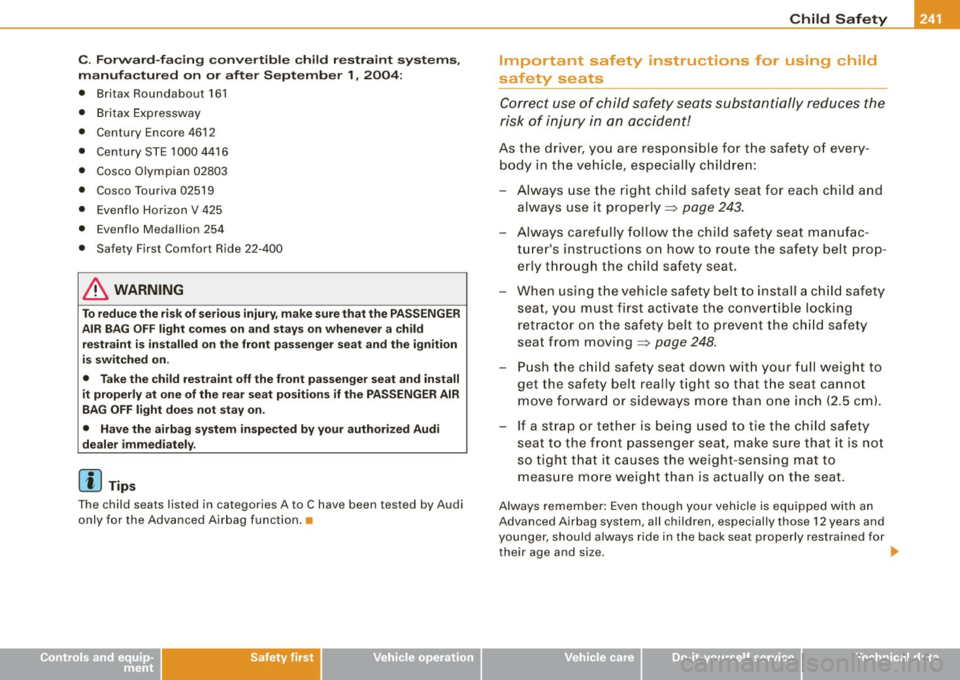
C. Forward-facing convertible child restraint systems,
manufactured on or after September 1, 2004:
• Britax Roundabout 161
• Britax Expressway
• Century Encore 4612
• Century STE 1000 4416
• Cosco Olympian 02803
• Cosco Touriva 02519
• Evenflo Horizon V 425
• Evenflo Medallion 254
• Safety First Comfort Ride 22-400
& WARNING
To reduce the risk of serious injury, make sure that the PASSENGER
AIR BAG OFF light comes on and stays on whenever a child
restraint is installed on the front passenger seat and the ignition
is switched on.
• Take the child restraint off the front passenger seat and install
it properly at one of the rear seat positions if the PASSENGER AIR
BAG OFF light does not stay on.
• Have the airbag system inspected by your authorized Audi
dealer immediately.
[ i] Tips
The child seats listed in categories A to C have been tested by Audi
only for the Advanced Airbag function. •
Controls and equip
ment Safety first Vehicle operation
Important safety instructions for using child
safety seats
Correct use of child safety seats substantially reduces the
risk of injury in an accident!
As the driver, you are responsible for the safety of every
body in the vehicle, especially children:
- Always use the right child safety seat for each child and
always use it properly~
page 243.
-Always carefully follow the child safety seat manufac
turer's instructions on how to route the safety belt prop
erly through the child safety seat.
- When using the vehicle safety belt to install a child safety
seat , you must first activate the convertible locking
retractor on the safety belt to prevent the child safety
seat from moving~
page 248.
-Push the child safety seat down with your full weight to
get the safety belt really tight so that the seat cannot move forward or sideways more than one inch (2.5 cm).
- If a strap or tether is being used to tie the child safety
seat to the front passenger seat, make sure that it is not
so tight that it causes the weight-sensing mat to
measure more weight than is actually on the seat.
Always remember: Even though your vehicle is equipped with an
Advanced Airbag system, all children, especially those 12 years and
younger, should always ride in the back seat properly restrained for
their age and size. ..,
Vehicle care Do-it-yourself service Technical data
Page 244 of 398
___ C_h_ i_ ld _ S_ a_ f_ e_ t_y ____________________________________________ _
& WARNING
Not using a child safety seat, using the wrong child safety seat or
improperly installing a child restraint increases the risk of serious
personal injury and death.
• All vehicle occupants and especially children must always be
restrained properly whenever riding in a vehicle .
- An unrestrained or improperly restrained child can be injured or killed by being thrown against the inside of the vehicle or by
being ejected from it during a sudden maneuver or impact.
- An unrestrained or improperly restrained child is at much
greater risk of injury or death by being struck by an inflating
airbag.
• Commercially available child safety seats are required to
comply with U.S . Federal Motor Vehicle Safety Standard (FMVSSI
213 (in Canada CMVSS 2131.
-When buying a child restraint , select one that fits your child
and the vehicle.
- Only use child restraint systems that fully contact the flat
portion of the seat cushion . The child restraint must not tip or
lean to either side . Audi does not recommend using child safety
seats that rest on legs or tube-like frames. They do not provide
adequate contact with the seat .
- Always heed all legal requirements pertaining to the installa
tion and use of child safety seats and carefully follow the
instructions provided by the manufacturer of the seat you are
using .
• Never allow children under 57 inches (1 .5 meters) to wear a
normal safety belt. They must always be restrained by a proper
child restraint system. Otherwise, they could sustain injuries to
the abdomen and neck areas during sudden braking maneuvers or
accidents.
• Never let more than one child occupy a child safety seat .
& WARNING (continued)
• Never let babies or older children ride in a vehicle while sitting
on the lap of another passenger.
- Holding a child in your arms is never a substitute for a child
restraint system .
- The strongest person could not hold the child with the forces
that exist in an accident. The child will strike the interior of the
vehicle and can also be struck by the passenger.
- The child and the passenger can also injure each another in
an accident.
• Never install rear-facing child safety seats or infant carriers on
the front passenger seat . A child will be seriously injured and can
be killed when the passenger airbag inflates - even with an
Advanced Airbag System .
• The inflating airbag will hit the child safety seat or infant
carrier with great force and will smash the child safety seat and
child against the backrest , center arm rest, door or roof .
• Always install rear -facing child safety seats or infant carriers on
the rear seat.
• Forward -facing child safety seats installed on the front
passenger's seat can interfere with the airbag when it inflates and
cause serious injury to the child . Always install forward -facing
child safety seats on the rear seat .
• If exceptional circumstances require the use of a forward
facing child restraint on the front passenger's seat , the child's
safety and well -being require that the following special precau
tions be taken:
- Make sure the forward -facing seat has been designed and
certified by its manufacturer for use on a front seat with a
passenger front and side airbag .
- Always carefully follow the manufacturer's instructions
provided with the child safety seat or carrier .