wheel AUDI S6 2009 Manual PDF
[x] Cancel search | Manufacturer: AUDI, Model Year: 2009, Model line: S6, Model: AUDI S6 2009Pages: 398, PDF Size: 43 MB
Page 338 of 398
-~_T_ ir_e_ s_ a_ n_d _ w_ h_ e_e _l_s _________________________________________________ _
• After any impact, immediately inspect your tires or have them
inspected by the nearest authorized Audi dealer. Replace a
damaged tire as soon as possible.
• Inspect your tires every 2,000 miles (3,000 km) for damage and
wear . Damage is not always easy to see . Damage can lead to loss of
air and underinflation, which could eventually cause tire failure . If
you believe that a tire may have been damaged, replace the tire as
soon as possible.
• These tires may wear more quickly than others.
• Please also remember that, while these tires deliver responsive
handling, th ey may ride less comfortably and make more noise than
other choices.
Reduced performance in winter/cold season
conditions
All tires are design ed for certain purposes. The low aspect rat io ,
ultra high performance tires originally installed on your vehicle are intended for maximum dry and wet road performance and handling.
They are not suitable for cold, snowy or icy weather conditions. If
you drive under those circumstances, you should equip your vehicle
with all -season or winter tires, which offer better traction under
those conditions . We suggest you use the recommended snow or
all -season tires specified for your vehicle, or their equivalent .
Refer to~
page 333for more detailed information regarding winter
tires. •
Tire pressure monitoring system
General notes U
Each tire, including the spare (if provided), should be checked
monthly when cold and inflated to the inflation pressure recom
mended by the vehicle manufacturer on the vehicle placard or tire
inflation pressure label. (If your vehicle has tires of a different size
than the size indicated on the vehicle placard or tire inflation pres- sure label, you should determine the proper tire i
nflation pressure
for those tires.)
As an added safety feature , your vehicle has been equipped with a
tire pressure monitoring system (TPMS) that illuminates a low tire
pressure telltale when one or more of your tires is significantly
under -inflated . Accordingly, when the low tire pressure telltale illu
minates, you should stop and check your tires as soon as possible,
and inflate them to th e proper pressur e. Driving on a signi ficantly
under-inflated tire causes the tire to overheat and can lead to tire
failure . Under-inflation also reduces fuel efficiency and tire tread
life, and may affect the vehicle's handling and stopping ability.
Please note that the TPMS is not a substitute for proper tire mainte
nance, and it is the driver's responsibility to maintain correct tire
pressure, even if under-inflation has not reached the level to trigger
illumination of the TPMS low tire pr essure telltale.
Your vehicle has also been equipped with a TPMS malfunction indi
cator to indicate when the system is not operating properly . The
TPMS malfunction indicator is combined with the low tire pressure
telltale . When the system detects a malfunction, the telltale will
flash for approximately one minute and then remain continuously
illuminated . This sequence will continue upon subsequent vehicle
start -ups as long as the malfunction exists .
When the malfunction indicator is illuminated, the system may not
b e able to de tect or signal low tire pr essure as in tended. TPMS
malfunctions may occur for a variety of reasons, including the
installation of replacement or alternate tires or wheels on the
vehicle that prevent the TPMS from functioning properly. Always
check the TPMS malfunction tell tale af ter replacing one or more
tires or wheels on your vehicle to ensure that the replacement or
alternate tires and wheels allow the TPMS to continue to function
properly. •
Page 339 of 398
Tires and wheels -
----------------------
Tire pressure indicator appears
The tire pressure indicator in the instrument cluster
informs you if the tire pressure is too low or if there is a
sys tem malfunc tion.
en
~ 0 ..:, ;g
0 g 0 ..:, ;g
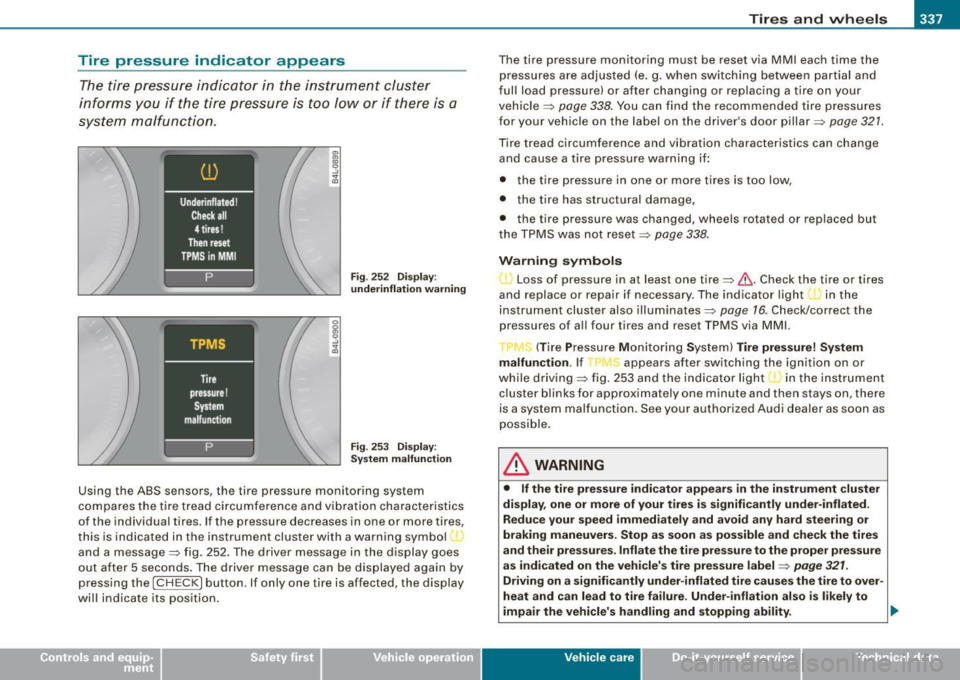
F ig . 25 2 Displa y:
underinflation warning
Fig . 253 Displ ay :
Sy stem malfunction
Using th e ABS sensors , th e t ire pr essur e monitoring system
c o m pares the tire tread ci rcu mference and vi bration character istics
of the individua l tires . If the pressure decreases in one or mor e tires,
th is is ind icated in the inst rumen t cl uster w ith a warning symbol,
and a message=> fig. 252. The driver message in the display goes
ou t af ter 5 sec onds. T he driver message can be dis pl ayed again by
pressing the [ CH ECK ] button. If only on e tire is affected, the display
will indicate its position . T
he tire pressure monitoring must be reset via MMI each time the
press ures are adjus ted (e .g . when swi tchi ng between par tial and
fu ll load pressu re) or after changing or replacing a tire on your
veh icle =>
page 338. You ca n find the recom mended tir e pres sures
for your vehicle on the label on the driver's door pillar=>
page 32 1.
Tire tread circumference and vibration characteristics can change
and cause a tire pressure war ning if:
• the tire pressu re in one or more t ires is too low,
• t he tire has st ructura l damage,
• the tire pressure was changed, wheels rotated or replaced but
t he TP MS was no t r eset =>
pag e 338 .
Warning symbols
• ~ Loss of pressur e in at le ast one tire=>&. Check the tire or tires
and replace or repair if necessary . T he indicator light in the
i nstrument cluster also illu mi nat es =>
page 16 . Che ck/cor rect th e
p ressures of al l four t ires and reset TPM S via MMI.
T (Ti re Pre ssure Mo nitorin g System)
Tire pressure! System
malfunction .
If appears after switch ing the ign it ion on or
w hi le drivi ng => fig . 253 an d the i ndica tor lig ht in th e in stru ment
c luster blinks for approximately one minute and the n stays on, there
i s a sy stem malfunction . See your authorized Au di d ealer as soon a s
possible .
& WARNING
• If the tire pressure indicator appears in the instrument cluster
display, one or more of your tires is significantly under -inflated.
Reduce your speed immediately and avoid any hard steer ing or
braking maneuvers. Stop as soon as possible and check the tires
and their pressures. Inflate the tire pressure to the proper pressure
as indicated on the vehicle's tire pressure label =>
page 321.
Driving on a significantly under-inflated tire causes the tire to over
heat and can lead to tire failure . Under- inflation also is l ikely to
impair the vehicle's handling and stopping ability .
~
Vehicle care I I irechnical data
Page 344 of 398
lllftl.,___W_ h_ a _ t_d_ o_ l _d _o_ n_ o_ vv_ ? ______________________________________________ _
What do I do now?
Trunk escape handle
In case of an emergency, the rear lid can be opened from
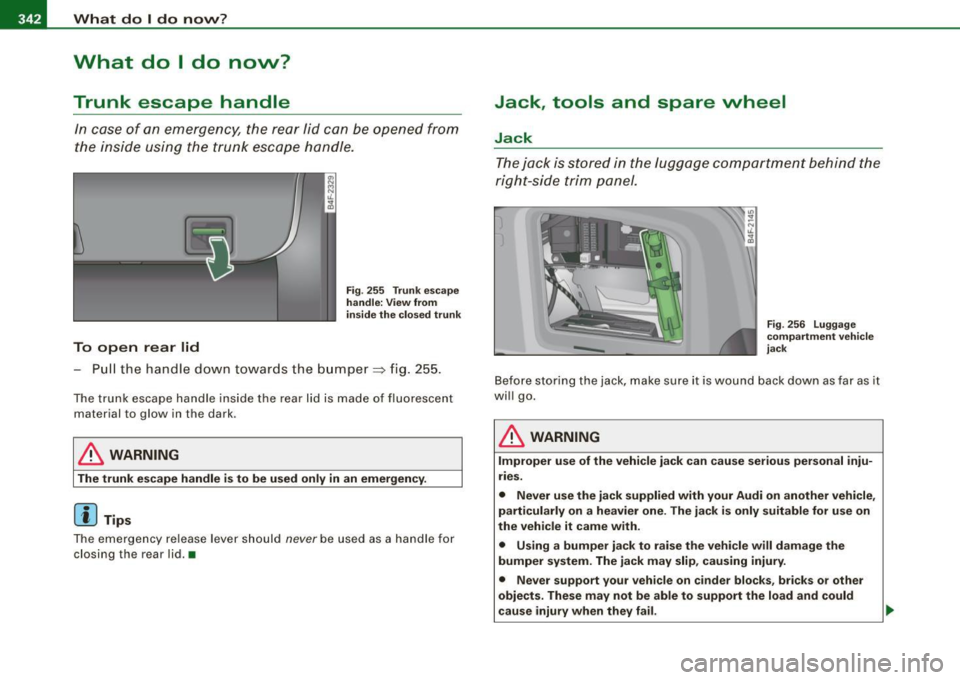
the inside using the trunk escape handle.
To open rear lid
Fig. 255 Trunk escape
handle: View from
inside the closed trunk
- Pull the handle down towards the bumper ::} fig. 255.
The trunk escape handle inside the rear lid is made of fluorescent
material to glow in the dark.
& WARNING
The trunk escape handle is to be used only in an emergency.
[ i ] Tips
The emergency release lever should never be used as a handle for
closing the rear lid. •
Jack, tools and spare wheel
Jack
The jack is stored in the luggage compartment behind the
right-side trim panel.
--
Fig . 256 Luggage
compartment vehicle
jack
Before storing the jack, make sure it is wound back down as far as it
will go.
& WARNING
Improper use of the vehicle jack can cause serious personal inju
ries.
• Never use the jack supplied with your Audi on another vehicle,
particularly on a heavier one. The jack is only suitable for use on
the vehicle it came with.
• Using a bumper jack to raise the vehicle will damage the
bumper system. The jack may slip , causing injury.
• Never support your vehicle on cinder blocks, bricks or other
objects. These may not be able to support the load and could
cause injury when they fail.
Page 345 of 398
What do I do now? 111111 _______________________________ ....:..:..:..:..:.:..:--=.:..::....:.....:.:...::..___;__ _ __,J
& WARNING !continued)
• Never start or run the engine while the vehicle is supported by
the jack.
• If you must work under the vehicle, always use safety stands
specifically designed for this purpose.
• Never use the hexagonal socket in the handle of the screw
driver to loosen or tighten the wheel bolts.
• Always make sure the spare tire and even a flat tire are secured
in place and not loose, otherwise they could fly forward, causing
personal injury to passengers in the vehicle in an accident or
sudden maneuver. •
Tools
The vehicle tools are stored in the luggage compartment
behind the right-side trim panel.
-
-
The onboard tool kit includes:
• Hook for removing wheel covers *
• Wheel bolt wrench
• Alignment pin for changing wheels
• Screwdriver with reversible blade
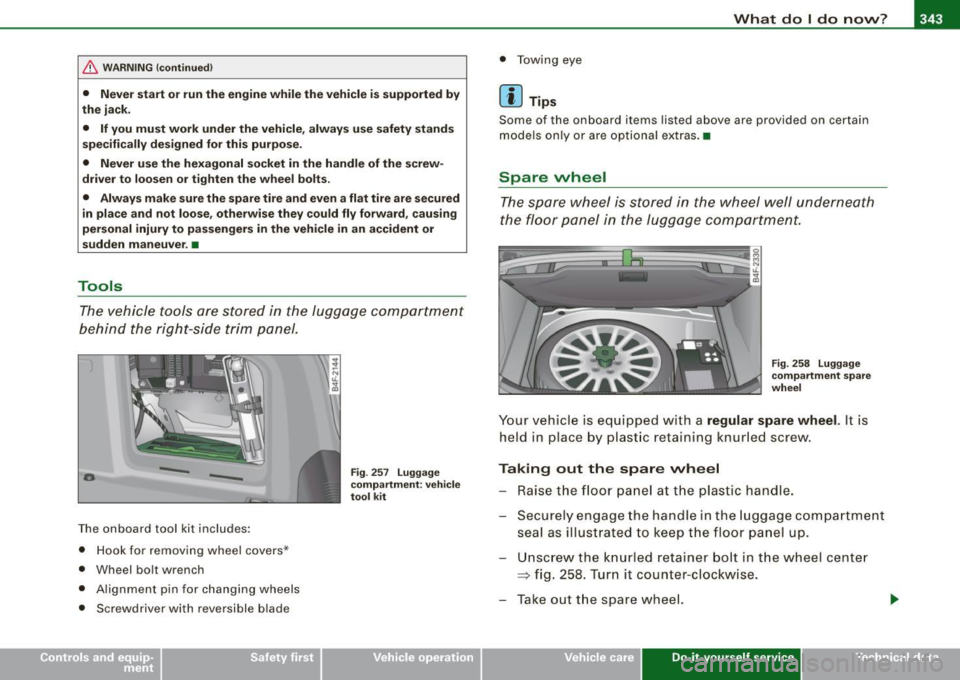
Fig. 257 Luggage
compartment: vehicle
tool kit
• Towing eye
[ i] Tips
Some of the on board items listed above are provided on certain
models only or are optional extras.•
Spare wheel
The spare wheel is stored in the wheel well underneath
the floor panel in the luggage compartment.
Fig. 258 Luggage
compartment spare
wheel
Your vehicle is equipped with a regular spare wheel. It is
held in place by plastic retaining knurled screw.
Taking out the spare wheel
- Raise the floor panel at the plastic handle.
- Securely engage the handle in the luggage compartment
seal as illustrated to keep the floor panel up.
Unscrew the knurled retainer bolt in the wheel center
=> fig. 258. Turn it counter-clockwise.
- Take out the spare wheel.
Vehicle care Do-it-yourself service irechnical data
Page 346 of 398
1111!1.___W_ h_ a_ t_ d_o_ l_ d_ o _ n_ o_w _ ? ____________________________________________ _
- Disengage and lower the floor panel before you close the
luggage compartment lid again.
Storing the replaced wheel
- Place the replaced wheel inside the spare wheel well in
the luggage compartment .
Tighten the knurled retaining screw clockwise to secure the wheel in place.
- Disengage and lower the floor panel before you close the
luggage compartment lid again.
& WARNING
Loose items in the passenger compartment can cause serious
personal injury during hard braking or in an accident .
• Never store the spare wheel or jack and tools in the passenger
compartment.
• Always store all jacking equipment, tools, and the spare wheel
in the luggage compartment.
• Tighten the knurled retaining screw for the spare wheel
securely.
[ i] Tips
Check the inflation pressure of the spare tire periodically to keep the
tire ready for use. •
Changing a wheel
Before changing a wheel
Observe the following precautions for your own and your
passenger's safety when changing a wheel.
- After you experience a tire failure, pull the car well away
from moving traffic and try to reach level ground before
you stop :::;. & .
- All passengers should leave the car and move to a safe
location (for instance, behind the guardrail) :::;,& .
- Engage the parking brake to prevent your vehicle from
rol ling unintentionally :::;.& .
- Move selector lever to position P :::;. & .
-If you are towing a trailer: unhitch the trailer from your
vehicle.
- Take the jack and the spare tire out of the luggage
compartment:::;.
page 342.
& WARNING
You or your passengers could be injured while changing a wheel if
you do not follow these safety precautions:
• If you have a flat tire, move a safe distance off the road. Turn off
the engine, turn the emergency flashers on and use other warning
devices to alert other motorists.
• Make sure that passengers wait
in a safe place away from the
vehicle and well away from the road and traffic.
• To help prevent the vehicle from moving suddenly and possibly
slipping off the jack, always fully set the parking brake and block
the wheel diagonally opposite the wheel being changed. When one ...
Page 347 of 398
_______________________________________________ W_ h_ a_t _ d_ o_ l _d _o_ n_ o _ w_ ? __ IIII
•
& WARNING (continued)
front wheel is lifted off the ground, placing the Automatic Trans
mission in "P" {Park) will
not prevent the vehicle from moving.
• Before you change a wheel , be sure the ground is level and firm.
If necessary, use a sturdy board under the jack.
• After installing the spare wheel, make sure that you replace the
flat tire/wheel in its storage area properly and tighten the knurled
retaining screw securely. •
Changing a vvheel
When you change a wheel, follow the sequence described
below step-by-step and in exactly that order.
1. Act ivate the vehicle jack mode (only vehicles with Adap
tive Air Suspension) ~
page 186.
2. Remove the decorative wheel cover*. For more details
see also ~
page 346, "Decorative wheel covers".
3. Loosen the
wheel bolts ~ page 346.
4. Locate the proper mounting point for the jack and align
the jack below that point~
page 347.
5. Lift the car with the jack~ page 347.
6. Remove the wheel with the flat tire and then install the
spare
~ page 348.
7. Tighten all wheel bolts lightly.
8.
Lower the vehicle with the jack.
9. Use the wheel bolt wrench and
firmly tighten all wheel
bolts
~ page 346.
10. Replace the decorative wheel cover*.
11. Deactivate the veh icle jack mode (only vehicles with
Adaptive Air Suspension)~
page 186.
& WARNING
Always read and follow all WARNINGS and information => & in
"Raising the vehicle" on
page 347 and => page 349. •
After changing a vvheel
A wheel change is not complete without the doing the
following.
- Store and secure the wheel you replaced in the spare
wheel well.
- Replace the tools and the jack in their proper location.
-Check the tire pressure on the spare wheel immediately
after mounting it.
- As soon as possible, have the
tightening torques on all
wheel bolts checked with a torque wrench. The correct
tightening torque is 90 ft lb (120 Nm).
- Have the flat tire
replaced as soon as possible.
[ i] Tips
• If you notice that the wheel bolts are corroded and difficult to
turn while changing a tire, they should be replaced before you check
the tightening torque.
• Drive at reduced speed until you have the tightening torques
checked. a
Do-it-yourself service
Page 348 of 398
-L--____:W:...:....:. h.:..: a::.. t:....: d.:..:o:....:. l...: d::.. o ..:.... n:..:..:: o...:vv ...:...;. ? ____________________________________________ _
Applies to veh ic les : with decorative wheel covers
Decorative wheel covers
The decorative wheel covers must be removed first to
access the wheel bolts.
Removing
Fig. 259 Changing a
wheel: Removing the
wheel cover
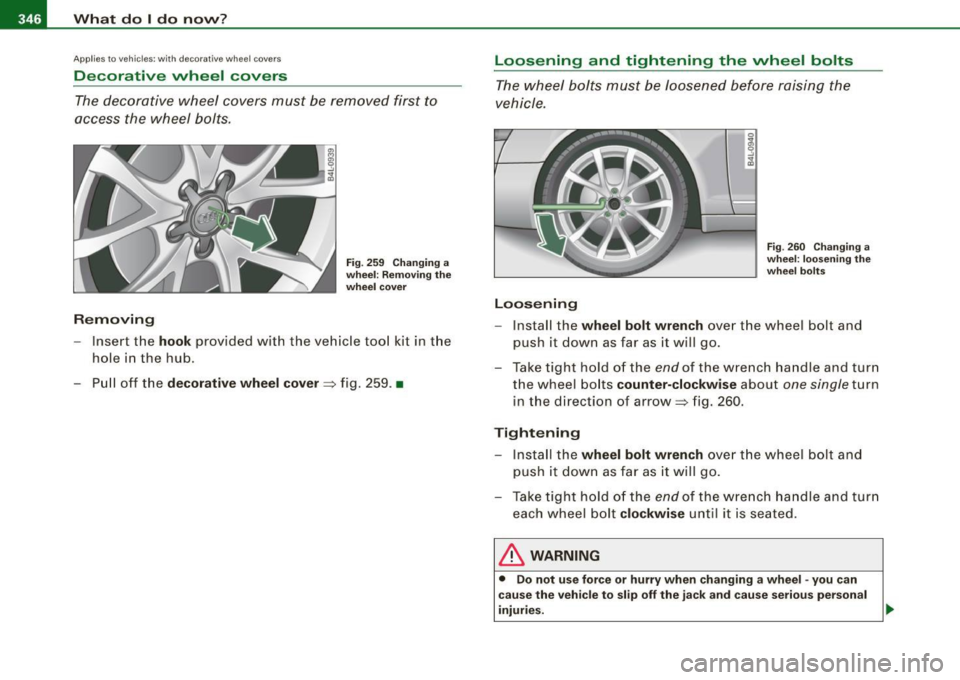
- Insert the hook provided with the vehicle tool kit in the
hole in the hub.
- Pull off the decorative wheel cover=> fig. 259. •
Loosening and tightening the wheel bolts
The wheel bolts must be loosened before raising the
vehicle.
Loosening
Fig. 260 Changing a
wheel: loosening the
wheel bolts
- Install the wheel bolt wrench over the wheel bolt and
push it down as far as it will go.
- Take tight hold of the
end of the wrench handle and turn
the wheel bolts counter-clockwise about
one single turn
in the direction of arrow~ fig. 260.
Tightening
- Install the wheel bolt wrench over the wheel bolt and
push it down as far as it will go.
- Take tight hold of the
end of the wrench handle and turn
each wheel bolt clockwise until it is seated.
& WARNING
• Do not use force or hurry when changing a wheel · you can
cause the vehicle to slip off the jack and cause serious personal
injuries.
Page 349 of 398
_____________________________________________ W_ h_ a_t _d_ o_l _ d_o _ n_o_ w_ ? _ __._
& WARNING !continued)
• Do not loosen the wheel bolts more than one turn before you
raise the vehicle with the jack . - You risk an injury.
[ i J Tips
• Never use the hexagonal socket in the handle of the screwdriver
to loosen or tighten the wheel bolts .
• If a wheel bolt is very tight, you may find it easier to loosen by
carefully pushing down on the end of the wheel bolt wrench with
one foot only . As you do so, hold on to the car to keep your balance
and take care not to slip .•
Rais ing the vehicle
The vehicle must be lifted with the jock first before the
wheel con be removed.
Fig. 261 Changing a
wheel: mounting
points for the jack Fig
. 262 Close-up:
proper positioning of
jack
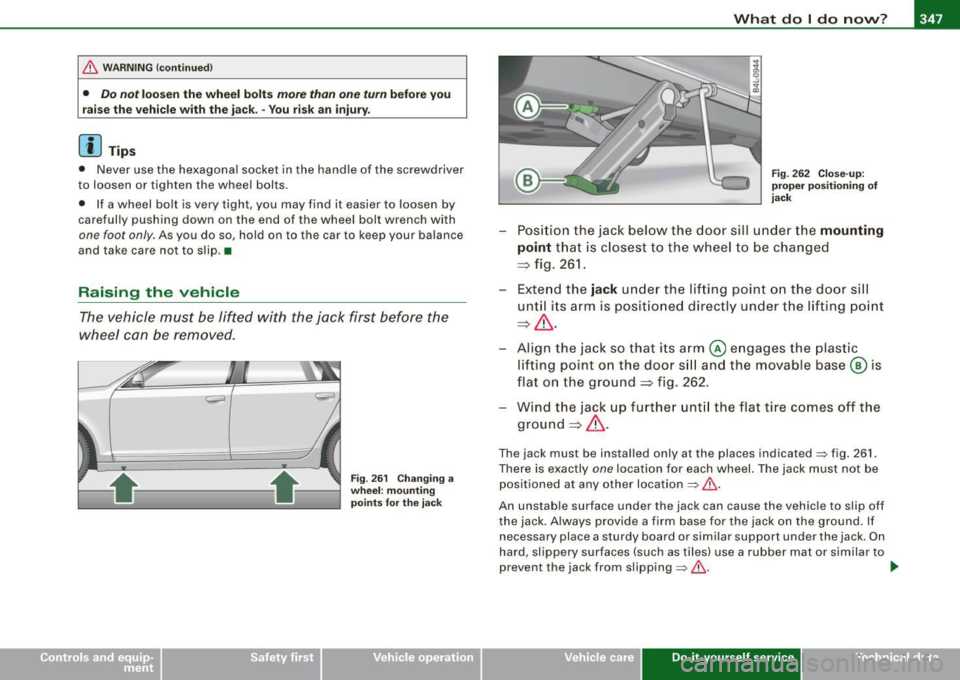
- Position the jack below the door sill under the mounting
point
that is closest to the wheel to be changed
:::;, fig. 261 .
- Extend the
jack under the lifting point on the door sill
until its arm is positioned directly under the lifting point
:::;, & .
- Align t he jack so that its arm @ engages the plastic
lifting point on the door sill and the movable base@ is
flat on the ground :::;, fig. 262.
- Wind the jack up further until the flat tire comes off the
ground :::;,& .
The jack must be installed only at the places indicated=> fig. 261.
There is exactly
one locat ion for each wheel. The jack must not be
positioned at any other location
=> & .
An unstable surface under the jack can cause the vehicle to slip off
the jack . Always provide a firm base for the jack on the ground. If
necessary place a sturdy board or similar support under the jack. On
hard, slippery surfaces (such as tiles) use a rubber mat or similar to
prevent the jack from slipping=> &. .,_
Vehicle care Do-it-yourself service Technical data
Page 350 of 398
111!1...__W_ h_ a _ t_d_ o_ l _d _o_ n_ o_ w_ ? ______________________________________________ _
& WARNING
• You or your passengers could be injured while changing a
wheel if you do not follow these safety precautions:
- Positioning the jack under the vehicle at any other place than
those indicated above may damage the vehicle or may result in
personal injuries.
- A soft or unstable surface under the jack may cause the
vehicle to slip off the jack. Always provide a firm base for the
jack on the ground.
If necessary, use a sturdy board under the
jack.
- On hard, slippery surface (such as tiles) use a rubber mat or
similar to prevent the jack from slipping.
• To help prevent injury to yourself and your passengers: -Do not raise the vehicle until you are sure the jack is securely
engaged.
- Passengers must not remain in the vehicle when it is jacked
up.
- Make sure that passengers wait in a safe place away from
the vehicle and well away from the road and traffic.
- Make sure jack position is correct, adjust as necessary and
then continue to raise the jack.
[ i ] Tips
Before changing the wheel, you must activate the jacking mode, so
that the automatic controls for the Adaptive Air Suspension do not
make it more difficult to lift the vehicle with the jack =>
page 186. •
Taking the wheel off /installing the spare
Follow these instructions step-by-step for changing the
wheel
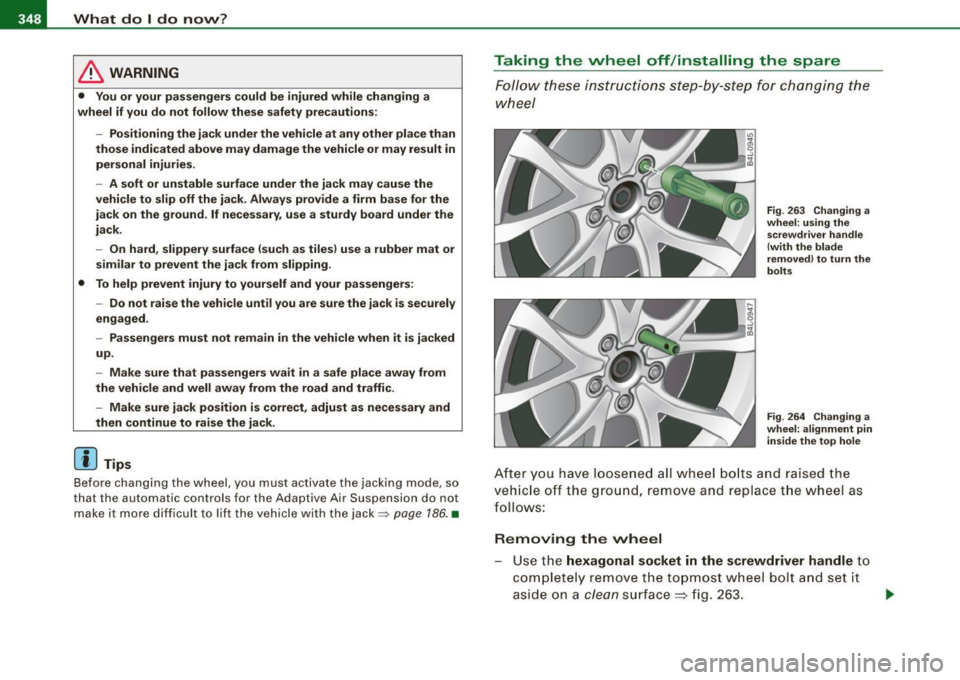
Fig . 263 Changing a
wheel: using the
screwdriver handle
(with the blade
removed) to turn the
bolts
Fig . 264 Changing a
wheel: alignment pin
inside the top hole
After you have loosened all wheel bolts and raised the
vehicle off the ground, remove and replace the wheel as
follows:
Removing the wheel Use the hexagonal socket in the screwdriver handle to
completely remove the topmost wheel bolt and set it
aside on a
clean surface ~ fig. 263. .,_
Page 351 of 398
_______________________________________________ W_ h_ a_t _ d_ o_ l _d _o_ n_ o _ w_ ? __ ffllll
•
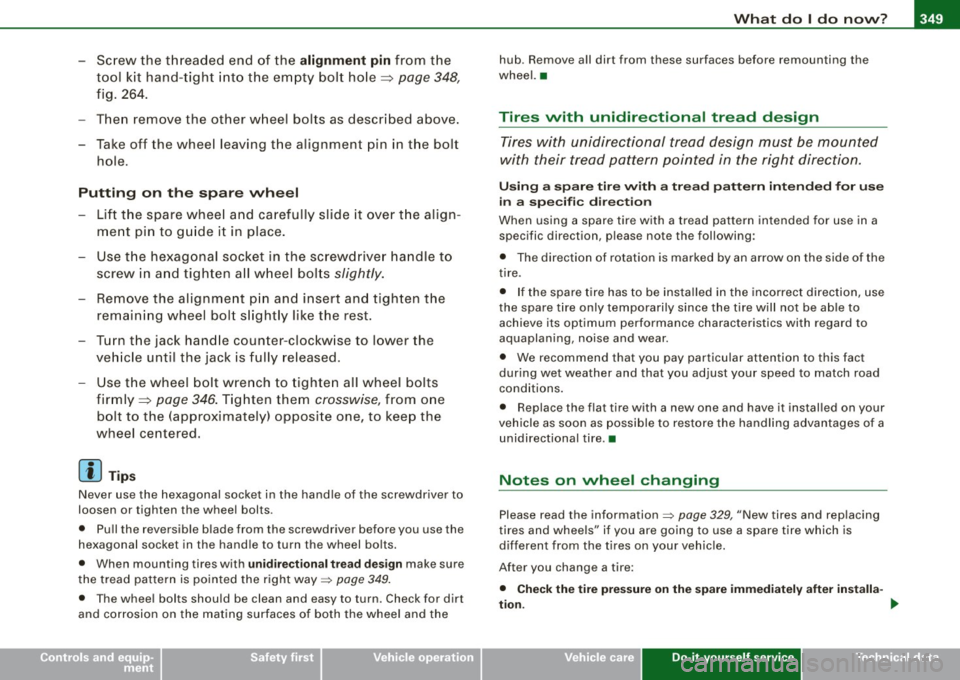
- Screw the th readed end of the a lignment pin from the
tool k it hand-tight into the em pty bolt hole~ page 348,
fig. 264 .
- Then remove the other w heel bolts as described above.
- Take off the wheel leaving the al ignment pin in the bolt
hole.
Putting on the spar e wheel
- Lift the spare whee l and carefully slide it over t he align
ment pin to g uide it in place .
- Use the hexagonal socket in the screw drive r ha ndle t o
screw in a nd tighten a ll w heel bol ts slightly .
- Remove the alignment p in and insert and tighten the
remaini ng wheel bol t slightly like the rest.
- Turn the jack hand le counter -clockwise to lower the
ve hicle until the jack is fully released .
- Use the wheel bolt wrench to tighten all wheel bolts
firmly ~ page 346 . Tighten them crosswise, from one
bolt to the (approximately) opposite one, to keep the
wheel centered .
[ i J Tip s
Never use the hexagonal socke t in the hand le of the screwdriver to
loosen or tighten the wheel bolts .
• Pull the reversible blade from the screwdriver before you use the
hexagonal socket in the hand le to turn the wheel bo lts .
• When mounting tires with
unidire ctional tre ad de sign make sure
t he tread pattern is po inted the right way~
page 349.
• T he wh ee l bolts should b e clean and easy to turn . Check for dirt
and corrosion on the mating surfaces of both the wheel and the hub
. Remove all dirt from these surfaces before remounting the
wheel. •
Tires with unidirectional tread design
Tires with unidirectional tread design must be mounted
with their tread pa ttern pointed in the right dire ction .
Using a spare tire with a tread patte rn intended f or use
in a s pec ific direc tio n
When using a spare tire with a t read pattern intended for use in a
specific direction, please note the following :
• The direction of rotation is marked by an arrow on the side of the
tire .
• I f the spare tire has to be insta lled in the incorrect direction, use
the spare t ire only temporarily since the tire will not be ab le to
achieve its optimum performance characteristics wi th regard to
aquaplaning , noise and wear.
• We recommend that you pay particular attention to this fact
dur ing wet weather and that you ad just your speed to match road
conditions .
• Replace the flat tire with a new one and have it installed on your
vehicle as soon as p ossible to res tore the handling advantages of a
unidirectional tire. •
Notes on wheel changing
Please read the information~ page 329, "New tires and replacing
tires and whee ls" if you are going to use a spare tire which is
different from the tires on your vehic le.
Aft er you change a tire :
• Check the tire pre ssure on the spare im mediat ely a fter in stalla -
tion . _,,,
Do-it -yourself service