emergency towing AUDI S6 2009 Owners Manual
[x] Cancel search | Manufacturer: AUDI, Model Year: 2009, Model line: S6, Model: AUDI S6 2009Pages: 398, PDF Size: 43 MB
Page 6 of 398
Table of contents
Weights . . . . . . . . . . . . . . . . . . . . . . . 367
Dimensions . . . . . . . . . . . . . . . . . . . . 368
Data . . . . . . . . . . . . . . . . . . . . . . . . . . . 369
300 hp, 3.0 liter, 6 -cylinder engine 369
255 hp, 3.2 liter, 6 -cy lind er engine 370
350 hp, 8-cylinder engine . . . . . . . 371
Do-it-yourself service ... 34
1 Consumer Information . . . . . . . . . 372
What do I do now? . . . . . . . . . . . . . 342
Trunk escape handle . . . . . . . . . . . . 342
Jack, tools and spare wheel . . . . . . 342
Changing a wheel . . . . . . . . . . . . . . 344
Fuses and bulbs . . . . . . . . . . . . . . . . 351
Fus es . . . . . . . . . . . . . . . . . . . . . . . . . . 351
Bulbs ................... •...... 355
Emergency situations . . . . . . . . . . 357
Genera l . . . . . . . . . . . . . . . . . . . . . . . . 357
Starting by pushing or towing . . . . 357
Starting with jumper cab les . . . . . . 357
Use of juniper cables . . . . . . . . . . . . 358
Em ergency towing with commercia l
tow truck . . . . . . . . . . . . . . . . . . . . . . 360
Lifting vehicle . . . . . . . . . . . . . . . . . . 362
Technical data
General information
Explanation of technical data ... .
Vehicle identification ........... .
Displaying Vehic le Ident ification
Number in the MMI ......... ... . 365
366
366
366
367 Warranty
coverages ........... .
Operating your vehicle outside the
U.S.A. or Canada .............. .
Audi Service Repair Manuals and
Literature ..................... .
Maintenance .............. ... .
Additional accessories, modifications and parts
rep lacement .................. .
Dec laration of Compliance,
Telecommunications and Electron ic
Systems .................. .... . 372
372
372
372
374
375
Alphabetical index
. . . . . . 379
Page 69 of 398
Emergency flasher ~
The emergency flasher makes other motorists aware that
you or your vehicle are in an emergency situation.
~ -.:.i.t'
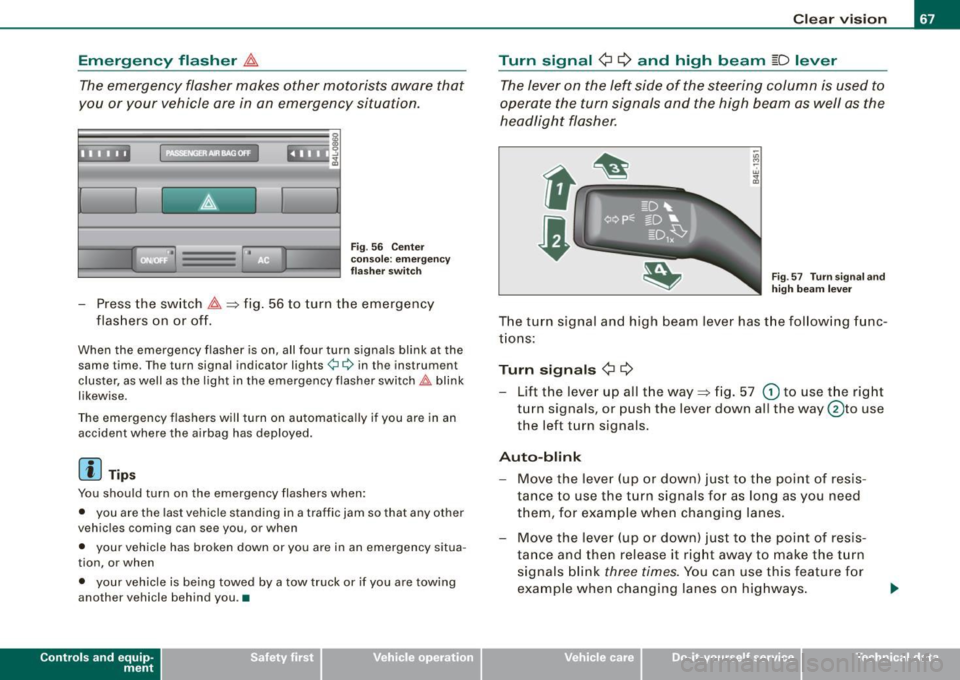
Fig . 56 Cente r
conso le: emergency
f lashe r swi tc h
- Press the switch ~~fig . 56 to turn the emergency
flashers on or off.
When the emergency flasher is on, all four turn signals blink at the same time. The turn signal indicator lights¢¢ in the instrument
cluster, as well as the light in the emergency flasher switch~ blink
likewise.
The emergency flashers will turn on automatica lly if you are in an
accident where the airbag has deployed.
[ i ] Tip s
You should turn on the emergency flashers when:
• you are the last vehicle standing in a traffic jam so that any other
vehicles coming can see you, or when
• your vehicle has broken down or you are in an emergency situa
tion, or when
• your vehicle is being towed by a tow truck or if you are towing
another vehicle behind you .•
Con tro ls and eq uip
ment
C lea r v is ion
Turn signal ¢ ¢ and high beam ~D lever
The lever on the left side of the steering column is used to
operate the turn signals and the high beam as well as the
headlight flasher.
-"' M
-w
"' a,
Fig . 57 T urn s igna l and
high beam lever
The turn signal and high beam lever has the follow ing func
tions:
Turn si gnals ¢ ¢
- Lift the lever up all the way~ fig. 57 G) to use the right
turn signals, or push the lever down al l the way @to use
the left turn signals.
Aut o-blink
- Move the lever (up or down) just to t he point of resis
tance to use the turn signals for as long as you need
them, for example when changing lanes.
- Move the lever (up or down) just to t he point of resis
ta nce and then release it right away to make the turn
signals blink
three times. You can use this feature f or
example when changing lanes on highways.
Vehicle care I ' irechnical data
Page 91 of 398
Folding backrest down
-Push forward release lever@~ page 88, fig. 82 in direc -
tion of arrow.
- Fold the backrest down .
Returning backrest to upright position
-Push rear seat backrest up until it engages~ &-You will
know that the seat is properly engaged when you cannot
see the red marking on the lever @.
Locking the backrest
- Insert your key into the lock~ page 88, fig. 83 and turn it
clockwise .
Unlocking the backrest
-Insert the key into the lock and turn it counter-clockwise.
Stowing luggage
-For safe loading and securing of items read and follow
the guidelines on~
page 201.
The rear seatback is divided into two segments -one third/two
thirds. You can fold down either or both parts of the seatback.
The release levers for the folding backrests can be locked when the
backrests are properly engaged in their upright position . This
prevents unauthorized access to the luggage compartment from
within the vehicle. The release levers can only be locked with the
master key or emergency key.
Controls and equip
ment
Seats and storage
& WARNING
• The backrest must always be securely latched so that the
safety belt of the center seating position can work properly to help
protect the occupant.
• The backrest must be securely latched in position so that no
items contained in the luggage compartment can slide forward
upon sudden braking.
• Never allow safety belts to become damaged by being caught
in door or seat hardware.
• Torn or frayed safety belts can tear and damaged belt hardware
can break in a crash. Inspect the belts periodically. Belts showing
damage to webbing, bindings, buckles, or retractors must be
replaced.
& WARNING
Always read and heed WARNINGS ~ & in "Loading the luggage
compartment" on
page 201.
0 Note
When folding the backrest back into place, make sure the safety belt
does not get caught, because it can be damaged. A damaged belt
can fail to provide safe restraint. •
I • •
Page 121 of 398
![AUDI S6 2009 Owners Manual On th e road 111111 _________________________________ __::..:....:.......;,;_;_;_ _ __;____,J
Switching the ignition on
- Press t he [ S TART] button once to the first stage to switch
on](/img/6/57595/w960_57595-120.png "AUDI S6 2009 Owners Manual On th e road 111111 _________________________________ __::..:....:.......;,;_;_;_ _ __;____,J
Switching the ignition on
- Press t he [ S TART] button once to the first stage to switch
on")
On th e road 111111 _________________________________ __::..:....:.......;,;_;_;_ _ __;____,J
Switching the ignition on
- Press t he [ S TART] button once to the first stage to switch
on on ly the ignition.
Starting the engine
- Step on t he brake.
- Move the se lector leve r to t he P or N posit ion
~ & .
- Press the [ STA RT ] button to t he second s tage to star t the
engine.
After a cold engine is started, there may be a brief period of
increased noise because oil pressure must first bui ld up in the
hydraulic valve adjusters . This is norma l and not a cause for
concern.
If the engine does not start immed iately, stop trying after 10
seconds and then try to restart the engine about 30 seconds later.
& WARNING
Ne ver all ow the e ngine to run in confined spa ce s -danger of
asphyxi atio n.
0 Note
• Avo id high engi ne rp m, full throttle and heavy engine loads unti l
the engine has reached operating temperature -otherwise you risk
engine damage .
• T he engine cannot be started by pushing or towing the vehic le.
c£> For the sake of the environment
Do not allow the engine to warm up with the vehicle stationary . Start
driving right away . In this way you avo id unnecessary emissions .
Contro ls and eq uip
ment
[ i ] Tip s
If you open the driver's door when t he ign itio n is switched on, a
buzzer sounds and the message
Ign ition i s on appears in the instru
ment cluster display. P lease switch the ignition off. •
Applies to vehic les : w ith C onven ien ce key
Switching engine off with the [STOP] button
Bring yo ur vehicle to a comp le te sto p.
Fig. 11 9 Con veni ence
k ey: E NGIN E STO P
button
Move the se lector lever to the P o r N position .
Press the [
STOP I button ~ fig. 119.
Pressing the ( STO P] button once switches off the engine and the
ignition . If you press the ( S T O P! button again for more than 1
second, the steering is locked, provided that the selector leve r is in
the P position
~ & .
Emergency OFF function
If necessary , the engine can be switched off with the selector leve r
in the R, Dor S positions. To do so, step on the brake peda l and
press and hold the ( STOP] button (vehicle speed must be less than
6 mph/ 10 km /h. .,,_
Vehicle care I I irechnical data
Page 346 of 398
1111!1.___W_ h_ a_ t_ d_o_ l_ d_ o _ n_ o_w _ ? ____________________________________________ _
- Disengage and lower the floor panel before you close the
luggage compartment lid again.
Storing the replaced wheel
- Place the replaced wheel inside the spare wheel well in
the luggage compartment .
Tighten the knurled retaining screw clockwise to secure the wheel in place.
- Disengage and lower the floor panel before you close the
luggage compartment lid again.
& WARNING
Loose items in the passenger compartment can cause serious
personal injury during hard braking or in an accident .
• Never store the spare wheel or jack and tools in the passenger
compartment.
• Always store all jacking equipment, tools, and the spare wheel
in the luggage compartment.
• Tighten the knurled retaining screw for the spare wheel
securely.
[ i] Tips
Check the inflation pressure of the spare tire periodically to keep the
tire ready for use. •
Changing a wheel
Before changing a wheel
Observe the following precautions for your own and your
passenger's safety when changing a wheel.
- After you experience a tire failure, pull the car well away
from moving traffic and try to reach level ground before
you stop :::;. & .
- All passengers should leave the car and move to a safe
location (for instance, behind the guardrail) :::;,& .
- Engage the parking brake to prevent your vehicle from
rol ling unintentionally :::;.& .
- Move selector lever to position P :::;. & .
-If you are towing a trailer: unhitch the trailer from your
vehicle.
- Take the jack and the spare tire out of the luggage
compartment:::;.
page 342.
& WARNING
You or your passengers could be injured while changing a wheel if
you do not follow these safety precautions:
• If you have a flat tire, move a safe distance off the road. Turn off
the engine, turn the emergency flashers on and use other warning
devices to alert other motorists.
• Make sure that passengers wait
in a safe place away from the
vehicle and well away from the road and traffic.
• To help prevent the vehicle from moving suddenly and possibly
slipping off the jack, always fully set the parking brake and block
the wheel diagonally opposite the wheel being changed. When one ...
Page 359 of 398
________________________________________________ E _m_ e_r.:g :;,. e_ n_c ...: y:.- s_ i_ t _u _a_ t_ i_ o _ n_ s __ lll
•
Emergency situations
General
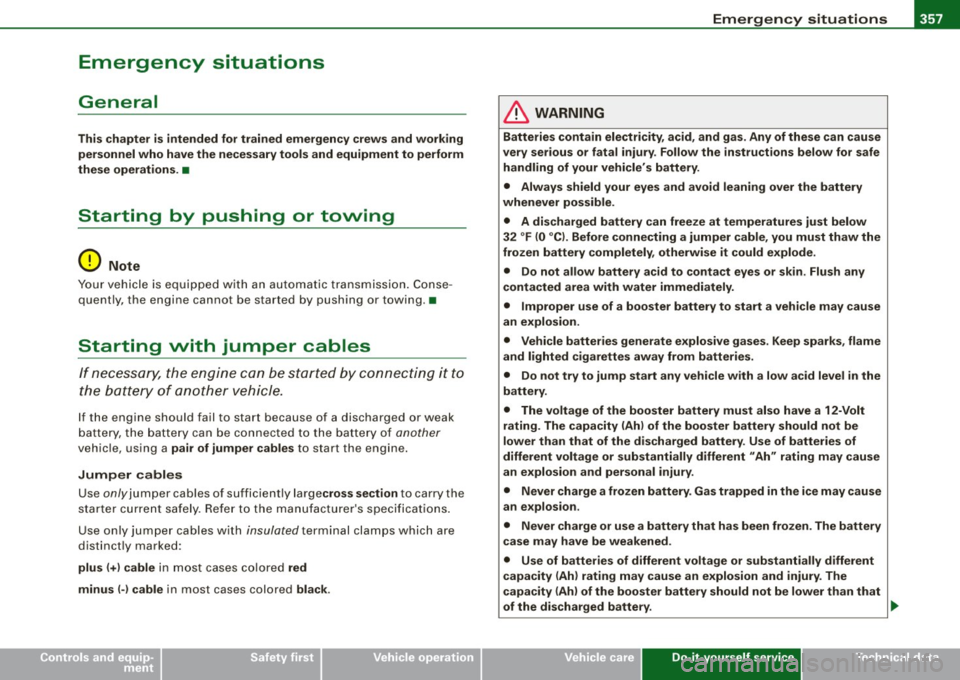
This chapter is intended for trained emergency crews and working
pe rsonnel who have the necessary tools and equ ipment to perform
these operations. •
Starting by pushing or towing
(D Note
You r ve hicle is eq uipped w ith an automatic trans missi on. C o nse
quent ly, the engine cannot be started by pushing or towing .•
Starting with jumper cables
If necess ary, the en gine can b e sta rted by conn ectin g it to
the battery of anothe r vehicle.
If th e engine should fail to start because of a discharged or weak
b at te ry, the batt ery ca n be co nnected t o the ba ttery of
another
vehicle, using a pair of jumper cables to start the engine .
Jumper cables
Use
only jumper cables of sufficiently large cross section to carry the
s tarte r curre nt safely. Refer t o the manu fac tu rer 's specif ica tions.
Use only ju mper cabl es with
insulated terminal clamps whic h are
distinct ly marked:
plus (+l cable in mo st cas es c olored red
minus
(- 1 cable in most cases colored black.
& WARNING
Batteries contain electricity, acid , and gas. Any of the se can cause
very ser ious or fatal injury . Follow the instructions below for safe
handling of your vehicle 's battery .
• Always shield your eyes and avoid leaning over the battery
whenever possible .
• A discharged battery can freeze at temperatures just below
32 °F (0 °C l. Before connecting a jumper cable , you must thaw the
frozen battery completely , otherwise it could explode .
• Do not allow battery acid to conta ct eyes or skin. Flush any
contacted area with water immediately.
• Improper use of a booster battery to start a vehicle may cause
an explosion.
• Vehicle batteries generate explosive gases . Keep sparks , flame
and lighted c igarettes away from batteries.
• Do not try to jump start any vehicle with a low acid level in the
battery.
• The voltage of the booster battery must also have a 12-Volt
rating. The capacity (Ah l of the booster battery should not be
lower than that of the discharged battery . Use of batteries of
different voltage or substantially different "Ah" rating may cause
an explosion and personal injury .
• Never charge a frozen battery. Gas trapped in the ice may cause
an explosion.
• Never charge or use a battery that has been frozen . The battery
c ase may have be weakened .
• Use of batter ies of different voltage or substantially different
c apacity (Ah l rating may cause an explosion and injury . The
capacity (Ahl of the booster batte ry should not be lower than that
of the discharged battery. _..
Do-it -yourself service
Page 362 of 398
lll'I...__E_ m _ e _r.;:g '-e_ n_ c-=y _ s_ i_t _u _a _t_ i_o _n_ s _______________________________________________ _
Emergency towing with commercial
tow truck
General hints
Your Audi requires special handling for towing.
The following information is to be used by commercial tow truck
operators who know how to operate their equipment safely.
• Never tow your Audi, towing will cause damage to the engine
and transmission.
• Never wrap the safety chains or winch cables around the brake
lines.
• To prevent unnecessary damage, your Audi must be transported
with a flat bed truck.
• To load the vehicle on to the flat bed, use the towing loop found
in the vehicle tools and attach to the front or rear anchorage
~ page 360 and~ page 361.
& WARNING
A vehicle being towed is not safe for passengers. Never allow
anyone to ride in a vehicle being towed, for any reason. •
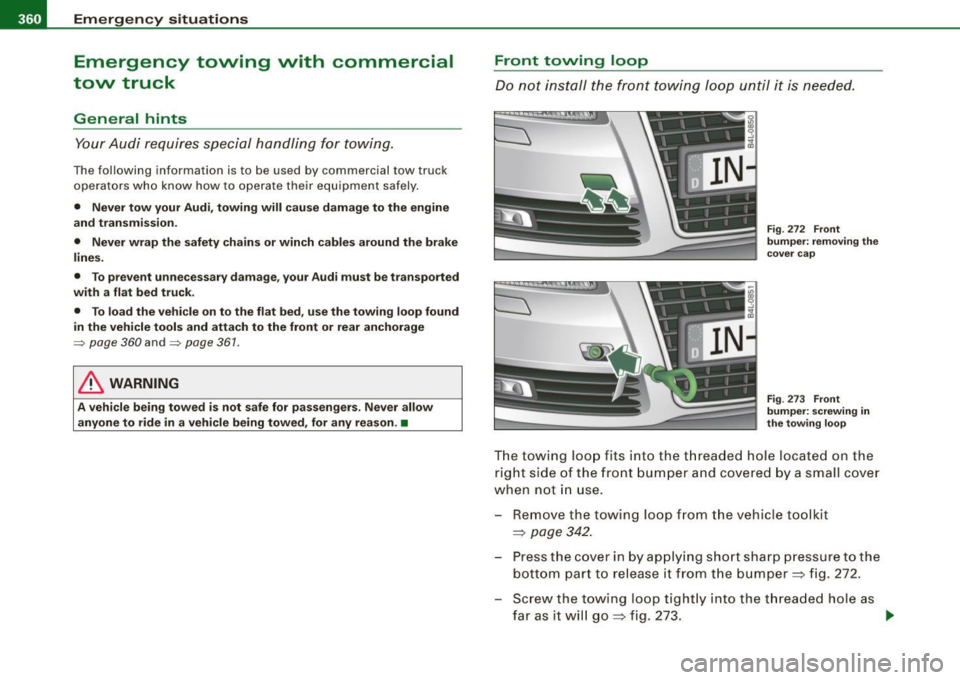
Front towing loop
Do not install the front towing loop until it is needed.
Fig. 272 Front
bumper: removing the
cover cap
Fig . 273 Front
bumper: screwing in
the towing loop
The towing loop fits into the threaded hole located on the
right side of the front bumper and covered by a small cover
when not in use.
- Remove the towing loop from the vehicle toolkit
=>
page 342.
- Press the cover in by applying short sharp pressure to the
bottom part to release it from the bumper => fig. 272.
- Screw the towing loop tightly into the threaded hole as
far as it will go=> fig. 273. ..,
Page 386 of 398
___ A_l.:,. p _h_ a_ b_e _t _ic _ a_l _in _ d_e _x ____________________________________________ _
Doors
Power child safety lock .... .... .... . 51
Power side door closer . . . . . . . . . . . . . 48
Driver information system .... .... .... . 23
Digital speedometer .. ............ . 25
Driver information messages .. .... . 28
Open door or rear lid warning ... .... 25
Outside temperature disp lay .. . .... . 24
Sound system display . .... ...... .. 24
Driver seat
See Seating position . . . . . . . . . . . . . . 196
Driver's seat . . . . . . . . . . . . . . . . . . . . . . . . 81
Driver's seat memory . . . . . . . . . . . . . . . . . 84
Activating remote control key .. ... .. 85
Recalling a seat position .. .... .... . 84
Storing a seat position ..... ... .... . 84
Driving messages .... .... .... ... .... . 28
Driving safely .. .............. ...... 194
Driving time ........ .... ... ........ .. 38
Duplicate key ........................ 41
DVD player for navigation system . . . . . . 91
Dynamic shift program ... .... ... .... 165
E
Easy entry feature 116
Electric seat adjustment
See Power seat . . . . . . . . . . . . . . . . . . . 81
Electromechanica l parking brake
Emergency braking .... ....... .... 123
Malfunction ...... .... .... ...... . 123
Operation . . . . . . . . . . . . . . . . . . . . . . . 121
Parking . . . . . . . . . . . . . . . . . . . . . . . . . 122 Releasing and app
lying ... .. .. .... 121
Starting off with a trailer .. ........ 123
Warning/indicator lights ... .... .... 21
Electronic differential lock (EDU How the system works . .... ....... 263
Warning/indicator lights ....... .... 21
Electronic immobilizer .......... ... 14, 44
Electronic power control (EPC) warning/indicator light ... .... . 18
Electronic speed limiter ..... ....... ... 27
Electronic stabi lization program (ESP)
How the system works ............ 262
Warning/indicator lights ....... .... 18
Emergency braking . . . . . . . . . . . . . . . . . 123
Emergency closing Power sunroof . ... ..... ... .... . 60, 61
Emergency flasher . . . . . . . . . . . . . . . . . . . 67
Warning/indicator lights ........... 19
Emergency locking of doors .. ........ . 50
Emergency starting ........ .... ... .. 357
Emergency towing ... .... .... .... ... 360
Energy management . ....... ... .. ... 269
Battery power . . . . . . . . . . . . . . . . . . . 270
Driver notification 270
Engine Compartment . .... .... .... .... .. 302
Coolant ....... .... ... .... ....... 307
Hood ..... .... .... .... ........ .. 300
Starting .. .... ... .... .... ... 116,117
Starting with jumper cables ... .... 357
Stopping .. .... .... .... .... ...... 118 Engine compartment
Safety instructions . ....... .... ... 301
Working the engine compartment .. 301
Engine coolant system .. ...... ....... 307
Adding coolant .... ....... ....... 309
Checking coo lant level . .... .... ... 308
Checking the engine coo lant level .. 308
Malfunction .. .. .. .. .. .... .... .. . . 31
Radiator fan . .... .... .... .... .... 310
Engine coolant temperature
Temperature gauge ....... .... .... 12
Engine data ...... .... .... ...... .... 369
Engine hood Closing .... .. ... ..... ....... .... 301
How to release the hood . . . . . . . . . . 300
Engine oi l .......................... 303
Adding ... .... .... .... .... ...... 306
Additives .. .... .... .... ... .... ... 306
Changing .. .... .... ... ........ .. 306
Checking the engine oil level ....... 305
Indications and conditions requiring extra
checking .. ...... .... ...... .... 305
Oil consumption . ...... .... .... .. 304
Oil grades .. .... .... ... .... ...... 303
Recommended oil check intervals .. 305
Specification and viscosity .. ..... .. 303
Engine oi l leve l ... .... .... .... ...... . 35
Engine oil pressure
Malfunction ....... ....... ........ 32
Engine oil sensor defective .... .... ... . 35
Engine speed limitation ... .... .... .... 36
Page 389 of 398
______________________________________________ A_ l_,_ p _h_ a_ b_e _t_i c_ a _ l _in _ d_e _ x __ lll
Instrument cluster indicator light ... 143
MMI settings .... .... ....... .... . 144
Notes on instrument cluster disp lay . 143
LATC H .... .... ... .. .... ...... .... .. 253
Description ...................... 253
Guidance fixtures for lower anchorages .
254
Installing a child restraint ........ .. 256
Location ... ... .... .... .... .... .. 253
Mounting and releasing the anchorage hook ... ............... ........ 257
Leather . ...... .. ........... ...... .. 290
Cleaning . ..... ... .... ..... .. .... 29 1
Leve l adjustment
See Adaptive Air Suspension . .... .. 184
Lifting jack . .... ... .... .... .... ..... 347
Lifting vehicle ... ... ............... . 362
Light
Exterior lighting in the mirror housing 66
leaving home ...... ... .. .... .... .. 66
Light sensor defective ................ 34
Lighting in the mirror housing ......... 66
Lights ........ .... .... .... .......... 63
Coming home ... .... .... .......... 64
Daytime running lights . .... .... .... 64
Emergency flashers . ... .. .... .... .. 67
Exterior lights ... .... .... ....... ... 64
Front fog lights .... .... .... .... ... 65
Headlights ....................... 63
High beam ... .... ....... .... .. 63, 67
High beam warning/indicator light ... 20
Leaving home ..................... 64
Rear fog lights ... .... .... ... .... .. 65
Controls and equip
ment Safety first
Side marker lights .
..... .. ... ..... . 63
Turn signals .. ... .... ... ... .. .... . 67
Xenon headlights .................. 63
Loading the luggage compartment .... 201
Loading the roof rack ................. 94
Lockable backrest ...... .... ... .. ... .. 88
Locking Power locking switch ....... .... ... 49
Rear lid/trunk lid ........... .. ... .. 50
Remote control key .... .... ....... . 46
Using the key . ............ ....... . 47
Lower anchorage locator button . .... .. 253
Lower universal anchorage bars (Canada) .. 253
Lower universal anchorages (Canada) . . 253
Luggage Stowing .. .... .... .... .... .... ... 20 1
Luggage compartment . .... .... .... ... 88
Cargo net .... ...... .... .... .... .. 90
DVD player for navigation system . ... 91
Expanding ... ....... .... .... ... .. . 88
Fastening eyelets ... .... ....... .... 90
Side Compartment ................ 91
Ski sack .......................... 92
See also Loading the luggage
compartment ...... .... ... .. .... 201
Lumbar support .. ......... ...... .... . 83
M
Maintenance .... ... ... .. .... .... ... 372
Malfunction Indicator Lamp (MIU .. .. 19, 27 Master key .
... .. .... .... ...... ... .. . 42
Battery replacement ... ... .... .... . 43
Check light ....................... 43
Mi leage
Average ... ... .... .... ... ..... ... . 38
Instantaneous .... .... .... .... .... . 38
Mirrors Activating the digital compass ... .. .. 78
Adjusting the anti -glare . ...... ..... 75
Automatic dimming for the outside mirrors .. ........... ........ .... 77
Automatical ly dimming inside mirror . 75
Inside day -night mirror .... .... ..... 75
Interior mirror ... .. .... ...... .... .. 75
Outs ide mirrors . ...... ...... .... .. 76
Recalling position of outside mirrors . 84
Storing position of outside mirrors ... 84
Monitoring the Advanced Airbag System ..
226
multitronic® ... .. .... .... ...... .... . 161
Automatic Shift Lock (ASL) ... .... .. 164
Driving the multitronic® . ...... .... 162
Dynamic shift program .. .... .... .. 165
Fail -safe mode .. .... ... .. .... .... 167
Kick -down ....................... 165
Manual shift program ..... .... ... . 166
Selector lever . ..... .. .... .... ... . 163
Steering wheel with tiptronic® ..... 167
tiptronic ...... .... .... ... ... ... .. 166 N
Natural leather . .......... .. .... .... . 290
New tires and wheels ... .... .... .... . 329
Vehicle operation Vehicle care Do-it-yourself service Technical data
Page 393 of 398
______________________________________________ A_ l_,_ p _h_ a_ b_e _t_i c_ a _ l _in _ d_e _ x __ _
Luggage compartment ... ... . ..... . 91
Ski sack . .... .... .... .... ..... .. .. 92
Storage compartment
Expanding . ... ...... .. ... .. .... ...
88
Sun shade .. .... .... ... .... ... .... .. 70
Sun visors .. .... ... ... ..... ...... ... 69
Suspension
See Adaptive Air Suspension . .... .. 184
Switches
Emergency flashers .. .... .... .... ..
67
Power sunroof .... ... .... .... .... . 58
Rear window defogger ... ... . ... .. 108
Symbols
Red . ...... .. ..... ... ..... .. .....
29
Yellow .. .. ... ... .... .... ... .... .. 33
Synchronizing climate control . ... .... 104
T
Tachometer . .... .... .... ... .... .... . 13
Tank f lap
Unlocking the fuel filler flap by hand
299
Technical modifications ........ .... .. 375
Temperature
Climate controls .. .... .... ... .... .
106
Setting for the driver's and front pass en-
ger's side ... ...... .... ... .... ..
106
Tether strap ...... .... .. ....... ..... 258
Securing the upper te ther strap 259
The first 1,000 miles (1,500 km) and
afterwards .. .... ... .... .... ....
271
Tie -downs .. .... .... .... ... .... .... 203
Tilt sensors ..... .... .... ... .. .. ..... 55
Controls and equip ment Safety first
Tips for the environmen
t
Saving fuel ... ... .... ...... .......
94
Using the air conditioner only when
necessary .. ... ..... .... .... ... .
. . ® t1ptronic ... .... .... .... .... .... .. .
Au tomatic Shift Lock (ASU ... ..... .
109
155
157
Driving .. . ... ... ... .. .. .. ... . ... . 155
Dynamic shift program ...... ...... 158
Fail -safe mode .. ....... .... .... .. 160
Kick -down .... .. . ... .. ...... ..... 158
Manual shift program .. ... .... .... 159
S elector lever .... .... ...... ..... . 156
Tire pressure . ... ... .... ... .... .... . 323
Tire pressure monitoring syst em .. .... 336
Loss of air pressure ... .... ..... 19 ,337
Malfunction . .... .... ...... ...... 337
Resetting tire pressures .. .. .. .... . 338
Tire servic e lif e ........ ... .. .... .... 327
Tires .. .... . ... ... . ... .... .... .... . 317
Service life . .... . ... ..... .... .... 327
speed rating letter code ... .... .... 330
Tire manufacturing date .... . ... ... 330
Tire specificat ions ... ..... ... ... .. 330
Tread depth .. ... ..... ... .... .... 327
Uniform tir e quality grading ..... ... 332
Winter tires ......... ........ .... . 333
Tires and vehicle load limits ... ...... . 325
Tires and wheels
Checking tire pressure . ... .... ....
323
Cold tire inflation pressure .... .... . 321
Dimensions . .... ... .. ...... .. .... 329
General notes ... ...... ..... ..... . 317
Glossary of tire and loading terminology
318
New tires and wheels .... .... .... . 329
Replacing ... .. .. .... .... .... .. . . 329
Snow chains .. ... .... ... . ... ..... 334
Tires and v ehicle load limits . ...... . 325
Wh eel bolts .. ... ........ ... .. .... 335
Winter tires ... .... ... ... .... ... .. 333
Tires/Wheels
Low aspect ratio tires ... .. .... .. . .
335
Tire pressure monitoring sys tem . 19, 336
Tools ...... ... .. .... .... ...... .... . 343
Torn or frayed safety b elts .... ... .. .. . 208
Touch -up paint ... .. .... .... .... .. .. 286
Towing
Front eyelet .. .. .. .... .... .... ....
360
Rear eyelet ... .... ....... .. ...... 361
Tow truck procedures .. ...... .... . 360
TPMS
Tire pressure monitoring system ....
337
Trailer towing .... ... ... .. ....... ... . 276
Operating instructions . ... ... ... .. 277
Technical r equ irem ents ... .... 276 , 277
Trailer towing tips ....... ..... .... 278
Transmission
tiptronic® ... ... .... .... .... .....
155
Transport Canada ...... ........ .... . 204
Tread Wear Indicator (TWll .... ... .... . 327
Trip computer
Fuel consumption . ... ... .... ..... .
38
Mileage . ... .. .... .... .. .... .... .. 38
Single -trip memory .. .... . .... ... .. 39
Total -trip memory ...... .... ... .. .. 39
Vehicle operation Vehicle care Do-it-yourself service Technical data