recommended oil AUDI S6 2009 Owners Manual
[x] Cancel search | Manufacturer: AUDI, Model Year: 2009, Model line: S6, Model: AUDI S6 2009Pages: 398, PDF Size: 43 MB
Page 306 of 398
-~_C_ h_e _c _ k_ i_n ...:::g::;...._ a_n_ d_ f_ i_ll _in -'g:::;.._ ___________________________________________ _
current list of oils (manufacturers, brand names etc.) that conform
t o Audi oi l standard VW 502 00 .
Changin g the engine oil
The engine oil and oil filter must be changed according to the
mi leage (ki lometers) and time intervals specified in your vehicle's
Warranty
& Maintenance booklet. Do not exceed these interva ls -
harmful deposits from old engine oil can reduce engine perfor
mance and can lead to expensive engine repairs.
Changing the oi l at the recommended intervals is so very important
because the lubricating prope rties of oi l decrease gradual ly during
normal vehicle use . If you are not sure when you have your oil
changed, ask your author ized Audi Serv ice Advisor.
Under some circumstances the engine oil should even be changed
more frequently. Change oil more often if you dr ive mostly short
distances, operate the vehicle in dusty areas or mostly under stop
and -go t raffic conditions, or when you use your vehicle where
temperatures stay be low freezing point for long per iods.
Detergent additives in the oil will make fresh oil look dark after the
engine has been running for a short time . This is normal and is not
a reason to change the oil more often than recommended.
Damag e or malfunctions due to lack o f mainten anc e
It is essentia l that you change your oi l at the recommended interva ls
using on ly engine oil that complies with Audi oil standard
VW 502 00. Your Limited New Vehicle Warranty does not cover damage or ma lfunctions due to failure to follow recommended
main tenance and use requirements as set forth in the Aud i Owner's
Manual and Warranty
& Maintenance booklet. Your dealer wi ll have
t o deny warranty cove rage unless you present to the dealer p ro o f in
the form of Service or Repair Orders that all schedu led maintenance
was pe rformed in a timely manner. •
Engine oil consumption
The engine in your vehicle depends on an adeq uate
amount of oil t o lubric ate and c ool all of its m oving parts.
In order to provide effective lubrication and coo ling of interna l
engine components, al l interna l combustio n eng ines consume a
certain amount of oil. Oil consumption varies from engine to engine
and may change significant ly over the life of the engine . Typ ically,
engines with a specified break-in period (see=> page 271) consume
more oil du ring the break-in period than they consume after oil
consumption has stabi lized .
Unde r normal conditions, the rate of oil consumption depends on
the quality and v iscosity of the oil, the RPM (revolutions per minute)
at which the engine is operated, the ambient temperature and road
cond itions. Fur ther factors are the amount of oil di lu tion from wate r
condensation or fue l residue and the oxidation leve l of the oi l. As
any engine is subject to wear as mileage bu ilds up, t he oil consump
tion may increase over time until replacement of worn components
may become necessa ry .
With all these variables coming into play, no standard rate o f oi l
consumption can be established or specified . There is no alternative
t o regula r and frequent checking of the oil level, see
Note .
If the yel low engine oil level warning symbo l in the instrument
clus ter lights up, yo u should check the oil level as soon as
possible with the oil dipstick=> page 305. Top off the oil at your
ea rliest convenience => page 306 .
& WARNING
Before you check anything in the engine compartment , always
read and heed all WARNING S
=> & in "Working in the engine
compartment " on
page 301.
Page 309 of 398
___________________________________________ C_ h_e _c_ k_ i_n _g _ a_n _d_ f_il _li _n _g __ lll
•
T he engine oil must be changed according to the intervals specified
in your Warranty
& Maintenance book le t. This is very important
because the lubricating properties of oi l diminish gradually during
normal vehicle use .
Under some circumstances the engine oil should be changed more
frequently. Change oil more often if you drive most ly short
distances, opera te the vehic le in dusty areas or under predomi
nant ly stop-and-go traffic conditions, or have your vehicle where
t emperatures remain below free zing for extended periods.
Detergent additives in the oil wil l make fresh oi l look dark after the
engine has been running for a sh ort time . This is normal and is not
a reason to chan ge the oi l more often than recommended.
Because of the problem of proper disposal, along with the specia l
t ools and necessary expertise requ ired, we strongly recommend
that you have your oi l changed by an authorized
Audi de aler or a
qualified se rvice statio n.
If you choo se to change your oil yourself , please note the following
important information:
& WARNING
To reduce the risk of per sonal injury if you mu st ch ange the engine
o il in you r veh icle your self :
• Wear eye protection.
• To reduce the ri sk of burns from hot engine oil , let the eng ine
c ool down to the touch.
• Wh en remo ving the oil dra in plug with your fingers , stay a s far
aw ay as po ssible. Alway s keep your forearm parallel to the ground
to help prevent hot oil from ru nning do wn your arm .
• Drain t he o il into a container designed for thi s purpo se , one
large enough to hold at lea st the total amount of oil in your eng ine.
• Engine oil i s poi sonous . K eep it well out of the rea ch of children .
& WAR N IN G ( continued )
• Continuous contact with used engine oil i s harmful to your
sk in. Al way s prote ct your skin b y was hing oil off thorough ly w ith
soap and water .
0 Note
Never mix oil additives with your engine oil. These additives can
damage your engine and adversely affect your Aud i Limited New
Vehicle Warranty.
can properly dispose of the used oil.
• Always dispose of used engine oil properly. Do not dump it on
garden soil, wooded areas, into ope n strea ms or down sewage
drains .
• Recycle used engine oil by taking it to a used engine oil collec
tion facility in your area, or contact a service station. •
Engine cooling system
Coolant
The engine coolan t per for ms two functions: i t kee ps the
engine from ove rhe ating and it prot ects the e ngine from
freezing in the winter.
The cooling system is sea led and general ly requires litt le attention.
The coo ling system has been fi lled at the fac tory with a per manent
coolant which does not need to be changed. The coo lant consists of
a m ixture of water and the manufacturer's glycol -b asedco olant
additive G 12++ antifreeze with anti corrosion additives (50% for USA .-,
Vehicle care I t •
Page 320 of 398
-~_T_ ir_e_ s_ a_ n_d _ w_ h_ e_e _l_s _________________________________________________ _
& WARNING (continued)
crashes and serious personal injuries . Have worn or damaged tires
replaced immediately.
• Tires age even if they are not being used and can fail suddenly,
especially at high speeds. Tires that are more than 6 years old can
only be used in an emergency and then with special care and at
low speed.
Glossary of tire and loading terminology
Accessory weight
means the combined weight (in excess of those standard items
which may be replaced) of automatic transmission, power steering,
power brakes, power windows, power seats, radio, and heater, to
the extent that these items are available as factory-installed equip
ment (whether installed or not).
Aspect ratio means the ratio of the height to the width of the tire in percent.
Numb ers of 55 or lower indicate a low sidewall for improved
steering response and better overall handling on dry pavement.
Bead
means the part of the tire that is made of steel wires, wrapped or reinforced by ply cords and that is shaped to fit the rim.
Bead separation means a breakdown of the bond between components in the bead.
Cord
means the strands forming the plies in the tire.
& WARNING (continued)
• Never mount used tires on your vehicle if you are not sure of
their "previous history." Old used tires may have been damaged
even though the damage cannot be seen that can lead to sudden
tire failure and loss of vehicle control.
• If you notice unusual vibration or if the vehicle pulls to one side
when driving, always stop as soon as it is safe to do so and check
the wheels and tires for damage . •
Cold tire inflation pressure
means the tire pressure recommended by the vehicle manufacturer
for a tire of a designated size that has not been driven for more than
a couple of miles (kilometers) at low speeds in the three hour period
before the tire pressure is measured or adjusted .
Curb weight means the weight of a motor vehicle with standard equipment
including the maximum capacity of fuel, oil, and coolant, air condi
tioning and additional weight of optional equipment.
Extra load tire
means a tire designed to operate at higher loads and at higher infla
tion pressures than the corresponding standard tire . Extra load tires
my be identified as "XL",
"xi", "EXTRA LOAD", or "RF" on the side
wall.
Gross Axle Weight Rating ("GAWR")
means the load-carrying capacity of a single axle system, measured
at the tire -ground interfaces .
Gross Vehicle Weight Rating ("GVWR"l
means the maximum total loaded weight of the vehicle.
Page 327 of 398
Tires and wheels -
----------------
•
& WARNING (continu ed )
• The driver is respon sible for the correct tire pres sures for all
tire s on the vehicle . The applicable pre ssure values are located on
a sticker on the driver 's side B-pillar .
• Only when all tires on the veh icle are filled to the correct pre s
sure , the tire pressure monitoring system can work correctly .
• The use of incorre ct t ire pressure values can lead to a ccidents
or other damage. Therefore it is essential that the driver observe
the specified tire pressure values for the tires and the correct pre s
sures for the function of the tire pressure monitor ing system.
• Always inflate tires to the recommended and corre ct tire pres
sure before driving off.
• Driving with underinflated tires bend more , letting them get
too hot resulting in tread separation, sudden tire failure and loss
of control.
• Excessive speed and /overloading can cause heat build-up ,
sudden tire failure and loss of control.
• If the tire pre ssure is too low or too high, the tires will wear
prematurely and the vehicle will not handle well .
• If the tire is not flat and you do not have to change a wheel
immed iately , drive at reduced speed to the nearest service stat ion
to check the tire pres sure and add air as required.
0 Note
Dr iving w ithout valve s tem caps can cause damage to the t ire
valves . To prevent this, a lways make sure that factory installed valve
stem caps on a ll whee ls are securely mounted o n the va lve.
For the sake of the environment
Unde rin fla ted tires will a lso increase the f uel c onsump tion .•
Tires and vehicle load limits
There are limits to the amount of load or weight that any vehic le and
any t ir e can carry. A veh icle that is overloaded w il l not handle wel l
and is more difficu lt to stop. Overloading can not only lead to loss
o f veh ic le control, but ca n also damage impor ta nt parts of the
vehic le and can lead to sudden tire failure, inc luding a blowout and
sudde n defla tion that can cause the vehic le to crash .
Your sa fety and that o f your passen gers also depends on mak ing
sure that load limits are not e xceeded. Vehicle load includes every
body and everythi ng in and on the veh ic le. T hese load lim its a re
technica lly referred to as the vehicle's
Gross Vehi cle We ight Rating
(" GVWR") .
T he "GVWR" includes the weight of the basic vehic le, all factory
insta lled acces so ries, a ful l ta nk of fuel, oil, coolant an d othe r flui ds
p lus maximum load. The maximum load inc ludes the number o f
p asse ngers that the vehicle is inte nded t o carry ("sea ting capacity")
w ith an assu med we ight o f 150 l bs (68 kg) fo r each passe nger at a
designated seating position and the total weight of any luggage in
t he vehicle. If you tow a trailer, the we ig ht o f the tra iler h itch an d th e
tongue weight of the loaded trailer must be included as part of the
ve hicle l oad.
The
Gross Axle Weight Rating !"GAWR") is t he maximum load that
can be applied a t each of the vehicle's two ax les.
The Gross Veh icle Weig ht Rating and t he G ross Axle Weig ht Rat ing
are listed on the safety comp liance sticker labe l located on the
d river 's s ide B -pi llar . Y o ur Au di h as 5 s eating positi ons, 2 i n the fro nt
and 3 in the rear for total seating capacity of 5 . Each seating position
has a safe ty bel t~
page 205, "Safe ty belts".
The fact that th ere is an upper limit to your vehicle's Gross Vehicle
Weight Rating means that the total weight of whatever is being
carried in the vehic le (includ ing the we ight of a trai ler hitch and the
tong ue weight of the loaded trai ler) is limited. The more passengers
i n the v ehicle or pass engers wh o are heavie r than t he sta nd ard
we ights assumed mean that less weight can be ca rried as luggage . .,_
Vehicle care I t •
Page 337 of 398
Tires and wheels -_______________________ ..::...:..:..-=::.......:.:..;::..:....____;___
•
Wheel bolts
Wheel bolts must always be tightened to the correct
torque.
The design of wheel bolts is matched to the factory installed rims. If
different rims are fitted, the correct wheel bolts with the right length
and correctly shaped bolt heads must be used. This ensures that
wheels are fitted securely and that the brake system functions
correctly.
In certain circumstances, you may not use wheel bolts from a
different vehicle - even if it is the same model~
page 374.
& WARNING
Improperly tightened or maintained wheel bolts can become loose
causing loss of control, a collision and serious personal injury.
• Always keep the wheel bolts and the threads in the wheel hubs
clean so the wheel bolts can turn easily and be properly tightened.
• Never grease or oil the wheel bolts and the threads in the wheel
hubs. They can become loose while driving if greased or oiled,
even if tightened to the specified torque.
• Only use wheel bolts that belong to the rim being installed.
• Never use different wheels bolts on your vehicle.
• Always maintain the correct tightening torque for the wheel
bolts to reduce the risk of a wheel loss.
If the tightening torque of
the wheel bolts is too low, they can loosen and come out when the
vehicle is moving. If the tightening torque is too high, the wheel bolts and threads can be damaged and the wheel can become
loose.
0 Note
The specified torque for the wheel bolts is 90 ft lb (120 Nm) with a
tolerance of ± 7,4 ft lb(± 10 Nm). Torque wheel bolts diagonally.
After changing a wheel, the torque must be checked as soon as possible with a torque wrench
-preferably by an authorized Audi
dealer or qualified workshop. •
Low aspect ratio tires
Your Audi is factory-equipped with low aspect ratio tires. These tires
have been thoroughly tested and been selected specifically for your
model for their superb performance, road feel and handling under
a variety of driving conditions. Ask your authorized Audi dealer for
more details.
The low aspect ratio of these tires is indicated by a numeral of 55 or
less in the tire's size designation. The numeral represents the ratio
of the tire's sidewall height in relation to its tread width expressed
in percentage. Conventional tires have a height/width ratio of 60 or
more.
The performance of low-aspect-ratio tires is particularly sensitive to improper inflation pressure. It is therefore important that low
aspect ratio tires are inflated to the specified pressure and that the
inflation pressure is regularly checked and maintained. Tire pres
sures should be checked at least once a month and always before a
long trip~
page 323, "Checking tire pressure" .
What you can do to avoid tire and rim damage Low aspect ratio tires can be damaged more easily by impact with
potholes, curbs, gullies or ridges on the road, particularly if the tire
is underinflated.
In order to minimize the occurrence of impact damage to the tires
of your vehicle, we recommend that you observe the following
precautions:
• Always maintain recommended inflation pressures . Check your
tire pressure every 2,000 miles (3,000 km) and add air if necessary.
• Drive carefully on roads with potholes, deep gullies or ridges.
The impact from driving through or over such obstacles can
damage your tires. Impact with a curb may also cause damage to
your tires. ..,
Vehicle care
I t •
Page 371 of 398
_____________________________________________________ D_a_ t_ a __ lllll
Data
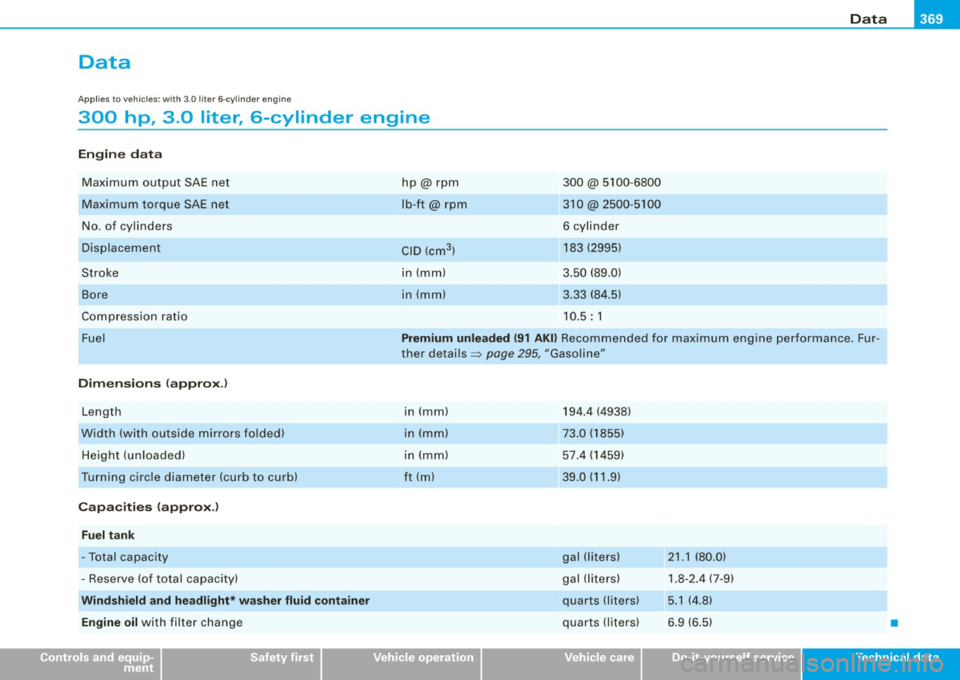
Ap plies to veh icles: wit h 3.0 lit er 6 -c ylinde r en gine
300 hp, 3 .0 liter, 6-cylinder engine
En gin e da ta
Maximum output SAE net
Maximum torque SAE net
No. of cylinders
Displacement
Stroke
Bore
Compression ratio
Fu el
Dim ension s (app rox.)
Length
Width (with outside mirrors fo lded)
Height (unloaded)
T urning circle diameter (curb to curb)
Ca pac ities (a pprox.)
F u el t ank
-Total capacity
- Reserve (of total capacity)
Wind shi eld and he adli ght * was her fluid container
E ngine oil
with filter change
Controls and equip
ment Safety first
hp@rpm
lb
-ft@ rpm
CID (c m
3
)
in (mm)
in (mm)
300@ 5100 -6800
310@ 2500 -5100
6 cylinder
183 (2995)
3.50 (89.0)
3 .33 (84 .5)
10.5 : 1
Premium unleaded (91 AKI) Recommended for maximum engine performance . Fur
ther details =>
page 295, "Gasoline"
in (mm)
in (mm)
in (mm)
ft (ml
194.4 (4938)
73 .0 (1855)
57.4 (1459)
39.0 (11.9)
gal Oiters)
gal (liters)
quarts (liters)
quarts (liters) 21 .1 (80 .0)
1.8-2.4 (7 -9)
5 .1 (4 .8)
6.9 (6.5)
•
Vehicle operation Vehicle care Do-it-yourself service Tec hn ica l da ta
Page 372 of 398
___ D_ a_t _a ________________________________________________________ _
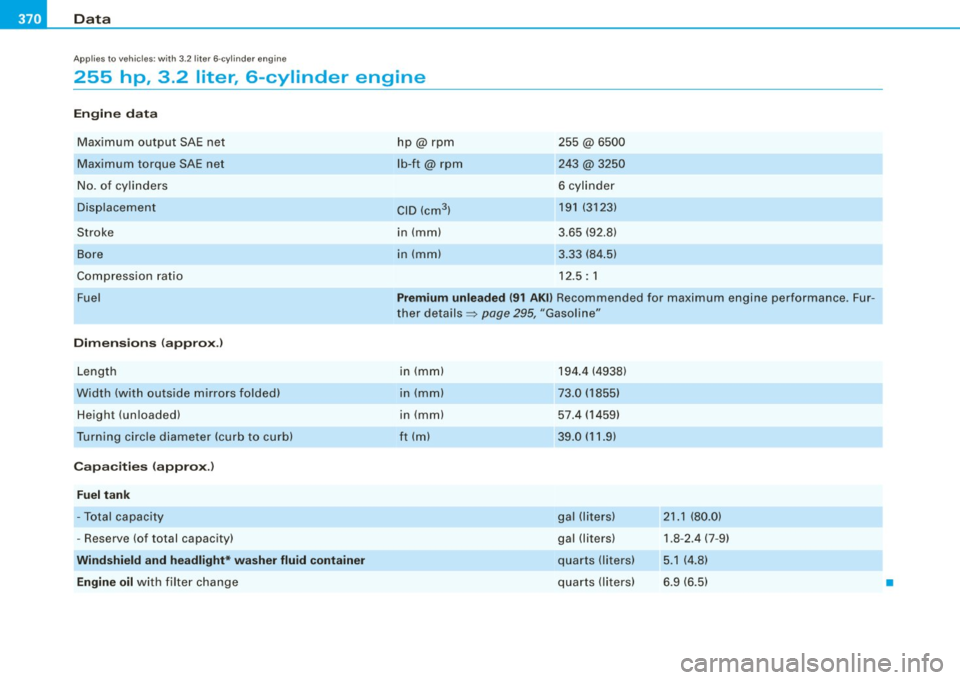
Applies to vehi cles : wit h 3.2 l iter 6-c ylinder e ngine
255 hp , 3 .2 liter, 6-cylinder engine
Engine data
Max imum output SAE net
Maximum torque SAE net
No . of cy lin ders
D isp laceme nt
Stroke
Bo re
Co mpress ion rati o
Fuel
Dimensions (appro x.)
Leng th
Width (wit h ou ts ide mirrors folded)
Height (un loaded)
T urning c ircle diameter (curb to c urb)
Capacities {approx .)
Fuel tank
-Total capacity
- Rese rve (of total capacity)
Windshield and headlight* washer fluid container
Engine oil
with filter cha n ge h
p@ rpm
lb-ft@ rpm
CID (cm
3 )
in (mm)
in (m m) 255 @6500
243@ 3250
6 cyl inde r
191 (3123)
3 .65 (9 2.8)
3 .33 (84 .5)
1 2 .5: 1
Premium unleaded {91 AKll Recommended for maximum engine performance . Fur
t her deta ils =:>
page 295, "Gasoli ne"
i n (m m)
in (m m)
in (mm)
ft (ml 1
9 4.4 (4 938)
73.0 (1855)
57.4 ( 1459)
39 .0 (1 1.9)
gal (l iters)
g al (li ters)
qua rts (l iters)
q ua rts (l ite rs) 2
1. 1 (80.0)
1 .8 -2 .4 { 7-9)
5.1 ( 4.8)
6 .9 (6 .5)
•
Page 373 of 398
Data -________________ RPI
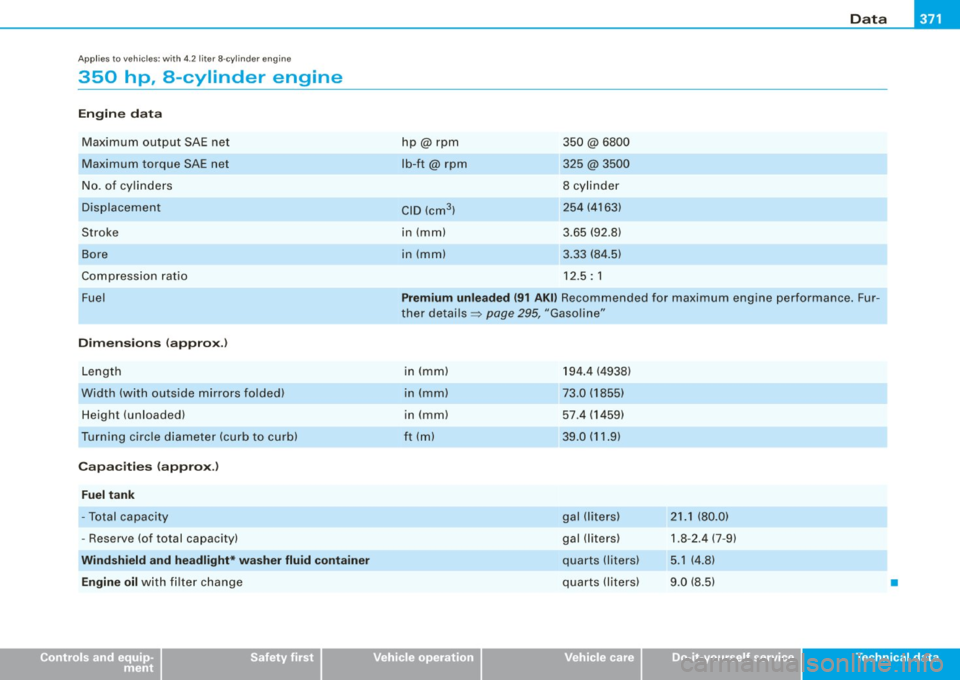
App lies to vehicles : wit h 4.2 lite r 8- cy lind er e ng in e
350 hp , a-cylinder engine
Engine data
Maximum ou tpu t SAE net
M aximum torque SAE net
No . of c ylind ers
Displaceme nt
Stroke
Bore
C om press ion ratio
F uel
Dimensions ( approx .)
L eng th
Width (w ith outside mirro rs fo lded)
Height (unloaded)
Tu rning circle d ia m eter (c urb to cu rb)
Capacities (approx .>
Fuel tank
- Tot al capaci ty
- Reserve (of total capacity)
Windshield and headlight* washer fluid container Engine oil wit h filter ch ange
Controls and equip ment Safety first h
p@rpm
l b -ft@ rpm
C ID (cm
3
)
in (mm)
in (m m) 35
0@ 6800
3 25@3500
8 c ylinde r
25 4 (4 163)
3.65 (92 .8)
3 .33 (8 4.5)
1 2 .5 : 1
Premium unleaded 191 AKO Recommended for maximum engine performance . Fur
t her details =>
pa ge 295, "Gasoli ne"
in ( mm)
i n (mm)
in (mm)
ft (m l 1
9 4.4 (4 938)
73. 0 (1855)
5 7 .4 (1459)
39.0 (11 .9)
ga l (liter s)
gal (liters)
qua rts (liters)
qua rts (liters) 2
1.1 (80 .0)
1 .8 -2. 4 (7-9)
5.1 ( 4.8)
9.0 (8.5)
•
Vehicle operation Vehicle care Do-it-yourself service Tec hn ica l da ta
Page 386 of 398
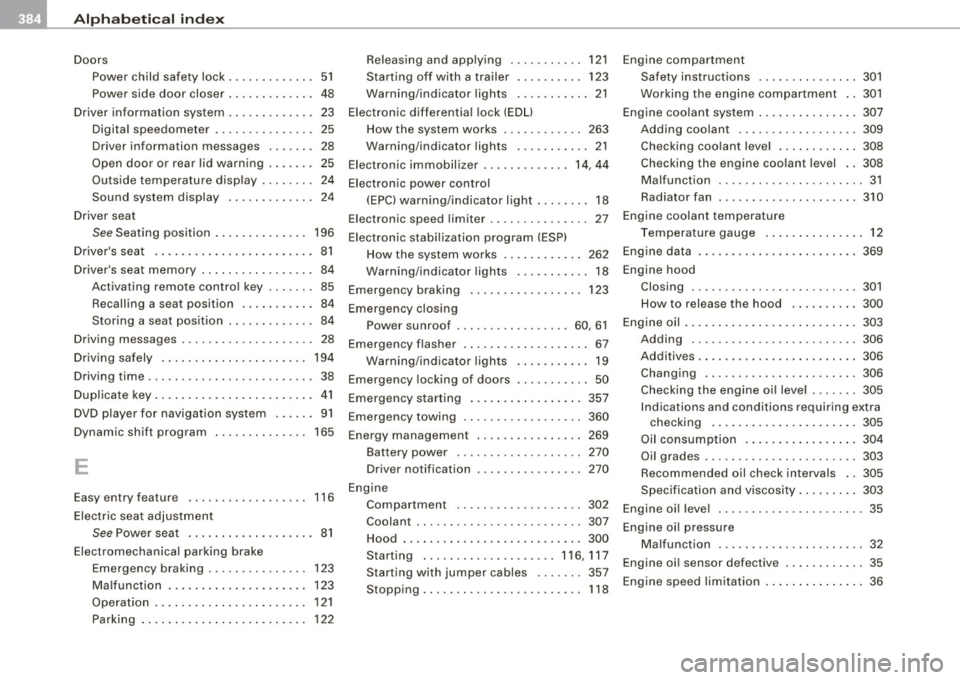
___ A_l.:,. p _h_ a_ b_e _t _ic _ a_l _in _ d_e _x ____________________________________________ _
Doors
Power child safety lock .... .... .... . 51
Power side door closer . . . . . . . . . . . . . 48
Driver information system .... .... .... . 23
Digital speedometer .. ............ . 25
Driver information messages .. .... . 28
Open door or rear lid warning ... .... 25
Outside temperature disp lay .. . .... . 24
Sound system display . .... ...... .. 24
Driver seat
See Seating position . . . . . . . . . . . . . . 196
Driver's seat . . . . . . . . . . . . . . . . . . . . . . . . 81
Driver's seat memory . . . . . . . . . . . . . . . . . 84
Activating remote control key .. ... .. 85
Recalling a seat position .. .... .... . 84
Storing a seat position ..... ... .... . 84
Driving messages .... .... .... ... .... . 28
Driving safely .. .............. ...... 194
Driving time ........ .... ... ........ .. 38
Duplicate key ........................ 41
DVD player for navigation system . . . . . . 91
Dynamic shift program ... .... ... .... 165
E
Easy entry feature 116
Electric seat adjustment
See Power seat . . . . . . . . . . . . . . . . . . . 81
Electromechanica l parking brake
Emergency braking .... ....... .... 123
Malfunction ...... .... .... ...... . 123
Operation . . . . . . . . . . . . . . . . . . . . . . . 121
Parking . . . . . . . . . . . . . . . . . . . . . . . . . 122 Releasing and app
lying ... .. .. .... 121
Starting off with a trailer .. ........ 123
Warning/indicator lights ... .... .... 21
Electronic differential lock (EDU How the system works . .... ....... 263
Warning/indicator lights ....... .... 21
Electronic immobilizer .......... ... 14, 44
Electronic power control (EPC) warning/indicator light ... .... . 18
Electronic speed limiter ..... ....... ... 27
Electronic stabi lization program (ESP)
How the system works ............ 262
Warning/indicator lights ....... .... 18
Emergency braking . . . . . . . . . . . . . . . . . 123
Emergency closing Power sunroof . ... ..... ... .... . 60, 61
Emergency flasher . . . . . . . . . . . . . . . . . . . 67
Warning/indicator lights ........... 19
Emergency locking of doors .. ........ . 50
Emergency starting ........ .... ... .. 357
Emergency towing ... .... .... .... ... 360
Energy management . ....... ... .. ... 269
Battery power . . . . . . . . . . . . . . . . . . . 270
Driver notification 270
Engine Compartment . .... .... .... .... .. 302
Coolant ....... .... ... .... ....... 307
Hood ..... .... .... .... ........ .. 300
Starting .. .... ... .... .... ... 116,117
Starting with jumper cables ... .... 357
Stopping .. .... .... .... .... ...... 118 Engine compartment
Safety instructions . ....... .... ... 301
Working the engine compartment .. 301
Engine coolant system .. ...... ....... 307
Adding coolant .... ....... ....... 309
Checking coo lant level . .... .... ... 308
Checking the engine coo lant level .. 308
Malfunction .. .. .. .. .. .... .... .. . . 31
Radiator fan . .... .... .... .... .... 310
Engine coolant temperature
Temperature gauge ....... .... .... 12
Engine data ...... .... .... ...... .... 369
Engine hood Closing .... .. ... ..... ....... .... 301
How to release the hood . . . . . . . . . . 300
Engine oi l .......................... 303
Adding ... .... .... .... .... ...... 306
Additives .. .... .... .... ... .... ... 306
Changing .. .... .... ... ........ .. 306
Checking the engine oil level ....... 305
Indications and conditions requiring extra
checking .. ...... .... ...... .... 305
Oil consumption . ...... .... .... .. 304
Oil grades .. .... .... ... .... ...... 303
Recommended oil check intervals .. 305
Specification and viscosity .. ..... .. 303
Engine oi l leve l ... .... .... .... ...... . 35
Engine oil pressure
Malfunction ....... ....... ........ 32
Engine oil sensor defective .... .... ... . 35
Engine speed limitation ... .... .... .... 36