engine AUDI S8 2008 Owners Manual
[x] Cancel search | Manufacturer: AUDI, Model Year: 2008, Model line: S8, Model: AUDI S8 2008Pages: 404, PDF Size: 52.7 MB
Page 318 of 404
___ C_ h_e _c _ k_ i_ n ~g~ a_ n_ d_ f_ i_ll _in _g~--------------------------------------------
&, WARNING (continued)
• Turn off the engine and allow it to cool down.
• Protect your face, hands and arms from escaping fluid and
steam by covering the cap with a large, thick rag.
• Turn the cap slowly and very carefully
in a counter-clockwise
direction while applying light, downward pressure on the top of
the cap.
• To avoid being burned, do not spill antifreeze or coolant on the
exhaust system or hot engine parts. Under certain conditions, the
ethylene glycol in engine coolant can catch fire.
0 Note
Do not add any type of radiator leak sealant to your vehicle's engine
coo lant. Adding radiator repair fluid may adversely affect the func
tion and perfo rmance of your cooling system and could result in
damage not covered by your New Vehicle Limited Warranty .
[ i] Tips
On vehicles with the 12-cylinder engine, the expansion tank is
located under a cover. •
Adding coolant
Be very careful when adding engine coolant.
Before you check anything in the engine compartment,
always read and heed all WARNINGS => & in "Wor king in
the engine compartment" on
page 307.
-Turn off the engine.
-Let the engine cool down.
-Place a thick rag over the coolant expansion tank
=> page 315, fig. 267 and carefully twist the cap counter
clockwise
=> & .
-Add coolant.
-Twist the cap on again tightly.
Replacement engine coolant must conform to exact specifications
=> page 314, "Coolant". Even in an emergency, if coolant additive
G12++, G12+ or G12 is not available, do
not use a different additive.
Use plain water instead until you can get the correct additive and
can restore the correct ratio. This should be done as soon as
possible.
If you have lost a considerable amount of coolant, then you should
add cold antifreeze and cold water only when the engine is cold.
Always use
new engine coolant when refilling.
Do not fill coolant above the "MAX" mark. Excess coolant will be
forced out through the pressure relief valve in the cap when the
engine becomes hot.
& WARNING
• The cooling system is under pressure and can get very hot.
Reduce the risk of scalding from hot coolant by following these
steps.
-Turn off the engine and allow it to cool down.
- Protect your face, hands and arms from escaping fluid and
steam by covering the cap with a large, thick rag.
- Turn the cap slowly and very carefully
in a counter-clockwise
direction while applying light, downward pressure on the top
of the cap.
- To avoid being burned, do not spill antifreeze or coolant on
the exhaust system or hot engine parts. Under certain condi-
tions, the ethylene glycol in engine coolant can catch fire. .,,
Page 319 of 404
Checking and filling -_______________________________ =..:..:..::...::.:..;~:.....:...;_.:..:..,__--=--.J
fl::. WARNING (continued )
• Antifr eez e is po isonous. Always stor e antifreeze in it s origin al
c ontainer and well out of the re ach of ch ildren .
• If you drain the coolant , it must be caught and saf ely stored in
a prop er co ntainer cle arly m arked "poi son ".
0 Note
• Coolant po llutes the environment and cou ld cause an engine
fire. Excess coolant will be forced out through the pressure relief
valve in the cap when the engine becomes hot.
• I f, in an emergency, only wa ter can be added, the correct ratio
between water and
antifreeze => page 314 must be restored as soon
as possib le .
W For the sake of the environment
Drained coolant should not be reused . A lways dispose of used
coolant while observing all environmental regulations . •
Radiator fan
The radiator fan switches on automatically by i tself .
The radiator fan is driven by the engine via the V-be lt. The viscous
clutch regulates the speed of the fan according to the temperature
of the coo lan t.
An auxiliary electric radiator fan * switches on and off depending on
coolant temperature and other vehic le opera ting condi tions.
After you switch the engine off , the auxiliary fan can continue
running for up to 10 minutes -even with the ignition off. It can even
switch on again later by
itself =>& , if
• the temperature of the engine coo lant rises due to the heat
bu ild -up fro m the engine in the engine c ompar tment , or •
the engine compartment heats up because the vehicle is parked
in intense sunlight .
& WARNING
• To reduce the ri sk of per sonal injury never tou ch the radiator
fan .
• The au xiliary elect ric fan i s te mperature controlled and can
switch on suddenly e ven when the engine is not running .
• The au xiliary radiato r fan switche s on auto matically when th e
eng ine coolant reache s a certain temperature and will continue to
run until the coo lant temperat ure drop s. •
Brake fluid
Checking brake fluid level
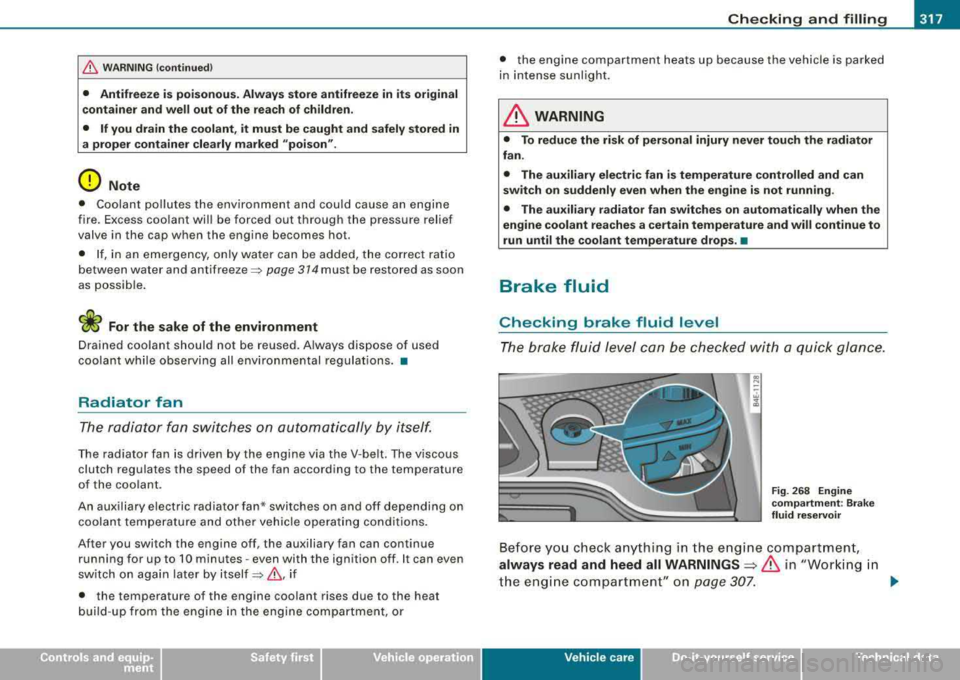
T he brake fluid level can be checked with a quick glance.
-w ;:;
Fig . 26 8 Engin e
c o mp artm ent: B ra ke
fluid r eservoir
Before you check anyth ing in the e ngine compartmen t,
always read and heed all WARNINGS ~ & in "Working in
t h e engi ne compartment " on
page 307. _,,,
Vehicle care I I irechnical data
Page 320 of 404
___ C_ h_e _c _ k_ i_ n ~g~ a_ n_ d_ f_ i_ll _in _g~--------------------------------------------
-Read the brake fluid level from the brake fluid reservoir
=> fig. 268. The brake fluid level must be between the
"MIN" and "MAX" markings.
The brake fluid reservoir is located at the rear partition of the engine
compartment on the left
side~ page 308.
The fluid level may drop slightly after some time due to the auto
matic adjustment of the brake pads. This is not cause for alarm.
If the brake fluid level falls considerably below the "MIN" mark, the
brake warning/indicator light (U.S. models:
BRAKE , Canadian models:
«D>l will come on~ page 22 and~ page 30. Do not continue to
operate the vehicle. The complete brake system should be thor
oughly checked by an authorized Audi dealer or other qualified
facility and the cause corrected. If the brake fluid level is too low, the
brake warning/indicator light will illuminate. Contact an authorized
Audi dealer
immediately. •
Changing brake fluid
Have the brake fluid changed by an experienced techni
cian.
Brake fluid absorbs moisture from the air. If the water content in the
brake fluid is too high, corrosion in the brake system may result
after a period of time. The boiling point of the brake fluid will also
decrease considerably and decrease braking performance.
Therefore, the brake fluid must be changed
every two years. Always
use new brake fluid which conforms to Federal Motor Vehicle Stan
dard "FMVSS 116 DOT 4".
The brake fluid reservoir can be difficult to reach, therefore, we
recommend that you have the brake fluid changed by your autho
rized
Audi dealer. Your dealer has the correct tools, the right brake
fluid and the know-how to do this for you.
& WARNING
• Brake fluid is poisonous . It must be stored only in the closed
original container out of the reach of children!
• Brake failure can result from old or inappropriate brake fluid .
Observe these precautions:
-Use only brake fluid that meets SAE specification J 1703 and
conforms to Federal Motor Vehicle Standard 116. Always check
with your authorized Audi dealer to make sure you are using
the correct brake fluid. The correct type of brake fluid is also indicated on the brake fluid reservoir .
- The brake fluid must be new. Heavy use of the brakes can
cause a vapor lock if the brake fluid is left in the system too
long. This can seriously affect the efficiency of the brakes as
well as your safety . This could result in an accident .
0 Note
Brake fluid will damage the paint of your vehicle .
<£> For the sake of the environment
Because of the problem of proper disposal of brake fluid as well as
the special tools required and the necessary expertise, we recom
mend that you have the brake fluid changed by your authorized Audi
dealer. •
Battery
General information
Under normal operating conditions, the battery in your Audi does
not need any maintenance. With high outside temperatures or long
daily drives we recommend that you have the electrolyte level .,,_
Page 321 of 404
_____________________________________________ C_h_ e_ c
_ k_in -= g_a
_ n_d _ f_il _li _n ..;::g ;;.___.IIIII
checked by a service facility. The e lectrolyte level should also be
checked each time the battery is charged =>
page 321.
Have the battery checked when you take your vehicle in for service.
You are well advised to replace a battery that is older than 5 years.
With ce rtain types of airbag deployment, the battery is discon
nected from the vehicle electrical system for safety reasons=>
& in
"Repair, care and disposal of the airbags" on
page 232.
Di sconn ecting the b atte ry terminal s
Some veh ic le functions (power window regulators, for example) are
lost if the battery terminals are disconnected. These functions have
to be relearned after the battery terminals are connected again. To
prevent this, the battery should only be disconnected from the
veh icle electrical sys tem when absolu tely necessary for repairs.
Veh icl es not driv en for lo ng p eriods
If you do not drive your vehicle over a period of several days or
weeks, electrical components are gradually cut back or switched off.
This reduces energy consumpt ion and maintains starting capability
over a longer period
=> page 274 .
Be aware that when you unlock your vehicle, some of the conve
nience functions may not operate, such as the Advanced Key*, the
remote control or the power seat adjustment. The convenience
functions will be ava ilable again when you turn on the ignition and
start the engine.
W int er operati on
During the winter months, battery capacity tends to decrease as
temperatures drop. This is because more power is also consumed
while starting, and the headlights, rear window defogger, etc. , are
used more often .
Avoid unnecessary power consumption, particularly in city traffic or
when trave ling only short distances . Let your authorized Audi dea ler
check the capacity of the vehicle battery before winter sets in
=> page 321. A well charged battery will n ot only prevent starting
problems when the weather is cold, but wi ll also last longer.
[ i ] Tips
If your vehic le is left standing for severa l weeks at extreme ly low
temperatures, the vehicle battery should be removed and stored
where it will not freeze. Th is wil l prevent it from be ing damaged and
having to be replaced.•
Working on the battery
Be espe cially careful when w orking on or near the battery.
Fig . 2 69 Lugg age
co mpartment : R ight
si de sto ra ge c omp art
m ent
F ig. 2 70 Lugg age
co mp artment : B atte ry
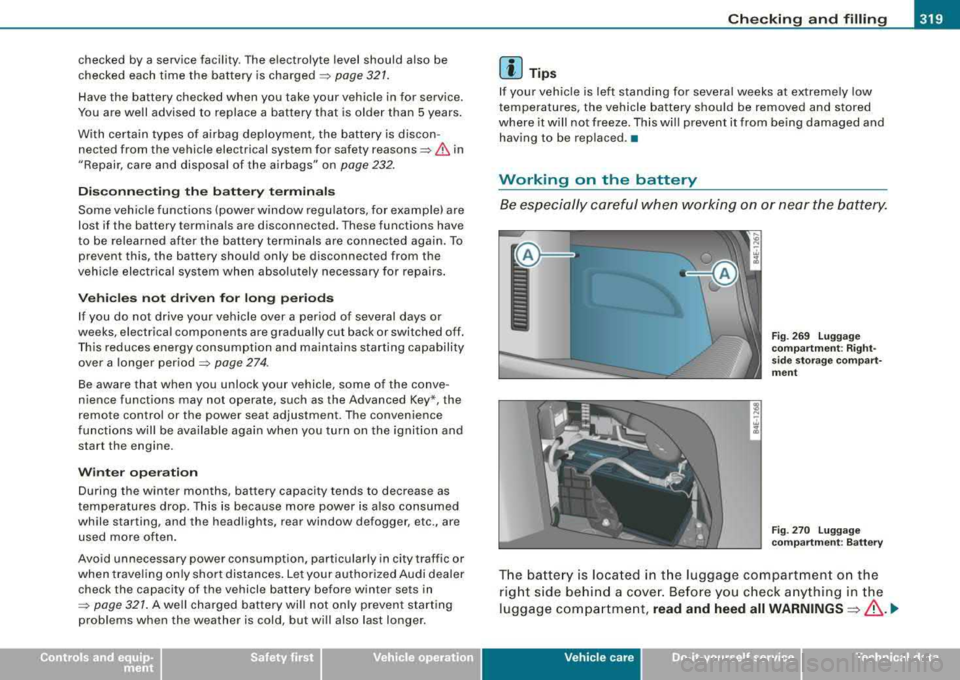
T h e ba tter y is lo ca te d in t he luggage compartm ent on the
r ight side b ehind a c ove r. Before you check a nything in the
luggag e co m partment,
read and heed all WARNINGS =>& . .,.
Vehic le care I I irechnical data
Page 322 of 404
_L--_C_ h_e _c _ k_ i_ n --=g::...._ a_ n_ d_ f_ i_ll _in --'g=-- --------------------------------------------
-To open the side storage compartment, turn the two pins
©~fig. 269 to the vertical position.
The positive (+l battery terminal is protected by a plastic cover . This
cover must be removed to access the positive (+l terminal when
connecting jumper cables to start the engine.
Always heed the safety warnings, when working on the vehicle
battery or the vehicle electrical system to prevent injury.
The following WARNINGS are very important when
working on the battery:
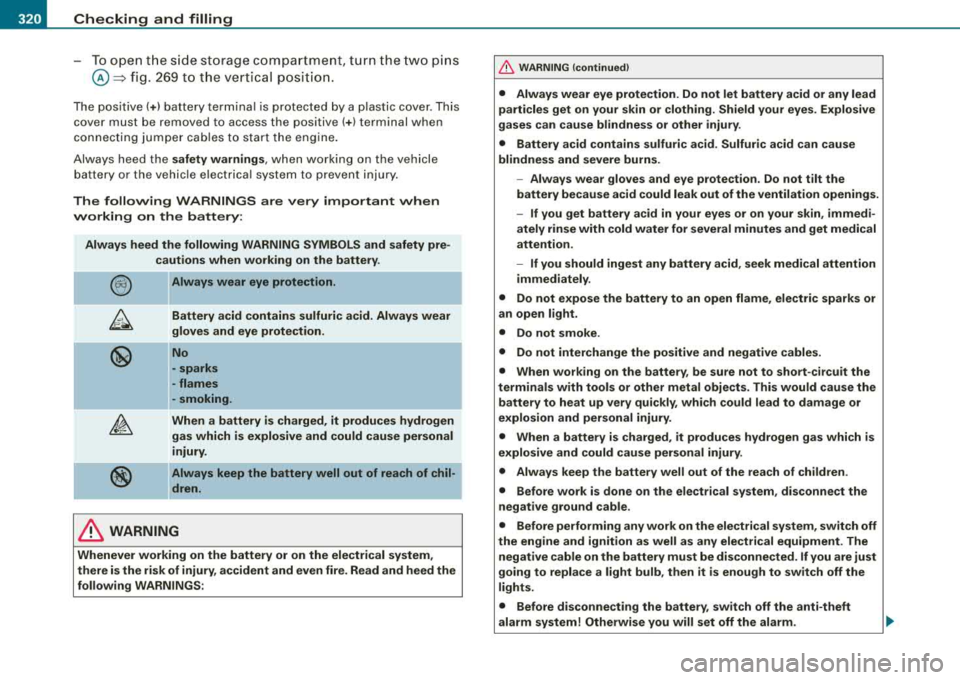
Always heed the following WARNING SYMBOLS and safety pre
cautions when working on the battery.
-
@
®
-Always wear eye protection.
Battery acid contains sulfuric acid. Always wear
gloves and eye protection.
No
-sparks
-flames
-smoking.
When a battery is charged, it produces hydrogen
gas which is explosive and could cause personal
injury.
Always keep the battery well out of reach of chil
dren.
& WARNING
Whenever working on the battery or on the electrical system,
there is the risk of injury, accident and even fire. Read and heed the
following WARNINGS:
& WARNING (continued)
• Always wear eye protection. Do not let battery acid or any lead
particles get on your skin or clothing. Shield your eyes. Explosive
gases can cause blindness or other injury.
• Battery acid contains sulfuric acid. Sulfuric acid can cause
blindness and severe burns.
-Always wear gloves and eye protection. Do not tilt the
battery because acid could leak out of the ventilation openings.
- If you get battery acid in your eyes or on your skin, immedi
ately rinse with cold water for several minutes and get medical
attention.
- If you should ingest any battery acid, seek medical attention
immediately.
• Do not expose the battery to an open flame, electric sparks or
an open light.
• Do not smoke.
• Do not interchange the positive and negative cables.
• When working on the battery, be sure not to short-circuit the
terminals with tools or other metal objects. This would cause the battery to heat up very quickly, which could lead to damage or
explosion and personal injury.
• When a battery is charged, it produces hydrogen gas which is
explosive and could cause personal injury.
• Always keep the battery well out of the reach of children .
• Before work is done on the electrical system, disconnect the
negative ground cable.
• Before performing any work on the electrical system, switch off
the engine and ignition as well as any electrical equipment. The
negative cable on the battery must be disconnected. If you are just
going to replace a light bulb, then it is enough to switch off the
lights.
• Before disconnecting the battery, switch off the anti-theft
alarm system! Otherwise you will set off the alarm.
Page 323 of 404
Checking and filling Ill
-------------~~~
•
& WARNING (continued )
• When disconnecting the battery, first disconnect the negative
cable and then the positive cable.
• Before reconnecting the battery, make sure all electrical
consumers are switched off. Reconnect the positive cable first and
then the negative cable . Never interchange the cables -this could
start a fire!
• Never charge a frozen or a thawed-out battery . It could
explode! If a battery has frozen, then it must be replaced . A
discharged battery can freeze over at 32 °F (0
°CI.
• Make sure the vent hose is always attached to the opening on
the side of the battery.
• Never use batteries which are damaged. There is the danger of
an explosion
I Always replace a damaged battery .
& WARNING
California Proposition 65 Warning :
• Battery posts , terminals and related accessories contain lead
and lead compounds, chemicals known to the State of California
to cause cancer and reproductive problems . Wash hands after
handling.
0 Note
• Do not disconnect the vehicle battery when the ignition is
switched on or when the engine is running, otherwise, you will
damage electronic components in the electrical system.
• I f your vehicle is going to stand for a long period of time without
being driven, protect the battery from "freezing", otherwise it will
be damaged and will then have to be replaced .•
Battery charging
Starting the engine requires a well charged battery.
Always read and heed all WARNINGS below ~ & and~ &
in "Working on the battery" on page 319.
-Turn off the ignition and all electrical consumers.
- Make sure the area is well ventilated when you charge
the battery.
- Attach the red (positive
8) clamp of the charging equip
ment to the positive terminal of the battery and the black
(negative(:)) clamp to the jumper terminal.
- Only now plug the mains lead for the charging equip
ment into the wall outlet and turn it
on~ &.
-Make sure the charging rate is not over 30 amps/14.8
Volt.
-When the battery is fully charged: Turn the charging
equipment off and remove the mains lead from the wall
outlet.
- Now remove the clamps for the charging equipm ent.
A discharged battery can freeze at temperatures of only O °C . Allow
a frozen battery to thaw completely before attempting to charge it
=> ,&. . However, we recommend not using a thawed battery again
because the battery casing can be cracked due to ice formation and
can leak battery acid.
Battery charging (Maximum charging rate of 30
amps/14.8 Volt)
When charging at low voltages (e.g . with a trickle charger ), the
battery cab les do not have to be disconnected first. The battery caps
should
not be opened when charging a battery. ~
Vehicle care
Page 324 of 404
-Checking and filling PW~---=---=----------------
It is not necessary to remove the battery from the luggage compart
ment, and it is also not necessa ry t o disco nnec t the cab les.
F a st ch arging th e batt ery ( charging rate above 14 .8
V olts )
For technical reasons do not use a battery charger that uses voltage
greater tha n 14.8 Vo lts to charge your veh ic le's battery.
& WARNING
C harging a b attery can be dangerou s.
• Always follow the operating in structions provided by the
battery charger manufacturer when ch arging your b attery .
• Never charge a frozen battery . It may expl ode because of ga s
t rapped in the ice . Allow a frozen batter y to tha w out fir st .
• Do not reu se batteries which were fro zen. The battery hou sing
m ay have cracked and weakened when the battery froze.
• Charge the battery in a well ventilated are a. Keep aw ay from
open flame or electric al spar k. Do not smoke . Hydr ogen gas gener
ated by the battery i s explosive.
• To reduc e the danger of e xplosion , never conne ct or dis conn ect
charger cable s while the charger i s oper ating.
• Fa st charging a batter y is dangerous and should only be
a ttempted by a competent technician with the proper equipment .
• Battery ac id that may spill during charging should be washed
off with a solution of warm water and b aking soda to neutralize
the a cid .
0 Note
Never use a fast charger as a booster to start the engine. This wil l
ser iously damage sens it ive elect ronic compo nents, such as control
units, r elays, radio , etc ., as wel l as the battery charger. •
Battery replacement
The new batte ry mus t have t he s ame s pecificati ons and
dimensions as the original equipment battery.
I ntel ligent energy management in your vehicle is responsible for
distr ibut ing the e lectr ica l energy throughout your veh icle
~ page 274. The inte lligent energy management system will keep
t he engine ba ttery charged be tter than vehicles without t his sys tem.
T o make sure the add it ional electr ical energy is avai lab le once aga in
after you have changed t he battery, we recommend that you ins tall
batteries of the same type and manufacture only (the same as those
insta lled at the time your vehicle was delivered). Specifications are
listed on the battery housing . Your authorized Audi dea ler wi ll then
code the battery management contro l unit .
The new battery must have the same capacity, voltage (12 volts), amperage, construction and p lug sea ling.
When instal ling the battery, make sure the ign ition and all elect rica l
consumers are turned off .
0 Note
Make sure the ventilation hose on the side of the battery is
connected, otherwise fumes or battery acid can leak out.
'£> For the sake of the environment
Because of the problem of proper disposal of a battery, we recom
mend your authorized Audi dealer change the battery for you.
Batteries contain sulfur ic acid and lead and must always be
disposed of proper ly i n compliance with all environmental regula
tions . Disposing of vehicle batteries improper ly is very dangerous to
t he environment .•
Page 325 of 404
Checking and filling -
----------------=--_;::;;.__,
Windshield/headlight washer
container
Using plain water is not adequate for filling the wind
shield washer system and the headlight washer system.
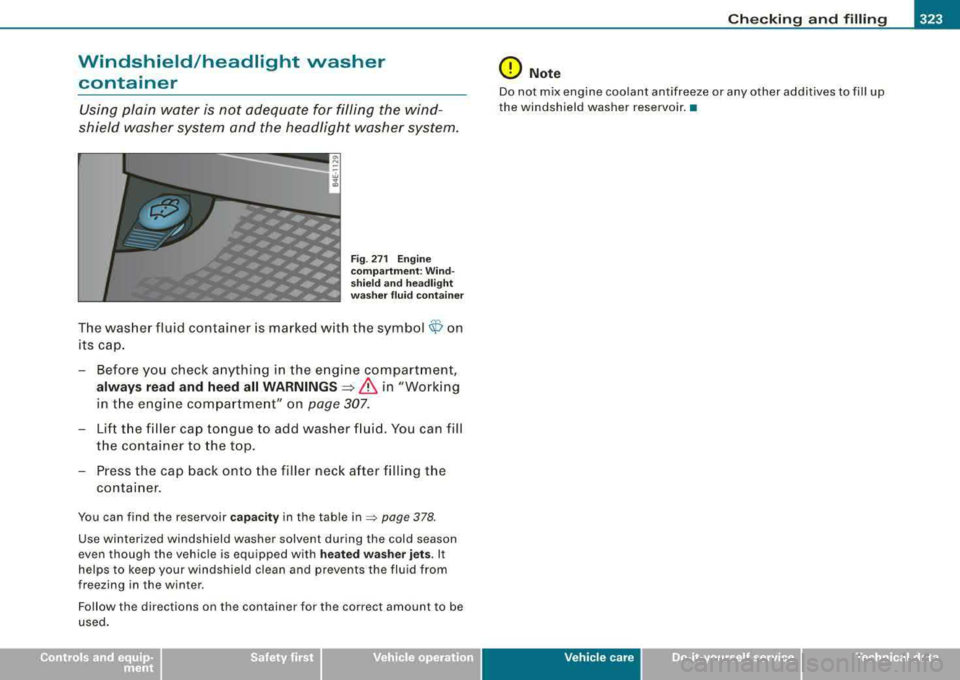
Fig . 271 Engine
compartment: Wind·
shield and headlight
washer
fluid container
1-.•,
The washer fluid container is marked with the symbol
- Before you check anything in the engine compartment,
always read and heed all WARNINGS~ & in "Working
in the engine compartment" on
page 307.
- Lift the filler cap tongue to add washer fluid. You can fill
the container to the top.
- Press the cap back onto the filler neck after filling the
container .
You can find the reservoir capacity in the table in=> page 378.
Use winterized windshield washer solvent during the cold season
even though the vehicle is equipped with heated washer jets. It
helps to keep your windshield clean and prevents the fluid from
freezing in the winter.
Follow the directions on the container for the correct amount to be
used.
0 Note
Do not mix engine coolant antifreeze or any other additives to fill up
the windshield washer reservoir. •
Vehic le care
I I irechnical data
Page 332 of 404
___ T_ ir_e _s_ a_n_ d_ w_ h
_ e_e_ l_ s _______________________________________________ _
Engine Tire designation Tire pressure front Tire pressure rear
( displace-
normal load full load normal load
full load
ment in
liter)
condition al condition conditiona l condition
kPA PSI kPA PSI kPA PSI
12-cylinder
255/45 R18 99H All Season 36 250 38 260 32 220 32 220
6.0 Individual
255 /40 R19 100V XL All Season 41 280 4 1 280 36 250 36 250
rear seats
255/40 R19 100V
XL High Performance
36 2
50
38 260 3
2 220 32 2 20
275 /35 R20 102Y
XL High Performance 38 41 280 35 2 40 44 300
12 -cylinder 255 /45 R18 99H All Season 36 250 36 250 32 220 32 220
6 .0
255 /40 R19 100V XL All Season 4 1
280 4
1
280 36 250 36 250
255 /40 R19 100V
XL High Performance
36 250 36 250 32 2 20 32 220
275 /35 R20 102Y XL High Performance 38 260 4 1 280 35 240 44 300
XL = reinforced or extra load tire . It may also appear as xi , EXTRA LOAD , or RF on the tire sidewall .
al norma l load cond ition => page 328.
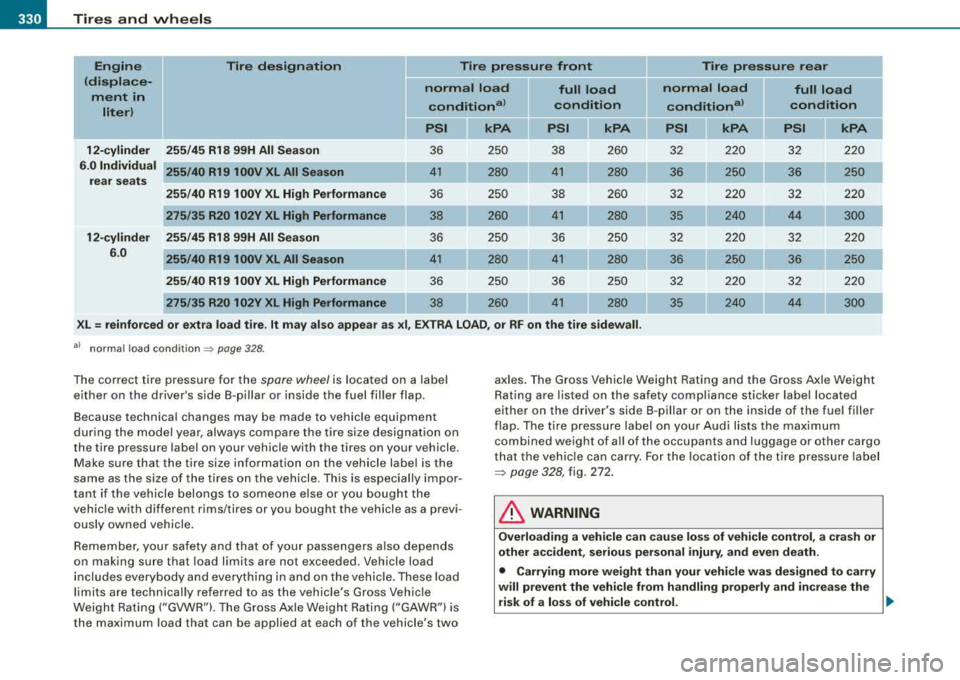
The co rrect tire pressure for the spare wheel is located on a label
either on the driver 's s ide 8-pillar or inside t he fue l fil ler flap.
Because technica l changes may be made to vehicle equipment
du ring t he mode l year, always co mpare the tire si ze desig nati on on
the tire pressure label on your vehicle with the tires on your vehicle .
M ake s ure t hat the tire si ze info rmat ion o n the ve hicle labe l is the
same as the size of the tires on the vehicle . T his is especial ly impor
t an t if t he vehicle bel ongs t o so me one e lse o r yo u boug ht the
vehic le with different rims/tires or you bought the vehicle as a previ
ously owned ve hicle.
Reme mber, you r safety and that of y our passengers a ls o depe nds
on making su re that load limits are not exceeded. Vehicle load
i nc ludes every body and everyt hin g in and o n th e veh icle . T hese load
limits are technically referred to as the vehicle's Gross Veh ic le
Weig ht Ratin g ("GVWR"). T he Gro ss Axle Weigh t Ra tin g ("GAWR") is
the maximum load that can be applied at each of the vehicle's two axles
. The Gross Vehic le We ight Rating and the Gross Axle Weight
Rating are l isted on the safety compl iance sticker labe l located
either on the driver's side 8 -pillar or on the inside of the fuel filler
fl ap . T he t ire p ressure label on you r A ud i lists t he m axi mum
combined weight of a ll of the occupants and luggage or other cargo
th at the v ehicle can carry . Fo r the locati on of the t ire press ure la be l
=> page 328, fig . 27 2.
& WARNING
Overloading a vehicle can cause loss of vehicle control , a crash or
other accident, serious per sonal injury , and even death .
• Carrying more weight than your vehicle was designed to carry
will prevent the vehicle from handling properly and increase the risk of a loss of vehicle control. ...,
Page 351 of 404
_______________________________________________ W_ h_ a
_ t_d_ o_ l _d _o_ n_ o_ w_ ? _ __,ffllll
[ i J Tips
If you no longer have your original warni ng triang le and need to
equip your vehic le with a new one, contact you r authorized Audi
d ea ler for a r eplace men t. •
Jack, tools and spare wheel
Jack
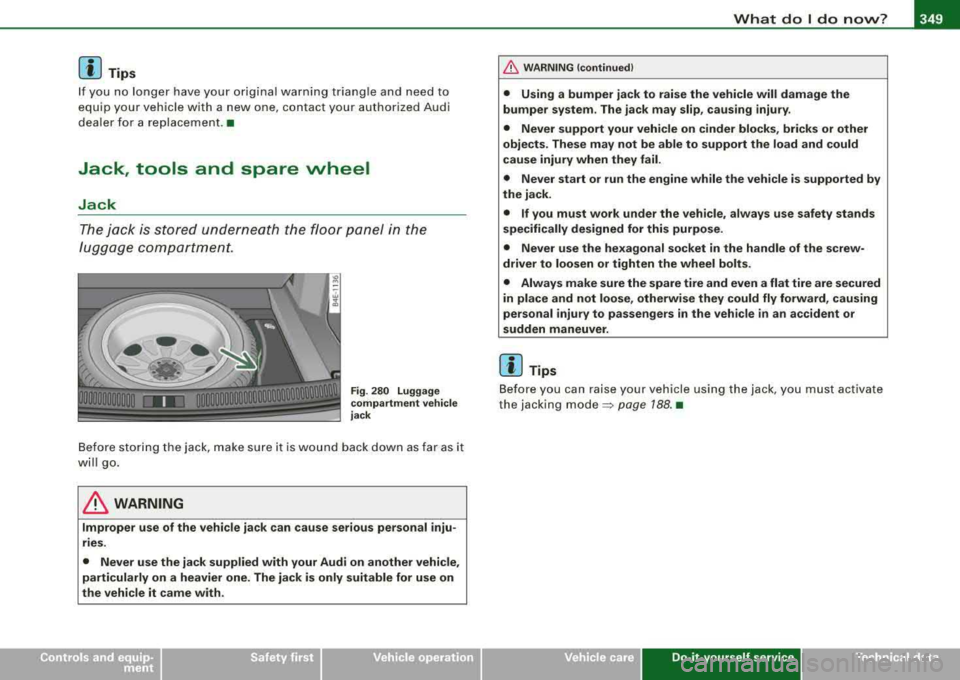
The jack is store d unde rnea th the floor panel in the
lug gage co mpartm en t.
Fig . 280 Luggage
c ompartment vehicle
jack
Before s tori ng the jack, make su re i t is wound back down as far as it
wi ll go.
& WARNING
Improper use of the vehi cle ja ck can cause serious personal inju
ries .
• Never use the jack supplied with your Audi on another vehi cle,
particularly on a heavier one. The jack is only suitable for u se on
the vehi cle it came with .
& WARNING (continued )
• Using a bumper jack to raise the vehicle will damage the
bumper system . The jack may slip , causing injury.
• Never support your vehicle on cinder blocks , bricks or other
objects. These may not be able to support the load and could
cause injury when they fail.
• Never start or run the engine while the vehicle is supported by
the jack.
• If you must work under the vehicle , always use safety st ands
s pecifically designed for this purpose .
• Never use the he xagonal socket in the handle of the s crew
driver to loosen or tighten the wheel bolts.
• Always make sure the spare tire and even a flat tire are secured
in place and not loose , otherwise they could fly forward , causing
personal injury to passengers in the v ehicle in an a ccident or
sudden maneuver .
[ i J Tips
Before you can raise your vehicle using the jack, yo u must act ivate
the jack ing mode ::}
page 188. •
Vehicle care Do-it-yourself service irechnical data