parking brake AUDI S8 2008 User Guide
[x] Cancel search | Manufacturer: AUDI, Model Year: 2008, Model line: S8, Model: AUDI S8 2008Pages: 404, PDF Size: 52.7 MB
Page 139 of 404
_________________________________________________ O_ n_ t_h _e _ ro_ a_d _ ___._
0 Note
If the warning/indicator light (U.S. models : BRAKE, Canadian models:
malfunction. By pressing the
I CHECK] button , you can bring up a
driv er m essage which explains the malfunction in more detail. If the
message
Parking brake! Please contact workshop appears, there is
a parking brake malfunction which you should have r epaired imme
diately by an authorized
dealership => page 30. •
Cruise control
Switching the system on
The cruise control system makes it possible to drive at a
constant speed starting at 20 mph (30 km/h).
rr- -- ...--,,-~------ -~ ----,-~
Contro ls a nd eq uip
ment
.... S? w ;f,
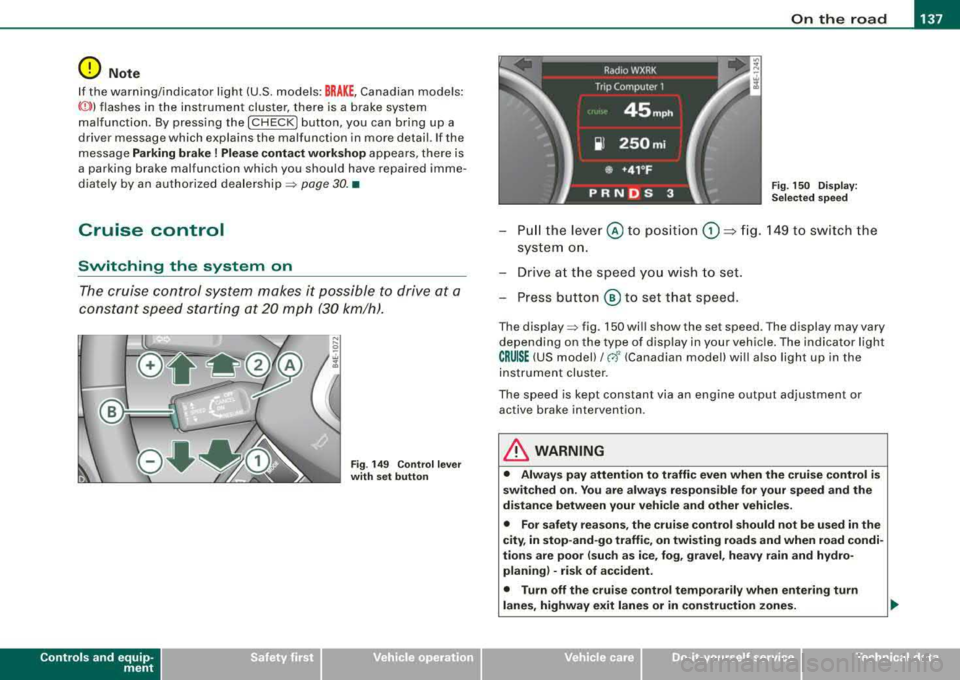
Fig . 149 Control lever
with set button Fig
. 150 Display:
Selected speed
Pull the lever © to position G) ~ fig. 149 to switch the
system on.
Drive at the speed you wish to set.
- Press button
® to set that speed.
The display => fig. 150 will show the set speed . The display may vary
depending on the type of display in your vehicle. The indicator light
CRUISE (US model)/ 0 (Canadian model) will also ligh t up in the
instrument cluster .
The speed is kept constant via an engine output adjustment or active brake intervention .
& WARNING
• Always pay attention to traffic even when the cruise control is
switched on. You are always responsible for your speed and the
distance between your vehicle and other vehicles.
• For safety reasons, the cruise control should not be used in the
city, in stop-and-go traffic, on twisting roads and when road condi
tions are poor (such as ice, fog, gravel, heavy rain and hydro
planing) -risk of accident.
• Turn off the cruise control temporarily when entering turn
lanes, highway exit lanes or in construction zones.
Vehicle care
I I irechnical data
Page 142 of 404

___ A_ d_a_ p_ ti_v _ e_ C_ ru_ is_ e_ C_ o_n_ t_ r_ o _ l ___________________________________________ _
&, WARNING (continued )
appl ied b y the s ystem when it det ects a situation when the brakes
mu st be applied.
• Alway s remember th at Ad aptive Cru ise Control has limits - it
doe s not rea ct when you dri ve toward s an ob stac le or something
e lse on or near the road th at is not mov ing , such as ve hic le s
s topped in a traffic jam , a sta lled or di sabled vehicle.
• Alway s remember th at the Ad aptive Cru ise Control cannot
detect a vehicle that i s driving to wards you in your tr affi c la ne and
that it cannot det ect narrow veh icles su ch a s motor cycles and
bicycle s.
[ i] Tips
• For sa fety reasons, the stored speed is deleted when the ign it ion
is turned off .
• When Adaptive Cru ise Control is switched on, the Electronic
Stabilization Program (ESP) is also automatically activated.
• Damage caused by accidents (e.g . if the vehic le is damaged
when parking) can affect the radar sensor settings. This can cause
the system to malfunct ion or switch off completely.
• In winter conditions, you should check the radar sensor cover
before driving to make sure it is free of ice and snow. If necessary ,
clean the area near the radar sensor
carefully => page 139, fig. 151.
• To ensure that the radar sensor is not blocked, foreign objects
(e.g. stickers, larger license plate mounts, add -on parts) must not
cover the area near the radar
sensor=> page 139, fig . 151. The area
near the radar sensor must not be painted, either .•
Ap plies to vehicles: with Ad aptive Crui se Co nt rol
How does Adaptive Cruise Control work?
Vehicles traveling ahead are detected with the aid of the
radar sensor.
Fi g. 152 Ra dar sens or
me asuremen t range
A forward -look ing radar sens or in the fro nt b umper monitors the
traffic situation ahead . Vehicles moving in your direction can be
de tec ted up to a distance of a bout 140 yards ( 130 meters) but the
Adaptive Cruise Contro l cannot detect vehicles that are stopped or
stal led, obstac les that do not move or narrow vehic les like motorcy
cles and
bicycles.=> fig. 152 .
Open road
When the road is clear, Adaptive Cruise Contro l works like cruise
co ntrol. The stored speed requested is main tained .
Driving in tr affi c
If you start to catch up with a vehic le in front of you, Adap tive Cruise
Control automatically slows your vehic le to a speed that will he lp
you stay a safe distance back .
If the vehicle in front acce lerates, Adaptive Cruise Control a lso accel -
erates up to the speed that you have set . .,_
Page 150 of 404
___ A_ d_a_ p_ ti_v _ e_ C_ ru_ is_ e_ C_ o_n_ t_ r_ o _ l ___________________________________________ _
The ACC sensor is dirty or blocked (e.g. leaves, snow).
The ACC sensor is located in the area under the front license plate.
If there is a loss of operation due to heavy contamination, this area
should cleaned to restore proper operation.
EPB activation
The text message EPB activation appears if emergency braking was
initiated with the Electromechanical Parking Brake (EPBl. Adaptive
Cruise Control is turned off. A gong sounds as a reminder.
ESP activation
The text message ESP activation appears if the Electronic Stabiliza
tion Program (ESP) has intervened to take control in a critical driving
situation. In this case Adaptive Cruise Control is automatically
turned off . A gong sounds as a reminder .
Speed range
The text message Speed range appears if the current speed is too
low to set or to hold the requested speed.
When setting a desired speed, it must be at least 20 mph (30 km/h).
At speeds below 17 mph (25 km/h), the cruise control is turned off.
Shift lever position!
The text message Shift lever position! appears when the shift select
lever is moved to position
N. In this position, Adaptive Cruise
Control is not available. •
Applies to veh ic les: with Ad apt ive Crui se Contro l
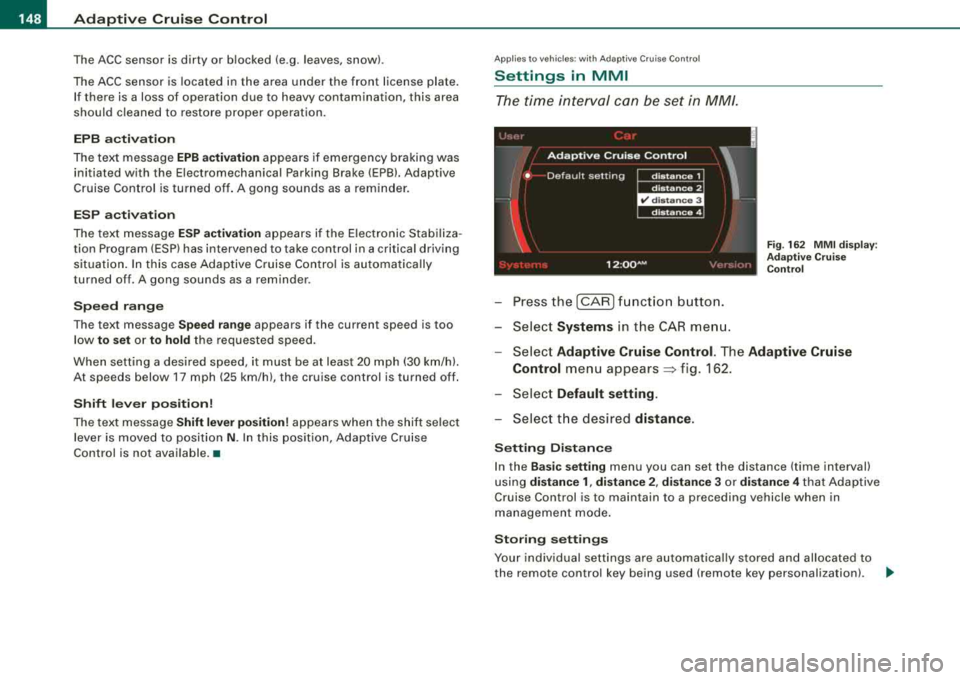
Settings in MMI
The time interval can be set in MM/.
-Press the [CAR] function button.
-Select Systems in the CAR menu.
Fig. 162 MMI display :
Adaptive Cruise Control
-Select Adaptive Cruise Control. The Adaptive Cruise
Control
menu appears~ f ig . 162.
-Select Default setting .
-Select the desired distance.
Setting Distance
In the Basic setting menu you can set the distance (time interval)
using
distance 1, distance 2, distance 3 or distance 4 that Adaptive
Cruise Control is to maintain to a preceding vehicle when in
management mode.
Storing settings
Your individual settings are automatically stored and allocated to
the remote control key being used (remote key personalization) .
~
Page 165 of 404

_____________________________________________ A_ u_t _o _m_ a_ t_ i_c _ t_ r_ a_ n_ s_m _ is_ s_ io_ n _ ___.11111
Automatic transmission
tiptronic ® (6-speed automatic
transmission)
Gener al information
Your vehicle is equipped with an electronically controlled 6-speed
automatic transmission. Upshifting and downshifting takes place
automatically.
The transmission is also equipped with tiptronic®. It allows the
driver to shift gears
manually if desired ~ page 167. •
Driving th e autom ati c transmission
Starting the engine
- The selector lever must be in Nor P.
Starting off
-Press and hold the brake pedal.
Contro ls a nd eq uip
ment
Fig . 183 Shift gate on
the center console:
selector lever with
release button
- Press and hold the release button in the selector lever
handle and move the selector lever from
P or N to D and
release the button
=> & .
- Wait briefly until the transmission has shifted (you will
feel a slight movement).
- Remove your foot from the brake pedal and accelerate.
Rocking back and forth to become unstuck
- Shift only between D and R when the vehicle is at a full
stop and the engine is running at idle speed.
Stopping
- Press and hold the brake pedal until the vehicle has come
to a complete stop.
Keep the brake pedal depressed so that the vehicle
cannot roll forward or backward while it is
idling=>& .
-Once stopped, do not depress the accelerator pedal to
rev up the
engine=> &.
Parking
- Press and hold the brake pedal until the vehicle has come
to a complete stop.
- Set the parking brake
firmly=> page 135, "Parking".
- Press and hold the release button in the selector lever
handle, move the selector lever into
P and then let go of
the release button
=> &. ._
Vehicle care I I irechnical data
Page 166 of 404

___ A_ u_ t
_ o_ m_ a_ t_ i_ c _ t_r _a _n_ s_ m_ is_ s_io _ n ________________________________________________ _
The selector lever must be in Nor P. If one of the driving positions
is e ngaged a sa fe ty swit ch will preven t the eng ine from bei ng
started. See
also=:> pa ge 130 .
Before you move the selector lever from the P pos ition, you m ust
a lways apply the b ra ke pe dal be fore and wh ile depress in g th e
button in the hand le of the selecto r lever.
& WARNING
• Unintended vehicle movement can cause seriou s injury .
- When the selector lever is in a driving position , the vehicle
may creep , even at idle speed . Therefore do not release the
parking brake or foot brake until you are ready to move,
be cause power is tran smitted to the wheels as soon as a
driving position is engaged .
- Do not accelerate while select ing a driving position . At th is
time the engine must be at idle speed so that undue stress is
not placed on the clut ches in the transmi ssion .
- Remember: -even when stopped briefly with the automatic
transmission in
" D " or "R ", engine power is being transmitted
to the wheels . Your vehicle could "creep " forward or backward.
When stopped , keep the brake pedal fully depressed and use
the parking brake if necessary to keep the vehicle from rolling.
• If the selector lever is unintentionally moved into N while you
are driving , take your foot off the accelerator pedal and wait for
the engine to return to idle speed before sele cting a driving posi
tion.
• Never shift into
" R " or "P " when the vehicle is in mot ion .
• Never get out of the dri ver's seat when the engine is running .
• If you must get out of the vehicle , move the selector lever
securely into the P position and apply the parking brake firmly .
• If the engine must remain running , never have any driving posi
tion engaged when checking under the hood . Make sure the
selector lever has securely engaged and is locked in
"P" with the
parking brake firmly
set => page 299, "Engine compartment ".
& WARNING (continued )
Otherwise , any increase in engine speed may set the vehi cle in
motion , even with the parking brake applied . •
Selector lever positions
This sec tion des crib es the selec tor lever p ositions an d
driv ing rang es.
Fig . 184 Disp lay in the
in strument clu ster :
selector lever in pos i
t ion D
T he sele cto r leve r posi tion engag ed ap pears next to the selector
l ever as we ll as in the instrument cluster disp lay . A lso, the current
gear engaged is show n in po sitions D and S .
P -Park
In this selector lever posit ion the t ra nsmi ssio n i s m ec hani cally
l ocked. Engage
P on ly when the vehicle is completely stopped=> &
i n "Dr iv ing th e auto mat ic tra nsmi ssion" on page 163 .
To shift in or out of position P , you must first press and hold the
b rake peda l
and then press the release button in th e selec tor leve r
handle wh ile movi ng the selector lever to or from
P . You can shift
ou t of this posi tion only wi th th e igni tio n on.
R -Reverse
Th e trans missi on wil l au to m atica lly select t he lowest gear ratio
when you shift into reverse .
Page 193 of 404

___________________________________________________ H_ o_m_ e_ L_ i_ n _ k_ ®_ R __ l!III
Homelink ®
Universal remote control
Applies to vehicles: w ith Home link® unive rsa l remo te cont rol
General information
The HomeLink® feature can learn up to three radio
frequency codes for most current transmitters used for
operating garage doors, estate gates, home or outdoor
lighting systems, and other devices.
You must first program the Homelink® transmitter before you can
use the
system=> page 191, "Programming the Homelink® trans
mitter".
In order to program the Homelink® transmitter for devices utilizing
rolling code , a second person on a ladder who can safely reach the
garage door opener motor is recommended. It is also necessary to
locate the
"learn" button on your garage door opener motor . Refer
to the operating instructions for the opener, as the location and
color of this button may
vary by manufacturer.
You can still use the original remote control for the device at any
time.
& WARNING
• Never use the Homelink"" transmitter with any garage door
opener that does have not the safety stop and reverse feature as
required by federal safety standards. This includes any garage
door opener model manufactured before April 1, 1982.
• A garage door opener which cannot detect an object, signaling
the door to stop and reverse does not meet current federal safety standards . Using a garage door opener without these features
increases risk of serious injury or death.
Controls and equip ment
& WARNING (continued)
• For safety reasons never release the parking brake or start the
engine while anyone is standing in front of the vehicle.
• A garage door or an estate gate may sometimes be set in
motion when the Homelink® remote control is being
programmed. If the device is repeatedly activated, this can over
strain motor and damage its electrical components -an over
heated motor is a fire hazard!
• To avoid possible injuries or property damage, please always
make absolutely certain that no persons or objects are located in
the range of motion of any equipment being operated. •
Applies to vehicles : wit h Home link ® uni vers al remote con trol
Programming the Homelink ® transmitter
The transmitter is programmed in two phases. For rolling
code transmitters, a third phase is also necessary.
f ( ~ ~
i
s: 0
,1, .., Cl)
ll
Fig . 213 Overhead
console: Homelink®
keypad
~
Page 194 of 404
--~H~o~m~e:_!L~i~n~k~®~ ----------------------------------------------
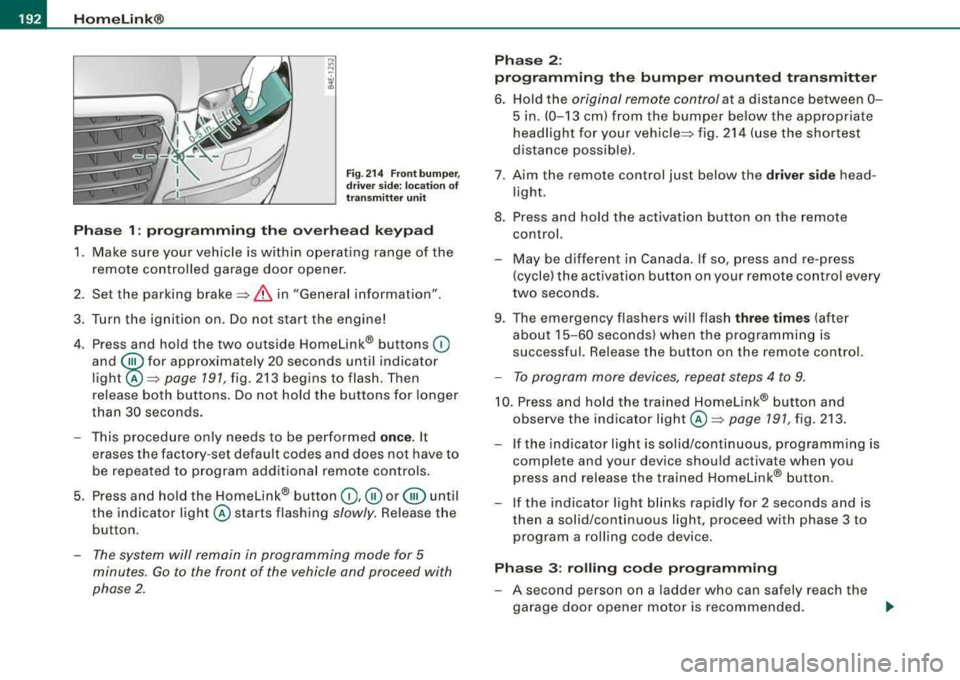
Fig. 214 Front bumper,
driver side: location of
transmitter unit
Phase 1: programming the overhead keypad
1. Make sure your vehicle is w ithin operat ing range of the
remote controlled garage door opener .
2. Set the parking
brake ::::,&, in "General information".
3. Turn the ignition on. Do not start the engine!
4. Press and hold the two outside Homelink ® buttons
(D
and @ for approxim~tely 20 sec _onds until indicator
light @::::,
page 191, fig. 213 begins to flash. Then
release both buttons. Do not hold the buttons for longer
than
30 seconds.
- This procedure only needs to be performed
once. It
erases the factory-set default codes and does not have to
be repeated to program add itional remote controls.
5. Press and hold the Homelink ® button
(D , ® or @ until
the indicator light @starts flashing
slowly. Release the
button.
- The system will remain in programming mode for 5
minutes.
Go to the front of the vehicle and proceed with
phase 2.
Phase 2:
programming the bumper mounted transmitter
6. Hold the original remote control at a d istance between 0 -
5 in. (0-13 cm) from the bumper below the appropriate
headlight for your
vehicle ::::, fig. 214 (use the shortest
distance possible).
7 . A im the remote control just below the
driver side head
l ight.
8. Press and hold the activation button on the remote control.
- May be different in Canada. If so , press and re-press
(cycle) the activation button on your remote control every
two seconds .
9. The emergency flashers will flash
three times (after
about
15-60 seconds) when the programming is
successful. Release the button on the remote control.
- To program more devices, repeat steps 4 to 9.
10. Press and hold the trained Homelink® button and
observe the indicator
light @=:> page 191, fig. 213.
If t he indicator light is solid/continuous, programming is
complete and your device should activate when you
press and release the tra ined Homelink® button.
-If the indicator light blinks rapidly for 2 seconds and is
then a solid/continuous light, proceed with phase 3 to
program a roll ing code device.
Phase 3: rolling code programming
-A second person on a ladder who can safely reach the
garage door opener motor is recommended.
..,
Page 286 of 404

ffl.___T_ r_a _il _e_ r_ t_o _w_ i_ n """g"'- ---------------------------------------------------
Speed
The higher the speed, the more difficu lt it becomes for the driver to
control the rig. Do not drive at the maximum permissible speed. Reduce your speed even more if load, weather or wind conditions
are unfavorable
-particularly when going downhi ll.
Reduce vehicle speed
i mm edia te ly if the trailer shows the slightest
sign of swaying.
Do not try t o stop the sway ing by accelerating.
Observe speed lim its. In some areas, speeds for vehicles towing
trai lers are lower than for regular ve hicles .
Always apply brakes ear ly. When driving down hill, shift into a lower
gear to use the engine braking effect to slow the vehicle. Use of the
brakes a lone can cause them to overheat and fail.
Cool ant temp era tu re
The coolant temperature gauge=> page 12 must be observed care
ful ly. If the needle moves close to the upper end of the scale, reduce
speed immed iately and/or turn off the air conditioner.
If the coolant temperature warning light in the instrument cluster
starts flas hing
-F- , pul l off the road, stop and let t he engine idle for
about two m inutes to prevent heat build-up.
& WARNING
An yone n ot properl y re str aine d in a mo ving vehi cle is at a mu ch
g re ate r ri sk in an accid ent . N ever let any on e rid e in y our car who
i s not properl y wea rin g th e res tra int s pr ov ided by Audi.
•
Trailer towing tips
Important to know
Your vehicle handles differently when towing a trailer because of
the additional weight and different weight distribution. Safety, performance and economy wi
ll greatly depend on how carefully you
l oad your trailer and opera te your r ig.
Before you actual ly tow your trailer, practice turn ing, stopping and
backing up in an area away from traffic . Keep practicing unti l you
have become comp letely fam iliar with the way your vehicle-trai ler
combination behaves and responds.
Backing up is di fficult and requires practice. Backing up with a
trai ler generally requires steering action opposite to that when
backing up your veh ic le without a tra iler.
Ma inta in a greater distance between your veh ic le and the one in
front of you . You will need more room to stop. To compensate for
the trai ler, you w ill need a larger than norma l turning radius.
When passing, remember that you cannot accelerate as fast as you n or mally wou ld because of t he added load . Make su re you have
enough room to pass . After passing, al low plenty of room for your
t rai ler befo re changing lanes again .
Avo id jerky starts, sharp turns or rapid lane changes.
[ i ] T ips
• Do not tow a tra iler during the break-in period o f your veh ic le.
• I f you tow a trailer, your Audi may require more frequent main te
nance due to t he extra
load=> page 380. •
Parking on a slope
Do n ot park on a slope with a trailer. If it cannot be
avoided, do
so o nly after doing the followi ng:
When p arking :
-Apply the foot b rake.
- Have someone p lace chocks under both the vehicle and
the trailer wheels. _,,,
Page 287 of 404
____________________________________________________ T_r_a _i_l e_ r_t_ o _ w_ i
_ n...; g=- -•
-Wit h chocks i n place, slowly release the brakes until the
wheel chocks absorb the load .
-Turn the wheels towards the curb.
-Apply the parking brake.
-Move the selector lever to P.
When rest arting after p arking :
-Apply the foot brake.
-Start the engine.
-Move the se lector lever to D.
-Re lease the parking brake and slowly pull out and away
f rom the whee l chocks .
-Stop and have someone retr ieve the wheel chocks .
[ i] Tip s
If you move the se lector lever of the automatic transmission to P
b efor e applying th e parking brak e and b efor e blocki ng th e wheels ,
you may have to use more force later to move the lever out of the
P
position .•
Controls and equip ment Safety first Vehicle operation
Vehicle care Do-it-yourself service Technical data
Page 309 of 404
___________________________________________ C=..:...: h:.:e :.: c:.: k.:.: i.:.: n :3:g ~ a:.:.n .:.: d::......:. f..:..:il ..:..:li .:.:n3g !._ _9I
•
Closing the engine hood
- Pull the hood down until the pressure from the struts is
reduced .
- Let the hood
drop down and latch in place. Do not try to
push it shut;
it may fail to engage =>& .
& WARNING
A hood that is not completely latched could fly up and block your
view while driving.
• When you close the engine hood, check it to make sure the
safety catch has properly engaged. The hood should be flush with
the surrounding vehicle body parts.
• If you notice while driving that the hood is not secured prop
erly, stop at once and close it. •
Working in the engine compartment
Be especially careful whenever you work in the engine
compartment.
Whenever you must perform any work in the engine compartment,
for example checking and filling different fluids, there is a risk of injury, burns and accidents. To prevent personal injury always
observe the following WARNINGS. The engine compartment of any
vehicle is a hazardous area
~ & .
& WARNING
To help avoid injury, before you check anything under the hood :
• Turn off the engine. • Remove the ignition key.
• Apply the parking brake.
• I I • • I
& WARNING (continued)
• Move selector lever to "P" (Park).
• Always let the engine cool down. Hot components will burn
skin on contact.
• To reduce the risk of being burned, never open the hood if you
see or hear steam or coolant escaping from the engine compart
ment. Wait until no steam or coolant can be seen or heard before
carefully opening the hood.
• Keep children away from the engine compartment .
• Never spill fluids on hot engine components. They can cause a
fire.
• Never touch the radiator fan. The auxiliary electric fan is
temperature controlled and can switch on suddenly.
• Never open the coolant reservoir cap when the engine is still
warm. The coolant system is pressurized and hot coolant could spray out.
• Protect your face, hands and arm from steam or hot engine
coolant by placing a thick rag over the cap when you open the
coolant reservoir.
• If work on the fuel system or the electrical system is necessary:
- Always disconnect the battery.
- Never smoke or work near heaters or open flames . Fluids in
the engine compartment could start a fire.
- Keep an approved fire extinguisher immediately available.
• To avoid electrical shock and personal injury while the engine
is running or being started, never touch:
-Ignition cables
- Other components of the high voltage electronic ignition system.
• If you must perform a check or repair with the engine running: -First, fully apply the parking brake, move selector lever to
"P"
(Park). .,_
Vehicle care