fuel AUDI S8 2008 Owner's Manual
[x] Cancel search | Manufacturer: AUDI, Model Year: 2008, Model line: S8, Model: AUDI S8 2008Pages: 404, PDF Size: 52.7 MB
Page 137 of 404
On the road -----------------
Parking
To prevent a parked vehicle from rolling away, there are a
few things you should do.
When you park your vehicle, do the following
- Stop the vehicle using the brake pedal.
- Pull the switch to apply the electromechanical parking
brake.
- Move the selector lever into the
P position => &.
- Switch off the engine and remove the ignition key from
the ignition lock.
When you park your vehicle on hills, do the
following
- Stop the vehicle using the brake pedal.
- Pull the switch to apply the electromechanical parking
brake.
- If you are parking headed
downhill, turn the front wheels
toward the curb.
- If you are parking headed
uphill, turn the front wheels
awayfrom the curb.
- Move the selector lever into the
P position.
- Switch off the engine and remove the ignition key from
the ignition lock.
& WARNING
This is how you can reduce the risk of injury when leaving your
vehicle.
Controls and equip ment
&, WARNING (continued)
• Never park the vehicle where it can come in contact with dry
grass, spilled fuel or any other flammable materials.
• When parking on hills, always turn the wheels so that the front
wheels will first roll into the curb, if the vehicle should start to roll.
• Never allow anyone -especially small children -to remain
in the
vehicle when it is locked. Locked doors make it more difficult for
rescuers to access the passenger compartment in the event of an
emergency. Danger to life!
• Never leave children unsupervised in the vehicle. Children
could release the parking brake or move the gearshift lever out of
gear. The vehicle could start to roll away and cause an accident.
• No matter what the season is, the temperature in a parked
vehicle can reach dangerous levels.
0 Note
• Please exercise care when you park your vehicle in parking areas
with parking barriers or curbs . Parking barriers and curbs vary in
height and could damage your bumper and related components as
the front of your vehicle moves over a barrier or curb that is too high, as you park or as you back out of a parking spot. In order to be
sure that no such damage can occur, you may wish to stop short of
having the front tires of your car touch the parking barrier or curb.
• Please also exercise exceptional care when you drive up or down
steep ramps or drive over curbs or other obstacles, for which the
vehicle is not designed , because components of the vehicle close to
the ground, such as bumper covers, spoilers and suspension and
exhaust system components, may become damaged. •
Page 168 of 404
___ A_ u_ t
_ o_ m_ a_ t_ i_ c _ t_r _a _n_ s_ m_ is_ s_io _ n ________________________________________________ _
Aut om at ic se lec tor l ever lock
The se lector lever is locked in the P and N pos itions when the ign i
tion is turned on. To move the lever from these positions the driver
must depress t he brake peda l. As a reminder to t he driver, the
follow ing warn ing appears in the instrument c luster disp lay when
the selector is in
P and N :
When stationar y appl y foot brak e while selecting gear
A time de lay e lement prevents the selector lever from lock ing when
it is moved through the
N position (going from R to D l. The locking
e lement will lock the selector lever if the lever is left in N (Neutral)
for more than approximate ly 1 second, without the brake peda l
being pressed.
At speeds above about 3 mph (5 km/h) the Automatic Shift Lock is
automatically deactivated in the
N pos ition .
Interlock button
The lock button on t he se lector lever prevents the lever from being
accidentally shifted into certain positions. Pressing this button
deactivates the selector lever lock. Depending on the direction of
the shift, the selector lever locks at different positions . The positions
a re h igh lighted in the
il lustration => page 165, fig. 185.
Igniti on k ey sa fe ty in te rlock
The key cannot be removed from the ignition un less the selector
lever is in the
P park position. When the ignition key is removed, the
selector leve r wil l be locked in the
P posi tion .•
Kick-down
T he kick-down feature allows the vehicle to generate
maximum acceleration.
When you press t he accelerator peda l beyond the resistance point
that is reached at ful l throttle, the transmission will select a lower
gear ratio based on vehic le speed and engine RPM. The engine RP M
wi ll be control led to produce maximum vehicle acce leration as long as you continue to press the accelerator pedal beyond this resis
t ance po int.
& WARNING
Be careful when u sing th e kick -down feature on slippery road s.
R apid ac cel erat ion m ay ca use th e ve hic le to skid . •
Dynamic shift program (DSP)
T he aut omatic transmission is electronically controlled.
T he transmission is self adapting and wi ll autom ati ca lly select the
best shift program suited to t he driving condi tions and drivi ng s tyle.
The transmission will se lect one of the
eco nom y programs when
you drive at a steady speed or a gradual ly changing speed without
heavy acce leration . T his achieves optimum fuel efficiency, with ear ly
upshifting and delayed downshifting .
T he trans mission wil l automat ica lly select the
s porty shift programs
when you drive at higher speeds, or with heavy acce leration and
frequen tly changing speeds . Upshifts are de layed to make full use
of engine power. Down shifting takes place at higher engine speeds
t han in the economy programs .
The selection of the most suitab le shift program is a continuous,
automatic process . The driver can also make the transmission
switch to a sporty program by
quickl y pressing down the gas peda l.
T his causes the transmission to shift down to a lower gear to
achieve rapid acceleration, e.g . for quickly passing ano ther veh ic le .
You do not need to press the gas pedal into the kick-down range .
After the transmission has upshifted, t he original program is
selected according to your driving style.
An additional shift program allows the automatic transmission to select the proper gear for uph ill and downh ill gradients.
T his prevents the transmission from upshifting and downshifting
unnecessa rily on hi lls. The transmiss ion will shift down to a lower
~
Page 169 of 404
_______________________________________________ A_ u_t _o _m_ a_ t_ i_ c _ t_r _
a _n _s_ m_ i_ s _ s_ i_ o _ n _ ___._
gear when the driver presses the brake pedal on a downhill
gradient. This makes use of the braking effect of the engine without
the need to shift down manually. •
Manual shift program
Using the manual shift program you can manually select
gears.
Fi g. 186 Center
console: shifting the
tiptr onic ® manually
Fig. 187 Display:
man ual shift pr ogra m ,
selected gear high
li ghted
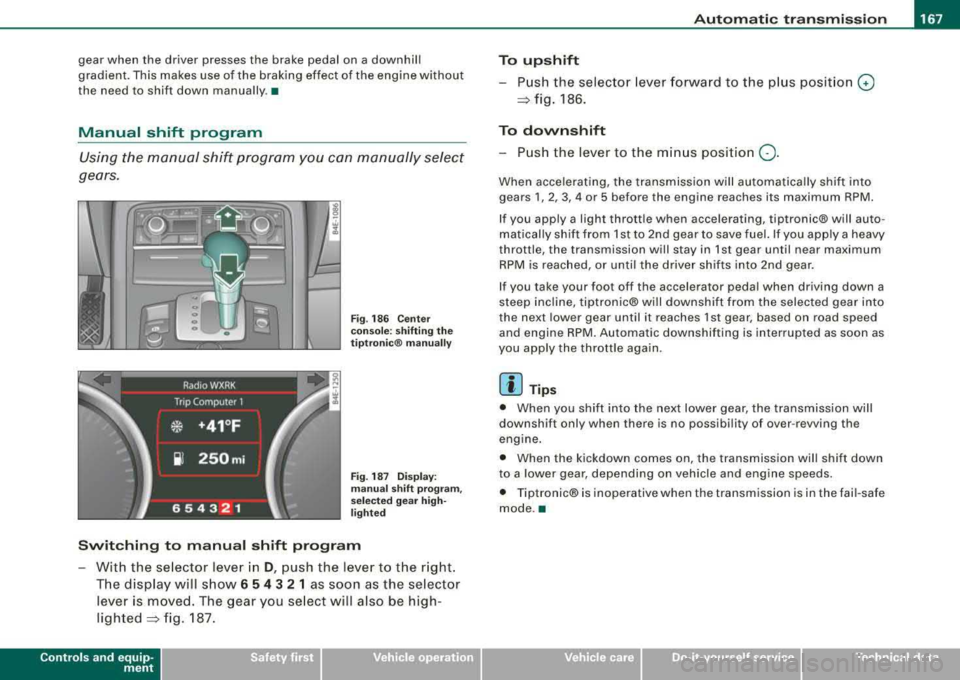
Switching to manual shift program
With the se lector lever in D, push the lever to the right.
The display will show
6 5 4 3 2 1 as soon as the selector
lever is
moved. The gear you select will also be high
lighted~ fig. 187.
Controls a nd eq uip
ment
To upshift
Push the selector lever forward to the plu s position 0
~ fig. 186.
To downshift
- Push the lever to the minus position Q.
When accelerating, the transmission will automatically shift into
gears
1, 2, 3, 4 or 5 before the engine reaches its maximum RPM.
If you apply a light thrott le when accelerating, tiptronic® will auto
matically shift from 1st to 2nd gear to save fuel. If you app ly a heavy
throttle, the transmission will stay in 1st gear until near maximum
RPM is reached, or until the driver shifts into 2nd gear.
If you take your foot off the accelerator peda l when driving down a
steep inc line, tiptronic® wi ll downshift from the selected gear into
the next lower gear until it reaches 1st gear, based on road speed
and engine RPM. Automatic downshifting is interrupted as soon as
you apply the throttle again.
[ i ] Tips
• When you shift into the next lower gear, the transmission will
downshift only when there is no possibi lity of over -revving the
engine.
• When the kickdown comes on, the transmission will shift down
to a lower gear, depending on vehicle and eng ine speeds.
• Tiptronic® is inoperative when the transmission is in the fai l-safe
mode .•
Vehicle care I I irechnical data
Page 188 of 404
___ A_ d_a_ p_ ti_v _ e_ A_ ir_ S_u_ s_ p_e _n_ s_ io_n ___________________________________________ _
Chassis Controls
Four different driving modes can be set by the driver.
The automatic control processes are speed -and time -dependent.
For example, it is not possible to raise the suspension to the lift
mode above certain speeds .
When a speed of about 75 mph (120 km/h) is exceeded for more than 30 seconds, the vehicle is automatically lowered approximate ly 1
inch (25 mm) to a level suitable for highway speeds, except in the
standard mode . Road holding is optim ized as a result of the lower
center of gravity and fuel consumption is reduced as a result of
reduced wind resistance .
Level adjustment
lift
standard
automatic
dynam ic
automatic Ground
clearan ce
about 5 .7 inches (145 mm)
a bout 4.7 inches ( 120 m m)
about 4 .7 inches (120 mm)
about 3.9 inches (100 mm)
Se lect the automatic mode if you prefer a suspension setting
e m phas izing comfort . Damping characterist ics emphasiz ing
comfort are selected in this mode.
• Lowering : When a speed of abou t 75 mph ( 120 km/h) is excee ded
for more than 30 seconds, the vehic le is automatically lowered by
about 1 inch (25 mm) .
• Raising : The vehic le is automat ical ly raised again if the speed
fa lls bel ow about 44 mph (70 km/h) for a per iod of 120 seconds. The
vehic le is raised immediate ly when speed fa lls below about 22 mph
(35 km/h) .
dynami c
Select the sport mode if you prefer a sporty suspensio n setting . In
this mode, the veh ic le is lowered whi le it is still stationary and sporty damping characteristics are selected
. The warning
light ~
in the instrument cluster will c ome on for a few seconds just to
remind you of the reduced ground clearance .
I f you switch off the engine while the vehic le is in the dynamic mode
and then switc h on the ign it ion once aga in,
t h e ~ warning lig ht
wi ll also come on again for a few seconds.
• Lowering : When a speed of abou t 75 mph (120 km/h) is exceeded
for more than 30 seconds , the vehicle is automatica lly lowered by an
addi tiona l 0 .2 in (5 mm).
• Raising : The vehic le is automatically raised again if the speed
f alls below ab out 44 mph (70 km/ h) for a per iod of 120 seconds . The
vehic le is raised immediate ly when speed fa lls below about 22 mph
(35 km/h) .
sta nd ard
Se lect the s tandard mode if you desire a suspensi on se tt ing with a
special emphasis on comfort . In the standard mode there is
n o
lo wer ing of t he suspension . Even at high speeds, the vehicle stays
at the same level. Damping characteristics with a decided emphasis
on com fort are selected in this mode.
lift
Se lec t t he lif t mode when you have to travel over poor secti ons of
road (e .g . trails). In the lift mode, the vehic le is raised by 1 inch (25
mm ) compared to norma l level wh ile it is st ill stati onary a nd
damping characteristics are ad justed to emphasize comfort.
T he lift mode can be act ivated on ly at speeds below 50 mph (80
k m/h). When a speed of about 62 mph (100 km/h) is exceeded, the
system automatical ly leaves lift mode and the mode set previously
(standard, au tomat ic, dynamic) is activated aga in. •
Page 279 of 404
______________________________________________ D_ ri_v _ i_ n _, g..,_ a_ n_d _ e_ n_ v_i_ro _ n_ m_ e_ n_t __ lll
Driving and environment
The first 1,000 miles (1,500 km) and
afterwards
New engine
The engine needs to be run-in during the first 1,000 miles
(1,500 km).
For the first 600 miles (1,000 kilometers):
Do not use full throttle.
- Do not drive faster than 3/4 of the top speed marked on
the speedometer.
- Avoid high engine speeds .
From 600 to 1,000 miles (1,000 to 1,500
kilometers):
- Speeds can gradually be increased to the maximum
permissible road or engine speed.
During and after break-in period
-Do not rev the engine up to high speeds when it is cold.
This applies whether the transmission is in N (Neutral) or
1n gear.
After the break-in period
- Do not exceed maximum engine speed under any
circumstances.
- Upshift into the next higher gear
before reaching the red
area at the end of the tachometer
scale => page 12.
Controls and equip
ment Safety first
Vehicle operation
During the first few hours of driving, the engine's internal friction is
higher than later when all the moving parts have been broken in.
How well this break-in process is done depends to a considerable
extent on the way the vehicle is driven during the first 1,000 miles
(1,500 kilometers).
0 Note
Extremely high engine speeds are automatically reduced. However,
these rpm limits are programmed for an engine well run-in, not a
new
engine.
~ For the sake of the environment
Do not drive with unnecessarily high engine speeds -upshifting
early saves fuel, reduces noise and protects the environment .•
New tires
If your vehicle is running on new tires, drive particularly
careful for the first 350 miles (500 kilometers) after fitting.
& WARNING
New tires tend to be slippery and must also be "broken-in". Be
sure to remember this during the first 350 miles (500 kilometers).
Brake
gently. Avoid following closely behind other vehicles or
other situations that might require sudden, hard braking.
•
Vehicle care Do-it-yourself service Technical data
Page 280 of 404
llffll,.__ __ D_r_ iv _ in_.... g,_ a_n_ d __ e_n _v_ ir_o_ n_ m_ e_n_ t _____________________________________________ _
New brake pads
Remember that new brake pads do not have a full braking
effec t during the first 250 miles (400 kilometers) after they
are installed .
New brake pads have to be "burnished in" before they have optimal
grab =>& .
During the break -in period, you s hou ld avoid putting severe loads
on the brakes . Severe loads include, for examp le, sudden hard
braking, in particular at very high speeds or, for example, on moun
t ain passes.
& WARNING
N ew brake p ad s don 't h ave the be st stopping po wer and mu st be
"broken -in " during the initial 100 to 150 mile s (150 to 200 kil ome
t e rs) of norm al c ity dri ving . You can comp en sa te for thi s by
pr ess ing the brake ped al more firmly . Thi s al so appli es later when
ne w pad s a re in sta lled. •
Catalytic converter
It is very important tha t your emission control sys tem
(catalytic converter) is functioning properly to e nsure that
y o ur vehicle is running in an environmentally sound
manner.
-Always use lead-f ree gasoli ne :=> page 301, "Fuel supply".
-Never run the tank down a ll the way to empty.
-Never put too much motor o il in your engine :=> page 312,
"Adding eng ine oil 'l=;r111
•
-Never try to push -or tow -s ta rt yo ur vehic le.
T he catalytic converter is an efficient "clean -up" device built into the
exhaust system of the vehicle. The catalytic converter burns ma ny
of the po llutants in the exhaust gas before they are released into the
atmosphere.
The exclusive use o f un leaded fue l is critica lly important for the l ife
of the cata lytic converter and proper functioning of the engine.
& WARNING
• Do not park or operate th e veh icle in ar ea s where the hot
e x hau st sys tem m ay come in cont act w ith dr y grass, brush , fuel
s pill or other material which can cau se a fire .
• Do not appl y additi ona l u ndercoating or ru stpr oofing on or
near the exhau st manifol d, exhau st pipe s, ca tal ytic converter or
h ea t shield s. Du ring dri ving , the sub sta nce u sed f or under coating
c ould overhe at and cau se a fir e.
0 Note
• Be aware that just one tank filling with leaded fue l wi ll already
seriously degrade the performance of the catalyt ic converter.
• Do not exceed the correct engine oil
level => page 312 .
• Do not drive until the fuel tank becomes comp letely empty . The
engine cou ld misfire. Unburned fuel could also get into the exhaust
system and this could cause the catalytic converter to overheat .
• Do not turn off t he ignition wh ile the vehicle is moving.
• Do not continue to operate your vehicle under these conditions,
as otherwise fuel can reach the cata lyt ic converter . This cou ld result
in overheating of the converter, requiring its rep lacement .
• To assure eff ic ient operat ion of the Emiss ion Contro l System:
- Have your vehicle maintained properly and in accordance with
the service recommendations in your Warranty
& Maintenance
booklet. _,.
Page 281 of 404
______________________________________________ D_ ri_v _ i_ n _, g..,_ a_ n_d _ e_ n_ v_i_ro _ n_ m_ e_ n_t __ ffllll
- Lack of proper maintenance as wel l as improper use of the
vehic le will impair the func tion of the emission con tro l system
and cou ld lead to damage .
<£> For the sake of the envir onment
Even when the Emission Control System is operating properly, the
exhaust gas can have a su lfur -like exhaust gas smell under some
operating states . This depends on the sulfur content of the fuel
being used. Using a different b rand of fue l may help, or fil ling the
tank with lead-free super grade gasol ine. •
Avoid damaging the vehicle
When you are driving on poor roads, or over curbs, steep ramps,
etc., make certain that low- lying parts such as spoi lers and exhaust
system parts do not bottom out and get damaged.
T his is especial ly true for vehicles with low -s lung chassis (sports
chassis)* and ful ly loaded vehicles .•
Operate your vehicle economically
and minimize pollution
General
Y o ur personal style of driving will determine the economy
of your vehicle , as well as exhaust and noise levels.
Fuel economy, environmenta l impact, and wear on your engine,
brakes and t ires largely depend on three factors :
• your personal driving style
• operat ing cond it ions
• t echnica l limitations
Controls and equip
ment Safety first Vehicle operation
I
f you anticipate what you need to do next and drive economica lly,
you can eas ily cut your fuel consumptio n by 10 -15 percent . This
section wil l give you some tips on how you can help the environ
ment and your poc ketboo k.
[ i ] Tips
The consumption estimates as published by ENV IRO NME NTA L
PRO TECTION AGENCY (EPA) and Transport Canada may not corre
spond to your actua l consumption on the road, which wi ll vary
depe nding upon veh ic le load and speed, road and weather condi
tions, trip length, etc. •
Drive smoothly and keep a lookout ahead
Vehicles use the most fuel when they ore accelerating .
-Avo id unnecessary accelerat ing a nd braking .
Vehicles use the most fue l when they are accelerating . If you antici
pate what is going to happen
ne xt, you wi ll need to brake less and,
thus, acce lerate less. Let the vehicle coast whenever possib le -for
examp le when you see that the next traffic light is red. •
Avoid full throttle
Driving at moderate speeds saves fuel and improves your
mileage.
- Try and keep we ll below your car 's max imum speed.
Acce lerating gently reduces fue l consumption, engine wear, and
does no t disturb the envir onment.
Fue l consumption, exhaust emissions and engine noise increase
dispropo rtionately at h ig h speeds . If yo u drive at approxi mate ly
three quarters of top speed, fuel consumpt ion wil l be reduced by
~
Vehicle care Do-it-yourself service Technical data
Page 282 of 404
ffl.,__ __ D_r_ i_v _i_n _.g..,_ a_ n_d_ e_ n_v _ i
_ r_o _ n_ m_ e_ n_ t _______________________________________________ _
one half. Never drive faster than the posted speed limit and weather
co nditions permit. •
Reducing unnecessary idling
Even when your car is just idling it burns up fuel.
- Shut the eng ine off when you are not driving the vehicle .
- Do not warm up the vehicle by letting the engine run at
id le .
It makes sense to shut off the engine in traff ic jams, when waiting
for trains to pass at rai lroad crossings, or at traffic lights that have
long waits on red. Turning the engine off for just 30 -40 seconds
saves more fue l than is burned starting the engine again .
It takes a long time for the engine to warm up fu lly when it is
running at idle. However, wear and noxious em issions are espec ially
high when the engine is warming up . So you should drive away as
soon as you start the engine and avoid running at high rpms while
the engine is sti ll warming up.
0 Note
Do not leave engine idling unattended after starting . If warning
lights should come on to indicate improper operation, they would
go unheeded. Extended idling also produces heat, which could
result in overheating or other damage to the vehicle or other
property .•
Regular maintenance
A badly tuned engine unnecessarily wastes a lot of fuel.
- H ave your vehicle serviced at regular intervals .
By having your vehicle regularly serviced by an Audi dealer helps to
ensure t hat it runs properly and economical ly . The condit ion of your
vehic le not only affects its safety and abi lity to hold its va lue, it also
affects
fuel con sumpt ion .
C hec k your oil each time you fill your tan k.
The amount of oil used is related to engine load and speed.
I t is norma l for the oi l consumption of a new engine to reach its
lowest va lue after a certain mileage has been driven.
You must drive your vehicle about 3,000 miles (5,000 kilometers) before you can properly assess oil consumption .
T his also applies to fuel consump tion and engine output .
0 Note
• Have your vehicle maintained properly and in accordance with
t he service recommendat ions in your Warranty
& Maintenance
booklet. Lack of proper ma intenance as well as improper use of the
vehic le wi ll impair the function of the emission control system and
cou ld lead to damage.
• Do not alter or remove any component of the Emission Contro l
System unless approved by the manufacturer.
• Do not alte r or remove any device, such as heat sh ields,
switches, ignition wires, valves, which are designed to protect your
vehic le's Emission Control System and other important vehic le
components .•
Fewer short trips
Fuel consumption will always be relatively high on short
trips.
- Try to avoid driving short dista nces with a cold engine. ~
Page 283 of 404
________________________________________________ D_ r_iv _ in_,... g,_ a_n_ d_ e_n_ v _i _ro _ n_ m_ e_ n_t __ ffllll
T he engine and catalytic converter have to reach their optimal op er
a ting t emp era tur e
to reduce fuel consumption and noxious emis
sions effective ly .
Just after starting, a cold engine in a mid -size car only achieves a
fue l economy of 6-8 m iles per gal lon (30-40 1/100 km). After about a
half a mi le, fue l economy climbs to 12 mpg (201/100 km). After about
2.5 m iles (4 km), the engine is at its proper operat ing temperature
and fuel economy has reached a normal level. So you can see that
you should avo id short tr ips whenever poss ib le .
The
out sid e te mperature is also critical in this regard . Your car
consumes more fuel in the winter than in the summer. •
Controls and equip
ment Safety first Vehicle operation
Vehicle care Do-it-yourself service Technical data
Page 285 of 404
____________________________________________________ T_r_a _i_l e_ r_t_ o _ w_ i
_ n...; g=- -•
Operating instructions
M ax im um tra iler weig ht
A trailer for your vehicle is limited to a typ ical c lass 1 or class 2
trailer.
T ra ile r l oad d is tributi on
Be sure the load in the trailer is he ld securely in place to prevent it
from shifting forward, backward or s ideways .
Never a llow a pass enger to r ide in a trailer:::::, & in "Driving instruc
t ions" .
Engin e coo lin g sys te m
Tow ing a trai ler makes the engine work harder. It is important that
the cooling system's performance is up to the additiona l load. Make
sure that the coo ling system has enough fluid .
Tire press ure
When towing a trailer, inflate the tires of your veh icle to t he co ld tire
pressure listed under "Full load" on the labe l located either on the
driver's side B -pil lar (visible when the door is open) or inside the fuel
filler flap . Inflate trailer tires to trai ler and tire manufacturers' spec
ifications.
L ig ht s
The head light settings should be checked wit h the trai ler attached
before driving off. Check to make sure both vehicle and trai ler lights
are working properly .
Safe ty c ha in s
Be s ure trailer safe ty chains are properly connected from the trailer
to the hitch on the vehicle. Leave enough slack in the chains to
permit turning corners . When yo u insta ll safety chains, make sure
they will not drag on the road when you are driving.
T he chains should cross under the trailer tongue to prevent it from
dropping in case of separat ion from the hitch.
Controls and equip
ment Safety first
Vehicle operation
0 Note
If you are go ing to tow a trai ler, you must activate the tra iler opera
tion
mode :::::, page 189, "Towing a Trailer". •
Driving instructions
Driving with a trailer always requires extra care and
consideration.
To obtain the best possib le handling of ve hicle and trailer,
p lease note t he following :
- Do not tow a loaded trailer when your car itself is not
loaded.
- Be especia lly careful whe n passing other vehic les .
- Observe speed limits .
- Do not drive at the maximum permiss ible speed .
- Always apply brakes early.
- Monitor t he temperature ga uge .
W eight d istr ibu tion
Towing a loaded trailer with an empty car results in a highly
unstable d istribution of weight. If this cannot be avoided, drive at
very low speeds only to avoid the risk of losing steering control.
A "balanced" rig is easier to operate and control. This means that
t he tow vehicle should be loaded to the extent possible and permis
sib le, while keeping the trailer as light as possib le under the circum
stances . Whenever possible, transfer some cargo to the luggage
compartment of the tow vehicle whi le observing tongue load
requirements and vehicle loading considera tions .
.,,.
Vehicle care Do-it-yourself service Technical data