tow AUDI S8 2008 Owner's Guide
[x] Cancel search | Manufacturer: AUDI, Model Year: 2008, Model line: S8, Model: AUDI S8 2008Pages: 404, PDF Size: 52.7 MB
Page 203 of 404
& WARNING (continued)
• Always adjust the driver's seat and the steering wheel so that
there are at least 4 inches (10 cm) between the knees and the
lower part of the instrument panel .
• Always hold the steering wheel on the outside of the steering
wheel rim with your hands at the 9 o'clock and 3 o'clock positions
to help reduce the risk of personal injury if the driver's airbag inflates .
• Never hold the steering wheel at the 12 o'clock position or with
your hands at other positions inside the steering wheel rim or on
the steering wheel hub. Holding the steering wheel the wrong way
can cause serious injuries to the hands, arms and head if the
driver's airbag inflates
• Pointing the steering wheel toward your face decreases the
ability of the supplemental driver's airbag to protect you in a colli
sion .
• Always sit in an upright position and never lean against or
place any part of your body too close to the area where the airbags
are located.
• Before driving, always adjust the front seats and head
restraints properly and make sure that all passengers are properly
restrained .
• Never adjust the seats while the vehicle is moving. Your seat
may move unexpectedly and you could lose control of the vehicle.
• Never drive with the backrest reclined or tilted far back! The
farther the backrests are tilted back, the greater the risk of injury due to incorrect positioning of the safety belt and improper
seating position.
• Children must always ride in child seats
=> page 243. Special
precautions apply when installing a child seat on the front
passenger seat
=> page 218 . •
Controls and equip
ment Safety first
Vehicle operation
Driving Safely
Proper seating position for the front
passenger
The proper front passenger seating position is important
for safe, relaxed driving.
For your own safety and to reduce the risk of injury in the
event of an accident, we recommend that you adjust the
seat for the front passenger to the follow ing position:
- Move the front passenger seat back as far as possible.
There must be a minimum of 10 inches (25 cm) between
the breastbone and the instrument
panel=> &.
-Adjust the angle of the seatback so that it is in an upright
position and your back comes in full contact with it
whenever the vehicle is moving.
- Adjust the head restraint so that the upper edge is as
even with the top of your head as possible but not lower
than eye level and so that it is as close to the back of your
head as
possible => page 203.
-Keep both feet flat on the floor in front of the front
passenger seat.
- Fasten and wear safety belts
correctly =:> page 213.
For detailed information on how to adjust the front passenger's
seat, see
=> page 86 .
& WARNING
Front seat passengers who are unbelted, out of position or too
close to the airbag can be seriously injured or killed by the airbag
as it unfolds. To help reduce the risk of serious personal injury : ..,_
Vehicle care Do-it-yourself service Technical data
Page 207 of 404
------------------------------------------------=D:.:.r.:.iv :..:.:. in.:.:g~ S::. a
::.:. fe::.:.! ly~ --
& WARNING
Pedals that cannot move freely can cause loss of vehicle control
and increase the risk of serious injury.
• Never place any objects in the driver's footwell . An object could
get into the pedal area and interfere with pedal function. In case
of sudden braking or an accident, you would not be able to brake
or accelerate!
• Always make sure that nothing can fall or move into the
driver's footwell. •
Floor mats on the driver side
Always use floor mats that can be securely attached to
the floor mat fasteners and do not interfere with the free
movement of the pedals.
-Make sure that the floor mats are properly secured and
cannot move and interfere with the pedals =>& .
Use only floor mats that leave the pedal area unobstructed and that
are firmly secured so that they canno t slip out of position . You can
obtain suitable floor mats from your authorized Audi Dealer.
Floor mat fasteners are installed in your Audi.
Floor mats us ed in your vehicle must be attach ed to these fas teners .
Properly securing the floor mats will prevent them from sliding into
positions that could interfere with the pedals or impair safe opera
tion of your vehicle in other ways.
& WARNING
Pedals that cannot move freely can result in a loss of vehicle
control and increase the risk of serious personal injury.
• Always make sure that floor mats are properly secured.
Controls and equip ment Safety first Vehicle operation
&, WARNING
(continued)
• Never place or install floor mats or other floor coverings in the
vehicle that cannot be properly secured in place to prevent them
from slipping and interfering with the pedals or the ability to
control the vehicle.
• Never place or install floor mats or other floor coverings on top
of already installed floor mats. Additional floor mats and other
coverings will reduce the size of the pedal area and interfere with
the pedals.
• Always properly reinstall and secure floor mats that have been
taken out for cleaning.
• Always make sure that objects cannot fall into the driver foot
well while the vehicle is moving. Objects can become trapped
under the brake pedal and accelerator pedal causing a loss of
vehicle control.
•
Stowing luggage
Loading the luggage compartment
All luggage and other objects must be properly stowed and secured in the luggage compartment.
Loose items in the luggage compartment can shift
suddenly, changing vehicle handling characteristics. Loose
items can also increase the risk of serious personal injury in
a sudden vehicle maneuver or in a collision.
- Distribute the load evenly in the luggage compartment.
- Always place and properly secure heavy items in the
luggage compartment as far forward as possible.
- Secure luggage using the tie-downs provided
=> page 100, "Luggage compartment ".
Vehicle care Do-it-yourself service Technical data
Page 210 of 404
-Driving Safely
Applicable to Canada
Canadian customers who wish to report a
safety-re lated defect to Transport Canada,
Defect Investigations and Recalls, may tele
phone the toll free hotline:
Tel.: 1-800-333-0371
or contact Transport Canada by mail at:
Road Safety and Motor Vehicle Regulation
Directorate
Transport Canada
Tower C, Place de Ville,
330 Sparks Street
Ottawa, ON K1 A 0N5
For additional road safety information, please
visit the Road Safety website at:
http://www.tc.gc.ca/roadsafety/menu.htm •
Page 217 of 404
fl::. WARNING (continued)
• Always read and heed all WARNINGS and other important infor
mation
~ page 212. •
Pregnant women must also be correct ly
restrained
The best way to protect the fetus is to make sure that
expectant mothers always wear safety belts correctly
-
throughout the pregnancy.
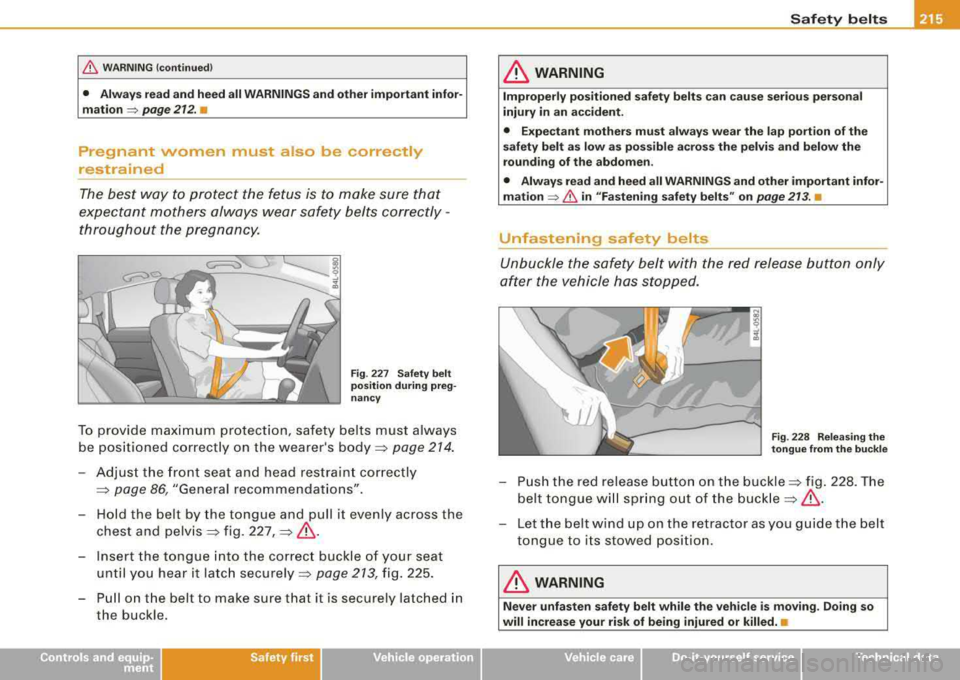
Fig. 227 Safety belt
position during preg
nancy
To prov ide maximum protection, safety belts must always
be posi tioned correctly on the wearer's
body => page 214.
-Adjust the front seat and head restraint correctly
=> page 86 , "General recommendations".
- Hold the belt by the tongue and pull it evenly across the
chest and
pelvis => fig. 227, => &.
- Insert the tongue into the correct buckle of your seat
until you hear it latch
securely => page 213, fig. 225.
- Pull on the belt to make sure that it is securely latched in
the buckle.
Safety belts
& WARNING
Improperly positioned safety belts can cause serious personal
injury in an accident.
• Expectant mothers must always wear the lap portion of the
safety belt as low as possible across the pelvis and below the
rounding of the abdomen.
• Always read and heed all WARNINGS and other important infor
mation
~ & in "Fastening safety belts" on page 213. •
Unfastening safety be lts
Unbuckle the safety belt with the red release button only
after the vehicle has stopped.
Fig . 228 Releasing the
tongue from the buckle
Push the red release button on the buckle => fig. 228. The
belt tongue will spring out of the buckle
=> &.
Let the belt wind up on the retractor as you guide the belt
tongue to its stowed pos it ion.
& WARNING
Never unfasten safety belt while the vehicle is moving. Doing so
will increase your risk of being injured or killed. •
Vehicle care I I irechnical data
Page 228 of 404
___ A_ ir_b_ a_ g
=-- s
--a. y_s _t _e _m _________________________________________________ _
• A s ensor in the safety belt latch for the driver and for the front
s eat pass enger tha t sen ses wheth er that safe ty bel t i s la tc hed or not
and transm its this information to t he el ectron ic control unit .
& WARNING
Damage to the front passenger seat can prevent the front airbag
from working properly .
• Improper repair or disassembly of the front passenger and
driver seat will prevent the Advanced Airbag System from func
tioning properly.
• Repairs to the front passenger seat must be performed by qual
ified and properly trained workshop personnel .
• Never remove the front passenger or driver seat from the
vehicle .
• Never remove the upholstery from the front passenger seat.
• Never disassemble or remove parts from the seat or disconnect
wires from it .
• Never carry sharp objects in your pockets or place them on the
seat .
If the weight-sensing mat in the passenger seat is punctured
it cannot work properly.
• Never carry things on your lap or carry objects on the
passenger seat . Such items can increase the weight registered by
the weight-sensing mat and send the wrong information to the
airbag control unit .
• Never store items under the front passenger seat . Parts of the
Advanced Airbag System under the passenger seat could be damaged , preventing them and the airbag system from working
properly.
• Never place seat covers or replacement upholstery that have
not been specifically approved by Audi on the front seats.
• Seat covers can prevent the Advanced Airbag System from
recognizing child restraints or occupants on the front passenger
seat and prevent the side airbag
in the seat backrest from
deploying properly.
& WARNING (continued)
• Never use cushions, pillows, blankets or similar items on the
front passenger seat . The additional padding will prevent the
weight-sensing mat in the seat from accurately registering the
child restraint or person on the seat and prevent the Advanced
Airbag System from functioning properly .
• If you must use a child restraint on the front passenger seat
and the child restraint manufacturer's instructions require the use
of a towel , foam cushion or something else to properly position
the child restraint, make certain that the PASSENGER AIR BAG OFF
light comes on and stays on whenever the child restraint is
installed on the front passenger seat .
• If the PASSENGER AIR BAG OFF light does not come on and stay
on , immediately install child restraint in a rear seating position
and have the airbag system inspected by your Audi dealer.
•
How the Advanced Airbag System
components work together
T he front Advanc ed Airba g Syst em and th e side airba gs supplement
t h e p rotection offered by the fro nt three -point safety belt s with
pretens ioners and load limiters and t he adjustab le head restraints
to help reduce the risk of in jury in a w ide range of acc ident and
cras h situat ions. Be sure to read the im por tant in form ation abo ut
safety and heed the WAR NINGS in this chapter.
Depl oyment of the Adva nced Airb ag Sys tem and the activa tio n of
the safety be lt pretensioners depend on the deceleration measured
b y th e c ra sh sen so rs and regi stere d by the elec tro nic c ontro l u nit.
C rash severity d epends on speed and dece leration as w ell as the
m ass a nd stiffness of t he vehicle o r object i nvo lve d in the c ra s h .
When t he elec tron ic contro l unit regist er s a lo w seve rity c rash a nd
the safety belt is be ing used, the a irbag wi ll not deploy . If the safety
b elt is not being u se d, the first s ta ge de ploys, f ollow ed by the
second stage after a much later time in t he crash sequence .
.,,_
Page 258 of 404
__ _:C~ h~il ~d !.._ S~ a~fe ~t~ y~ ------------------------------------------
&, WARNING (continued)
• Always buckle the child safety seat firmly in place even if a
child is not sitting in it. A loose child safety seat can fly around
during a sudden stop or in a crash .
• Always make sure the seat backrest to which the child restraint
is installed is in an upright position and securely latched into place
and cannot fold forward. Otherwise, the seat back with the child
safety seat attached to it could fly forward in the event of an acci
dent or other emergency situation.
• Always read and heed all WARNINGS whenever using a child
restrained in a vehicle is being used
=> page 243. Special precau
tions apply when installing a child safety seat on the front
passenger seat
=> page 220, "Child restraints on the front seat -
some important things to know".•
Deactivating the convertible locking retractor
The convertible locking retractor for child restraints will
be deactivated automatically when the belt is wound all the way back into the retractor.
-Press the red button on the safety belt buckle. The belt
tongue will pop out of the buckle.
- Guide the belt all the way back into its stowed position.
Always let the safety belt retract completely into its stowed position.
The safety belt can now be used as an ordinary safety belt without
the convertible locking retractor for child restraints.
If the convertible locking retractor should be activated inadvert
ently, the safety belt must be unfastened and guided completely
back into its stowed position to deactivate this feature. If the
convertible locking retractor is not deactivated, the safety belt will
gradually become tighter and uncomfortable to wear.
& WARNING
Improperly installed child safety seats increase the risk of serious
personal injury and death in a collision.
• Never unfasten the safety belt to deactivate the convertible
locking retractor for child restraints while the vehicle is moving.
You would not be restrained and could be seriously injured in an
accident.
• Always read and heed all WARNINGS whenever using a child
restrained in a vehicle is being used
=> page 243. Special precau
tions apply when installing a child safety seat on the front
passenger seat
=> page 220, "Child restraints on the front seat -
some important things to know" .•
Additional Information
What types of child restraint anchors are
available and how are they related to child
safety?
For years, child restraints have been installed using the safety belts
already present in every vehicle.
Since September
1, 1999, child restraint manufacturers have been
providing tether straps that attach the top of the child restraint to
the vehicles structure, on most of their forward-facing systems in order to comply with U .S . Federal regulations for child restraint
performance in a crash. Vehicle manufacturers are required to
phase -in tether anchorages for attachment of the tether strap in
their U.S. vehicles beginning September 1, 1999.
The combination of the tether anchorages and the lower anchor
ages is now generally called the
LATCH system for "Lower Anchor
and Tether for Children".
~
Page 273 of 404
_________________________________________ ___..!l~ n ~t ~e :..!.ll ~ig ~ e:.!::n ~t ~ t~ e~ c~ h~ n~o ~l~o ~g !Jy ~ --
•
On steep slo pes, you shou ld use th e braking effect of the engine .
This way, yo u preve nt u nn ecessary wear on the bra ke sys te m. If you
must use your brakes, do not hold the brakes down cont inuous ly .
Pu mp the brakes at in terval s.
Moisture or road salt
U nder ce rtain cond itions, for e xa m ple, w hen drivi ng thro ug h w ate r
or v ery h eavy rain, or even after washing your vehicle, the braking
e ff ect can be red uce d du e to mo is tu re ( or in fr eezin g c ond it ions ice)
on t he b rake pads . A few carefu l brake applicatio ns should dry off
t h e br ake pads o r rem ove a ny ice coatings .
The e ffective ness of t he b ra kes ca n b e red uced wh en th e ve hicle is
driven o n a salt -covered road and t he brakes are not used. Here too,
yo u should cle an off acc umulate d sa lt co atin g from b rake di scs a nd
pads w ith a few careful app lications of th e
brake=>&.
Corrosion
T here may be a tendency for dirt to build up on t he bra ke pads and
c o rr os ion t o form on th e dis cs if t he car is not driven reg ular ly or
only for short trips with little use of the bra kes .
If th e bra ke s are not us ed fr equ ent ly , or if corro sion h as form ed on
th e discs, it is adv isab le to cl ean off the pa ds and discs by braking
firm ly a few times from a moderate ly h igh
speed =>& .
Faults in the brake system
If y ou s ho uld n oti ce a
sud d en inc rea se in b rake pe dal trave l, then
one of the two b rake c ircuits may h ave
fai led =>& .
Low brake fluid level
M alfunctions can occur in the brake system if the b ra ke fluid leve l is
t oo low. Th e br ake fluid level is monitor ed ele ctr onic a lly .
& WARNING
• You should perform braking maneuvers for the purpose of
cleaning the brake system only if road conditions permit. Other
road users must not be put at risk -you may cause an accident!
& WARNING (continued )
• Before descending a steep grade , reduce speed and shift trans
mission into a lower gear or lower driving range . Do not ride the
brakes or hold the pedal down too long or too often . This could
cause the brakes to get hot and diminish braking efficiency .
• Do not "ride the brakes" by resting your foot on the pedal when
you do not intend to brake . This may cause the brakes to overheat ,
premature wear and increased stopping distance .
• Under certain climatic and operating conditions such as
passing through water, driving in heavy rain or after washing the
vehicle , the effectiveness of the brakes can be reduced . In winter,
ice can accumulate on the brake pads , linings , discs and drums .
Carefully apply brakes for a test. Brakes will dry and ice coatings
will be cleaned off after a few careful brake applications .
• Driving for an extended period of time on salt-covered roads
without using your brakes can also affect braking efficiency. Clean
off accumulated salt coating from brake discs and pads with a few
careful brake applications .
• If you damage the front spoiler , or if you install a different
spoiler, be sure the air flow to the front brakes is not obstructed.
Otherwise the brake system could overheat reducing the effective
ness of the entire brake system.
• Failure of one brake circuit will impair the braking capability
resulting in an increased stopping distance. Avoid driv ing the
vehicle and have it towed to the nearest Audi dealer or qualified
workshop. •
Brake booster
Th e brake boo ster adds ex tra braking po wer.
The b ra ke booster works wit h vacuu m press ure which is created
on ly wh en th e e ngi ne is
r un ning => & .
Page 274 of 404
-Intelligent technology
P:V:1--------=-- --=-=-------------
& WARNING
• Never let the vehi cle roll to a stop with the engine shut off .
• If the brake boo ster i s not working, for example when towing
your vehicle , or because the brake booster has so mehow been
damaged, the brake pedal must be pres sed considerably harder to
make up for the la ck of booster as sistan ce . •
Functioning of Anti-Lock Brake System (ABS)
AB S pre vent s th e wh eels fr o m lo ckin g up un der braking .
The ABS contributes effective ly to ve hicle control s ince it prevents
th e whee ls from
lo cking w hen t he brakes are a ppl ied. This mea ns
that the vehicle remains steerable and is less likely to skid.
With ABS you do not need to pump the brake . Just hold the brake
pedal down.
H owever, do not expect the ABS to shorten braking distance under
all cir cum stances. W hen drivin g on g ravel o r on new ly fallen s now
on top of icy surfac es, bra king distance may be even longer, there
fo re, unde r th ese circum stances, i t is especially i mporta nt th a t yo u
drive slow ly and with great care .
How the ABS system works
An automatic check is made when a speed of about 4 mph (6 km/h)
is reac hed . When this ha p pens, a pumping n oise can be hea rd.
If an indiv idua l wheel begins to rotate too s lowly in relation to
vehic le speed and tends to lock, the ABS automatica lly reduces
brake pressure to prevent that whee l from loc king .
T his automat ic adjustment process wil l cause a
slight vibration of
th e br ak e pe dal a nd some noises to ale rt you th at ve hic le sp eed
must be adapted to existing road and traffic conditions.
& WARNING
Although the ABS is very effe ctive , always remember that braking
capability is limited by tire traction. Alway s adjust your driving
speed a ccording to the road and traffi c conditions . Do not let the
extra safety afforded by the ABS tempt you into taking extra risks.
The ABS cannot overcome the laws of physics.
[ i ] Tips
• I f ABS is not funct io ni ng properl y, a wa rn ing li ght will co me o n.
See ~ page 21.
• I f a fault occurs in the A BS, the EDL is also not functioning. This
i s indica ted by the ABS wa rn ing l igh t.•
Brake assistant
The brake assis tant is desig ned to ach ieve the o ptim um
brakin g eff ec t.
The br ake assistan t helps to in cr eas e the effec tive b raki ng pow er
and thus to achieve a shorter stopping distance . If the driver
p re sses the b rake pe dal very q uick ly, the brake assistan t auto mati
ca lly boosts the brakin g force to the maximum level, up to th e point
whe re the a nti-lock b rake functi on (AB S) int ervenes to sto p the
w hee ls from loc king . You s hou ld t hen k eep th e br ake pedal pressed
until t he vehicle ha s braked to the required speed . The brake a ssis
t ant s witches itse lf off as soo n as you re lease t he bra ke pedal.
T he b rake assistant will not be ope rative if there is a malfunction in
th e ABS .
& WARNING
Please remember that the accident risk always increases if you
drive too fast , especially in corners or on a slippery road , or if you
follow the vehicle ahead of you too closely . Increased risk of an
~
Page 275 of 404

Intellig ent tec hnol ogy -
------------ -=--=-= '-
& WAR NIN G (c onti nued )
acc ident canno t b e co mp ensat ed for even b y th e br ake assis tant,
s o alway s maintain a safe sp eed . •
Servotronic® - advanced power
steering system
The power steering systems uses the power of the
running engine to allow precise s teering with little effor t.
The advanced Servotronic® power steering system senses the road
speed and electronically adjusts power assistance to provide
comfortab le and safe steer ing response exactly matched to the
vehic le speed.
Power s teeri ng will not work if the engine is off . As a result, the
steering whee l wil l be hard to turn .
The power steering fluid level is checked during the scheduled
maintenance serv ices.
0 Note
If there is an electron ic ma lfunction, servotronic will sti ll funct ion
like a conventiona l power steering system, providing a constant
steer ing suppor t force that is no longer proportionate to the vehicle
speed . This is most noticeable when turning the steering wheel at
low speeds (for examp le w hen parking), -more effor t wi ll be
required than usual.
• Be aware of the different than usua l steering response and
adjust your steering force accordingly .
• Have the problem checked and set right by an Aud i dea ler as
soon as possib le.
Controls and equip ment Safety first Vehicle operation
[
i ] Tip s
• When the engine is running, never hold the steer ing whee l
turned all the way to the right or to the left for longer than 15
seconds. The power steer ing pu mp wil l overheat the hydraul ic fluid
if you keep ho lding the steering whee l turned a ll the way. This is
like ly to damage the power steering system.
• I f the power steering system shou ld fail entire ly, or if the engine
is not runn ing ( for examp le, wh ile be ing towed), you w ill st ill be able
to steer the vehicle . However, considerably more effort will be
requ ired to do so.
• I f the power steering system shou ld have a leak, or is not func
tioning properly, contact your author ized Audi dealer im mediately.
• The power stee ring system requires a special ly formulated
hydrau lic fluid . The power steer ing reservo ir is the one located most
forward on the left side of the engine
compartment => page 308. The
correct flu id level in the reservo ir is important for proper func
tioning of the power steering. •
Driving with your quattro®
With All Wheel Drive, all four wheels are driven.
Genera l inf orm ati on
With All Whee l Drive, power is d istributed to all fo ur wheels. This
happens automatically depending on your driving style and the
road condi tions at the time . See
a lso => page 269, "Electronic differ
entia l lock ! EDU" .
Winter tires
When driving in the winter, your vehicle with All Wheel Drive has an
advantage, even with regular tires . In winter road conditions it may
be advisable to mount winter tires (or all-season tires) for improved
driveabi lity and braking: these ti res must be mounted on all four
wheel s. See
also=> page 341, "Winter tires". ~
Vehicle care Do-it-yourself service Technical data
Page 280 of 404
llffll,.__ __ D_r_ iv _ in_.... g,_ a_n_ d __ e_n _v_ ir_o_ n_ m_ e_n_ t _____________________________________________ _
New brake pads
Remember that new brake pads do not have a full braking
effec t during the first 250 miles (400 kilometers) after they
are installed .
New brake pads have to be "burnished in" before they have optimal
grab =>& .
During the break -in period, you s hou ld avoid putting severe loads
on the brakes . Severe loads include, for examp le, sudden hard
braking, in particular at very high speeds or, for example, on moun
t ain passes.
& WARNING
N ew brake p ad s don 't h ave the be st stopping po wer and mu st be
"broken -in " during the initial 100 to 150 mile s (150 to 200 kil ome
t e rs) of norm al c ity dri ving . You can comp en sa te for thi s by
pr ess ing the brake ped al more firmly . Thi s al so appli es later when
ne w pad s a re in sta lled. •
Catalytic converter
It is very important tha t your emission control sys tem
(catalytic converter) is functioning properly to e nsure that
y o ur vehicle is running in an environmentally sound
manner.
-Always use lead-f ree gasoli ne :=> page 301, "Fuel supply".
-Never run the tank down a ll the way to empty.
-Never put too much motor o il in your engine :=> page 312,
"Adding eng ine oil 'l=;r111
•
-Never try to push -or tow -s ta rt yo ur vehic le.
T he catalytic converter is an efficient "clean -up" device built into the
exhaust system of the vehicle. The catalytic converter burns ma ny
of the po llutants in the exhaust gas before they are released into the
atmosphere.
The exclusive use o f un leaded fue l is critica lly important for the l ife
of the cata lytic converter and proper functioning of the engine.
& WARNING
• Do not park or operate th e veh icle in ar ea s where the hot
e x hau st sys tem m ay come in cont act w ith dr y grass, brush , fuel
s pill or other material which can cau se a fire .
• Do not appl y additi ona l u ndercoating or ru stpr oofing on or
near the exhau st manifol d, exhau st pipe s, ca tal ytic converter or
h ea t shield s. Du ring dri ving , the sub sta nce u sed f or under coating
c ould overhe at and cau se a fir e.
0 Note
• Be aware that just one tank filling with leaded fue l wi ll already
seriously degrade the performance of the catalyt ic converter.
• Do not exceed the correct engine oil
level => page 312 .
• Do not drive until the fuel tank becomes comp letely empty . The
engine cou ld misfire. Unburned fuel could also get into the exhaust
system and this could cause the catalytic converter to overheat .
• Do not turn off t he ignition wh ile the vehicle is moving.
• Do not continue to operate your vehicle under these conditions,
as otherwise fuel can reach the cata lyt ic converter . This cou ld result
in overheating of the converter, requiring its rep lacement .
• To assure eff ic ient operat ion of the Emiss ion Contro l System:
- Have your vehicle maintained properly and in accordance with
the service recommendations in your Warranty
& Maintenance
booklet. _,.