wheel AUDI S8 2008 Repair Manual
[x] Cancel search | Manufacturer: AUDI, Model Year: 2008, Model line: S8, Model: AUDI S8 2008Pages: 404, PDF Size: 52.7 MB
Page 332 of 404
___ T_ ir_e _s_ a_n_ d_ w_ h
_ e_e_ l_ s _______________________________________________ _
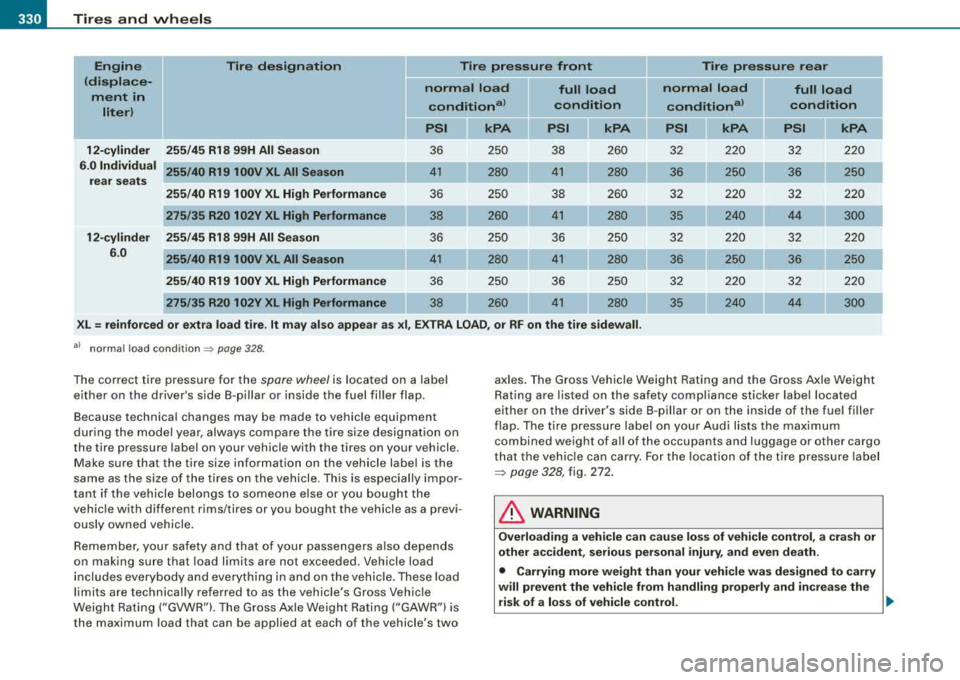
Engine Tire designation Tire pressure front Tire pressure rear
( displace-
normal load full load normal load
full load
ment in
liter)
condition al condition conditiona l condition
kPA PSI kPA PSI kPA PSI
12-cylinder
255/45 R18 99H All Season 36 250 38 260 32 220 32 220
6.0 Individual
255 /40 R19 100V XL All Season 41 280 4 1 280 36 250 36 250
rear seats
255/40 R19 100V
XL High Performance
36 2
50
38 260 3
2 220 32 2 20
275 /35 R20 102Y
XL High Performance 38 41 280 35 2 40 44 300
12 -cylinder 255 /45 R18 99H All Season 36 250 36 250 32 220 32 220
6 .0
255 /40 R19 100V XL All Season 4 1
280 4
1
280 36 250 36 250
255 /40 R19 100V
XL High Performance
36 250 36 250 32 2 20 32 220
275 /35 R20 102Y XL High Performance 38 260 4 1 280 35 240 44 300
XL = reinforced or extra load tire . It may also appear as xi , EXTRA LOAD , or RF on the tire sidewall .
al norma l load cond ition => page 328.
The co rrect tire pressure for the spare wheel is located on a label
either on the driver 's s ide 8-pillar or inside t he fue l fil ler flap.
Because technica l changes may be made to vehicle equipment
du ring t he mode l year, always co mpare the tire si ze desig nati on on
the tire pressure label on your vehicle with the tires on your vehicle .
M ake s ure t hat the tire si ze info rmat ion o n the ve hicle labe l is the
same as the size of the tires on the vehicle . T his is especial ly impor
t an t if t he vehicle bel ongs t o so me one e lse o r yo u boug ht the
vehic le with different rims/tires or you bought the vehicle as a previ
ously owned ve hicle.
Reme mber, you r safety and that of y our passengers a ls o depe nds
on making su re that load limits are not exceeded. Vehicle load
i nc ludes every body and everyt hin g in and o n th e veh icle . T hese load
limits are technically referred to as the vehicle's Gross Veh ic le
Weig ht Ratin g ("GVWR"). T he Gro ss Axle Weigh t Ra tin g ("GAWR") is
the maximum load that can be applied at each of the vehicle's two axles
. The Gross Vehic le We ight Rating and the Gross Axle Weight
Rating are l isted on the safety compl iance sticker labe l located
either on the driver's side 8 -pillar or on the inside of the fuel filler
fl ap . T he t ire p ressure label on you r A ud i lists t he m axi mum
combined weight of a ll of the occupants and luggage or other cargo
th at the v ehicle can carry . Fo r the locati on of the t ire press ure la be l
=> page 328, fig . 27 2.
& WARNING
Overloading a vehicle can cause loss of vehicle control , a crash or
other accident, serious per sonal injury , and even death .
• Carrying more weight than your vehicle was designed to carry
will prevent the vehicle from handling properly and increase the risk of a loss of vehicle control. ...,
Page 333 of 404
Tires and wheels Ill
----------------
•
& WARNING (continued )
• The brakes on a vehicle that has been overloaded may not be
able to stop the vehi cle within a safe distance .
• Tires on a vehicle that has been overloaded can fail suddenly
c au sing lo ss of control and a cra sh.
• Always make sure that the total load being transported -
including the we ight of a trailer hitch and the tongue weight of a
loaded trailer -does not make the vehicle heavier than the
v ehicle's Gross Vehicle Weight Rating .
& WARNING
• Incorrect tire pressures and /or underinflation can lead to a
serious or fatal accident.
• Incorre ct tire pressures and /or underinflation cause in creased
tire wear and can affect the handling of the vehicle .
• Incorrect tire pressures and /or underinflation can also lead to
sudden tire failure, including a blowout and sudden deflation,
c ausing loss of vehi cle control.
•
Checking tire pressure
The c orrect tire pressu re f or the tires ori gina lly installe d
on your vehicle is lis ted on the ti re pressure la bel loca ted
either on driver's side 8-pillar or inside the fuel filler flap.
The rec omme nded ti re p ressu res a re on the tire pr essure la be l an d
in the
table~ page 328, "Co ld tire inflation pressure". This means
t ha t th e pres su re m us t be c hecked a nd adjus ted w he n t he ti re has
not been driven for more than a couple of miles (kilometers) at low
speeds du rin g the p revio us th ree hou rs . Ai r in t he tires ex pand s
when the tire heats up as a resu lt of internal fr iction as it flexes in
use. The tire pressure is hig her when the tire has warmed up than
when it is "co ld ." I
t is the inflation pressure in a "cold" t ire that counts . Therefore, you
s h oul d never le t air ou t of a warm ti re to matc h "Co ld t ire in fl ati on
pressure"
recommendations~ pa ge 328 . The tires wou ld then be
u nde rinflate d and could fail sud denly .
The t ire pressure label o n your Au di lists the recomme nded cold t ire
inflation press ures at maximum capacity for the new, origina l equip
m ent tires t hat we re on yo ur vehicle at t he t ime it was manufac
tured. For the location of the
labe l~ page 328, fig . 272.
M ost tires lose a ir natu rally ove r ti m e. T hey can a lso lose so me air if
you drive ov er a pothole or h it a curb while parkin g. It is usually not
pos sible to see whe the r the rad ial tir es use d today are unde rin flated
just by look in g at t hem .
T herefore, be sure to chec k tire pressures at least once a month and
a lways be fore go ing o n a lo ng trip . Make su re to take the nu mber o f
people and the amount of luggage into account when ad justing tire
pr ess u re fo r a trip -even one t hat you wou ld not conside r to be
" long ."
See~ page 333, "Tires and vehic le load limits" for more
i mp ort ant i nfor mati on .
A lways use a n accu rate ti re p ressure gauge w hen c hec kin g a nd
adjusting inflation pressures . Chec k all of the tires and be sure not
t o fo rget t he spare t ire . If the pressu re i n an y tire is too high when
the tire is "co ld," let air out of the tire slow ly with the edge of the tire
ga uge and kee p checking the press ure u ntil y ou r each th e pr essu re
that is correct for the load (passengers and luggage) and kind of
d riv in g yo u plan to do .
I f the pressure in any tire is too low, note the difference between the
pressure in the cold tire and the pressure you need and add the air
t hat you need to r each the correct pressure for the veh ic le load
(passengers and luggage) for the tires on your vehicle as listed on
t he o n you r vehicl e and i n thi s m anua l a n d t he kind of driving yo u
p lan to do.
Never exceed the maximum inflation pressure listed on the tire
sidewall for any reason .
Remember that the vehic le manufacturer, not the tire manufacturer,
deter mines the correc t tire pressure for the ti res on your vehicle.
~
Vehicle care
Page 334 of 404
-Tires and wheels Pft'::I _______________ _
It is important to check the t ire pressur e wh en the tires are cold .
• Read the req uire d tire p re s su re from the tire p re ssur e la bel. On
USA ve hicles, the tir e pressure label is located on the driver's side
8 -pilla r. On Canada vehic les, the ti re p ress ure label is located eit her
o n the driv er's s ide 8-pill ar or ins id e th e fuel fill er flap .
• Tur n the va lve stem cap co unte r-cloc kw ise to re move it fr om t he
tire valv e.
• Place th e a ir p re s sur e ga uge on th e valve .
• T he tire pressures should o nly be checked and ad justed when
th e tir es are col d. The s lig ht ly ra ise d pres sur es of wa rm tir es mu st
not b e re duc ed .
• Adjus t the tire pre ss ure to the l oad y ou are carry ing.
• Reinstal l the valve stem cap on the valve.
When should I check the tire pressure?
The co rrec t tir e pr ess ure is especiall y important a t hi gh spee ds. T he
pressu re should th er efor e b e checked a t le ast once a mo nth an d
a lwa ys be fore s ta rti ng a j ourn ey . D o not for get to chec k the ti re pr es
sure fo r the sp are wh eel
=> page 350.
When should I adjust the tire pressures?
Adjust the tire pr essur e to the load you are carrying . After chan gin g
a w hee l or r epl ac ing w hee ls you have to ad just th e tire pr essu re s on
a ll whee ls. I n ad ditio n, yo u must t hen sto re the ne w tire pressu res
in t he t ire pres sure m onit or ing
system => page 40.
& WARNING
Incorrect tire pressures and /or underinflation can lead sudden tire
failure , loss of control, collision, serious personal injury or even
death .
• When the warning symbol
(l) appears in the instrument
cluster , stop and inspect the tires .
& WARNING (continued)
• Incorrect tire pressure and /or underinflation can cause
increased tire wear and can affect the handling of the vehicle and
stopping ability .
• Incorrect tire pressures and/or underinflation can also lead to
sudden tire failure, including a blowout and sudden deflation,
causing loss of vehicle control .
• The driver is responsible for the correct tire pressures for all
tires on the vehicle. The applicable pressure values are located on
a sticker on the driver's side B-pillar or on the inside of the fuel
filler flap.
• Only when all tires on the vehicle are filled to the correct pres
sure , the tire pressure monitoring system can work correctly.
• The use of incorrect tire pressure values can lead to accidents
or other damage . Therefore it is essential that the driver observe
the specified tire pressure values for the tires and the correct pres
sures for the function of the tire pressure monitoring system .
• Always inflate tires to the recommended and correct tire pres
sure before driving off .
• Driving with underinflated tires bend more , letting them get
too hot resulting in tread separation , sudden tire failure and loss
of control.
• Excessive speed and /overloading can cause heat build-up ,
sudden tire failure and loss of control.
• If the tire pressure is too low or too high , the tires will wear
prematurely and the vehicle will not handle well.
• If the tire is not flat and you do not have to change a wheel
immediately, drive at reduced speed to the nearest service station
to check the tire pressure and add air as required . _..
Page 336 of 404
-Tires and wheels Determining correct load limit
Use the example below to calculate the
total weight of the passengers and
luggage or other things that you plan to
transport so that you can make sure that
your vehicle will not be overloaded.
Steps for Determining Correct
Load Limit
1. Locate the statement "THE COMBINED
WEIGHT OF OCCUPANTS AND CARGO SHOULD NEVER EXCEED XXX KG OR XXX
LBS"on your vehicle's placard (tire infla
tion pressure label) => page 328, fig. 272.
2. Determine the combined weight of the driver and passengers that will be riding in your vehicle.
3. Subtract the combined weight of the driver and passengers from
"XXX" kilo
grams or
"XXX" pounds shown on the
sticker=> page 328, fig. 272. 4. The resulting figure equals the available
amount of cargo and luggage load
capacity. For example, if the
"XXX"
amount equals 1400 lbs. and there will
be five 150 lbs. passengers in your
vehicle, the amount of available cargo
and luggage load capacity is 650 lbs.
(1400-750 (5
X 150) = 650 lbs.)
5. Determine the combined weight of luggage and cargo being loaded on the
vehicle. That weight may not safely
exceed the available cargo and luggage
load capacity calculated in Step 4.
6. If your vehicle will be towing a trailer,
load from your trailer will be transferred
to your vehicle. Consult this manual to
determine how this reduces the avail
able cargo and luggage load capacity of
your vehicle.
- Check the tire sidewall
( => page 336,
fig. 276) to determine the designated
load rating for a specific tire. •
Page 337 of 404
Tires and wheels -
-----------------'
Tire service life
The service life of tires depends on a lot of different things
including proper installation and balancing, correct tire
pressure and driving style .
Tread Wear Ind icator (TWI)
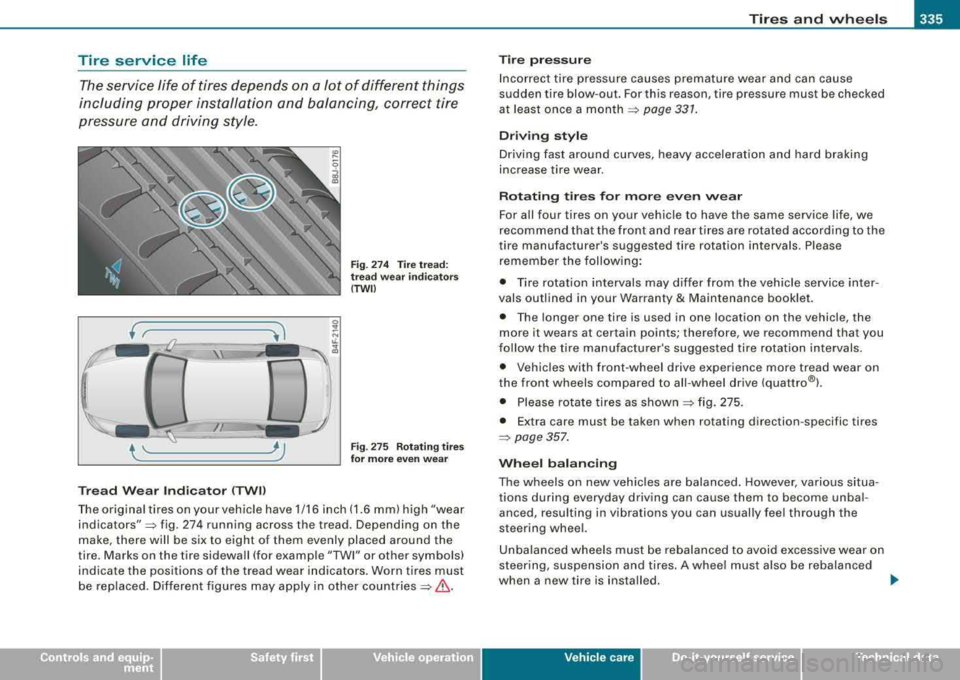
Fig. 274 Tire tread:
tread wear indicators
(TWII
Fig . 275 Rotating tires
for more even wear
The origina l tires on your vehic le have 1/16 inch (1.6 mm) high "wear
indicators"::::, fig. 274 running across the tread. Depending on the
make, there will be six to eight of them evenly placed around the
tire. Marks on the tire sidewall (for example
"TWI" or other symbols)
indicate the positions of the tread wear indicators. Worn tires must
be rep laced. Different figures may apply in other
countries::::, &-
Tire pressure
Incorrect tire pressure causes premature wear and can cause
sudden tire blow-out. For this reason, tire pressure must be checked
at least once a
month ::::, page 331.
Driving style
Driving fast around curves, heavy accele ration and hard braking
increase tire wear .
Rotating tires for more even wear
For all four tires on your vehicle to have the same service life, we
recommend that the front and rear tires are rotated according to the
tire manufacturer's suggested tire rotation intervals. Please
remember the following:
• Tire rotation intervals may differ from the vehicle service inter
vals outlined in your Warranty
& Maintenance booklet.
• The longer one tire is used in one location on the vehicle, the
more it wears at certain points; therefore, we recommend that you
follow the tire manufacturer 's suggested tire rotation intervals .
• Vehicles with front-wheel drive experience more tread wear on
the front wheels compared to all -wheel drive (quattro®l .
• Please rotate tires as shown
~ fig. 275.
• Extra care must be taken when rotating direction -specific tires
::::, page 357.
Wheel balancing
The wheels on new vehicles are balanced. However, various situa
tions during everyday driving can cause them to become unbal
anced, resu lting in vibrations you can usually feel through the
steering wheel.
Unbalanced wheels must be rebalanced to avoid excessive wear on
steering, suspension and tires. A whee l must also be rebalanced
when a new tire is insta lled.
...
Vehic le care I I Technical data
Page 338 of 404
1119...__T_ ir_e _ s_ a_ n
_ d_ w_ h_ e_ e_ls _________________________________________________ _
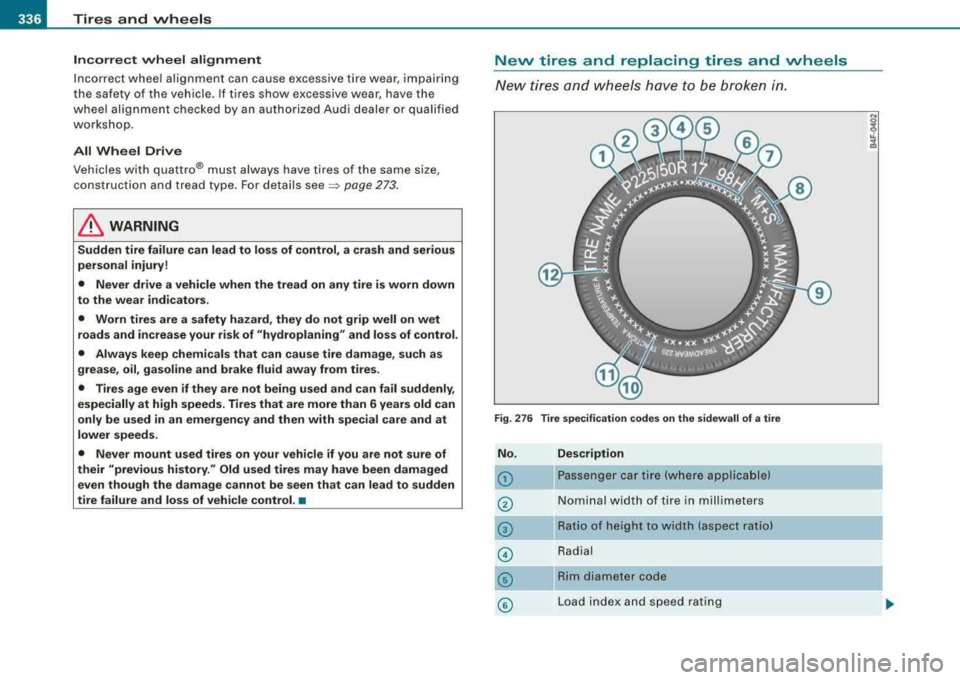
Incorrect wheel alignment
Incorrect wheel alignment can cause excess ive tire wea r, impairi ng
the safety of the vehic le. If tires show excessive wear, have the
whee l alignment c hecked by an au th o rize d Audi deale r or qualifie d
wo rkshop.
All Wheel Drive
Vehicles with quattro® must always have tires of the same size, construc tion and tread type. F or details see
~ p age 273 .
& WARNING
Sudden tire failure can lead to los s of control, a crash and serious
personal injury !
• Never drive a vehicle when the tread on any tire is worn down
to the wear indi cators .
• Worn tires are a safety hazard, they do not grip well on wet
roads and increase your risk of "hydroplaning " and loss of control.
• Always keep chemicals that can cause tire damage , such as
grease, oil , gasoline and brake fluid aw ay from tires .
• Tires age even if they are not being used and can fail suddenly ,
especially at high speeds. Tires that are more than 6 years old can
only be used in an emergency and then with special care and at
lower speed s.
• Never mount used tires on your vehicle if you are not sure of
their "previous history." Old used tires may have been damaged
even though the damage cannot be seen that can lead to sudden
tire failure and los s of veh icle control. •
New tires and replacing tires and wheels
N ew t ires and wheels h ave t o be broke n in.
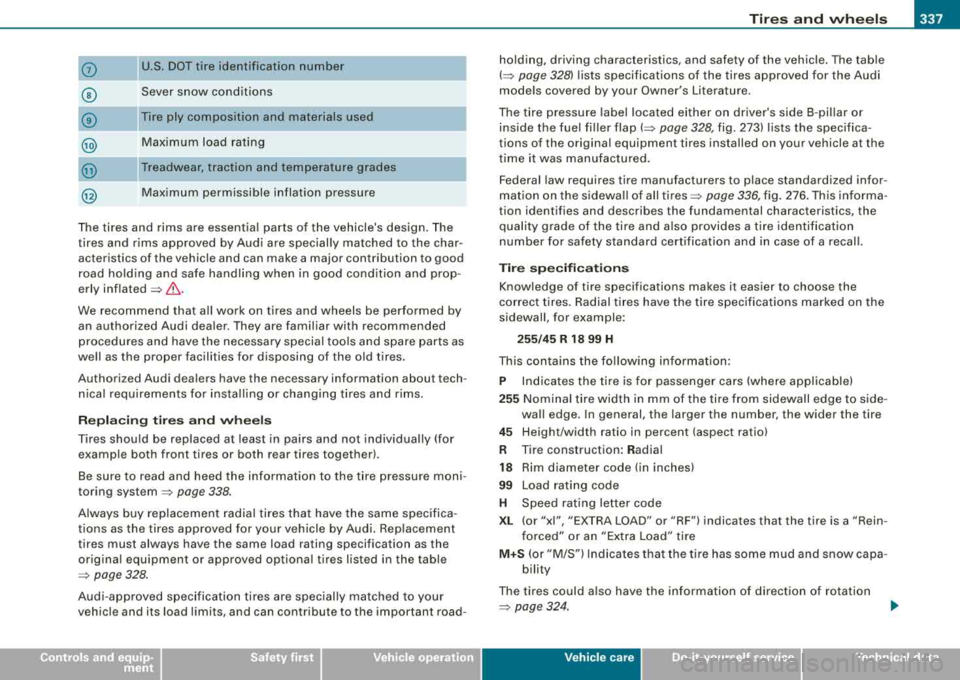
Fig . 2 76 T ir e specification code s on the sidewall of a tire
No .
G)
0
©
©
©
©
Description
Passenger car tire (where applicable)
Nominal width of tire in millimeters
Ratio of height to width (aspect ratio)
Radial
Rim diameter code
L o ad in dex and s peed rat ing
Page 339 of 404
Tires a nd wh eels -
----------------
•
0
©
U.S. DOT tire identification number
Sever snow cond itions
Ti re ply composition and materials used
Maximum load rating
Treadwear, traction and temperature grades
@ Maximum permissible inflation pressure
The tires and rims are essentia l parts of the vehicle 's design. The
tires and rims approved by Audi are special ly matched to the char
acteristics of the vehic le and can make a major contribution to good
road hold ing and safe handling when in good cond ition and prop
erly inf lated
=> .&, .
We recommend tha t all work on tires and wheels be performed by
an authorized Audi dea ler . They are familiar with recommended
procedures and have the necessary special too ls and spare parts as
we ll as the proper facilities for disposing of the old tires.
Authori zed Audi dea lers have the necessary information about tech
n ical requirements for insta lling or changing tires and rims.
R ep lac ing t ires and wh eels
Tires shou ld be replaced at least in pairs and not individual ly (for
examp le both front tires or both rear tires together).
Be sure to read and heed the informat ion to the tire pressure mon i
toring
system => page 338.
Always buy replacement radial tires t hat have the same specifica
tions as the tires approved for your vehicle by Audi. Rep lacement
tires must always have the same load rating specification as the
origina l equipment or approved optional t ires listed in the table
=> page 328.
Audi -approved specification tires are specially matched to your
vehicle and its load limits, and can contribute to the important road- holding, driving characteristics, and safety of the vehicle
. The table
(=> page 328) lists specificat ions of the tires approved for the Audi
models covered by your Owner's Literature .
The tire pressure labe l located either on driver's side 8 -pil lar or
ins ide the fuel fi ller
flap( => page 328, fig. 273) lists the specifica
tions of the original equipment tires installed on your vehicle at the
t ime it was manufactured.
Federa l law requires tire manufacturers to place standardized infor
mation on the sidewa ll of all
tires => page 336, fig . 276. This informa
tion identifies and describes the fundamental characteristics, the quality grade of the tire and a lso provides a tire identification
number for sa fety standard cert ificat ion and in case of a recall.
T ire s pec ificat ion s
Knowledge of tire specifications makes it easier to choose the
correct tires . Radial tires have the tire specifications marked on the
sidewall, for example :
255/45 R 18 99 H
This contains the fo llowing information:
P Indicates the tire is for passenger cars (where applicable)
255 Nominal tire width in mm of the tire from sidewall edge to side -
wa ll edge. In general, the larger the number, the wider the tire
45 Height/width ratio in percent (aspect ratio)
R Tire construction: Radial
18 Rim diameter code (in inches)
99 Load rat ing code
H Speed rat ing letter code
XL (or "xi", "EXTRA LOAD" or "RF") indicates that the tire is a "Rein
forced" or an "Extra Load" tire
M +S (or "M/S") Indicates tha t the tire has some mud and snow capa
bility
The tires could a lso have the information of direction of rotation
=> page 324.
Vehicle care
Page 340 of 404
___ T_ ir_e _s_ a_n_ d_ w_ h
_ e_e_ l_ s _______________________________________________ _
Tire ma nufact uring d ate
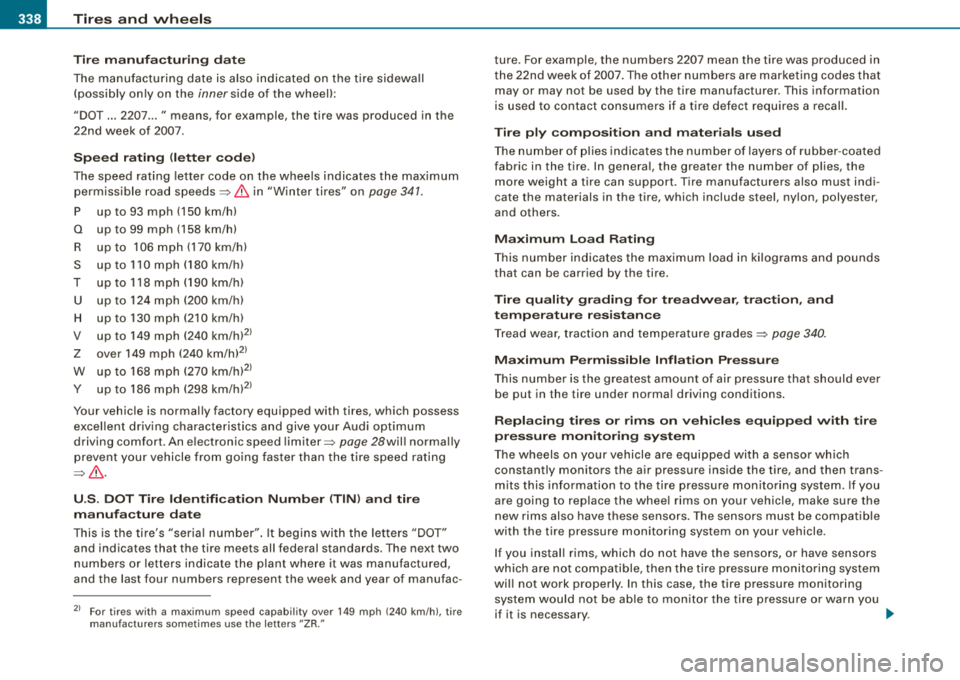
The manufacturing date is a lso indicated on the t ire sidewa ll
(possib ly on ly on the inner side of the wheel):
"DOT ... 2207 ...
" means, for example, the tire was produced in the
22nd week of 2007.
Sp eed ratin g (lett er code )
The speed rating letter code on the whee ls indicates the maximum
permissible road speeds =>
& in "Winter tires" on page 341.
P up to 93 mph (150 km/h)
Q up to 99 mph (158 km/h)
R up to 106 mph (170 km/h)
S upto110mph(180km/h)
T upto118mph(190km/ h)
U up to 124 mph (200 km/h)
H up to 130 mph (210 km/h)
V up to 149 mph (240 km/h)2>
Z over 149 mph (240 km/h)2>
W up to 168 mph (270 km/h)21
Y up to 186 mph (298 km/ h)21
Your vehicle is normally factory equipped with tires, which possess
excel lent driving characteristics and give your Audi opt imum
driving comfort . An e lectronic speed
limiter=> page 28wil l norma lly
prevent your vehicle from going faster t han the tire speed rating
=> & .
U.S . D OT T ire Iden tifi cation Number (TIN ) and tire
m anuf actur e date
This is the tire's "seria l num ber" . It beg ins with t he letters "DOT"
and indicates that the tire meets all federal standards . The next two
numbers or letters indicate the plant where it was manufactured,
and the last four numbers represent the week and year of manufac-
2 1 For tires with a maximum speed capab il ity over 149 mph (240 km/h), ti re
manufacturers somet imes use the lett ers "ZR."
ture . For example, the numbers 2207 mean the tire was produced in
t he 22nd
week of 2007 . The other numbers are marketing codes that
may or may not be used by the tire manufacturer . This information
is used to contact consumers if a tire defect requires a recall.
T ire p ly co mpos ition and mate ria ls used
The number of plies indicates the number of layers of rubber -coated
fabric in the tire . In genera l, the greater the number of p lies, the
more weight a tire can support. Tire manufacturers also must ind i
cate the materials in the tire, which include steel, ny lon, polyester,
and others.
M ax imum Lo ad R ating
T his number indicates the maximum load in kilograms and pounds
that can be carried by the tire.
Tire quali ty grading f or treadwe ar, t rac tion , and
t e mp era tu re resis ta nce
Tread wea r, traction and temperature
grades => page 340.
M ax imum P ermi ssible Infl atio n Press ure
T his number is the greatest amount of air pressure that should ever
be put in the tire under norma l driving conditions.
Repl acing tir es o r rim s on vehi cles e quipp ed w ith tire
pr ess ur e monit orin g sy st em
T he wheels on your vehicle are equipped with a sensor which
constantly monitors the air pressure inside the tire , and then trans
m its this information to the tire pressure mon itoring system. If you
are going to replace the whee l rims on your vehicle, make sure the
n ew rims also have t hese sensors. The sensors mus t be compa tible
with the tire pressure monitoring system on your vehicle .
I f you instal l rims, which do not have the sensors, or have sensors
whic h are not compatible, then the t ire pressure monitoring system
wi ll not work properly. In this case, the tire pressure monitoring
system would not be ab le to mon itor the tire pressure or warn you
if it is necessary . .,_
Page 341 of 404
________________________________________________ T_ i
_ r_e _s_ a_n_ d_ w_ h_ e_e _ l_s __ l'III
•
• T he batt ery inside of the tire pressure sensor has a l imited
s er vice l ife.
• Al ways drive with the va lve stem ca ps sec ure ly m ounted. We
r ec om mend u sin g fa ctor y in sta lle d v alv e stem caps. Ask your autho
rized Audi d ealer to replac e lost valve stem caps .
T he in stalla tio n of replacement ti res with steel cord body plies i n
th e tire s id ewal l may cause malfunct ion of the tire pressure moni
toring sy ste m, and is not recommended (c ord mate ria l infor mation
i n mo lded on the tire s idewa ll).
Al ways check your tir e pressure monitor ing system indicator after
r eplac ing on e o r m ore tire s on y our vehi cle. If the tire pressu re
monitorin g system indicator flashes, or is on, your system is not
w orki ng pr ope rly. You r rep lace ment tir e mi ght be in co m pati ble w ith
your t ire pr essure monitoring system, or some component of the
t ir e pr ess ure m oni to ring sys te m m ay be damaged .
& WARNING
• Using incorrect or unmatched tires and / or wheels or improper
tire and wheel combinations can lead to loss of control , collision
and serious personal injury .
• Always use tires , rims and wheel bolts that meet the specifica
tions of original factory -installed tires or other combinations that
have been specifically approved by the vehi cle manufacturer .
• Tires age even if they are not being used and can fail suddenly,
espe cially at high speeds . Tires that are more than 6 years old can
only be used in an emergency and then with special care and at
lower speeds .
• Never mount used tires on your vehicle if you are not sure of
their "previous history ." Old used tires may have been damaged
even though the damage cannot be seen that can lead to sudden
tire failure and loss of vehicle control.
• All four wheels must be fitted with radial tires of the same type ,
size (rolling cir cumference ) and the same tread pattern . Driving
&, WARNING (continued )
with different tires reduces vehicle handling and can lead to a loss
of control.
• If the spare tire is not the same as the tires that are mounted
on the vehicle
-for example with winter tires -only use the spare
tire for a short period of time and drive with extra care . Refit the
normal road wheel as soon as safely possible.
• Never drive faster than the maximum speed for which the tires
on your vehicle are rated because tires that are driven faster than
their rated speed can fail suddenly.
• Overloading tires cause heat build -up , sudden tire failure,
including a blowout and sudden deflation and loss of control.
• Temperature grades apply to tires that are properly inflated and
not over or underinflated.
• For techni cal reasons it is not always possible to use wheels
from other vehicles -in some cases not even wheels from the
same vehicle model.
• If you install wheel trim discs on the vehicle wheels , make sure
that the air flow to the brakes is not blocked . Reduced airflow to
the brakes can them to overheat , increasing stopping distances
and causing a collision.
• Run flat tires may only be used on vehicles that were equipped
with them at the factory . The vehicle must have a chassis designed
for run flat tires and a factory-installed tire pressure monitoring
system that indicates a loss of tire pressure. Incorrect use of run
flat tires can lead to vehicle damage or accidents . Check with an
authorized Audi dealer or tire specialist to see if your vehicle can
be equipped with run flat tires . If run flat tires are used , they must
be installed on all four wheels . Mixing tire types is not permitted.
0 Note
• Fo r tec hnica l reaso ns, i t is not gene rally p oss ibl e to use the
whee l rims from other vehicles . T his can hold true for wheels of t he
sa me v ehicl e typ e.
Vehicle care
Page 342 of 404
___ T_ ir_e _s_ a_n_ d_ w_ h
_ e_e_ l_ s _______________________________________________ _
• If the spare tire is different from the tires that you have mounted
on your vehicle (for example winter tires or wide profile tires), then
use the spare tire for a short period of time only and drive with extra
care . Replace the flat tire with the tire matching the others on your
vehicle as soon as possible.
• If you should put different wheels and tires on your vehicle (e.g.
winter wheels and tires), you must be certain that the wheels and
tires are compatib le with the tire pressure monitoring system.
Otherwise the system will register a malfunction and a fault message will be displayed. For more information, contact your Audi
dea ler.
0 Note
• When installing new tires, be careful not to damage the valves or
tire pressure monitoring system sensors.
• Never drive without the va lve stem cap. The valves could get
damaged.
• If the sensors must be replaced, then the valve must also be
replaced at the same time.
For the sake of the environment
Dispose of o ld tires in accordance with the loca l requirements. •
Uniform tire quality grading
• Tread wear
• Traction AA A B C
• Temperature A B C
Qua lity grades can be found where applicable on the tire side wal l
between tread shoulder and maximum section width
=> page 336,
fig. 276.
For example: Tread wear 200, Traction AA, Temperature A.
All passenger car tires must conform to Federal Safety Require
ments in addit ion to these grades.
Tread wear
The tread wear grade is a comparative rating based on the wea r rate
of the tire when tested under contro lled conditions on a specified
government test course.
For example, a tire graded 150 wou ld wear one and one half (1 1/2)
times as well on the government course as a tire graded 100.
The relative performance of tires depends upon the actua l condi
tions of their use, however, and may depart significantly from the
n orm due to variations in driving habits, service practices and differ
ences in road characteristics and climate .
Traction
The traction grades, from highest to lowest, are AA, A, Band C.
T hose grades represent the tire's ability to stop on wet pavement as
measured under contro lled conditions on specified government
t est surfaces o f asphalt and concrete. A tire marked C may have
poor traction performance
=:> & .
Temperature
The temperature grades are A (the highest), B, and C, representing
t he tire's resistance to the genera tion of heat and its abi lity to dissi
pate heat when tested under control led conditions on a specified
indoor laboratory test wheel.
Sustained high temperature can cause the mater ial of the tire to
degenerate and reduce tire life, and excessive temperature can lead
to sudden tire
failure=> &.
The grade C corresponds to a leve l of performance which a ll
passenger car tires must meet under the Federal Motor Vehicle
Safety Standard No. 109. Grades Band A represent higher levels of
performance on the laboratory test whee l than the minimum
required by law.
~