wheel AUDI S8 2008 Owner's Guide
[x] Cancel search | Manufacturer: AUDI, Model Year: 2008, Model line: S8, Model: AUDI S8 2008Pages: 404, PDF Size: 52.7 MB
Page 179 of 404
__________________________________________ A_ d_v _a_ n_ c_e _d _ P_a_ r_ k_ i_n -=g ;.._ S...:y'-- s_ t_ e_ m __ ......
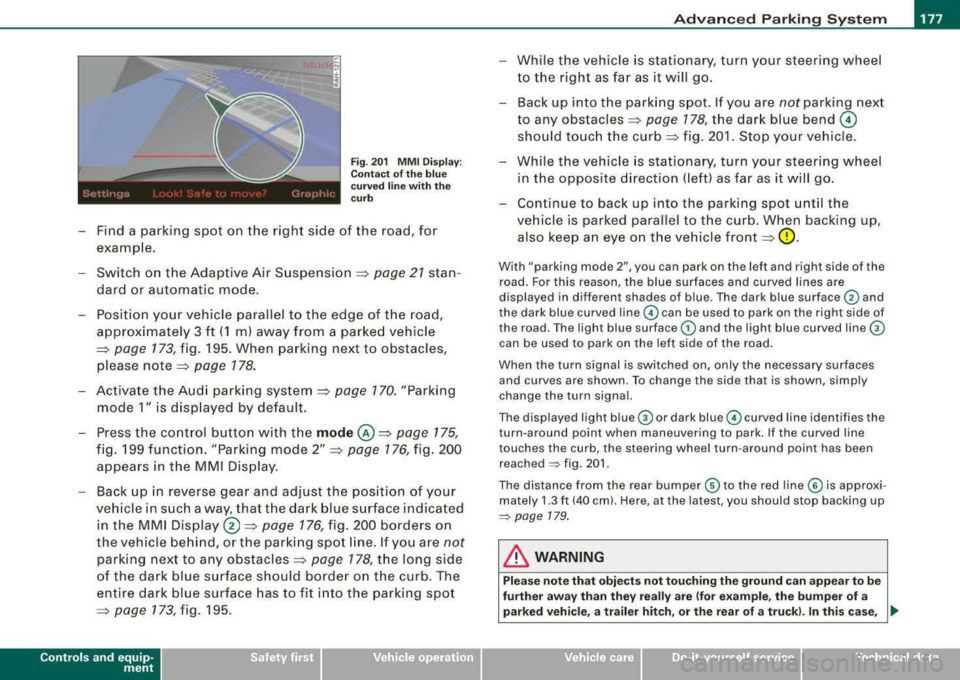
Fig . 201 MMI Display:
Contact of the blue
curved line with the
curb
- Find a parking spot on the right side of the road, for
example .
- Switch on the Adaptive Air Suspension =>
page 21 stan
dard or automatic mode.
- Position your vehicle parallel to the edge of the road,
approximately 3 ft (1 ml away from a parked vehicle
=> page 173 , fig. 195. When parking next to obstacles,
please
note => page 178.
- Activate the Audi parking system => page 170. "Parking
mode 1" is displayed by default.
- Press the control button with the
mode @=> page 175,
fig. 199 function. "Parking mode 2" => page 176, fig. 200
appears in the MMI Display.
- Back up in reverse gear and adjust the position of your
vehicle in such a way, that the dark blue surface indicated in the MMI
Display ®=> page 176, fig. 200 borders on
the vehicle behind, or the parking spot line. If you are
not
parking next to any obstacles => page 178, the long side
of the dark blue surface should border on the curb. The
entire dark blue surface has to fit into the parking spot
=> page 773,fig.195 .
Controls a nd eq uip
ment
While the vehicle is stationary, turn your steering wheel
to the right as far as it will go.
- Back up into the parking spot. If you are
not parking next
to any
obstacles => page 178, the dark blue bend ©
should touch the curb=> fig. 201. Stop your vehicle.
- While the vehicle is stationary, turn your steering wheel
in the opposite direction (left) as far as it will go.
- Continue to back up into the parking spot until the
vehicle is parked parallel to the curb. When backing up, also keep an eye on the vehicle
front => 0.
With "parking mode 2", you can park on the left and right side of the
road. For this reason, the blue surfaces and curved lines are
displayed in different shades of blue . The dark blue surface
G) and
the dark blue curved
line © can be used to park on the right side of
the road . The light blue surface
G) and the light blue curved line ©
can be used to park on the left side of the road.
When the turn signal is switched on, only the necessary surfaces
and curves are shown. To change the side that is shown, simply
change the turn signal.
The displayed light
blue © or dark blue© curved line identifies the
turn -around point when maneuvering to park. If the curved line
touches the curb, the steering wheel turn-around point has been reached
~ fig. 201 .
The distance from the rear bumper © to the red line© is approxi
mately
1.3 ft (40 cm). Here, at the latest, you should stop backing up
~ page 179.
in. WARNING
Please note that objects not touching the ground can appear to be
further away than they really are (for example, the bumper of a
parked vehicle, a trailer hitch, or the rear of a truck). In this case,
..,_
Vehicle care I I irechnical data
Page 180 of 404
___ A_ d
_ v_a _ n_ c_ e_d _ P_a _ r_ k _i_n ~g _ S_y _ s_ t_ e_ m _________________________________________ _
&, WARNING (continued)
you should not use the guide help lines to measure distance -
danger of accident!
0 Note
In the MMI Display, the direction of travel of the vehicle rear is repre
sented depending on the steering wheel angle . The vehicle front
swings out more than the vehicle rear.
[ i] Tips
• In order for the rear-view camera to function properly, the
camera
lens=> page 170, fig . 191 must be kept clean, and free of
snow and ice. Please follow the additional notes
on=> page 183.
• The positions of the orientation lines/ surfaces are displaced up
or down if the parking process is carried out with the rear -view
camera in Adaptive Air Suspension=> page 21 dynamic or lift mode.
Therefore, the accuracy is reduced.•
Special parking situations
Applies to vehicles : with Advance d Par king Sys tem wi th rear view came ra
Parking next to obstacles
When parking next to an obstacle, enough distance must
left on the side.
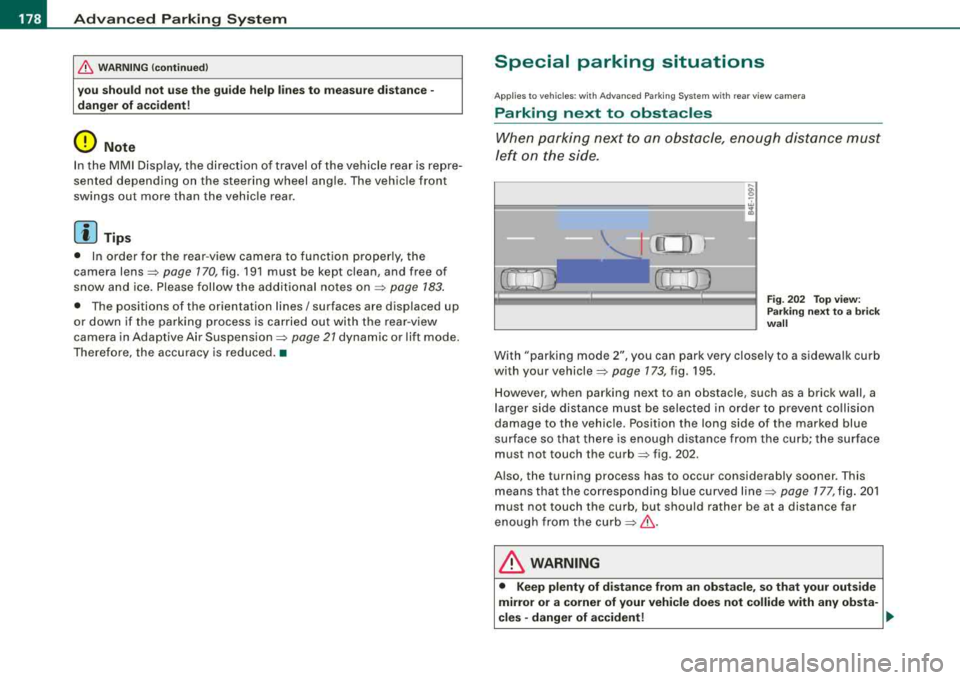
Fig. 202 Top view:
Parking next
to a brick
wall
With "parking mode 2", you can park very closely to a sidewalk curb
with your
vehicle=> page 173, fig. 195.
However, when parking next to an obstacle, such as a brick wall, a
larger side distance must be selected in order to prevent collision
damage to the vehicle. Position the long side of the marked blue
surface so that there is enough distance from the curb; the surface
must not touch the
curb=> fig . 202.
Also, the turning process has to occur considerably sooner. This
means that the corresponding blue curved
line=> page 177, fig. 201
must not touch the curb, but should rather be at a distance far
enough from the
curb=>&,.
& WARNING
• Keep plenty of distance from an obstacle, so that your outside
mirror or a corner of your vehicle does not collide with any obsta-
cles -danger of accident!
~
Page 190 of 404
___ A_ d_a_ p=--- t_iv _ e_ A
_ i_ r _ S_ u_s--= p'--- e_n _ s_ i
_ o _ n _____________________________________________ _
Setting the Driving Modes
The driving modes are set in MM/.
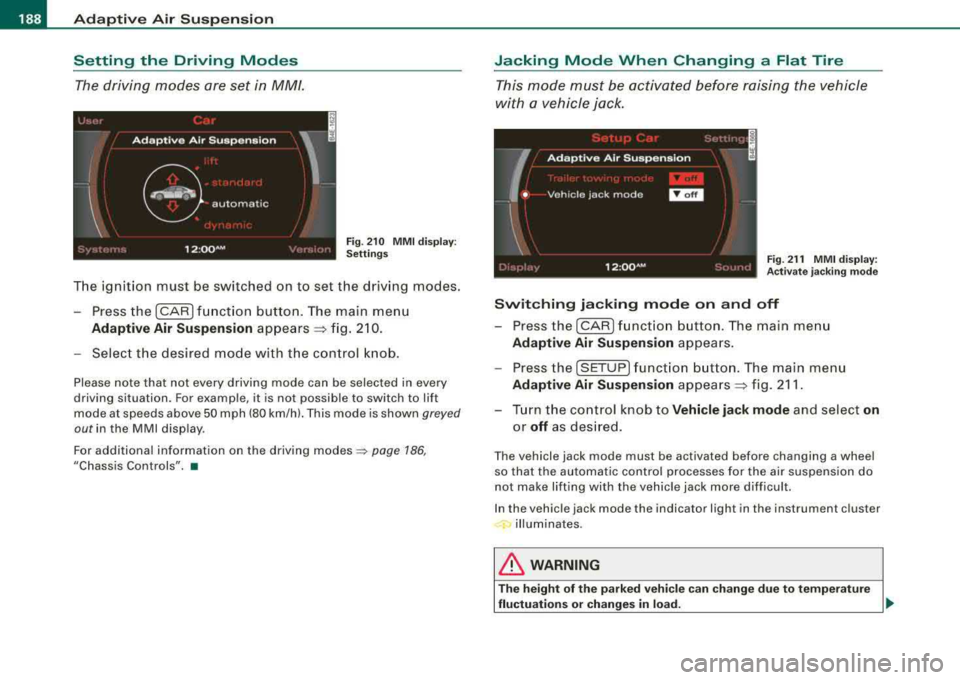
F ig . 2 10 MM I d is pl ay:
Setti ngs
The ignition must be switched on to set the driving modes .
- Press the (CAR] f unction button . The main menu
Ad aptive Air Suspension appears ~ fig. 2 10.
- Select the desired mode with the c ontrol k nob .
Please note that not every driving mode can be selected in every
driving situation. For examp le, it is not possible to switch to lift
mode at speeds above 50 mph (80 km/h). This mode is shown
greyed
out in the MMI disp lay .
For additional information on the driving
modes ~ page 186,
"Chassis Controls". •
Jacking Mode When Changing a Flat Tire
This mode must be activated before raising the vehicle
with a vehicle jack .
Fig. 21 1 MMI displ ay:
Ac tivat e ja ckin g m od e
Switching jacking mod e on and off
- Press the
I CAR ) fu nct io n bu tton. The main me nu
Adaptive Air Su spen sion appea rs .
- Press the
[SETUP] f unct io n button . The main menu
Adaptive Air Su spen sion appea rs ~ fig. 211 .
- Turn the co ntrol knob to
Vehicle jack mode and select on
or off as des ired .
The vehicle jack mode must be activated before changing a wheel
so that the automatic control processes fo r the air suspension do
not make lifting with the vehicle jack more difficult.
In the vehic le jack mode the indicator light in the instrument cluster
illuminates.
& WARNING
T he height of the p arked vehic le c an change du e to te mpera ture
fluctu ation s or change s in lo ad.
~
Page 202 of 404
___ D_ ri_v _i_n ..;::g:c..- S_ a_ f
_ e____, IY,__ ________________________________________________ _
Proper occupant seating positions
Proper seating position for the driver
The proper driver seating position is important for safe ,
relaxed driving.
I.I> N
;
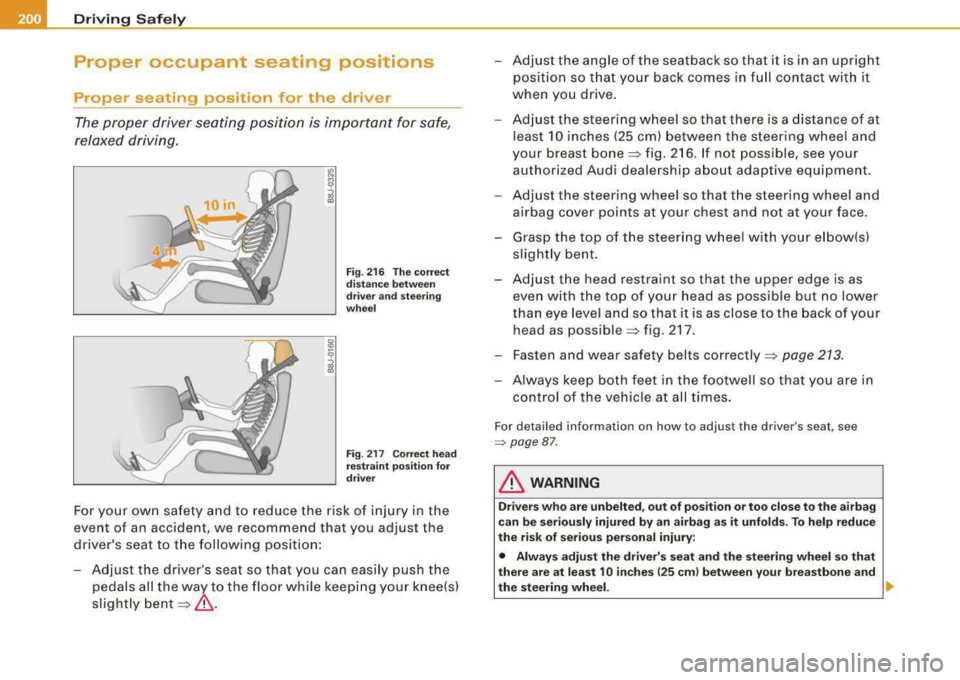
Fig. 216 The correct
distance between
driver and steering
wheel
Fig . 217 Correct head
restraint position for
driver
For your own safety and to reduce the risk of injury in the
event of an acc ident , we recommend that you adjust the
driver's seat to the following position:
- Adjust the driver's seat so that you can easily push the
pedals all the way to the floor while keeping your knee(s)
slightly
bent =:>& .
- Adjust the angle of the seatback so that it is in an upright
position so that your back comes in full contact with it
when you drive.
- Adjust the steering wheel so that there is a distance of at
least 10 inches (25 cm) between the steering wheel and
your breast
bone =:> fig. 216. If not possible, see your
authorized Audi dealership about adaptive equipment.
- Adjust the steering wheel so that the steering wheel and
airbag cover points at your chest and not at your face.
- Grasp the top of the steering wheel with your elbow(s)
slightly bent.
- Adjust the head restraint so that the upper edge is as even with the top of your head as poss ible but no lower
than eye level and so that it is as close to the back of your
head as
poss ible =:> fig. 217 .
- Fasten and wear safety belts
correctly =:> page 213.
- Always keep both feet in the footwell so that you are in
control of the vehicle at all times.
For detailed information on how to adjust the driver's seat, see
=> page 87 .
& WARNING
Drivers who are unbelted, out of position or too close to the airbag
can be seriously injured by an airbag as it unfolds. To help reduce
the risk of serious personal injury:
• Always adjust the driver's seat and the steering wheel so that
there are at least 10 inches
125 cm) between your breastbone and
the steering wheel. .,
Page 203 of 404
& WARNING (continued)
• Always adjust the driver's seat and the steering wheel so that
there are at least 4 inches (10 cm) between the knees and the
lower part of the instrument panel .
• Always hold the steering wheel on the outside of the steering
wheel rim with your hands at the 9 o'clock and 3 o'clock positions
to help reduce the risk of personal injury if the driver's airbag inflates .
• Never hold the steering wheel at the 12 o'clock position or with
your hands at other positions inside the steering wheel rim or on
the steering wheel hub. Holding the steering wheel the wrong way
can cause serious injuries to the hands, arms and head if the
driver's airbag inflates
• Pointing the steering wheel toward your face decreases the
ability of the supplemental driver's airbag to protect you in a colli
sion .
• Always sit in an upright position and never lean against or
place any part of your body too close to the area where the airbags
are located.
• Before driving, always adjust the front seats and head
restraints properly and make sure that all passengers are properly
restrained .
• Never adjust the seats while the vehicle is moving. Your seat
may move unexpectedly and you could lose control of the vehicle.
• Never drive with the backrest reclined or tilted far back! The
farther the backrests are tilted back, the greater the risk of injury due to incorrect positioning of the safety belt and improper
seating position.
• Children must always ride in child seats
=> page 243. Special
precautions apply when installing a child seat on the front
passenger seat
=> page 218 . •
Controls and equip
ment Safety first
Vehicle operation
Driving Safely
Proper seating position for the front
passenger
The proper front passenger seating position is important
for safe, relaxed driving.
For your own safety and to reduce the risk of injury in the
event of an accident, we recommend that you adjust the
seat for the front passenger to the follow ing position:
- Move the front passenger seat back as far as possible.
There must be a minimum of 10 inches (25 cm) between
the breastbone and the instrument
panel=> &.
-Adjust the angle of the seatback so that it is in an upright
position and your back comes in full contact with it
whenever the vehicle is moving.
- Adjust the head restraint so that the upper edge is as
even with the top of your head as possible but not lower
than eye level and so that it is as close to the back of your
head as
possible => page 203.
-Keep both feet flat on the floor in front of the front
passenger seat.
- Fasten and wear safety belts
correctly =:> page 213.
For detailed information on how to adjust the front passenger's
seat, see
=> page 86 .
& WARNING
Front seat passengers who are unbelted, out of position or too
close to the airbag can be seriously injured or killed by the airbag
as it unfolds. To help reduce the risk of serious personal injury : ..,_
Vehicle care Do-it-yourself service Technical data
Page 213 of 404
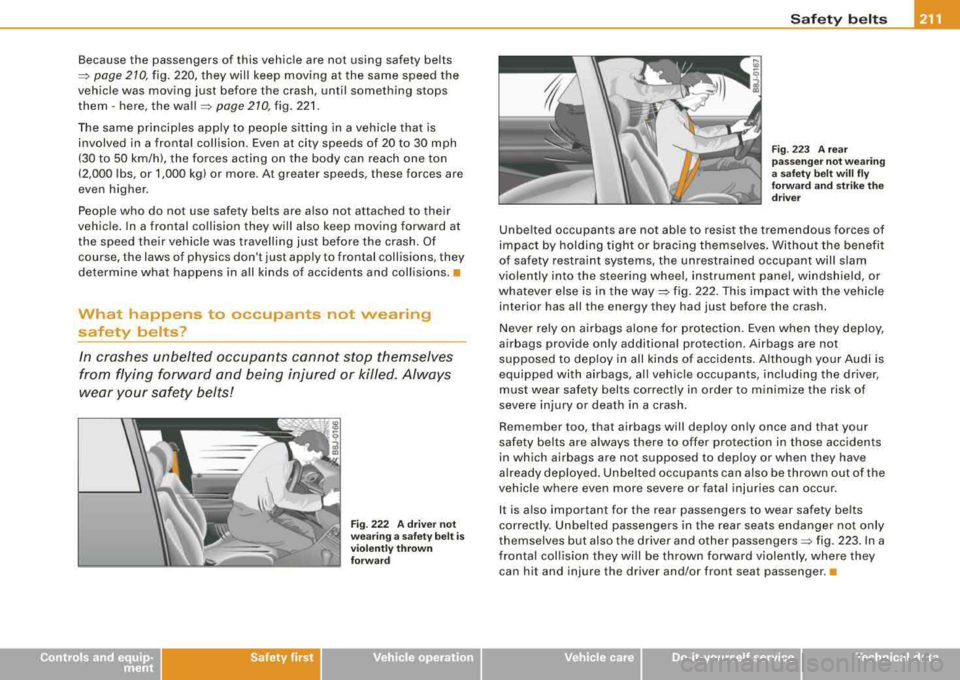
Because the passengers of this vehicle are not using safety belts
=> page 210, fig. 220, they will keep moving at the same speed the
vehicle was moving just before the crash, un til some thing stops
them
-here, the wall ~ page 210, fig. 221.
The same principles apply to people sitting in a vehicle that is involved in a frontal collision. Even at city speeds of 20 to 30 mph
(30 to 50 km/h), the forces acting on the body can reach one ton
(2,000 lbs, or 1,000 kg) or more . A t grea ter spe eds, these forc es are
even higher.
People who do not use safety bel ts are also no t attached to their
vehicle. In a frontal collision they will also keep moving forward at
the speed their vehicle was travelling just before the crash. Of course, the laws of physics don't just apply to frontal collisions, they
determine what happens in all kinds of accidents and collisions. •
What happens to occupants not wearing
safety belts?
In crashes unbelted occupants cannot stop themselves
from flying forward and being injured or killed. Always
wear your safety belts!
Fig . 222 A driver not
wearing a safety belt is
violently thrown
forward
Safety belts
Fig . 223 A rear
passenger not wearing
a safety belt will fly
forward and strike the
driver
Unbelted occupants are no t able to resist the tremendous forces of
impact by holding tight or bracing themselves. Without the benefit
of safety restraint systems, the unrestrained occupant will slam
violently into the steering wheel, instrument panel, windshield, or
whatever else is in the
way~ fig. 222 . This impact with the vehicle
interior has all th e energy th ey had just before the crash.
Never rely on airbags alone for protection. Even when they deploy,
airbags provide only additional protection. Airbags are not
supposed to deploy in all kinds of accidents. Although your Audi is
equipped with airbags , all vehicle occupants, including the driver,
must wear safety belts correctly in order to minimize the risk of
severe injury or death in a crash .
Remember too , that airbags will deploy only once and that your
safety belts are always there to offer protection in those accidents
in which airbags are not suppos ed to deploy or wh en they have
already deployed. Unbelted occupants can also be thrown out of the
vehicle where even more severe or fatal injuries can occur .
It is also important for the rear passengers to wear safety belts
correctly . Unbelted passengers in the rear seats endanger not only
themselves but also the dr iver and other
passengers => fig. 223. In a
frontal collision they will be thrown forward violently, where they can hit and injure the driver and/or front seat passenger. •
Vehicle care I I Technical data
Page 220 of 404
___ A_ ir_b _ a_ g=- s-a. y_s _t _e _m _________________________________________________ _
Airbag system
Important things to know
Importance of wearing safety belts and
sitting properly
Airbags are only supplemental restraints. For airbags to
do their jo b, occu pants must always properly we ar their
safety belts and be in a proper seating position.
Fo r your safe ty a nd the safety o f your passen gers, before
dr iving o ff, a lways:
- Adjust the driver 's seat and steering wheel proper ly
=> page 200,
- Adjust the front passenger's seat properly=> page 87,
-Wear safety be lts proper ly=> page 212,
- Always properly use the proper chi ld restrain t to pro tect
ch ildren
=> page 243 .
In a collision airbags mus t inflate with in t he blink of an eye and with
considerable force . The supplemental airbags can cause injuries if
t he driver or the fron t seat passenger is not seated properly. There
fore in order to help the airbag to do its job, it is important, both as a driver and as a passenger to sit properly at a ll ti mes.
By keep ing room between your body and t he steer ing wheel and the
front of the passenger compartment, the airbag can inflate fu lly and
comp letely and prov ide supplementa l protection in certain frontal
collisions => page 200, "Proper occupant seating positions". For
deta ils on the operation of t he seat adjustment
controls => page 87.
It's especia lly important that chi ldren are proper ly restrained
=> page 243 .
There is a lot that the driver and the passengers can and must do to
help the individual safety features installed in your Audi work
together as a system.
P roper seating position is important so that the front airbag on the
driver side ca n do its job. I f yo u have a physical impairment or
condition that prevents you from sitting properly on the driver seat
wi th the safety belt p roperly fastened and reaching the pedals, o r if
you have concerns with regard to the function or operation of the
Advanced Airbag System, p lease contact your authorized Audi
dea ler or qua lif ied workshop, or call Audi Customer CAR E at 1 -800-
822 -2834 for possib le modifications to your vehicle .
When the a irbag system deploys, a gas generator wi ll fil l the
airbags, break open the padded covers, and inflate between the
steer ing wheel and the dr iver and between the inst rume nt panel
and the front passenger. The airbags wi ll deflate immediate ly after
deployment so that the front occupants can see through the wind
shield again without interruption .
A ll of this takes p lace in the b link of an eye, so fast that many people
do n't even rea lize that the a irbags have dep loyed . T he airbags also
inflate with a great dea l of force and nothing should be in their way
when they dep loy. Fron t airbags in combinati on wi th properly worn
safety belts slow down and limit the occupant's forward movement.
Together t hey help to prevent the driver and front seat passenger
from hitting parts of the inside the vehicle while reducing the forces act ing on the occupant during the crash . In this way they he lp to
reduce the r isk of injury to the head and upper body in the crash .
Airbags do not protect the arms or the lower parts of the body .
Both front a irbags w ill not in flate i n all fro ntal col lis io ns. The trig
gering of the airbag system depends on the vehic le dece lerat ion
r ate caused by the co llision and registe red by the electr onic c ontro l
unit . If this rate is be low the reference value programmed into the
co ntrol unit, the ai rbags w il l not be t riggered, even tho ug h the car
may be bad ly damaged as a result of the collision . Vehicle damage,
~
Page 221 of 404
__________________________________________________ A_ i_ r _b _a-' g=- s_ y=- s_t _e _m __ lfflll
r ep air costs or ev e n the lac k of veh icle dama ge is not necessari ly an
indicati on of w heth e r an air b ag s houl d infla te or not .
I t is not poss ib le to def in e a ran ge of v ehicle sp ee ds t hat w il l cover
eve ry po ssible kind and ang le of impact that wil l a lway s trigger the
a ir b ags , s in ce t he cir cum stanc es w ill vary c onsid era bly be tw een
one co llision and another . Important factors inc lude , for example,
th e nat ure ( hard or soft) of the o bject w hic h the car h its, the a ng le
of impact, ve hicle speed, etc. The front airbags wi ll also not inflate
in side or rea r co lli s io ns, or i n ro ll-ov ers .
Always remember : Airbags w ill d eploy only onc e, an d on ly in c ertain
k inds of coll isi ons. Your s afe ty b elt s a re a lway s the re to o ffer prot ec
t ion in th ose s ituat io ns in whi ch airba gs are not su pposed to deplo y,
or whe n th ey hav e a lready dep lo yed; for ex am ple, wh en your v ehi cle
s tr ik es or i s struc k by another a ft e r th e fir st c ollis ion .
T his is just one of the reasons why a n airbag is a su pple mentary
r es traint and is not a sub stitut e for a sa fe ty b elt. T he ai rbag s ystem
w ork s most eff ect ively wh en us ed w ith the saf ety be lts . T herefore,
alw ay s pr operly w ea r y ou r safe ty b e lts ~ page 2 09.
& WARNING
Sitting too close to the steering wheel or instrument panel will
decrease the effectiveness of the airbags and will increase the risk
of personal injury in a collision.
• Never sit closer than 10 inches (25 cm) to the steering wheel or
instrument panel.
• If you cannot sit more than 10 inches (25 cm ) from the steering
wheel , investigate whether adaptive equipment may be available
to held you reach the pedals and increase your seating distance
from the steering wheel.
• If you are unrestrained , leaning forward, sitting sideways or out
of position in any way, your risk of injury is much higher .
• You will also receive serious injuries and could even be killed if
you are up against the airbag or too close to it when it inflates -
even with an Advanced Airbag.
Controls and equip ment Safety first
Vehicle operation
&, WARNING (continued )
• To reduce the risk of injury when an airbag inflates, always
wear safety belts
properly ~ page 213, "Safety belts ".
• Always make certain that children age 12 or younger always
ride in the rear seat . If children are not properly restrained , they
may be severely injured or killed when an airbag inflates.
• Never let children ride unrestrained or improperly restrained in
the vehicle . Adjust the front seats properly .
• Never ride with the backrest reclined .
• Always sit as far as possible from the steering wheel or the
instrument panel
~ page 200.
• Always sit upright with your back against the backrest of your
seat.
• Never place your feet on the instrument panel or on the seat .
Always keep both feet on the floor in front of the seat to help prevent serious injuries to the legs and hips if the airbag inflates .
• Never recline the front passenger's seat to transport objects.
Items can also move into the area of the side airbag or the front
airbag during braking or in a sudden maneuver. Objects near the
airbags can become projectiles and cause injury when an airbag
inflates .
& WARNING
Airbags that have deployed in a crash must be replaced.
• Use only original equipment airbags approved by Audi and
installed by a trained technician who has the necessary tools and
diagnostic equipment to properly repla ce any airbag in your
vehicle and assure system effectiveness in a crash .
• Never permit salvaged or recy cled airbags to be installed in
your vehicle. •
Vehicle care Do-it-yourself service Technical data
Page 224 of 404
-Airbag system P'll:1-~--------------
& WAR N IN G ( continued )
• Improper in stallation of child restraints can reduce their effec
tiveness or even prevent them from p roviding any protection .
• An improperly installed child restraint can interfere with the
airbag as it deploys and seriously injure or even kill the child -
even with an Advanced Airbag System .
• Always carefully follow the manufa cturer's instruction s
provided with the child seat or carrier .
• Never pl ace additional items on the seat that can in crease the
total weight registered by the weight -sensing mat and can cause
injury in a crash . •
Front airbags
Description of front airbags
Th e air bag s ystem c an provide su ppleme ntal pro te cti on
t o prop erl y restra ined fr ont seat occu pants.
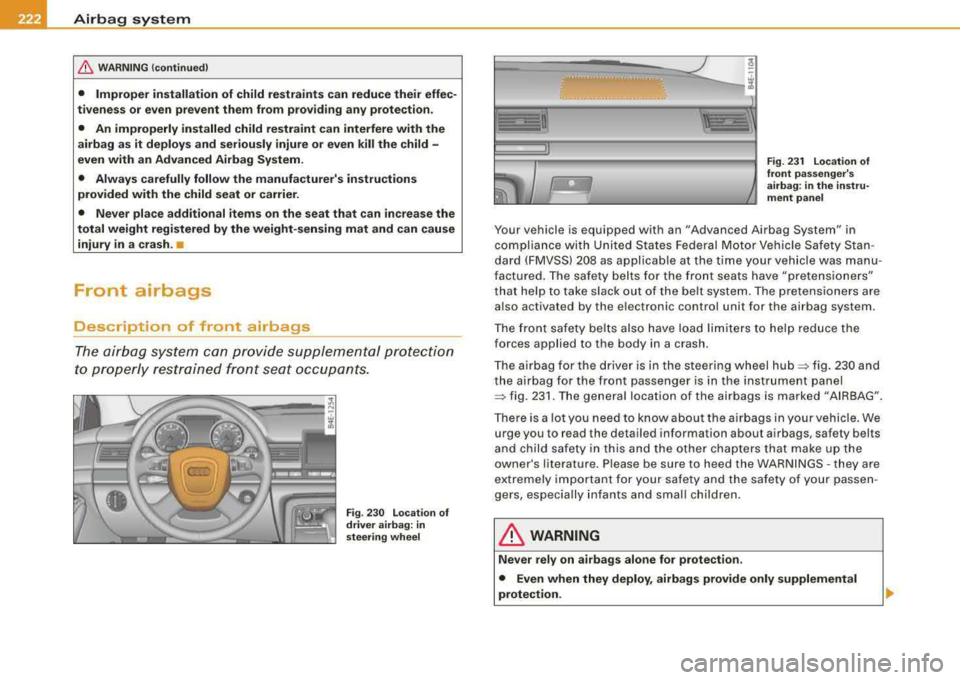
Fig. 2 30 Location of
driver airbag: in
s teering wheel
r I.. • ............ .
-= I
J
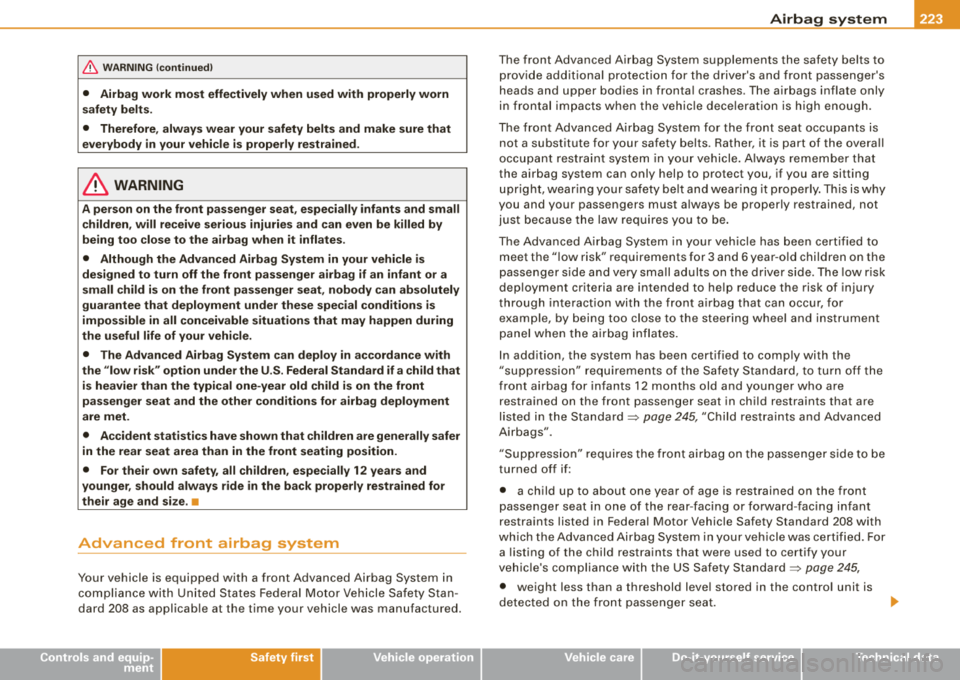
Fig . 231 Locat ion of
front pa ssenger' s
airbag : in the in stru
ment pa nel
Y our vehicle is equipped with an "Advanced Airbag System" in
complia nce with United States Federal M otor Vehicle Sa fe ty Sta n
dard (FMVSS) 2 08 as applicable at t he time your vehicle was manu
f actured. The safe ty bel ts for the front seat s have "pretensione rs"
t h at help to ta ke slack out of the be lt sys tem . Th e p retensio ners are
a lso activated by the e lectronic control unit for the airbag system .
T he fron t sa fe ty be lts als o have loa d lim iters to hel p red uce the
forces applied to the body in a crash.
T he ai rbag f or the driver is in t he stee ring wheel
hub ~ fig. 230 and
th e ai rbag for the front passenger is in the instr ument panel
~ fig. 23 1. T he genera l location of the airbags is marked "A IRBAG".
There is a lo t yo u ne ed to know ab out the a irbags in y our vehicle. We
urge you to read the detailed informa tion about airbags, safety belts
and child s afety in t his an d th e other cha pters tha t make u p the
owner's literature . P lease be sure to heed the WARNINGS
-the y are
e xtr em ely im po rt ant for y our safety and the safe ty of y our passen
gers , especia lly infants and small children .
& WARNING
Never rely on airbags alone for protection .
• Even when they deploy, airbags provide only supplemental
protection .
Page 225 of 404
Airbag system -
--------------=---=--
& WARNING (continued)
• Airbag work most effectively when used with properly worn
safety belts.
• Therefore, always wear your safety belts and make sure that
everybody in your vehicle is properly restrained.
& WARNING
A person on the front passenger seat, especially infants and small
children, will receive serious injuries and can even be killed by
being too close to the airbag when it inflates.
• Although the Advanced Airbag System in your vehicle is
designed to turn off the front passenger airbag if an infant or a
small child is on the front passenger seat, nobody can absolutely
guarantee that deployment under these special conditions is
impossible in all conceivable situations that may happen during
the useful life of your vehicle.
• The Advanced Airbag System can deploy in accordance with
the
"low risk" option under the U.S. Federal Standard if a child that
is heavier than the typical one-year old child is on the front
passenger seat and the other conditions for airbag deployment
are met.
• Accident statistics have shown that children are generally safer
in the rear seat area than in the front seating position.
• For their own safety, all children, especially 12 years and
younger, should always ride in the back properly restrained for
their age and size. •
Advanced front airbag system
Your vehicle is equipped with a front Advanced Airbag System in
compliance with United States Federal Motor Vehicle Safety Stan
dard 208 as applicable at the time your vehicle was manufactured.
Controls and equip ment Safety first Vehicle operation
The
front Advanced Airbag System supplements the safety belts to
provide additional protection for the driver's and front passenger's
heads and upper bodies in frontal crashes . The airbags inflate only
in frontal impacts when the vehicle deceleration is high enough.
The front Advanced Airbag System for the front seat occupants is
not a substitute for your safety belts . Rather, it is part of the overall
occupant restraint system in your vehicle. Always remember that
the airbag system can only help to protect you, if you are sitting
upright, wearing your safety belt and wearing it properly. This is why
you and your passengers must always be properly restrained, not
just because the law requires you to be.
The Advanced Airbag System in your vehicle has been certified to
meet the "low risk" requirements for 3 and 6 year -old children on the
passenger side and very small adults on the driver side. The low risk
deployment criteria are intended to help reduce the risk of injury
through interaction with the front airbag that can occur, for
example, by being too close to the steering wheel and instrument
panel when the airbag inflates.
In addition, the system has been certified to comply with the
"suppression" requirements of the Safety Standard, to turn off the
front airbag for infants 12 months old and younger who are
restrained on the front passenger seat in child restraints that are
listed in the
Standard=> page 245, "Child restraints and Advanced
Airbags".
"Suppression" requires the front airbag on the passenger side to be
turned off if:
• a child up to about one year of age is restrained on the front
passenger seat in one of the rear-facing or forward-facing infant
restraints listed in Federal Motor Vehicle Safety Standard 208 with
which the Advanced Airbag System in your vehicle was certified. For
a listing of the child restraints that were used to certify your
vehicle's compliance with the US Safety
Standard => page 245,
• weight less than a threshold level stored in the control unit is
detected on the front passenger seat.
~
Vehicle care Do-it-yourself service Technical data