brakes AUDI S8 2009 User Guide
[x] Cancel search | Manufacturer: AUDI, Model Year: 2009, Model line: S8, Model: AUDI S8 2009Pages: 408, PDF Size: 91.63 MB
Page 153 of 408
Adaptive Crui se Control -
---------------=-------'
Applies to vehicles: with Adaptive Cru ise Co nt rol
When driving around curves
k;;;:;::;;;;~==========; ~
o5
J
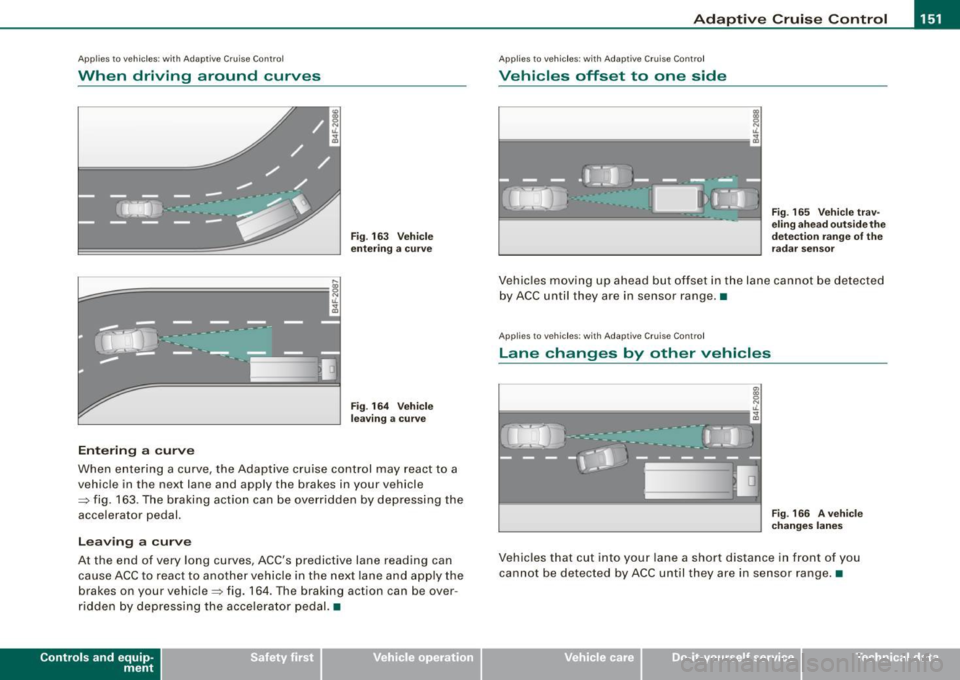
Entering a curve
Fig . 1 63 V eh ic le
enterin g a c urve
F ig . 164 Vehicle
l ea ving a curv e
When entering a curve, the Adaptive cruise control may react to a
vehicle in the next lane and apply the brakes in your vehicle
=> fig . 163 . The braking action can be overridden by depressing the
accelerator pedal.
L e avi ng a cu rve
At the end of very long curves, ACC 's predictive lane reading can
cause ACC to react to a nother vehicle in the next lane and app ly the
brakes on your vehicle=> fig. 164 . T he braking action can be over
ridden by depressing the accelera tor pedal. •
Contro ls and eq uip
ment
Ap plies to veh icles: with Adapt ive Crui se Contro l
Vehicles offset to one side
Fig . 165 V ehi cle tra v
e ling ahe ad outsid e th e
d etec tion r ange of the
ra dar se nsor
Vehic les moving up ahead but offset in the lane cannot be detected
by ACC until they are in sensor range. •
Applies to veh ic les: with Adaptive Cruise Co nt ro l
Lane changes by other vehicles
Fig . 166 A veh ic le
c han ges la ne s
Vehicles that cut into your lane a short distance in front of you
cannot be detected by ACC until they are in sensor range. •
Vehicle care I I irechnical data
Page 170 of 408
• ..__A_ u_ t _o_ m_ a_ t_ i_ c _ t_r _a _n_ s_ m_ is_ s_io _ n ________________________________________________ _
Select R only when the vehicle is at a full stop and the engine is
running at idle speed=>
& in "Driving the automatic transmission"
on
page 166.
Before you move the selector lever to R, press both the button in the
handle of the selector lever
and the brake pedal at the same time.
When the ignition is on, the backup lights illuminate when the
selector lever is moved into
R.
N -Neutral
The transmission is in neutral in this position. Shift to this position
for standing with the brakes applied =>
page 168 .
When the vehicle is stationary or at speeds below 3 mph (5 km/h),
you must always apply the footbrake before and while moving the
lever out of
N.
D -Normal position for driving forward
Position Dis for normal city and highway driving. It ranges from zero
to top speed and all six gears shift automatically, depending on
engine load, driving speed and automatically selected shift
programs.
When the vehicle is stationary or at speeds below 3 mph (5 km/h),
you must always apply the foot brake before and while moving the
lever to
D out of N.
In certain circumstances it may be advantageous to temporarily
switch to the manual shift program to manually select gear ratios to
match specific driving conditions=>
page 170.
S -Sport position
Select this position for sportier performance. In this position, the
transmission will not upshift as soon, allowing the vehicle to use the increased power available at higher engine speeds to achieve live
lier acceleration.
When the vehicle is stationary or at speeds below 3 mph (5 km/h),
you must always apply the foot brake before and while moving the lever to
S out of N.
& WARNING
Read and follow all WARNINGS => & in "Driving the automatic
transmission" on
page 166.
0 Note
Coasting downhill with the transmission in N and the engine not
running will result in damage to the automatic transmission and
possibly the catalytic converter. •
Automatic Shift Lock (ASL)
Automatic shift lock prevents you from accidentally
shifting into a forward gear or into reverse, thus causing the vehicle to move unintentionally.
Fig. 187 Shift gate
selector lever lock
positions and interlock
button highl ighted
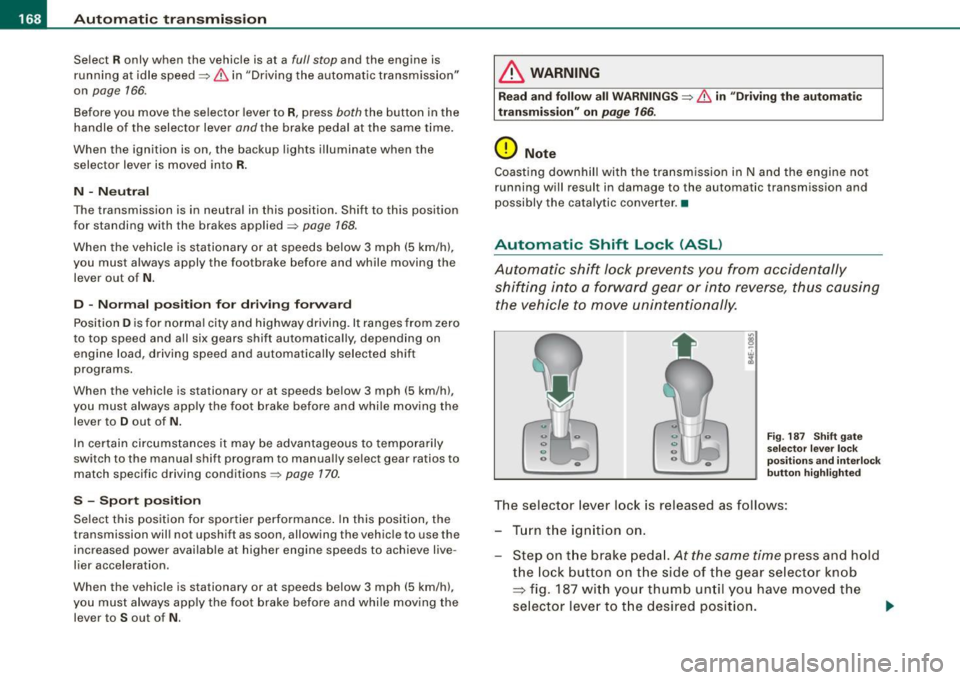
The selector lever lock is released as follows:
- Turn the ignition on.
Step on the brake pedal.
At the same time press and hold
the lock button on the side of the gear selector knob
=> fig. 187 with your thumb until you have moved the
selector lever to the desired position.
~
Page 273 of 408
The direction in which the driver wishes to travel is determined with
t he aid of the steering angle and vehicle speed and is continua lly
compared with the actual behavior of the vehicle. If the two do not
match, for example, when the vehic le starts hydrop laning on a wet
road, ESP will automatically brake the appropriate whee l to correct
the prob lem.
The vehicle is then stab ilized by the forces acting on the whee l
during braking. If the vehicle is oversteering (rear tends to skid out
of the turn), the brakes are mainly app lied on the wheel that is on
the outside of the curve. In the case of a vehicle that is understeering
(tendency to sl ide out of the curve), the brakes are applied at the
rear wheel that is on the inside of the curve . An acoustic signal indi
cates when ESP brake application cuts in
~ & .
The system operates across the entire speed range in combination
with the ABS system
~ page 274 . If the Anti -Lock Brake System
(ABS) malfunctions, the ESP wi ll be out of action as well.
Ac tivat ion
When you turn on the eng ine, ESP will automatically be activated
and will perform a self -test.
The system can be activated or deactiva ted by pressing the button
~ page 270, fig. 256. The warning light comes on when the system
is switched off
~ page 18.
Normally , the ESP should always be on, however, it may be advanta
geous to turn off the system in certain special cases when some
degree of wheel spin is desired such as :
• when driving with snow chains
• when driving in deep snow or on a loose surface (to allow the
wheels to dig in to reach firm ground)
• when trying to "rock" the vehicle free when it has beco me stuck.
T he system should be reactivated once you are no longer in such
situations .
Both the ABS and EDS systems are still functioning even if the ESP
is switched off .
Controls and equip
ment Safety first Vehicle operation
In
te llig ent tec hn olo gy
& WARNING
The Ele ctron ic St abiliz ation Progr am i s ne ve rt h el ess s ubject to the
laws of ph ysics. It i s particularl y important t o pay attention t o th is
f ac t on wet an d slipp ery road s. It i s th ere fore important that you
alway s adapt your driving to the condition of the road and traffic
c onditio ns. Do n ot allow the in crease d sa fety p ro vi ded by t he El ec
tronic Stabiliz ation Program sy stem to lu ll you into a ccepting
a dditional safety ri sk s.
c
Electronic differential lock (EDL)
The electronic differential lock monitors the rotation al
s p eed of the drive wheels.
G en era l not es
The elect ronic differential lock (EDU helps the car to start moving,
accelerate and c limb a gradient on surfaces providing poor or
a lmost no grip . Without EDL , this would be difficult, if not impos
s ib le.
How the system works
The EDL operates automatical ly. It monitors the rotational speed of
the drive wheels on an axle with the he lp of the ABS sensors
~ page 274. If a noticeable difference in rotational speed between
the drive wheels on one axle is detected (e.g. on slippery ground on
one side), the spinning w heel is braked, thereby transferring power
to the other drive wheel or wheels (all -whee l drivel. This is done up
to a speed of about 60 mph (100 km/h) . Noises from the brake
system signal that wheel spin is being control led .
Dri ving off
When driving off, always be sur e to ke ep road conditions in mind as
you accelerate. I f one drive wheel spins because it is on a surface
with less grip, gradual ly increase the pressure on the accelera tor
pedal unt il the car star ts to
move . The whee l less able to t ra nsfer
power spins. _.,
Vehicle care Do-it-yourself service Technical data
Page 274 of 408
-Intelligent technology --=---=-=-------------
Overheating
of brakes
To prevent the disc brake of the braked wheel from overheating if
subjected to excessive loads, the EDL cuts out temporarily . The
vehicle remains operational and behaves in the same way as a
vehicle without EDL.
As soon as the brake has cooled down, EDL switches on again auto
matically.
& WARNING
• When accelerating on slippery surfaces, such as on ice or snow,
always be careful when depressing the accelerator pedal. Even
with the EDL working, the drive wheels can spin and reduce your ability to control your car. Risk of crash!
• The increased safety afforded by EDL does not mean that you
can take safety risks . Always adapt your driving style to the road
conditions and traffic situation.
[ i] Tips
If a fault occurs in the ABS, the EDL is also not functioning. This is
indicated by the ABS warning light=>
page 21. •
Anti-Slip Regulation System (ASR)
The Anti-Slip Regulation System prevents the driven
wheels from spinning when the car is accelerating.
General notes
The Anti-Slip Regulation System (ASR) is integrated in the electronic
stabilization program (ESP). When the vehicle starts up and acceler
ates, the wheels are prevented from spinning by adjusting the
engine power to match the amount of grip available from the road
surface.
How the system works
ASR performs automatically, i.e. without the driver's intervention.
With the aid of the ABS sensors=>
page 274, ASR monitors the
speed of the driven wheels. If the wheels start to spin, the engine
power is reduced automatically until the tires find enough grip to
lock onto the road surface. The system is active across the entire
speed range.
The ASR works in conjunction with the ABS. If a malfunction should
occur in the ABS, the ASR will also be out of action.
& WARNING
The increased safety afforded by ASR does not mean that you can
take safety risks. Always adapt your driving style to the road
conditions and traffic situation.
[ i] Tips
To ensure that the ASR works properly, all four wheels must be fitted
with identical tires Any differences in rolling radius of the tires can
cause the system to reduce engine power when this is not desired.
See also=>
page 338, "New tires and replacing tires and wheels".
Braking
General information
What affects braking efficiency?
Operating conditions and driving habits
The brakes on today's automobiles are still subject to wear,
depending largely on operating conditions and driving habits=>& .
On vehicles that are either driven mostly in stop-and-go city traffic
or are driven hard, the brake pads should be checked by your autho
rized Audi dealer more often than specified in the
Warranty & Main- ~
Page 275 of 408
tenance boo klet. Failure to have your brake pads inspected can
r esult i n reduce d brake pe rfor mance .
On steep slopes , you s hou ld use the braking effect of the engine .
T his way, you prevent unnecessary wear on the bra ke system . If you
must use your brakes, do not hold the brakes down con tinuo usly.
P ump the brakes at intervals.
Moisture or road salt
U nder ce rtain conditions, for example, when driving through water
or very heavy rain, or even after washing your vehicle, the brak ing
effect can be reduced due to moisture (or in freezing conditions ice)
on the b rake pads. A few carefu l brake appl icat io n s sh ould d ry o ff
the brake pads or remove any ice coatings.
Th e eff ectiveness of the b rakes ca n b e re d uce d whe n the ve hicle is
driven on a salt -covered road and the brakes are not used . Here too,
you sh ould clean off acc umulated sa lt coat ing from brake d iscs and
pads with a few careful app lications of the brake~&.
Corrosion
T here may be a tendency for dirt to build up on the brake pads and
co rrosion to form o n the discs if the car is not d rive n regu lar ly or
only for short trips with little use of the brakes .
I f the brakes are not used frequently, or if corrosion has fo rmed on
t he d iscs, i t is a dv isab le to clea n off th e pads an d discs by braking
firmly a few times from a moderate ly high speed~& .
Faults in the brake system
I f you shou ld notice a sudden increase in brake pedal trave l, then
one of the two brak e circu its may have failed~ &.
Low brake fluid level
Ma lfunctions can occur in the brake system if the brake fluid leve l is
t oo low. T he b rake fl uid level is mon ito red e lect ro nica lly .
Controls and equip ment Safety first
Vehicle operation
Intelligent technology
Brake lining wear status
Brake l ini ng w ear may be checke d by visua l ins pec tion of the co nd i
tion of the brake pads throu gh the open ings in the wheel. If neces
sa ry, the wheel may be removed for this i nspectio n
~ page 353,
"Changin g a whee l".
& WARNING
• You should perform braking maneuvers for the purpose of
cleaning the brake system only if road conditions permit . Other
road use rs must not be put at r isk -you may cause an accident !
• Before descending a steep grade , reduce speed and shift trans
mi ssion into a lower gear or lower driving range . Do not ride the
brakes or hold the pedal down too long or too often . This could
cau se the brakes to get hot and diminish braking efficiency .
• Do not "ride the brakes" by resting your foot on the pedal when
you do not intend to brake. This may cause the brakes to overheat ,
premature wear and increased stopping distance.
• Under certain climati c and operating conditions such as
passing through water , driving in heavy rain or after washing the
vehi cle , the effectiveness of the brakes can be reduced. In winter ,
ice can accumulate on the brake pads , linings , discs and drums .
Carefully apply brakes for a test. Brakes will dry and ice coatings
will be cleaned off after a few careful brake applications .
• Driving for an extended period of time on salt -covered roads
without using your brakes can also affect braking efficiency. Clean off accumulated salt coating from brake disc s and pads with a few
careful brake applications .
• If you damage the front spo iler , or if you install a different
spoiler, be sure the air flow to the front brakes is not obstructed.
Otherwise the brake sy stem could overheat reducing the effective
ness of the entire brake system.
• Failure of one brake cir cuit will impair the braking capability
resulting in an increased stopping distance. Avoid driving the
Vehicle care Do-it-yourself service Technical data
Page 276 of 408
___ ln_ t _e_ ll-'"ig ...,_ e_ n_t _t_ e_ c_ h _ n_o _ l_o _,.g= y,_ __________________________________________ _
& WARN ING (continued )
vehicle and have it towed to the nearest Aud i dealer or qualified
workshop.
;:a
Brake booster
The brake booster a dds ex tra braking power.
The bra ke booster works wit h vacuu m pressure w hich is created
only when the engine is running =>& .
& WARNING
• Never let the vehicle roll to a stop with the engine shut off .
• If the brake boo ster i s not wor king , for e xample when towing
your vehicle, or because the brake booster has somehow been
damaged , the brake pedal must be pre ssed considerably harder to
make up for the lack of booster as sistance. •
Functioning of Anti-Lock Brake System {ABS)
A BS prevents the wheels from l ocking up under braking.
The ABS contributes effective ly to vehicle contr ol since i t preven ts
t he whee ls from
locking whe n the brakes are appl ied. This mea ns
that the vehicle remains steerable and is less likely to skid .
With ABS you do not need to pump the brake. Ju st hold the brake
pedal down .
However, do no t ex pect the ABS to sho rten braking distance u nder
all circumstances. When drivin g on gravel or on new ly fallen snow
on top of icy surfaces, bra king distance may be even longer, there
f ore, under these c ircu msta nces, it is especially importa nt that you
drive slow ly and with great care.
How the ABS system works
An au toma tic c heck is made when a s peed of about 4 mph (6 km/h)
is reached. When this happens, a pumping no ise can be heard.
I f an individual wheel begins to rotate too slowly in relation to
veh ic le speed and tends to lock, the ABS au tomat ically reduces
brake pressure to prevent that whee l from locking.
Th is au tomatic a djust ment pr oces s wi ll cause a
slight vibration o f
the brake peda l and some noises to alert you that vehicle speed
m ust be ada pted to e xisting road and traff ic conditio ns.
& WARNING
Although the ABS is very effective , alway s remember that braking
capability is limited by tire traction . Always adjust your driving
speed according to the road and traffi c conditions. Do not let the
extra safety afforded by the ABS tempt you into tak ing extra risks.
The ABS cannot overcome the laws of physics.
[ i ] Tips
• I f ABS is not functioning properly, a wa rning light will come on .
See=>
page 27.
• I f a faul t occurs in t he ABS, t he EDL is also n ot fu nctio ning . Th is
is indicated by the ABS warning light. •
Brake assistant
T he brak e assi stant i s designe d to ac hie ve th e optimu m
bra kin g eff ec t.
The bra ke assistant helps to increase the effective braking power
an d th us to achieve a shorter s top ping dis tan ce. If the dr iver
presses the brake pedal very quic kly, the brake assistant automati
c a lly bo osts t he braking force to the max imum level, up to th e point
where the anti -lock brake function (ABS) intervenes to stop the
whee ls from locking. You shou ld then keep the brake peda l pressed .,
Page 282 of 408
___ D_ r_iv _ in_... g"'- a_ n_ d_ e_ n_ v_i_r _o _n_ m_ e_n_ t _______________________________________________ _
New brake pads
--
Remember that new brake pads do not have a full braking
effect during the first 250 miles (400 kilometers) after they
are installed .
New brake pads have to be "burnished in" before they have optimal
grab =>& .
During the break -in period, you should avoid putting severe loads
on the brakes . Severe loads include, for examp le, sudden hard
braking, in particular at very high speeds or, for example, on moun
tain passes.
& WARNING
New brake pads don't have the best stopping power and must be
"broken-in" during the initial 100 to 150 miles (150 to 200 kilome
ters) of normal city driving. You can compensate for this by
pressing the brake pedal more firmly . This also applies later when
new pads are installed.
:J
Catalytic converter
It is very important that your emission control system
(catalytic converter) is functioning properly to ensure that
your vehicle is running in an environmentally sound
manner.
- Always use lead-free gasoline:=> page 303, "Fuel supply".
- Never run the tank down all the way to empty.
- Never put too much motor oil in your engine ==>
page 314,
"Adding engine oil 't=:;r\11
•
Never try to push- or tow-start your vehicle.
The catalytic converter is an efficient "clean-up" device built into the
exhaust system of the vehicle. The catalytic converter burns many
of the po llutants in the exhaust gas before they are released into the
atmosphere.
The exclusive use of unleaded fuel is critically important for the life
of the catalytic converter and proper functioning of the engine.
& WARNING
• Do not park or operate the vehicle in areas where the hot
exhaust system may come in contact with dry grass, brush, fuel
spill or other material which can cause a fire .
• Do not apply additional undercoating or rustproofing on or
near the exhaust manifold, exhaust pipes, catalytic converter or
heat shields. During driving, the substance used for undercoating
could overheat and cause a fire .
0 Note
• Be aware that just one tank filling with leaded fuel will alr eady
seriously degrade the performance of the catalytic converter.
• Do not exceed the correct engine oil level=>
page 314.
• Do not drive until the fuel tank becomes completely empty. The
engine could misfire. Unburned fuel could also get into the exhaust
system and this could cause the catalytic converter to overheat.
• Do not turn off the ignition while the vehicle is moving.
• Do not continue to operate your vehicle under these conditions,
as otherwise fuel can reach the catalytic converter. This could result
in overheating of the converter, requiring its replacement .
• To assure efficient operation of the Emission Control System:
- Have your vehicle maintained properly and in accordance with
the service recommendations in your Warranty
& Maintenance
booklet. •
Page 283 of 408
- Lack of proper maintenance as wel l as improper use of the
vehic le wi ll impair the func tion of the emission con tro l system
and could lead to damage.
<£> For the sake of th e envir onm ent
Even when the Emission Control System is operating properly, the
exhaust gas can have a su lfur -like exhaust gas smell under some
operating states . This depends on the sulfur content of the fuel
being used. Using a different brand of fue l may help, or filling the
tank with lead-free super grade gasoline. •
Avoid damaging the vehicle
When you are driving on poor roads, or over curbs, steep ramps,
etc., make certain that low- lying parts such as spoi lers and exhaust
system parts do not bottom out and get damaged.
This is especially true for vehicles with low-slung chassis (sports
chassis) * and fully loaded vehicles .
a
Operate your vehicle economically
and minimize pollution
General
Your personal style of driving will determine the economy
of your vehicle, as well as exhaust and noise levels.
Fuel economy, environmental impact, and wear on your engine,
brakes and tires largely depend on three factors:
• your personal driving style
• operating cond itions
• technica l limitations
Controls and equip
ment Safety first Vehicle operation
Dri
ving and environm ent
If you anticipate what you need to do next and drive economica lly,
you can easily cut your fuel consumption by 10 -15 percent . This
section wil l give you some tips on how you can help the environ
ment and your pocketbook.
[ i ] Tips
The consumption estimates as published by ENV IRONMENTAL
PRO TEC TION AGENCY (EPA) and Transport Canada may not corre
spond to your actua l consumption on the road, which wi ll vary
depending upon vehic le load and speed, road and weather condi
tions, trip length, etc. •
Drive smoothly and keep a lookout ahead
Vehicles use the most fuel when they ore accelerating.
-Avoid unnecessary accelerat ing and braking.
Vehicles use the most fuel when they are accelerating . If you antici
pate what is going to happen next, you wi ll need to brake less and,
thus, acce lerate less. Let the vehicle coast whenever possib le - for
examp le when you see that the next traffic light is red. •
Avoid full throttle
Driving at moderate speeds saves fuel and improves your
mileage.
-Try and keep well below your car 's max imum speed.
Acce lerating gently reduces fue l consumption , engine wear, and
does not disturb the environment.
Fue l consumption, exhaust emissions and engine noise increase
disproportionately at high speeds . If you drive at approximate ly
three quarters of top speed, fuel consumption wil l be reduced by
Vehicle care Do-it-yourself service Technical data
Page 287 of 408
Operating instructions
Max im um tra iler weight
A trailer for your vehicle is limited to a typical class 1 or class 2
trailer.
T ra ile r l oa d di stributio n
Be sure the load in the trailer is he ld securely in place to prevent it
from shifting forward, backward or sideways .
Never allo w a passe nger to r ide in a tr aile r~ & in "Driving instruc
tions" .
Engin e c oolin g sys te m
Towing a trailer makes the eng ine work harder. It is important that
the cooling system's performance is up to the additiona l load. Make
sure that the coo ling system has enough fluid .
Tire pr ess ure
When towing a trailer, inflate the tires of your vehicle to the co ld tire
pressure listed under "Full load" on the labe l located either on the
driver's side B -pil lar (visible when the door is open) or inside the fuel
filler flap . Inflate trai ler tires to trai ler and tire manufacturers' spec
ifications.
L ig ht s
The head light settings should be checked wit h the trai ler attached
before driving off. Check to make sure both vehicle and trai ler lights
are working properly .
Safe ty c ha in s
Be sure traile r safety chains are properly connected from the trailer
to the hitch on the vehicle. Leave enough slack in the chains to
perm it turning corners . When you i nsta ll safety chains, make sure
they will not drag on the road when you are driving.
T he chains should cross under the trailer tongue to prevent it from
dropping in case of separat ion from the hitch.
Controls and equip
ment Safety first Vehicle operation
Tr
aile r t owing
0 Note
If you are going to tow a trai ler, you must activate the trailer opera
tion mode ~
page 192, "Towing a Trailer". •
Driving instructions
Driving with a trailer always requires extra care and
consideration.
To obtain the best possible handling of veh icle and trailer,
please note t he following :
- Do not tow a loaded trailer when your car itself is not
loaded.
Be espec ia lly careful whe n passing other vehicles.
- Observe s peed limits .
Do not drive at the maximum permiss ible speed .
Always apply brakes ear ly.
Moni tor t he temperature ga uge.
Weight distr ibution
Towing a loaded trailer with an empty car results in a highly
unstable distr ibution of weight. If this cannot be avoided, drive at
very low speeds only to avoid the risk of losing steering control.
A "balanced" rig is easier to operate and control. This means that
the tow vehicle should be loaded to the extent possible and perm is
s ib le, while keeping the trailer as light as possib le under the circum
stances . Whenever possible, transfe r so me cargo to t he luggage
compartment of the tow vehicle whi le observing tongue load
requirements and vehicle loading considera tions . .,
Vehicle care Do-it-yourself service Technical data
Page 288 of 408
___ T_ r _a_ il_e _r_ t_ o_ vv_ in__... g,_ __________________________________________________ _
Speed
The higher the speed, the more difficult it becomes for the driver to
control the rig. Do not drive at the maximum permissible speed. Reduce your speed even more if load, weather or wind conditions
are unfavorable -particularly when going downhi ll.
Reduce vehicle speed
im med ia tel y if the trailer shows the slightest
sign of swaying.
Do not try to s top the swayi ng by accelerating.
Observe speed limits. In some areas, speeds for vehicles towing
trai lers are lower than for regular vehicles .
Always apply brakes ear ly. When driving downhill, shift into a lower
gear to use the engine braking effect to slow the vehicle. Use of the
brakes a lone can cause them to overheat and fail.
C ool ant t emp era tur e
The coolant temperature gauge=> page 12 must be observed care
fully. If the needle moves close to the upper end of the scale, reduce
speed immed iately and/or turn off the air conditioner.
If the coolant temperature warning light in the instrument cluster
starts flashing
- F- , pull off the road, stop and let the engine idle for
about two minutes to prevent heat build-up.
& WARNING
A nyo ne n ot properly re str aine d in a moving vehi cle i s at a mu ch
g re ater ri sk in an accident . Never let any on e r ide in y our car who
is n ot pr operl y wea ring th e re stra ints pr ovided b y Audi . •
Trailer towing tips
Important to know
Your vehicle handles differently when towing a trailer because of
the additional weight and different weight distribution. Safety, performance and economy will greatly depend on how carefully you
l
oad your trailer and operate your r ig.
Before you actually tow your trailer, practice turning, stopping and
backing up in an area away from traffic . Keep practicing unti l you
have become comp letely familiar with the way your vehicle-trai ler
combination behaves and responds.
Back ing up is difficult and requires practice. Backing up with a
trailer generally requires steering action opposite to that when backing up your vehic le without a tra iler.
Ma intain a greater distance between your veh ic le and the one in
front of you . You will need more room to stop. To compensate for
the trai ler, you w ill need a larger than norma l turning radius.
When passing, remember that you cannot accelerate as fast as you nor mally wou ld because of the added load . Make su re you have
enough room to pass. After passing, allow plenty of room for your
trai ler befo re changing lanes again .
Avoid jerky starts, sharp turns or rapid lane changes.
[ i ] T ips
• Do not tow a trailer during the break -in period of your vehicle.
• I f you tow a trailer, your Audi may require more frequent main te
nance due to the extra load=>
page 382. •
Parking on a slope
Do n ot park on a slope with a trailer. If it cann ot be
avoi ded, do so only after d oing the followi ng:
When p arking :
-Apply the foot brake.
- Have someone p lace chocks under both the vehicle and
the trailer wheels. ._