battery AUDI S8 2009 Owner's Manual
[x] Cancel search | Manufacturer: AUDI, Model Year: 2009, Model line: S8, Model: AUDI S8 2009Pages: 408, PDF Size: 91.63 MB
Page 237 of 408
Airbag system -----------------=~-
& WARNING (continued )
-Never install seat covers or replacement upholstery over the
front seatbacks that ha ve not been specifically approved by
Audi .
- Never use additional seat cush ions that cover the areas
where the side airbags inflate.
- Damage to the or iginal seat covers or to the seam in the area
of the s ide airbag module must always be repaired immedi
ately by an authorized Audi dealer .
• The airbag system can be activated only once. After an airbag
has inflated , it must be replaced by an authorized Audi dealer or
qualified technician who has the technical information , training
and special equipment nece ssary .
• The airbag system can be deployed only once . After an airbag
has been deployed , it must be replaced with new replacement
parts designed and approved especially for your Audi model
version . Replacement of complete airbag systems or airbag
components must be performed by qualified workshops only .
Make sure that any airbag service action is entered in you r Audi
Warranty
& Maintenance booklet under AIRBAG REPLACEMENT
RECORD .
• For safety reasons in severe accidents , the alternator and
starter are separated from the vehicle battery with a pyrotechnic
c ircuit interrupter .
- Work on the pyrotechnic circuit interrupter must only be
performed by a qualified dealer -risk of an accident!
- If the vehi cle or the circuit interrupter is scrapped , all appli
cable safety precautions must be followed .
For the sake of the environment
Undepl oyed airbag m odu les a nd preten sioners m ig ht b e class if ied
as Perchlorate Material -specia l handling may apply, see
www .dtsc.ca.gov/hazardouswaste/perchlorate. When the vehicle or
Controls and equip
ment Safety first Vehicle operation
parts of the restraint system inc
luding a irbag modules and safety
be lts with p re tensione rs are sc rapped, a ll a ppl icable laws an d regu
lations must be observed . Your authorized Audi dea ler is fami liar
wi th the se requi rements and we recomme nd that you have y our
dea ler perform this service for you. •
Other things that can affect Advanced Airbag
performance
Changing the veh ic le 's suspens ion s ystem can change th e way that
t he Adva nced Air bag Sys tem perfo rm s in a crash. F or e xam ple,
using tire -r im combinations not approv ed by Audi, lower ing the
ve hic le, c hangi ng th e st iffne ss of the su spen sion , inclu ding the
springs, suspension struts, shock absorbers e tc . can change the
forc es that are measu re d b y th e a irbag sens ors and sent to the elec
t ron ic control u nit. Some sus pensio n chan ges can , for examp le ,
inc rea se the f orce le v els mea sured by the senso rs and make the
a irb ag sys te m de plo y in cras hes in whi ch it wo uld not de p loy i f the
changes had not been made . Other kinds of changes may reduce
t he force le v e ls measured by t he se nso rs a nd preve nt t he a irba g
from deploying when it should .
T he se nsor s in th e safe ty bel t buckl e f or th e d river a nd front
passen ger seat te ll the e lectronic control module if the safety belt is
l a tc h e d or n ot. If t he safety belt i s being use d, th e fr ont ai rbag w ill
dep loy at a s lightly h ig her rate of v eh ic le dec elerat ion t han if the
safet y belt is not being used . Ther efore, in a partic ular collision, it is
poss ible that an airba g w ill not deplo y at a seati ng pos itio n wh ere
the safety be lt is be ing used but wi ll inflate at the position where the
sa fe ty be lt is no t being used . It i s im porta nt that n othi ng i nterfe re
with the safety belt b uckles so that the sensors can send the correct
i n fo rm ati on about sa fety belt use t o th e el ectronic con trol unit. _..
Vehicle care Do-it-yourself service Technical data
Page 278 of 408
ll}Jl __ ln_ t _e_ ll-'"ig ...,_ e_ n_t _t_ e_ c_ h _ n_o _ l_o _,.g= y,_ __________________________________________ _
Winter tires
When driving in the winter, your vehicle with All Wheel Drive has an
advantage, even with regular tires. In winter road conditions it may be advisable to mount winter tires (or all -season tires) for improved
driveability and braking: these tires must be mounted on
all four
wheels.
See also ~ page 343, "Winter tires".
Tire chains
Where tire chains are mandatory on certain roads, this normally
also applies to vehicles with All Wheel Drive~
page 344, "Snow
chains".
Replacing wheels/tires
Vehicles with All Wheel Drive must always have tires of the same
size. Also avoid tires with different tread depths . For details see
page ~
page 338, "New tires and replacing tires and wheels".
Off-Road driving?
Your Audi does not have enough ground clearance to be used as an
off-road vehicle. It is therefore best to avoid rough tracks and
uneven terrain as much as possible. Also refer to~
page 281.
& WARNING
Always adjust your driving to road and traffic conditions. Do not
let the extra safety afforded by All Wheel Drive tempt you into
taking extra risks.
• Although the All Wheel Drive is very effective, always
remember that braking capacity is limited by tire traction. You
should therefore not drive at excessive speeds on icy or slippery
road surfaces.
• On wet road surfaces, be careful not to drive too fast because
the front wheels could begin to slide on top of the water (aqua
planing).
If this should occur, you will have no warning from a
sudden increase in engine speed as with a front-wheel drive
vehicle. Always drive at speeds which are suited to the road condi
tions - risk of crash. •
Energy management
Starting ability is opt:m·zed
Energy management controls the distribution of electrical
energy and thus optimizes the availability of electrical
energy for starting the engine.
If a vehicle with a conventional energy system is not driven for a
long period of time, the battery is discharged by idling current
consumers (e.g . immobilizer) . In certain circumstances it can result
in there being insufficient energy available to start the engine.
Intelligent energy management in your vehicle handles the distribu
tion of electrical energy. Starting ability is markedly improved and
the life of the battery is extended.
Basically, energy management consists of
battery diagnosis, idling
current management
and dynamic energy management.
Battery diagnosis
Battery diagnosis continuously determines the state of the battery.
Sensors determine battery voltage, battery current and battery
temperature. This determines the current state of charge and the
power of the battery .
Idling current management
Idling current management reduces energy consumption while the
vehicle is standing. With the ignition switched off, it controls the
energy supply to the various electrical components . Data from
battery diagnosis is considered.
Depending on the battery's state of charge, individual consumers
are gradually turned off to prevent excessive discharge of the
battery and thus maintain starting capability.
Dynamic energy management
While the vehicle is being driven, dynamic energy management distributes the energy generated according to the needs of the indi-•
Page 279 of 408
vidual components. It regulates consumption, so that more elec
trical energy is not being used than is being genera ted and ensures
an optimal state of charge for the battery.
[ i ] Tips
• But even energy management cannot negate the limits of
physics. Consider that the power and life of a battery are limited.
• If starting ability is threatened, you are informed by a warning
~ page 277, "Driver notification in the instrument cluster
display". •
What you should know
The highest priority is given to maintaining starting capa
bility.
The battery is severely taxed in short -distance driving, in city traffic
and during the cold time of year . Abundant electrical energy is
required, but only a little is generated . It is also critical if the engine
is not running and e lectrical components are turned on. In this
instance energy is being consumed but none is being generated .
It is in precisely these situations that you wi ll notice energy manage
ment actively regulating the distribution of energy.
Vehicle stands for an extended period
If you do not drive your vehicle over a period of several days or
weeks, electrical components are gradually cut back or switched off.
This reduces energy consumption and maintains starting capability
over a longer period.
Be aware that when you unlock your vehicle, some of the conve
nience functions may not operate, such as the Convenience key, the
remote control or the power seat adjustment. The convenience
functions will be available again when you turn on the ignition and start the engine.
Controls and equip ment Safety first Vehicle operation
Intelligent technology
With the
engine turned off
If you listen to the radio, for examp le, with the engine turned off or
use other MMI functions, the battery is being discharged.
If starting capability is jeopardized due to energy consumption, the
following warning appears in the MMI display:
Please start engine, otherwise system will switch off in 3
minutes .
The warning indicates that the system wi ll be turned off automati
cal ly after 3 minutes. If you wish to continue using the functions,
you have to start the engine .
With the engine running
Although e lectrica l energy is generated when the vehicle is being
driven, the battery can become discharged. This happens mostly
when little energy is being generated and a great deal consumed
and the battery's state of charge is not optimal.
To bring the energy balance back into equi librium , consumers
which require especia lly large amounts of energy are temporarily
cut back or switched off. Heating systems in particular require a
great deal of energy. If you notice, for example, that the heated
seats* or the heated rear window are not heating, they have been
temporarily cut back or switched off. These systems will be available
again as soon as the energy balance has been restored.
You wil l also notice that engine idle speed has been increased
s lightly . This is norma l and not a cause for concern . By increasing
engine idle speed the additiona l energy required is generated and
the battery is charged. •
Driver notification in the instrument cluster
display
If the battery's state of charge is not in the optimal range, this driver
notification appears in the instrument cluster display:
Low battery charge: battery will be charged while driving ~
Vehicle care Do-it-yourself service Technical data
Page 280 of 408
___ ln_ t _e_ ll-'"ig ...,_ e_ n_t _t_ e_ c_ h _ n_o _ l_o _,.g= y,_ __________________________________________ _
This notification reminds you that the starting capability of the
engine may be limited . As soon as you s tart driv ing again, the
battery wi ll be recharged and the notification wi ll go out .
Driver notification appears and goes out again
If this driver notification appears after the ignition is turned on or
wh ile dr iving and i t go es out again after a w hile, the ba ttery has
been adequately recharged .
Driver notification appears and does not go out again
If this driver notification appears after the ignition is turned on or
w hile driving and d oes not go out aga in, the batte ry's s tate of
charge is not in the optimal range . Starting abi lity is restricted . Have
t he battery checke d as soon as p ossi ble at a deale rship .•
Page 311 of 408
_____________________________________________ C_ h_ e .=....= c..:..k :..:.in :....:..:= g:.....= a..:..n .:....:d::......:. f.:..:il .:..:li ..:..n ::.:g:!....-_11111
•
Closing the engine hood
- Pull the hood down until the pressure from the struts is
reduced .
- Let the hood
drop down and latch in place. Do not try to
push it shut;
it may fail to engage => &.
& WARNING
A hood that is not completely latched could fly up and block your
view while driving.
• When you close the engine hood, check it to make sure the
safety catch has properly engaged. The hood should be flush with
the surrounding vehicle body parts.
• If you notice while driving that the hood is not secured prop
erly, stop at once and close it. •
Working in the engine compartment
Be especially careful whenever you work in the engine
compartment.
Whenever you must perform any work in the engine compartment,
for example checking and filling different fluids, there is a risk of injury, burns and accidents. To prevent personal injury always
observe the following WARNINGS. The engine compartment of any
vehicle is a hazardous area
~ & .
& WARNING
To help avoid injury, before you check anything under the hood :
• Turn off the engine.
• Remove the ignition key.
• Apply the parking brake .
& WARNING (continued)
• Move selector lever to "P" (Park).
• Always let the engine cool down. Hot components will burn
skin on contact.
• To reduce the risk of being burned, never open the hood if you
see or hear steam or coolant escaping from the engine compart
ment. Wait until no steam or coolant can be seen or heard before
carefully opening the hood.
• Keep children away from the engine compartment .
• Never spill fluids on hot engine components. They can cause a
fire.
• Never touch the radiator fan. The auxiliary electric fan is
temperature controlled and can switch on suddenly.
• Never open the coolant reservoir cap when the engine is still
warm . The coolant system is pressurized and hot coolant could
spray out.
• Protect your face, hands and arm from steam or hot engine
coolant by placing a thick rag over the cap when you open the
coolant reservoir.
• If work on the fuel system or the electrical system is necessary :
- Always disconnect the battery.
- Never smoke or work near heaters or open flames . Fluids in
the engine compartment could start a fire.
- Keep an approved fire extinguisher immediately available.
• To avoid electrical shock and personal injury while the engine
is running or being started, never touch:
- Ignition cables
- Other components of the high voltage electronic ignition system.
• If you must perform a check or repair with the engine running: -First, fully apply the parking brake, move selector lever to "P"
(Park). .,
Vehicle care
I t •
Page 312 of 408
___ C_h_ e_ c_k _in --== g'-- a_n _d_ f_il _li _n ..:::g:::..- ___________________________________________ _
& WARNING (continued )
-Always u se extreme caution to prevent cloth ing , jewelry, or
long hair from getting caught in the radiator fan , V-belt s or
other moving parts , or from contacting hot parts . Tie back hair
before starting , and do not wear clothing that will hang or
droop into the engine .
• Minimize exposure to emis sion and chemical hazards
::::> & .
& WARNING
California Proposition 65 W arn ing :
• Engine exhaust , some of its constituents , and certain vehicle
c omponents cont ain or emit chemicals known to the State of Cali
fornia to cause cancer and birth defects and reproductive harm. In addition , certain fluids contained in vehi cles and certa in products
of component wear contain or emit chemicals known to the State
of California to cause cancer and birth defect s or other reprodu c
tive harm.
• Battery posts , terminals and related ac cessories conta in lead
and lead compounds , chemicals known to the State of California
to cause cancer and reproductive harms. Wash hands after
handling.
0 Note
When adding f luids, always make sure that they are poured into the
proper container or filler ope ning, otherwise serious damage to
vehic le systems wi ll occur .
ci> For the sake of the environment
To detect leaks in time, inspect the vehicle floor pan from under
n eath regularly. If you see spots fro m oil o r o th e r v eh icle flu ids, hav e
your vehicle inspected by an author iz ed Audi dea le r. •
Engine compartment
Ap plies to vehi cle s: w ith 8 -c yli nd er e ng in e
Engine compartment overview : 8-cylinder
engine
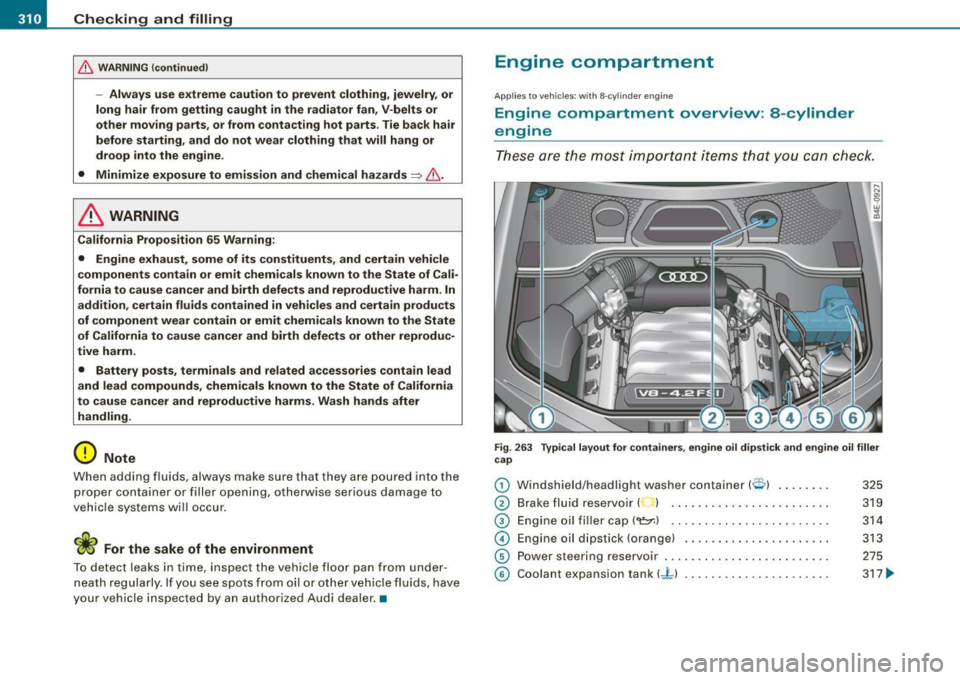
T hese are the mos t impor tant items th at you c an ch eck .
Fig. 26 3 Typical l ayout for containe rs, engine o il d ip stic k and engine oil fille r
c a p
G) Winds hield/headlight washer containe r(<;;;> ) .. ..... .
0 Brake fluid reservoir ( l) .. .. .. .. ...... .... ... .. .
© En gine oil filler cap ('I::?:) .. .. .... ...... .... ... . _ .
© Engine oil d ipstick (orange) .... ..... ........ .... .
© Power st eering r eservoir ...... ........ ... ......• .
© Coolant expansion tank (- L l ... ...... .... ... .... . .
325
319
314
31 3
275
317 ..
Page 322 of 408
-~_C_ h_e _c _ k_ i_n ...:::g::;...._ a_n_ d_ f_ i_ll _in -'g:::;.._ ___________________________________________ _
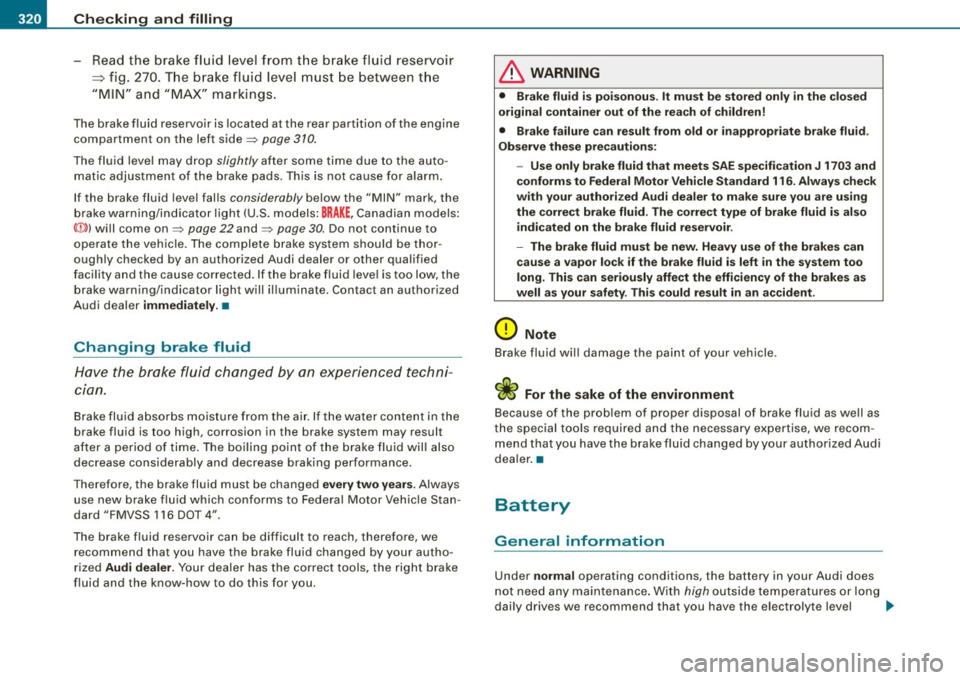
-Read the brake fluid level from the brake fluid reservoir
=> fig. 270. The brake fluid level must be between the
"MIN" and "MAX" markings.
The brake fluid reservoir is located at the rear partition of the engine
compartment on the left side~ page 310.
The fluid level may drop slightly after some time due to the auto
matic adjustment of the brake pads. This is not cause for alarm.
If the brake fluid level falls considerably below the "MIN" mark, the
brake warning/indicator light (U.S. models:
BRAKE , Canadian models:
«D> l will come on~ page 22 and~ page 30. Do not continue to
operate the vehicle. The complete brake system should be thor
oughly checked by an authorized Audi dealer or other qualified
facility and the cause corrected. If the brake fluid level is too low, the
brake warning/indicator light will illuminate. Contact an authorized
Audi dealer
immediately. •
Changing brake fluid
Have the brake fluid changed by an experienced techni
cian.
Brake fluid absorbs moisture from the air. If the water content in the
brake fluid is too high, corrosion in the brake system may result
after a period of time. The boiling point of the brake fluid will also
decrease considerably and decrease braking performance.
Th erefore, the brake fluid must be changed
every two years. Always
use new brake fluid which conforms to Federal Motor Vehicle Stan
dard "FMVSS 116 DOT 4".
The brake fluid reservoir can be difficult to reach, therefore, we
recommend that you have the brake fluid changed by your autho
rized
Audi dealer. Your dealer has the correct tools, the right brake
fluid and the know-how to do this for you.
& WARNING
• Brake fluid is poisonous. It must be stored only in the closed
original container out of the reach of children!
• Brake failure can result from old or inappropriate brake fluid .
Observe these precautions:
-Use only brake fluid that meets SAE specification
J 1703 and
conforms to Federal Motor Vehicle Standard 116. Always check
with your authorized Audi dealer to make sure you are using
the correct brake fluid. The correct type of brake fluid is also
indicated on the brake fluid reservoir .
- The brake fluid must be new. Heavy use of the brakes can
cause a vapor lock if the brake fluid is left in the system too
long. This can seriously affect the efficiency of the brakes as
well as your safety . This could result in an accident .
0 Note
Brake fluid will damage the paint of your vehicle.
~ For the sake of the environment
Because of the problem of proper disposal of brake fluid as well as
the special tools required and the necessary expertise, we recom
mend that you have the brake fluid changed by your authorized Audi
dealer. •
Battery
General information
Under normal operating conditions, the battery in your Audi does
not need any maintenance. With high outside temperatures or long
daily drives we recommend that you have the electrolyte level .,_
Page 323 of 408
Checking and filling -
---------------------=----"=---------
checked by a service facility. The electrolyte level should also be
checked each time the battery is charged =>
page 323.
Have the battery checked when you take your vehicle in for service.
You are well advised to replace a battery that is older than 5 years.
With certain types of airbag deployment, the battery is discon
nected from the vehicle electrical system for safety reasons=>.& in
"Repair, care and disposal of the airbags" on
page 234.
Disconnecting the battery terminals
Some vehicle functions (power window regulators, for example) are
lost if the battery terminals are disconnected. These functions have
to be relearned after the battery terminals are connected again. To
prevent this, the battery should only be disconnected from the
vehicle electrical system when absolutely necessary for repairs .
Vehicles not driven for long periods If you do not drive your vehicle over a period of several days or
weeks, electrical components are gradually cut back or switched off.
This reduces energy consumption and maintains starting capability
over a longer period
=> page 276.
Be aware that when you unlock your vehicle, some of the conve
nience functions may not operate, such as the Convenience key*,
the remote control or the power seat adjustment. The convenience
functions will be available again when you turn on the ignition and
start the engine.
Winter operation During the winter months, battery capacity tends to decrease as
temperatures drop. This is because more power is also consumed
while starting, and the headlights, rear window defogger, etc., are
used more often.
Avoid unnecessary power consump tion, particularly in city traffic or
when traveling only short distances. Let your authorized Audi dealer
check the capacity of the vehicle battery before winter sets in
=> page 323. A well charged battery will not only prevent starting
problems when the weather is cold, but will also last longer.
[ i] Tips
If your vehicle is left standing for several weeks at extremely low
temperatures, the vehicle battery should be removed and stored
where it will not freeze. This will prevent it from being damaged and
having to be replaced.•
Working on the battery
Be especially careful when working on or near the battery.
Fig . 271 Luggage
compartment: Right·
side storage compart
ment
Fig . 272 Luggage
compartment : Battery
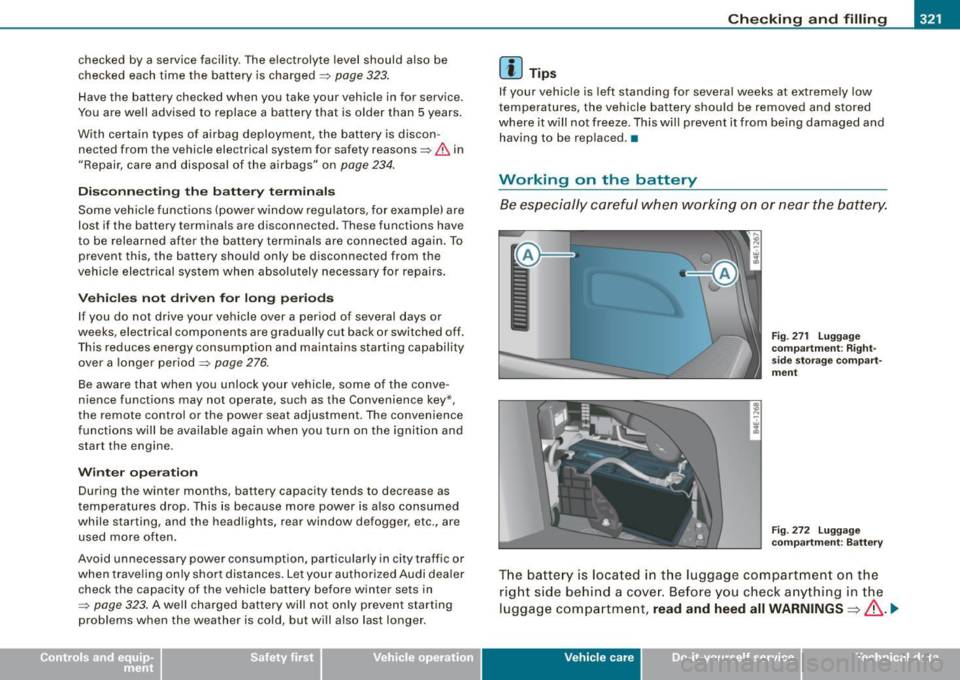
The battery is located in the luggage compartment on the
right side behind a cover. Before you check anything in the
luggage compartment,
read and heed all WARNINGS=>& . .,_
Vehic le care I I irechnical data
Page 324 of 408
-Checking and filling PW~--=----=----------------
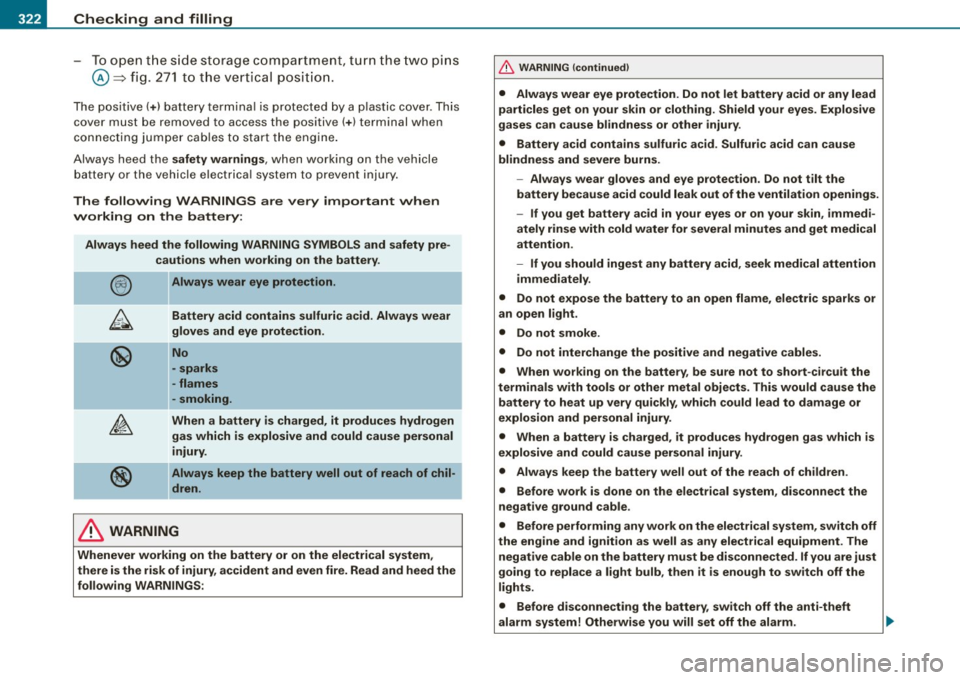
-To open the side storage compartment, turn the two pins
@ ~fig . 271 to the vertical position.
The positive(+) battery terminal is protected by a plastic cover . This
cover must be removed to access the positive(+) terminal when
connecting jumper cables to start the eng ine.
Always heed the safety warnings , when working on the vehicle
battery or the vehicle electrica l system to prevent injury.
The following WARNINGS are very important when
working on the battery:
Always heed the following WARNING SYMBOLS and safety pre
cautions when working on the battery .
@
®
Always wear eye prote ction .
Battery acid contains sulfuric acid. Always wear
gloves and eye protection .
No
• sparks
- flames
· smoking.
When a battery is charged, it produces hydrogen
gas which is explosive and could cause personal injury .
Always keep the battery well out of reach of chil
dren .
& WARNING
Whenever working on the battery or on the electrical system,
there is the risk of injury, accident and even fire. Read and heed the
following WARNINGS :
& WARNING (continued)
• Always wear eye protection. Do not let battery acid or any lead
particles get on your skin or clothing. Shield your eyes. Explosive
gases can cause blindness or other injury.
• Battery acid contains sulfuric acid. Sulfuric acid can cause
blindness and severe burns.
-Always wear gloves and eye protection . Do not tilt the
battery because acid could leak out of the ventilation openings.
- If you get battery acid in your eyes or on your skin, immedi
ately rinse with cold water for several minutes and get medical
attention.
- If you should ingest any battery acid , seek medical attention
immediately .
• Do not expose the battery to an open flame , electric sparks or
an open light .
• Do not smoke.
• Do not interchange the positive and negative cables.
• When working on the battery, be sure not to short-circuit the
terminals with tools or other metal objects. This would cause the battery to heat up very quickly, which could lead to damage or
explosion and personal injury.
• When a battery is charged, it produces hydrogen gas which is
explosive and could cause personal injury.
• Always keep the battery well out of the reach of children.
• Before work is done on the electrical system, disconnect the
negative ground cable.
• Before performing any work on the electrical system, switch off
the engine and ignition as well as any electrical equipment. The
negative cable on the battery must be disconnected. If you are just
going to replace a light bulb , then it is enough to switch off the
lights.
• Before disconnecting the battery, switch off the anti-theft
alarm system! Otherwise you will set off the alarm.
Page 325 of 408
Checking and filling -
--------------~-
•
& WARNING (continued)
• When disconnecting the battery, first disconnect the negative
cable and then the positive cable.
• Before reconnecting the battery, make sure all electrical
consumers are switched off. Reconnect the positive cable first and
then the negative cable. Never interchange the cables -this could
start a fire!
• Never charge a frozen or a thawed-out battery. It could
explode! If a battery has frozen, then it must be replaced. A
discharged battery can freeze over at 32 °F (0 °CI.
• Make sure the vent hose is always attached to the opening on
the side of the battery.
• Never use batteries which are damaged. There is the danger of
an explosion! Always replace a damaged battery.
& WARNING
California Proposition 65 Warning:
• Battery posts, terminals and related accessories contain lead
and lead compounds, chemicals known to the State of California
to cause cancer and reproductive problems. Wash hands after
handling.
0 Note
• Do not disconnect the vehicle battery when the ignition is
switched on or when the engine is running, otherwise, you will
damage electronic components in the electrical system.
• If your vehicle is going to stand for a long period of time without
being driven, protect the battery from "freezing", otherwise it will
be damaged and will then have to be replaced .•
Battery charging
Starting the engine requires a well charged battery.
Always read and heed all WARNINGS below=> & and => &
in "Working on the battery" on
page 321.
-Turn off the ignition and all electrical consumers.
- Make sure the area is well ventilated when you charge
the battery.
- Attach the red (positive
8) clamp of the charging equip
ment to the positive terminal of the battery and the black
(negative(:)) clamp to the jumper terminal.
- Only now plug the mains lead for the charging equip
ment into the wall outlet and turn it on=> &.
-Make sure the charging rate is not over 30 amps/14.8
Volt.
-When the battery is fully charged: Turn the charging
equipment off and remove the mains lead from the wall
outlet.
- Now remove the clamps for the charging equipment .
A discharged battery can freeze at temperatures of only O °C . Allow
a frozen battery to thaw completely before attempting to charge it
=> &. However, we recommend not using a thawed battery again
because the battery casing can be cracked due to ice formation and
can leak battery acid.
Battery charging (Maximum charging rate of 30
amps/14.8 Volt)
When charging at /ow voltages (e.g. with a trickle charger), the
battery cables do not have to be disconnected first. The battery caps
should
not be opened when charging a battery. ._.
Vehicle care I t •