height AUDI S8 2009 Owner's Manual
[x] Cancel search | Manufacturer: AUDI, Model Year: 2009, Model line: S8, Model: AUDI S8 2009Pages: 408, PDF Size: 91.63 MB
Page 218 of 408
-Safety belts -----=-----------------------------------------
Automatic safety belt retractors
Every safety belt is equipped with an automatic belt retractor on the
shoulder bel t. This featu re locks the bel t when the belt is pulled out
fast, during hard braking and in an accident. The belt may also lock
when you drive up or down a steep hill or through a sharp curve. During normal driving the bel t lets you move freely.
Safety belt pretensioners
The safety belts are equipped with a belt pretensioner that helps to
tighten the safety belt and remove slack when the pretensioner is
activated. The function of the pretensioner is monitored by a
warning light=> page
19.
Switchable locking feature
Every safe ty belt excep t the one on the driver seat is equipped with
a switchable locking feature that
must be used when the safety belt
is used to attach a child seat. Be sure to read the important informa
tion about this feature => page
255.
& WARNING
Improperly positioned safety belts can cause serious injury in an
accident=>
page 216, "Safety belt position" .
• Safety belts offer optimum protection only when the seat back
is upright and belts are properly positioned on the body.
• Never
attach the safety belt to the buckle for another seat.
Attaching the belt to the wrong buckle will reduce safety belt
effectiveness and can cause serious personal injury.
• A passenger who is not properly restrained can be seriously
injured by the safety belt itself when it moves from the stronger
parts of the body into critical areas like the abdomen.
• Always lock the convertible locking retractor when you are
securing a child seat in the vehicle => page
257. •
Safety belt position
Correct belt position is the key to getting maximum
protection from safety belts.
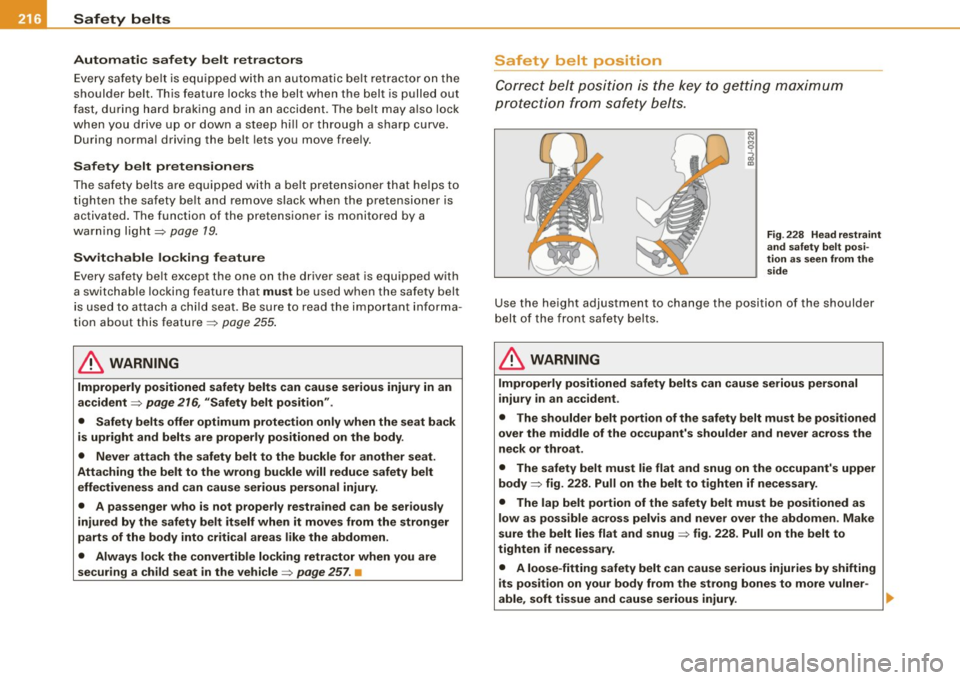
Fig . 228 Head restraint
and safety belt posi
tion as seen from the
side
Use the height adjustment to change the position of the shoulder
belt of the front safety belts.
& WARNING
Improperly positioned safety belts can cause serious personal
injury in an accident .
• The shoulder belt portion of the safety belt must be positioned
over the middle of the occupant's shoulder and never across the
neck or throat.
• The safety belt must lie flat and snug on the occupant's upper
body => fig. 228. Pull on the belt to tighten if necessary.
• The lap belt portion of the safety belt must be positioned as
low as possible across pelvis and never over the abdomen. Make
sure the belt lies flat and snug => fig. 228. Pull on the belt to
tighten if necessary.
• A loose-fitting safety belt can cause serious injuries by shifting
its position on your body from the strong bones to more vulner -
able, soft tissue and cause serious injury.
~
Page 220 of 408
___ S_a_ f_ e_ t-= y_ b_e_ l_ t _s _______________________________________________ _
Adjusting safety belt height
Use the safety belt height adjustment to change belt posi
tion on the shoulder.
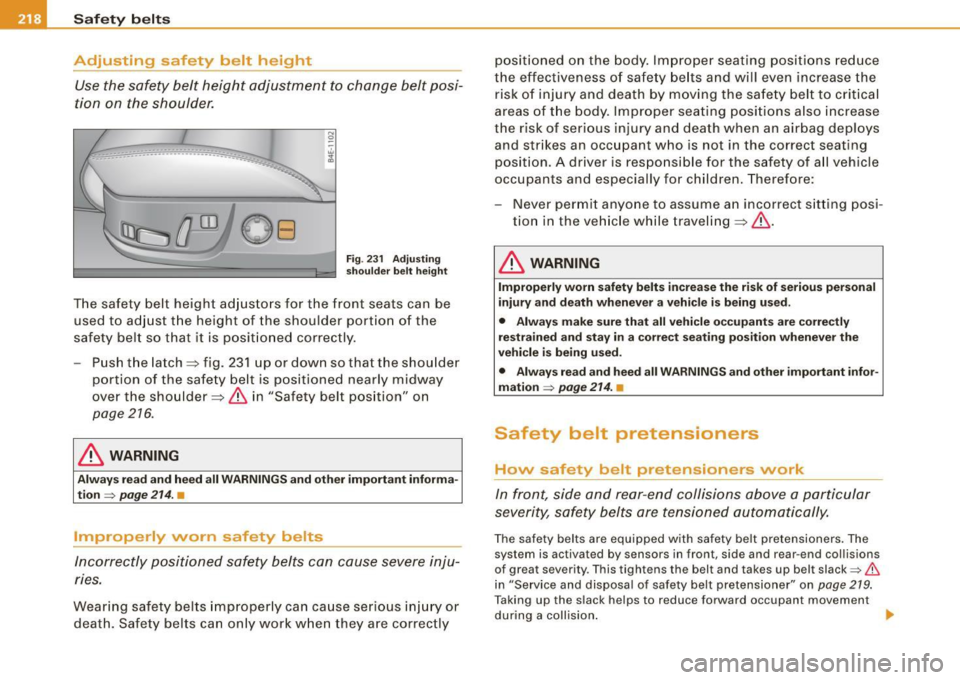
Fig . 231 Adjusting
shoulder belt height
The safety belt height adjustors for the front seats can be
used to adjust the height of the shoulder portion of the
safety belt so that it is positioned correctly.
- Push the latch=:, fig. 231 up or down so that the shoulder
portion of the safety belt is positioned nearly midway
over the shoulder =:, & in "Safety belt position" on
page 216.
& WARNING
Always read and heed all WARNINGS and other important informa
tion
=> page 214. •
Improperly worn safety belts
Incorrectly positioned safety belts can cause severe inju
ries.
Wearing safety belts improperly can cause serious injury or
death. Safety belts can only work when they are correctly positioned on the body. Improper seating
positions reduce
the effectiveness of safety belts and will even increase the
risk of injury and death by moving the safety belt to critical
areas of the body . Improper seating positions also increase
the risk of serious injury and death when an airbag deploys
and strikes an occupant who is not in the correct seating
position. A driver is responsible for the safety of all vehicle
occupants and especially for children. Therefore:
- Never permit anyone to assume an incorrect sitting posi
tion in the vehicle while traveling=:,& .
& WARNING
Improperly worn safety belts increase the risk of serious personal
injury and death whenever a vehicle is being used.
• Always make sure that all vehicle occupants are correctly
restrained and stay in a correct seating position whenever the
vehicle is being used.
• Always read and heed all WARNINGS and other important infor
mation
=> page 214. •
Safety belt pretensioners
How safety belt pretensloners work
In front, side and rear-end collisions above a particular
severity, safety belts are tensioned automatically.
The safety belts are equipped with safety belt pretensioners . The
system is activated by sensors in front, side and rea r-end collisions
of great severity . This tightens th e belt and takes up belt slack=>
&
in "Service and disposal of safety belt pretensioner" on page 219.
Taking up the slack helps to reduce forward occupan t movement
during a collision. _.,
Page 238 of 408
___ A_ ir_b _a_ g;:::;_ s--:.. y_s _t _e _m _________________________________________________ _
& WARNING
Changing the vehicle's su spension includ ing use of un approved
tire -rim combinations can change Advanced Airbag performance
and increase the ris k of serious personal injury in a crash .
• Never install suspen sion component s that do not have the
same performance chara cteristics as the components or iginally
installed on your vehicle.
• Never use tire-r im comb inations that have not been approved
by Audi.
& WARNING
Items stored between the safety belt bu ckle and the center
c onsole can cause the sensors in the buc kle to send the wrong
information to the electroni c control module and prevent the
Advanced Airbag System from working properly .
• Alway s make sure that nothing can interfere with the safety
belt buckles and that they are not obstructed .
<£> For the sake of the environment
Undeployed airbag modules a nd pretensioners might be classified
as Pe rchlorate Mat erial -spe cia l han dling may a pply, see
www.dtsc.ca.gov/hazardouswaste/perchlorate. When the vehicle or
par ts o f the restraint syst em i ncludi ng ai rbag modules and saf ety
belts with pretensioners are scrapped, a ll app licab le laws and regu
latio ns must be observed . Yo ur au thori zed A udi dealer is fam ilia r
with these requirements and we recommend that you have your
dealer perfo rm this serv ice for you .•
Knee airbags
Description of knee airbags
T he airba g sys tem c an prov id e sup plemen tal prot ect ion
t o pro pe rly rest rained fron t seat occ upant s.
0
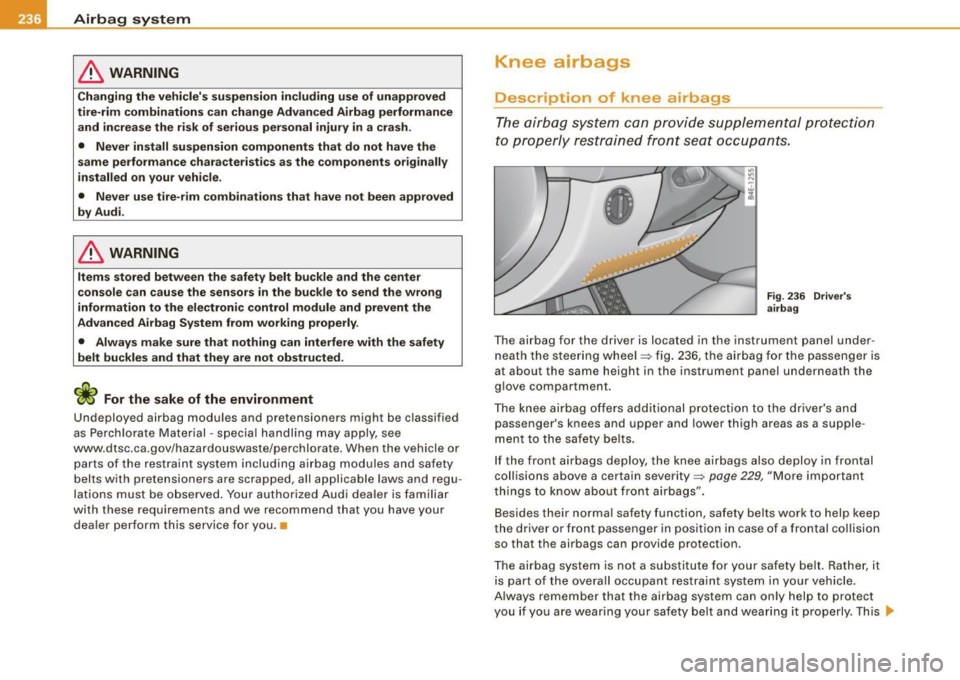
Fig. 2 36 Drive r's
airba g
The airbag for the driver is located in the instrument panel under
neath the steering wheel=> fig. 236, the airbag for the passenger is
at about the same height in the instrument panel und erneath the
glove compartment.
T he knee air bag offe rs addi tio nal pr ote cti on to the d river's a nd
passenger 's knees and upper and lower thigh ar eas as a supple
me nt to t he sa fety be lts.
I f the front airbags deploy , the knee airbags also deploy in frontal
collisions above a certain severity=> page
229, "M ore important
thi ngs to kno w about fron t a irba gs" .
B esides their normal safety function, safety belts wor k to help keep
t h e dri ver o r fr on t passeng er in pos itio n in case of a fro ntal col lis ion
so that the airbags can provide protection .
T he airbag system is not a substitute for your safety belt . Rathe r, it
i s part of the overa ll occupa nt res tra int system i n your ve hi cle.
A lwa ys re member that the airbag system can on ly help to protect
you if you a re wearing your safe ty belt and weari ng it properly . T hi s .,,_
Page 266 of 408
1111 Child Safety
---------..!...--------------------------------------
0 Note
On vehicles with power individual rear seats* some criteria must be
observed when attaching the child restraint using the
LATCH
system :
• To attach the child restraint securely, the seat must be moved to
the farthest rear position, the seat height set to the lowest position
and the head restraint must be adjusted to the ver tical position
~ page 97.
• If a child safety seat is attached to one of the rear seats, this seat
must not be adjusted using the power controls under any circum
stances. The easy entry function for this seat must also be deacti
vated in the
MMI ~ page 700. The child safety seat as well as the
rear seat can be damaged by the adjustment process .•
Mounting and releasing the anchorage hook
If you use a child restraint system with hooks or other
latches attached to adjustable straps.
Mounting
-Press the anchorage hook with the spring catch release
onto the lower anchorage so that the anchorage hook
locks into place .
- Pull on the anchorage hook to make sure that it has
securely engaged the lower anchorage.
- Tighten the strap following the child restraint manufac
turer's instructions.
Releasing
- Loosen the tension on the strap following the child
restraint manufacturer's instructions .
- Depress the spring catch on the hook. -
Hold the spring catch in depressed position.
- Move the hook in the direction of the vehicle floor so that
there is enough space to release the anchorage hook
from the lower anchorage.
& WARNING
• Improper installation of child restraints will increase the risk of
injuries in a crash.
• Always refer to the child restraints manufacturer's instructions
for proper installation of the child restraint and proper use of the
lower anchorages or safety belts
in your vehicle. •
Tether anchors
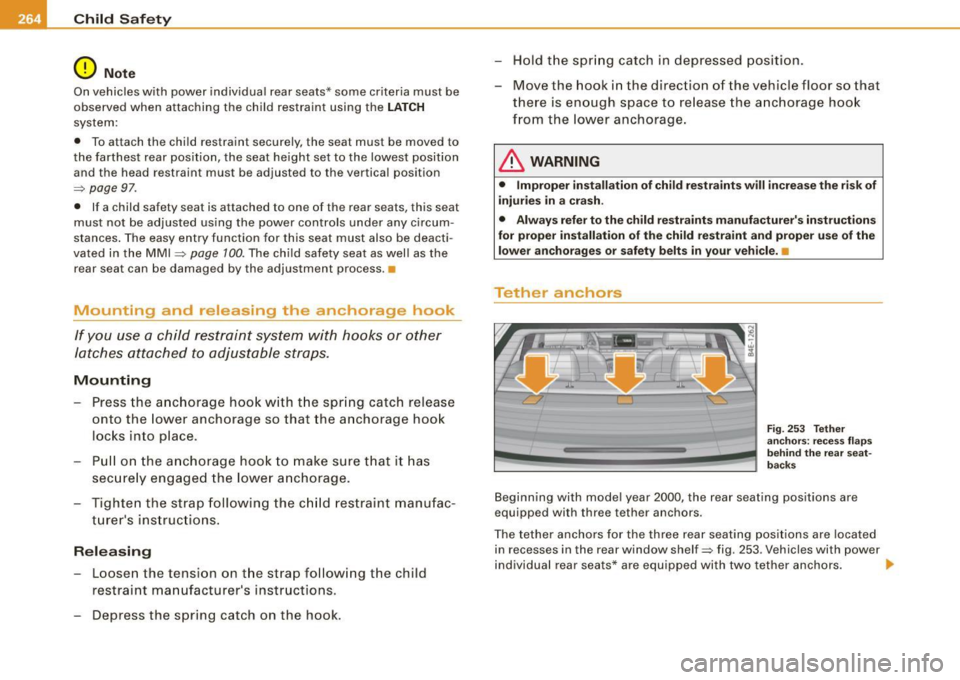
Fig. 253 Tether
anchors: recess flaps
behind the rear seat
backs
Beginning wi th model year 2000 , the rear seating positions are
equipped with three tether anchors .
The tether anchors for the three rear seating positions are located
in recesses in the rear window shelf~ fig. 253 . Vehicles with power
individual rear seats* are equipped with two tether anchors. .,.
Page 329 of 408
________________________________________________ T_ i _r_e _s_ a_n_ d_ w_ h_ e_e _ l_s __ ,n
•
& W ARNING (continu ed )
crashes and serious personal in jur ies . Have worn or da maged t ires
replaced immediately .
• Tires age even if they are not being u sed and can fail suddenly ,
especially at high speeds. T ires that are more than 6 years old can
only be used in an emergency and then w ith special care and at
low speed.
Glossary of tire and loading terminology
Accessory weight
means the co mbined we ig ht ( in excess o f those sta nda rd items
which may be rep laced) of automatic transmission, power steering,
power brakes, power w indows, powe r seats, rad io, a nd heater, to
the extent that these items are avai lab le as factory-installed equip
m ent (w hether insta lled or not).
Aspect ratio means t he ratio o f th e height to t he w idt h of the tire in perce nt.
N umbers of 55 or lower indicate a low sidewa ll for improved
steer ing respo nse and b ette r overall ha ndl ing on dry pave ment.
Bead
means the part of the tire that is made of stee l wires, wrapped or
reinforced by ply cords and that is shaped to fit the rim.
Bead separation
means a breakdow n of the bond be tween co mponents i n the bead.
Cord
m eans the strands fo rmi ng the plies in the ti re.
& W ARNING (continued )
• Never mount used tires on your vehicle if you are not sure of
their "previous history. " Old used t ire s may ha ve been damaged
even though the damage cannot be seen that can lead to sudden
tire failure and lo ss of vehicle control.
• If you noti ce unusual vibration or if the vehicle pulls to one side
when driving , always stop as soon as it is safe to do so and check
the wheels and tires for damage . •
Cold tire inflation pressure
mea ns t he ti re pressure reco mm ended by the ve hicle ma nufacturer
for a tire of a designated size that has not been d riven for more tha n
a cou ple o f miles (k ilometers) at low speeds in t he t hre e ho ur per iod
before the tire pressure is measured or ad justed .
Curb weight
means the weight of a moto r vehic le with standard equipment
i nc lud ing the max imu m capac ity o f fue l, o il, and coola nt, a ir c ond i
tioning and additiona l weight of optional equipment.
Extra load tire
means a tire des ign to operate at higher loads and at highe r infla
tion pressures than the corresponding standard tire. Extra load tires
may be identified as "XL", "xi", "EXTRA LOAD", or "RF" on the side
wa ll.
Gross Axle Weight Rating ("GAWR ")
means the load -carrying capacity of a sing le ax le system, measured
at the ti re -ground interfaces.
Gross Vehicle Weight Rating ("GVWR "l
mea ns the ma ximum tot al l oade d weigh t of the vehicle.
Vehicle care
I t •
Page 340 of 408
___ T_ i_ r_e _s_ a_ n_ d_ w_ h_ e_ e _ ls _________________________________________________ _
Incorrect wheel alignment
Incorrect wheel alignment can cause excess ive tire wea r, im pairing
the safety of the vehic le. If tires show excessive wear, have the
whee l alignment c hecked by an au th o rize d Audi deale r or qualifie d
wo rkshop.
All Wheel Drive
Vehicles with quattro® must always have tires of the same size, c ons truc tion and tread type. F or details see
~ p age 275 .
& WARNING
Sudden tire failure can lead to los s of control, a crash and serious
personal injury !
• Never drive a vehicle when the tread on any tire is worn down
to the wear indicators .
• Worn tires are a safety hazard, they do not grip well on wet
roads and increase your risk of "hydroplaning " and loss of control .
• Always keep chemicals that can cause tire dam age , such as
grease, oil , gasoline and brake fluid aw ay from tires .
• Tires age even if they are not being used and can fail suddenly ,
especially at high speeds. Tires that are more than 6 years old can
only be used in an emergency and then with special care and at
lower speeds .
• Never mount used tires on your vehicle if you are not sure of
their "previous history." Old used tires may have been damaged
even though the damage cannot be seen that can lead to sudden
tire failure and los s of veh icle control. •
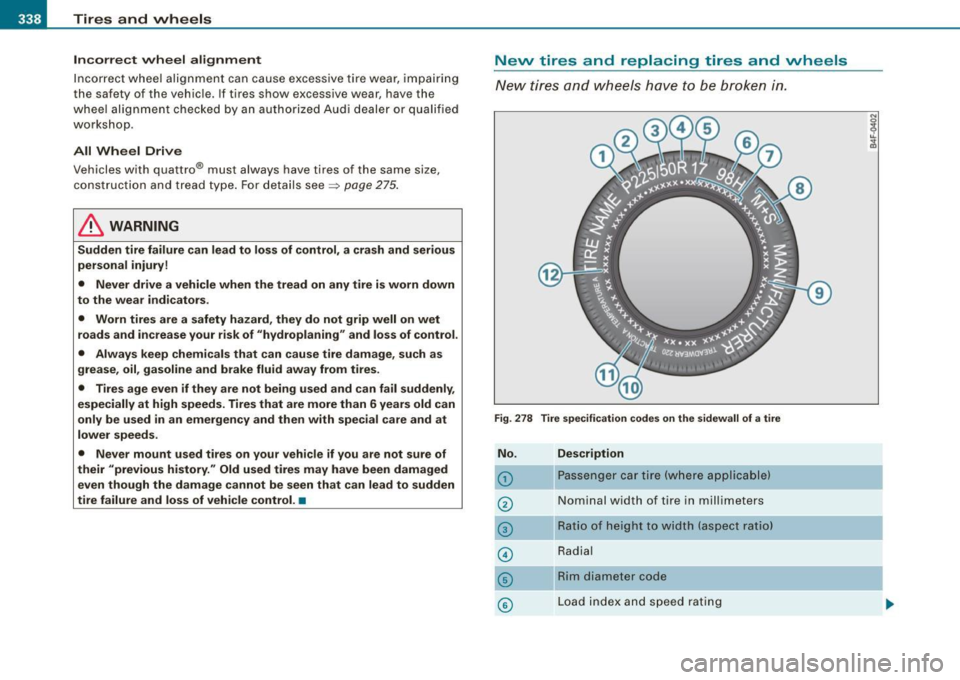
New tires and replacing tires and wheels
New t ires and wheels h ave t o be broke n in.
Fig . 278 T ir e specif ication cod es on the sidewall of a tir e
No.
©
0
©
©
©
©
Description
Passenger car tire (where applicable)
Nominal width of tire in millimeters
Ratio of height to width (aspect ratio)
Radial
Rim diameter code
L o ad in dex and s peed ra ting
Page 341 of 408
________________________________________________ T_ i _r_e _s_ a_n_ d_ w_ h_ e_e _ l_s __ lR
•
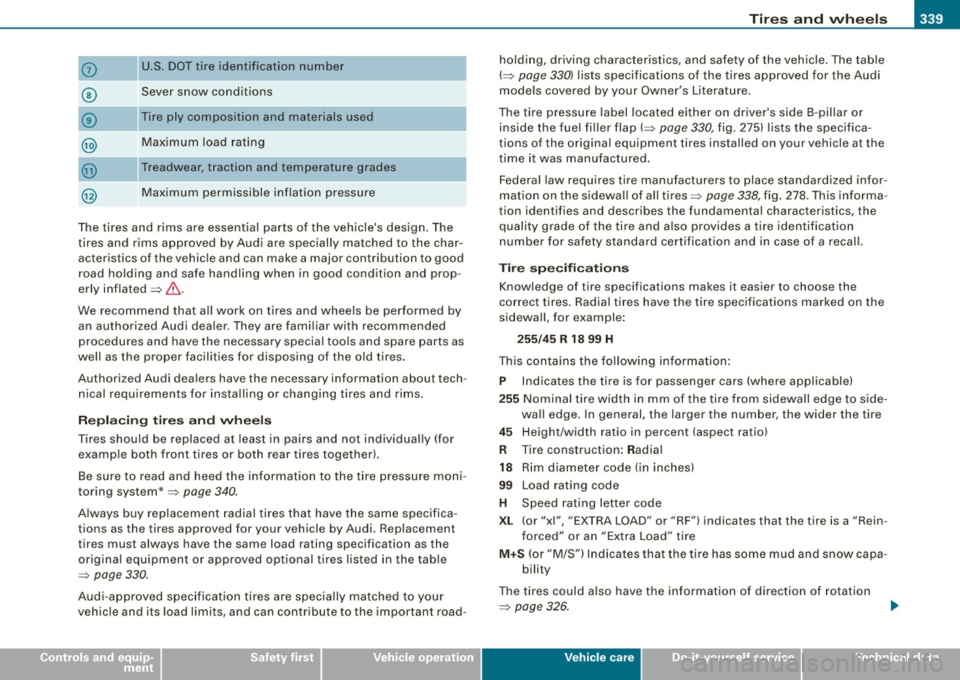
0
-
©
®
U.S. DOT ti re identification number
Sever snow conditions
Tire ply composition and materials used
Maximum load rating
Treadwear , traction and temperature grades
@ Maximum permissible inflation pressure
The tires and rims are essential parts of the vehicle 's design. The
tires and rims approved by Audi are specially matched to the char
acteristics of the vehicle and can make a major contribution to good
road hold ing and safe handling when in good cond ition and prop
erly inflated =>& .
We recommend that a ll work on tires and wheels be performed by
an authorized Audi dealer. They are familiar with recommended
procedures and have the necessary special tools and spare parts as
well as the proper facilities for d isposing of the old tires.
Authorized Audi dea lers have the necessary info rmation about tech
nical requirements for insta lling or changing tires and rims.
R epl ac ing tires and wheels
Tires shou ld be replaced at least in pairs and not individually (for
examp le both front tires or both rear tires together).
Be sure to read and heed the information to the tire pressure moni
toring system*=>
page 340.
Always buy replacement radial tires that have the same specifica
tions as the tires approved for your vehicle by Audi. Rep lacement
tires must always have the same load rating specification as the
origina l equipment or approved optional t ires listed in the table
=>
page 330.
Audi -appr oved spec ification tires are spec ially matched to your
vehicle and its load limits, and can contribute to the important road- holding, driving characteristics, and safety of the vehicle
. The table
(=>
page 330) l ists specifications of the tires approved for the Audi
models covered by your Owner's Literature.
The tire pressure labe l located either on driver's side 8 -pi llar or
inside the fuel fi ller flap(=>
page 330, fig. 275) lists the specifica
tions of the original equipment tires installed on your vehicle at the
ti me it was manufactured.
Federa l law requires tire manufacturers to place standardized infor
mation on the sidewa ll of all tires =>
page 338, fig . 278. This informa
t ion identifies and describes the fundamental characteristics, the
qua lity grade of the ti re and also provides a tire identification
number for safety standard certificat ion and in case of a recal l.
Tire specificat ions
Knowledge of tire specifications makes it easier to choose the
co rrect t ires . Radial tires have the tire specifications marked on the
sidewall, for example:
255 /45 R 18 99 H
This contains the following informat ion:
P Indicates the ti re is for passenger cars (where applicab le)
255 No minal tire width i n mm of the tire fro m sidewall edge to side -
wa ll edge. In general, the larger the number, the wider the tire
45 Height/width ratio in percent (aspect ratio)
R Tire construction: Radial
18 Rim diameter code (in inches)
99 Load rating code
H Speed rating lette r code
XL (or "xi", "EXTRA LOAD" or "RF") indicates that the tire is a "Rein
forced" or an "Extra Load" ti re
M +S (o r "M/S") Indicates that the tire has some mud and snow capa
bility
The tires could a lso have the information of direct ion of rotation
=>
page 326.
Vehicle care I t •
Page 347 of 408
Tires and wheels 1111111 ________________________________ ::..:..:....::.=.....::.:..:..:..::..:___:__ _ ___:,___
•
Wheel bolts
Wheel bolts mus t alwa ys be tighte ned to t he correct
to rq ue .
The design of wheel bo lts is matched to the factory installed rims. If
di fferent r ims are fitted , th e cor rect whe el bo lts wi th the rig ht l ength
and c orrec tly shaped bolt heads must be used . This ens ures that
w he els a re fitted se cur ely and th at the bra ke syste m functi ons
correctl y.
In cer ta in c ircums tances, yo u ma y not use w hee l bolts fr om a
differ ent vehicle - even if it is the same model~
page 384 .
& WARNING
Improperly tightened or maintained wheel bolts can become loose
causing loss of control, a collision and serious personal injury.
• Always keep the wheel bolts and the threads in the wheel hubs
clean so the wheel bolts can turn easily and be properly tightened .
• Never grease or oil the wheel bolts and the threads in the wheel
hubs. They can become loose while driving if greased or oiled,
even if tightened to the specified torque .
• Only use wheel bolts that belong to the rim being installed .
• Never use different wheels bolts on your vehicle.
• Always maintain the correct tightening torque for the wheel
bolts to reduce the risk of a wheel loss .
If the tightening torque of
the wheel bolts is too low, they can loosen and come out when the
vehicle is moving . If the tightening torque is too high, the wheel
bolts and threads can be damaged and the wheel can become
loose .
0 Note
The s pecified torque for the wheel bolts is 90 ft lb ( 120 N m) with a
to lerance o f± 7,4 ft lb(± 1 0 Nm). Torque whee l bolt s diago nally.
After chang ing a whee l, the torque must be checked as soon as possible with a torque wrench
-preferably by an authorized Audi
d e aler o r qua lifi ed wo rksho p.•
Low aspect ratio tires
You r A ud i is fac tory-eq uippe d w ith low aspect ra tio tire s. T hese tire s
have been thorough ly t ested and b een se lected specifica lly for your
mod el for thei r su p erb pe rf or manc e, r oad f eel an d ha nd ling under
a variety of driving con ditions . As k your authorized Audi d ealer for
m ore de ta ils.
The low aspect rat io o f th ese t ires is indicated by a numer al of 55 or
less in the t ire's size designation. The numeral rep resents the ratio
o f t he t ire's s idewa ll he ig ht in rel ati on to it s tread w idt h ex pressed
in percentage . Conventiona l tires have a height/width ratio of 60 or
mo re.
The performan ce of low -aspe ct-ratio tires is particularly sensitive to
improper inflation pressure . It is therefore important that low
aspect ratio tires are inflated to the specified pressure and that the
inflat ion pressure is regularly checked and ma intained. Tire pres
sures should be checked at least once a month and always before a
long trip~
page 333, "Checking tire pressure" .
What you can do to avoid tire and rim damage L ow aspect ratio tires can be damaged mo re easily by impact with
po tho les, cu rbs, gull ies o r rid ges o n th e road, particular ly if the t ire
is underinf lated .
I n or der to mini mize th e occurrence of i mpac t da mag e to t he tires
of your vehicle, we recommend that you observe the fol lowing
pr ecaut ions :
• Always ma intain recom mended inflatio n pr essu res . C heck you r
ti re p ressu re eve ry 2,000 mi les (3,000 k m) and add a ir if neces sary .
• D rive carefully on roads with potho les, deep gullies or ridges.
T he impact from d riving th rough or ove r such obstac les can
da mage y our tires. I mpact with a cu rb m ay a lso cause damage to
your tire s. ..,
Vehicle care
I t •
Page 382 of 408

___ D_ a_t _a ________________________________________________________ _
Data
Applies to vehi cle s: wi th 8 -cy lin der eng ine a nd all whee l dri ve
350 hp, a-cylinder engine, with all wheel drive
Engin e data
Maximum output SAE net
Maximum torque SAE net
No. of cy linders
Dis placement
Stroke
Bore
Compression ratio
Fuel
D im ensi on s (ap prox.)
Length (with licence plate bracket)
Width (across mirrors) Height (unloaded)
Turning circle diameter (curb to curb)
Ca pacitie s (a pprox.)
Fuel t ank
-Total capacity
- Reserve (of total capacity)
Wind shield and h eadlight washer fluid cont aine r
Engine oil
with filter change hp@rpm
lb
-ft@ rpm
CID (cm
3 )
in (mm)
in (mm)
350@6800
325@3500
8 cylinder
254 (4163)
3.65 (92.8)
3 .33 (84.5)
12.5: 1
Premium unleaded (91 AKI) Recommended for maximum engine performance . Fur
ther details =:>
page 303, "Gasoline"
in (mm)
in (mm)
in (mm)
ft. (ml
A8 = 199.3 (5062)
A8 = 79 .8 (2028)
A8 = 56.9 (1444)
A8 = 41.0 (12.5)
gal (liters)
gal (liters)
quarts (liters)
quarts (liters)
A8 L = 204 .4 (5192)
A8 L = 79 .8 (2028)
A8 L = 57.3 (1455)
A8 L =41.7 (12.7)
23.8 (90.0)
2.4 (9.0)
5 .1 (4.8)
9.6(9. 1)
•
Page 383 of 408
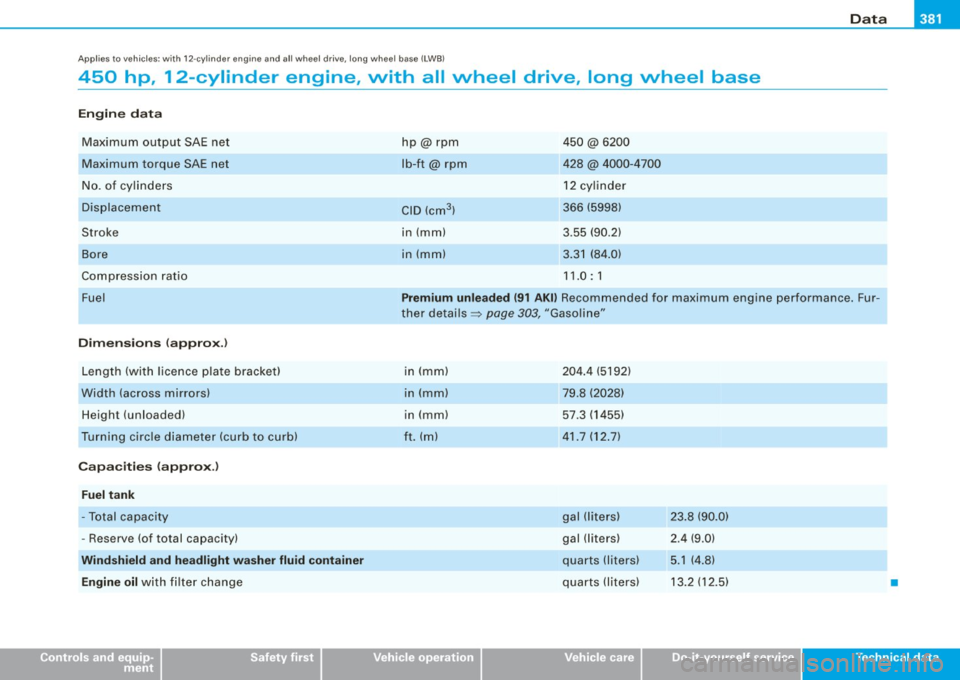
_______________________________________________________ D_ a _ t_a __ lllll
Ap plies to vehic les : w it h 12-c ylinde r en gine a nd a ll whee l dr ive, lo ng wheel base (L WBl
450 hp , 12-cylinder engine , with all wheel drive , long wheel base
Engine data
Maximum ou tput SAE net
M aximum torque SAE net
No . of c ylind ers
D isplac eme nt
Stroke
Bore
Co mpress ion ratio
Fuel
Dimensions (approx .)
Leng th (wi th lice nce plate bracke t)
Width (ac ross m irrors)
Height (unloaded)
Tu rning circle d ia m ete r (cu rb to cu rb)
Capacities (approx .>
Fuel tank
- Tot al capac ity
- Reserve (of total capacity)
Windshield and headlight washer fluid container Engine oil wit h filter ch ange hp@rpm
lb-ft@ rpm
CID (c
m
3
)
in (mm)
in (m m) 45
0@ 6200
428 @ 4000-47 00
1 2 cy linde r
366 (5998)
3 .55 (90.2)
3 .3 1 (84 .0)
11. 0: 1
Premium unleaded 191 AKO Recommended for maximum engine performance . Fur
t her details =>
pa ge 303, "Ga soli ne"
in ( mm)
i n (mm)
in (mm)
f t. Im ) 20
4.4 (519 2)
79.8 (2028)
57.3 (1 455)
4 1.7 (12 .7)
gal (liter s)
gal (liters)
qua rts (liters)
qua rts (liters) 2
3 .8 (90 .0)
2. 4 (9 .0)
5.1 ( 4.8)
13 .2 (12. 5)
•
Controls and equip
ment Safety first Vehicle operation
Vehicle care Do-it-yourself service Tec hn ica l da ta