warning AUDI S8 2010 Owners Manual
[x] Cancel search | Manufacturer: AUDI, Model Year: 2010, Model line: S8, Model: AUDI S8 2010Pages: 384, PDF Size: 90.95 MB
Page 195 of 384

------------------------------------------------=D __ r __ i..: v ....:..i.:...n :.::g ~ S:...:a=- f=-- e= ly~ _-
& WARNING
Pedals that cannot move freely can cause loss of vehicle control
and in crease the risk of serious injury .
• Never place any objects in the driver 's footwell. An object could
get into the pedal area and interfer e with peda l function . In ca se
of sudden braking or an accident, you would not be able to brake
or accelerate!
• Always make su re that noth ing can fall o r move into the
driver' s footwe ll. •
Floor mats on the driver side
Always use floor mats that can b e securely attach ed to
the floor mat fasteners and do not interfere with the fre e
movement of the pe dals.
- Make sure that the floor mats are properly secur ed and
cannot move and i nte rfere with t he peda ls=> &.
Use on ly floor ma ts t hat leave the pe dal area uno bstr ucted and that
are firm ly sec ured so that they cannot slip out of position . You can
obtain s uita ble f loor mats from yo ur authori zed Audi Dealer .
Floo r mat fas teners are installed in your Audi.
Floor mats used in your vehicle must be attached to these fasteners.
P roperly secur ing t he f loor mats wi ll prevent them from s lid ing into
positions that cou ld interfere with the peda ls or impa ir safe opera
ti on of your veh icle in other ways.
& WARNING
Pedals that cannot move freely can re sult in a loss of vehicle
control and inc rease the risk of serious personal injury.
• Alway s make sure that floor mats are properly se cured .
Controls and equip ment Safety first Vehicle operation
& WARNING
(co ntinued )
• Never place or in stall floo r m ats or other floor coverings in the
vehicle that cannot be properly secured in place to prevent them from slipping and interfering with the pedals or the ability to
c ontrol the v ehicle.
• Never place or install floor mat s or other floor coverings on top
of alr eady in stalled floor mats. Additional floor mat s and other
cove rings will reduce the size of the pedal area and interfere w ith
the pedals .
• Always properly rein stall and secure floor mats that have been
taken out for cleaning.
• Always make sure that objects cannot fall into the driver foot
well while the vehicle is moving . Obje cts can become trapped
under the brake pedal and accele rator pedal causing a loss of
vehicle control. •
Stowing luggage
Loading the luggage compartment
All luggage and oth er objects must be properly stowed
and secured in the lu ggage comp artment.
Loose items in t he luggage compartme nt can s hift suddenly ,
chang ing ve hicle handling c haracteristics. Loose items ca n
also incre ase the r isk of serious pe rsonal i njury in a sudde n
veh icle maneuver or in a co llis io n.
- Distr ibute the loa d eve nly in t he luggage compartme nt.
- Always pla ce and p roperl y se cure heavy it em s in the
l u gg age compar tme nt a s far forwar d as possi ble .
- S ecur e luggag e using t he tie -d ow ns prov id ed =>
page 90,
"Lugga ge com partm ent". 1111-
Vehicle care Do-it-yourself service Technical data
Page 196 of 384
111....__D_ r_iv _i_ n_, g=-- S_ a _ f_e _,Ly _ ______________________________________________ _
in. WARNING
Improperly stored luggage or other items can fly through the
vehicle causing serious personal injury in the event of hard braking
or an accident. To help reduce the risk of serious personal injury:
• Always put objects, for example, luggage or other heavy items
in the luggage compartment.
• Always secure objects in the luggage compartment using the
tie-down hooks and suitable straps.
& WARNING
Heavy loads will influence the way your vehicle handles. To help
reduce the risk of a loss of control leading to serious personal
injury:
• Always keep in mind when transporting heavy objects, that a
change in the center of gravity can also cause changes in vehicle
handling:
-Always distribute the load as evenly as possible.
- Place heavy objects as far forward in the luggage compart-
ment as possible.
• Never exceed the Gross Axle Weight Rating or the Gross Vehicle
Weight Rating specified on the safety compliance sticker on the
left door jamb. Exceeding permissible weight standards can cause
the vehicle to slide and handle differently.
• Please observe information on safe driving
=> page 186.
in. WARNING
To help prevent poisonous exhaust gas from being drawn into the
vehicle, always keep the rear lid closed while driving.
• Never transport objects larger than those fitting completely
into the luggage area because the rear lid cannot be fully closed.
& WARNING (continued)
• If you absolutely must drive with the rear lid open, observe the
following notes to reduce the risk of poisoning:
-Close all windows,
- Close the power roof,
- Open all air outlets in the instrument panel,
- Switch off the air recirculation,
- Set the fresh air fan to the highest speed.
in. WARNING
Always make sure that the doors, all windows, the power roof and
the rear lid are securely closed and locked to reduce the risk of
injury when the vehicle is not being used.
• After closing the rear lid, always make sure that it is properly
closed and locked.
• Never leave your vehicle unattended especially with the rear lid
left open. A child could crawl into the vehicle through the luggage
compartment and close the rear lid becoming trapped and unable
to get out. Being trapped in a vehicle can lead to serious personal
injury.
• Never let children play in or around the vehicle.
• Never let passengers ride in the luggage compartment. Vehicle
occupants must always be properly restrained in one of the
vehicle's seating positions.
(I) Tips
Air circulation helps to reduce window fogging. Stale air escapes to
the outside through vents in the trim panel, on the left side of the
luggage compartment . Be sure to keep these slots free and open.•
Page 197 of 384

____________________________________________ D_ r_ iv _ in_ g,,,.,_ S_ a_ fe___,, ly'--- __
Tie-downs
The luggage compartment is equipped with four tie
downs to secure luggage and other items.
Use the t ie-downs to secure yo ur cargo properly ~ page 193,
"Loading the luggage compartment".
In a collision, the laws of physics mean that even sma ller items that
are loose in the vehicle will become heavy missiles t hat can cause
serious injury. Items in the vehicle possess energy wh ich vary w ith
vehicle speed and the weight of the item. Vehicle speed is the most
significant factor.
For examp le, in a frontal coll is ion at a speed of 30 mph (48 km/h),
the forces acting on a 10-lb (4 .5 kg) object a re ab out 20 times the
normal weig ht of the item. This means that the weight of the item
wou ld s uddenly be abo ut 20 0 lbs. (90 kg). You can imagine the inju
r ies that a 200 lbs. (90 kg) item flying freely throug h the passenger
compartment could cause in a collision like this .
& WARNING
Weak, damag ed or improper straps us ed to secure item s to tie
downs can fail dur ing hard braking or in a collision and cause
s eriou s personal injury.
• Always u se suitable mounting straps and prope rly se cure items
to the tie -downs in the luggage compartment to help prevent
items from shifting or flying forward as dangerous missiles. •
Reporting Safety Defects
Applicable to U.S.A.
If you belie ve that your vehicle has a defect
which could cause a crash or coul d cause injury
or death, you should immedi ate ly inform the
Controls and equip
ment Safety first Vehicle operation
National Highway Traffic S
afet y Admini stration
(NHTSA) in addition to notifying Audi of
America, Inc.
If NHTSA re ce ive s similar complaints, it may
op en a n inve stig ation , and if it finds that a
safety defects exists in a group of vehicles, it
may order a recall and remedy campaign.
However, NHTSA cannot become involved in
indi vidual problem s between y ou, y our dealer,
or Audi of Am erica, Inc.
To contact NHTSA, you may call the Vehicle Safety Hotline toll-free at:
Tel.: 1 -888-32 7-4236 (TTY: 1-800-424 -9153)
or write to:
Admini strator
NHTSA 1200 New Jer sey A venue, SE
Washington, D.C . 20590
You can also obtain other information about motor vehi cle safety from :
http: / /www .safer car.gov
Applicable to Canada
Canadian customer s who wish to report a
safety-related defect to Tr ansport Canada,
Vehicle care Do-it-yourself service Technical data
Page 199 of 384

_____________________________________________ S_a _f _e _t _y _b_ e_lt _ s __ l!'II
Safety belts
General notes
Always wear safety belts!
Wearing safety belts correctly saves lives!
This chapter explains why safety belts are necessary, how
they work and how to adjust and wear them correctly.
- Read all the information that follows and heed all of the
instructions and WARNINGS.
& WARNING
Not wearing safety belts or wearing them improperly increases
the risk of serious personal injury and death.
• Safety belts are the single most effective means available to
reduce the risk of serious injury and death in automobile acci
dents. For your protection and that of your passengers, always
correctly wear safety belts when the vehicle is moving.
• Pregnant women, injured, or physically impaired persons must
also use safety belts. Like all vehicle occupants, they are more
likely to be seriously injured if they do not wear safety belts. The
best way to protect a fetus is to protect the mother - throughout
the entire pregnancy. •
Number of seats
Your Audi has a total of five seating positions: two in the front and
three in the rear . Vehicles with power individual rear seats* have
seating for four: two in the front and two in the rear. Each seating
position has a safety belt.
Controls and equip
ment Safety first Vehicle operation
& WARNING
Not wearing
safety belts or wearing them improperly increases
the risk of serious personal injury and death.
• Never strap more than one person, including small children,
into any belt. It is especially dangerous to place a safety belt over
a child sitting on your lap.
• Never let more people ride in the vehicle than there are safety
belts available.
• Be sure everyone riding in the vehicle is properly restrained
with a separate safety belt or child restraint. •
Safety belt warning light t
Your vehicle has a warning system for the driver and front
seat passenger to remind you about the importance of
buckling-up.
Before driving off, always:
Fig. 201 Safety belt
warning light in the
instrument cluster -
enlarged
- Fasten your safety belt and make sure you are wearing it
properly .
IJ,,
Vehicle care Do-it-yourself service Technical data
Page 200 of 384
___ S_a _f_e _t-=y '-- b_e_ l_ t _s _____________________________________________ _
-Make sure that your passengers also buckle up a nd prop
erly wear their safety belts .
- Protect c hildren with a child rest raint system appropria te
fo r the size and ag e.
The warn ing light ~ in the instrument cluster lights up when the igni
tion is sw itched on as a reminder to fasten the safety belts. In addi
tion, you will hear a warn ing to ne .
After the ignition is switched on, the warn ing light in the instrument
clu ster will alw ays come on fo r a bout 6 seconds and i f the driver has
not fastened the safety belt, a warning tone will also sound for about
6 seconds. As soon as the d rive r has fastened the safety belt, the
warning tone will stop and the war ning light w ill go out.
If the driver or front seat passenger have not buck led-up within about
1 0 se conds afte r th e war ning tone has stopped and the veh icle is
moving faster than about 15 mph, the warning tone will sound again
for a bout 6 se conds and then s to p for 24 seco nds and the n re pea t
this rem inder sequence for a max imum of 2 m inutes . At speeds
below 5 mph, the w arning tone will not sou nd.
Fa sten your safety belt and make sure that your passenger s also
properly put on their safety belts.
& WARNING
• Safety belt s are the single most effe ctiv e mean s available to
reduce the risk of serious injury and death in automobile a cci
dents . For your protection and that of your pa ssenger s, always
c orrectly wear safety belts when the vehicle is moving .
• Failure to pay attention to the warning light that come on,
could lead to person al injury .•
Why safety belts?
Frontal collisions and the law of physics
Frontal cr ashes cre ate very stron g forc es for people
riding i n vehi cles.
Fig . 202 Unbe lted
o ccupa nts in a vehicle
h eading f or a w all
Fig. 203 Th e vehicle
cr as hes int o t he wall
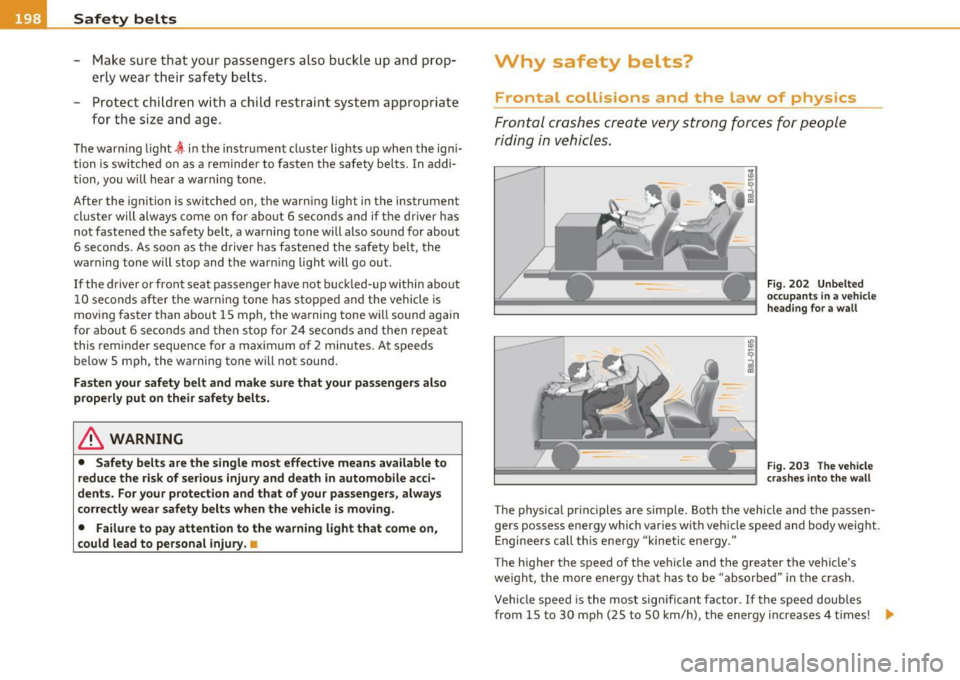
The p hys ica l pr inc iples are simple. Both the vehicle and the passen
gers possess energy which var ies wit h veh icle speed and body weight.
E nginee rs ca ll t his ene rgy "kinetic energy."
The higher the speed of the veh icle and t he greater the vehicle's
we ight, the more energy that has to be "abso rbed" in the crash .
Vehicle speed is the most sig nifican t fa ctor. If t he speed doubles
from 15 to 30 mph (25 to 50 km/h), the energy increases 4 times! .,
Page 202 of 384
__ _:::S:.::a :..:f...:e :.:t::1y ~ b:..:e:.: l:.: t :.:s :._ ____________________________________________ _
Safety belts protect
People think it's possible to use the hands to brace the
body in a minor collision . It's simply n ot true!
F ig. 2 06 Dri ver is
correct ly re str ain ed in
a s udden b rakin g
m ane uver
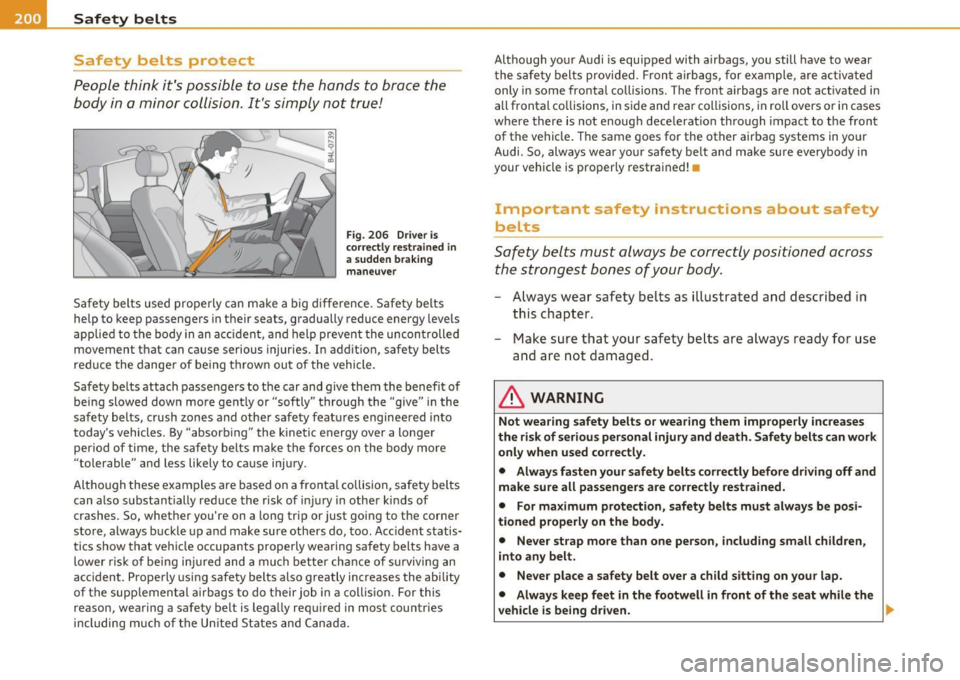
Safe ty belts used properly can make a big d ifference. Safe ty belts
help to keep passengers in their seats, gradually reduce energy levels
applied to the body in an accident, an d help prevent the uncon trolled
movement that can cause serious injuries. In add it ion, safety belts
red uce the danger of be ing t hrown ou t of the vehicle .
Safety be lts attach passengers to the car and give them the benefit of
being slowed down more gently or "softly" through the "give" in the
safety belts, crush zones and othe r saf ety features engine ered into
today's vehicles. By "absorb ing" the kinetic energy over a longer
per iod of time , the safety belts m ake the forces on the body more
"tolerable" and less likely to cause injury.
Altho ugh these examples are based on a fronta l collision, safety belts
can also s ubstant ially red uce the risk of injury in other ki nds of
crashes. So, whether you're on a long trip or just going to the corner
sto re, always buckle up and make sure others do, too. Acc ident statis
tics show that vehicle occupants properly wear ing safety belts have a
lower ris k of bei ng inj ured and a mu ch better cha nce of s urviv ing an
acc ident . Properly using safety belts also greatly increases the ability
of the supp lemen tal air bags to do the ir job in a coll is ion. For this
reason, wearing a safety bel t is lega lly requ ired in most coun tries
including muc h of the Un ited States and Canada. Altho
ugh your Audi is equ ipped with a irbags, you still have to wear
t he safe ty belts provided. Fron t air bags, for ex ample, are a ctiv ate d
only in some frontal collisions . T he front a irbags are not act ivated in
all frontal co llisions, in s ide and rear coll isio ns, in roll overs or in cases
where there is not enough decelerat ion thro ugh impact to the front
of the vehicle . The same goes for the other airbag systems in yo ur
Audi. So, always wea r your safety be lt and make su re everybody in
your vehicle is properly restrained!
Important safety Instructions about safety
belts
Safety b elts must always be correctly positioned across
the strongest bones of your body .
-Always wear safety belts as illustrated and described in
this chapter .
- Make sure that your safety belts are always ready for use and are not damaged .
& WARNING
Not wearing safety belts o r wearing them improperly inc reases
the risk of s eriou s personal injury and death . Safety belts can work
only when u sed correctl y.
• Alway s fasten your safety belts correctly bef ore driving off and
make sure all passengers are corre ctly restrained.
• For ma ximum protection , safety belts must alw ays be posi
ti oned properly on the body.
• Never strap more than one person , including small children ,
into any belt .
• Never place a safety belt o ver a ch ild sitting on you r lap .
• Alway s keep feet in the footwell in front of the seat while the
vehicle is being driven.
~
Page 203 of 384
& WARNING (continued)
• Never let any person ride with their feet on the instrument
panel or sticking out the window or on the seat.
• Never remove a safety belt while the vehicle is moving. Doing
so will increase your risk of being injured or killed.
• Never wear belts twisted.
• Never wear belts over rigid or breakable objects in or on your
clothing, such as eye glasses, pens, keys, etc., as these may cause
injury.
• Never allow safety belts to become damaged by being caught
in door or seat hardware.
• Do not wear the shoulder part of the belt under your arm or
otherwise out of position .
• Several layers of heavy clothing may interfere with correct
positioning of belts and reduce the overall effectiveness of the
system.
• Always keep belt buckles free of anything that may prevent the
buckle from latching securely.
• Never use comfort clips or devices that create slack in the
shoulder belt. However, special clips may be required for the
proper use of some child restraint systems.
• Torn or frayed safety belts can tear, and damaged belt hard
ware can break in an accident. Inspect belts regularly. If webbing, bindings, buckles, or retractors are damaged, have belts replaced
by an authorized Audi dealer or qualified workshop.
• Safety belts that have been worn and loaded in an accident
must be replaced with the correct replacement safety belt by an
authorized Audi dealer. Replacement may be necessary even if
damage cannot be clearly seen. Anchorages that were loaded
must also be inspected.
• Never remove, modify, disassemble, or try to repair the safety
belts yourself.
Safety first Vehicle OP-eration
Safety belts
& WARNING (continued)
• Always keep the belts clean. Dirty belts may not work properly
and can impair the function of the inertia reel=>
page 281,
"Safety belts". •
Safety belts
Fastening safety belts
Seat first -everybody buckle up!
Fig. 207 Belt buckle
and tongue on the
driver's seat
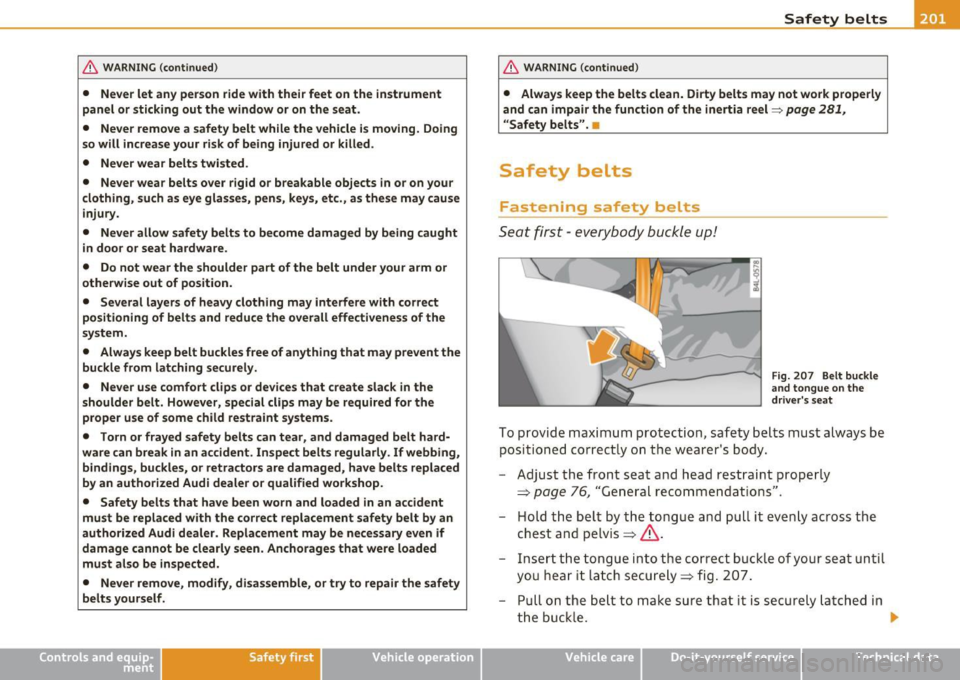
To provide maximum protection , safety belts must always be
positioned correctly on the wearer's body.
- Adjust the front seat and head restraint properly
=>
page 76 , "General recommendations" .
- Hold the belt by the tongue and pull it evenly across the
chest and pelvis=>& .
- Insert the tongue into the correct buckle of your seat until
you hear it latch securely => fig. 207 .
- Pull on the belt to make sure that it is securely latched in
the buckle. _.
Vehicle care Do-it-yourselt service iTechnical data
Page 204 of 384
-Safety belts -----=-----------------------------------------
Automatic safety belt retractors
Every sa fe ty be lt is equipped wi th an au toma tic be lt r etrac tor on the
shoulder be lt. This feat ure locks t he belt whe n the belt is pull ed out
fast, during ha rd bra king an d in an acc ident . The belt may also loc k
w hen you dr ive up or dow n a s te ep h ill or throug h a sharp curve .
Dur ing norma l driv ing the belt lets you move freely.
Safety belt pretensioners
Th e safety belts are e quipped w ith a belt p retensioner that hel ps to
t igh ten the saf ety be lt and remove slac k w he n the p re tensioner is
act ivated . The f unction of t he p retens ioner is monitore d by a warn ing
light=>
pag e 17.
Switchable locking feature
Every safety be lt except the one on the driver sea t is equipped with a
switchab le locking feature that
must b e used when the safety belt is
us ed to attach a c hild se at. B e s ure to rea d the i mporta nt info rmation
about th is feature =>
page 241.
& WARNING
Improperly positioned safety belts can cause serious injury in an
accident =>
page 202, "Safety belt position ".
• Safety belt s offer optimum protection only when the seat back
is upright and belts are properly positioned on the body.
• Never attach the safety belt to the buckle for another seat.
Attaching the belt to the wrong buckle will reduce safety belt
effe ctivene ss and can cause seriou s per sonal injury.
• A passenger who is not properly restrained can be seriously
injured by the safety belt itself when it moves from the stronger
parts of the body into critical areas like the abdomen.
• Always lock the convertible locking retractor when you are
securing a child seat in the vehicle=>
page 243. •
Safety belt position
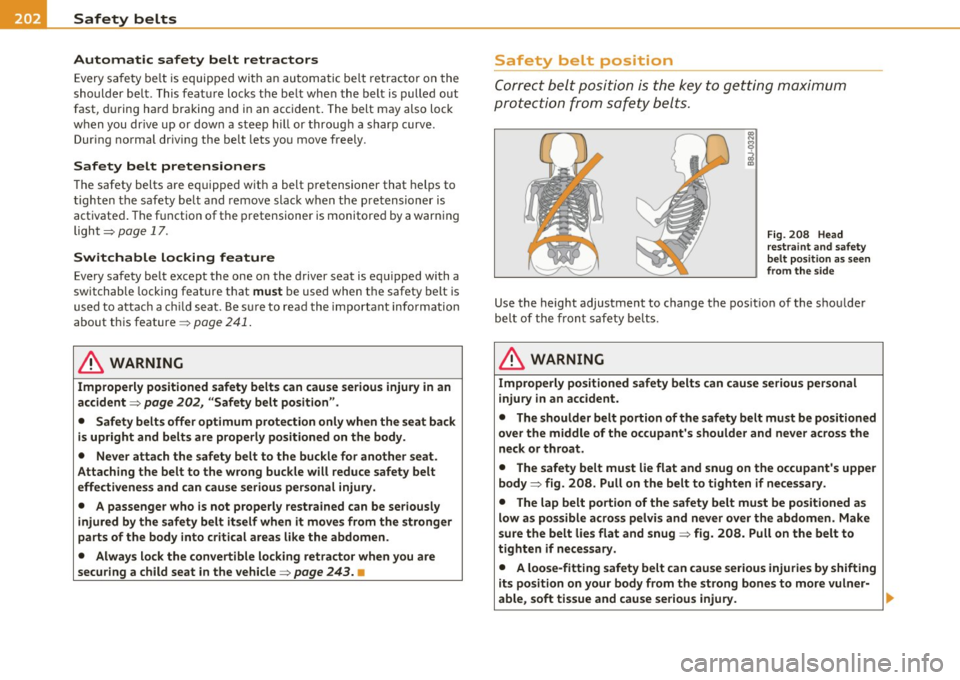
Corre ct b elt posi tion is the key t o getting maximum
p ro tec tion fro m sa fety belts .
Fig. 208 Head
restraint a nd safety
belt po sit ion as s een
from the side
Use the height adjustment to change the pos it io n of the s houl de r
be lt of the fron t sa fety be lts.
& WARNING
Improperly po sitioned safety belts can cau se serious per sonal
injury in an accident.
• The shoulder belt portion of the safety belt must be positioned
over the middle of the occupant's shoulder and never across the
neck or throat.
• The safety belt must lie flat and snug on the occupant's upper
body => fig. 208. Pull on the belt to tighten if necessary.
• The lap belt portion of the safety belt must be positioned a s
low as possible across pelvis and never over the abdomen . Make
sure the belt lies flat and snug => fig. 208. Pull on the belt to
tighten if necessary .
• A loose-fitting safety belt can cause serious injuries by shifting
its position on your body from the strong bones to more vulner-
able , soft tissue and cause serious injury .
~
Page 205 of 384

& WARNING (continued)
• Always read and heed all WARNINGS and other important
information ~
page 200. •
Pregnant women must also be correctly
restrained
The best way to protect the fetus is to make sure that
expectant mothers always wear safety belts correctly -
throughout the pregnancy.
Fig. 209 Safety belt
position during preg
nancy
To provide maximum protection, safety belts must always be
positioned correctly on the wearer's body=:>
page 202.
- Adjust the front seat and head restraint correctly
::::, page 76, "General recommendations".
- Hold the belt by the tongue and pull it evenly across the
chest and pelvis::::, fig.
209, ::::, /1.
- Insert the tongue into the correct buckle of your seat until
you hear it latch securely::::,
page 201, fig. 207.
-Pull on the belt to make sure that it is securely latched in
the buckle.
Safety first Vehicle OP-eration
Safety belts
& WARNING
Improperly positioned safety belts can cause serious personal
injury in an accident.
• Expectant mothers must always wear the lap portion of the
safety belt as low as possible across the pelvis and below the
rounding of the abdomen.
• Always read and heed all WARNINGS and other important
information ~
& in "Fastening safety belts" on page 201. •
Unfastening safety belts
Unbuckle the safety belt with the red release button only
after the vehicle has stopped.
Fig. 210 Releasing
the tongue from the
buckle
Push the red release button on the buckle::::, fig. 210. The
belt tongue will spring out of the buckle::::,
/1.
Let the belt wind up on the retractor as you guide the belt
tongue to its stowed position .
& WARNING
Never unfasten safety belt while the vehicle is moving. Doing so
will increase your risk of being injured or killed. •
Vehicle care Do-it-yourselt service iTechnical data
Page 206 of 384
Ill Safety belts
---=-------------------------------
Adjusting safety belt height
Use the safety belt height adjustment to change belt
position on the shoulder.
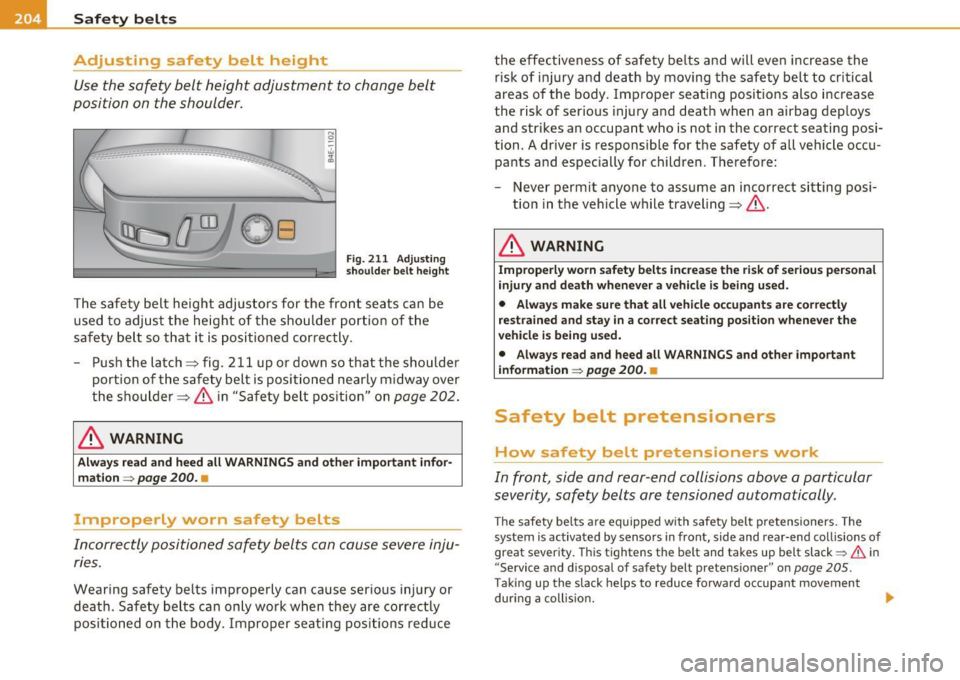
Fig. 211 Adjusting
shoulder belt height
The safety belt height adjustors for the front seats can be
used to adjust the height of the shoulder portion of the
safety belt so that it is positioned correctly.
- Push the latch=> fig. 211 up or down so that the shoulder
portion of the safety belt is positioned nearly midway over
the shoulder => & in "Safety belt position" on
page 202.
& WARNING
Always read and heed all WARNINGS and other important infor
mation =>
page 200. •
Improperly worn safety belts
Incorrectly positioned safety belts can cause severe inju
ries.
Wearing safety belts improperly can cause serious injury or
death. Safety belts can only work when they are correctly
positioned on the body . Improper seating positions reduce the effectiveness of safety belts and will even increase
the
risk of injury and death by moving the safety belt to critical
areas of the body. Improper seating positions also increase
the risk of serious injury and death when an airbag deploys and strikes an occupant who is not in the correct seating posi
tion. A driver is responsible for the safety of all vehicle occu pants and especially for children . Therefore:
- Never permit anyone to assume an incorrect sitting posi
tion in the vehicle while traveling=>& .
& WARNING
Improperly worn safety belts increase the risk of serious personal
injury and death whenever a vehicle is being used.
• Always make sure that all vehicle occupants are correctly
restrained and stay in a correct seating position whenever the
vehicle is being used.
• Always read and heed all WARNINGS and other important
information =>
page 200. •
Safety belt pretensioners
How safety belt pretensioners work
In front, side and rear-end collisions above a particular
severity, safety belts are tensioned automatically.
The safety belts are equipped with safety belt pretensioners. The
system is activated by sensors in front, side and rear-end collisions of
great severity. This tightens the belt and takes up belt slack~
& in
" Service and disposal of safety belt pretensioner" on
page 205 .
Taking up the slack helps to reduce forward occupant movement
during a collision. ..