airbag off AUDI S8 2010 User Guide
[x] Cancel search | Manufacturer: AUDI, Model Year: 2010, Model line: S8, Model: AUDI S8 2010Pages: 384, PDF Size: 90.95 MB
Page 202 of 384
__ _:::S:.::a :..:f...:e :.:t::1y ~ b:..:e:.: l:.: t :.:s :._ ____________________________________________ _
Safety belts protect
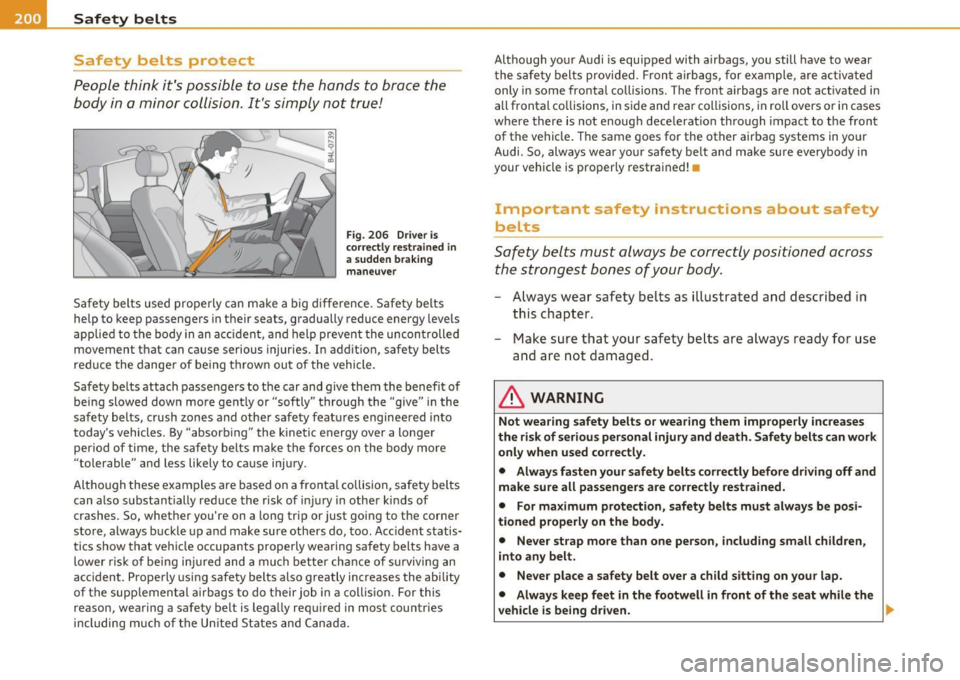
People think it's possible to use the hands to brace the
body in a minor collision . It's simply n ot true!
F ig. 2 06 Dri ver is
correct ly re str ain ed in
a s udden b rakin g
m ane uver
Safe ty belts used properly can make a big d ifference. Safe ty belts
help to keep passengers in their seats, gradually reduce energy levels
applied to the body in an accident, an d help prevent the uncon trolled
movement that can cause serious injuries. In add it ion, safety belts
red uce the danger of be ing t hrown ou t of the vehicle .
Safety be lts attach passengers to the car and give them the benefit of
being slowed down more gently or "softly" through the "give" in the
safety belts, crush zones and othe r saf ety features engine ered into
today's vehicles. By "absorb ing" the kinetic energy over a longer
per iod of time , the safety belts m ake the forces on the body more
"tolerable" and less likely to cause injury.
Altho ugh these examples are based on a fronta l collision, safety belts
can also s ubstant ially red uce the risk of injury in other ki nds of
crashes. So, whether you're on a long trip or just going to the corner
sto re, always buckle up and make sure others do, too. Acc ident statis
tics show that vehicle occupants properly wear ing safety belts have a
lower ris k of bei ng inj ured and a mu ch better cha nce of s urviv ing an
acc ident . Properly using safety belts also greatly increases the ability
of the supp lemen tal air bags to do the ir job in a coll is ion. For this
reason, wearing a safety bel t is lega lly requ ired in most coun tries
including muc h of the Un ited States and Canada. Altho
ugh your Audi is equ ipped with a irbags, you still have to wear
t he safe ty belts provided. Fron t air bags, for ex ample, are a ctiv ate d
only in some frontal collisions . T he front a irbags are not act ivated in
all frontal co llisions, in s ide and rear coll isio ns, in roll overs or in cases
where there is not enough decelerat ion thro ugh impact to the front
of the vehicle . The same goes for the other airbag systems in yo ur
Audi. So, always wea r your safety be lt and make su re everybody in
your vehicle is properly restrained!
Important safety Instructions about safety
belts
Safety b elts must always be correctly positioned across
the strongest bones of your body .
-Always wear safety belts as illustrated and described in
this chapter .
- Make sure that your safety belts are always ready for use and are not damaged .
& WARNING
Not wearing safety belts o r wearing them improperly inc reases
the risk of s eriou s personal injury and death . Safety belts can work
only when u sed correctl y.
• Alway s fasten your safety belts correctly bef ore driving off and
make sure all passengers are corre ctly restrained.
• For ma ximum protection , safety belts must alw ays be posi
ti oned properly on the body.
• Never strap more than one person , including small children ,
into any belt .
• Never place a safety belt o ver a ch ild sitting on you r lap .
• Alway s keep feet in the footwell in front of the seat while the
vehicle is being driven.
~
Page 208 of 384
ffl..,___A_ i_rb _ a_,g,:;._ s_, y'- s_ t_e _m ________________________________________________ _
Airbag system
Important things to know
Importance of wearing safety belts and
sitting properly
Airbags are only supplemental restraints. For airbags to
do their job, occupants must always properly wear their
safety belts and be in a proper seating position.
For your safety and the safety of your passengers, before
driving off, always:
- Adjust the driver's seat and steering wheel properly
~ page 188,
-Adjust the front passenger's seat properly~ page 77,
- Wear safety belts properly~
page 200,
- Always properly use the proper child restraint to protect
children~
page 231.
In a collision, airbags must inflate within the blink of an eye and with
considerable force. The supplemental airbags can cause injuries if the
driver or the front seat passenger is not seated properly. Therefore in
order to help the airbag to do its job, it is important, both as a driver
and as a passenger to sit properly at all times.
By keeping room between your body and the steering wheel and the
front of the passenger compartment, the airbag can inflate fully and
completely and provide supplemental protection in certain frontal
collisions =>
page 188, "Proper occupant seating positions". For
details on the operation of the seat adjustment controls=>
page 77.
It's especially important that children are properly restrained
=>
page 231.
There is a lot that the driver and the passengers can and must do to help the individual safety features installed in your Audi work
together as a system.
Proper seating position is important so that the front airbag on the
driver side can do its job. If you have a physical impairment or condi
tion that prevents you from sitting properly on the driver seat with
the safety belt properly fastened and reaching the pedals, or if you
have concerns with regard to the function or operation of the
Advanced Airbag System, please contact your authorized Audi dealer
or qualified workshop, or call Audi Customer CARE at 1-800-822-
2834 for possible modifications to your vehicle.
When the airbag system deploys, a gas generator will fill the airbags,
break open the padded covers, and inflate between the steering
wheel and the driver and between the instrument panel and the front
passenger . The airbags will deflate immediately after deployment so
that the front occupants can see through the windshield again
without interruption.
All of this takes place in the blink of an eye, so fast that many people don't even realize that the airbags have deployed. The airbags also
inflate with a great deal of force and nothing should be in their way
when they deploy. Front airbags in combination with properly worn
safety belts slow down and limit the occupant's forward movement.
Together they help to prevent the driver and front seat passenger
from hitting parts of the inside of the vehicle while reducing the
forces acting on the occupant during the crash. In this way they help
to reduce the risk of injury to the head and upper body in the crash .
Airbags do not protect the arms or the lower parts of the body.
Both front airbags will not inflate in all frontal collisions. The trig
gering of the airbag system depends on the vehicle deceleration rate
caused by the collision and registered by the electronic control unit.
If this rate is below the reference value programmed into the control
unit, the airbags will not be triggered, even though the car may be
badly damaged as a result of the collision. Vehicle damage, repair .,,,.
Page 209 of 384

_______________________________________________ A_ ir_ b_ a_,,,g '--- s.:.y _s _t_ e _ m ___ lJ'II
costs o r even t he lack of ve hicle damage is not necessarily an ind ica
t ion of w heth er an a irba g should inflat e or not.
S ince the c ircumstances will vary considera bly b etwee n one co llision
and another, it is not possi ble to define a range of vehicle spee ds that
w ill c ove r eve ry po ssibl e kind and angle of i mpac t that will alw ay s
trigge r the a irbags. Im portant facto rs include, for examp le, the
n at ure (har d or so ft ) of th e obje ct wh ich t he c ar hi ts, the an gle of
impact, vehicle speed, etc . T he front airbags w ill also not inflate in
s ide or rear co ll is io ns, or i n roll-o ve rs.
Always remember: Airbags will deploy only once, a nd only in certain
kinds of coll isions . Yo ur safety be lts are a lways there to offer protec
ti on in t hose situ ations i n w hich air bags are not s upposed to deploy,
or w hen they have alrea dy de ploye d; for examp le, w hen your ve hicle
s tr ikes or is st ruc k by ano ther ve hicle after the fi rst co llisio n.
T hi s is just one of the reasons w hy a n airbag is a s upplementary
res tra in t a nd i s no t a su bs titu te for a saf ety bel t. The air bag syste m
works most effective ly whe n used w ith the safety belts . Therefore,
always p rope rly wea r you r sa fety belts ~ page 197 .
& WARNING
Sitting too close to the steering wheel or instrument panel will
decrease the effectiveness of the airbags and will increase the r isk
of personal injury in a collision.
• Never sit closer than 10 inches (25 cm ) to the steer ing wheel or
instrument panel.
• If you cannot sit more than 10 inches (25 cm ) from the
steering wheel, investigate whether adaptive equipment may be
available to help you reach the pedals and increase your seating
distance from the steering wheel.
• If you are unrestrained, leaning forward, sitting sideways or
out of po sition in any way, your risk of injury is much higher.
• You will also receive serious injuries and could even be killed if
you are up against the airbag or too close to it when it inflates - even with an Advanced Airbag .
Controls and equip ment Safety first Vehicle operation
& WARNING
(co ntinued )
• To reduce the risk of injury when an airbag inflates, always
wear safety belts properly=>
page 201, "Safety belts ".
• Always make certain that children age 12 or younger always
ride in the rear seat. If children are not properly restrained, they
may be severely injured or killed when an airbag inflates.
• Never let children r ide unrestrained or improperly restrained in
the vehicle. Adjust the front seats properly .
• Never r ide with the backrest reclined.
• Always sit as far as possible from the steering wheel or the
instrument panel=>
page 188.
• Always sit upright with your back against the backre st of your
seat .
• Never place your feet on the instrument panel or on the seat.
Always keep both feet on the floor in front of the seat to help
prevent serious injuries to the legs and hips if the airbag inflates .
• Never recline the front passenger 's seat to transport objects .
Items can also move into the area of the side airbag or the front
airbag during braking or in a sudden maneuver. Objects near the
airbags can become projectiles and cause injury when an airbag
inflates .
& WARNING
Airbags that have deployed in a crash must be replaced.
• Use only original equ ipment airbags approved by Aud i and
installed by a trained technician who ha s the necessary tools and
diagnostic equipment to properly replace any airbag in your
vehicle and assure system effectiveness in a crash.
• Never permit salvaged or recycled airbags to be installed in
your vehicle. •
Vehicle care Do-it-yourself service Technical data
Page 210 of 384
........ _A_ i_rb _ a_,g,:;._ s_, y'- s_ t_e _m ________________________________________________ _
Child restraints on the front seat - some
important things to know
- Be sure to read the important information and heed the WARNINGS for important details about children and Advanced Airbags =:>
page 231.
Even though your veh icle is eq uipped with an Advanced Airbag
System, make certain that all children, especially those
12 years and
younger, a lways r ide in the back seat properly rest rained for the ir age
and size . The airbag on the passenger side makes the front seat a
potentially dangerous place fo r a child to r ide. The front seat is not
the safest p lace for a child in a forward-facing c hild seat . It can be a
very d angerous pla ce fo r an in fant or a ch ild in a rearwa rd-faci ng sea t.
The Advanced Airbag System in your vehicle has been cert ified to
comply with the req uirements of United States Federa l Motor Vehicle
Safety Standard
208 as applicable at the time your vehicle was manu
factured .
T he S ta n dard requi res the front airbag on the passenger side to be
turned off ("suppressed") if a child up to about one year of age
restra ined in o ne of the rea r-facing or forward -fa cing in fant
restra ints listed in Federa l Motor Vehicle Safety Standard
208 with
w hich the Advanced Airbag System in your ve hicl e was ce rtified has
been installed o n the front passenger seat . For a listing of the ch ild
restraints that were used to certify compliance with the US Safety
Standard=>
page 233 .
The PASSENGER AIR BAG OFF light in the instrument panel tells you
w hen the front Advanced Ai rbag on the passenge r side has been
turned off by the electronic control unit .
Eac h time you t urn on the ign ition, the
PASSENGER AIR BAG OFF
light will come on for a few seconds and:
• will stay on if the front passenger seat is not occupied,
• will stay on if there is a small ch ild or child rest rai nt on the front
passenger seat, •
will go off if the front passenger seat is occup ied by an adult as
registe red by t he weigh t-sens ing ma t:::::>
page 217, "Moni toring the
Advanced Airbag System" .
Th e
PASSENGER AIR BAG OFF light comes on when the control unit
detects a tota l we igh t on the front passenger seat t hat req uires the
front airbag to be turned off.
If the total we ight on the front passenge r sea t is more than that of a
typical 1 year-old child but less than the weight of a small adu lt, the
front ai rbag on the passenger side can dep loy (the
PASSENGER AIR
BAG OFF
lig ht does not come on). If the PASSENGER AIR BAG OFF
light does not come on, the fro nt airbag on the passenger side has
not been tu rned off by the e lectro nic cont rol u nit and can deploy if
the cont rol unit senses an impact that meets the conditions stored in
its memory.
Fo r example , the a irbag may deploy if:
• a small child that is heavier than a typical 1 year-old child is on the
front passenge r seat (regard less of whet her the child is in one of the
child seats listed:::::>
page 233), or
• a chi ld who has outgrown ch ild restra ints is o n the front passenger
seat.
If the fron t passenger a irbag is turned off, the
PASSENGER AIR BAG
OFF
light comes on in the instrument cluster and stays on.
Th e front a irbag on the passenger side may
not dep loy (the
PASSENGER AIR BAG OFF li ght does not illum inate and stay lit) even
if a small ad ult o r teenage r, or a passenger who is not sitting upright
w it h th e ir back against a non-recli ned backrest w it h their feet on the
veh icle floor in front of the seat is on the front passenger seat
=>
page 188, "Prope r seat ing pos ition for the dr ive r".
If the front passenger airbag deploys, the Federal Standard requires
t he airbag to meet the " low risk" deployment criteria to red uce the
r isk of injury through interaction with the airbag. "Low risk" deploy
ment occurs in those crashes that ta ke place a t lower decelerations as
defined in the elec tronic control unit:::::>
page 218, "PASS ENGER AIR
BAG O FF light".
liJ,
Page 211 of 384

_______________________________________________ A_ ir_ b_ a_,,,g ::...-- s~y _s _t_ e _ m ___ _
Always remember, a child seat or infant carrier insta lled on the front
sea t m ay be s truck and kno cked o ut o f p osition by the rapidl y
inflating passenge r's airbag in a frontal coll is io n. The a irbag cou ld
great ly reduce the effect iveness of the c hild restraint and even seri
ously i njure the child dur ing inflat io n.
For this reason, and because the back seat is the safest place for chil
dren -whe n pro perly restra ined a ccording to their age an d siz e -we
strongly recommend that childre n always sit in the back seat
=> page 23 1, "Child S afety".
& WARNING
A child in a rearward -facing child seat installed on the front
passenger seat will be seriously injured and can be killed if the
front airbag inflates - even with an Advanced Airbag System.
• The inflating airbag will hit the child seat or infant carrier with
great force and will smash the child seat and child against the
backrest, center armrest, door or roof.
• Always install rear-facing child seats on the rear seat.
• If you must install a rearward facing child seat on the front
passenger seat because of exceptional circumstances and the PASSENGER AIR BAG OFF light does not come on and stay on,
immediately install the rear-facing child seat in a rear seating
position and have the airbag system inspected by your Audi
dealer .
• Forward-facing child seats installed on the front passenger 's
seat may interfere with the deployment of the airbag and cause
serious personal injury to the child.
& WARNING
If, in exceptional circumstances, you must install a forward-f acing
child restraint on the front passenger's seat:
Controls and equip ment Safety first Vehicle operation
& WARNING
(co ntinued )
• Always make sure the forward-facing seat has been designed
and certified by its manufacturer for use on a front seat with a
passenger front and side airbag.
• Never put the forward -facing child restraint up aga inst or very
near the instrument panel.
• Always move the passenger seat into its rearmost position in
the seat's fore and aft adjustment range, as far away from the
airbag as possible before installing the forward-facing child
restraint. The backrest must be ad justed to an upright position.
• Make sure that the PASSENGER AIR BAG OFF light comes on
and stays on all the time whenever the ignition is switched on.
& WARNING
To reduce the risk of seriou s injury, make sure that the
PASSENGER AIR BAG OFF light will be displayed whenever a child re straint is installed on the front pas senger seat and the ignition
is switched on.
• If the PASSENGER AIR BAG OFF light does not stay on, perform
the checks described=>
page 217, "Monitoring the Advanced
Airbag System ".
• Take the child restra int off the front passenger seat and install
it properly at one of the rear seat positions if the PASSENGER AIR BAG OFF light does not stay on .
• Have th e airbag system inspected by your Audi dealer immedi ·
ately.
• Always carefully follow instructions from child restraint manu·
facturers when installing child restraints .
& WARNING
If, in exceptional circumstances , you must install a forward or
rearward-facing child restraint on the front passenger's seat :
Vehicle care Do-it-yourself service Technical data
Page 213 of 384

Airbag system -----------------=--=---
& WARNING (co ntinued )
• Airbag work most effectively when used with properly worn
safety belts .
• Therefore, always wear your safety belts and make sure that
everybody in your vehicle is properly restrained .
& WARNING
A person on the front passenger seat, especially infants and small
children, will receive serious injuries and can even be killed by
being too close to the airbag when it inflates .
• Although the Advanced Airbag System in your vehicle is
designed to turn off the front passenger airbag if an infant or a
small child is on the front pa ssenger seat, nobody can absolutely
guarantee that deployment under these special conditions is
impossible in all conceivable situations that may happen during
the useful life of your vehicle.
• The Advanced Airbag Sy stem can deploy in accordance with the
" low risk " option under the U .S. Federal Standard if a child that is
heavier than the typical one-year old child is on the front
pas senger seat and the other condition s for airbag deployment
are met.
• Accident statistics have shown that children are generally safer
in the rear seat area than in the front seating position.
• For their own safety, all children, especially 12 years and
younger, should alway s ride in the back properly re strained for
their age and size. •
Advanced front airbag system
Your vehicle is equipped with a front Advanced Airbag System in
compliance wi th Uni ted States Feder al Motor Vehicle Safe ty Standar d
208 as app licab le at the time your vehicle was manufactured.
Controls and equip
ment Safety first Vehicle operation
T
he front Advanced A irbag System supp lements the safety belts to
prov ide add itional p rote ction for the dr ive r's and fr ont pa ssenge r's
heads a nd upper bodies in fro ntal crashes. The airbags inflate on ly in
fronta l im pacts w he n the vehicle dece le ration is high enoug h.
Th e front Adv anced Airbag Sys te m f or the fron t se at oc cupan ts is no t
a s ubstitute for your safety be lts. Rathe r, it is part o f the overa ll occu
p a nt res tra in t system in y our ve hicl e. Alway s remembe r th at the
airbag system can on ly help to protect you, if yo u are s itting upr ight,
we aring yo ur sa fety be lt and wear ing it prope rly. This i s why you and
your passengers must always be p roperly restra ined, not just beca use
t he law requires you to be.
The Adva nce d A irbag System in your vehicl e has b een cert ified to
meet the " low ris k" requirements fo r 3 and 6 year-old c hildren on the
p as senge r side an d very sma ll adults on the d river side. The low r isk
deployment criter ia a re intended to he lp red uce the risk of in jury
t hroug h in ter action wi th the fr ont air bag t hat can oc cur, fo r exam ple,
by being too close to the steering wheel and instr ument panel when
t he ai rbag inf lates.
I n addit ion, the system has bee n certified to comply wi th t he
"sup pression" requirements of the Safety Sta nda rd, to turn
off the
front airbag for infants 12 mont hs old and you nger w ho are
restra ined o n the front passenger seat in child restraints that are
listed i n the Standard::::>
pag e 233, "Child restraints a nd Advanced
Airbags".
"Supp ression" re quires the fron t airb ag on the passenger side to be
t urn ed
off if:
• a ch ild up to about one yea r of age is restrained on the front
passenger s eat in one o f the re ar-fa cing o r forwar d-fac ing infant
restra ints listed i n Federal Moto r Vehicle Safety Stan dard 208 with
w hich the A dvanc ed Air bag System in y our ve hicle w as certi fied . For a
list ing of the child rest raints t hat were used to ce rtify your vehicle's
co mplia nce wi th th e US Safety St and ard
=> page 2 33,
• weight less than a thresho ld level stored in the contro l unit is
de te cted on t he fr ont passenge r sea t.
Vehicle care Do-it-yourself service Technical data
Page 214 of 384
-Airbag system
----
--=----------------
When a perso n is detected on the fro nt passenger seat, we ig hi ng
mo re t han t he total we ight of a chi ld t hat i s ab out 1 year old
restra ined in o ne of the rear -facing or forward -fac ing infant
restraints (listed in Fed eral Moto r Vehicle Safety Sta ndard
208 with
w hich the Advanced A irbag System in you r veh icle was cert ified), the
front airbag on the passenge r side may or may not dep loy.
Th e
PASSENGER AIR BAG OFF ligh t co mes on when the ele ct ronic
control un it detects a tota l weight on t he front passenger seat t hat
re qu ires the fron t air bag to be turned of f. If the
PASSENGER AIR
BAG OFF
li ght does not come on, the front a irbag on the passenger
side has not been tu rned of f by the con trol unit and can dep loy i f the
cont rol un it senses an impact that meets the cond itions stored in its
memory.
If the tota l weig ht o n th e fron t passenger seat is more than that of a
typical
1 year-old, but less than the weight of a small adult, the front
a ir bag o n the p assenge r sid e m ay deploy (the
PASSENGER AIR BAG
OFF
lig ht does not come on).
For example , the airbag may deploy if:
• a small ch ild that is heav ie r th an a typ ica l 1 year-o ld child is on the
front passenger seat (regard less of whethe r the chi ld is in one of the
c hild se ats liste d=>
page 23 3),
• a child who has outgrown chi ld rest rai nts is on t he front passenger
se at.
If the front passenger a irbag is turned off, the
PASSENGER AIR BAG
OFF
lig ht in the cen ter of t he ins trume nt panel w ill come on and stay
on.
T he front a irbag on the passenger side may
not deploy (the
PASSENGER AIR BAG OFF light do es not illum inate and s tay lit) if:
• a small a dult or teenager is on the front passenger seat
• a passenger w ho i s not sit ting up rig ht w ith their back against a
non -reclined bac krest with the ir feet on the ve hicle floor in front of
th e seat is o n the fr ont pas senge r seat.
If the front passenge r a irbag dep loys, the Federal Standard requires
t he airbag to mee t the "low risk" deployment c rit er ia to help reduce the risk of in
jury t hrough interaction with the a irbag. "Low r isk"
de ploymen t oc cur s in th o se cra shes that take plac e at l owe r de celer
ations as defined in the elect ronic contro l unit=>
page 217 .
Always remember: Even t hough your ve hicle is eq uipped with
Adv anced Airbags, the safes t pla ce for child ren is prope rly re st rai ned
on the back seat. Please be sure to read the important in formation in
th e sections t hat foll ow and be su re t o hee d all of the WA RNINGS .
& WARNING
To reduce the risk of injury when an airbag inflate s, always wear
safety belts properly.
• If you are unrestrained, leaning forward, sitting sideways or
out of position in any way, your risk of injury is much higher .
• You will also receive serious injuries and could even be killed if
you are up against the airbag or too close to it when it inflates -
even with an Advanced Airbag =>
page 206.
& WARNING
A child in a rearward-facing child seat installed on the front
pa ssenger seat will be seriou sly injured and can be killed if the
front airbag inflates -even with an Advanced Airbag System.
• Although the Advanced Airbag System in your vehicle is
designed to turn off the front airbag when a rearward-facing child
restraint has been installed on the front passenger seat, nobody
can absolutely guarantee that deployment is impossible in all
conceivable situation s that may happen during the useful life of
your vehicle .
• The inflating airbag will hit the child seat or infant carrier with
great force and will smash the child seat and child against the
backrest, center armre st, door , or roof .
• Always install rearward-facing child restraints on the rea r seat .
• If you must install a rearward facing child seat on the front
passenger seat because of exceptional circumstances and the
Page 215 of 384

Airbag system Ill
----------------=--=---
& WARNING (co ntinued )
PASSENGER AIR BAG OFF light does not come on and stay on,
imm ediately ins tall the rear-facing child seat in a rear seating
position and have the a irbag system inspected by your Audi
dealer .
& WARNING
If, in exceptional circumstances, you mu st install a forward-facing
c hild restraint on the front passenger 's seat:
• Always make sure the forward-facing seat has been designed
and cert ified by its manufacturer for use on a front seat with a
pa ssenger front and side airbag .
• Never put the forward-facing child re straint up against or very
near the instrument panel.
• Alway s move the passenger seat into it s rearmost po sition in
the seat's fore and aft adjustment range, as far away from the
airbag as possible , befo re installing the forward-facing child
restraint. The backrest must be adjusted to an upright pos ition.
• Make sure that the PASSENGER AIR BAG OFF light comes on
and stays on all the time whenever the ignition is switched on .•
Advanced Airbag System components
The front passenger seat i n your veh icle has a lot of very important
parts o f th e A dva nced A irbag System in it. These parts include t he
we ight-sens ing mat, sensors, wiring, bracke ts, and more . The func
ti on of the system in the front p assenger seat is chec ke d by the e lec
tr on ic contro l u ni t whe n the ig ni tion is on . T he contro l unit monitors
the Advanced Airbag System and turns the airbag indicator light on
when a mal function in the system compone nts is detected. The func
tion of the a irbag indicator light is described in g reater detail be low.
Be ca u se the fron t passenge r seat con tains import ant parts of the
Advanced Ai rbag System, you must take care to prevent it from being
Controls and equip
ment Safety first Vehicle operation
damaged
. Damage to the seat may prevent t he Adva nced A irbag for
t he fro nt pa ssenge r se at from d oin g its jo b in a cra sh.
The front Advanced Airbag System consists of the
following:
• Cras h sensors in the front of the vehicle t hat measure vehicle
acc ele rat ion/d ece le rat ion to prov ide info rma tion t o the Adv anced
Airbag System about t he severity of the crash .
• An e lec tron ic con trol uni t, w ith i ntegr ated cr ash sen sors fo r front
and side impacts. The contro l unit "dec ides" w het her to fire the front
air bag s base d on th e inf ormati on re ceived from t he cr ash sensors.
T he control unit also "decides" whether the saf ety b elt pret ensio ners
sh ould be ac tiva ted.
• An Advanced Airbag with gas generator for the dr ive r inside the
stee ring w hee l hub .
• An Advanced Airbag with gas generator inside the inst rument
p ane l for the fron t passenge r.
• A weig ht-sensing mat under the upholste ry padd ing of the front
passenge r seat cushi on th at m easures the tota l we ig ht on t he seat.
The informat ion registe red is se nt co ntinuo us ly to the electronic
contr ol un it to r egulat e dep lo ym en t of th e fr ont Adv anced A irbag on
the passenger side .
• An a irbag moni to ring system a nd ind icator light in the inst rume nt
cl uster =>
page 217.
• The PASSENGER AIR BAG OFF light comes on an d stays o n in the
center o f the instr ument panel =>
page 218, fig. 215 an d tells you
whe n the fr ont Ad van ced Air bag on the p assenge r sid e has bee n
t ur ned off.
• A senso r bel ow th e saf ety b elt la tch fo r the front s eat pa ss e ng er
to meas ure the tension on the safety be lt . Th e tens io n on the safety
bel t an d t he we ight regi stered by the we ig ht- se ns ing mat he lp t he
cont rol un it "dec ide" whether the front airbag fo r th e front
pa ssenger se at sh o uld be tur ned o ff o r no t =>
p age 20 8, "Ch ild
restraints on t he front seat -some important thi ngs to know". ...
Vehicle care Do-it-yourself service Technical data
Page 216 of 384

........ _A_ ir_ b_ a-=g :..- s.:o.y _s _t _e_ m _______________________________________________ _
• A sensor in the safety belt latch for t he driver and for the front
sea t passenge r that senses w hether t hat s afe ty bel t is la tc h ed or not
and transmits this information to the electron ic cont rol un it .
& WARNING
Damage to the front passenger seat can prevent the front airbag
from working properly .
• Improper repair or disassembly of the front passenger and
driver seat will prevent the Advanced Airbag Sy stem from func
tioning properly.
• Repairs to the front passenger seat mu st be performed by qual
ified and properly trained wo rkshop personnel.
• Never remove the front passenger or driver seat from the
vehicle.
• Never remove the uphol stery from the front passenger seat.
• Never disas semble or remove parts from the seat or disconnect
wires from it.
• Never carry sharp object s in your pockets or place them on th e
seat.
If the weight -sens ing mat in the passenger seat is punctured
it cannot work properly.
• Never carry things on your lap or carry objects on the passenger
s eat. Such items can in crease the weight regi stered by the weight
sensing mat and send the wrong information to the airbag control
unit.
• Never store items under the front passenger seat. Parts of the
Advan ced Airbag Sy stem under the pass enger seat could be
damaged, prevent ing them and the airbag system from working
properly.
• Never place seat covers or replacement upholstery that have
not been specifically approved by Audi on the front seat s.
• Seat covers can prevent the Advanced Airbag System from
recognizing child re straints or occupants on the front pas senger
seat and prevent the side airbag in the seat backrest from
deploying properly .
& WARNING (c on tinued )
• Never u se cushions , pillow s, blankets or s imilar items on the
front passenger seat . The additional padding will prevent the
weight-sens ing mat in the seat from accurately registering the
child restraint or person on the seat and prevent the Advan ced
Airbag System from functioning properly .
• If you must use a child restraint on the front passenger seat
and the child restraint manufacturer's instructions require the use
of a towel, foam cushion or something else to properly po sition
the child restraint , make certain that the PASSENGER AIR BAG
OFF light come s on and stay s on whenever the child re straint is
i nstalled on the front passenger seat.
• If the PASSENGER AIR BAG OFF light does not come on and
stay on , immediately install child restraint in a rear seating posi
tion and have the airbag system inspected by your Audi dealer. •
How the Advanced Airbag System
components work together
Th e front Advanced A irbag System and the side airbags sup plement
the protect ion offered by the fro nt three -po int safety belts with
pretens ioners and load lim iters a nd the adjustable head restra ints to
he lp red uce the risk of i nju ry in a wide range of accident and crash
si tua tions. Be su re to re ad the impo rtan t info rmat ion about safe ty
and heed the WARNINGS in this c hapter.
Deploy ment o f the Advan ced Air bag Sys tem and t he activ ation o f the
safety belt pretensioners depend on the deceleration measured by
the crash sensors and registered by the electronic contro l u ni t. Crash
sever ity depe nds on speed and decelerat ion as well as the mass a nd
st iffness of the ve hicle or object invo lve d in the crash.
W hen the elect ronic contro l uni t reg isters a low sever ity cras h and
the safety belt is being used, the airbag will not dep loy . If the safety
be lt i s no t being used , the fi rs t sta ge dep loy s, followed by t he second
stage after a much later time in the crash sequence. ..
Page 217 of 384

If the electronic control unit reg isters a crash of medium severity, the
first stage of the airbag deploys follo wed by the second stage at a
much later t ime in the crash sequence -regardless of whether the
safety belt is being used or not. In higher severity crashes as regis
tered by the electronic control unit, both the first and second stages
deploy almost at the same time .
On the passenger side, regardless of safety belt use, the airbag will
be turned off if the weight on the passenger seat is less than the
amount programmed in the electronic control unit. The front airbag
on the passenger side w ill also be turned off if one of the child seats
that has been certified under Federal Motor Vehicle Safety Standard
208 has been recognized on the seat . The
PASSENGER AIR BAG OFF
light comes on and stays on to tell you when the front Advanced
Airbag on the passenger side has been turned off~
page 208, "Child
restraints on the front seat -some important things to know".
& WARNING
To reduce the risk of injury when an airbag inflates, always wear
safety belts properly .
• If you are unrestrained, leaning forward, sitting sideways or
out of position in any way, your risk of injury is much higher.
• You will also receive serious injuries and could even be killed if
you are up against the airbag or too close to it when it inflates -
even with an Advanced Airbag~
page 206. •
Safety first Vehicle OP-eration
Airbag system
More important things to know about front
airbags
Fig. 214 Inflated
front airbags
Safety belts are important to help keep front seat occupants in the
proper seated position so that airbags can unfold properly and
prov ide supplemental protection in a frontal collision.
Th e front airbags are designed to provide additiona l protection for
the chest and face of the driver and the front seat passenger when:
• safety belts are worn properly ,
• the seats have been positioned so that the occupant is properly
seated as far as possible from the airbag ,
• and the head restraints have been properly adjusted .
Because airbags inflate in the blink of an eye with great force, things
you have on your lap o r have placed on the seat could become
dangerous projectiles, and be pushed into you if the airbag inflates .
When an airbag deploys, fine dust is released. This is normal and is
not caused by a fire in the vehicle. This dust is made up mostly of a
powder used to lubricate the airbags as they deploy . It could irritate
skin .
It is important to remember that while the supplemental airbag
system is desig ned to reduce the likelihood of serious injur ies, other
injuries, for example swell ing, bruising and m inor abrasions, can also
happen when airbags inflate. Airbags do not protect the arms or the •
Vehicle care Do-it-yourselt service iTechnical data