brakes AUDI S8 2010 User Guide
[x] Cancel search | Manufacturer: AUDI, Model Year: 2010, Model line: S8, Model: AUDI S8 2010Pages: 384, PDF Size: 90.95 MB
Page 158 of 384
1111....__A_ u_ t_o _m_ a_ t_ic _ t_ r_ a_ n_s _m_ i _s_ s_ i_ o_ n ____________________________________________ _
Select R only when the vehicle is at a full stop and the engine is
running at id le speed =>
& in "Driving the automatic transmission"
on
page 154.
Before you move the selector lever to R , press both the button in the
hand le of the selector lever
and the brake pedal at the same time.
When the ignition is on, the backup lights illuminate when the
selector lever is moved into
R .
N -Neutral
The transmission is in neutral in this position. Shift to this position
for standing with the brakes applied =>
page 156.
When the vehicle is stationary or at speeds be low 3 mph (5 km/h),
you must always apply the footbrake before and while mov ing the
lever out of
N.
D -Normal position for driving forward
Posit ion Dis fo r normal city and highway driving . It ranges from zero
to top speed and all six gears shift automatically, depending on
engine load, driving speed and automat ica lly se lected shift
programs.
When the vehicle is stationary or at speeds below 3 mph (5 km/h),
you must always apply the foot bra ke before and while moving the
lever to
D out of N .
In certa in circumstances it may be advantageous to temporarily
switch to the manual sh ift program to manually select gear ratios to
match specific driving conditions =>
page 158.
S -Sport position
Select this position for sportie r performance. In this position, the
transmission will not upshift as soon, allowing the vehicle to use the
increased power available at higher engine speeds to achieve livelier
acceleration .
When the vehicle is stationary or at speeds be low 3 mph (5 km/h),
you must always apply the foot bra ke before and while moving the
lever to
S out of N .
& WARNING
Read and follow all WARNINGS=> & in "Driving the automatic
transmi ssion" on
page 154.
0 Note
Coasting downhill with the transmission in N and the engine not
running will result in damage to the automatic transmission and
possibly the catalytic converter. •
Automatic Shift Lock (ASL)
Automatic shift lock prevents you from accidentally
shifting into a forward gear or into reverse, thus causing
the vehicle to move unintentionally.
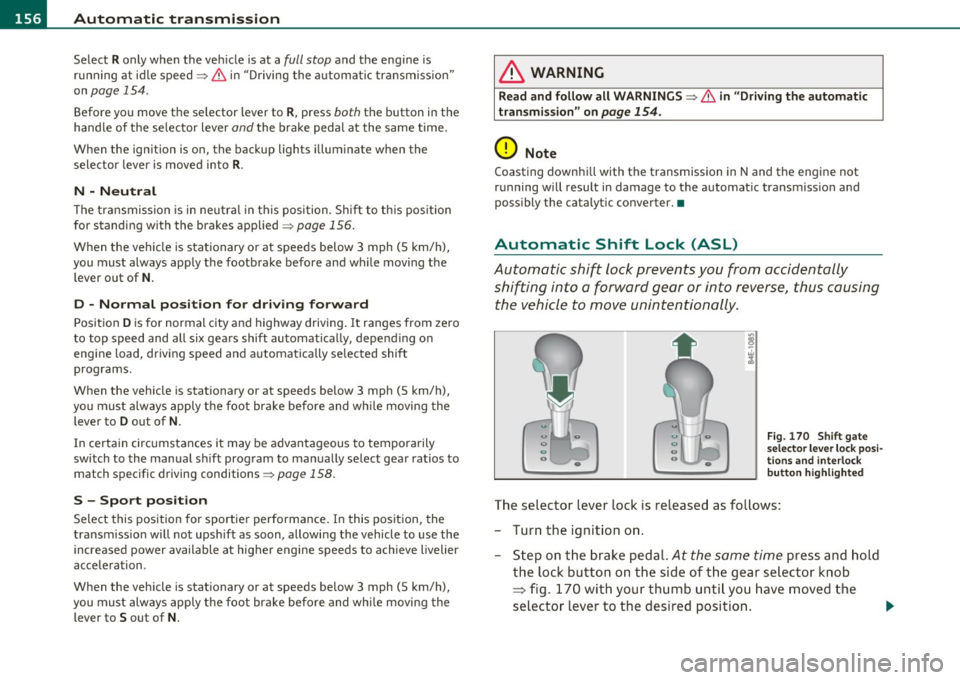
0
Fig . 170 Shift gate
se lector lever lock posi
tions and interlock
button highlighted
The selector lever lock is released as follows:
- Turn the ignition on .
- Step on the brake pedal.
At the same time press and hold
the lock button on the side of the gear selector knob
=:> fig. 170 with your thumb until you have moved the
selector lever to the desired position. .,_
Page 255 of 384

_________________________________________ I_ n_ t_ e_ ll_,igent technology ,__E~-
acting on the vehicle, the brake pressure and the steering angle are
all meas ured.
The direction in which the driver wishes to travel is determined with
the aid of the steering angle and vehicle speed and is continually
compared with the actual behavior of the vehicle. If the two do not
match, for example , when the vehicle starts hydroplaning on a wet
road, ESP will automatically brake the appropriate wheel to correct
the problem.
The vehicle is then stabi lized by the forces acting on the whee l during
braking. If the vehicle is
oversteering (rear tends to skid out of the
turn), the brakes are main ly applied on the wheel that is on the
outs ide of the curve. In the case of a vehicle that is
understeering
(tendency to slide out of the curve), the brakes are applied at the rear
wheel that is on the inside of the curve. An acoustic signal ind icates
when ESP brake application cuts in =>
&.
Th e system operates across the entire speed range in combination
with the ABS system=>
page 256. If the Anti-Lock Brake System
(ABS) malfunctions, the ESP will be out of action as we ll.
Activation
When you turn on the engine, ESP will automatically be activated and
will perform a self-test .
The system can be activated or deactivated by pressing the button
=>
page 252, fig. 234 . The warning light comes on when the system
is switched off=>
page 16.
Normally, the ESP should always be on, however, it may be advanta
geous to turn off the sys tem in certain special cases when some
degree of whee l spin is desired such as:
• when driving with snow chains
• when driving in deep snow or on a loose surface (to allow the
wheels to dig in to reach firm ground)
• when trying to "roc k" the vehicle free when it has become stuck.
The system should be reactivated once you are no longer in such situ
ations.
Controls and equip ment Safety first Vehicle operation
Both the ABS and
EDS systems are still functioning even if the ESP is
switched off.
& WARNING
The Electroni c Stabilization Program is nevertheless subject to the
laws of physics. It is particularly important to pay attention to
this fact on wet and slippery roads. It is therefore important that
you always adapt your driving to the condition of the road and
traffic conditions. Do not allow the increased safety provided by
the Electronic Stabilization Program system to lull you into
accepting additional safety risks. •
Electronic differential lock (EDL)
The electronic differential lock monitors the rotational
speed of the drive wheels.
General notes
The electronic differential lock (EDL) helps the car to start moving,
acce lerate and climb a gradient on surfaces providing poor or almost
no grip . Without EDL, this would be difficult, if not impossible .
How the system works
The EDL operates automatically. It monitors the rotational speed of
the drive wheels on an axle with the he lp of the ABS sensors
=>
page 256 . If a noticeable difference in rotational speed between
the drive wheels on one axle is detected (e .g . on slippery ground
on
one side),
the spinning wheel is braked, thereby transferring power to
the other drive whee l or wheels (all -wheel drive). This is done up to a
speed of about 60 mph (100 km/h) . Noises from the brake system
signal that wheel spin is being contro lled.
Driving off
When driving off, always be sure to keep road conditions in mind as
you accelerate. If one drive wheel spins because it is on a surface with
less grip , gradually increase the pressure on the accelerator peda l
Iii>
Vehicle care Do-it-yourself service Technical data
Page 256 of 384

Intelligent technology
'-----------------------------------------------
until the car starts to move . The whee l less ab le to transfer power
spins .
Overheating of brakes
To prevent the disc b rake of the bra ked wheel from ove rhea ting if
subjected to excessive loads, the EDL cuts out temporarily . The
veh icle remains operat ional and beh aves in the same way as a vehicle
without EDL .
As soon as the brake has coo led down, EDL switches on again auto
matically .
& WARNING
• When a ccelerating on slippery surfaces, such as on ice or snow,
alw ay s be careful when depre ssing the a ccelerator pedal. E ven
with the EDL working, the drive wheel s can spin and reduce your
ability to control your car . Risk of crash !
• The in creased safety afforded by EDL does not mean that you
can take safety ri sks. Always adapt your driving st yle to the road
condition s and traffic situation .
fi Tips
If a fault occurs i n the ABS, the EDL is also no t fu nct ion ing . This is
indicated by the ABS warning light~
page 19. •
Anti-Slip Regulation System (ASR)
The Anti-Slip Regulati on System prevents the driven
wheels from spinning when the car is a ccel erating.
General notes
T he Anti-S lip Regulation System (ASR) is integrated in the electronic
stabilization program (ESP). When the veh icle starts up and acceler
ates , the wheels are p reve nted from sp inning by adjust ing the eng ine
powe r to match t he amo unt of grip avai lab le from the road s urface.
How the system works
ASR perfo rms au toma tica lly, i .e . witho ut the drive r's in tervent ion .
With the aid of the A BS sensors~
page 256, ASR monitors the speed
of the driven wheels . If the wheels start to spin, the engine powe r is
reduced automat ically u nti l the t ires find enough gr ip to lock onto
the road s urface. The system is active across the entire speed range.
Th e ASR wor ks in con ju nction with the A BS .
If a m alfu nction sho uld
occur in the ABS, the ASR w ill also be out of action.
& WARNING
The increased safety afforded by ASR does not mean that you can
take safety ri sks . Always adapt your driving style to the road
condit ions and traffic situation.
[ i ] Tips
To ensure that the ASR works prope rly, all four wheels must be fitted
w ith ident ic a l ti res Any differences in rollin g radius of the tires can
cause the system to reduce engine power when t his is not desired .
See also ~
page 318, "N ew t ires and replacing tires and whee ls" .•
Braking
General Information
What affects b raking efficiency ?
Operating cond itions and driving habits
Th e bra kes on t oday's automo biles are still subjec t to we ar,
depending large ly on operating conditions a nd driving habits~ &.
O n ve hicles tha t are eithe r driven mostly in stop- and-go city t raff ic or
are drive n hard, the brake pads should be checked by your author ized
Audi de aler more o ften than specified in the
Warranty & Mainte
nance booklet .
Failure to have your brake pads i nspected can result
in re duced brake pe rformance. .,
Page 257 of 384

________________________________________ __;I:..: n~ t -=-e .=.:.: ll:.:.;igent technology .__==-
On steep s lopes , you shou ld use the brak ing effect of t he e ngine. This
w ay, y ou p revent unne ce ss ary we ar o n t he bra ke sys te m . If you mus t
use your brakes , do not ho ld the brakes down conti nuously . Pump the
bra kes at intervals.
Moisture or road salt
Under cer ta in c on di tions, for ex ample, when drivin g thr ough w at er or
very heavy rain, or e ve n after was hing your veh icle, the braking effect
c an be re duced due to moi st ur e (o r in freezi ng condi tio ns ice) o n the
bra ke pads . A few care ful b rake app lica tions should dry off the bra ke
pads or
remove any ice coatings .
Th e effec tiveness of the bra ke s ca n be re d uced whe n the vehicle is
driven on a salt-covered road and the brakes are not used . He re too,
yo u sh ould clean off a ccumula ted sa lt c oat ing from brake disc s and
pads with a few caref ul app lications of the brake::::;,&.
Corrosion
The re may be a tendency fo r dirt to build up on the bra ke pads and
cor ro si on t o fo rm on the di scs if t he c ar is not driven re gularly or o nly
for short t rips w ith litt le use of the bra kes.
If the bra kes are not used fre quent ly, o r if corrosion ha s fo rme d on
t he d iscs, i t is advisable to clean off t he pads and d is cs by bra king
fi rm ly a few t imes from a mo derately high speed ::::;,& .
Faults in the brake system
If yo u shou ld no tice a sudden in cre ase in b rake ped al t ravel, t hen one
o f t he two brake circ uits may have failed::::;,&.
Low brake fluid level
Malfunctions can occ ur in the brake system if the brake fluid level is
t o o low. The bra ke f lui d level is mon itored e lectroni cally.
Brake lining wear status
Brak e lining we ar may be checked by v isual inspec tio n o f the condi
tion of the brake pads throug h the openings in the wheel. If neces
sa ry, t he wheel m ay be re m oved f or this in spection ::::;,
page 335,
"C hanging a w hee l" .
Controls and equip
ment Safety first Vehicle operation
& WARNING
•
You should perform braking maneuvers for the purpose of
cleaning the brake system only if road condition s permit. Other
road users must not be put at risk -you may cause an accident!
• Before descending a steep grade, reduce speed and shift trans
mission into a lower gear or lower driving range. Do not ride the
brakes or hold the pedal down too long or too often. This could
cause the brakes to get hot and diminish braking efficiency.
• Do not "ride the brakes " by resting your foot on the pedal when
you do not intend to brake. This may cause the brakes to overheat,
premature wear and increased stopping di stan ce.
• Under certain climatic and operating conditions such as
passing through water, driving in heavy rain or after washing the
vehicle, the effectiveness of the brakes can be reduced. In winter,
ice can accumulate on the brake pads , linings, discs and drums .
Carefully apply brakes for a test . Brakes will dry and ice coatings
will be cleaned off after a few careful brake applications.
• Driving for an extended period of time on salt-covered roads
without using your brakes can also affect braking efficiency. Clean
off accumulated salt coating from brake discs and pads with a few
careful brake applications.
• If you damage the front spoiler, or if you install a different
spoiler, be sure the air flow to the front brakes is not obstructed.
Otherwise the brake system could overheat reducing the effective
ness of the entire brake system .
• Failure of one brake circuit will impair the braking capability
resulting in an increased stopping di stance . Avoid driving the
vehicle and have it towed to the nearest Audi dealer or qualified
workshop .•
Vehicle care Do-it-yourself service Technical data
Page 258 of 384

lillill.a._...:I:..: n~ t .::.e::::..::.: ll~igent technology ,_ _______________________________________ _
Brake booster
The brake booster adds extra braking power.
The brake booster works with vacuum pressure which is created on ly
w hen the eng ine is ru nn ing =>& .
& WARNING
• Nev er let the vehicle roll to a stop w ith the engine shut off.
• If the brake booster is n ot working , for e xample when towing
your vehicle, or because the brake booster has som ehow been
damaged , the brake pedal must be pressed conside rably harder to
make up for the lack of booster assistan ce. •
Functioning of Anti-Lock Brake System
(ABS)
A BS prevents the wheels fr om locking up under braking.
The ABS co ntributes effectively to ve hicle contro l s i nee it preve nts the
w heels from
locking when the brakes a re applied. T his means that the
vehicle remains steerable and is less likely to skid .
With ABS you do not need to pump the brake. Just hold the brake
pedal down.
However, do not expect the A BS to shorten brak ing distance under all
circumstances. When driving on grave l o r on newly fa llen snow on top
of icy su rfaces, b raking distance may be even longer, therefore, under
these circumstances, it is especially important that you drive slowly
and w ith great care.
How the ABS system works
An automatic check is made w hen a speed of abo ut 4 mph (6 km/h) is
reached . When this happens, a pumping noise can be heard . If a
n ind iv idua l wheel begins to rotate too slow ly in relat ion to ve hicle
speed and tends to lo ck, the ABS automat ically redu ces bra ke pres
su re to p revent t hat wheel from lock ing.
Th is automatic adjustment process wi ll cause a
slight vib ration of
t he bra ke pedal and so me noises to al er t you tha t vehicle s peed mus t
be adapted to existing road and traff ic conditions.
& WARNING
Although the ABS is very effective, always remember that braking
capability is limited by tir e traction. Always adjust your driving
speed acco rding to the road and traffic conditions. Do not let the
extra safety afforded by the ABS tempt you into taking extra ri sks .
The ABS cannot ove rcome the laws of physics.
[I) Tips
• If ABS is not funct ioning properly, a warning light will come on.
See=>
page 19.
• If a fa ult occ urs in the ABS, the ED L is also not functioning . This is
ind icated by the A BS warn ing ligh t.•
Brake assistant
T he brake assistant is designed to achi eve the optimum
b ra king effect.
The b rake ass istant helps to i ncrease the effective brak ing power and
thus to achieve a shorter stopping distance. If the driver p resses the
bra ke pedal
very quickly, the brake assistan t automatically boosts t he
brak ing fo rce to the maximum level, up to the po int where the anti
lo ck bra ke f un ct ion (ABS) intervenes to stop the whee ls from locking.
You shou ld then keep the brake pedal pressed unt il the ve hicle has
bra ked to t he required s peed . T he bra ke ass ist ant sw itches itse lf off
as soon as you re lease the brake pedal. ._
Page 264 of 384

Driving and environment
New brake pads
Remember that new brake pads do not have a f ull braki ng
e ff e ct during the first 250 miles (400 kilometers) after they
are i nsta lle d.
New bra ke pads have to be "burnished in" before they have opt ima l
grab=> &.
Dur ing the break -in period, you sho uld avoid putting severe loads on
the brakes. Severe loads incl ude, for example, sudden hard braki ng,
in particu lar at very high s peeds or, for examp le, on mountai n passes.
& WARNING
New brake pads don 't have the be st stopping power and must be
" broken -in " during the initial 100 to 150 miles (150 to 200 kilo
meters ) of normal cit y driving. You can compensate for thi s by
pressing th e brak e pedal more firmly. This also applies lat er wh en
new pad s are installed. n
Catalytic converter
It is very important that your emissio n contr ol system
(catalytic converter) is functioning prop erly to ensure
that your vehicle is running in an environmentally sound
manner.
- Always use lead-free gasoline==> page 283, "Fue l su pp ly" .
- Never ru n the tank down a ll th e way to empty .
- Never put too m uch motor oil in your engine==>
page 294,
"Adding engine o il
The catalytic converter is an efficient "clean- up" device bu ilt into the
exha ust syste m of the ve hicle. The cat alytic converte r burns many of
the polluta nts in the exhaust gas before they are released into the
atmosphe re.
Th e e xcl usive use of unleaded fuel is cr itic ally important for the life of
the catalytic converter and proper f unction ing of the engine.
& WARNING
• Do not park or operate the vehicle in areas whe re the hot
exhaust sy stem may come in contact with dry grass, brush, fuel
spill or other material which can cause a fire .
• Do not apply additional undercoating or ru stproofing on or
near the exhaust manifold , exhaust pipes, catalytic conve rter or
heat shield s. During driving, the substance used for undercoating
could overheat and cause a fire .
0 Note
• Be aware that just one tank filling wit h leaded fu el wi ll alrea dy
ser iou sly degrade the performan ce of the ca talyt ic co nve rter.
• Do not exceed the correct engine oil leve l=>
page 294 .
• Do not dr ive unti l the f uel tank becomes complete ly empty. The
eng ine could misfire . Unburned fuel could a lso get into the exha ust
system and th is could cause the catalytic converter to overheat.
• Do not t urn o ff the igni tion whi le the ve hicle is moving.
• Do not continue to operate your vehicle under these conditions, as
o therwi se fuel c an reach the cat alytic c onve rter. Th is cou ld resu lt in
over heating of t he converte r, requiring its rep lacement.
• T o ass ure eff ic ient operat ion of the Emi ssion Co ntro l System:
- Have your vehicle maintained properly and in accordance with
t h e se rvice recommenda tions in your Warranty
& M aintenance
booklet. •
Page 265 of 384

Driving and environment
------------------------------------------------'
- Lack of proper maintena nce as well as improper use of the
vehicle w ill imp air t he funct io n of t he emission con trol system and
could lead to damage.
<£> For the sake of the environment
Even when the Emiss ion Contro l System is operating properly, the
exhaust gas can have a sulfur-like exhaust gas sme ll under some
operat ing states. This depends on the s ulfur content of the fue l being
used. Using a differe nt brand of fuel may help, or filling the tank with
lead-free supe r grade gasoline. •
Avoid damaging the vehicle
When you are dr iving on poor roads, or ove r cur bs, steep r amps, etc.,
make certain that low-lying parts such as spoilers and exhaust system
p arts do not bo ttom ou t and ge t damage d.
Th is is espec ia lly true for vehicles with low-slung chass is (sports
chassis)* and fully loaded vehicles .•
Driving through water on roads
N ote the following to avoid vehicle damage w hen driving through
water, fo r examp le on flooded roads:
• The water must not be any higher than the bottom of the vehicle
b ody.
• Do not drive faster tha n walking speed.
& WARNING
After driving through water , mud, slush , etc. , the brakes may be
slow to take effect because of wet brake rotors and pads . Dry the
brakes first by braking carefully to restore the full braking effect.
Controls and equip ment Safety first Vehicle operation
0 Note
Vehicle
compone nts such as the engine, tra nsmiss ion, s uspension or
electrical system can be severely damaged by driv ing thro ugh water .
[ i ] Tips
• Check the depth of the water before d riving throug h it.
• Do not stop the vehicle, d rive in revers e or switch the e ngine off
when driving through wate r.
• Keep in m ind that oncoming vehicles may c reate waves t hat raise
the water leve l and make it too deep for yo ur vehicle to drive throug h
sa fely.
• Avoid driving through salt water because it can ca use corros io n.
Operate your vehicle economically
and minimize pollution
General
You r personal style of driving will determi ne the econom y
of your vehicle, as well as exhaust and noise l evels.
Fuel economy, environmenta l impact, and wea r on your eng ine,
brakes and tires largely depend on t hree factors:
• your persona l dr iving style
• operati ng conditions
• t echni cal lim itations
If you an ticipa te what you need to do next and drive economically,
you can easily cut your fuel consumption by 10-15 percent. This
s e ct io n w ill give you so me tip s on how you can he lp the e nvir onme nt
and your pocketbook.
~
Vehicle care Do-it-yourself service Technical data
Page 268 of 384
Trailer towing
"---------------------------------------------------
Trailer towing
Driving with a trailer
General information
Your Audi was designed primarily for passenger transpor
tation .
If you p lan to tow a t railer, p lease remember that the additional load
w ill affect durability, economy and performance.
Tr ailer towing not on ly p laces mo re s tress on the vehicle, it also calls
for more concentration from the driver.
For this reason, a lways follow the operating and dr iv ing inst ructions
prov ided and use common sense .
0 Note
If you are going to tow a trailer, you must activate the tra iler ope ra
tion mode =>
page 179, "Towing a Trailer".
Technical requirements
Trailer hitch
Use a we igh t-car rying h itch co nform ing to the gross tra iler we ig ht.
The h itch must be suitab le for your vehicle and trailer and must be
mou nted securely o n th e vehi cle's ch assi s at a
techni cally sound loc a
tion . Use only a trailer hitch with a removab le ball mount. Always
check wit h the t railer h itch manufactu rer to make sure that yo u are
using the correct h itch .
Do not use a bumper hitch.
The h itch mus t be installed in such a way t hat it does not in terfe re
w ith t he impact-absorb ing bumper system. No modifications shou ld be made to t
he veh icle exha ust and bra ke systems. From t ime to
time, check that a ll hitch mounting bo lts rema in securely fastened.
W hen you are no t tow in g a tra ile r, remove the t railer hit ch ball
mount. This prevents the hitc h from caus ing damage should your
vehicle be str uck from behind=>& .
Trailer brakes
If your trail er is e quipped w ith a b raking system, che ck to be s ure t hat
it conforms to all regulations.
T he tra ile r hydrau lic brake system m ust not be directly connected to
t he vehicle's hyd raulic b rake sys tem .
Safety chains
Always use safety chains between your veh icle and t he tra ile r.
Trailer lights
Trailer lights must meet all regulations. Be sure to check w ith your
Audi de aler fo r corr ec t wir ing , sw itches and re lays.
Mirrors
If you are unab le to see t he t raff ic be hind you using t he regular
outs ide mirrors, then you
must install extended mi rrors. It is impor
t an t th at yo u
always ha ve clear vi sion to the re ar.
& WARNING
After removing the trailer hitch, do not store it in your vehicle. In
case of sudden braking , the hitch could fly forward and inju re you
or your passengers. •
Page 269 of 384

Operating instructions
Maximum trailer weight
A trailer for your vehicle is limited to a typical class 1 or class 2 trailer.
Trailer load distribution
Be sure the load in the trailer is held securely in place to prevent it
from shifting forward, backward or sideways.
Never allow a passenger to ride in a trailer=>
& in "Driving instruc
tions".
Engine cooling system
Towing a trailer makes the engine work harder. It is important that
the cooling system's performance is up to the additional load. Make
sure that the cooling system has enough fluid.
Tire pressure
When towing a trailer, inflate the tires of your vehicle to the cold tire
pressure listed under "Full load" on the label located either on the
driver's side B -pillar (visible when the door is open) or inside the fuel
filler flap. Inflate trailer tires to trailer and tire manufacturers' spec
ifications .
Lights
The headlight settings should be checked with the trailer attached
before driving off. Check to make sure both vehicle and trailer lights
are working properly.
Safety chains
Be sure trailer safety chains are properly connected from the trailer
to the hitch on the vehicle. Leave enough slack in the chains to permit
turning corners . When you install safety chains, make sure they will
not drag on the road when you are driving.
The chains should cross under the trailer tongue to prevent it from
dropping in case of separation from the hitch .
Controls and equip ment Safety first Vehicle operation
Trailer
towingL_,1!:::!:·~-
0 Note
If you are going to tow a trailer, you must activate the trailer opera
tion mode =>
page 179, "Towing a Trailer". •
Driving instructions
Driving with a trailer always requires extra care and
consideration .
To obtain the best possible handling of vehicle and trailer,
please note the following:
- Do not tow a loaded trailer when your car itself is not
loaded.
- Be especially careful when passing other vehicles.
- Observe speed limits.
- Do not drive at the maximum permissible speed.
- Always apply brakes early .
- Monitor the temperature gauge.
Weight distribution
Towing a loaded trailer with an empty car results in a highly unstable
distribution of weight. If this cannot be avoided, drive at very low
speeds only to avoid the risk of losing steering control.
A "balanced" rig is easier to operate and control. This means that the
tow vehicle should be loaded to the extent possible and permissible,
while keeping the trailer as light as possible under the circumstances.
Whenever possible, transfer some cargo to the luggage compart
ment of the tow vehicle while observing tongue load requirements
and vehicle loading considerations.
Vehicle care Do-it-yourself service Technical data
Page 270 of 384

Trailer towing
"---------------------------------------------------
Speed
T he higher the speed, the more difficult it becomes for the driver to
control the rig. Do not dr ive at the max imum permiss ible speed.
Reduce your speed even more if load, weather or wind conditions are
unfavorable -part icu larly when go ing downhill.
Reduce vehicle speed
immediately if the tra iler shows the slightest
sign of swaying.
Do not try to stop the swaying by accelerating.
Observe speed limits. In some areas, speeds for veh icles towing
trailers are lower than for regu lar vehicles.
Always apply brakes early. When driv ing dow nhill, shift in to a lower
gear to use the eng ine braking effect to slow the veh icle. Use of the
bra kes alone can cause them to overheat and fail.
Coolant temperature
Th e coolant temperature gauge~ page 10 must be observed care
fully. If the needle moves close to the upper end of the scale, reduce
speed immediately and/or turn off the air conditioner.
If the coolant temperature warning light in the instrument cluster
starts flashing
_f_ , pull off the road, stop and let the engine idle for
about two m inutes to prevent heat build-up.
& WARNING
Anyone not properly restrained in a moving vehicle is at a much
greater risk in an accident. Never let anyone ride in your car who is
not properly wearing the restraints provided by Audi.•
Trailer towing tips
Important to know
------------
Your vehicle handles differently when tow ing a trailer because of the
additiona l weight and different weight distribution. Safety, perfor- mance and economy will greatly depend on how carefully you load
your trailer and operate your rig.
Before you actually tow your trailer, practice turning, stopp ing and
backing up in an area away from traffic. Keep practicing until you have
become completely familiar with the way your vehicle-t railer comb i
nation behaves and responds.
Backing up is difficult and requires practice. Backing up with a trailer
generally requires steering action oppos ite to that when backing up
your vehicle without a trai ler.
Maintain a greater distance between your vehicle and the one in front
of you. You will need more room to stop. To compensate for the
trailer, you will need a larger than normal turning radius .
When passing, remember that you cannot accelerate as fast as you normally would because of the added load . Make sure you have
enoug h room to pass. After passing, allow plenty of room for your
trai ler before changing lanes again.
Avoid jerky sta rts, sharp tur ns or rapid lane changes.
W Tips
• Do not tow a trailer during the break-in per iod of your veh icle.
• If you tow a trai ler, your Audi may require more frequent mainte
nance due to the extra load
~ page 361. •
Parking on a slope
Do not park on a slope with a trailer. If it cannot be
avoided, do so only after doing the following:
When parking:
- Apply the foot brake.
- Have someone p lace chocks under both the vehicle and the
trailer wheels . ._