brakes AUDI S8 2010 Owner's Manual
[x] Cancel search | Manufacturer: AUDI, Model Year: 2010, Model line: S8, Model: AUDI S8 2010Pages: 384, PDF Size: 90.95 MB
Page 271 of 384

-With chocks in place, slowly release the brakes until the
wheel chocks absorb the load.
- Turn the whee ls towards the curb .
- Apply the parking brake.
- Move the selector lever to
P.
When restarting after parking:
- Apply the foot brake.
- Start the eng ine .
- M ove the selector lever to
D.
-Release the parking brake and slowly pu ll out and away
from the wheel chocks .
- Stop and have someone retrieve the wheel chocks .
[ i ) Tips
If you move the se lector lever of the automat ic t ransm ission to P
before applying the parking brake and before blocking the whee ls,
yo u may have to use mo re force later to move the leve r out of t he
P
position. •
Controls and equip
ment Safety first Vehicle operation
Vehicle care Do-it-yourself service Technical data
Page 272 of 384
-~_C_ le_ a_n_ i_ n_ g=- a_ n_d___. p_ ro_ t_e _c_ t_ i_o _n ___________________________________________ _
Cleaning and protection
General information
Regular care preserves vehicl e val ue.
Any automobile is exposed to industria l fumes, co rrosive road salt,
m ud dy dog fee t, e tc. A well c ared for Audi can look like new many
years after p urchase . Regular and correct care will contribute to
m aint aining the bea uty and val ue of your Audi.
Furthermore, good care may be a condition for substantiating a
warranty claim should corrosion damage or paint defects occur.
Y ou r au thor ized Audi d eale r h as a var iety of dedicated vehicle-care
products
and can advise w hich ones to use for clea ning the exterior
a n d inter io r of your ve hicle.
W het her you use products recommended by Aud i or o ther comme r
cia lly availab le cleaning agents , please ma ke sure yo u appl y them
co rrectly .
& WARNING
• Cleaning agents may be poisonous . Keep them out of the reach
of children.
• Heed all caution labels .
• Always read directions on the container before using any
product. Follow the directions carefully.
• Most chemical cleaners are concentrated and have to be
diluted .
• Use spot removing fluids only in well ventilated areas.
• Do not use gasoline, kero sene , diesel fuel , nail polish remover
or other volatile fluids . They may be toxic, flammable or
hazardous in other ways. Do not wash, wax or dry the vehicle with
the ignition on or the engine running.
& WARNING (co ntinued)
• Do not clean the under sides of chassi s, fenders , wheel covers,
etc. without protecting your hands and arms. You may cut your
self on sharp-edged metal parts.
• Moisture and ice on brakes may impair braking efficiency
~ page 254, "General information ". Test the brakes carefully
each time you wash the vehicle .
'£> For the sake of the environment
Select only envir onmenta lly fr iendly clea ning produc ts . Leftover
cleaning pro ducts sho uld not dis posed of i n the household waste .•
Care of exterior
Washing
F re qu ent w ashin g protec ts th e vehicl e.
T he best protection aga inst env ironmental influences is frequent
w ashi ng and w ax ing. How o ften t his is requ ired depen ds on:
• How m uch the vehicle is use d
• Whe re the ve hicle is parke d (gar age, in the o pen un der tr ees, e tc.)
• The seasona l and weather conditions
• E nviron mental influences
T he longer bi rd droppings , insects , tree resin, road and industria l
gr ime, t ar, soo t, road sa lt and o ther ma ter ia ls remain on the veh icle
body, the more lasti ng their destructive effects w ill be. H igh temper
atu res cause d by ex pos ure to intense s unlight int ensify the co rrosive
effect, part icu larly when humid ity is high as we ll.
~
Page 278 of 384
-~_C_ le_ a_n_ i_ n_ g=- a_ n_d___. p_ ro_ t_e _c_ t_ i_o _n ___________________________________________ _
Use only special acid-free cleaners formulated for a lloy r ims . Sa fe
pro ducts are availabl e at your A udi de aler. Never leave t he cle aner on
the rims longe r tha n spec ified on the label. If not rinsed off promptly,
the ac id contained in some cleaners can attack the t hreads on the
w heel bolts.
Never use abrasive or metal po lish ing cleaning agents.
If the protec
t ive coa ting ha s been ch ipped, e.g. by k icked up road dirt, touch it up
as soon as possible.
& WARNING
• Moisture and ice on brakes may affect braking efficiency
=> page 254, "General information ". Test the brakes carefully
each time you wash the vehicle.
• Always read and heed all WARNINGS and other information
=:>page 270 . •
Body cavity sealing
The body cavity sealing does not need to be checked .
All body cavit ies which cou ld be affected by corrosion have been thor
oughly p rotected at the factory .
Th is sea ling does not require any inspection or additiona l treatment.
If any wax sho uld seep ou t of the cavi ty when the ambien t tempera
ture is h igh, it can be removed w it h a plastic scraper and a suitable
so lvent .
& WARNING
Solvents can be dangerous.
• Benzine is flammable and toxic. If you use benzine for
removing the wa x, keep sparks, flame and lighted cigarettes
away. Never dump benzine on the ground, into open st reams or
down sewag e drains.
& WARNING (co ntinued )
• Be su re to observe all safety and environmental regulations.
Follow all instructions on the container.
• Always read and heed all WARNINGS and other information
=:>page 270 . •
Chassis
Hav e the undercoa ting checked fo r damage f rom time to
ti me.
The lower body shell of your Audi is a lso thoroughly protected against
c orrosion .
Any damage to the u nde rcoat ing caused by road ha za rds sho uld be
repaire d promptly.
& WARNING
Too mu ch undercoating in the wrong places can caus e a fire.
• Do not apply additional undercoating or rustp roofing on or
near the exhau st manifold , exhaust pipes, catalytic converter or
heat shields. While dr iving, the substance used for undercoating
c ould overheat and cau se a fire.
• Always read and heed all WARNINGS and other info rmation
=> page 270 . •
E x haust tail pipes
Road s alt and ot her c orrosive mater ials w ill damage the m ate rial in
the exhaust ta il pipes if they a re not cleaned regularly. Do not clean
t he t ail pipes w ith w heel cleaner, p aint polish, chrome po lish or o ther
abrasive cleaners. C lean the tail pipes with car care products that are
sui table for sta inless s teel.
~
Page 302 of 384
___ C_ h_e _c_ k_ i_ n ~ g~ a_ n _ d_ f_il _l _in _ g ____________________________________________ _
- Read the brake fluid level from the brake fluid reservoir
=> fig. 248 . T he brake fluid level mus t be between the
" M IN" and "MAX" markings.
The br ake fl uid re se rvoir is loc ated at the rear pa rt iti on of the engine
compartment on the left side~ page 290.
T he f lu id level may drop slightly after some time due to the auto
matic adjus tment of t he b rake pads. This is not caus e for alarm.
If the brake flu id leve l falls considerably below the "MIN" mark, t he
br ak e wa rning/ind ic ator lig ht ( U.S . model s:
BRAKE , Can adi an mod els:
«D> ) will come on~ page 20 and~ page 28. Do not continue to
operate the vehicle . The comple te brake system sho uld be thoro ughly
checked by an author ized A udi dealer or ot her qualified facility and
t he ca use correcte d. If the b rake fl uid leve l is too low, the bra ke
wa rning/in dicator light will illu mi nate . Con tact an au thorized Aud i
dealer
immediately .•
Changing brake fluid
H ave the brake flui d changed by an ex perienc ed techni
cian.
Brake flui d abso rbs mois ture from t he a ir . If t he wa ter con ten t in the
brake fl uid is too hig h, corros io n in the b rake system may res ult afte r
a period of time . The boiling po int o f the bra ke fl uid will also decrease
cons iderab ly and decrease brak ing perfo rmance.
The refore, the brake fl uid m ust be changed
every two years . Always
use new bra ke fluid w hich conforms to Fede ral Motor Veh icle St an
dard "FMVSS 116 DOT 4" .
Th e b rake fl uid reservoi r ca n be diffi cult to rea ch, there fore, we
recommend that you have the bra ke fluid c hanged by your author ized
Audi dealer. Your dea ler has the correct tools, the right b rake fl uid
and the know-how to do t his for you .
& WARNING
• Brake fluid is poisonous. It must be stored only in the closed
original container out of the reach of children!
• Brake failure can result from old or inappropriate brake flu id.
Observe these pre cautions:
- Use only brake fluid that meets SAE specification
J 1703 and
conforms to Federal Motor Vehicle Standard 116. Always che ck
with your authorized Audi dealer to make sure you are us ing
the correct brake fluid. The correct type of brake fluid i s also
indicated on the brake fluid reservoir .
- The brake fluid must be new. Heavy use of the brakes can
cause a vapor lock if the brake fluid is left in the system too
long . Thi s can seriously affect the efficiency of the brakes as
well as your safety . This could result in an accident.
0 Note
Brake fluid will damage the paint of your ve hicle .
~ For the sake of the environment
Because of the prob lem of proper disposal of brake fl uid as we ll as
the spec ia l too ls req uired and the necessary expe rtise, we recom
m en d that you have t he brake fl uid changed by your autho rized Audi
dea ler .•
Battery
General information
Under normal operat ing condit ions, the battery in your Aud i does not
nee d any m ain ten ance. Wi th high outs ide temper atures o r long d aily
dr ives we recommend that yo u have the elect rolyte level checked by .,_
Page 310 of 384

-~_T_ i_ re _ s_ a_n _ d_ w_ h _e_ e_ ls _________________________________________________ _
Groove
means the space between two adjacent tread ribs.
Load rating (code)
means the maximum load that a tire is rated to carry for a given infla
tion pressure. You may not find this information on all tires because
it is not required by law.
Maximum load rating
means the load rating fo r a tir e at the maximum permissible inflation
pressure for that tire.
Maximum loaded vehicle weight
means the sum of:
(a) Curb weight
(b) Accessory weight
(c) Vehicle capacity weight, and
(d) Production options weight
Maximum (permissible) inflation pressure
means the maximum cold inflation pressure to which a tire may be
inflated. Also called "maximum inflation pressure."
Normal occupant weight
means 150 lbs. (68 kilograms) times the number of occupants seated
in the vehicle up to the total seating capacity of your vehicle.
Occupant distribution
means distr ibution of occupants in a vehicle .
Outer diameter
means the overall diameter of an inflated new tire.
Overall width
means the linear distance between the exteriors of the sidewalls of
an inflated tire, including elevations due to labeling, decorations, or
protective bands or ribs.
Ply
means a layer of rubber -coated paralle l cords.
Production options weight
means the combined weight of those installed regular production
options weigh ing over 5 lbs. (2.3 kg) in excess of those standard
items which they replace, not previously considered in curb weight or
accessory weight, including heavy duty brakes, ride levelers, roof
rack, heavy duty battery, and special trim.
Radial ply tire
means a pneumatic tire in which the ply cords that extend to the
beads are laid at substantially 90 degrees to the centerline of the
tread .
Recommended inflation pressure
see=> page 307, "Cold tire inflation pressure".
Reinforced tire
means a tire design to operate at higher loads and at higher inflation
pressures than the corresponding standard tire. Reinforced t ires may
be identified as "XL ", "x l", "EXTRA LOAD", or "RF" on the sidewall.
Rim
means a metal support for a tire or a tire and tube assembly upon
wh ich the tire beads are seated .
Rim diameter
means nominal diameter of the bead seat . If you change your wheel
size, you w ill have to purchase new tires to match the new rim diam
eter .
Rim size designation
means rim diameter and width.
Rim width
means nom inal distance between rim flanges.
Page 314 of 384
Ill Tires and wheels
-------------------
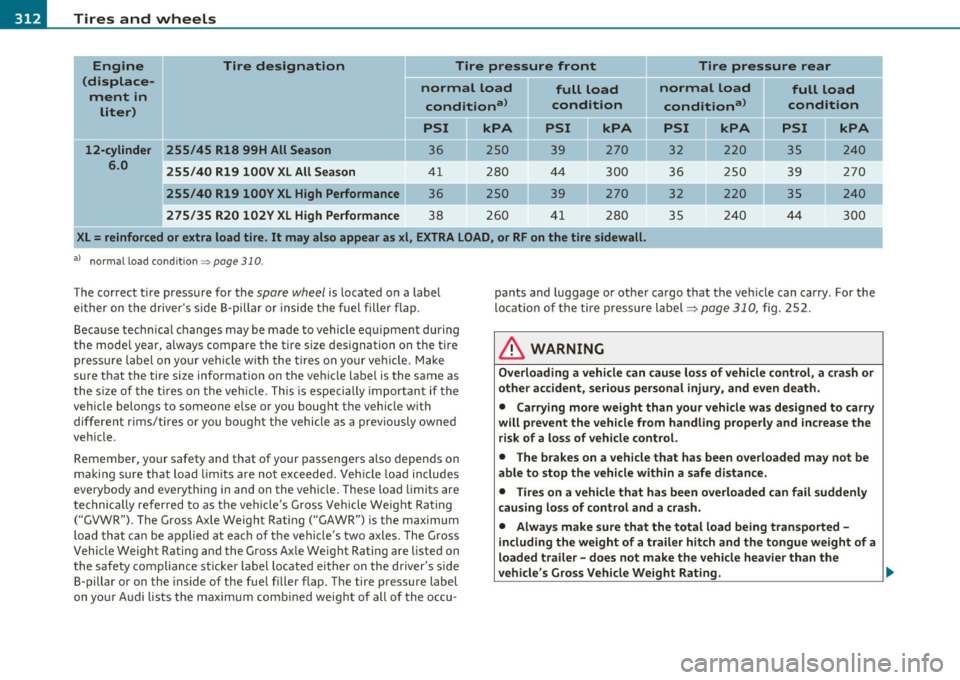
Engine Tire designation Tire pressure front Tire pressure rear
(displace- normal load
full load normal load
full load
ment in
liter) conditiona
> condition
conditiona> condition
PSI kPA PSI kPA PSI
kPA
PSI kPA
12-cylinder
255/45 R18 99H All Season 36 250 39 270 32 220 35 240
6 .0
255/40 R19 lOOV XL All Season 41 280 44 300 36 250 39 270
255 /40 R19 lOOY XL High Performance 36 250 39 270 32 220 35 240
275/35 R20 102V XL High Performance 3 8 260 41
280 35 240 44 300
XL= reinforced or extra load tire . It may also appear as xl, EXTRA LOAD, or RF on the tire sidewall.
a) norma l load cond iti on => page 310.
The correct tire pressure for the spare wheel is located on a label
ei ther on the driver 's s ide B- pillar o r inside the f uel fille r flap .
Beca use techn ica l changes may be made to vehicle equipment during
the model year, always compare the tire size designation o n the tire
pressure labe l on yo ur vehi cle w it h the tires on your ve hicle. Make
sure that the tire size information on the ve hicle labe l is the same as
t he s ize of the tires on the vehicle. This is especia lly im portant if the
vehicle belongs to someone e lse or you boug ht the vehicle w it h
different r ims/ tires or you bo ugh t the vehicle as a prev iously owne d
veh icle .
Remember, your safety and that of your passengers also depends on
ma king sure that load limits are not exceeded. Vehicle load includes
everybody and everything in an d on the vehicle . These load limits are
t echnically refer red to as the veh icle's G ross Ve hicle Weig ht Ra ting
("GVWR"). The Gross Axle Weight Rating ("GAWR") is the max imum
load that ca n be applied at ea ch of the vehi cle's two axles. The G ross
Vehicle Weight Rating and the Gross Ax le Weight Rating are listed on
t he safety compliance sticke r label lo cated ei ther on the d river 's side
B-pil lar or o n the inside of the fuel filler flap. T he tire pressure label
on yo ur A udi lists the maximum comb ined weight o f all of the occu -pa
nts and luggage or other ca rgo that the ve hicle can carry . For the
loc atio n of t he tir e pressure label~
page 310, fig. 252.
& WARNING
Overloading a vehicle can cause loss of vehicle control, a crash or
other accident, serious personal injury, and even death.
• Carry ing more weight than your vehicle was designed to carry
will prevent the vehicle from handling prope rly and increase the
ri sk of a lo ss of vehicle control.
• The brakes on a vehicle that has been overloaded may not be
able to stop the vehicl e within a safe distance.
• Tires on a vehicle that ha s been overloaded can fail suddenly
causing lo ss of control and a crash .
• Always make sure that the total load being transported -
i ncluding the weight of a trailer hitch and the tongue weight of a
loaded trailer -does not make the vehicle heavier than the
vehicle 's Gro ss Vehicle Weight Rating .
~
Page 317 of 384

Tires and wheels -________________ fWII
is mor e difficult to s top . Ov erloadin g can not only lead to loss of
ve hicle cont rol , but can a lso dam ag e im por tant parts of th e veh icl e
and can lead to s udden t ire failur e, incl uding a blowout and sudd en
deflation that can cause the vehicle to c ras h.
You r saf ety an d that o f your p assenger s also d ep end s on maki ng sur e
tha t load limits a re not exceeded. Vehi cle load in cludes everyb ody
a nd every thing in and on the ve hicl e. The se l oad l imi ts are tech nicall y
referred to as the ve hicle's
Gross Vehicle Weight Rating ("GVW R").
Th e "GVWR " includes the we ight of the basic vehicle, all factory
ins talled accessories, a f ull tank of fue l, o il, coola nt and o ther flu ids
plus maxim um loa d. The maxim um loa d i ncludes the number of
pass eng ers that t he v ehicle is inten ded to ca rry ("s eating capa city")
w it h an ass ume d we ight of 150 lbs (68 kg) for each passenger at a
desig nated se ating pos it io n and t he tota l weig ht o f any luggage in
the vehicle . If you tow a tra iler , the weight of t he trailer hitch and t he
t o ngue we ig ht of th e load ed t rail er m ust be i ncluded as p art o f the
vehicle load.
Th e
Gross Axle Weight Rating ("GAW R") is the ma ximu m load that
can be a pplied at each of t he veh icle's two axles.
T he Gross Vehicle Weight Rati ng and the Gross Axle Weight Rat ing
a re list ed on the sa fe ty c ompl iance sticke r label loca te d ei the r on the
driver's side B-pilla r or on the inside of the fuel fille r flap . Your Audi
h as 5 se ating posit ion s, 2 i n the fro nt and 3 in t he re ar for to tal
seating capacity of 5. Ve hicles wit h power ind iv id ual rear s eats* have
4 se ating posi tions, 2 in the front and 2 i n the rea r for tot al sea ting
capacity of 4. Each seat ing pos ition has a safety belt =>
page 197,
"Safety be lts" .
Th e fa ct that th ere is an upper li mit to your ve hicle's Gross Vehicle
We ight Rating means that the total weight o f whatever is being
c ar ried in the vehicle ( including the we igh t o f a t rail er hit ch and the
tongue weight of the loa ded tra ile r) is limited. The mo re passengers
in the vehi cle or p assen gers wh o are he avie r than t he stand ard
we ights assum ed mean t hat less weight ca n be carried as luggage.
Safety first
The tire pressure label on yo ur Aud i also lis ts the maxim um combined
we ight of all of the o ccupant s and lug gage o r oth er c argo that t he
vehicle ca n car ry . For the location o f the label=>
pag e 310, fig. 252 .
& WARNING
Overloading a vehicle can cause loss of vehicle control, a crash or
other accident, serious personal injury, and even death .
• Carrying more weight than your vehicle was designed to carry
will prevent the vehicle from handling properly and increase the risk of the loss of vehicle control.
• The brakes on a vehicle that has been overloaded may not be
able to stop the vehicle within a safe distance.
• Tires on a vehicle that has been overloaded can fail suddenly,
including a blowout and sudden deflation, causing loss of control
and a crash.
• Always make sure that the total load being transported -
including the weight of a trailer hitch and the tongue weight of a
loaded trailer -does not make the vehicle heavier than the
vehicle's Gross Vehicle Weight Rating. •
Determining correct load limit
Use the example below to calculate the
total weight of the passengers and luggage
or other things that you plan to transport so
that you can make sure that your vehicle
will not be overloaded. .,_
Vehicle care Technical data
Page 323 of 384

Tires and wheels Ill
----------------
If you install rims, which do not have the sensors, or have sensors
w hich are not compa tible, then the tire pressure moni toring sys tem *
w ill not wo rk p roperly. I n this case, t he tire pressure monitor ing
system * wo uld not be ab le to monitor the tire pressure or warn yo u if
it is necessary .
• The battery inside of the tire pressure sensor has a limited service
l ife.
• Always dr ive wit h the
valve stem caps securely mo unted. We
recommend using factory ins ta lled
valve stem caps. As k your autho
r ized Audi dea ler to rep lace lost
valve stem caps .
Th e insta llation of repl acement tir es w ith s teel co rd bo dy plies in the
t ire sidewa ll may ca use ma lfunctio n of the tire pressure mo nitoring
system *, and is not recommende d (cord material informat io n i n
molded on the ti re s idewall).
Always check your tire pressure monito ring system* indicator afte r
re plac ing one or mo re tires on your vehicle. If the tire press ure m oni
to ring system* indicator flashes, or is on, your system is not working
pro perl y. Yo ur repla ceme nt tire might be incomp atible with your t ire
pressure monitoring system*, or some component of the tire pres
sure mon itor ing system * may be damaged.
& WARNING
• Using incorrect or unmatched tires and / or wheels or improper
tire and wheel combinations can lead to loss of cont rol, collision
and seriou s per sonal injury .
• Always use tires, rims and wheel bolts that meet the specifica
tions of original fa ctory-in stalled tires or other combination s that
have been specifically appro ved by the vehicle manufacturer.
• Tires age even if they are not being used and can fail suddenly ,
especially at high speeds. Tires that are more than 6 years old can
only be u sed in an emergen cy and then with special care and at
lowe r speeds.
• Never mount used tires on your vehicle if you are not sure of
their "previous history." Old used tires may have been damaged
Safety first
& WARNING (co ntinued )
eventhoughthedamagecannotbeseenthatcanleadtosudden
tire failure and loss of vehicle control.
• All four wheels must be fitted with radial tires of the same
type, size (rolling circumference ) and the same tr ead pattern.
Driving with different t ires reduces vehicle handling and can lead
to a lo ss of control.
• If the spare ti re is not the same as the tires that are mounted
on the vehicle - for example with w inter tires - only use the spare
tire fo r a sho rt pe riod of t ime and drive with extra care. Refit the
normal road wheel as soon as safely possible.
• Never drive faster than the ma ximum speed for which the tires
on your vehicle are rated because tires that are driven faster than
their rated speed can fail suddenly .
• Overloading tire s cause heat build-up, sudden tire failure,
including a blowout and sudden deflation and loss of control.
• Temperature grades apply to tires that are properly inflated
and not over or underinflated.
• For technical reasons it is not always possible to use wheels
from other vehicles - in some c ases not even wheel s from the same
vehicle model.
• If you install wheel trim discs on the vehicle wheels , make sure
that the air flow to the brakes is not blocked. Reduced airflow to
the brakes can them to overheat , increasing stopping distance s
and causing a collision.
• Run flat tires may only be u sed on vehicles th at were equipped
with them at the factory. The vehicle must have a chassis designed
fo r run flat tires and a factor y-in stalled tire pres sure monitoring
system* that indicates a loss of tire pre ssure. Incorrect use of run
flat tires can lead to vehicle damage or accident s. Check with an
authorized Audi dealer or tire specialist to see if your vehicle can
be equipped with run flat tires . If run flat tires are used , they must
be installed on all four wheels. Mixing tire types is not permitted . ..,_
Vehicle care Technical data
Page 369 of 384

___________________________________________ A_ l::.. p _h _a_ b_ e_t _ic _a_ l_ in_ d _ e_x __ nn
We ight-sensing mat .... .. .. .. . ... 232
When must the system be inspected? 217
Aircraft Transporting your vehicle .......... 353
All Wheel Drive ............ .. ...... . 257
Alloy wheels . .... .. .. .. .. .. .. ... ... 275
All-wheel drive
Winter tires ....... .. ............ 323
Alternator See Generator .................... 16
Anti-freeze See Engine coolant ...... .. .. .. ... 296
Anti -lock brake system
How the ABS system works ......... 256
Warning/indicator lights ... .. ..... . 19
Anti-Sl ip Regulation System (ASR)
How the system works . .. .. .. .. .. . 254
Anti-theft systems Anti-theft alarm system ....... ... .. 52
Electronic immobilizer ............. 41
Ashtray Front .............. ...... ........ 96
Rear ........ .. .... .. ... . .. .... .. 96
ASR How the Anti-Slip Regulation System
works ..... .. ... .. ... ... ....... 254
Audi Service Repair Manuals and Literature
361
AUTO mode AC climate control ....... .... .. .. . 106
Auto Safety Hotline ... ... ... . .. ..... 195
Auto-Check Contro l .............. .... . 26 Automatic car wash
See Washing ............... ... .. 271
Automatic Shift Lock (ASL) ... .. .. .. ... 156
Automatic transmission 6-speed automatic transm iss ion .. .. 154
Automatic Sh ift Lock (ASL) ....... .. 156
Dr iv ing ................. ...... .. 154
Dynamic shift program ......... ... 157
Emergency release for selector lever . 159
Fail-safe mode ................ ... 159
lg nition key safety lock .... ..... ... 119
Kick-down . ............ .. ....... 157
Manual shift program .. .. .. .. .. .. . 158
Selector lever ............ ........ 155
Shift buttons ... ...... .. .. .. ..... 159
Steering wheel with tiptronic ...... . 159
Average speed ........... .. .......... 36
Avoid damaging the vehicle .. ....... .. 263
B
Background lighting ... . .. .. .......... 67
Battery . .. .. .. .. .... ............... 300
Battery location inside the luggage
compartment .................. 301
Charging ........................ 303
Important warnings when working on the battery ..... ........... ...... .. 301
low . .. .. .. .. .. ...... .. ......... 258
Rep lacing the battery . ... ......... 304
State of charge ..... .. ........... 258
Winter operation . .... ... ..... .... 300
Working on the battery .... ... .. .. . 301 Before driving
.. .. ... ... ... .... ... .. 187
Blended gasoline ................. .. 283
Body cavity sealing .............. . ... 276
Booster seats ......... ............ . 239
Brake fluid
Changing the brake fluid .......... . 300
Checking the brake fluid level ....... 299
What is the correct brake fluid level?. 299
What should I do if the brake fluid warning
light comes on? . .. .. .. .......... 299
Brake system Anti-lock brake system .. ........... 19
Brake assistant .. .. .. .. .. ...... .. 256
Brake booster ........... ... ..... 256
Brake fluid .. .. .. ................ 299
Brake fluid specificat ions for refill and
repla cemen t .................. . 300
Brake light defective . .... .. .. .. .. .. 24
Brake pads ..................... . 262
Electromechanical parking brake .... 123
Fluid reservoir . .......... ... .. ... 299
How does moisture or road salt affect the
brakes? ... .. ................ .. 254
Malfunction ...................... 28
Warning/indicator lights ... .... .. .. 20
Worn brake pads symbol ........... 32
Break-in period .... . .. .............. 261
Brake pads . ... ................ .. 262
Tires ..... .................... .. 261
Bulbs ............ .... .. .... .... .. . 346
Bumper cover Caution when parking near a parking barri-er or curb . ... ................ .. 124
Automatic belt retractor .......... .. . 201 Battery voltage .. ........... ........ . 34
Controls and equip
ment Safety first Vehicle operation
Vehicle care Do-it-yourself service Technical data