radio AUDI S8 2010 User Guide
[x] Cancel search | Manufacturer: AUDI, Model Year: 2010, Model line: S8, Model: AUDI S8 2010Pages: 384, PDF Size: 90.95 MB
Page 222 of 384
........ _A_ i_rb _ a_,g,:;._ s_, y'- s_ t_e _m ________________________________________________ _
& WARNING (conti nued)
position and have the airbag system inspected by your Audi
deal er.
• A tight tether or othe r strap on a rearward-facing child
restraint attached to the front passenger seat can put too much
pressure on the weight-sensing mat in the seat and register more
weight than i s actually on the seat. The heav ier weight registered
can make the system work as though an adult were on the seat
and deploy the Advanced Airbag when it must be suppressed
causing serious or even fatal injury to the child .
• If, in ex ceptional circumstances, you must install a forward·
facing child restraint on the front passenger seat, always move
the seat into i ts rearmo st po sition in the seat's fore and aft adjust ·
ment range, as far away from the airbag as possible . The backrest
must be adjusted to an upright position. Make sure that the
PASSENGER AIR BAG OFF light comes on and stays on all the time
whenever the ignition is switched on.
& WARNING
• If the PASSENGER AIR BAG OFF light do es not go out when an
adult is sitting on the front passenger seat after taking the steps
de scribed above, make sure the adult i s properly seated and
restrained at one of the rear seating positions.
• Have the airbag system inspected by your Audi dealer before
transporting anyone on the front passenger seat .
[ i ] Tips
If the we ight-sens ing mat in the front passenger seat detects an
empty seat, the front a irbag on the passenger side w ill be t urne d off,
and the PASSENGER
AIR BAG OFF light w ill stay on .•
Repair, care and disposal of the airbags
Parts o f the a irbag system are installed at many different p laces on
your Audi. Install ing, remov ing, servic ing or repa iring a part in an
area of the ve hicle can damage a part of an airbag system and preve nt
t ha t system from working pro perl y in a coll is ion.
T here are some important thi ngs you have to know to make sure that
the effectiveness of the system will not be impa ired and that
discarded components do no t cause injury or poll ute the enviro n
ment .
& WARNING
Improper care , servicing and repair procedures can increase the
risk of personal injury and death by preventing an airbag from
deploying when needed or deploying an airbag unexpectedly:
• Never cover, obstruct , or change the steering wheel horn pad or
airbag cover or the instrument panel or modify them in any way.
• Never attach any objects such as cup holders or telephone
mountings to the surfaces covering the airbag unit s.
• For cleaning the horn pad or instrument panel, use only a soft,
dry cloth or one moistened with plain water. Solvent s or cleaners
could damage the airbag cover or change the stiffness or strength
of the material so that the airbag cannot deploy and protect prop·
erly .
• Never repair, adjust, or change any part s of the airbag system .
• All work on the steering wheel, instrument panel , front seats
or electrical sy stem (including the installation of audio equip·
ment , cellular telephones and CB radios, etc .) must be performed
by a qualified technician who ha s the training and special equip ·
ment necessary .
• For any work on the airbag system, we strongly re commend
that you see your autho rized Audi dealer o r qualified workshop.
• Never modify the front bumper or parts of the vehicle body.
liJ,,
Page 261 of 384

_________________________________________ I_ n_ t_ e_ ll_,igent technology ,__E~-
vidual components. It regulates consumption, so that more electrical
ene rgy is not being used than is being generated and ensures an
optimal state of charge for the battery.
[I] Tips
• But even energy management cannot negate the limits of physics.
Consider that the power and life of a battery are limited.
• If starting ability is threatened, you are informed by a warning
~ page 259, "Driver notification in the instrument cluster display" .•
What you should know
The highest priority is given to maintaining starting capa
bility.
Th e battery is severely taxed in short-distance driving, in city tra ffic
and during the cold time of year. Abundant electrical energy is
required, bu t on ly a little is generated .
It is also critical if the engine
is not running and electrical components are turned on. In this
instance energy is being consumed but none is being generated.
It is in prec isely these situations that you will notice energy manage
ment actively regulating the distribution of energy.
Vehicle stands for an extended period
If you do not drive your vehicle over a period of several days or weeks,
electrical components are gradually cut back or switched off. This
reduces energy consumption and maintains starting capability over a
longer period.
Be aware that when you unlock your vehicle, some of the convenience
functions may not operate, such as the Convenience key, the remote
control or the power seat adjustment. The convenience functions will
be available aga in when you turn on the ignition and start the eng ine.
Controls and equip
ment Safety first Vehicle operation
With the
engine turned off
If you listen to the radio, for example, with the engine turned off or
use other MMI functions, the battery is being discharged .
If starting capab ility is jeopardized due to energy consumption, the
following warning appears in the MMI display:
Please start engine, otherwise system will switch off in 3
minutes.
The warning indicates that the system will be turned off automati
cally after 3 minutes. If you wish to continue using the functions, you
have to start the engine.
With the engine running
Although electrical energy is generated when the vehicle is being
driven, the battery can become discharged . This happens mostly
when little energy is being generated and a great dea l consumed and
the battery's state of charge is not optimal.
T o bring the energy balance back into equilibrium, consumers which
require especially large amounts of energy are temporarily cut back
or switched off. Heating systems in particular require a great deal of
energy . If you notice, for example, that the heated seats* or the
heated rear window are not heating, they have been temporarily cut
back or switched off . These systems w ill be ava ilable again as soon as
the energy balance has been restored.
You will also notice that engine idle speed has been increased
slightly. This is normal and not a cause for concern . By increasing
engine idle speed the additional energy required is generated and the
battery is charged. •
Driver notification in the instrument
cluster display
If the battery's state of charge is not in the optimal range, this driver
no tifi cation appears in the instrument cluster display:
Low battery charge: battery will be charged while driving ~
Vehicle care Do-it-yourself service Technical data
Page 309 of 384

________________________________________________ T_i_re _ s_ a _ n_d_ w_ h_ e_ e_l_s __ l!'II
& WARNING (co ntinued )
• Tires age even if they are not be ing used and can fail suddenly ,
e specially at high speeds . Tires that are more than 6 year s old can
only be used in an emergency and then with special care and at low
s peed .
Glossary of tire and loading terminology
Accessory weight
means the combined weigh t (in excess of those sta ndard items wh ich
may be replaced) of automatic transmission, power steer ing, power
bra kes, powe r win dows, power sea ts, radio, and heate r, to the exte nt
that these items are available as factory-insta lled equipment
(whet her i ns ta lled or no t).
Aspect ratio
means the r atio of t he he ight to t he widt h of the t ire in percent.
N umbers of 55 or lower indicate a low sidewa ll for improved steer ing
res ponse and bet ter over all h andling on dry p avemen t.
Bead
means the part of the t ire that is made of stee l wi res, w rapped or
re in forced by ply cords and that is shaped to fit the rim.
Bead separation
means a brea kdown of the bond between components in the bead.
Cord
means the st rands forming the plies in the ti re.
Safety first
& W ARNING (co ntinued )
• Never mount u sed tires on your vehicle if you are not sure of
their "previous history ." Old u sed tires may have been damaged
eventhoughthedamagecannotbeseenthatcanleadtosudden
tire failure and loss of vehicle control.
• If you notice unusual vibr ation or if the vehicle pulls to one side
when driving, always stop as soon as it is safe to do so and check
the wheels and tires for damage. •
Cold tire inflation pressure
means the t ire pressu re recom mended by the vehicle manufa ctu rer
for a tire of a desig nate d size that has not been driven for more than
a couple of m iles ( kilomete rs) a t low speeds in the t hree hour per io d
before the tire pressu re is measured or adjusted.
Curb weight
means the weight of a moto r vehicle wit h standard equipment
incl uding the max imum ca pac it y of fue l, o il, and coo lan t, air condi
tioning and additiona l weig ht of optional eq uipment.
Extra load tire
means a tire design to operate at higher loads and at higher inflat ion
pressures than t he co rresponding sta ndard t ire. Extra load tires may
be identif ied as "XL", "xl", "EXTRA LOAD", or "RF" on the sidewa ll.
Gross Axle Weight Rating ( "GAWR ")
means the loa d-carrying capac ity of a sing le ax le system, measure d at
the t ire-grou nd interfaces.
Gross Vehicle Weight Rating ("GVWR")
mea ns the maximum tota l loaded we ig ht of the vehicle .
Vehicle care Technical data
Page 329 of 384

________________________________________________ T_i_re _ s_ a _ n_d_ w_ h_ e_ e_l_s __ __
lation of replacement or alternate tires or wheels on the vehicle that
prevent the TPMS from functioning properly. Always check the TPMS
malfunction telltale after replacing one or more tires or wheels on
your vehicle to ensure that the replacement or alternate tires and
wheels allow the TPMS to continue to function properly .•
App lies to veh icles: with Tire pressure monitoring syste m
Introduction
The tire pressure monitoring system monitors air pres
sure in all four road wheels and the spare tire* while the
vehicle is moving.
As soon as the tire pressure monitoring system senses a significant
loss of air pressure in one or several tires, text messages and yellow
symbols appear in the instrument cluster display to alert the driver.
The
1warning light in the instrument cluster comes on when the tire
is significantly underinflated
=> page 17.
The warning light
L also illuminates in the case of a system malfunc
tion.
The system continuously receives radio signals from sensors located
inside each tire.
Be aware that tire pressure is also dependent on the temperature of
the tire. For every 18 °F (10 °C) increase in tire temperature, tire pres
sure increases by about 1.5 psi (0.1 bar). The tire warms up while the
vehicle is moving and tire pressure rises. So you should adjust tire
pressure only when the tires are
cold, when the temperature of the
tires is roughly the same as the ambient air temperature.
In order to keep the tire pressure monitoring system properly cali
brated, tire pressure on all four tires and on the spare tire* should be
checked at regular intervals, adjusted if necessary and saved in the
proper setting (recommended pressure)=>
page 330.
The tire pressure is shown on the tire pressure label. On USA vehicles,
the tire pressure label is located on the driver's side B-pillar. On
Canada vehicles, the tire pressure label is located either on the
Safety first
driver's side B-pillar or inside the fuel filler flap. The tire pressure
label lists the recommended cold tire inflation pressures for the
vehicle at its maximum capacity weight and the tires that were on
your vehicle at the time it was manufactured. For recommended tire
pressures for normal load conditions, please see chapter
=> page 310.
The current temperatures and pressure of your tires can be viewed in
the MMI
=> page 329.
& WARNING
• When the tire pressure monitoring system warning light is lit,
one or more of your tires is significantly under-inflated. You
should stop and check your tires as soon as possible, and inflate
them to the proper pressure as indicated on the vehicle's tire pres sure label =>
page 310. Driving on a significantly under-inflated
tire causes the tire to overheat and can lead to tire failure. Under
inflation also is likely to impair the vehicle's handling and stop
ping ability.
• Do not adjust tire pressure when tire temperature is excessive.
This could lead to serious tire damage and even cause the tire to
burst, with the additional danger of an accident.
<£> For the sake of the environment
Driving with under-inflated tires reduces fuel efficiency and tire tread
life.
(I) Tips
• Each tire, including the spare*, should be checked monthly when
cold and set to the recommended inflation pressure as specified on
the tire pressure label=>
page 310.
• The tire pressure monitoring system helps the driver to keep an
eye on tire pressures. But the driver still has the responsibility for
maintaining the correct tire pressure. .,,,
Vehicle care Technical data
Page 333 of 384

Tires and wheels Ill _______________ _____.
• Afte r the t ires have been rotated on the vehicle (includi ng use o f
the sp a re t i re*),
• If tires with new wheel sensors are used .
All pressure wa rning and system malfunction indicators in the display
will be canceled .
I f a wheel change has been made , it is necessary to complete the
Initializ e wheel s function .
The tire pressure monitor ing system is not available during the
prog ramming process and no p ressure and temperat ure val ues are
displayed on the MM I display .
After you have selected the function, th e new whe els are
programmed and the act ua l pressures are stored . Th is learn ing phase
can take up to 20 minutes d riving time .•
A pp lies to vehicles : w ith Tir e pressu re mon itor ing system
Malfunctions
A malfunction can have various causes.
Fig. 26 1 D ispl ay :
S ys tem malf uncti on
If the warning ligh t in the inst rument cl uste r flashes fo r approxi -
mately one minu te and then remain continuously illuminated and
additionally the => fig . 261 symbol appears in the d is p lay , the
tire pressure monito ring system is not available . This can have various
causes.
Vehicle OP-eration
• If the message appears at the end of the learning process, the
system c annot recognize the whee ls ins talled o n the veh icle . T his can
be because one or more wheels without a wheel sensor were
installed .
• A wheel sensor or other component may have failed .
• T he sy stem has detected more than S whee ls wi th whee l sensors
i n the ve hicle, for example when carry ing snow tires.
• A tire was changed but the
Init ialize wheel s function was not acti
vated =>
page 330.
• Audi rep lacemen t pa rts were no t used .
• If snow chai ns are be ing used, system function can be compro
mised due to the shielding properties of the chains .
• Th e tire press ure monitor in g sys tem may not be ava ilable because
of a radio malfunction.
• Transmitters wi th the same freq uen cy, s uch as radio headphones
in the vehicle or radio equipment, can cause a temporary disrupt io n
of the sys tem throug h ex cessive elect romag net ic fie lds.
• Eliminate the interference if possible/if you can and then re-start
t he
Initialize wheels f unc tion. If the wa rning light comes on again,
you should contact your authori zed Audi dealer immediately to have
the problem corrected .
• Do not use commercially ava ilab le tire sealants . Otherw ise, the
elect rical components of the tire pressure mon itor ing system w ill no
longer work proper ly and the sensor for the t ire pressure monitoring
system will have to be replaced by a qualified workshop. •
Vehicle care Do-it-yourselt service iTechnical data
Page 351 of 384
_____________________________________________ E_ m___;, e_r-=g ~ e_ n_c,_:!y:.__: s_i:..:t ..:..u :..:a;;,. t.:.; i...: o :..: n...:..:. s _ __,J_
& WARN ING (conti nued)
• Before you check anything in the engine compartment , always
read and heed all WARNINGS~
page 281, "Engine compart
ment ".
0 Note
• App lying a higher vo ltage booster battery will cause expensive
damage to sens itive e lectron ic components, such as contro l units,
relays, radio, etc.
• There must be no electrical contact between the vehicles as other
wise current could already start to flow as soon as the positive(+)
terminals are connected.
[I] Tips
• The discharged battery must be properly connected to the
vehicle's electrical system . When jump starting or charging the
battery, never connect the negative ground cable to the battery nega
tive post because the battery manager system must be able to detect
the battery's state of charge . Always connect the negative ground
cable to the negative ground post of the battery manager control
unit. •
Vehicle OP-eration
Use of jumper cables
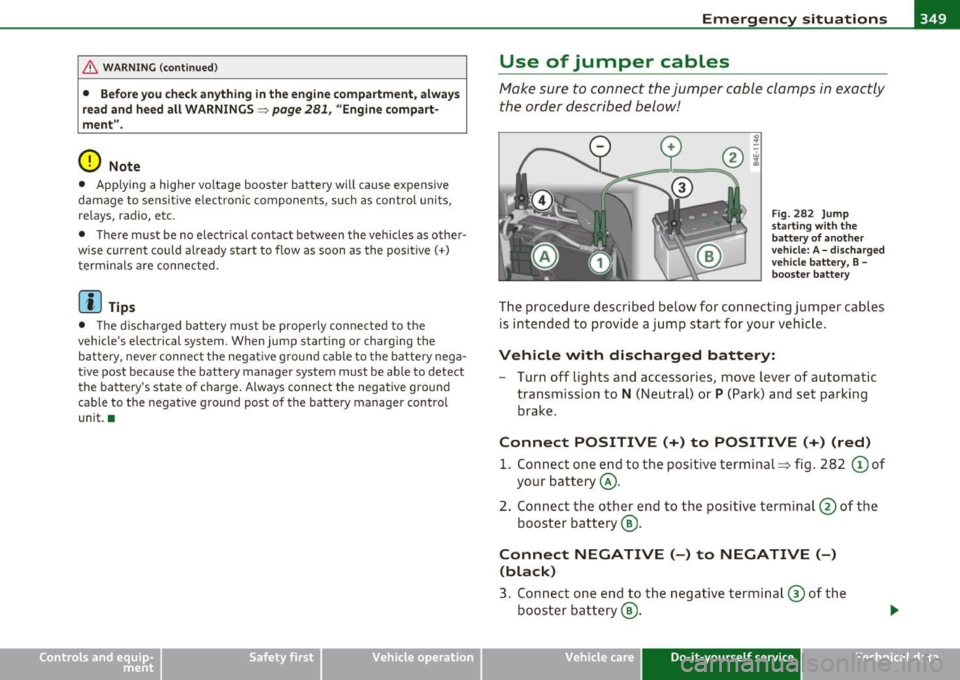
Make sure to connect the jumper cable clamps in exactly
the order described below!
Fig. 282 Jump
starting with the
battery of another
vehicle: A -discharged
vehicle battery, B -
booster battery
The procedure described below for connecting jumper cables
is intended to provide a jump start for your vehicle.
Vehicle with discharged battery:
- Turn off lights and accessories, move lever of automatic
transmission to
N (Neutral) or P (Park) and set parking
brake.
Connect POSITIVE(+) to POSITIVE(+) (red)
1. Connect one end to the positive terminal~ fig. 282 © of
your battery @.
2 . Connect the other end to the positive terminal @ of the
booster battery®·
Connect NEGATIVE(-) to NEGATIVE(-)
(black)
3. Connect one end to the negative terminal® of the
booster battery@.
Vehicle care Do-it-yourself service iTechnical data