ECU AUDI S8 2010 Owner's Guide
[x] Cancel search | Manufacturer: AUDI, Model Year: 2010, Model line: S8, Model: AUDI S8 2010Pages: 384, PDF Size: 90.95 MB
Page 316 of 384
-~_T_ ir_e_ s_ a_ n_ d_ w_ h_e_ e_ ls _______________________________________________ _
• The tire pr ess ure s sho uld o nly be c hecke d an d adjusted wh en the
t ire s ar e cold . Th e slightly rais ed pr ess ure s of war m tir es mu st not b e
r e d uced .
• Adjust th e tire p re ss ur e to t he load yo u a re ca rr yin g.
• Reinstall the valve stem cap on the valve.
When should I check the tire pressure?
The correct tire press ure is especia lly imp orta nt at high speeds . T he
pr essu re s hou ld t here fo re b e ch ec ked at least onc e a mo nth an d
always be fore sta rting a jo ur ney. Do not fo rget to check the tire pres
su re for th e s pare wheel~
page 33 4.
When should I adjust the tire pressures?
Adjus t the tire pr essur e to th e load yo u are carrying . A ft e r changi ng a
w heel
or replac ing w heels yo u have to adjust the ti re pressures on all
w heels. In addi tio n, yo u mu st then stor e the new tir e press ures in the
tire pressu re monitoring system*~
page 326.
& WARNING
Incorrect tire pressures and/or underinflation can lead sudden tire
failure, los s of control, collision, serious personal injury or even
death.
• When the warning symbol appears in the instrument
cluster , stop and inspect the tires.
• Incorrect tire pressure and/or underinflation can cause
increased tire wear and can affect the handling of the vehicle and
stopping ability.
• Incorrect tire pressures and/or underinflation can also lead to
sudden tire failure, including a blowout and sudden deflation,
causing loss of vehicle control.
• The dr iver is responsible for the correct tire pressures for all
tires on the vehicle. The applicable pressure values are located on
a sticker on the driver 's side 8-pillar or on the inside of the fuel
filler flap .
& WARNING (co ntinued )
• Only when all tires on the vehicle are filled to the correct pres
sure, the tire pressure monitoring* system can work correctly .
• The use of incorrect tire pressure values can lead to accidents or
other damage. Therefore it is essential that the driver observe the
specified tire pressure values for the tires and the correct pres
sures for the function of the tire pressure monitoring system*.
• Always inflate tires to the recommended and correct tire pres
sure before driving off .
• Driving with underinflated tires bend more , letting them get
too hot resulting in tread separation, sudden tire failure and loss
of control.
• Excessive speed and/overloading can cause heat build-up,
sudden tire failure and loss of control.
• If the tire pressure is too low or too high, the tires will wear
prematurely and the vehicle will not handle well.
• If the tire is not flat and you do not have to change a wheel
immediately, drive at reduced speed to the nearest service station
to check the tire pressure and add ai r as required.
0 Note
Dr iv ing witho ut valve stem caps can caus e damage to the tire valves.
T o preven t this, alw ays m ake s ure th at facto ry installe d valv e st em
caps o n all whee ls a re securely mo unted o n the valve.
Tires and vehicle load limits
T here a re lim its to the amount of load or we ight that any veh icle a nd
a ny t ire c an car ry. A veh icle th at is overloade d wi ll not ha n dle we ll an d ...
Page 323 of 384

Tires and wheels Ill
----------------
If you install rims, which do not have the sensors, or have sensors
w hich are not compa tible, then the tire pressure moni toring sys tem *
w ill not wo rk p roperly. I n this case, t he tire pressure monitor ing
system * wo uld not be ab le to monitor the tire pressure or warn yo u if
it is necessary .
• The battery inside of the tire pressure sensor has a limited service
l ife.
• Always dr ive wit h the
valve stem caps securely mo unted. We
recommend using factory ins ta lled
valve stem caps. As k your autho
r ized Audi dea ler to rep lace lost
valve stem caps .
Th e insta llation of repl acement tir es w ith s teel co rd bo dy plies in the
t ire sidewa ll may ca use ma lfunctio n of the tire pressure mo nitoring
system *, and is not recommende d (cord material informat io n i n
molded on the ti re s idewall).
Always check your tire pressure monito ring system* indicator afte r
re plac ing one or mo re tires on your vehicle. If the tire press ure m oni
to ring system* indicator flashes, or is on, your system is not working
pro perl y. Yo ur repla ceme nt tire might be incomp atible with your t ire
pressure monitoring system*, or some component of the tire pres
sure mon itor ing system * may be damaged.
& WARNING
• Using incorrect or unmatched tires and / or wheels or improper
tire and wheel combinations can lead to loss of cont rol, collision
and seriou s per sonal injury .
• Always use tires, rims and wheel bolts that meet the specifica
tions of original fa ctory-in stalled tires or other combination s that
have been specifically appro ved by the vehicle manufacturer.
• Tires age even if they are not being used and can fail suddenly ,
especially at high speeds. Tires that are more than 6 years old can
only be u sed in an emergen cy and then with special care and at
lowe r speeds.
• Never mount used tires on your vehicle if you are not sure of
their "previous history." Old used tires may have been damaged
Safety first
& WARNING (co ntinued )
eventhoughthedamagecannotbeseenthatcanleadtosudden
tire failure and loss of vehicle control.
• All four wheels must be fitted with radial tires of the same
type, size (rolling circumference ) and the same tr ead pattern.
Driving with different t ires reduces vehicle handling and can lead
to a lo ss of control.
• If the spare ti re is not the same as the tires that are mounted
on the vehicle - for example with w inter tires - only use the spare
tire fo r a sho rt pe riod of t ime and drive with extra care. Refit the
normal road wheel as soon as safely possible.
• Never drive faster than the ma ximum speed for which the tires
on your vehicle are rated because tires that are driven faster than
their rated speed can fail suddenly .
• Overloading tire s cause heat build-up, sudden tire failure,
including a blowout and sudden deflation and loss of control.
• Temperature grades apply to tires that are properly inflated
and not over or underinflated.
• For technical reasons it is not always possible to use wheels
from other vehicles - in some c ases not even wheel s from the same
vehicle model.
• If you install wheel trim discs on the vehicle wheels , make sure
that the air flow to the brakes is not blocked. Reduced airflow to
the brakes can them to overheat , increasing stopping distance s
and causing a collision.
• Run flat tires may only be u sed on vehicles th at were equipped
with them at the factory. The vehicle must have a chassis designed
fo r run flat tires and a factor y-in stalled tire pres sure monitoring
system* that indicates a loss of tire pre ssure. Incorrect use of run
flat tires can lead to vehicle damage or accident s. Check with an
authorized Audi dealer or tire specialist to see if your vehicle can
be equipped with run flat tires . If run flat tires are used , they must
be installed on all four wheels. Mixing tire types is not permitted . ..,_
Vehicle care Technical data
Page 327 of 384

Tires and wheels -_______________________________ f!:f'II
[I) Tips
Where snow cha ins a re mandatory on certain roads, this no rmally
also applies to vehicles with All W heel Dr ive .•
Wheel bolts
Wheel b olts must al ways be tig hten ed to the correct
torque.
Th e design of whee l bo lts is matc hed to the facto ry installed rims. If
different r ims are fitted, the correct wheel bolts wi th t he r igh t lengt h
and correctly s haped bolt heads must be used . Thi s ensures that
w heels are fi tted secure ly and tha t the br ake system f unc tion s
correctly.
I n cert ain circumst ances, yo u may not us e wheel bolts from a
different veh icle -even if it is the same model=>
page 363.
& WARNING
Improperly tightened or maintained wheel bolts can become
loose causing lo ss of control, a collision and serious per sonal
injury .
• Always keep the wheel bolts and the thread s in the wheel hub s
clean so the wheel bolts can turn easily and be properly tightened .
• Never grease or oil the wheel bolts and the threads in the wheel
hubs. They can become loose while d riving if greased or oiled , even
if tightened to the specified torque.
• Only use wheel bolts that belong to the rim being installed.
• Never use different wheels bolts on your vehicle.
• Always maintain the correct tightening torque for the wheel
bolts to reduce the risk of a wheel loss. If the tightening torque of
the wheel bolts is too low , they can loo sen and come out when the
vehicle is moving. If the tightening torque is too high, th e wheel
Safety first
& WARNING (co ntinued )
bolts and threads can be damaged and the wheel can become
loose .
0 Note
The speci fied tor que f or th e wheel bolts is 90 ft lb (1 2 0 Nm) wi th a
tolerance of ± 7,4 ft lb( ± 10 Nm). Torque wheel bolts diagonally.
After ch anging a wheel, the to rque mu st be checked a s so on as
poss ible with a torque w rench -prefe rab ly by an authorized Aud i
dealer or qualified workshop. •
Low aspect ratio tires
Your Audi is fa cto ry -equ ip ped wi th low aspec t ratio tires. These tire s
have been thorough ly tested and been selected specifically for your
mode l for the ir supe rb perfo rmance, roa d fee l an d han dling un der a
var iety of driv ing cond it ions. Ask your author ized Audi dea ler for
more deta ils.
Th e low a spect rat io of these tires is indica ted by a nu meral of
55 or
less
in the tire's size designation. The numeral represents the ratio of
t he t ire's s idewall heigh t in relat io n t o its t re ad wi dth expressed in
percentage. Conventiona l tires have a height/width ratio of 60 or
more .
The performance of low -aspect -ratio tires is particularly sen sitive to
improper inflation pressure. It is therefore important that low
aspect ratio tires are inflated to the specified pressure and that the
inflation pressure is regularly checked and mainta ined. Tire pres
s ure s should be checked at lea st once a month and always before a
long trip =>
page 313, "Checking tire pressure".
What you can do to avoid tire and rim damage
Low aspect ratio ti res can be damaged more easi ly by impact w ith
potholes, curbs, gull ies or ridges on the road, p articular ly if the tire is
underinflated. .,_
Vehicle care Technical data
Page 335 of 384
![AUDI S8 2010 Owners Guide What do I do now? -_______________ __.EWII
(]] Tips
If you no longer have your or iginal warn ing triangle and need to equip
your vehicle with a new one, contact your authori](/img/6/57617/w960_57617-334.png "AUDI S8 2010 Owners Guide What do I do now? -_______________ __.EWII
(]] Tips
If you no longer have your or iginal warn ing triangle and need to equip
your vehicle with a new one, contact your authori")
What do I do now? -_______________ __.EWII
(]] Tips
If you no longer have your or iginal warn ing triangle and need to equip
your vehicle with a new one, contact your authorized Aud i dealer for
a rep lacement. •
Jack, tools and spare wheel
Jack
The jack is stored underneath the floor panel in the
luggage compartment.
Fig. 26 5 Luggag e
c ompart ment vehicl e
jack
Be fore stori ng the jack, ma ke sure it is wound back down as far as it
w ill go .
& WARNING
Improper use of the vehicle jack can cause serious personal inju
ries.
• Never use the jack suppl ied with your Audi on another vehicle ,
particularly on a heavier one . The jack is only suitable for use on
the vehicle it came with .
Vehicle OP-eration
& WARNI NG (continued )
• Using a bumper jack to raise the veh icle will dam age the
bumper system . The ja ck may slip, causing injury .
• Never support your vehicle on cinder blocks , bricks or other
objects . These may not be able to support the load and could cause
injury when they fail.
• Never sta rt or run the engine while the vehicle is suppo rted by
the jack.
• If you must work under the vehicle , always use safety stands
specifically designed for this purpo se.
• Never use the he xagonal so cket in the handle of the screw
driver to loosen or tight en the wheel bolts .
• Always make sure the sp are tire and even a flat tire are secured
in pla ce and not loose, otherwis e they could fly forward, causing
personal injury to passengers in the vehicle in an accident or
sudden maneuver .
(]] Tips
Before you c an raise your vehi cle us ing t he jack, you mus t activate the
jack ing mode~
page 179 . •
Vehicle care Do-it-yourself service iTechnical data
Page 336 of 384
-What do I do now? ..._ __________________________________________ _
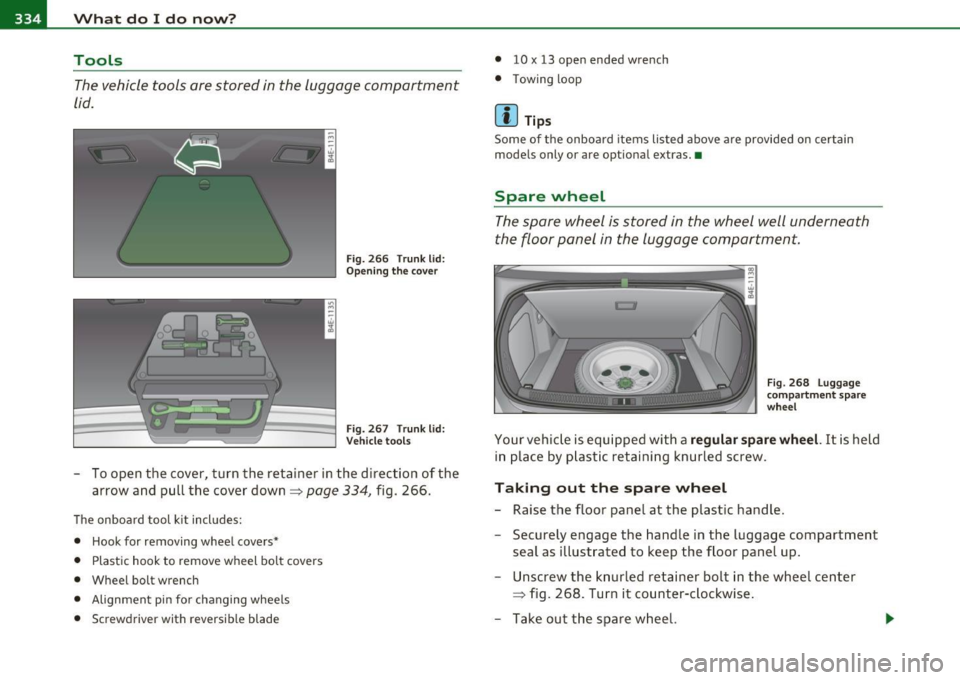
Tools
The vehicle tools are stored in the luggage compartment
lid.
Fig. 266 Trunk lid:
Opening the cover
Fig. 267 Trunk lid:
Vehicle tools
-To open the cover, turn the retainer in the direction of the
arrow and pull the cover down==>
page 334, fig. 266 .
The onboard tool kit includes:
• Hook for removing wheel covers*
• Plastic hook to remove wheel bolt covers
• Wheel bolt wrench
• Alignment pin for changing wheels
• Screwdriver with reversible blade •
10 x 13 open ended wrench
• Towing loop
(I) Tips
Some of the on board items listed above are provided on certain
models only or are optional extras. •
Spare wheel
The spare wheel is stored in the wheel well underneath
the floor panel in the luggage compartment.
Fig. 268 Luggage
compartment spare
wheel
Your vehicle is equipped with a regular spare wheel. It is held
in place by plastic retaining knurled screw.
Taking out the spare wheel
-Raise the floor panel at the plastic handle.
- Securely engage the handle in the luggage compartment
seal as illustrated to keep the floor panel up.
- Unscrew the knurled retainer bolt in the wheel center
==> fig. 268. Turn it counter-clockwise.
- Take out the spare wheel.
Page 337 of 384
What do I do now? -____________________ .:..::......:..:...___Wi'.'11
- Disengage and lower the floor panel before you close the
luggage compartment lid again.
Storing the replaced wheel
-Place the replaced wheel inside the spare wheel well in the
luggage compartment.
Tighten the knurled retaining screw clockwise to secure
the wheel in place.
- Disengage and lower the floor panel before you close the luggage compartment lid again.
& WARNING
Loose items in the passenger compartment can cause serious
personal injury during hard braking or in an accident.
• Never store the spare wheel or jack and tools in the passenger
compartment.
• Always store all jacking equipment, tools, and the spare wheel
in the luggage compartment.
• Tighten the knurled retaining screw for the spare wheel
securely.
[I] Tips
Check the inflation pressure of the spare tire periodically to keep the
tire ready for use .•
Safety first
Changing a wheel
Before changing a wheel
Observe the following precautions for your own and your
passenger's safety when changing a wheel.
- After you experience a tire failure, pull the car well away
from moving traffic and try to reach
level ground before
you stop ~& .
- All passengers should
leave the car and move to a safe
location (for instance, behind the guardrail)~& .
- Engage the
parking brake to prevent your vehicle from
rolling unintentionally~ &.
- Move
selector lever to position P ~ & .
- If you are towing a trailer: unhitch the trailer from your
vehicle.
- Take the
jack and the spare tire out of the luggage
compartment~
page 333 .
& WARNING
You or your passengers could be injured while changing a wheel if
you do not follow these safety precautions:
• If you have a flat tire, move a safe distance off the road. Turn
off the engine, turn the emergency flashers on and use other
warning devices to alert other motorists.
• Make sure that passengers wait in a safe place away from the
vehicle and well away from the road and traffic.
• To help prevent the vehicle from moving suddenly and possibly
slipping off the jack, always fully set the parking brake and block
the wheel diagonally opposite the wheel being changed. When
one front wheel is lifted off the ground, placing the Automatic ..,
Vehicle care Do-it-yourself service Technical data
Page 338 of 384

-What do I do now? ..._ __________________________________________ _
& WARNING (conti nued)
Tra nsmissi on i n " P" ( Park) wi ll not preve nt th e vehicle from
m ov ing.
• Befor e you chan ge a wh eel, be s ure th e grou nd i s lev el and
firm . If n ece ssa ry , us e a s turdy board under th e j ack .
• Afte r in stalling the sp are whee l, make su re that you r eplace
the flat tire /wh ee l i n it s storage are a properly and t ight en th e
knu rled ret ain in g sc rew s ecu rely .
[ i J Tips
Before changing the wheel, you must activate the jacking mode, so
that the automatic contro ls for the Adaptive A ir Suspension do not
make it more difficult to
lift the vehicle with the jack=> page 179. •
Changing a wheel
When you change a wheel, follow the sequence described
below step-by-step and in exactly that order.
1. Activate the vehicle jacking mode==> page 179.
2 . Remove the decorati ve wheel cover* . For more details see
also ==>
page 33 7, "Decorative wheel covers" or
==>
page 337, "Wheels with wheel bolt caps".
3 . Loosen the
wh eel bolts ==> page 338.
4. L ocate the proper mounting point for the jack and align
the jack below that point==>
page 338 .
5. Lift the car with the jack==> page 338.
6. Remove the wheel with the flat tire and then install the
spare ==>
page 340.
7. Tighten all wheel bolts lightly . 8
.
Lower the vehicle with the jack.
9. Use the wheel bolt wrench and
firmly tighten all wheel
bolts==>
page 338.
10. Replace the decorative wheel cov er*.
11. Deactivate the vehicle jacking mode==> page 179.
& WARNING
A lw ays rea d and f ollow all W ARNING S and inf ormation => & in
" Rai sing th e vehicl e" on
page 33 8 and => pag e 341. •
After changing a wheel
A wheel change is not complete without the doing the
following .
-Store and secure the whe el you rep laced in the spare
wheel well.
- Replace the tools and the jack in their proper location.
- Check the
tire pre ssure on the spare wheel immediately
after mounting it .
- As soon as possible, have the
tighten ing torques on all
wheel bolts checked with a torque wrench . The correct
tightening torque is 90 ft lb (120 Nm).
- Have the flat tire
re placed as soon as possible .
[ i J Tips
• If you notice that the wheel bolts are corroded and diff icult to turn
wh ile chang ing a tire, they shou ld be rep laced before you check the
tightening torque. .,_
Page 341 of 384

_____________________________________________ W __ h_a _ t_ d_o_ I_ d _ o_ n_o_ w_ ? _ ___._
Fig. 273 Close-up:
proper positioning of
jack
-Activate the vehicle jacking mode => page 179.
- Engage the parking brake to prevent your vehicle from
rolling unintentionally.
- Move the
selector lever to position P .
- Position the jack below the door sill under the mounting
point
that is closest to the wheel to be changed
~ page 338, fig. 272.
- Extend the
jack under the lifting point on the door sill until
its arm is positioned directly under the lifting point~ &.
- Align the jack so that its arm@=> fig. 273 engages in the
designated lifting point in the door sill and the movable
base ® lies flat on the ground. The base @ must be
vertical under the lifting point@.
- Wind the jack up further until the flat tire comes off the
ground =>& .
The jack must be installed only at the places indicated=::> page 338,
fig. 272. There is exactly
one location fo r each wheel. The jack must
not be positioned at any other location=::>& .
An unstable surface under the jack can cause the vehicle to slip off the
jack . Always provide a firm base for the jack on the ground . If neces-
Vehicle OP-eration
sary place a sturdy board or simila r support under the jack. On hard ,
slippery surfaces (such as tiles) use a rubber mat or similar to prevent
the jack from slipping=> &-
& WARNING
• You or your passengers could be injured while changing a
wheel if you do not follow these safety precautions:
-Positioning the jack under the vehicle at any other place than
those indicated above may damage the vehicle or may result in personal injuries.
- A soft or unstable surface under the jack may cause the
vehicle to slip off the jack. Always provide a firm base for the
jack on the ground. If necessary, use a sturdy board under the
jack.
- On hard, slippery surface (such as tiles) use a rubber mat or
similar to prevent the jack from slipping.
• To help prevent injury to yourself and your passengers:
-Do not raise the vehicle until you are sure the jack is securely
engaged.
- Passengers must not remain in the vehicle when it is jacked
up.
- Make sure that passengers wait in a safe place away from the
vehicle and well away from the road and traffic.
- Make sure jack position is correct, adjust as necessary and
then continue to raise the jack. •
Vehicle care Do-it-yourself service iTechnical data
Page 343 of 384

_______________________________________________ W __ h_a _ t_ d_o_ I_ d_o_ n_ o_w _ ? __ _
Tires with unidirectional tread design
Tires with unidirectional tread design must be mounted
w ith their tread pattern pointed in the right direction .
Using a spare tire w ith a tread pattern intended for
u se in a specific direction
When using a spare tire w ith a tread pattern intended for use in a
spec ific direction, please note the fo llow ing:
• The d irect ion of rotation is marked by an arrow on the side of the
tire.
• If the spare tire has to be installed in the incorrect direct ion, use
t he spare t ire only temporar ily since the tire w ill no t be ab le to
achieve its optimum pe rformance character istics with rega rd to
aquap lan ing, no ise and wear.
• We recommend that you pay particular attent ion to t his fact
during wet wea ther and that you adjust you r speed to match road
conditions .
• Rep lace the flat tire w it h a new one and have it ins talled on your
vehicle as soon as poss ible to resto re the handling advantages of a
unidirectio na l tire .•
Notes on wheel changing
Please read the in forma tion => page 318, "New t ires and replacing
tires and wheels" if you are going to use a spare t ire which is different
from the tires on yo ur vehi cle.
After you change a t ire:
• Check the tire pressure on the spare immediately after installa
tion.
• Have the wheel bolt t ightening torque checked with a torque
wren ch as soon a s possible by your authorized Audi dealer or a qua l
i fied serv ice stat ion.
Safety first • With steel and alloy wheel rims
, the wheel bolts are correctly
tightened at a torque of 90
ft lb (120 Nm ).
• If you notice that the wheel bolts are corroded and difficult to
turn while changing a tire, they should be replac ed before you check
the tightening torque.
• R epla ce the flat tire with a new one and have it install ed on your
vehicle as soon as possible. Remount the wheel cover.
Until then, drive with extra care and at reduced speed s.
& WARNING
• If you are going to equip your vehicle with tires or rims which
differ from those which were factory installed, then be sure to
read the information =>
page 318, "New tires and replacing tire s
and whe els ".
• Always make sure the damaged whe el or ev en a flat tire and
the jack and tool kit are prope rly secured in the luggage compart ·
ment and are not loo se in the pa ssenger compartment.
• In an accident or sudden maneu ver they could fly forward ,
injuring anyone in the vehicle .
• Always store dam aged wheel , jack and tools secu rely in the
luggage compartment. Otherwi se, in an accident or sudden
maneuver they could fly fo rward , caus ing inju ry to passengers in
the vehicle .
• Do not u se commercially available tire sealants . Otherwi se, the
electrical component s of the tire pre ssure monitoring system * will
no longer work properly and the sensor for the t ire pressure moni ·
toring sy stem* will have to be replaced b y a qualified work shop .•
Vehicle care Do-it-yourself service Technical data
Page 352 of 384
llffl.___E_ m_ e_r-= g=- e_ n_c-= y'-- s_ i_t _u _a_ t_ i_ o _ n_ s ____________________________________________ _
4. C onn ect the ot her end to the negative ground post of the
battery manager control unit located nex t to the battery .
Starting the engine
-Start the engine o f th e vehicle with the booster battery .
Ru n the engine at a mode rate speed.
- Start engine with discharged vehic le battery in the usua l
manner.
- If the e ngine fai ls to star t: do no t keep the s tarter
crank ing for longer than 10 seconds . Wait for about 30
seconds a nd then try aga in.
- With eng ine runni ng, remove jumper cables from bot h
veh icles in t he exact
reverse order.
T he b att ery is ven ted to the outside to p reve nt gases from en ter ing
the vehicle interior. Make sure that the jumper clamps are well connected wi th their
metal parts in full contact with the battery
terminals.
& WARNING
To avoid serious personal injury and damage to the vehicle, heed
all warnings and in stru ction s of the jumper cable manufa cturer . If
in doubt , call for road service.
• Jumper cable s mu st be long enough so that the vehicle s do not
touch.
• Wh en connecting jumper cables, make sure that they cannot
get caught in any moving part s in the engine compa rtment.
• Before you check anything in the engine compartment, always
read and heed all WARNINGS~
page 281, "Engine compart
ment ".
0 Note
Improper hook-up of jumpe r cables can ruin the generator.
• Always connect POS ITIVE(+) to POS ITIVE(+), and NEGA TIVE(-)
to NEGATIVE (-) ground post of the battery manager co ntrol unit .
• Check t hat all s crew p lugs on t he b attery cells are screwed in
firm ly . If not, tighten plugs pr ior to co nnecting clamp on negative
battery terminal.
• Please note that the procedure for connecting a jumper cable as
descr ibed above appli es specifically to the case o f yo ur vehi cle be in g
jump started. W hen you are giving a jump sta rt to another vehicle, do
not connect the negative (-) cab le to t he negative ( -) termina l on the
discharged battery©~
page 349, fig. 282 . Instead, securely
connect the negative(-) cable to either a solid metal component that
is firmly bolted to t he eng ine b lock o r to the eng ine b lock itself. If the
battery that is being charged does not vent to the outside, escap ing
b attery gas could ignite and exp lode! •
Emergency towing with
commercial tow truck
General hints
Your Audi requires special handling for towing.
Th e fo llow ing in forma tion is to be used by commerci al tow tru ck
operators who know how to operate their equ ipment safely .
• Never to w your Aud i, towing will cause damage to the eng ine
and tran smi ssion .
• Neve r wrap the safety chains or winch cable s around the b rake
lines.
• To prevent unnece ssary damage, your Audi must be transported
with a flat bed truck . _.,