lights AUDI S8 2010 Owner's Guide
[x] Cancel search | Manufacturer: AUDI, Model Year: 2010, Model line: S8, Model: AUDI S8 2010Pages: 384, PDF Size: 90.95 MB
Page 76 of 384
Clear vision
Mirrors
Rear view mirror
When the ignition is on, t he interior m irro r will darken automatically
depending on t he amo unt of light strik ing the m irro r (such as head
lights shin ing into the veh icle from the rear) . The mirro r will retu rn to
the o rigi na l state (anti -glare off) when yo u move the manua l gear
shift/gear se lector lever into
Reverse or w he n you turn o n the in te rior
lights .
& WARNING
Broken glass of automatic dimming mirror can cause electrolyte
fluid l eakage . Electrolyte fluid can irritate skin, eyes, and respira
tory system .
• Repeated or prolonged exposure to electrolyte can cause irrita
tion to the respiratory system , especially among people with
asthma or other respiratory conditions . Get fresh air immediately
by leaving the vehicle or , if that is not possible , open windows and
doors all the way .
• If electrolyte gets into the eyes , flush them thoroughly with
large amounts of clean water for at least 15 minutes; medical
attention is recommended.
• If electrolyte contacts skin, flush affected area with clean
water for at least 15 minutes and then wash affected area with
soap and water; medical attention is recommended. Thoroughly
wash affected clothing and shoes before reuse.
• If swallowed and person is conscious, rinse mouth with water
for at least 15 minutes. Do not induce vomiting unless instructed
to do so by medical professional. Get medi cal attention immedi
ately.
[I] Tips
T he au tomati c anti-glare feature on the mi rro r will not operate prop
erly if the lig ht shini ng on the inside mir ror is blocked by othe r
objec ts. •
Outside mirrors
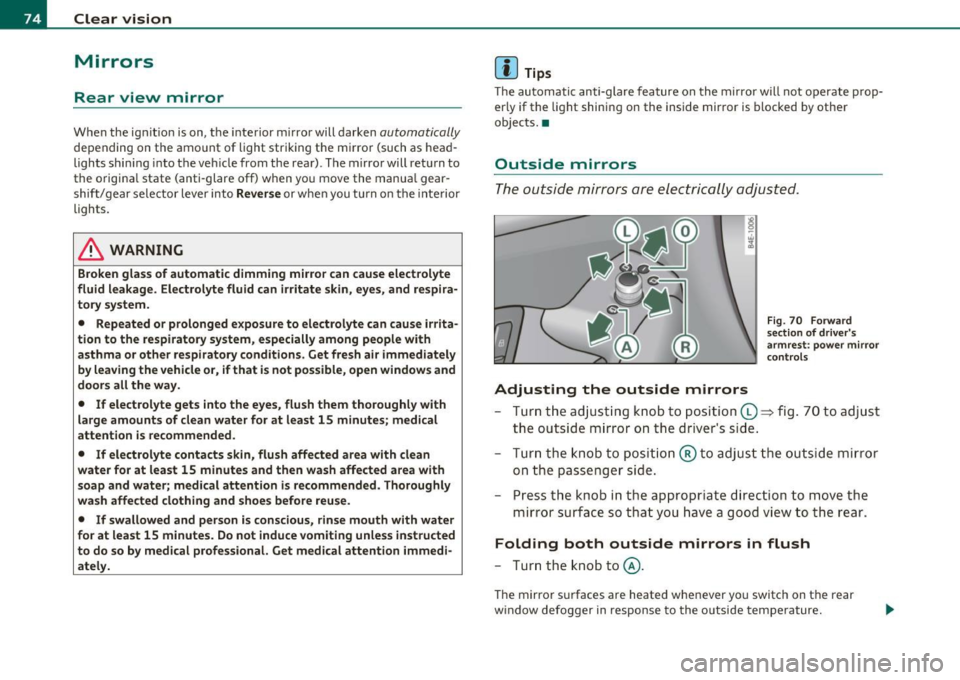
The outside mirrors are elec trically a djust ed.
Adjusting the outside mirrors
Fig . 70 F orw ard
section of d river 's
armrest : power mi rro r
c on trols
- Tur n th e ad jus ting k nob to posi tion (0 ~ fig. 7 0 to ad just
the outside m irror on the drive r's s ide.
- Tur n the k nob to posit io n ® to adjust t he out side mirror
on the passe nger side.
- Pr ess t he knob i n th e ap propriate direc tion to move t he
mirror s urf a ce so tha t you have a goo d view to the r ear .
Folding both outside mirrors in flush
- Turn the knob to@ .
The m irro r sur faces are heated whe never you switch on the rear
w indow defogger in re sponse to the o utside temperature.
Page 77 of 384

You are well-advised to fold the outside mirrors in when maneuvering in tight spaces or w hen leaving t he car pa rked close to othe r vehicles.
Tilting the passenger's side outside mirror
When yo u move the se lecto r lever in to R (Reve rse), the mi rror on the
front passenger's door (knob turned to® =>
page 74, fig . 70) w ill tilt
sligh tly downw ard. This make is easier for you to see the curb when
you are back ing into a parking space .
The mirror returns to its initial position as soon as reverse gear is disengaged and vehicle speed is above about 9 mph (15 km/h). The
mirror also returns to its initia l position if the switch is moved to the
dr iver's ou ts ide mir ror © or Neutral @ .
Memory setting for the outside mirrors
When the seat position is saved in memo ry, t he position of the
outs ide mirrors is saved at the same time=>
page 84.
Automatic anti-glare for the outsid e mirro rs
The o utside mir rors dim at the same time as the inside mirro r. When
the ign ition is sw itched on, the mirrors automatically dim depend ing
on the amo unt of light strik ing the m irro rs (such as head lights
shini ng into the veh icle from t he rear) .
When you turn on the inter ior light, or when you move the se lector
lever in to R (Reve rse), the anti-glare f unct ion s tops and the mir rors
return to their orig inal condition (not darkened) .
& WARNING
Broken glass of automatic dimming mir ro r can cause electrolyte
fluid leakage . Electrolyte fluid c an irritat e skin, eye s, and respira
tory system.
• Repeated or prolonged e xposure to electrolyte can cause irrita
tion to the resp iratory system, especially among people w ith
asthma or other re spiratory condition s. Get fresh air immediately
by leaving the vehicle or, if that is not possible , open windows and
door s all the way.
Controls and equip
ment Safety first
Clear v
ision
& WARNING (co ntinued )
• If electrolyte get s into the eye s, flu sh them thoroughly with
large amount s of clean water for at l east 15 minut es; medical
attention i s re commended .
• If electrolyte contact s skin, flush affected area w ith clean
water for at least 15 minute s and then wash affe cted area with
soap and water; medical attention is recommend ed . Thoroughly
wash affected clothing and shoes befo re reu se.
• If swa llowed and person is consciou s, rinse mouth with water
for at least 15 minutes. Do not induce vomiting unle ss instructed
to do so by medical prof essional. Get medi cal attention immedi
atel y.
0 Note
• Curved (i.e. convex) mirror surfaces increase yo ur field of v iew .
Remembe r th at vehicles or o ther objects will appea r smalle r and
farther away than when seen in a flat mirror. If you use this mirror to es tima te dist ances of following veh icles whe n chang ing lanes, yo u
cou ld estimate incorrectly and cause an acc ident .
• If the mirror ho using is moved un intent io na lly (for examp le, w hile
parking your ve hicle), then you must first fold the mirror electr ically.
Do not read just the mirro r ho using manually. Yo u could damage the
motor w hich controls the mirror .
[ i ] Tips
• If
there should be a malfunction in the electrical system, you can
sti ll adjust the outs ide mir rors by pressing the edge of the mirror .
• The au tomatic anti-glare feature on the mirror will not operate
prope rly if the light sh ining on the i nside m irro r is bloc ked by ot her
objects .•
Vehicle care Technical data
Page 125 of 384

On the road -
----------------
Electromechanical parking brake
Operation
The electromechanical parking brake replaces the hand
brake.
Fig. 135 Center
console: Parking brake
- Pull the switch to apply the parking brake~ fig. 135. The
indicator light in the switch will come on.
- Step on the brake pedal or the accelerator pedal and press
the switch at the same time to release the parking brake.
The indicator light in the switch will go out.
Your vehicle is equipped with an electromechanical parking brake
which replaces the handbrake. The parking brake is designed to
prevent the vehicle from rolling unintentionally.
In addition to the normal functions of a traditional hand brake, the
electromechanical parking brake provides various convenience and
safety functions.
Emergency brake
An emergency brake ensures that the vehicle can be slowed even if
the normal brakes fail~ page 125, "Emergency braking".
Controls and equip
ment Safety first
Indicator lights
•
If the parking brake is applied with the ignition turned on, the
indicator light in the instrument cluster (U.S. models:=.., Canadian
models: ©) and in the switch
«el) will come on.
• If the parking brake is applied with the ignition turned off, the
indicator light in the instrument cluster (U.S. models:=., Canadian
models: ©) and in the switch
«fl) will come on for about 30 seconds
and then go out.
& WARNING
If the vehicle is stationary and the transmission is engaged with
the engine running, the engine should not be speeded up (e.g.
manually from under the hood). Otherwise the vehicle will start to
move -you run the risk of an accident.
0 Note
If the warning/indicator light (U.S . models: BRAKE, Canadian models:
«I» ) flashes in the instrument cluster, there is a brake system
malfunction . By pressing the [CHECK! button, you can bring up a
driver message which explains the malfunction in more detail. If the
message
Parking brake ! Please contact workshop appears, there is
a parking brake malfunction which you should have repaired immedi
ately by an authorized dealership~ page 28.
[ i] Tips
• You can apply the parking brake at any time -even with the igni
tion turned off . The ignition must be turned on in order to release the
parking brake.
• Occasional noises when the parking brake is applied and released
are normal and are not a cause for concern.
• The parking brake goes through a self-test cycle at regular inter
vals -when the vehicle is parked. Any associated noises are normal. •
Vehicle care Technical data
Page 129 of 384

_________________________________________________ O_ n_t_ h _ e_ ro_ a_d __ ffllll
& WARNING (continued)
• Please note that inadvertently "resting" your foot on the accel
erator pedal causes the cruise control not to brake. This is because
the cruise control is overridden by the driver's acceleration.
[ i] Tips
The brake lights illuminate as soon as the brakes decelerate automatically. •
Changing speed
-Press lever in the
0 or O direction=> page 126, fig. 136
to increase or decrease your speed.
- Release the lever to save that speed.
Change speed in increments of 1 mph (1 km/h) by lightly pressing the
lever. If you keep the lever pressed down, you will alter your speed in
S mph (10 km/h) increments.
You can also press the accelerator pedal down to increase your speed,
e.g. if you want to pass someone. The speed you saved earlier will
resume as soon as you release the accelerator pedal.
If, however, you exceed your saved speed by S mph (10 km/h) for
longer than S minutes, the cruise control will turn off temporarily .
The green symbol in the display~
page 126, fig. 13 7 is replaced with
a white symbol. The saved speed remains the same.•
Presetting your speed
You can preset your desired speed while the vehicle is not
moving .
-Turn on the ignition.
Controls and equip
ment Safety first
- Pull lever
into position ©=> page 126, fig. 136.
- Press the lever in the
0 or O direction to increase or
decrease your speed.
- Release the lever to save that speed .
This function makes it possible, for example, to save the speed you
want before driving on the highway. Once on the highway, activate
the cruise control by pulling the lever toward
(D . •
Switching the system off
Temporary deactivation
- Press the brake pedal, or
- Press the lever into position@ (not clicked into place)
=> page 126, fig. 136, or
- Drive for longer than 5 minutes at more than 5 mph
(10 km/h) above the stored speed.
Switching off completely
- Press lever into position @ (clicked into place), or
- Switch the ignition off .
The system retains the saved speed if you deactivate the cruise
control temporarily. To resume the saved speed, release the brake
pedal and pull the lever to position
(D.
Switching the ignition off erases the saved speed.
& WARNING
You should only return to the saved speed if it is not too fast for
the current traffic conditions -risk of an accident! •
Vehicle care Technical data
Page 137 of 384

--------------------------------------------=A~ d:..: a=. p !::...: t~iv .:.. e =-- C=-=- r=u :.:.is =-:: e_C=.:: o:.:n..:. t.:: r:..: o:::.:. L _..J_
Driver information
Applies to veh icles: with A daptive C ruise Cont ro l
Displays in the instrument cluster
Depending on the driving situation, driver information is
displayed in the instrument cluster .
@ Primary d isp lay in the speedometer .
Fig. 145 O vervi ew
in strume nt clu ster
@ Supplementary display in the instrument cluster .
© Message in the instrument cluster d isp lay.
@ Primary display
Important information concerning vehicle operation with Adaptive
C rui se Con trol i s shown in display area @ . T he desired speed you set
is highlighted in the speedometer and the warning lights show
whet her adjustments are being made for an object ahe ad.
T hi s information is always displayed. Display area@ is the refore
called the
primary di splay.
@ Supplementary display
In d isp lay area @ information from the navigation system a nd the
trip computer is displayed in addit ion to information about Adapt ive
Cru ise Control.
Con tro ls a nd e quip ·
m en t Vehicle
OP-eration
You can select among the different information by repeated brief
ta ps o n the R ES ET button on the windshield wiper lever =>
page 38,
"Operatio n".
Particularly on your first trips with Adaptive Cruise Control, the
s upplementar y display should be tur ned on .
© Message
The information in a rea © is not displayed permanently . Informat ion
is displayed on ly if you c hange the time interval, if there is a malfunc
tion or if the Adapt ive Cru ise Contro l is turned off .•
A p plies to v ehicles : wi th Adaptive C ru ise Cont ro l
Primary display in the speedometer
Desired speed
Fi g. 14 6 Pr im ary
d is p lay
i n the spe ed ·
o m et er
Th e desi red speed set by the d river is displayed wi th a red L ED .
T he system a llows only speeds from 20 to 95 mph (30 to 150 km/h)
to be set . This speed range is faint ly illumina ted in the speedometer.
Warning lights (symbols)
• ""c::;, Open road: T he wa rning lig ht ""c::;, shows that AC C is active
and that no moving vehicle has been detected with in range of the
ra dar senso r up ahead in your lane of travel. The set speed is main-
tained . _,,,
Vehicle care Do-it-yourselt service iTechnical data
Page 147 of 384

_________________________________________________ A_ u _ d_ i_ s_ id_ e_ a _ s_s _ i_s _t _ __.fflll
Audi side assist
Lane Change Assistant
Applies to veh icles : with s ide ass ist
Descr iption
The side assist helps you when changing lanes.
l Audi AS J
Fig. 158 Rear
bumper: Position of
radar sensors (not
visible on outside)
Fig. 159 Signal light
on the outside mirror·
driver's side
Side ass ist uses radar sensors (not visible on outside)~ fig. 158 to
help the driver check blind spots, and see what is happening in traffic
behind the vehicle~
page 146, fig. 161.
Signal lights are built into both outside mirrors~ fig. 159. The signal
light on the left outs ide mirror assists when moving over into the left
Contro ls a nd e quip
m en t Vehicle
OP-eration
lane and the signal light on the right outside mirror assists when
moving over into the right lane.
Th e signal light comes on to tell you that side assist has detected a
vehicle on that side and that the position of this other vehicle should be taken into account if you were to change lanes. This is called the
informational stage signal~ page 147. The informational stage
signal is designed so that you notice it only when you are looking in
the outside mirror .
When you activate the turn s ignal and side assist detects a vehicle in
a notab le location, the corresponding signal on the outside mirror
flashes briefly and brightly several times. This is the
alert stage
signal ~
page 147. •
App lie s to ve hicle s: with sid e ass ist
Activating and deactivating
Activating
Fig. 160 Cockpit : Side
assist button
- Press the button~ fig. 160. The indicator on the button
lights up. ..,
Vehicle care Do-it-yourselt service iTechnical data
Page 150 of 384
ffl..__A_ u_ d_ i_ s_ i_ d_ e _ a_ s_s _i_s _t _________________________________________________ _
Applie s to vehi cles : w ith si de assist
Driving situation: Fast approaching
vehicles
l!l
~----- "'
i
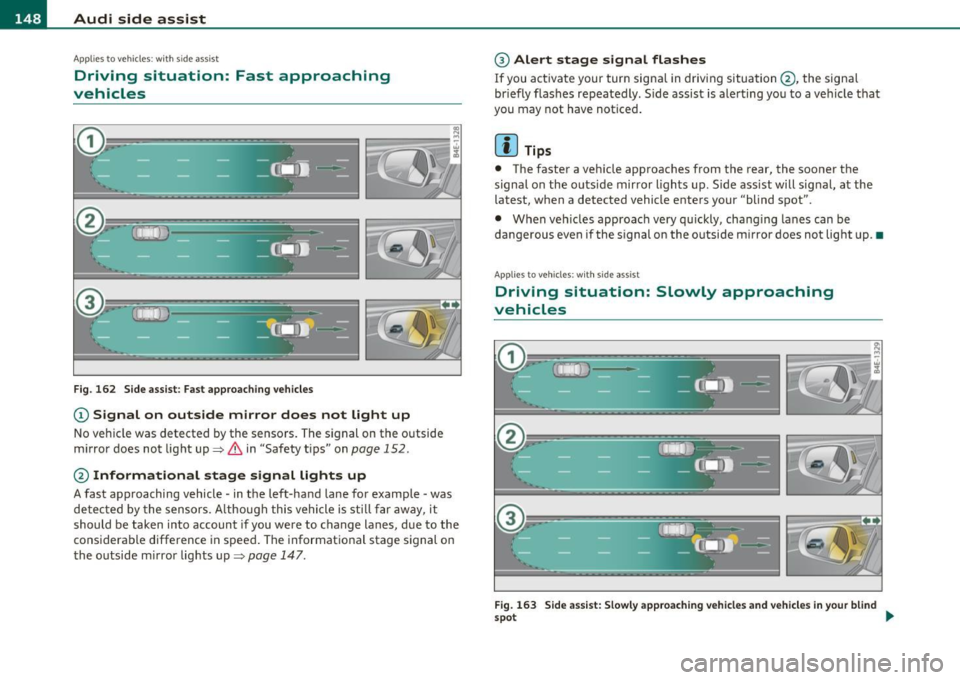
Fig. 162 Side assist: Fast approaching vehicles
(D Signal on outside mirror does not light up
No veh icle was detected by the sensors. The signal on the outside
mirror does not light up~
& in "Safety tips" on page 152.
@ Informational stage signal lights up
A fast approaching vehicle· in the left-hand lane for example· was
detected by the sensors. A lthough this vehicle is stil l far away, it
should be taken into account if you were to change lanes, due to the
considerable difference in speed. The informational stage signal on
the outside m irror lights up~
page 147.
@ Alert stage signal flashes
If you activate your turn signal in driving situation@, the signal
br iefly flashes repeatedly . Side assist is alerting you to a veh icle that
you may not have noticed.
[I] Tips
• The faster a vehicle approaches from the rear, the sooner the
signa l on the outs ide mirror lights up. S ide assist will signal, at the
latest, when a detected vehicle enters your "blind spot".
• When vehicles approach very qu ickly, chang ing lanes can be
dangerous even if the s ignal on the outside m irror does not light up. •
Applies to vehicles : w ith si de assist
Driving situation: Slowly approaching
vehicles
Fig. 163 Side assist: Slowly approach ing vehicles and vehicles in your blind
spo t ..
Page 151 of 384

_________________________________________________ A ___ u...:d _ i_ s ---- id ___ e_.:.; a..::s ...:s...: i..::s ...:t _ ___,J_
CD S ignal on out sid e mirror do es n ot light up
A vehicle approach ing slow ly- in the left -hand lane for example -was
detected by the sensors . Because of the small difference in speed and
the conside rable d istance from your vehicle, the signal on the outside
mirror will not light up=>
& in "Safety tips" on page 152.
@ Informational stage signal light s up
The distance between your veh icle and that of the slowly approach ing
vehicle has narrowed. The informational stage signal on the outside
m irror lig hts up.
As soon as the difference in speed and distance is registered as
notable if you we re to change la nes, a sig nal on the m irror lights up.
Side ass ist wi ll signal at the latest when a detected vehicle enters
your "b lind spot" .
@ Alert stage signal flashes
If you activate your tur n sign al in drivi ng situa tion @, the signa l light
briefly flashes repeatedly. Side assist is alerting you of a veh icle t hat
you may not have no tic ed.
[ i ] Tips
• T he faste r a veh icle approaches from the rear, the soone r the
signal on the outs ide mirror lights up. Side assist will signal, at the
latest, when a detected vehicle enters your "blind spot".
• When veh icles approach very quickly, chang ing lanes can be
dangerous even if the s ignal on the outside mi rror does not light up. •
Con tro ls a nd e quip
m en t Vehicle
OP-eration
Applies to vehicles : w ith side assist
Driving situation: Vehicles dropping back
slowly
Fi g. 16 4 Side as sis t : V ehi cle s dro ppi ng b ack slowly
CD S ignal on outside m irror does not light up
T he vehicle that you passed has not yet been detected by s ide assist .
T he signa l on the outside mirror does not light up=>
& in "Safety
tips" on
page 152.
@ Informational stage signal lights up
A veh icle dropping back slow ly on the r ight (d if f erence in speed of
less than 9 mph, or 15 km/h) has been detected by side ass ist . The
informational stage signa l on the outside mirror lights up .
@ Alert stage signal flashes
If you activate your tur n signa l in dr iv ing si tua tion @, the signa l
briefly flashes repeatedly. Side assist is alerting you of a vehicle that
you may not have not iced .•
Vehicle care Do-it-yourselt service iTechnical data
Page 158 of 384
1111....__A_ u_ t_o _m_ a_ t_ic _ t_ r_ a_ n_s _m_ i _s_ s_ i_ o_ n ____________________________________________ _
Select R only when the vehicle is at a full stop and the engine is
running at id le speed =>
& in "Driving the automatic transmission"
on
page 154.
Before you move the selector lever to R , press both the button in the
hand le of the selector lever
and the brake pedal at the same time.
When the ignition is on, the backup lights illuminate when the
selector lever is moved into
R .
N -Neutral
The transmission is in neutral in this position. Shift to this position
for standing with the brakes applied =>
page 156.
When the vehicle is stationary or at speeds be low 3 mph (5 km/h),
you must always apply the footbrake before and while mov ing the
lever out of
N.
D -Normal position for driving forward
Posit ion Dis fo r normal city and highway driving . It ranges from zero
to top speed and all six gears shift automatically, depending on
engine load, driving speed and automat ica lly se lected shift
programs.
When the vehicle is stationary or at speeds below 3 mph (5 km/h),
you must always apply the foot bra ke before and while moving the
lever to
D out of N .
In certa in circumstances it may be advantageous to temporarily
switch to the manual sh ift program to manually select gear ratios to
match specific driving conditions =>
page 158.
S -Sport position
Select this position for sportie r performance. In this position, the
transmission will not upshift as soon, allowing the vehicle to use the
increased power available at higher engine speeds to achieve livelier
acceleration .
When the vehicle is stationary or at speeds be low 3 mph (5 km/h),
you must always apply the foot bra ke before and while moving the
lever to
S out of N .
& WARNING
Read and follow all WARNINGS=> & in "Driving the automatic
transmi ssion" on
page 154.
0 Note
Coasting downhill with the transmission in N and the engine not
running will result in damage to the automatic transmission and
possibly the catalytic converter. •
Automatic Shift Lock (ASL)
Automatic shift lock prevents you from accidentally
shifting into a forward gear or into reverse, thus causing
the vehicle to move unintentionally.
0
Fig . 170 Shift gate
se lector lever lock posi
tions and interlock
button highlighted
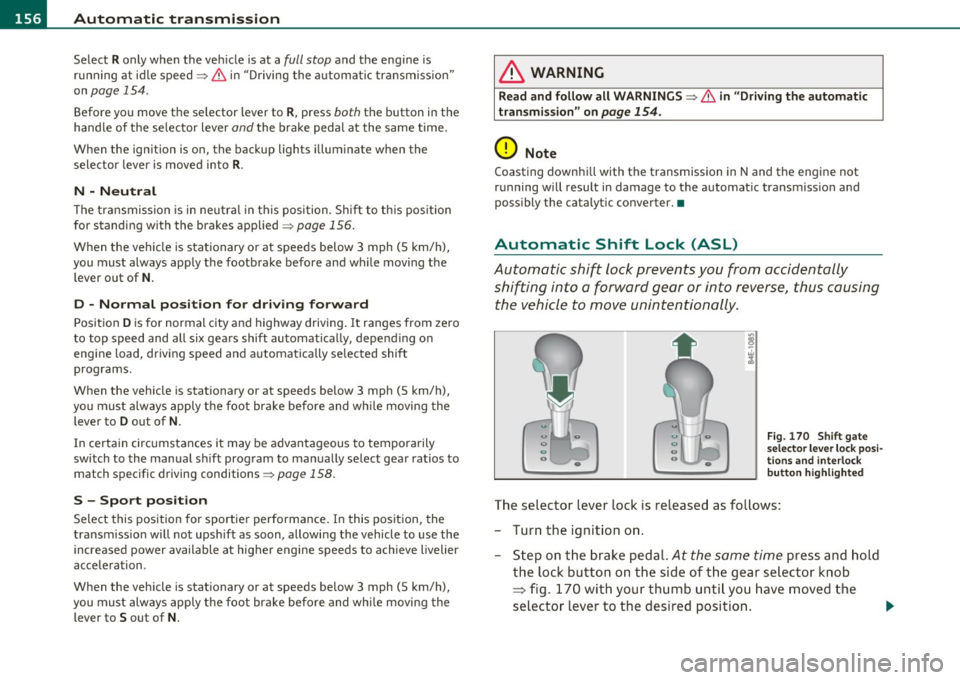
The selector lever lock is released as follows:
- Turn the ignition on .
- Step on the brake pedal.
At the same time press and hold
the lock button on the side of the gear selector knob
=:> fig. 170 with your thumb until you have moved the
selector lever to the desired position. .,_
Page 164 of 384

IIII.___A_ d_v_ a_ n _ c_e _d _ P_ a_ rk_ in--= g'-S -=- y_s_t_ e_ m _________________________________________ _
- Press the switch P1JJ! in the center console=:, page 161,
fig. 177 to activate the Audi parking system manually.
Activation of the acoustic parking system is confirmed by
a brief acknowledgement sound. The indicator light in the
switch lights up.
Deactivation
- If you drive forwards faster than approx. 6 mph (10 km/h), or
- if you switch the ignition off, the entire acoustic parking
assist is automatically deactivated, or
- you can press the switch
Pw! in the center console
=:, page 161, fig. 177 to deactivate the Audi parking
system. The indicator light in the switch goes out.
You have to turn on the acoustic parking assist manually if you wish
to park the vehicle forwards or if you wish to approach an obstacle
forwards and want a distance warning.
The range at which the sensors start to measure is
about :
Front
Rear
Warning tones
side
center
side
center 3 ft (0.90 m)
4 ft (1.20 m)
2 ft (0.60 m)
5.2 ft (1.60 m)
Distance warning is given by chimes which are generated by a signal
generator . The volume and the pitch of the chimes can be adjusted in
the MMI =>
page 171.
Mute
In the case of vehicles with automatic transmission, an acoustic
distance warning is discontinued when the transmission selector lever is moved to the P position
. However, the system remains active.
As soon as the selector lever is moved from the
P position and the
vehicle approaches an obstacle, the acoustic distance warning
resumes.
Driving forward/backward
Distance warning when driving forward/backward is based on detec
tion of an obstacle in the range of the parking assist . As the distance
decreases, the time interval between the audible tones becomes
shorter.
When the distance is less than approx. 1 ft (0.30 m), the tone
becomes continuous. At this point you should stop backing up or
driving forward .
If the distance to an obstacle remains the same, the volume of the
distance warning is gradually reduced after about
4 seconds (does
not apply to the zone for the continuous tone). If you start to
approach the detected obstacle again, the distance warning will
sound at the normal volume again.
Parking
When you select another gear when parking (e.g. reverse/forward),
the warning tones are temporarily suppressed, but the visual display
remains on the MMI display. If you start approaching a detected
obstacle again, the distance warning will sound at the normal volume
again.
Visual display
The segments on the MMI display indicate a change in the distance
between the vehicle and an obstacle . The number of segments
displayed depends on the obstacles in front of or behind the vehicle.
The closer the vehicle comes to the obstacle, the closer the segments
approach the vehicle=>
page 161, fig. 178. When the segment
before last is displayed, the vehicle has reached the collision zone. At
this point you should stop backing up or driving forward=>& .
The image in the visual display can be switched off on the MMI display
=>
page 173 . The acoustic distance warning remains active. .,,