lights AUDI S8 2010 Service Manual
[x] Cancel search | Manufacturer: AUDI, Model Year: 2010, Model line: S8, Model: AUDI S8 2010Pages: 384, PDF Size: 90.95 MB
Page 189 of 384

______________________________________________ D_ ri_v _ i_n _,,g ,c.._ S_a_ f_ e_ l..:: y __ __
Important things to do before driving
Safety is everybody's job! Vehicle and occupant safety always depends on the informed and careful driver.
For your safety and the safety of your passengers, before
driving always:
- Make sure that all lights and signals are operating
correctly.
- Make sure that the tire pressure is correct.
- Make sure that all windows are clean and afford good visi-
bility to the outside.
- Secure all luggage and other items carefully::::>
page 98.
-Make sure that nothing can interfere with the pedals.
- Adjust front seat, head restraint and mirrors correctly for your height .
- Instruct passengers to adjust the head restraints according to their height.
- Make sure to use the right child restraint correctly to
protect children ::::,
page 231, "Child Safety".
- Sit properly in your seat and make sure that your passen gers do the same::::,
page 76, "General recommenda
tions".
- Fasten your safety belt and wear it properly. Also instruct
your passengers to fasten their safety belts properly
=:> page 197. •
Controls and equip
ment Safety first Vehicle operation
What impairs driving safety?
Safe driving is directly related to the condition of the
vehicle, the driver as well as the driver's ability to concen
trate on the road without being distracted .
The driver is responsible for the safety of the vehicle and all
of its occupants. If your ability to drive is impaired, safety
risks for everybody in the vehicle increase and you also
become a hazard to everyone else on the road::::,,& . There
fore:
Do not let yourself be distracted by passengers or by using
a cellular telephone.
NEVER drive when your driving ability is impaired (by
medications, alcohol, drugs, etc.).
- Observe all traffic laws, rules of the road and speed limits
and plain common sense .
- ALWAYS adjust your speed to road, traffic and weather
conditions.
- Take frequent breaks on long trips. Do not drive for more than two hours at a stretch.
- Do NOT drive when you are tired, under pressure or when
you are stressed .
& WARNING
Impaired driving safety increases the risk of serious personal
injury and death whenever a vehicle is being used.•
Vehicle care Do-it-yourself service Technical data
Page 200 of 384
___ S_a _f_e _t-=y '-- b_e_ l_ t _s _____________________________________________ _
-Make sure that your passengers also buckle up a nd prop
erly wear their safety belts .
- Protect c hildren with a child rest raint system appropria te
fo r the size and ag e.
The warn ing light ~ in the instrument cluster lights up when the igni
tion is sw itched on as a reminder to fasten the safety belts. In addi
tion, you will hear a warn ing to ne .
After the ignition is switched on, the warn ing light in the instrument
clu ster will alw ays come on fo r a bout 6 seconds and i f the driver has
not fastened the safety belt, a warning tone will also sound for about
6 seconds. As soon as the d rive r has fastened the safety belt, the
warning tone will stop and the war ning light w ill go out.
If the driver or front seat passenger have not buck led-up within about
1 0 se conds afte r th e war ning tone has stopped and the veh icle is
moving faster than about 15 mph, the warning tone will sound again
for a bout 6 se conds and then s to p for 24 seco nds and the n re pea t
this rem inder sequence for a max imum of 2 m inutes . At speeds
below 5 mph, the w arning tone will not sou nd.
Fa sten your safety belt and make sure that your passenger s also
properly put on their safety belts.
& WARNING
• Safety belt s are the single most effe ctiv e mean s available to
reduce the risk of serious injury and death in automobile a cci
dents . For your protection and that of your pa ssenger s, always
c orrectly wear safety belts when the vehicle is moving .
• Failure to pay attention to the warning light that come on,
could lead to person al injury .•
Why safety belts?
Frontal collisions and the law of physics
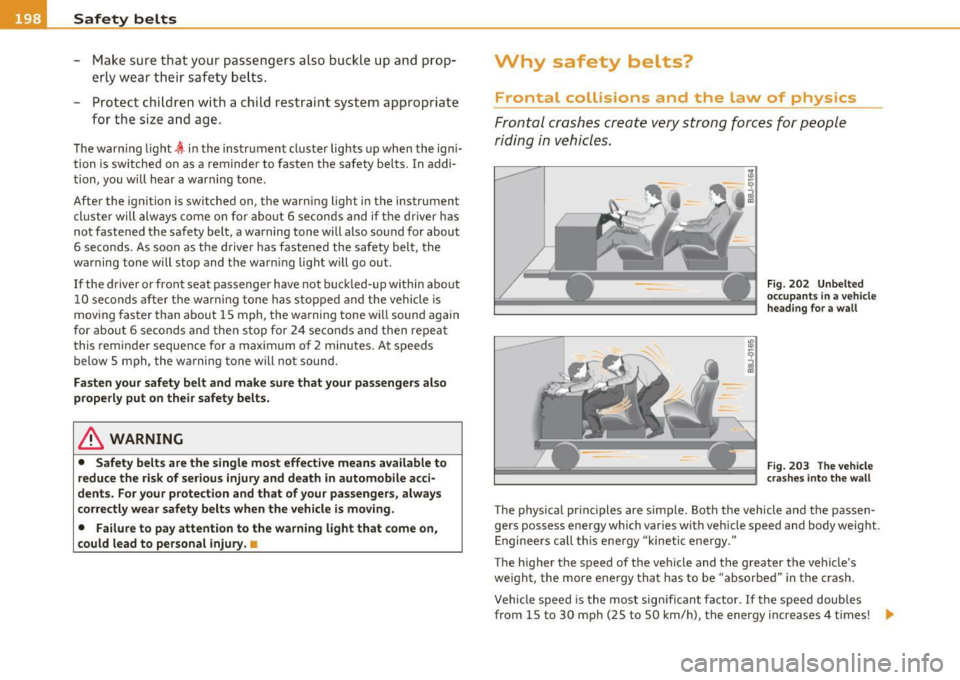
Frontal cr ashes cre ate very stron g forc es for people
riding i n vehi cles.
Fig . 202 Unbe lted
o ccupa nts in a vehicle
h eading f or a w all
Fig. 203 Th e vehicle
cr as hes int o t he wall
The p hys ica l pr inc iples are simple. Both the vehicle and the passen
gers possess energy which var ies wit h veh icle speed and body weight.
E nginee rs ca ll t his ene rgy "kinetic energy."
The higher the speed of the veh icle and t he greater the vehicle's
we ight, the more energy that has to be "abso rbed" in the crash .
Vehicle speed is the most sig nifican t fa ctor. If t he speed doubles
from 15 to 30 mph (25 to 50 km/h), the energy increases 4 times! .,
Page 266 of 384
![AUDI S8 2010 Service Manual Driving and environment
(I] Tip s
The consumption estimates as pub lished by ENV IRONMENTAL
PROTECTION AGENCY (EPA) and Transport Canada may not corre
spond to your actual consump](/img/6/57617/w960_57617-265.png "AUDI S8 2010 Service Manual Driving and environment
(I] Tip s
The consumption estimates as pub lished by ENV IRONMENTAL
PROTECTION AGENCY (EPA) and Transport Canada may not corre
spond to your actual consump")
Driving and environment
(I] Tip s
The consumption estimates as pub lished by ENV IRONMENTAL
PROTECTION AGENCY (EPA) and Transport Canada may not corre
spond to your actual consumption on the road, which will vary
depending upon vehicle load and speed, road and weather conditions,
trip length, etc. •
Drive smoothly and keep a lookout ahead
Vehicles use the most fuel when they are accelerating .
-Avo id unnecessary accelerating and braking.
Vehicles use the most fue l when they a re accele rating. If you antici
pate what is going to happen next, you will need to brake less and,
thus, accelerate less. Let the vehicle coast whenever possible -for
example when you see that the next traffic l ight is red. •
Avoid full throttle
Driving at moderate speeds saves fuel and improves your
mileage.
- Try and keep well below your car's maximum speed .
Accelerating gently reduces fuel consumption, engine wear, and does
not disturb the environment.
Fuel consumption, exhaust emissions and engine noise increase
disproportionately at high speeds . If you drive at approx imately three
qua rters of top speed, fuel consumption will be reduced by one half.
Never drive faster than the posted speed limit and weather condi
tions permit.
a Reducing unnecessary idling
Even when your car is just idling it burns up fuel.
-
Shut the engine off when yo u are not driving the vehicle.
- Do not warm up the vehic le by letting the eng ine run at
idle.
It makes sense to shut off the engine in traffic jams, when waiting for
trains to pass at rai lroad crossings, o r at traffic lights that have long
wa its on red . Turn ing the eng ine off for just 30-40 seconds saves
more fuel than is burned starting the engine again.
It takes a long t ime for the engine to warm up fully when it is running
at idle. Howeve r, wear and noxious emissions are espec ially high
when the eng ine is wa rm ing up. So you sho uld d rive away as soon as
you start the engine and avoid running at hig h rpms while the eng ine
is still warming up.
0 Note
Do not leave engine idling unattended after starting . If warning
lights should come on to indicate improper operation, they would go
unheeded. Extended idling also produces heat, which cou ld result in
overheat ing o r othe r damage to the vehicle or other p roperty. •
Regular maintenanc_e ____________ _
A badly tuned engine unnecessarily wastes a lot of fuel .
- Have your vehicle serviced at regular intervals .
By having yo ur vehicle regularly se rviced by an Audi dealer helps to
ensure that it runs properly and economically . T he condition of your
vehicle not only a ffects its safety and ability to ho ld its va lue, it a lso
affects
fu el con sumption .
Check your o il e ach tim e you fill you r tank.
~
Page 268 of 384
Trailer towing
"---------------------------------------------------
Trailer towing
Driving with a trailer
General information
Your Audi was designed primarily for passenger transpor
tation .
If you p lan to tow a t railer, p lease remember that the additional load
w ill affect durability, economy and performance.
Tr ailer towing not on ly p laces mo re s tress on the vehicle, it also calls
for more concentration from the driver.
For this reason, a lways follow the operating and dr iv ing inst ructions
prov ided and use common sense .
0 Note
If you are going to tow a trailer, you must activate the tra iler ope ra
tion mode =>
page 179, "Towing a Trailer".
Technical requirements
Trailer hitch
Use a we igh t-car rying h itch co nform ing to the gross tra iler we ig ht.
The h itch must be suitab le for your vehicle and trailer and must be
mou nted securely o n th e vehi cle's ch assi s at a
techni cally sound loc a
tion . Use only a trailer hitch with a removab le ball mount. Always
check wit h the t railer h itch manufactu rer to make sure that yo u are
using the correct h itch .
Do not use a bumper hitch.
The h itch mus t be installed in such a way t hat it does not in terfe re
w ith t he impact-absorb ing bumper system. No modifications shou ld be made to t
he veh icle exha ust and bra ke systems. From t ime to
time, check that a ll hitch mounting bo lts rema in securely fastened.
W hen you are no t tow in g a tra ile r, remove the t railer hit ch ball
mount. This prevents the hitc h from caus ing damage should your
vehicle be str uck from behind=>& .
Trailer brakes
If your trail er is e quipped w ith a b raking system, che ck to be s ure t hat
it conforms to all regulations.
T he tra ile r hydrau lic brake system m ust not be directly connected to
t he vehicle's hyd raulic b rake sys tem .
Safety chains
Always use safety chains between your veh icle and t he tra ile r.
Trailer lights
Trailer lights must meet all regulations. Be sure to check w ith your
Audi de aler fo r corr ec t wir ing , sw itches and re lays.
Mirrors
If you are unab le to see t he t raff ic be hind you using t he regular
outs ide mirrors, then you
must install extended mi rrors. It is impor
t an t th at yo u
always ha ve clear vi sion to the re ar.
& WARNING
After removing the trailer hitch, do not store it in your vehicle. In
case of sudden braking , the hitch could fly forward and inju re you
or your passengers. •
Page 269 of 384

Operating instructions
Maximum trailer weight
A trailer for your vehicle is limited to a typical class 1 or class 2 trailer.
Trailer load distribution
Be sure the load in the trailer is held securely in place to prevent it
from shifting forward, backward or sideways.
Never allow a passenger to ride in a trailer=>
& in "Driving instruc
tions".
Engine cooling system
Towing a trailer makes the engine work harder. It is important that
the cooling system's performance is up to the additional load. Make
sure that the cooling system has enough fluid.
Tire pressure
When towing a trailer, inflate the tires of your vehicle to the cold tire
pressure listed under "Full load" on the label located either on the
driver's side B -pillar (visible when the door is open) or inside the fuel
filler flap. Inflate trailer tires to trailer and tire manufacturers' spec
ifications .
Lights
The headlight settings should be checked with the trailer attached
before driving off. Check to make sure both vehicle and trailer lights
are working properly.
Safety chains
Be sure trailer safety chains are properly connected from the trailer
to the hitch on the vehicle. Leave enough slack in the chains to permit
turning corners . When you install safety chains, make sure they will
not drag on the road when you are driving.
The chains should cross under the trailer tongue to prevent it from
dropping in case of separation from the hitch .
Controls and equip ment Safety first Vehicle operation
Trailer
towingL_,1!:::!:·~-
0 Note
If you are going to tow a trailer, you must activate the trailer opera
tion mode =>
page 179, "Towing a Trailer". •
Driving instructions
Driving with a trailer always requires extra care and
consideration .
To obtain the best possible handling of vehicle and trailer,
please note the following:
- Do not tow a loaded trailer when your car itself is not
loaded.
- Be especially careful when passing other vehicles.
- Observe speed limits.
- Do not drive at the maximum permissible speed.
- Always apply brakes early .
- Monitor the temperature gauge.
Weight distribution
Towing a loaded trailer with an empty car results in a highly unstable
distribution of weight. If this cannot be avoided, drive at very low
speeds only to avoid the risk of losing steering control.
A "balanced" rig is easier to operate and control. This means that the
tow vehicle should be loaded to the extent possible and permissible,
while keeping the trailer as light as possible under the circumstances.
Whenever possible, transfer some cargo to the luggage compart
ment of the tow vehicle while observing tongue load requirements
and vehicle loading considerations.
Vehicle care Do-it-yourself service Technical data
Page 274 of 384
-Cleaning and protection pn,,._____ _ __,____ ____________ _
0 Note
• Never try to remove dirt, mud o r d ust if the s urface of the vehicle
is dry. Never use a dry cloth or sponge, s ince this could scratch your
veh icle's pai nt o r win dows.
• Never was h your car in bright sunlight . D rops of water act as
magnifyi ng lenses and may damage your p aint.
• When you was h yo ur car in the winter: if you rinse your vehicle w ith
a hose , be careful not to a im the stream of wate r d irect ly at locks, or
at doo r or hatch openings -they can freeze s hut.
• N ever use sponges des igned to remove insects, o r any kitchen
sco uring sponges or s imilar pro ducts. They can damage yo ur paint
fi ni sh.
• N ever use a dry cl oth o r sp on ge to clean t he he adlig hts. Only use
wet cloths or sponges to prevent scratches . It is best to use soapy
water .
• You shou ld remove debr is (s uch as insects) from the head light
lenses o n a regu lar b asis, for examp le w hen re fue ling your veh icle.
N ever clean the headlights w ith a dry clot h or sponge . Use a wet cloth
or sponge. It is best to use soapy water.
c£> For the sake of the environment
In the interest of the environment, the ve hicl e should on ly be washed
in spe cial wash bays .•
Washing your vehicle with a power washer
C le aning the exterior of y our car wit h a hi gh-pressur e
p ower washe r is s afe as long as you observe a few simple
r ul es .
- Before using t he power washer, make su re yo u have read
and und ers tood th e WARNI NGS =:::>
& in "General in for
mation" o n
page 270. -
Always fo llow t he operat ing inst ructio ns for the power
washer .
- Make su re that t he jet o n th e sp ray hose produces a "fan
s ha ped spr ay".
- Do
not hold the spray nozz le too close to soft ma terials.
W hen cleaning the vehicle with a power washer always fo llow the
operat ing in str uctio ns. T his appli es p art icu larly to t he
operating
pressure
and the spraying distance . Maintain a suffic ient distance to
so ft ma ter ia ls s uch as rubbe r hoses an d so und/v ibration deaden ing
materials (part icular ly on the unde rside o f the engine hood) . Do not
use a jet wh ich sprays water in a
direct stream o r o ne that has a
rotating jet .
Water temperature sho uld not exceed 140
°F (60 °().
& WARNING
Never wash tires with a jet that sprays water in a direct stream .
This could cau se invisible damage to the tires and weaken them,
even if the spray i s from a relatively long distance and for a short
time . Damaged and weakened tires can fail and cause accidents
and personal injury.
0 Note
To avoid damaging your vehicle, always ma ke su re that there is suffi
cien t dista nce between the spr ay head and sof t mate ria ls like r ubber
hoses, p lastic parts and sound-deadening mater ials. Never aim the
spr ay he ad at the s ame po int for a long t ime . This also ap plies to
cleaning headlights and pai nted b umpe rs. Remember : the close r the
noz zle is to the surfa ce of the mate rial, t he greate r the stress on the
material. •
Page 295 of 384

___________________________________________ C_ h_e _c _k_ i_n ~g_ a_n_ d_ f_ i_ll _i_n _g __ _
the form of Serv ice or Repair O rde rs that all scheduled ma inte nance
w as perfo rm ed in a t im ely mann er.•
Engine oil consumption
Th e e ngin e in your v ehi cle dep ends on an ad equate
amount of oil to lubricate and cool a ll of its movin g parts.
In order to p rovide e ffect ive lubric ation and cooling of inter na l
eng ine components, all internal combust ion eng ines consume a
c ert ain a mo unt o f oil. Oil co nsump tion va ries from e ngine to eng ine
and may change sign ifican tly over the li fe of the engine . Typically,
eng ines w ith a sp ecifie d brea k-in period (s ee =>
page 261) co nsum e
more o il dur ing the break -in period t han they cons ume a fter oil
cons umption has stabilize d.
Under norm al cond itions, th e ra t e of oil con su mp tio n depe nds on t he
quality and v iscosi ty of the oil, the RPM ( revolutions pe r minute) at
w hich the engi ne i s op erate d, the ambie nt te m pe ratu re and r oad
conditions. Further factors are the amount of oi l di lution from water
co ndens ation or f uel re sidue and th e oxid ation level of the oil. As any
eng ine is s ubject to wear as mileage builds up, the oil consumption
may increase over time until replacemen t of wo rn components may
become necessa ry .
With all these varia bles comin g into play, no stan dar d rate of oil
co nsum ption can be establis hed o r spe cified. Th ere is no alte rnative
to regular and frequent chec kin g of the o il level, see
Note .
If the yellow e ngine oil leve l w arning symbol in the ins trumen t
cl uster · .. lights up, yo u should chec k the o il lev el as soon as possible
with the oil dipstick=> page 293 . Top off the oil at yo ur earliest
conveni ence=>
pag e 294 .
& WARNING
Before you check anything in the engine compartment , always
read and heed all WARNINGS=>
& in "Working in the engine
compartment " on
page 289.
Safety first
0 Note
Driv ing with an in sufficie nt o il level is like ly to c ause severe d amage
to the engine .
[ i ] Tips
• The oil pressure warn ing display 'e.::1; is not an indicator of the oil
level. Do not rely on it . Instead, check the oil level in your engine at
regular intervals, preferably each time you refuel, and always
before going on a long trip .
• If you have the impression your eng ine consumes excessive
am ounts of o il, we recom mend that you cons ult your Audi dea le r to
have the cause of your concern properly d iagnosed. Keep i n m ind that
t he accurate meas urement of oil co nsum ption re quires great care
and may take some t ime. Your Audi dealer has instruct io ns about how
t o meas ure o il cons umption a ccu ra tely .•
Checking the engine oil Level
Vehicle care
Fig . 24 3 Illustration
o f principle 1 : M arker s
on oil dipstick ...
Technical data
Page 303 of 384

_____________________________________________ C_h _ e_ c_ k_in --= g'-- a_n _d_ f_i _ll _i_n -=g ::;__ ____.fflll
a service facility . The electrolyte level should also be checked each
time the battery is charged =>
page 303.
Have the batte ry checked when you take your vehicle in for serv ice .
You are well advised to rep lace a battery that is older than 5 years.
With certa in types of a irbag deployment, the ba ttery is disconnected
from the vehicle electrical system for safety reasons=>
& in "Repair,
care and disposal of the airbags" on
page 220.
Di sconne cting th e bat tery t ermina ls
Some vehicle f unct ions (power window regulators, fo r example) are
lost if the battery termina ls are disconnected . These functions have
to be re learned after the battery termina ls are connected aga in. To
prevent this, t he battery should only be disconnected from the
vehicle e lectr ica l system when absol ute ly necessary for repairs.
Vehicles not driven for long periods
If you do no t dr ive your veh icle over a period of severa l days or weeks,
electrical components are gradually cut back or switched off. Th is
red uces e nergy consumption and main tains sta rt ing capabili ty ove r a
longer period=>
page 258.
Be aware that when you unlock your vehicle, some of the convenience
functions may not operate, such as the Convenience key*, the remote
control or the power seat adjustment. The convenience functions will
be availab le aga in whe n you tur n on th e ignition and start the eng ine.
Winter operation
Dur ing the winter months, battery capac ity tends to decrease as
temperatures drop. This is because more power is also consumed
while starting, and the headlights, rear w indow defogger, etc., a re
used more often.
Avoid unnecessa ry power consum ption, part ic ula rly i n city traffic o r
when traveling only short distances. Let your authorized Audi dealer check the capacity of the vehicle battery before w inter sets in
=>
page 303 . A well charged battery will not only prevent start ing
prob lems when the wea ther is cold, but will also las t longe r.
Vehicle OP-eration
(I) Tips
If your vehicle is left standing fo r seve ral weeks at extremely low
temperatures, the vehicle battery should be removed and stored
w here it will not free ze. This will preven t it from being damaged and
having to be replaced. •
Working on the battery
Be especially careful when working on or near the
battery.
Vehicle care
Fi g. 2 49 Lugga ge
co mp artme nt: Righ t·
s ide stor age co mpar t·
me nt
Fig. 25 0 Lug gage
comp art me nt: Batt ery ~
Do-it-yourselt service iTechnical data
Page 305 of 384

___________________________________________ C_ h_e _c _k_ i_n ~g_ a_n_ d_ f_ i_ll _i_n _g __ _
& WARNING (co ntinued )
just going to replace a light bulb , then it is enough to switch off
the lights .
• Before disconnecting the battery , switch off the anti-theft
alarm system! Otherwise you will set off the alarm.
• When disconne cting the battery, first disconnect the negat ive
cable and then the po sitive cable.
• Before reconnecting the b attery, make sure all electrical
consumer s are sw itched off. Reconnect the positiv e cable fir st and
then the negative cable . Never inte rchange the cables -this could
start a fire!
• Never charge a frozen or a thawed-out battery.
It could
explode! If a battery has frozen, then it must be replaced . A
di scharged batter y can freeze over at 32 °F (0 °C ).
• Make sure the vent hose is always attached to the opening on
the side of the battery .
• Never use batteries which are damaged. There is the danger of
an explosion! Alway s replace a damaged battery.
& WARNING
California Proposition 65 Warning:
• Battery posts , terminal s and related accessories contain lead
and lead compounds, chemicals known to the State of California
to cause cancer and reproductive problems. Wash hands after
handling.
0 Note
• Do not disconnec t the vehicle batte ry when t he ignit ion is
switched on o r when the engine is running, otherwise, you will
d amage e le ctro nic c ompone nts in t he ele ctrica l sys tem.
Safety first
• If your ve hicle is go ing to sta nd for a long per iod of time w it h out
bein g driven, protec t th e battery fro m "freezi ng", o therw ise i t wi ll be
damaged and will then have to be replaced .•
Battery charging
Sta rting t he e ng in e req uires a well c harged battery.
Always read and heed all WARNINGS b elo w =:> & and=:> &
i n "W orki ng on t he batt ery" o n
page 3 01.
- Turn off th e igni tio n and all electr ica l co nsum ers.
- Make su re the area is well vent ilated w hen you charge the
batte ry .
- Attach the red (posi tive
(B) c la m p of the charging equip
me nt to the posit ive te rmin al o f th e bat tery and t he b lac k
( n eg at ive(:)) clam p to t he jumper term inal.
- Only now plug t he m ain s lead for the c harg ing e quip ment
i n to t he wa ll outlet a nd tu rn it on=:> &.
- Make sure the charging rate is not over 30 amps/14.8
Volt.
- When the b attery is fully c harg ed: Turn t he ch arging
equ ip m ent off and remo ve t he mains l ead fr om the wall
ou tlet.
- Now remove the clamp s for the cha rging eq uipment .
A discharged ba ttery can freeze a t temperat ures of on ly O 0C. Allow a
frozen batte ry to thaw comp letely before attempting to charge it
=> & . However, we recomme nd not usin g a thawed battery aga in
because the battery casing can be cracke d due to ice formation and
c a n l eak battery a cid. .,._
Vehicle care Technical data
Page 349 of 384

_______________________________________________ F_u _s_ e_ s_ a_ n_ d_ b_u _ l_ b _ s __ lllll
erly put back together to he lp prevent breakage of parts and long
t erm d am ag e fro m wat er th at can enter housin gs th at h ave not been
properly resealed.
For your safety, we recommend that you have your a uthorized Audi
de aler repla ce a ny bu lbs for you, s ince your deale r has the prope r
too ls, t he correct bu lbs and t he expertise.
Ga s discharge lamp s (Xenon lights) :
Due to the high electrical voltage, have the bulbs replaced by a qual
ifie d technician. Headlig hts with Xe non light can be identified by the
hig h volt age sticker.
& WARNING
Contact with high-voltage components of the electrical system
and improper replacement of gas discharge (Xenon ) headlight
bulbs can cause serious personal injury and death .
• Xenon bulb s are pres surized and can explode when being
changed.
• Changing Xenon lamp s requires the special training, instruc
tions and equipment .
• Only an authorized Audi dealer or other qualified workshop
should change the bulbs in gas discharge lamps .
& WARNING
There are parts with sharp edges on the openings and on the bulb
holders that can cause serious cuts .
• If you are uncertain about what to do , have the work
performed by an authorized Audi dealer or other qualified work
shop. Serious personal injury may result from improperly
performed work.
Safety first
(I] Tips
• If you mus t repl ace the light bulbs yourse lf , a lways remember
that the eng ine compartme nt of any vehicle is a hazar do us area to
work in. Always read and hee d all WA RNING S=>
page 281, "E ngi ne
compartment" =>& .
• It is bes t to ask yo ur author ized Audi dealer wheneve r yo u need to
change a bulb.•
Vehicle care Do-it-yourself service Technical data