seats AUDI S8 2010 Workshop Manual
[x] Cancel search | Manufacturer: AUDI, Model Year: 2010, Model line: S8, Model: AUDI S8 2010Pages: 384, PDF Size: 90.95 MB
Page 222 of 384
........ _A_ i_rb _ a_,g,:;._ s_, y'- s_ t_e _m ________________________________________________ _
& WARNING (conti nued)
position and have the airbag system inspected by your Audi
deal er.
• A tight tether or othe r strap on a rearward-facing child
restraint attached to the front passenger seat can put too much
pressure on the weight-sensing mat in the seat and register more
weight than i s actually on the seat. The heav ier weight registered
can make the system work as though an adult were on the seat
and deploy the Advanced Airbag when it must be suppressed
causing serious or even fatal injury to the child .
• If, in ex ceptional circumstances, you must install a forward·
facing child restraint on the front passenger seat, always move
the seat into i ts rearmo st po sition in the seat's fore and aft adjust ·
ment range, as far away from the airbag as possible . The backrest
must be adjusted to an upright position. Make sure that the
PASSENGER AIR BAG OFF light comes on and stays on all the time
whenever the ignition is switched on.
& WARNING
• If the PASSENGER AIR BAG OFF light do es not go out when an
adult is sitting on the front passenger seat after taking the steps
de scribed above, make sure the adult i s properly seated and
restrained at one of the rear seating positions.
• Have the airbag system inspected by your Audi dealer before
transporting anyone on the front passenger seat .
[ i ] Tips
If the we ight-sens ing mat in the front passenger seat detects an
empty seat, the front a irbag on the passenger side w ill be t urne d off,
and the PASSENGER
AIR BAG OFF light w ill stay on .•
Repair, care and disposal of the airbags
Parts o f the a irbag system are installed at many different p laces on
your Audi. Install ing, remov ing, servic ing or repa iring a part in an
area of the ve hicle can damage a part of an airbag system and preve nt
t ha t system from working pro perl y in a coll is ion.
T here are some important thi ngs you have to know to make sure that
the effectiveness of the system will not be impa ired and that
discarded components do no t cause injury or poll ute the enviro n
ment .
& WARNING
Improper care , servicing and repair procedures can increase the
risk of personal injury and death by preventing an airbag from
deploying when needed or deploying an airbag unexpectedly:
• Never cover, obstruct , or change the steering wheel horn pad or
airbag cover or the instrument panel or modify them in any way.
• Never attach any objects such as cup holders or telephone
mountings to the surfaces covering the airbag unit s.
• For cleaning the horn pad or instrument panel, use only a soft,
dry cloth or one moistened with plain water. Solvent s or cleaners
could damage the airbag cover or change the stiffness or strength
of the material so that the airbag cannot deploy and protect prop·
erly .
• Never repair, adjust, or change any part s of the airbag system .
• All work on the steering wheel, instrument panel , front seats
or electrical sy stem (including the installation of audio equip·
ment , cellular telephones and CB radios, etc .) must be performed
by a qualified technician who ha s the training and special equip ·
ment necessary .
• For any work on the airbag system, we strongly re commend
that you see your autho rized Audi dealer o r qualified workshop.
• Never modify the front bumper or parts of the vehicle body.
liJ,,
Page 233 of 384

Child Safety -
-------------------"'---
Child Safety
Important things to know
Introduction
The rear seat is generally the safest place in a collision.
The physical pr in ci ples o f wha t happens w hen yo ur vehicl e is in a crash
app ly a lso to children=>
page 199, "What happens to occupants not
wearing safety be lts?". But unlik e adu lts and teenagers, the ir
muscles and bones are not fully developed. In many respects c hildren
are at greate r risk of ser io us injury in cras hes than adults .
Because children 's bodies a re not f ully deve loped, they require
restraint systems especially designed fo r their size, weight, and body
st ruct ure. Many cou ntries and all states of t he Unite d States and
prov inces of Canada have laws req uiring the use of approved ch ild
restrain t sys tems for infan ts an d sm all ch ild ren .
I n a fronta l crash at a speed of 20 -35 mph (30-56 km/h) the forces
act ing o n a 13- pound (6 kg) infant w ill be more than 20 times the
we ight of the ch ild . This means the we ight of the child wo uld
suddenly be more than 260 po unds (120 kg). Unde r these conditions,
only a n app ropr iat e child restra int proper ly used can red uce the risk
of serious injury. Child restraints, like adult sa fety be lts, must be used
pro perl y to be effective. Use d imprope rly, they can i ncrease t he ris k
of serious injury in an accident.
C onsult the ch ild safety seat manufacturer's i nstr uctions to be s ure
t he seat is right for your child's size
=> page 234, "Importa nt safety
instructions for using ch ild safety seats" . P lease be sure to read and
heed all of the impo rtant informat io n and WAR NIN GS about child
safety, Advanced Airbags, and the insta llation of ch ild rest raints in
t his chapte r.
There is a lot you need to know about the Advanced Airbags in your
vehicle and how t hey wo rk when inf ants and childre n in child
restra ints are on the front passenger seat. Beca use of t he large
Controls and equip
ment Safety first Vehicle operation
amou
nt of importa nt info rmation, we cannot repeat i t all he re. We
urge you to read the detailed information in th is owne r's man ua l
abou t airbags and t he Advanced A irbag System in your vehicle and the
very important information abo ut transporting c hildren on the front
p assenger se at. P lea se be sure to heed the WARNIN GS - they a re
extremely important for your safety and the safety of your passe n
gers, especially infan ts and small ch il dre n.
& WARNING
• Accid ent statisti cs have shown that children are generally safer
in the rear seat area than in the front seating position. Always
re strain any child age 12 and under in the rear.
• All vehicle occupants and especially children must be
restrained properly when ever riding in a vehicle. An unre strained
or improperly restrained child could be injured by striking the
interior or by being ejected from the vehicle during a sudden
maneuver or impact. An unrestrained or improperly rest rained
child is also at greater risk of injury or death through contact with
an inflat ing airbag .
• A suitable child restraint properly installed and used at one of
the rear seating posi tions provides the highest degree of protec
tion for infants and small children in most accident situations.
& WARNING
Children on the front seat of any car even with Advanced Airbags
can be seriously injured or even killed when an airbag inflates. A
c hild in a rearward -facing child safety seat ins talled on the front
passenger seat will be seriously injured and can be killed if the
front airbag inflate s.
• The inflating airbag will hit the child safety seat or infant
c arrier with great force and will sma sh the child safety seat and
child against the backrest, center armrest, or door . •
Vehicle care Do-it-yourself service Technical data
Page 236 of 384
ffl,___C_ h_ il_d _ S_a _ f_ e _ t-= y ;....._ ____________________________________________ _
C. Forward-facing convertible child restraint
systems, manufactured on or after September 1,
2004:
• Britax Roundabout 161
• Century Encore 4612
• Century STE 1000 4416
• Cosco Olympian 02803
• Cosco Touriva 02519
• Evenflo Horizon V 425
• Evenflo Medallion 254
• Safety First Comfort Ride 22-400
& WARNING
To reduce the risk of serious injury, make sure that the
PASSENGER AIR BAG OFF light comes on and stays on whenever a
child restraint is installed on the front passenger seat and the ignition is switched on.
• Take the child restraint off the front passenger seat and install
it properly at one of the rear seat positions if the PASSENGER AIR BAG OFF light does not stay on.
• Have the airbag system inspected by your authorized Audi
dealer immediately.
W Tips
The child seats listed in categories A to C have been tested by Audi
only for the Advanced Airbag function. •
Important safety instructions for using
child safety seats
Correct use of child safety seats substantially reduces the
risk of injury in an accident!
As the driver, you are responsible for the safety of everybody
in the vehicle, especially children:
Always use the right child safety seat for each child and
always use it properly~
page 236.
-Always carefully follow the child safety seat manufac
turer's instructions on how to route the safety belt prop
erly through the child safety seat.
- When using the vehicle safety belt to install a child safety
seat, you must first activate the convertible locking retractor on the safety belt to prevent the child safety seat
from moving ~
page 241.
-Push the child safety seat down with your full weight to
get the safety belt really tight so that the seat cannot
move forward or sideways more than one inch (2.5 cm).
- If a strap or tether is being used to tie the child safety seat
to the front passenger seat, make sure that it is not so
tight that it causes the weight-sensing mat to measure more weight than is actually on the seat.
Always remember: Even though your vehicle is equipped with an
Advanced Airbag system, all children, especially those 12 years and
younger, should always ride in the back seat properly restrained for
their age and size . _,,
Page 237 of 384

_____________________________________________ C _h_i_ld _ S_ a_ f_ e_ t__. y'--- __
& WARNING
Not using a child safety seat, using the wrong child safety seat or
improperly installing a child restraint increases the risk of serious
personal injury and death.
• All vehicle occupants and especially children must always be
restrained properly whenever riding in a vehicle.
- An unrestrained or improperly restrained child can be injured or killed by being thrown against the inside of the
vehicle or by being ejected from it during a sudden maneuver or impact.
- An unrestrained or improperly restrained child is at much greater risk of injury or death by being struck by an inflating
airbag.
• Commercially available child safety seats are required to
comply with U.S. Federal Motor Vehicle Safety Standard (FMVSS)
213 (in Canada CMVSS 213).
- When buying a child restraint, select one that fits your child and the vehicle.
- Only use child restraint systems that fully contact the flat portion of the seat cushion. The child restraint must not tip or
lean to either side. Audi does not recommend using child
safety seats that rest on legs or tube-like frames. They do not
provide adequate contact with the seat.
- Always heed all legal requirements pertaining to the instal
lation and use of child safety seats and carefully follow the
instructions provided by the manufacturer of the seat you are
using.
• Never allow children under S7 inches (1.5 meters) to wear a
normal safety belt. They must always be restrained by a proper
child restraint system. Otherwise, they could sustain injuries to
the abdomen and neck areas during sudden braking maneuvers or
accidents.
• Never let more than one child occupy a child safety seat.
Controls and equip ment Safety first Vehicle operation
& WARNING
(continued)
• Never let babies or older children ride in a vehicle while sitting
on the lap of another passenger.
-Holding a child in your arms is never a substitute for a child
restraint system.
- The strongest person could not hold the child with the forces
that exist in an accident. The child will strike the interior of the
vehicle and can also be struck by the passenger.
- The child and the passenger can also injure each another in
an accident.
• Never install rear-facing child safety seats or infant carriers on
the front passenger seat . A child will be seriously injured and can
be killed when the passenger airbag inflates - even with an
Advanced Airbag System.
• The inflating airbag will hit the child safety seat or infant
carrier with great force and will smash the child safety seat and
child against the backrest, center armrest, door or roof.
• Always install rear-facing child safety seats or infant carriers
on the rear seat.
• Forward-facing child safety seats installed on the front
passenger's seat can interfere with the airbag when it inflates and
cause serious injury to the child. Always install forward-facing
child safety seats on the rear seat.
• If exceptional circumstances require the use of a forward
facing child restraint on the front passenger's seat, the child's
safety and well -being require that the following special precau
tions be taken:
- Make sure the forward-facing seat has been designed and certified by its manufacturer for use on a front seat with a
passenger front and side airbag.
- Always carefully follow the manufacturer's instructions
provided with the child safety seat or carrier.
Vehicle care Do-it-yourself service Technical data
Page 238 of 384
Ill Child Safety __ .,.___ ____________ _
& WARNING (continued )
-Always move the front passenger seat into the rearmost
position of the passenger seat's fore and aft adjustment range,
and as far away from the airbag as possible before installing
the child restraint.
- Always make sure that nothing prevents the front
pas senger' s seat from being moved to the rearmost position in
its fore and aft adjustment range.
- Always make sure that the backrest i s in the upright pos i
tion.
• Always buckle the child safety seat firmly in place even if a
child i s not sitting in it. A loo se child safety seat can fly around
during a sudden stop or in a collision .
• Always read and heed all WARNINGS whenever using a child
restrained in a vehicle is being used=>
page 197, "Safety belts",
=>
page 206 , "Airbag system " and => page 231, "Child Safety ".
& WARNING
To reduce the risk of seriou s injury, make sure that the
PASSENGER AIR BAG OFF light comes on and stays on whenever a
child restraint is installed on the front passenger seat and the
ign ition is switched on.
• Take the child re straint off the front pa ssenger seat and install
it prope rly at one of the rear seat positions if the PASSENGER AIR
BAG OFF light does not stay on.
• Have the airbag system inspected by your authorized Audi
dealer immediately .
& WARNING
A child in a child restraint installed with the LATCH lower anchor
ages or with the standard safety belt on the rear seat may play
& WARNING (cont inued )
with unused rear seat safety belts and become entangled
re sulting in serious personal injury and even death.
• Always buc kle unused rear se at safety belts out of reach of chil
dren in child seats and p roperly activate the convertible locking
retractor so that the child cannot unreel the safety belt from the
retractor. •
Child safety seats
Infant seats
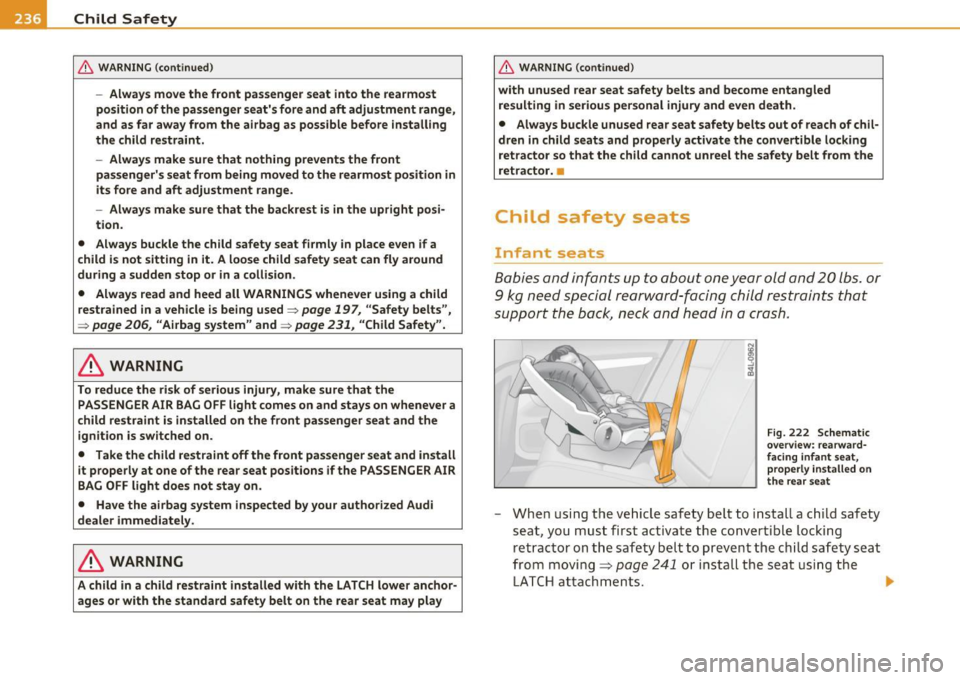
Babi es an d infants up to about one year old and 20 lbs. or
9 k g n eed sp ecial r earward -facing child res traints tha t
suppor t the back, neck and head in a cras h.
Fig. 222 Schemati c
ove rview : re arwa rd
facing infan t seat ,
prope rly installed o n
t he rear s eat
- W hen usi ng the ve hicle safety bel t to i nstall a c hild safety
seat, you must first activa te the co nvert ible locki ng
ret ractor on the safety belt to preven t the child sa fety seat
fro m mo ving=>
page 241 or install the seat usi ng the
L ATCH attach ments. ..,_
Page 239 of 384

-Push the child safety seat down with your full weight to
get the safety belt really tight so that the seat cannot
move forward or sideways more than one inch (2.5 cm).
Infants up to about one year (20 lbs. or 9 kg) are best protected in
special infant carriers and chi ld safety seats designed for t heir age
group. Many experts believe that infants and small childr en should
r ide only in spec ia l restra ints in w hich the child faces the back of the
vehicle. These infant seats support the baby's back, neck and head in
a crash=> fig. 222.
The airbag on the passenger side makes the front seat a potentially
dangerous place for a child to ride. The front seat is not the safest
place for a ch ild in a forward-facing child seat.
It is a very dangerous
place for an infant or a large r child in a rear ward-fac ing seat.
& WARNING
Not using a child safety seat, using the wrong child safety seat or
improperly installing a child restraint increases the risk of serious
personal injury and death in a crash.
• Never install rear-facing child safety seats or infant carriers on
the front passenger seat· even with an Advanced Airbag System.
A child will be seriously injured and can be killed when the
inflating airbag hits the child safety seat or infant carrier with
great force and smashes the child safety seat and child against the
backrest, center armrest, door or roof=>
page 208, "Child
restraints on the front seat -some important things to know".
• Always install rear-facing child safety seats or infant carriers
on the rear seat.
• Never install a rear-facing child rest raint in the forward-facing
direction. Such restraints are designed for the special needs of
infants and very small children and cannot protect them properly
if the seat is forward-facing.
• If you must install a rearward facing child safety seat on the
front passenger seat because of exceptional circumstances and
the PASSENGER AIR BAG
OFF light does not come on and stay on,
Safety
first Vehicle OP-eration
Child Safety
& WARNING (continued)
immediately install the rear-facing child safety seat in a rear
seating position and have the airbag system inspected by your
Audi dealer.
• Always read and heed all WARNINGS whenever using a child
restrained in a vehicle is being used=>
page 197, "Safety belts",
=>
page 206, "Airbag system" and => page 231, "Important
things to know ".•
Convertible child safety seat:s
Properly used convertible child safety seats can help
protect toddlers and children over age one who weigh
b etween 20 and 40 lbs. (9 and 18 kg) in a crash.
Vehicle care
Fig . 223 Schematic
overview: installation
of the attachments
applicable to a LATCH
seat
ti,
Do-it-yourselt service iTechnical data
Page 241 of 384

& WARNING (continued)
• Make sure the forward-facing seat has been designed and certi·
fied by its manufacturer for use
on a front seat with a passenger
front and side airbag.
• Always follow the manufacturer's instructions provided with
the child safety seat or infant carrier.
• Always move the front passenger seat into the rearmost posi
tion of the passenger seat's fore and aft adjustment range, and as
far away from the airbag as possible before installing the child
restraint.
• Always make sure that nothing prevents the front passenger's
seat from being moved to the rearmost position in its fore and aft
adjustment range.
• Always make sure the backrest is in an
upright position.
• Make sure that the PASSENGER AIR BAG
OFF light comes on
and stays on all the time whenever the ignition is switched
on.
• If the light does not stay on, perform the checks => page 217,
"Monitoring the Advanced Airbag System".
• Take the child restraint off the front passenger seat and install
it properly at one of the rear seat positions if the PASSENGER AIR
BAG
OFF light does not stay on whenever the ignition is switched
on. a
Safety first Vehicle OP-eration
Child Safety
Booster seats and safety belts
Properly used booster seats can help protect children
weighing between about 40 lbs. and 80 lbs. (18 kg and
36 kg) who are less than 4 ft.
9 in.
(57 inches/1.45 meters) tall .
Fig. 225 Rear seat:
child properly
restrained in a booster
seat
The vehicle's safety belts alone will not fit most children until
they are at least 4 ft. 9 in. (57 inches/1.45 meters) tall and
weigh about 80 lbs. (36 kg). Booster seats raise these chil
dren up so that the safety belt will pass properly over the
stronger parts of their bodies and the safety belt can help
protect them in a crash.
- Do not use the convertible locking retractor when using
the vehicle's safety belt to restrain a child on a booster
seat.
- Always position the shoulder portion of the safety belt
midway over the child's shoulder. If you must transport an
older child in a booster seat on the front passenger seat,
you can use the safety belt height adjustment to help
adjust the shoulder portion prop erly.
- Always make sure that the shoulder portion of the safety
belt never rests against or across the child's neck.
9'>
Vehicle care Do-it-yourselt service iTechnical data
Page 242 of 384
• .___C_ h_ il_d _ S_a _ f_ e _ t--= y '------------------------------------------------
- A lways make sure that the chi ld can properly wear the lap
po rtio n of the belt low across t he th ig hs o r pelvis a nd
never over the stomach o r abdome n.
Ch ild ren up t o at le ast 8 years old (over 40 lbs or 18 kg) are best
protected in child safety seats des igned for their age and we ight.
Expe rts say t hat the ske letal structure, par tic ul arly the pelvis, of
these ch ildren is not fully developed , a nd they must not use the
vehicle safety belts w it h out a suitable c hild rest raint .
It is usually best to pu t these ch ildren in app ropria te booster seats.
Be sure the booster seat meets all appl icable safety standards.
Booste r seats r aise the se ating posi tion of the child and reposi tion
both the lap and sho ulder parts of the safety belt so t hat they pass
across the c hild 's body i n the rig ht places . The ro uting of the be lt ove r
t he c hild 's body is ve ry i mp ort an t fo r th e ch ild's p rot ection, wh eth er
or not a booster seat is used . Children age 1 2 and under m ust a lways
r ide in t he re a r se at.
Chi ldren who are at least 4 ft . 9 in . (57 inc hes/1. 45 meters) tall can
gene rally use t he ve hicl e's th ree poi nt la p and sho uld er bel ts. N ever
use t he lap belt port ion of the vehicle 's safety belt alone to restra in
a ny chi ld , re gar dless o f how big t he ch ild i s. Always remem ber that
childr en do no t have the pronounced pelvic s tru ctur e required for the
pr op er f unc tion of lap belt port io n of the vehi cle's t hree poin t lap and
shoulder b elts. Th e chi ld's saf ety absolu tely r equir es tha t a lap belt
portion of the safety be lt be fastened snugly and as low as possible
arou nd the pelvis . Ne ver l et t he lap bel t port ion of the safety b elt
pass over the child's stomach o r abdome n.
I n a cra sh, air bag s must inflat e withi n a bli nk of an eye a nd wi th
cons iderable fo rce . In o rder to do its job, the airbag needs room to
in flat e so t hat it will b e the re to p rotect th e occupa nt a s th e occu pan t
mov es forward into t he a irbag .
A vehi cle occ upant who is out of position and too close to the a irba g
ge ts in the w ay of an inf latin g air bag . Whe n an o ccup ant is too clos e,
he or s he will be struck violently and will rece ive s erio us or poss ibly
eve n fata l in jury. I
n order for the airbag to offe r protect ion, it is impo rta nt t hat all
ve hicle occupant s, especiall y any childr en , wh o must b e in t he front
sea t beca use of exc eptiona l circu mstances, be pro per ly r estra ined
and as far away from t he a irba g as possib le . By keep ing room
b etween t he child's body and the front o f the passenger co mpart
ment , th e a irba g can inflate completely an d prov ide sup plemental
pr ote ction in ce rt ain fro ntal coll isions.
& WARNING
Not using a booster seat, using the booster seat improperly, incor
rectly installing a booster seat or using the vehicle safety belt
improperly increases the risk of serious personal injury and death
in a collision or other emergency situation. To help reduce the risk
of seriou s personal injury and/or death:
• Always make sure to position the shoulder portion of the three
point belt over the middle of child 's shoulder.
• Never let the shoulder portion of the belt rest against or acros s
the neck, face, chin, or throat of the child.
• Always make sure the lap belt portion of the three-point belt is
worn snug and passes as low as possible across the child's pelvis.
Never let the belt pass over the soft abdomen.
• Failure to properly route safety belts over a child's body will
cause severe injuries in an accident or other emergency situation
~ page 197 .
• Children on the front seat of any car, even with Advanced
Airbags, can be seriously injured or even killed when an airbag
inflates.
• Never let a child stand or kneel on any seat, for example the
front seat.
• Never let a child ride in the cargo area of your vehicle .
• Always remember that a child leaning forward, sitting side
ways or out of position in any way during an accident can be struck
by a deploying airbag. This will result in serious personal injury or
death.
~
Page 243 of 384

_______________________________________________ C_ h_ il_d _ S_a _ f_ e _ t..,. Y :...._ __
& WA RNING (c on tinued )
• If you mu st install a booster seat on the front pa ssenger seat
becau se of exceptional circumstance s the PASSENGER AIR BAG
OFF light must come on and stay on , whenever the ignition is
switched on.
• If the PASSENGER AIR BAG OFF light does not come on and
stay on, perform the checks described=>
page 217, "Monitoring
the Advanced Airbag System ".
• Take the child re straint off the front pa ssenger seat and install
it p roperly at one of the rear seat positions if the PASSENGER AIR
BAG OFF light does not stay on whenever the ign ition i s switched
on.
• Always read and heed all WARNINGS whenever using a child
restrained in a vehicle i s being used=>
page 197, "Safety belts",
=> page 206, "Airbag sy stem " and => page 231, "Important
things to know ".•
Installing a child safety seat
Securing a child safety seat using a safety
belt
S af ety b elts f or the re ar seats and th e fr on t passen ger
can be lock ed wit h the converti ble locking ret ract or to
properly secu re child safety seats.
The safety be lts emergency lo ck ing re trac tors for the rear seats
safety belts and for the front passenge r's seat safety belt have a
convertib le locking retractor for child rest raints . The safety be lt must
be locked so that belt webbing canno t un reel. The retractor can be
activated to lock the safety be lt and prevent the safety belt webbing
from loose ning up during normal dr iv ing. A child saf ety sea t can only
be properly insta lled when the safety belt is locked so that t he chi ld
and child s afety seat will stay in pla ce.
Controls and equip
ment Safety first Vehicle operation
Always remember:
Even though yo ur vehicle is equipped w ith a n
Adv anced Air bag system, all ch ild ren, espe cially those 12 ye ars and
younger, should always ride in the back seat properly restra ined for
their age and size.
& WARNING
Improperly installed child safety seats increase the risk of seriou s
personal injury and death in a collis ion.
• Alway s make sure that the safety belt retractor is locked when
installing a child safety seat . An unlocked safety belt retractor
c annot hold the child safety seat in place during normal driving or
in a crash .
• Always bu ckle the child safety seat firmly in pla ce even if a
child is not sitting in it. A loose child safety seat can fly around
during a sudden stop or in a colli sion .
• Always make sure that the rear seat backrest to which the
center rear safety belt is attached is securely latched whenever the
rear cente r safety belt is being used to secure a child restraint.
• If the backrest is not securely latched, the child and the child
restraint will be thrown forward together w ith the backrest and
will strike part s of the vehicle interior. The child can be seriou sly
injured or killed .
• Never install rear-facing child safety seat s or infant carriers on
the front passenger seat . A child w ill be seriously injured and can
be killed when the pa ssenger airbag inflates.
• The inflating airbag will hit the child safety seat or infant
carrier with great force and will smash the child safety seat and
child against the backrest, center armrest, door or roof.
• Always install rear-facing child safety seats or infant carriers
on the rear seat .
• Forward-facing child safety seats or infant carriers installed on
the front pas senger' s seat may interfere with the deployment of
the airbag and cause ser iou s injury to the child. .,
Vehicle care Do-it-yourself service Technical data
Page 246 of 384
lffll.___C_ h_ il_d _ S_a _ f_ e _ t--= y '------------------------------------------------
Deactivating the convertible Locking
retractor
The convertible locking retractor for child restraints will
be deactivated automatically when the belt is wound all
the way back into the retractor .
- Press the red button on the safety be lt buckle . T he belt
tongue will pop out of the buckle.
- G uide the safety belt all the way back into its stowed posi-
t ion.
Always let the safety be lt retract completely into its stowed position .
The safety belt can now be used as a n ord inary safety belt withou t the
convertible locking retractor for c hild rest raints.
If the co nvertible locking retra ctor should be activated inadve rten tly,
the safety be lt must be unfastened and guided completely back into
i t s s towed posi tion to de activa te this fe ature. If the convert ible
locking retractor is not deactivated, the safety belt w ill gradually
become tighter and uncomfortable to wear.
& WARNING
Improperly in stalled child safety seats increase the ri sk of seriou s
personal injury and death in a collision .
• Never unfa sten the safety belt to deactivate the convertible
locking retracto r for child restraints while the vehicle is mo ving.
You would not b e re strained and could be seriously injured in an
accident.
• Alway s read and heed all WARNINGS whenever u sing a child
restrained in a vehicle is being used~
page 231. Special precau
tions apply when installing a child safety sea t on the front
passenger seat~
page 208, "Child restraints on the front seat -
s ome important thing s to know ".•
LATCH Lower anchorages and
tethers for children
Child Restraint System anchors and how
are they related to child safety
To prov ide a simpler and more practicable way to attach the child
restrain t on the vehicle se at, Federal regulat io ns re quire special
lower ancho rages in ve hicles and devices on new chi ld restraints to
a ttac h to the veh icle an chorages.
T he combination of the tether anchorages and the lower anchorages
is now generally called the
LATCH system for " Lower Anc horages and
T ethers fo r Children."
Forward -fac ing ch ild restraints manufactured after September 1,
1 999 , a re requ ired by U.S. federa l reg ulat ions to com ply w ith new
child head movement performance requirements . These new perfor
m an ce req uiremen ts make a tether necessary on most new c hild
seats .
Insta lling a child restraint that req uires a top tether without one can
ser iously impair the performance of the chi ld restra int and its abi lity
to protect the chi ld in a collision. Insta lling a child restraint that
req uires a top te ther w ithout t he top tethe r may be a violation of
state law.
Chi ld restraint manufacturers offer LA TCH lowe r anchorages on their
child seats with hook -on or push -on connectors attached to adj ust
ab le st raps.
In addit ion to the LA TC H l owe r an chorages, these ch ild restrain t
systems usually require the use of tethe r straps to help keep the child
restraint firm ly in pla ce.
& WARNING
Improper in stallation of child re straint s will increase the ri sk of
i njury and death in a crash. .,