fuel consumption AUDI S8 2010 Owners Manual
[x] Cancel search | Manufacturer: AUDI, Model Year: 2010, Model line: S8, Model: AUDI S8 2010Pages: 384, PDF Size: 90.95 MB
Page 39 of 384
Current fuel mileage
T he instantaneous fuel consumption in miles per ga llon (l/100 km) is
show n in this disp lay. You can use this d isp lay to adjust you r driv ing
technique to achieve a desired m ileage .
Fuel consumption is recalculated at inte rvals of 33 ya rds (30 metres).
When the vehicle is stat ionary, the most recent fuel consumption is
displ ayed.
Average speed
Th e average speed in mph (km/h) since the last time the display w as
reset appears in the display.
Elapsed time
The length of time that you have been driving since you last reset the
memory appea rs in t his display.
rn Tips
• Fuel consumptions (average and cu rrent), ra nge a nd speed are
displayed in metr ic units on Canadian models.
• All s tored values will be lost if the vehicle battery is
disconnected. •
Contro ls a nd e quip
m en t Vehicle
OP-eration
Driver information display
Memories
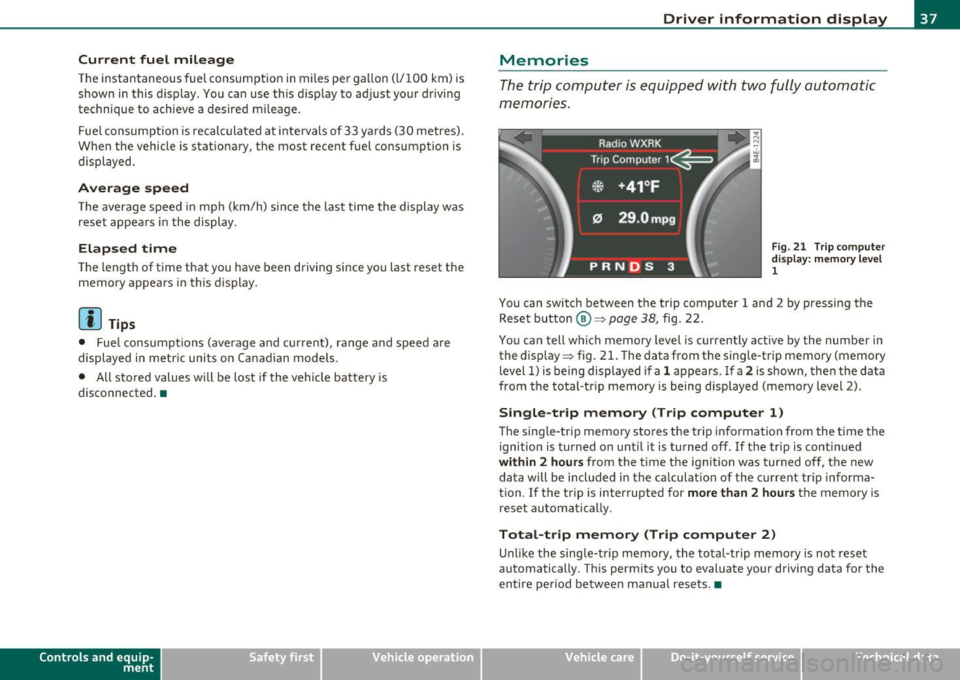
The trip comp uter is equ ippe d wi th two fully auto matic
memones.
Fig . 2 1 Trip co mpute r
di sp lay: m emory l ev e l
1
You can switch between the t rip computer 1 and 2 by pressing the
Rese t button
® ~page 38, fig. 22.
You ca n tell which memory level is curren tly active by the number in
the disp lay ~ fig. 21. The data from the sing le -trip memory (memory
level 1) is being displayed if a
1 appears . If a 2 is shown, the n the data
from t he total-tr ip memory is being displayed (memory level 2).
Single-trip memory (Trip computer 1)
Th e sing le -t rip memory sto res t he tri p inf ormation from the ti me the
ignitio n is turned on unti l it is t urned off . If th e tr ip is contin ued
within 2 hours from the t ime the ignit ion was turned off, the new
data will be included in the ca lculat ion of the c urrent tr ip informa
tion. If the trip is interrupted for
more than 2 hours the memory is
reset au toma tic ally.
Total-trip memory (Trip computer 2)
Unli ke the single -t rip m emo ry, th e total-trip memo ry is not rese t
automatically. Th is permits you to evaluate your driving data for the
entire pe riod be twee n man ual rese ts. •
Vehicle care Do-it-yourselt service iTechnical data
Page 114 of 384
-Warm and cold .,.,..__ ______________ _
(I) Tips
If the climate control system is operating in cooling mode , air flows
p rima rily from th e outlets in the center console and in the door
pillars . T o ach ieve adequa te cooling, you should never close the
ou tle ts completely. •
Using climate controls economically
Using the climate controls prudently can help save fuel.
When you use the a ir conditioner, e ngine power is reduced
and fuel consumption increa ses. To save fu el, you should use
the air co nditioner o nly when necessary. Also please note the
following points :
If you want to save fuel , activate ECON .
If you are going to drive with the wi ndows open, use ECO N.
~ For the sake of the environment
By reducing t he amount of fuel you use, you also reduce the amou nt
of pollutants emitted into the air .•
A ppli es to vehicl es : w ith sola r sliding /til tin g sunroof
Solar blower fan /solar roof
With sufficient sunlight, the blower fan continues to
operate with solar energy to bring in fresh air after the
ignition has been switched off
The fan motor is operated by solar energy throug h the solar roof after
t he ignition is tur ned off . P lease make certai n that vents @ and ©
are ope n to ach ieve op timal ventilation =:,
page 111, fig. 124.
The venti lation operates on ly with the sunroof closed or in the ti lted
position. If the veh
icle was switched off in the rec irculat ion mode, the air
condi tioning au tomatically sw itches to fresh a ir operation .
Solar operation is not activated at low outside temperatures .•
Windshield defogging/defrosting
A pp lie s t o v eh icles: w it h win dshie ld defo gger/ defrost er
Windshield defogger/defroster ®
The windshield defogger removes humidity from the
windshield .
Fig. 12 5 Wi ndshie ld
def ogger switch
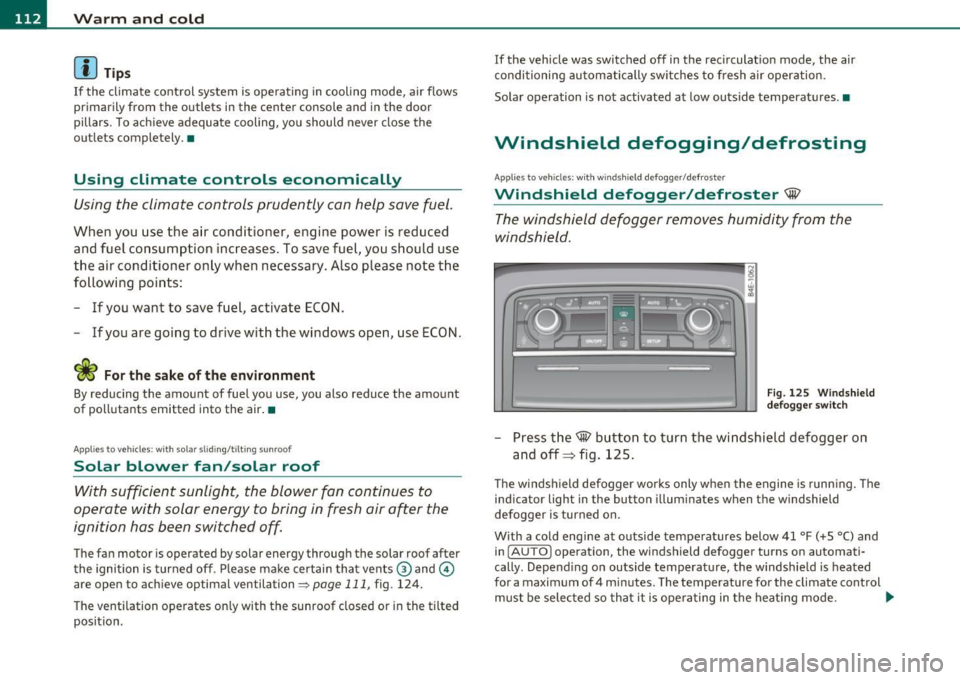
- Press the~ button to turn the wi ndsh ield defogger on
and off=> fig. 125.
T he windsh ield defogger works only when the engine is runn ing . T he
ind icator light in the button illum inates when the windshield
defogger is turned on.
With a cold engine at outside temperatures below 41 °F (+5 °C) and i n
( AU TO] operation, the windshield defogger turns on automati
cally . Depend ing o n outside temperat ure, the w indshie ld is heated
for a maximum of 4 m inutes. The temperature for the climate control
must be selected so tha t it is ope ra ting in the heat ing mode . .,_
Page 265 of 384

Driving and environment
------------------------------------------------'
- Lack of proper maintena nce as well as improper use of the
vehicle w ill imp air t he funct io n of t he emission con trol system and
could lead to damage.
<£> For the sake of the environment
Even when the Emiss ion Contro l System is operating properly, the
exhaust gas can have a sulfur-like exhaust gas sme ll under some
operat ing states. This depends on the s ulfur content of the fue l being
used. Using a differe nt brand of fuel may help, or filling the tank with
lead-free supe r grade gasoline. •
Avoid damaging the vehicle
When you are dr iving on poor roads, or ove r cur bs, steep r amps, etc.,
make certain that low-lying parts such as spoilers and exhaust system
p arts do not bo ttom ou t and ge t damage d.
Th is is espec ia lly true for vehicles with low-slung chass is (sports
chassis)* and fully loaded vehicles .•
Driving through water on roads
N ote the following to avoid vehicle damage w hen driving through
water, fo r examp le on flooded roads:
• The water must not be any higher than the bottom of the vehicle
b ody.
• Do not drive faster tha n walking speed.
& WARNING
After driving through water , mud, slush , etc. , the brakes may be
slow to take effect because of wet brake rotors and pads . Dry the
brakes first by braking carefully to restore the full braking effect.
Controls and equip ment Safety first Vehicle operation
0 Note
Vehicle
compone nts such as the engine, tra nsmiss ion, s uspension or
electrical system can be severely damaged by driv ing thro ugh water .
[ i ] Tips
• Check the depth of the water before d riving throug h it.
• Do not stop the vehicle, d rive in revers e or switch the e ngine off
when driving through wate r.
• Keep in m ind that oncoming vehicles may c reate waves t hat raise
the water leve l and make it too deep for yo ur vehicle to drive throug h
sa fely.
• Avoid driving through salt water because it can ca use corros io n.
Operate your vehicle economically
and minimize pollution
General
You r personal style of driving will determi ne the econom y
of your vehicle, as well as exhaust and noise l evels.
Fuel economy, environmenta l impact, and wea r on your eng ine,
brakes and tires largely depend on t hree factors:
• your persona l dr iving style
• operati ng conditions
• t echni cal lim itations
If you an ticipa te what you need to do next and drive economically,
you can easily cut your fuel consumption by 10-15 percent. This
s e ct io n w ill give you so me tip s on how you can he lp the e nvir onme nt
and your pocketbook.
~
Vehicle care Do-it-yourself service Technical data
Page 266 of 384
![AUDI S8 2010 Owners Manual Driving and environment
(I] Tip s
The consumption estimates as pub lished by ENV IRONMENTAL
PROTECTION AGENCY (EPA) and Transport Canada may not corre
spond to your actual consump](/img/6/57617/w960_57617-265.png "AUDI S8 2010 Owners Manual Driving and environment
(I] Tip s
The consumption estimates as pub lished by ENV IRONMENTAL
PROTECTION AGENCY (EPA) and Transport Canada may not corre
spond to your actual consump")
Driving and environment
(I] Tip s
The consumption estimates as pub lished by ENV IRONMENTAL
PROTECTION AGENCY (EPA) and Transport Canada may not corre
spond to your actual consumption on the road, which will vary
depending upon vehicle load and speed, road and weather conditions,
trip length, etc. •
Drive smoothly and keep a lookout ahead
Vehicles use the most fuel when they are accelerating .
-Avo id unnecessary accelerating and braking.
Vehicles use the most fue l when they a re accele rating. If you antici
pate what is going to happen next, you will need to brake less and,
thus, accelerate less. Let the vehicle coast whenever possible -for
example when you see that the next traffic l ight is red. •
Avoid full throttle
Driving at moderate speeds saves fuel and improves your
mileage.
- Try and keep well below your car's maximum speed .
Accelerating gently reduces fuel consumption, engine wear, and does
not disturb the environment.
Fuel consumption, exhaust emissions and engine noise increase
disproportionately at high speeds . If you drive at approx imately three
qua rters of top speed, fuel consumption will be reduced by one half.
Never drive faster than the posted speed limit and weather condi
tions permit.
a Reducing unnecessary idling
Even when your car is just idling it burns up fuel.
-
Shut the engine off when yo u are not driving the vehicle.
- Do not warm up the vehic le by letting the eng ine run at
idle.
It makes sense to shut off the engine in traffic jams, when waiting for
trains to pass at rai lroad crossings, o r at traffic lights that have long
wa its on red . Turn ing the eng ine off for just 30-40 seconds saves
more fuel than is burned starting the engine again.
It takes a long t ime for the engine to warm up fully when it is running
at idle. Howeve r, wear and noxious emissions are espec ially high
when the eng ine is wa rm ing up. So you sho uld d rive away as soon as
you start the engine and avoid running at hig h rpms while the eng ine
is still warming up.
0 Note
Do not leave engine idling unattended after starting . If warning
lights should come on to indicate improper operation, they would go
unheeded. Extended idling also produces heat, which cou ld result in
overheat ing o r othe r damage to the vehicle or other p roperty. •
Regular maintenanc_e ____________ _
A badly tuned engine unnecessarily wastes a lot of fuel .
- Have your vehicle serviced at regular intervals .
By having yo ur vehicle regularly se rviced by an Audi dealer helps to
ensure that it runs properly and economically . T he condition of your
vehicle not only a ffects its safety and ability to ho ld its va lue, it a lso
affects
fu el con sumption .
Check your o il e ach tim e you fill you r tank.
~
Page 267 of 384

Driving and environment
------------------------------------------------'
The amount of oil used is related to engine load and speed.
It is normal for the oil consumption of a new engine to reach its
lowest value after a certain mileage has been driven .
You must drive your vehicle about 3,000 miles (5,000 kilometers)
before you can properly assess oil consumption.
This also applies to fuel consumption and engine output .
0 Note
• Have your vehicle maintained properly and in accordance with the
service recommendations in your Warranty
& Maintenance booklet.
Lack of proper maintenance as well as improper use of the vehicle w ill
impair the function of the emission control system and cou ld lead to
damage.
• Do not alter or remove any component of the Emission Control
System un less approved by the manufacturer.
• Do not a lter or remove any device, such as heat shie lds, switches,
ignition wires, valves, which are designed to protect your vehicle's Emission Contro l System and other important vehicle components. •
Fewer short trips
Fuel consumption will always be relatively high on short
trips .
-Try to avoid driving short distances with a cold engine.
The eng ine and catalytic converter have to reach thei r optima l oper
ating temperature
to reduce fuel consumption and noxio us em is
sions effectively.
Just after starting, a cold engine in a mid -size car only achieves a fuel
economy of 6-8 miles per gallon (30-40 l/100 km) . After about a half
a mile, fuel economy climbs to 12 mpg (20 l/100 km). After about
2.5 miles (4 km), the engine is at its proper operating temperature
Controls and equip
ment Safety first Vehicle operation
and fuel economy has
reached a normal level. So you can see that you
should avoid short trips whenever possible.
The
outside temperature is also cr it ical in th is regard . Your car
consumes more fuel in the winter than in the summer. •
Vehicle care Do-it-yourself service Technical data
Page 295 of 384

___________________________________________ C_ h_e _c _k_ i_n ~g_ a_n_ d_ f_ i_ll _i_n _g __ _
the form of Serv ice or Repair O rde rs that all scheduled ma inte nance
w as perfo rm ed in a t im ely mann er.•
Engine oil consumption
Th e e ngin e in your v ehi cle dep ends on an ad equate
amount of oil to lubricate and cool a ll of its movin g parts.
In order to p rovide e ffect ive lubric ation and cooling of inter na l
eng ine components, all internal combust ion eng ines consume a
c ert ain a mo unt o f oil. Oil co nsump tion va ries from e ngine to eng ine
and may change sign ifican tly over the li fe of the engine . Typically,
eng ines w ith a sp ecifie d brea k-in period (s ee =>
page 261) co nsum e
more o il dur ing the break -in period t han they cons ume a fter oil
cons umption has stabilize d.
Under norm al cond itions, th e ra t e of oil con su mp tio n depe nds on t he
quality and v iscosi ty of the oil, the RPM ( revolutions pe r minute) at
w hich the engi ne i s op erate d, the ambie nt te m pe ratu re and r oad
conditions. Further factors are the amount of oi l di lution from water
co ndens ation or f uel re sidue and th e oxid ation level of the oil. As any
eng ine is s ubject to wear as mileage builds up, the oil consumption
may increase over time until replacemen t of wo rn components may
become necessa ry .
With all these varia bles comin g into play, no stan dar d rate of oil
co nsum ption can be establis hed o r spe cified. Th ere is no alte rnative
to regular and frequent chec kin g of the o il level, see
Note .
If the yellow e ngine oil leve l w arning symbol in the ins trumen t
cl uster · .. lights up, yo u should chec k the o il lev el as soon as possible
with the oil dipstick=> page 293 . Top off the oil at yo ur earliest
conveni ence=>
pag e 294 .
& WARNING
Before you check anything in the engine compartment , always
read and heed all WARNINGS=>
& in "Working in the engine
compartment " on
page 289.
Safety first
0 Note
Driv ing with an in sufficie nt o il level is like ly to c ause severe d amage
to the engine .
[ i ] Tips
• The oil pressure warn ing display 'e.::1; is not an indicator of the oil
level. Do not rely on it . Instead, check the oil level in your engine at
regular intervals, preferably each time you refuel, and always
before going on a long trip .
• If you have the impression your eng ine consumes excessive
am ounts of o il, we recom mend that you cons ult your Audi dea le r to
have the cause of your concern properly d iagnosed. Keep i n m ind that
t he accurate meas urement of oil co nsum ption re quires great care
and may take some t ime. Your Audi dealer has instruct io ns about how
t o meas ure o il cons umption a ccu ra tely .•
Checking the engine oil Level
Vehicle care
Fig . 24 3 Illustration
o f principle 1 : M arker s
on oil dipstick ...
Technical data
Page 373 of 384
Alphabetical index Ill
----------------
Proper disposal of drained brake fluid 300
Proper disposal of dra ined engine coolant
298
Proper disposal of drained engine oil 294,
295
Recycl ing used engine o il ....... .. . 294
Unleaded fuel . ............... .. . 283
What should I do with an old battery? ...
304
EPC
See Electronic power control ........ 16
ESP
See E lectronic stabilizat ion program ( ESP)
16
Event Data Recorder (EDR) ....... .... . 252
Exhaust tail pipes
Cleaning .. ............. .. .. .. .. . 276
Expansion tank ........ .. .... .. .... . 297
F
Fan
Radiator .. ............. .. .. .. .. . 299
Fastening Booster seats ............. .. ... .. 239
Convertible child safety seats .... ... 237
Infant seats ..................... 236
Flat tire changing . .. ............. .. . 330
Floor mats .. .... .. .. ... . .. .. .. .... . 193
Fog lights Front .................... .. .. .. .. 62
Rear ........ .... .. .. .. .......... 62
Warning/indicator lights ... .. ...... 17
Folding master key with remote control .. 39
Controls and equip
ment Safety first
Foot pedals
.... ... ...... .. .. .. ... .. 192
For the sake of the environment
Gasoline fumes and the environment 285
Letting your engine warm up .. ..... 119
Reducing engine noise by early upshifting 10
Refueling ........ .. .. .. .. ....... 285
Saving fuel by early upshifting ....... 10
Using the rear window defogger ..... 113
Front airbags Description .. ..... .. .. .. .. ....... 210
How they work .... ....... ...... .. 215
Front ashtray .. .. .. ........ .......... 96
Front fog lights . ..................... 62
Front seats . .. .................. ... . 76
Adjusting .. .. .. ..... .... ...... .. 189
Child restraints in the front seat .. .. 208
Convenience side view .. .. .. .. ...... 81
Pockets ............... .. .. .... .. 100
Symmetrical seat positions .......... 81
Frontal collisions and the laws of physics 198
Fuel Additives .. .. .... .... ........... 283
Average consumption .. ............ 36
Blended gasoline .... .. .. .. ....... 283
Fuel filler neck .. ..... ...... ...... 284
Fuel gauge . ........ ......... ..... 12
Gasoline ... .. ... ........ ........ 283
Gasoline additives ................ 284
Instantaneous fuel consumption .... . 36
Low fuel level symbol .. .. .......... 33
Octane rating ...... .............. 283
Recommendation ................ 283 Refuelling
.. .. .. .. ... ...... ... .. 285
Reserve ......... ........ ... .. ... . 12
Tank capacity . . . . . . . . . . . . . . . . 12, 360
Unlocking the fuel filler flap by hand . 287
Fuse arrangement ............ .. .. .. . 342
G
Garage door opener (Homelink ®) ...... 181
Gas discharge lamps .......... .. .. .. . 346
Gauges Engine coolant temperature ......... 10
Fuel gauge .. .. ... ................ 12
Speedometer ....... ...... .. . ... .. 12
Tac hometer ..... .. ............... 11
Tr ip odometer ............ .... .. .. 12
General illustration Instruments and controls .. ... . ... .. . 9
Generator Warning/indicator lights ... ... . .. .. 16
Glossary of tire and loading terminology 307
Glove compartment ... .... ...... ..... 99
cd changer .. .. .. .. .. .. ... ....... . 99
Owner's Literature ................ . 99
Gross Vehicle Weight Rating (GVWR) ... 357
H
Head restraints ..................... 191
Adjusting .......... ...... .. .... . 191
Comfort head restraints ............ 81
Front seats .. ...... ............... 81
Rear seats .. .. .. .. .. .. .. ..... .... 82
Vehicle operation Vehicle care Do-it-yourself service Technical data
Page 379 of 384

___________________________________________ A_ l::.. p _h _a_ b_ e_t _ic _a_ l_ in_ d _ e_x __ __
T Storing tire pressures .. .. .. ... .... 330 Towing
Tires and wheels .................
320 Tow truck procedures ........ .. ... 350
Tachometer .................... .... . 11 Valves ................... .... ... 320 Towing hitch
Technical modifications .. .. ..........
364 Tire service life .. .............. ..... 317 Audi parking system ...... ..... ... 171
Temperature
Climate controls .......... .. .... .
106
Setting for the d river's and front passen-
ger's side .. ... .. .. .. .. .. .. .... .
106
Tether anchors ............. .... ... . 249
Tether strap .... ........... .. .... .. . 249
The first 1,000 mi les (1,500 km) and
afte rwards .... .... .. .. .. ... ... .
261
Tie-down eyelets .... ... .. ... . .. . 90, 195
T ips for the environment
Saving fue l ............. .... ... ...
94
Using the air conditioner only when
necessary ......... .. .. .. .. .... . 112
tiptronic ® ............ .. .. .. .. .... .
154
Automatic Shift Lock (ASL) ...... ... 156
Driving ......... ... ... ... .. ..... 154
Dynamic shift program ....... .. .. . 157
Fail-safe mode ..... .. .. .. .... .... 159
K ick-down ......... ..... ... .. .. . 157
Manual shift program .......... .. . 158
Selector leve r ......... .. .. .. .... . 155
Tire pressure . ..... ....... ... .. .. .. . 313
Tire pressure monitoring system . ...... 327
Displaying tire pressures ....... .... 329
Initialize wheels .. .. ........... ... 330
Learning process ........ ...... .. . 330
Loss of air pressure .. ......... 17,328
Malfunctions .......... ... .. ..... 331
Sensors ...... ........ .. .. .. .. .. . 320
Controls and equip
ment Safety first
Tir
es . .... ....................... .. 306 T owing loop ........... ...... .. .. .. . 351
Replacing .. .. .. .... ... . .... ..... 320 front . .. .. .. ................. .. . 351
Service life ....... .. .. .. .. .. ..... 317 rear .. .. ........... ...... .... .. . 352
speed rating letter ,code ........... 320 Trailer towing .. .. .................. 266
T ire manufacturing date ........... 320 Operating instructions .. .. .... .... 267
Tire specifications ................ 319 Technical requirements .. .. .. . 266,267
T read depth . ...... .............. 317 Tr ailer towing tips ......... .. .. .. . 268
Uniform tire quality grading . .. ..... 322 Train
Winter tires ................... ..
323 Transporting your vehicle ... ... . .. . 353
T ires and vehicle load Limits ........... 314 Transmission
Tires and wheels
See Automatic transmission ........ 154
Checking tire pressure .. .. .... .... . 313 T ransport Canada ..... ....... ...... . 195
Cold tire inflation pressure ....... .. 310
Dimens ions .. .... ............. ..
318
General notes ................... 306
Glossary of tire and loading terminology .
307
New tires and wheels .... ..... ... . 318
Replacing .. .. .. .... .. .. .... ..... 319
Snow chains .. ........... .... .. .. 324
Transporting your vehicle . .. .......... 353
Tr ead Wear Indicator ( TWI) . ..........
317
Trip computer
Fuel consumption .. ...............
36
Mileage ................. .. .. .. .. 36
Single-trip memory ........ ... ... .. 37
T otal-t rip memory ... ...... .... .. .. 37
Tir e pressure monitoring system .... 320
Tires and vehicle load limits ... .. ... 314
Wheel bolts .. ................ ... 325
Trip odometer .. .. .................. . 12
What does it mean when dEF appears in
the trip odometer display? . ... .. ...
12
Winter tires ..................... 323 Trunk
Tires/Wheels
See Rear lid . .. .. .. ............... 46
Low aspect rat io tires .. .... .. .. .. . 325 Trunk escape handle . ...... .... ...... 332
Tools .... ......................... 334 T urn s ignals ................ ... .. .. .. 64
Torn or frayed safety be lts ... ......... 200 Warning/indicator lights ... .. . ... .. 17
Touch-up paint .. .. .... .. .. .. ... .... 274
Vehicle operation Vehicle care Do-it-yourself service Technical data