check AUDI S8 2013 Repair Manual
[x] Cancel search | Manufacturer: AUDI, Model Year: 2013, Model line: S8, Model: AUDI S8 2013Pages: 318, PDF Size: 79.34 MB
Page 248 of 318
246 Checking and filling
Battery charging
Starting the engine requires a well charged
battery.
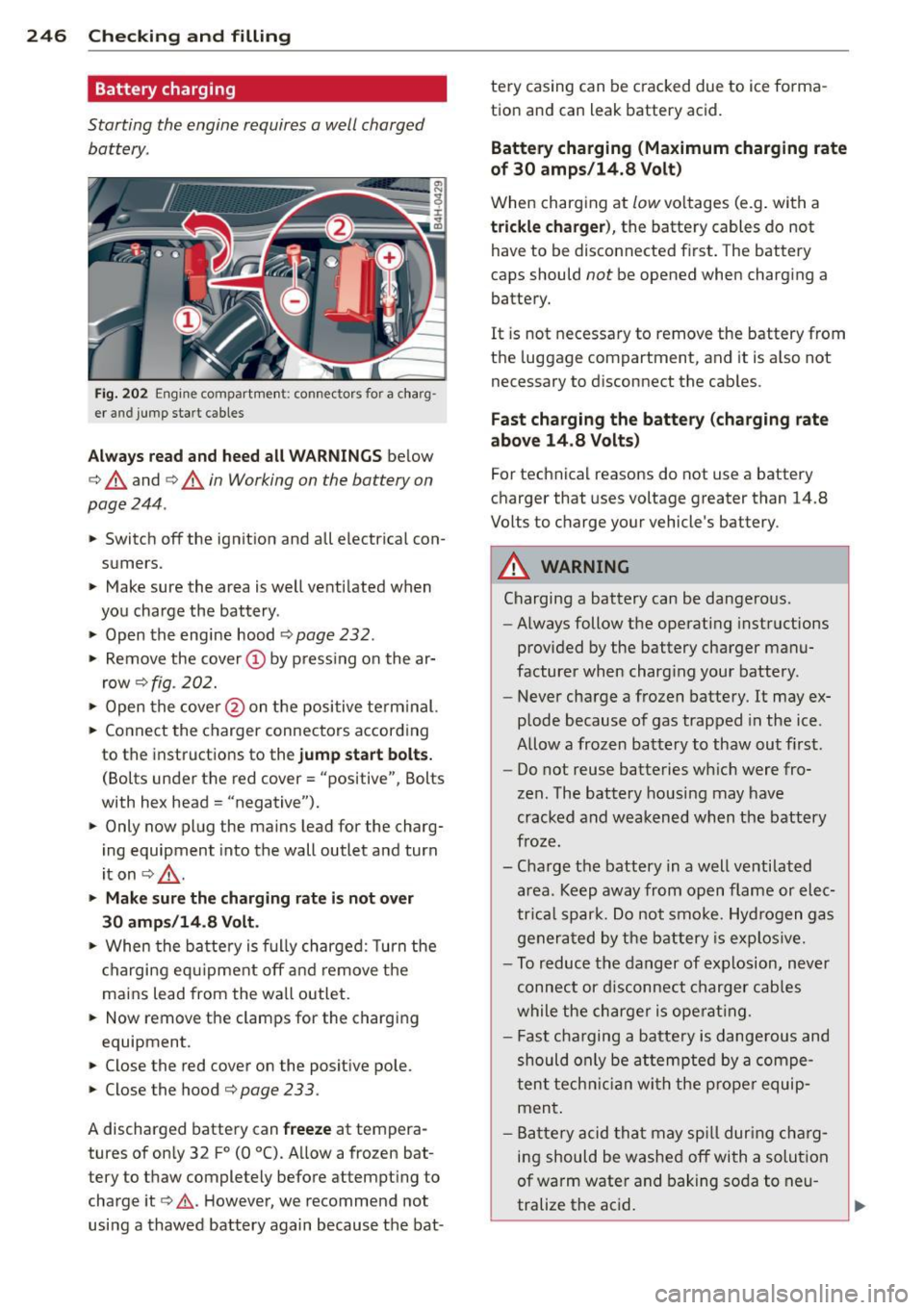
Fig . 202 Engine co mpartme nt: connectors fo r a charg
er and jump sta rt cables
Always read and heed all WARNINGS below
c:> A and c:> A in Working on the battery on
page 244 .
.,. Switch off the ignition and all electrical con
sumers .
.,. Make sure the area is well ventilated when
you charge the battery .
.,. Open the engine hood
r:::.> page 232 .
.,. Remove the cover© by press ing on the ar
row
c:>fig . 202.
.,. Open the cover @on the positive term inal.
.,. Connect the charger connectors according
to the instructions to the
jump start bolts.
(Bolts under the red cover= "positive" , Bolts
with hex head = "negative").
.,. Only now plug the mains lead for the charg
ing equipment into the wall outlet and turn
it on
r:::.> &_ .
.,. Make sure the charging rate i s not over
30 amps/14.8 Volt.
.,. When the battery is fully charged: Turn the
charging equipment off and remove the
mai ns lead from the wall outlet.
.,. Now
remove the clamps for the charging
equipment.
.. Close the red cover on the posit ive pole .
.,. Close the hood
c:> page 233 .
A discharged battery can freeze at tempera
tures of only 32 F
0 (0 °C). Allow a frozen bat
tery to thaw completely before attempting to
charge it
r:::.> &. . However , we recommend not
using a thawed battery again because the bat -tery casing can be cracked due to ice forma
tion and can leak battery acid.
Battery charging (Maximum charging rate
of 30 amps/14.8 Volt)
When charging at low voltages (e.g. with a
trickle charger), the battery cables do not
have to be disconnected f irst. The battery
caps should
not be opened when charging a
battery.
It i s not necessary to remove the battery from
the luggage compartment, and it is also not
necessary to disconnect the cables.
Fast charging the battery (charging rate
above 14 .8 Volts )
For technical reasons do not use a battery
charger that uses voltage greater than 14.8
Volts to charge your vehicle's battery .
A WARNING
Charging a battery can be dangerous.
- Always follow the operating instructions
provided by the battery charger manu
facturer when charg ing your battery .
- Never charge a frozen battery. It may ex
plode because of gas trapped in the ice .
Allow a frozen battery to thaw out first .
- Do not reuse batteries wh ich were fro
zen. The battery housing may have
cracked and weakened when the battery
froze.
- Charge the battery in a well ventilated area . Keep away from open flame or elec
tr ica l spar k. Do not smoke. Hydrogen gas
generated by the battery is explos ive .
- To reduce the danger of explosion,
never
connect or disconnect charger cables
while the charger is operating .
- Fast charging a battery is dangerous and
should only be attempted by a compe
tent technician with the proper equip
ment .
- Battery acid that may spill dur ing charg
ing should be washed off with a solution
of warm water and baking soda to neu
tralize the acid.
Page 249 of 318

CD Note
Never use a fast charger as a booster to
start the engine . This will seriously dam
age sensitive electronic components, such
as control units, relays, radio, etc ., as well
as the battery charger .
Battery replacement
The new battery must have the same specifi
cations and dimensions as the original equip
ment battery .
Intelligent energy management in your vehi
cle is responsible for d istributing the electr i
cal energy throughout your vehicle
c::> page 203 . The intelligent energy manage
ment system w ill keep the engine battery
charged bette r than vehicles w ithout t his sys
tem. To make sure the additional electr ica l en
ergy is available once again after you have
changed the battery, we recommend that you
install batteries of the same type and manu
facture only (the same as those installed at
the time your vehicle was delivered). Specifi
cations are listed on the bat tery hous ing. Your
author ized dealer must code the battery in
the energy management system to enable you
to use the energy management functions cor
rectly after replac ing the battery .
T he new battery must have the same capacity ,
voltage (12 volts), amperage, construction and p lug sealing.
When installing the battery, make sure the ig
n ition and all electr ical consumers are sw itch
ed off .
CD Note
-Make sure the ventilat ion hose on the
s ide of the battery is connected, other
wise fumes or battery acid can leak out.
- Vehicles with the Start-Stop-System* are
equipped with a special cycle-proof AGM
battery. Insta lling a different type of
batte ry can cause prob lems in the vehi
cle elect rical system. When replacing the
vehicle battery, always insta ll one wi th
Checkin g and fillin g 247
the same specifications as the origina l
battery .
- Battery mounts and clamps must always
be sec ured correct ly .
- Read and fo ll ow the warnings under
c::> page 244, Working on the battery be
fore performing any work on the battery.
@ For the sake of the environment
Because of the prob lem of p roper disposal
of a ba ttery, we recommend your author
ized Audi dealer change the battery for
you. Batteries contain sulfuric acid and l ead and must always be disposed of prop
erly in compliance with all environmental
regulat ions. Disposing of vehicle batter ies
i mproperly is very dangerous to the envi
r o nment .
Windshield/headlight
washer container
.., N
-N
" ~
Fig. 203 Eng in e compa rtm ent: cove r on the w inds hield
washer flu id rese rvo ir
T he washer fluid container is marked w ith the
symbol-$ on its cap
c::>fig. 203, c::>page 234.
.,. Before you check anything in the engine
compa rtment, always read and heed all
WARNINGS c::> A in Working in the engine
compartment on page 232.
.,. Lift the filler cap tongue to add washer flu
id. You can fi ll the container to the top .
.,. Press the cap back onto the f iller neck after
filling the container .
You can find the reservoir capacity in the table
inc::>page292. ""
•
•
Page 250 of 318

248 Checking and filling
Clean wate r sho uld be used when fill ing up. I f
possib le, use soft wate r to prevent sca ling on
washer jets . A lways add a glass cleane r solu
tion (with frost protection in the winter).
Do not mix engine coo lant antifreeze or
any ot her add itives to f ill up the wind
shie ld washer reserv oir.
Page 252 of 318
250 Tire s and wheel s
-Never mount used tires on yo ur vehicle if
you are not sure of their "previous histo
ry." Old used tires may have been dam
aged even though the damage cannot be
seen that can lead to sudden t ire failure
and loss of vehicle control.
- If you notice unusual vibration or if the
vehicle pulls to one side when driving, al
ways stop as soon as it is safe to do so
and check the wheels and tires for dam
age.
(D Note
Please note that summer and wi nte r tires
are designed for the cond itions that are
Glossary of tire and loading terminology
Accessory weight
means t he comb ined we ight (in excess of
those sta ndard items which may be rep laced)
of au toma tic tra nsmission, power steer ing,
power brakes, power windows, power seats,
radio, and heater, to the extent that th ese
items are availab le as factory -installed equip
ment (whether installed or not) .
Aspect ratio
means t he ratio of the he ight to the w idth of
the tire in percent . Numbers of 55 or lower in
dicate a low sidewall for improved steering re
sponse and better overall handling on dry pavement .
Bead
means the part of the ti re that is made of
steel wires, wrapped or reinforced by ply cords
and that is shaped to fit the rim.
Bead separation
means a b reakdown of the bond between
components in the bead.
Cord
means the strands forming the plies in the
tire . typ
ica l in those seasons . Aud i recommends
using winter tires during the winter
months . Low temperatures signif icant ly
decrease the e lasticity of summer tires,
which affects tract ion and brak ing ability.
If summer tires are used in very co ld tem
peratures, cracks ca n form on the tread
bars, res ulting in permanent tire damage
that can cause loud driving no ise and un
balan ced t ires. Audi is not responsible for
th is type of damage .
Cold tire inflation pressure
means the tire p ressu re recommended by t he
vehicle manufacturer fo r a tire of a des igna ted
s iz e that has not bee n driven for more than a
coup le of miles (k ilometers) at low speeds in
t h e three hour period before the tire pressure
is measured or adjusted.
Curb weight
mea ns the we ight of a motor ve hicle with
standard equipment in cl uding the max imum
capacity of fuel, oil, and coolant, air condi
tioning and additional weight of optiona l
equipment.
Extra load tire
me ans a t ire design to operate at higher loads
and at h igher inflation pressures than the cor
responding standard tire . Extra load tires may
be identified as "XL", "x l" , "EXTRA LOAD", or
"RF" on the sidewall.
Gross A xle Weight Rating ("GAWR ")
means the lo ad -c a rry ing c apac ity of a s ingle
axle system , measured a t the tire-ground in
terfaces.
Gross Vehicle Weight Rating ("GVWR ")
mea ns the maximum total loaded we ight of
t h e ve hicl e. .,.
Page 257 of 318
The correct tire pressure for the spare wheel is
l ocated on a label on the driver's side B-pillar.
Because tec hnical changes may be made to
veh icle equ ipment dur ing the model yea r, a l
ways compare the tire size designation on the
tire pressure label on your vehicle wit h the
tires on your vehicle . Make s ure that the tire
size information on the veh icle label is the
same as the s ize of the t ires on the vehicle.
This is especially important if the vehicle be
longs to someone else or you bought the veh i
cle with different rims/tires or you boug ht the
ve hicle as a previously owned vehicle.
Remember, your safety and that of your pas
sengers also depends on mak ing su re that
l oad l imits are not exceeded. Vehicle load in
cludes everybody and everything in and on the
veh icle. These load limits are technically refer
red to as the vehicle's Gross Vehicle Weight
Rating ("GVWR") . The Gross Ax le Weight Rat
ing ("GAWR") is the maximum load that can
be app lied at each of the veh icle's two axles.
The Gross Vehicle Weight Rating and the
Gross Axle We ight Rating are listed on the
safety compliance st icker label located on the
driver's side B-p illar . The t ire pressure label on
your Aud i lists the maximum combined
weight of a ll of the occupants and luggage or
other cargo that the vehicle can carry. For the
l ocat ion of the tire pressure labe l
c;, fig. 204.
A WARNING
Overloading a vehicle can cause loss of ve
hicle control, a crash or other accident, se
rious personal injury, and even death.
- Car rying more weight than yo ur vehicle
was designed to carry will prevent the
vehicle from handling properly and in
crease the risk of a loss of veh icle con
trol.
- The brakes on a veh icle that has been
overloaded may not be able to stop the
vehicle within a safe distance .
- Tires on a vehicle that has been overload
ed can fail suddenly causing loss of con
t rol and a crash.
Tire s an d wheel s 255
-Always make sure that the total load be
ing transported - includ ing the weight of
a trailer hitch and the tongue we ight of a
loaded trailer -does not make the vehi
cle heavier than the vehicle's Gross Vehi
cle Weight Rating.
A WARNING
- Inco rrect tire pressures and/or underin
flation can lead to a ser ious or fatal acci
dent.
- Inco rrect tire pressures and/or underin
flation cause increased tire wear and can
affect the handling of the vehicle.
- Inco rrect tire pressures and/or underin
flation can a lso lead to sudden t ire fail
ure, including a blowou t and sudden de
flation, caus ing loss of veh icle contro l.
Checking tire pressure
The correct tire pressure for the tires original
ly installed on your vehicle is listed on the tire
pressvre label located on driver's side 8-pil
lar.
T he recommended tire pressures are on the
ti re pressure label and in the table
c;, page 253, Cold tire inflation pressure .This
means that the pressure m ust be checked and
adjusted when the tire has not been dr iven for
more than a couple of miles (kilometers) at
low speeds during the previous three hours.
Air in the tires expands when the tire heats up
as a result of internal frict ion as it flexes in
use. The tire pressure is h igher when the tire
has warmed up t han when it is "cold."
It is the inflation pressure in a "cold" t ire that
counts. Therefore, you should never let a ir out
of a warm tire to match "Cold t ire inflat ion
pressure" recommendat io ns
c;, page 253 . The
ti res wo uld then be unde rinfl ated and co uld
fail suddenly.
T he tire pressure label on your Audi lists the
recommended co ld tire inflation pressures at
max imum capacity for the new, or ig inal
equipment tires that were on your vehi cle at
1J1>
•
•
Page 258 of 318

256 Tires and wheels
the time it was manufactured . For the
location of the label~
page 253, fig . 204.
Most tires lose air naturally over time. They
can also lose some air if you drive ove r a pot
hole or hit a curb while parking . It is usually
not possible to see whether the radial tires
used today are under inflated just by looking
at them.
Therefore, be sure to check tire pressures at
least once a month and always before going
on a long tr ip. Make sure to take the number
of people and the amount of luggage into ac
count when adjusting tire pressure for a trip -
even one that you would not consider to be
"long." See~
page 257, Tires and vehicle
load limits
for more important information.
Always use an accurate tire pressure gauge
when checking and adjusting inflation pres
sures. Check all of the tires and be sure not to
forget the spare t ire. If the pressure in any tire
is too high when the tire is "cold," let air out
of the tire slowly with the edge of the tire
gauge and keep checking the pressure until
you reach the pressure that is correct for the
l oad (passengers and luggage) and kind of
driving you plan to do.
If the pressure in any tire is too low, note the
difference between the pressure in the cold
tire and the pressure you need and add the air
that you need to reach the correct pressure for
the vehicle load (passengers and luggage) for
the tires on your vehicle as listed on the on
your veh icle and in this manual and the kind
of dr iving you plan to do .
Never exceed the maximum inflation pres
sure listed on the tire sidewall for any rea
son.
Remember that the vehicle manufacturer, not
the tire manufacturer, determ ines the correct
tire pressure for the tires on your vehicle.
It is important to check the tire pressure when
the tires are cold.
- Read the req uired ti re pressure from the tire
pressure label. The tire pressure label is lo
cated on the driver's side B-pi llar . -
Tu rn the va lve stem cap counter -clockwise
to remove it from the tire va lve .
- Place the air pressure gauge on the va lve.
- The tire pressu res should only be checked
and adjusted when the tires are cold. The
slightly raised pressures of warm tires must
not be reduced.
- Adjust the tire pressure to the load you are
carrying.
- Reins tall the valve stem cap on the valve.
When should I check the tire pressure?
The correct tire pressure is especially impor
tant at high speeds. The pressure should
therefore be checked at least once a month
and always before starting a jour ney. Do not
f orget to check the tire pressure for the spare
whee l
~page 272.
When should I adjust the tire pressures?
Adjust the tire pressure to the load you are
carrying. After changing a wheel
or replacing
whee ls you have to adjust the tire pressures
on all whee ls. In addition, you m ust then
store the new tire pressures in the tire pres
sure monitoring system*~
page 267.
A WARNING
Incorrect tire pressures and/or underinfla
tion can lead sudden tire fa ilure, loss of
control, collision, serious personal injury
or even death.
- When the warning symbol
Rt] appears in
the instrument cluster, stop and inspect
the tires.
- Incorrect tire pressure and/or underinfla
tion can cause increased tire wear and
can affect the handling of the vehicle and
stopping abi lity.
- Incorrect tire pressures and/or underin
flation can also lead to su dden t ire fail
ure, including a blowout and sudden de
flation, causing loss of veh icle control.
- The driver is responsible for the correct
tire pressures for all tires on the vehicle.
The applicable pressure values are locat ed on a sticker on the driver's side B-pil-
la~
~
Page 259 of 318
-Only when a ll tires on the vehicle are fi l
led to the correct pressure, the tire pres
sure monitoring* system can work cor rect ly.
- The use of incorrect tire pressure values
can lead to accidents or other damage.
Therefore it is essential that the d river
observe the specif ied tire pressure values
for the tires and the co rrect p ress ures for
the f un ct ion of t he tire pressure mo nitor
ing sy stem*.
- Always inflate ti res to the recommended
and co rrec t tire pressu re befo re dr ivi ng
off.
- Driv ing wi th under infla ted ti res bend
more, letti ng them get too ho t res ulting
in t read separation, sudden t ire fail ure
and loss of control.
- Excessive spee d and/ove rloading can
ca use heat bui ld -up, sudden tire fa il ur e
and loss of control.
- If the t ire pressure is too low or too high,
the tires w ill wea r prematu rely an d the
vehicle will not hand le we ll.
-If the t ire is no t flat and you do no t have
to change a w heel imme diate ly, drive at
reduced speed to the nearest service sta
t ion to check the tire pressure and add
air as required.
(D Note
Driving without va lve stem caps ca n cause
damage to the t ire va lves. To prevent this,
always make s ure that facto ry installed
valve stem caps on all wheels a re secure ly
mounted on the va lve .
@) For the sake of the environment
Underinflated tires will a lso increase the
fue l consumption .
Tires and vehicle load limits
There are limits to the amount of load or
weight that any veh icle and any t ire can carry .
A vehicle that is ove rloaded w ill not ha ndle
well and is more difficult to stop . Overload ing
can no t on ly lead to loss o f vehi cle con tro l,
Tire s an d wheel s 257
but can also damage important parts of the
vehicle and ca n lead to sud den tire fai lure, in
clud ing a b lowout and s udden def lation that
can cause the vehicle to cras h.
Your safety and that of your passengers also depends on making sure that load limits are
not exceeded . Vehicle load includes everybody
and everything in and on the veh icle. These
load lim its are technically referred to as the
vehicle's
Gross Vehicle We ight Rating
("GVWR ") .
The "GVWR" includes the weight of the basic
vehicle, all factory installed accessories, a full
tank of fuel, o il, coo lant and other fluids plus
maximum load . The max imum load includes
the number of passenge rs that th e vehicle is
i n tended to car ry ("seat ing capa city") wi th an
ass umed we igh t of 150 lbs (68 kg) fo r each
passenger at a designated seating posi tion
and t he tota l weight of any luggage i n the ve
hicle . If you tow a trai ler, the weight of the
tra iler hitch and the tongue weight of the
loaded tra iler must be included as part of the
vehicle load.
T he
Gro ss Axle Weight Rating ("GAWR") is
the maximum load that can be applied at each
of the vehicle's two axles.
T he Gross Vehicle Weight Rating and the
G ross Ax le Weig ht Rating are listed on the
safety comp liance sticker label located on the
driver's side B-pillar. Your Audi has 5 seat ing
pos itions, 2 in the front and 3 in the rea r fo r
total seating capacity of 5 . Vehicles with pow
er ind iv idual rea r seats* have 4 seat ing pos i
tions, 2 in the front and 2 in the rea r fo r total
seat ing capac ity o f 4. Each seating position
has a safety belt~
page 144, Safety belts.
The fact that there is a n uppe r limit to you r
vehicle's G ross Vehicle We ight Rating means
t h at the to tal weig ht of whatever is bei ng car
ried in the vehicle ( in cl ud ing t he weight of a
trai ler hitch and the tongue weigh t of t he
loa ded trai le r) is limite d. The more passen
gers in the vehicle or passengers who are
heavier than the standard we ights assumed
•
•
Page 261 of 318
being load ed on th e ve hicle .
Th at w eight ma y no t safely
e xce ed the av ailabl e car go
a nd lug gag e lo ad ca pacity
c alcul ated in St ep 4 .
6. If y our vehicle will be t owing
a tr aile r, lo ad from your trail
er will b e tr an sfe rred to yo ur
ve hicle. Con sult thi s m anu al
t o de te rmine ho w th is re
d uce s th e av ailable car go
a nd lug gage loa d ca pacit y of
y o ur ve hi cle .
_,.. Check the tire sidewall
( c:> pag e 260 ~ fig. 208 ) to de
t e rmin e the d esign ated lo ad
rating f or a sp ecifi c ti re.
Tire service life
The service life of tires depends on a lot of
different things including proper installation
and balancing, correct tire pressure and driv
ing style.
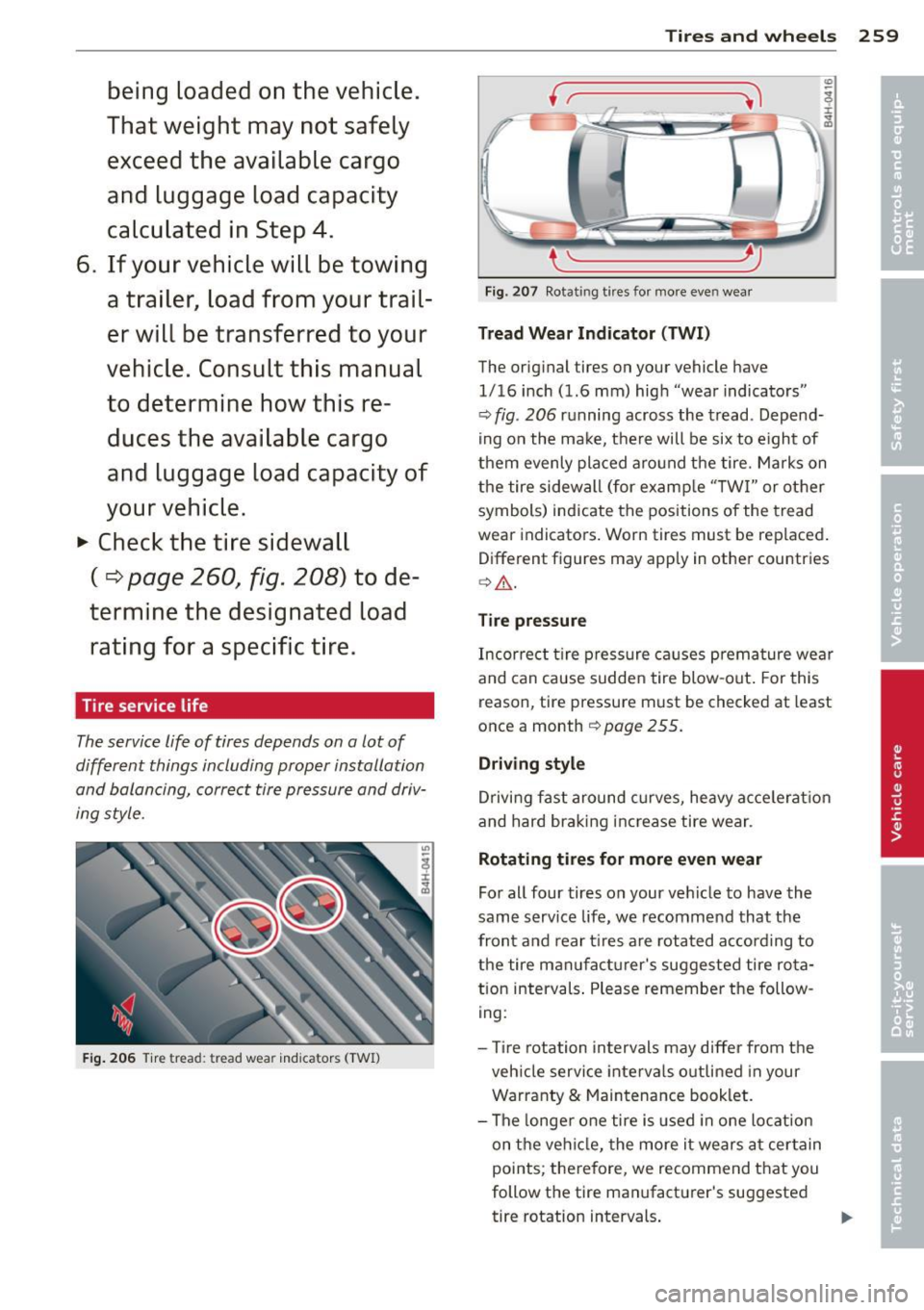
F ig . 2 06 Tire tread : tread wear ind icators (TWil
Tires and wheels 259
{ '"------
F ig. 207 Rotat ing tires for more eve n wea r
Tread Wear Indicator (TWI)
The orig inal tires on your vehicle have
1/16 inch (1.6 mm) high "wear indicators"
9 fig. 206 r u nning across the tread. Depend
ing on the ma ke, there will be six to e ight of
them evenly pla ced aro und the tire. Marks on
the tire sidewall (for e xamp le "T W I" or other
symbols) indicate the positions of the tread
wear indicators . Worn tires must be replaced .
D ifferent figures may apply in othe r countries
9 & .
Tire pres sure
Incor rect t ire press ure ca uses premature wear
and can cause sudde n tire blow-out . For this
reason, tire pressure must be checked at least
once a month
9 page 255.
Driving style
Driving fast around curves, heavy a ccele rat io n
and har d brak ing inc rease tire wear.
Rotating tires for more even w ear
For all four tires on your vehicle to have the
s a me service life, we recommend that the
front and rear t ires are rota ted accord ing to
the tire m anufact urer's suggested tire ro ta
tion intervals . Please remember the follow
ing:
- Tire rotation in tervals may d iffer from the
veh icle service inte rva ls o utlined in your
Warranty & Main tenance booklet.
- The longer o ne tire i s used in one lo cation
on the vehi cle, the more it wears at cer tain
points ; therefore, we recommend t hat you
follow the tire manufact urer's suggested
tire rotation intervals .
Page 262 of 318

260 Tires and wheels
-Vehicles with front-wheel drive experience
more tread wear on the front wheels com
pared to all-wheel drive (quattro ®).
- Please rotate tires as shown
¢fig. 207.
- Extra care must be taken when rotating di-
rection-specific tires
¢ page 2 78.
Wheel balancing
The wheels on new vehicles are balanced .
H owever, various situations during everyday
driving can cause them to become unbal
anced , resu lting in vibrations you can usually
feel through the steering wheel.
Unba lanced wheels must be rebalanced to
avoid excessive wea r on steering , suspens ion
and tires . A wheel must also be rebalanced
when a new tire is installed.
Incorrect wheel alignment
Incorrect whee l alignment can cause exces
sive tire wear, impair ing the safety of the vehi
cle .
If tires show excess ive wear, have the
wheel alignment checked by an authorized
Audi dealer or qualified workshop.
All Wheel Drive
Vehicles with quattro® must always have ti res
of the same size, construction and tread type.
F or details see
¢page 203.
A WARNING
Sudden tire failure can lead to loss of con
trol, a crash and serious personal injury!
- Never drive a vehicle when the tread on
any tire is worn down to the wear indica
tors.
- Worn tires are a safety hazard, they do
not grip well on wet roads and increase
your risk of "hydrop laning" and loss of
control.
- Always keep chemicals that can cause
tire damage, such as grease, oil, gasoline
and brake fluid away from tires.
- Tires age even if they are not be ing used
and can fail suddenly, especially at high
speeds. Tires that are more than 6 years old can only be used in an emergency and then with specia
l care and at lower
speeds.
- Never mount used tires on your vehicle if
you are not sure of their "previous histo
ry." Old used tires may have been dam
aged even though the damage cannot be
seen that can lead to sudden tire failure
and loss of vehicle control.
New tires and replacing tires and wheels
New tires and wheels have to be broken in.
Fig. 208 Tir e spec ificatio n codes on the s idewall of a
tire
No.
©
®
®
0
®
®
@
Description
Passenger car tire (where applicable)
Nominal width of tire in mill imeters
Ratio of height to width (aspect ratio)
Rad ial
Rim diameter code
Load index and speed rating
U.S. DOT tire identification number
Aud i Original tire
Sever snow conditions
Tire ply composition and materials
used
Maximum load rating
Page 265 of 318
-Never mount used tires on your vehicle if
you are not sure of their "previous histo
ry." Old used tires may have been dam
aged even though the damage cannot be
seen that can lead to sudden tire failure
and loss of vehicle control.
- All four wheels must be fitted with radial
tires of the same type, size (rolling cir
cumference) and the same tread pattern.
Driving with different tires reduces vehi
cle handling and can lead to a loss of
control.
- If the spare tire is not the same as the
tires that are mounted on the vehicle -
for example with winter tires - only use
the spare tire for a short period of time and drive with extra care. Refit the nor
mal road wheel as soon as safely possi
ble.
- Never drive faster than the maximum
speed for which the tires on your vehicle
are rated because tires that are driven
faster than their rated speed can fail
suddenly.
- Overloading tires cause heat build-up,
sudden tire failure, including a blowout
and sudden deflation and loss of control.
- Temperature grades apply to tires that
are properly inflated and not over or un
derinflated .
- For technical reasons it is not always
possible to use wheels from other
vehicles - in some cases not even wheels
from the same vehicle model.
- If you install wheel trim discs on the ve
hicle wheels, make sure that the air flow
to the brakes is not blocked. Reduced air
flow to the brakes can them to overheat,
increasing stopping distances and caus
ing a collision.
- Run flat tires may only be used on
vehicles that were equipped with them
at the factory. The vehicle must have a
chassis designed for run flat tires. Incor
rect use of run flat tires can lead to vehi
cle damage or accidents. Check with an
authorized Audi dealer or tire specialist
to see if your vehicle can be equipped
Tires and wheels 263
with run flat tires. If run flat tires are
used, they must be installed on all four
wheels. Mixing tire types is not permit
ted.
@ Note
- For technical reasons, it is not generally
possible to use the wheel rims from oth
er vehicles. This can hold true for wheels
of the same vehicle type.
- If the spare tire is different from the
tires that you have mounted on your ve
hicle (for example winter tires or wide
profile tires), then use the spare tire for a
short period of time only and drive with
extra care. Replace the flat tire with the
tire matching the others on your vehicle
as soon as possible.
- Never drive without the valve stem cap .
The valves could get damaged.
(® For the sake of the environment
Dispose of old tires in accordance with the
local requirements.
Uniform tire quality grading
-Tread wear
- Traction AA A B C
- Temperature ABC
Quality grades can be found where applicable
on the tire side wall between tread shoulder
and maximum section width
~ page 260,
fig. 208 .
For example: Tread wear 200, Traction AA,
Temperature A.
All passenger car tires must conform to Feder
al Safety Requirements in addition to these
grades .
Tread wear
The tread wear grade is a comparative rating
based on the wear rate of the tire when tested
unde r contro lled conditions on a specified
government test course. •
•