check AUDI S8 2013 Service Manual
[x] Cancel search | Manufacturer: AUDI, Model Year: 2013, Model line: S8, Model: AUDI S8 2013Pages: 318, PDF Size: 79.34 MB
Page 204 of 318
202 Intellig ent technol ogy
- If you damage the fro nt spoiler, or if you
install a different spoiler, be sure the air
flow to the front brakes is not obstruct ed . Otherwise the brake system could
overheat reducing the effectiveness of
the ent ire brake system .
- Failure of one brake c ircuit will impair
the braking capability resulting in an in creased stopp ing distance. Avoid driv ing
the vehicle and have it towed to the near est Aud i dea ler or qualified workshop .
Brake booster
The brake booster adds extra braking power .
The brake booster works with vacuum pres
sure which is created only when the engine is
running ¢& .
& WARNING
-Never let the vehicle ro ll to a stop w ith
the engine shut off.
- If the brake booster is not work ing, for
example when towing your vehicle, or
because the b rake booste r has somehow
been damaged, the brake pedal must be
pressed considerab ly harder to make up
for the lack of booster assistance .
Servotronic® -
advanced power
steering system
The power steering systems use the power of
the running engine to allow precise steering
with little effort.
The advanced Servotronic ® power steering
system senses the road speed and e lectroni
cally adjusts powe r ass istance to p rov ide com
fortable and sa fe stee ring response exactly
matc hed to the ve hicle speed .
Power steering w il l not work if the eng ine is
off . As a result, the steering whee l w ill be hard
to turn.
The power steering fluid level is chec ked dur
ing the scheduled ma intenance serv ices.
(D Note
If there is an e lectronic malfunction, ser
votronic
will still function like a conven
tiona l power steering system, providing a
constant steering support force that is no
l onger proportionate to the vehicle speed.
This is most not iceable when t urning the
steering wheel at low speeds (for example
when pa rking), - more effort w ill be re
q uired than us ual.
- Be aware of the diffe rent than usual
steering response and adjust your steer
ing force acco rding ly.
- Have the problem checked and set right
by an A udi dealer as soon as poss ible.
(D Tips
- When the eng ine is running, never ho ld
the stee ring wheel turned all the way to
the rig ht or to the left fo r longer than 15
seconds. The powe r stee ring pump will
overheat the hydraulic fluid i f yo u keep
holding the stee ring wheel turned all the
way. This is likely to damage the power steering system.
- If the powe r steering system sho uld fai l
entire ly, or if the engine is not runn ing
(for example, wh ile be ing towed), you
w ill still be able to stee r the veh icle.
However,
considerably more effort will
be requi red to do so.
- If the power steering system should
have a leak, or is not functioning proper
ly, contact your author ized Audi dealer
immed iately.
- The power steer ing system req uires a
specially fo rmu lated hyd raulic fluid. The
powe r stee ring fluid reservoir is located
in the engine comp art ment¢
page 234.
T he cor rect fluid level in the reservoir is
impo rtant fo r proper functioning of the
powe r stee ring .
Page 210 of 318

208 Driving and en vir onm ent
Driving through water
on roads
Note the following to avoid vehicle damage
when driving through water, for example on
flooded roads:
- The water must not be any higher than the
bottom of the vehicle body.
- Do not drive faster than wa lking speed.
A WARNING
After driving through water, mud, slush,
etc., the brakes may be slow to take effect
because of wet brake rotors and pads. Dry
the brakes first by braking carefully to re
sto re the full braking effect.
@) Note
- Vehicle components such as the eng ine,
transmission, suspension or electr ical
system can be severely damaged by driv i ng th rough water.
- Always switc h off the Start-Stop-System
when driving through water~
page 87.
(1) Tips
-Check the depth of the water before dr iv
i ng through it.
- Do not stop the veh icle, dr ive in reverse
or switch the engine off when driving
through water .
- Keep in mind that oncoming vehicles
may create waves that raise the water
level and make it too deep for your vehi
cle to drive th rough safely.
- Avoid dr iving through salt water because
i t can cause corrosion.
Operate your vehicle
economically and
minimize pollution
General
Your personal style of driving will determine
the economy of your vehicle, as well as ex
haust and noise levels.
Fuel economy, environmenta l impact, and
wear on your engine, brakes and tires largely
depend on three factors:
- your personal driving style
- operating conditions
- technical limitat ions
If you ant ic ipate what you need to do next and
drive economically, you can easily cut your
fuel consumpt ion by 10-15 percent . This sec
t ion w ill give you some tips on how you can
help the env ironment and your pocketbook.
@ Tips
The consumption estimates as published
by ENVIRONMENTAL PROTEC TION AGENCY
( E PA) and Transpo rt Canada may not corre
spond to your actual consumption on the
road, which will vary depending upon vehi
cle load and speed, road and weather con
ditions, trip length, etc.
Drive smoothly and keep a lookout
ahead
Vehicles use the most fuel when they are ac
celerating.
.,. Avoid unnecessary accelerating and braking.
Vehicles use the most fuel when they a re ac
ce lerating. If you anticipate what is going to
happen next, you will need to brake less and,
t hu s, acce lerate less . Let the vehicle coast
whenever possible -for examp le when you see
that the next traff ic light is red.
Page 213 of 318
Trailer towing Driving with a trailer
General information
Your Audi was designed primarily for passen
ger transportation .
If you plan to tow a trai ler, p lease remember
that the addit ional load will affect durab ility,
economy and performance .
Trailer towing not on ly places more stress on
the vehicle, it also calls for more concentra
tion from the driver.
F or this reason, a lways fo llow the operating
and d riving instr uctions provided and use
common sense.
(D Note
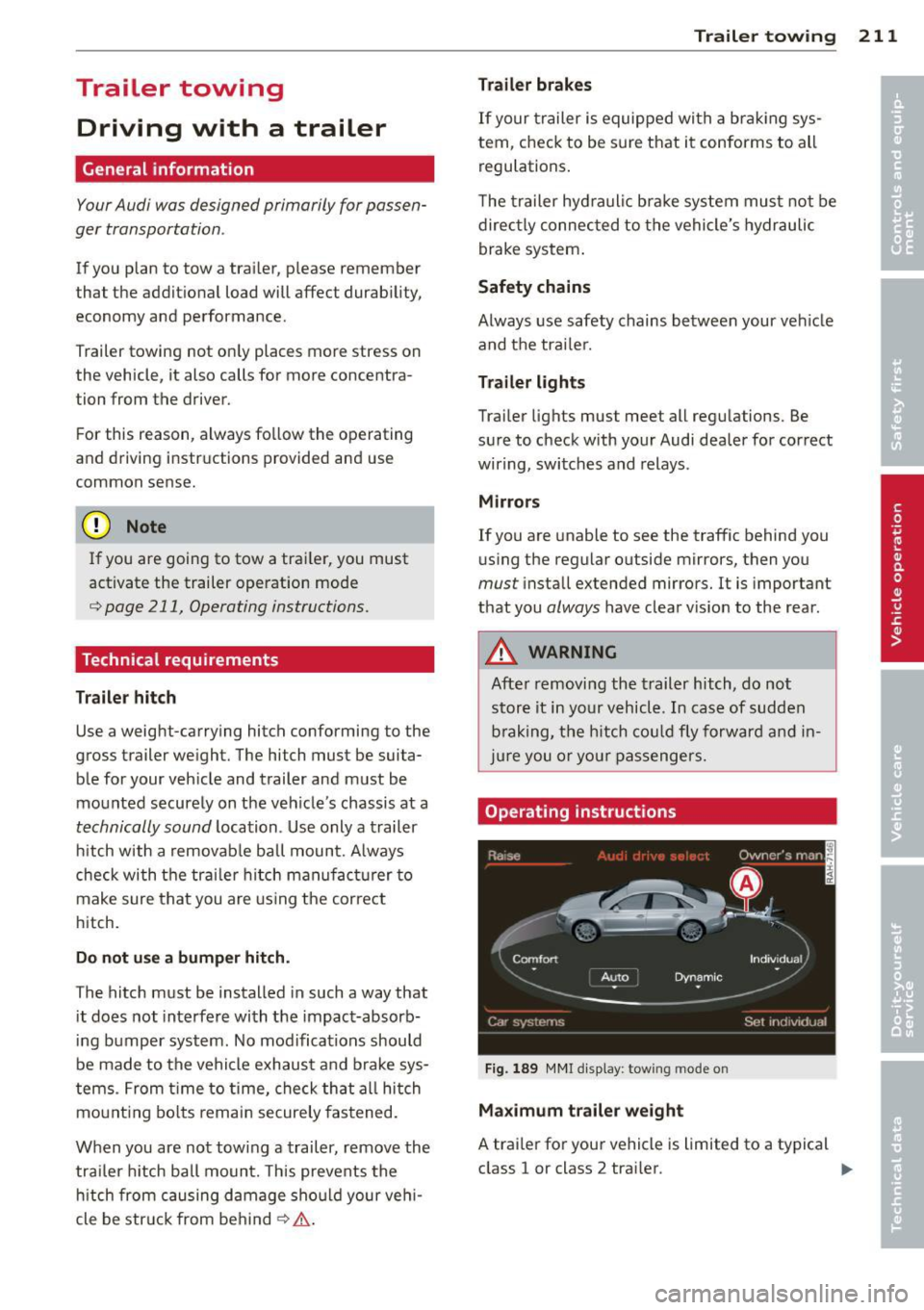
If you are going to tow a trai ler, you must
activate the trailer operat ion mode
~ page 211, Operating instructions.
Technical requirements
Trailer hitch
Use a weight-carrying hitc h co nforming to the
gross trailer we ight. The hitch must be suita
b le for your veh icle and trailer and must be
mounted secure ly on the veh icle's chassis at a
technically sound location . Use only a trailer
hi tch wit h a removab le ball moun t. A lways
check with t he trail er hitch ma nufactur er to
make sure tha t you are using the corre ct
hi tch.
Do not use a bumper hitch.
The hitc h must be installed in such a way that
i t does not interfere with the impac t-absorb
i ng bumpe r sys tem. No mod ifica tio ns should
be made to the vehicle exh aust a nd brake sys
tems . From time to time, check that a ll hitch
mo unt ing bolts remain securely fastened.
W hen you are not towing a trail er, remove the
traile r hitch ball mount. Th is prevents the
hi tch from causing damage sho uld your ve hi
cle be str uck from behind ¢& .
Trailer towin g 211
Trailer brakes
If your trailer is equippe d wi th a br akin g sys
tem, check to be s ure that i t conforms to all
r egulations .
T he trailer hy draul ic brak e sys tem mus t not be
direc tly connec ted to the vehi cle' s h ydraulic
brake system .
Safety chains
Always use safety chains between your veh icle
and the tra ile r.
Trailer lights
Trai ler lights must meet all regu lations. Be
su re to check with your Audi dealer for cor rect
wir ing, swi tches and relays .
Mirrors
If you are unable to see the traffic behind you
us ing the reg ular o utside mirrors, then you
must insta ll extended mirrors. It is imp ortant
that you
always have clea r v is ion to the rear.
A WARNING ...__ -
Afte r removing the trailer hitch, do not
stor e it i n yo ur v ehicl e. In cas e o f sudden
b ra king, the hitch co uld fly forwar d and in
ju re you or your p ass en ger s.
Operating instructions
Fi g. 189 MM I dis pl ay: tow ing mode on
Ma ximum trailer weight
A trai ler fo r you r vehicle is limited to a typical
class 1 or class 2 tra iler.
ll>
Page 214 of 318
212 Trailertowing
Trail er load dis tr ibut ion
Be sure the load in the trai ler is held securely
in place to prevent it from shifting forward,
backward or sideways.
N eve r all ow a p assenger to rid e in a trailer
~.&. in Driving instructions on page 213.
Engine cooling sy stem
Towing a tra iler makes the eng ine work hard
er . It is important that the cooling system's
performance is up to the addit ional load .
Make sure that the cooling system has eno ugh
flu id.
Tir e pressure
When tow ing a tra iler, inflate the t ires of your
vehicle to the co ld tire pressure listed under
" Full load " on the label loca ted o n the dr iver's
side B-pillar (v is ible when the door is open).
I nflate trailer tires to tra iler and tire manufac
turers' specifications.
Lights
Check to make sure both veh icle and trailer
l ights are wor king p roperly.
Safe ty chain s
Be sure tra iler safety cha ins are properly con
nected from the trailer to the hitch on the ve
h icle . Leave enough slack in the chains to per
mit turning corners . When you install safety
cha ins, make su re they w ill not drag on the
road when yo u are driving.
The chains shou ld cross under the tra iler
tongue to prevent it from dropping in case of
separat ion from the hitch .
Adjusting the Audi drive select
Make sure the vehicle is on a level surface be
for e
hitching up the tra iler and b efor e adjust
ing the tongue weight . The vehicle must be i n
auto or comfort driving mode and not raised
~ page 109, ~CD .
Make sure that the vehicle is lowered . In Info
tainment, select:
I CARI function button > Low
e r
control button . If you must drive under poor road conditions,
you can raise the vehicle
afte r coupling the
trailer or
a fter adjust ing the tongue we ight
~ page 111.
(D Note
-Changes in temperature or load can af
fect the height of the vehicle .
- Always select auto or comfort mode .
Otherw ise, the tongue load specified for
your vehicle will no longer be applicable.
Driving instructions
Driving with a trailer always requires extra
core and consideration.
T o obtain the best possible hand ling of vehicle
and trailer, please note the fo llowing:
.. Do not tow a loaded t railer when you r ca r it
self is not loaded .
.. Be especially carefu l when passing other
vehicles.
.. Observe speed limits.
.. Do not drive at the maximum permissible
speed .
.. Always apply brakes early .
.. Monitor the temperature gauge .
Weight di stribut ion
T owing a loaded trailer with an empty car re
su lts in a highly unstable d istribution of
weight. If this cannot be avoided, drive at very
l ow speeds only to avoid the risk of losing
steering control.
A "balanced" rig is easier to operate and con
trol. This means that the tow vehicle should
be loaded to the extent possible and permissi
ble , while keep ing the trailer as light as possi
ble under the ci rcumstances. Whenever poss i
ble , transfer some ca rgo to the luggage com
partment of the tow vehicle while obse rv ing
tong ue load requi rements and vehicle load ing
considerations .
Speed
The higher the speed, the more d ifficu lt it be
comes fo r the driver to cont rol the rig. Do not
1111>
Page 223 of 318
-To prevent damage to the wi res of the
rear defogger, do not place any adhesive
stickers on the inside of the rear window
over the wires.
- To he lp prevent dirt from scratching the
window, always scrape in a forward di
rection - pushing the scraper away from
you - never back and forth .
Cast (light) alloy wheels
Cast (light) alloy wheels require special care.
~ Wash the wheels with a sponge or hose
brush every other week.
~ For deep cle aning afterwa rds, use only a
dedica ted
acid -free cast alloy wheel cleaner.
~ Rub a coa t of liquid wax on to the r ims every
three month . Be sure to reach and treat all
parts of the rim .
To preserve the decorat ive appearance of the
cast alloy wheels , some special care is neces
sary . In add it ion to road dirt and salt , brake
dust is also corros ive. If left on for too long,
b rake dust can cause pi tting.
Use only specia l
acid-free cleaners formulated
for alloy rims. Safe products are available at
your Aud i deale r. Never leave the cleaner on
the r ims longe r than spec ified on the label. If
n o t rinsed off promptly , the acid co nta ined in
some cleaners can attack the th reads on the
wheel bo lts .
Never use abras ive or metal polishing clean
in g agents. If the prote ctive coat ing has been
chipped, e .g. by k icked up road d irt, touch it
up as soon as possib le .
A WARNING
- Moist ure and ice on brakes may affect
braking efficiency
i:> page 200, General
information.
Test the brakes carefully
each time you wash the vehicle .
- Always read and heed all WARNINGS and other information
c> page 215.
Cleaning and protec tion 221
Body cavity sealing
The body cavity sealing does not need to be
checked .
All body cav ities which could be affected by
corros io n have been thoroughly protected at
the factory .
This sealing does not require any inspection or additional treatmen t. If any wax should seep
out of the cavi ty when the ambie nt tempera
ture is high, it can be removed with a p lastic
scraper and a su itable solvent .
A WARNING
Solvents can be dangero us.
- Benz ine is flammab le and toxic. If you
use benz ine fo r removing the wax , keep
sparks, flame and lig hted cigarettes
away. Never d ump ben zine on the
grou nd, into open streams or down sew
age drains .
- Be s ure to obse rve a ll safe ty and environ
men tal reg ulations. Fo llow all instruc
tions on the container.
- Always read and heed a ll WAR NIN GS and
o ther information ¢
page 215.
Chassis
Have the undercoating checked for damage
from time to time.
The lower body shell of your Aud i is also thor
oughly p rotec ted against cor ros io n.
Any damage to the undercoat ing caused by
road hazards should be repaired promptly .
A WARNING
Too much undercoating in the wrong pla
ces can cause a fire.
- Do not apply additional undercoating or
rustp roofing on or nea r the exhaust
manifold, exhaust pipes, catalyti c con
ver ter or he at shields. While driving, the
substance used fo r undercoating co uld
overheat and cause a fire.
•
•
Page 227 of 318
~ Apply the product very sparing ly .
~ Wipe it off with a damp cloth.
If you have any questions abo ut cleaning and
caring for the leather in your vehicle, it is best
to contact your authorized Audi dealer, who
will be glad to help you and tell you about our
fu ll range of leather care products, such as:
- Leather cleaning and care kit
- Creams to care for colored leathe r
- Spot removers for ballpo int pens, shoe pol-
ish , etc.
- Oil/grease dissolv ing spray
- New and upcoming products.
A WARNING
Always read and heed all WARNINGS and other information
~ page 215.
CD Note
- Never use chemical solvents (e.g. lighter
flu id, turpentine), waxes, shoe polis h or
s imilar products on the leather surfaces
i n your Audi.
- To avoid damage, have stubborn stains removed by a commerc ial cleani ng spe
cia list .
Cleaning Alcantara ® (synthetic suede)
Appl ies to vehicles : wit h Alcantara upholstery
Removing dust and dirt
~ Moisten a cloth, squeeze out excess water
and wipe down the se at su rfaces .
Removing stains
~ Moisten a cloth w ith lukewarm water or
with diluted ethyl (rubb ing) alcohol.
~ Dab at the stain. Start at the outside and
work inwa rds.
~ Once the s tain is no longer visib le, use a
soft d ry cloth or t issue to soak up the mois
tu re .
D o not use leather cleaning produc ts on Al
cantara.
You may use a suitable shampoo fo r removing
dust and dirt.
Cleaning and protec tion 225
D ust and gr it in the po res and seams can
scratch and damage th e surface. If the car is
l eft stand ing in the sun for long per iods, the
A lcantar a cover s should be protected aga inst
direct sunlight to prevent it from fad ing.
Slight co lor variations will develop in normal
use a nd are not an indication of mate rial dete
rioration .
CD Note
- Never use chemical so lvents (e.g . lighter
fluid, tu rpenti ne), waxes, shoe polish or
simi lar p roducts on A lcantara ® surfaces .
- T o avoid damage, have stubborn sta ins
removed by a comme rcial clean ing spe
cialist.
- Do not use b rushes, stiff sponges or sim
ilarly abrasive cleani ng a ids.
Safety belts
Only well -maintained safety belts work relia
bly when needed .
~ Keep belts clean.
~ For cleaning, use a mild soap a nd wate r so l
ution . Let belts dry thorough ly and away
from d irect sunlight .
~ Do not allow i nertia ree l safety belts to re
tract before they are comp letely dry.
~ Check t he condition of your safety belts reg
ularly .
Heavi ly so iled safety be lts may not ret ra ct
properly.
A WARNING ~
D amaged safety belts can break in a crash .
- Anyth ing th at m ight damage yo ur safety
be lts could mean tha t you and your pas
sengers would not be adequate ly pro
tected in an accident.
- Safety belt performance depends on cor
rect insta llation . Never remove be lts
from the vehicle to clean them.
- Do not use chemical cleaning agents,
b leach or dyes. They have corrosive prop
erties which weaken the webb ing .
•
•
Page 234 of 318
232 Checking and filling
Checking and filling Engine hood
Releasing the engine hood
The engine hood is released from inside the
vehicle .
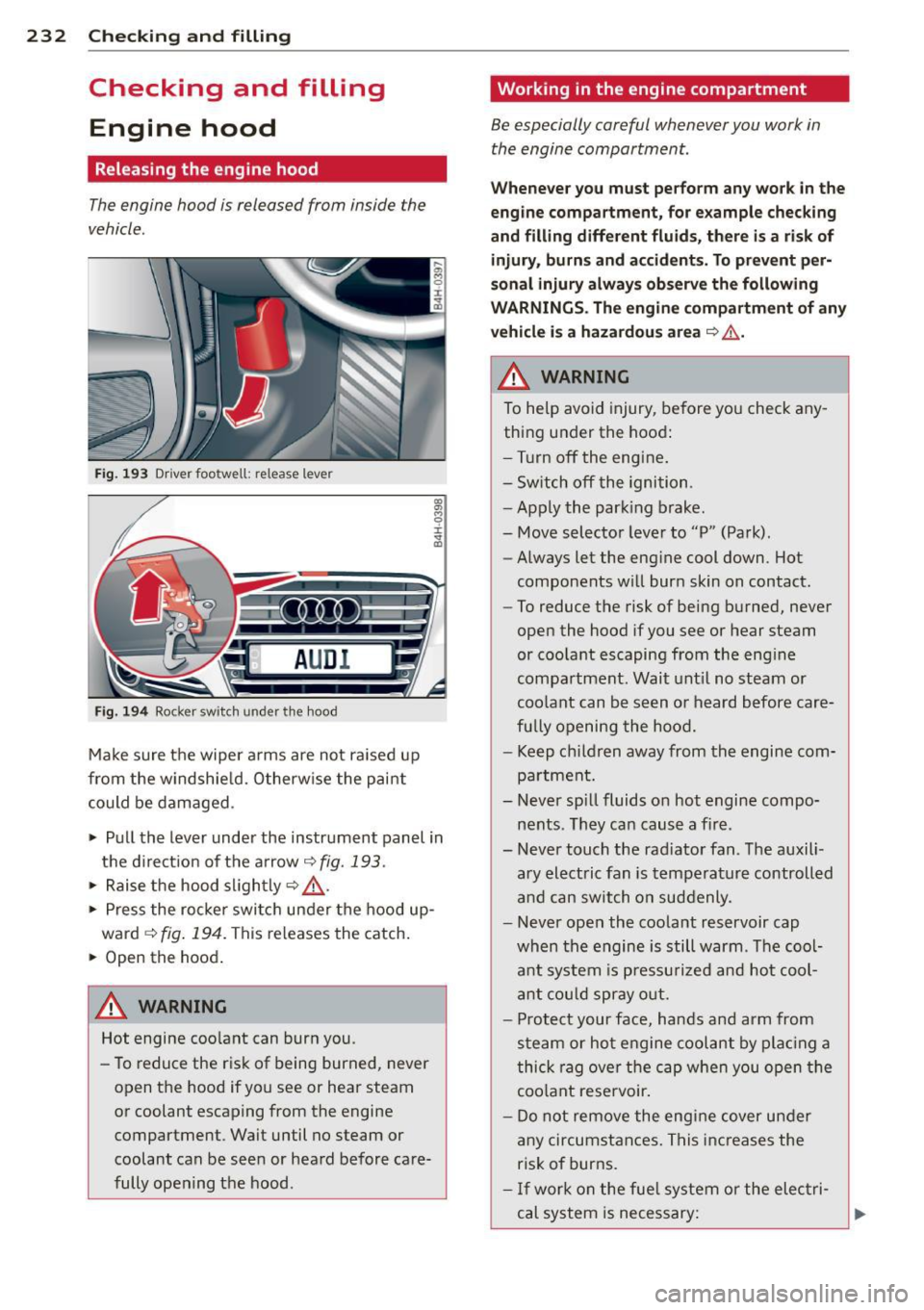
Fig. 193 Driver foo twell: release lever
AUD I
Fig. 194 Rocker switch un der the hood
Make sure the wiper arms are not raised up
from the windshield. Otherwise the paint
could be damaged .
.,. Pull the lever under the instrument panel in
the direction of the arrow
~ fig. 193.
.,. Raise the hood slightly~,&. .
... Press the rocker switch under the hood up
ward
~ fig. 194. This releases th e catch.
... Open the hood.
&_ WARNING
Hot engine coolant can burn you.
- To reduce the risk of being burned, never
open the hood if you see or hear steam
or coolant escaping from the engine compartment . Wait until no steam or
coolant can be seen or heard before care
fully opening the hood .
' Working in the engine compartment
Be especially careful whenever you work in
the engine compartment.
Whenever you must perform any work in the
engine compartment, for example checking
and filling different fluids, there is a risk of injury, burns and accidents. To prevent per
sonal injury always observe the following
WARNINGS. The engine compartment of any
vehicle is a hazardous area
~ ,&. .
A WARNING
To help avoid injury, before you check any
thing under the hood:
- Turn off the engine.
- Switch off the ignition .
- Apply the parking brake.
- Move selector lever to "P" (Park) .
- Always let the engine cool down. Hot
components will burn skin on contact.
- To reduce the risk of being burned, never
open the hood if you see or hear steam
or coolant escaping from the engine
compartment. Wait until no steam or
coolant can be seen or heard before care
fully opening the hood.
- Keep children away from the engine com
partment.
- Never spill fluids on hot engine compo
nents . They can cause a fire .
- Never touch the radiator fan. The auxili
ary electric fan is temperature controlled
and can switch on suddenly .
- Never open the coolant reservoir cap
when the engine is still warm . The cool
ant system is pressurized and hot cool
ant could spray out.
- Protect your face, hands and arm from
steam or hot engine coolant by placing a
thick rag over the cap when you open the
coolant reservoir.
- Do not remove the engine cover under
any circumstances. This increases the
risk of burns.
- If work on the fuel system or the electri
cal system is necessary:
Page 235 of 318

-Always disconnect the battery.
- Never smoke or work near heaters or open flames. Fluids in the engine com
partment could start a fire.
- Keep an approved fire extinguisher im
mediately available.
- To avoid electrical shock and personal in
jury while the engine is running or being
started, never touch :
- Ignition cables
- Other components of the high voltage
electronic ignition system.
- If you must perform a check or repair
with the engine running:
- First, fully apply the parking brake,
move selector lever to "P" (Park).
- Always use extreme caution to prevent
clothing, jewelry, or long hair from get
ting caught in the radiator fan, V-belts
or other moving parts, or from contact ing hot parts. Tie back hair before
starting, and do not wear clothing that
will hang or droop into the engine.
- Minimize exposure to emission and
chemical ha zards c:::> & .
A WARNING
California Proposition 65 Warning:
- Engine exhaust, some of its constituents,
and certain vehicle components contain
or emit chemicals known to the State of
California to cause cancer and birth de
fects and reproductive harm. In addition ,
certain fluids contained in vehicles and
certain products of component wear con
tain or emit chemicals known to the
State of California to cause cancer and
birth defects or other reproductive harm .
Checking and filling 233
-Battery posts, terminals and related ac
cessories contain lead and lead com
pounds, chemicals known to the State of
California to cause cancer and reproduc
tive harms. Wash hands after handling.
(D Note
When adding fluids, always make sure that
they are poured into the proper container
or filler opening, otherwise serious dam
age to vehicle systems will occur.
(® For the sake of the environment
To detect leaks in time, inspect the vehicle
floor pan from underneath regularly . If
you see spots from oil or other vehicle flu ids, have your vehicle inspected by an au
thorized Audi dealer.
Closing the engine hood
.,. Pull the hood down until the pressure from
the struts is reduced.
"' Let the hood
drop down and latch in place.
Do not try to push it shut; it may fail to en
gage
c:::> ,A .
A WARNING
-
A hood that is not completely latched
could fly up and block your view while driv
ing .
- When you close the engine hood, check it
to make sure the safety catch has proper ly engaged. The hood should be flush
with the surrounding vehicle body parts.
- If you notice while driving that the hood
is not secured properly , stop at once and
close it. •
•
Page 236 of 318
234 Checking and filling
Engine compartment
Engine compartment overview
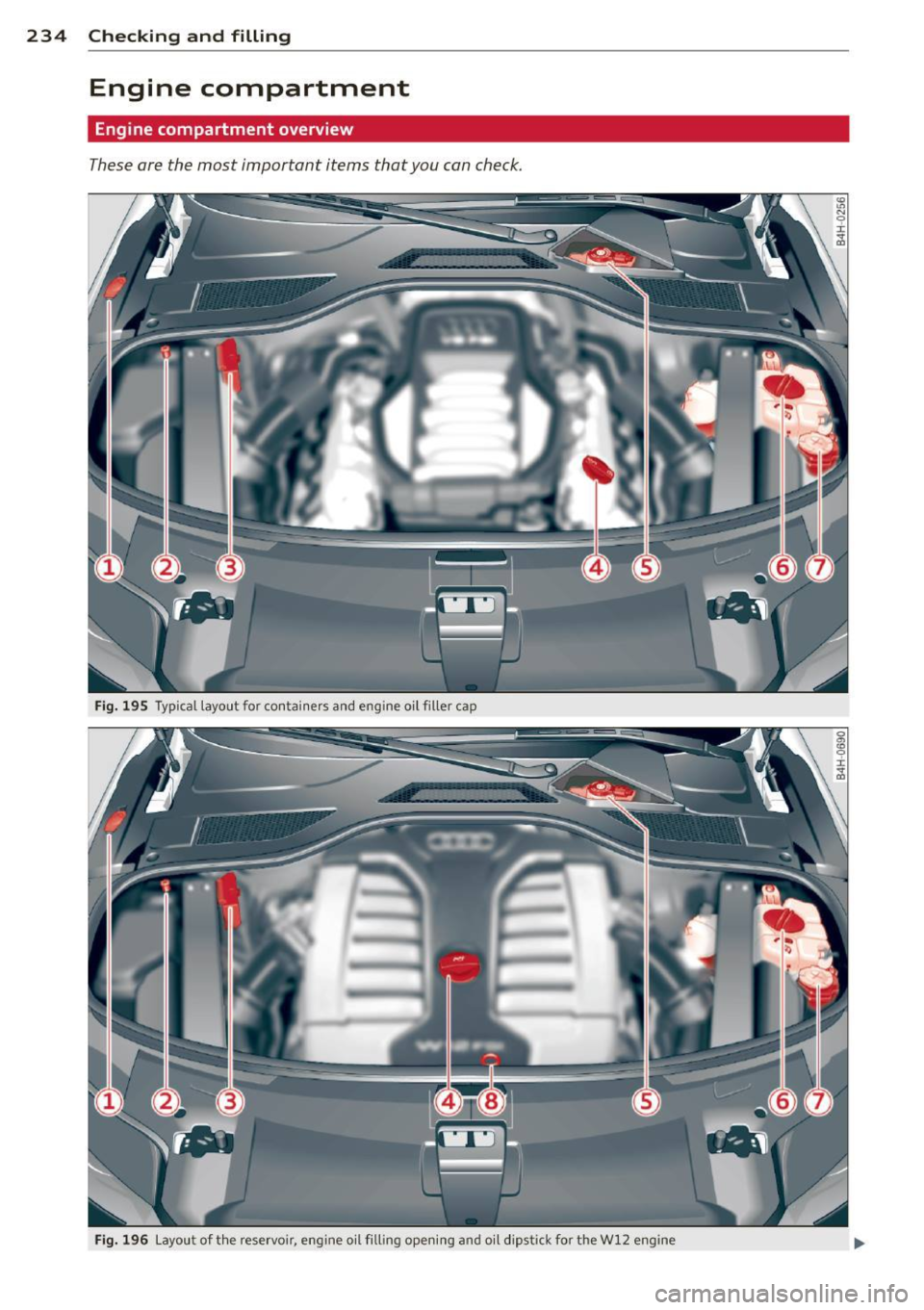
These are the most important items that you can check.
Fig. 195 Typical layout for co nta iners and eng ine o il filler cap
Fig. 196 Layo ut of th e rese rvo ir, engine o il filling op enin g and o il dipstick for the W l2 eng ine
Page 237 of 318
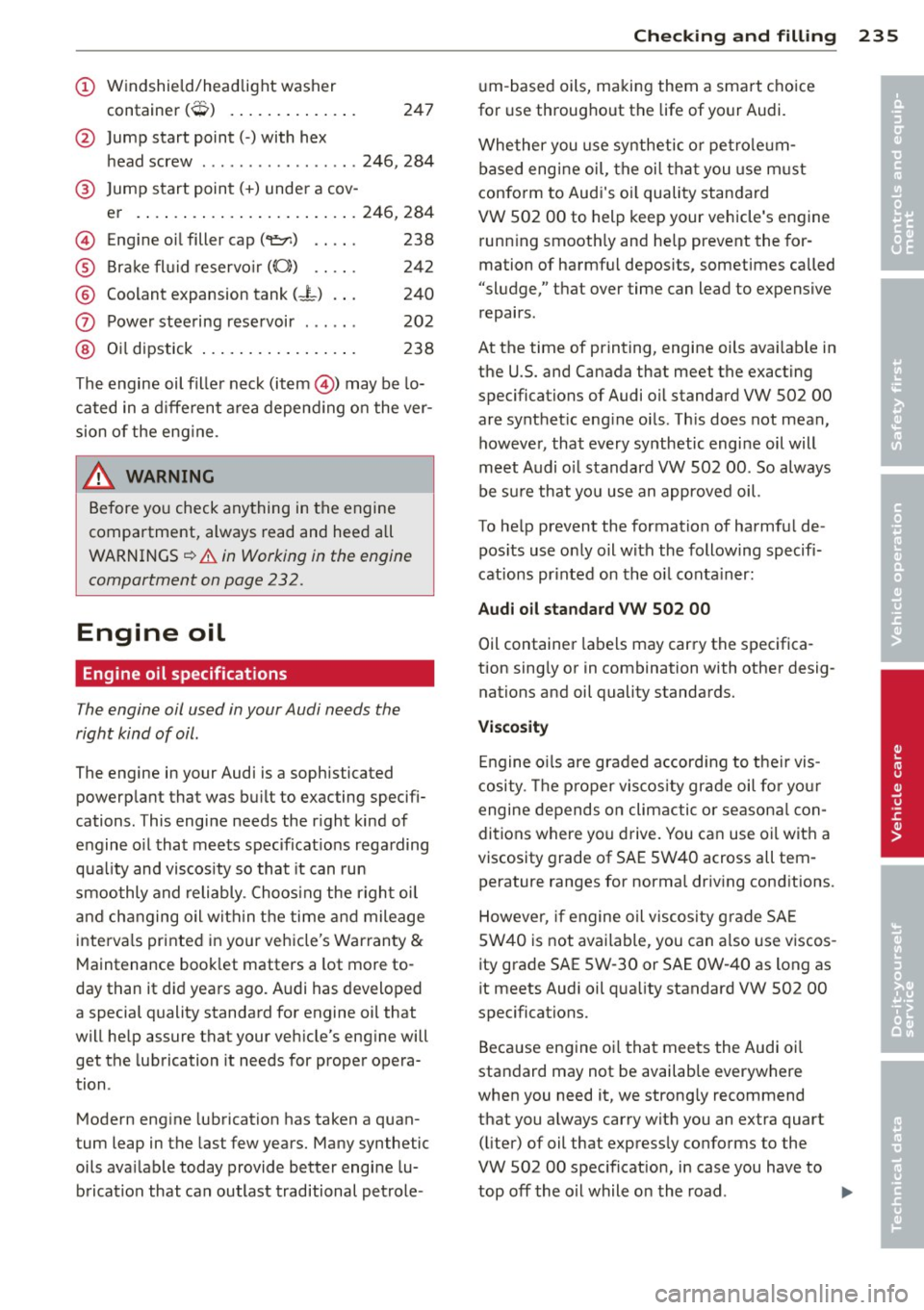
(!) Windshield/headlight washer
t .
(~ ) con ainer ,..., .. .... ... ... . . 247
@ Jump start point( -) with hex
h ead screw ............... .. 246, 284
® Jump start point( +) under a cov-
er . ..... .. ... .. ..... ... .. . 246, 284
@ Engine oil filler cap(~) . . . . . 238
® Brake fl uid reservo ir ((0)) . . . . . 242
® Coolant expansion tank (-L) . . . 240
0 Power steering reservoir . . . . . . 202
@ Oil dipstick . . . . . . . . . . . . . . . . . 238
The engine oil fille r nec k (item @) may be lo
cated in a d ifferent a rea depend ing o n the ver
sion of the eng ine .
A WARNING
Before yo u check any thing in the engine
compartment, always read and heed all
WARNINGS
~ &. in Working in the engine
compartment on page 232.
Engine oil
Engine oil specifications
The engine oil used in your Audi needs the
right kind of oil.
-
The engine in your Audi is a sophisticated
powerp lant that was bu ilt to exacting specifi
cations. This engine needs the r ight kind of
engine o il that meets specificat ions rega rding
qua lity and viscos ity so that it can run
smoothly and reliably . Choos ing the righ t oi l
and ch anging oil with in t he time and mileage
inte rva ls printed in your veh icle's Warranty
&
M aintenance book let matters a lot more to
day than it d id years ago. A udi has developed
a special quality standard for engine oil that
will he lp assure that your veh icle's eng ine will
get the lubrication it needs for prope r opera
tion .
M odern eng ine lubrication has taken a quan
tum leap in the last few years. Many synthetic
oils ava ilable today provide better engine lu
brication that can outlast traditional pet role -
Checkin g and fillin g 235
um -based oils, ma king them a smart cho ice
for use throughout the life of your Audi.
Whether you use sy nthetic o r pe trole um
based eng ine oil, the oil tha t you use m ust
confo rm to Aud i's oi l quality standard
VW 502 00 to help keep your vehicle's engine runn ing smooth ly and he lp prevent the for
mation of harmful deposits, sometimes called
"sludge," that over time can lead to expensive
repairs .
At the time of printing, engine oils ava ilab le in
the U.S. and Canada that meet the exact ing
specifications of Audi oi l standard VW 502 00
are synthet ic eng ine o ils . Th is does not mean,
howeve r, that every sy nthetic engi ne oil will
meet A udi o il standard VW 502 00 . So always
be s ure that yo u use an approved oil.
To he lp prevent the formation of harmfu l de
pos its use on ly o il wi th the following specifi
cat ions pr inted on th e oil conta iner:
Audi oil standard VW 502 00
Oil container labe ls may car ry the specifica
tion sing ly or in combination with othe r desig
nations and oil quality standards.
Viscosity
E ngine o ils are graded a ccord ing to the ir vis
cosi ty . T he p roper viscos ity grade oil fo r yo ur
engine depends on climactic o r seasona l con
ditions where yo u drive. You can use oi l wit h a
viscosity grade of SAE 5W40 across all tem
perature ranges for norma l driv ing cond itions.
However, if engine oil viscosity g rade SA E
5W40 is not available, you can also use viscos
ity grade SAE 5W -30 or SAE OW -40 as long as
it meets Audi oil q ua lity standard VW 502 00
specifications.
Because eng ine o il tha t meets the Audi oi l
standard may not be availab le everywhere
when you need it, we strong ly recommend
that you a lways carry wit h you an extra quart
( li ter) of oil that express ly conforms to the
VW 502 00 spec if icat ion, in case you have to
top off the o il while o n the road . .,..
•
•