wheel AUDI S8 2014 Workshop Manual
[x] Cancel search | Manufacturer: AUDI, Model Year: 2014, Model line: S8, Model: AUDI S8 2014Pages: 314, PDF Size: 78.47 MB
Page 180 of 314

178 Child Safety
-Always install rear-facing child safety
seats on the rear seat.
- If you must install a rearward facing
child safety seat on the front passenger
seat in exceptional circumstances and
the
PASSENGER AIR BAG OFF light does
not come on and stay on, immediately
install the rear-facing child safety seat in
a rear seating position and have the air
bag system inspected immediately by
your Audi dealer.
_& WARNING
If, in exceptional circumstances, you must
install a forward-facing child restraint on
the front passenger's seat:
- Always make sure the forward-facing
seat has been designed and certified by
its manufacturer for use on a front seat
with a passenger front and side airbag.
- Always follow the manufacturer's in
structions provided with the child safety
seat or carrier.
- Always move the passenger seat into its
rearmost position in the seat's fore and
aft adjustment range, as far away from
the airbag as possible before installing
the child restraint. The backrest must be
adjusted to an upright position .
- Always make sure that the
PASSENGER
AIR BAG OFF
light comes on and stays
on all the time whenever the ignition is
switched on.
(D Tips
Always replace child restraints that were
installed in a vehicle during a crash. Dam
age to a child restraint that is not visible
could cause it to fail in another collision
situation.
Advanced front airbag system and children
Your vehicle is equipped with a front "Ad
vanced Airbag System" in compliance with United States Federal Motor Vehicle Safety Standard (FMVSS) 208 as applicable at the
time your vehicle was manufactured.
The Advanced Airbag system in your vehicle
has been certified to meet the "low-risk" re
quirements for 3- and 6-year old children on
the passenger side and small adults on th e
driver side. The low ris k deployment criteria
are intended to reduce the risk of injury
through interact ion with the airbag t hat can
occur, for example, by being too close to the
steering wheel and instrument panel when
the airbag inflates . In addition, the system
has been certified to comply with the "sup
pression" requirements of the Safety Stand
ard, to turn off the front airbag for infants up
to 12 months who are restrained on the front
passenger seat in child restraints that are list
ed in the Standard.
Even though your vehicle is equipped with an
Advanced Airbag system , all children, espe
cially those 12 years and younger, should al
ways ride in the back seat properly restrained
for their age and size. The airbag on the pas
senger side makes the front seat a potentially
dangerous place for a child to ride . The front
seat is not the safest place for a child in a for
ward-facing child safety seat. It can be a very
dangerous place for an infant or a larger child
in a rearward-facing seat .
Advanced Airbags and the weight
sensing mat in the front seat
The Advanced Airbag System in your vehicle
detects the presence of an infant or child in a
child restraint on the front passenger seat us
ing the weight-sensing mat in the seat cush
ion and the sensor below the safety belt latch
on the front passenger seat that measures the
tension on the safety belt.
The weight -sensing mat measures total
weight of the child and the child safety seat
and a child blanket on the front passenger
seat. The weight on the front passenger seat
is related to the design of the child restraint
and its "footprint", the size and shape of the
bottom of the child restraint as it sits on the .,..
Page 201 of 314
Intelligent technology Notice about data
recorded by vehicle
control modules
Your vehicle is not equipped with an Event Da
ta Recorder (EDR), installed by some manu
facturers for the express purpose of capturing
data for retrieval after an accident or crash
event. EDR's are sometimes called "crash re
corders".
Some state laws restrict the retr ieval or down
loading of data stored by EDR's that were in
stalled in a vehicle for the express purpose of
retrieving data after an accident or crash
event without the owner's consent.
Although your vehicle is not equipped with an
EDR, it is equipped with a number of electron
ic control modules for various vehicle systems
such as, for examp le, engine function, emis
sion control, as well as for the airbags and
safety belts.
These electronic control modules also record
vehicle-related data during norma l vehicle op
eration for diagnostic and repair purposes.
The recording capacity of the electronic con
trol modules is limited to data (no sound is re
corded) and only a small amount of data is ac
tually recorded over a very limited period of
time and stored when a system fault or other
condition is sensed by a control unit. Some of
the data then stored may relate to vehicle
speed, direction, braking as we ll as restraint
system use and performance in the event of a
crash or other condition. Stored data can only be read and downloaded with special equip
ment.
Electronic Stabilization
Control (ESC)
Description
ESC helps to improve road holding and vehicle
dynamics to help reduce the probability of
skidding and loss of veh icle control. It works
only when the engine is running. ESC detects
Intelligent technology 199
certain difficult driving situations, including
when the vehicle is beginning to spin (yaw)
out of control and helps you to get the veh icle
back under control by se lectively braking the
wheels, and/or reducing engine power and
providing steering ass istance to help hold the
vehicle on the driver's intended course. The in
dicator light
JjJ in the instrument cluster
blinks when ESC is taking action to help you
control the vehicle.
ESC has limitations .
It is important to remem
ber that ESC cannot overcome the laws of
physics.
It will not always be able to help out
under all conditions you may come up against.
For example, ESC may not always be able to
help you master situations where there is a
sudden change in the coefficient of friction of
the road surface. When there is a section of dry road that is suddenly covered with water,
slush or snow, ESC cannot perform the same
way it would on the dry surface. If the vehicle
hydroplanes (rides on a cushion of water in
stead of the road surface), ESC will not be
able to help you steer the vehicle because con
tact with the pavement has been interrupted
and the vehicle cannot be braked or steered .
During fast cornering, particularly on winding
roads, ESC cannot always deal as effectively
with difficult driving situations than at lower
speeds. When towing a trailer, ESC is not able
to help you regain control as it would if you
were not tow ing a trailer.
A lways adjust your speed and driving style to
road, traffic and weather conditions. ESC can
not override the vehicle's physical limits, in
crease the available traction, or keep a vehicle
on the road if road departure is a result of
driver inattention. Instead, ESC improves the
poss ibility of keeping the vehicle under con
trol and on the road dur ing extreme maneu
vers by using the driver's steering inputs to
help keep the vehicle going in the intended di
rection. If you are traveling at a speed that
causes you to run off the road before ESC can
provide any assistance, you may not experi
ence the benefits of ESC.
•
•
Page 202 of 314
200 Intellig ent technol ogy
ESC includes and/or works together with the
anti-lock braking system (ABS), brake assist
system, anti-slip regulat ion (ASR), electronic
d ifferential lock (EDL), dynamic steering* and
electronic interaxle differential lock*. ESC is
switched on all the time. In certain situations
when you need less tract ion, you ca n sw itch
off ASR by pressing the button above
~ page 201, fig. 188 the se lector lever. Be
sure to sw itch ASR on aga in when you no lon
ger need less traction.
Anti -lock braking system (ABS )
ABS prevents the wheels from locking up
when braking. The vehicle can still be steered
even du ring ha rd b raking . Apply steady pres
sure to the brake pedal. Do not pump the ped
a l. A pulsing in the brake peda l indicates that
the system is he lping you to brake the vehicle.
Br ake assist system
The brake assist system can decrease brak ing
d istance. It increases braking power when the
d river p resses the brake pedal q uick ly in emer
gency situations. You must press and hold the brake peda l until the situation is over. In
vehicles with adaptive cruise control*, the brake assist system is more sensitive if the
d istance detected to the vehicle ahead is too
small.
Anti- slip regulati on (ASR )
ASR reduces engine power when the drive
wheels begin to spin and adapts the force to
the road condit ions. This makes it easier to
start, accelerate and drive up hills.
El ectronic diff erential lo ck (EDL )
The ED L brakes wheels that are spinning and
transfers the drive power to the other drive
wheel or whee ls if the vehicle is equipped with
all whee l drive*. This funct ion is available up
to about 7S mph (120 km/h).
In extreme cases, EDL a utomatica lly switches
off to help keep the brake on the braked whee l
from overheating. EDL will switch on again au
tomatically when conditions have returned to normal.
Dynamic ste ering *
On vehicles with dynamic s teering, ES C helps
stabilize the steering in certain situations.
Electronic interaxle differential lock
function*
T he electronic interaxle differentia l lock f unc
tion activates when driving thro ugh curves.
Braking is targeted toward the wheels on the
inside of the curve as needed . This he lps to
minimize front whee l skid, improves traction
and allows for more precise driving through
curves .
A WARNING
- ESC, ABS, ASR, EDL, dynamic steering*
and the electronic interaxle differential loc k function* cannot overcome the laws
of physics. This is espec ially impo rtant
on slippery o r we t roads.
If the systems
begin acting to stabilize your vehicle, you
should immediately change yo ur speed
to match the road and traffic conditions .
Do not let the increased safety provided
by these systems tempt you to take risks. Doing so will increase the risk of a loss of
veh icle control, collision and ser ious per
sonal injur ies.
-Always adapt your speed to road, traffic and weather conditions. The risk of losing control of the vehicle increases when
d riving too fast, espec ially through
curves and on slippery or wet roads, and
when driving too close to vehicles up
ahead. ESC, ABS, the brake ass ist sys
tem, EDL, ASR, dynamic steering * and
the electron ic interaxle differential lock
function* cannot prevent collisions.
- Always accelerate with special care on
even, smooth s urfaces such as those that
are wet or covered with ice and snow.
The drive wheels can spin even w ith
these assistance systems that cannot al
ways he lp to red uce the risk of loss of ve
h icle control.
-
Page 203 of 314
@ Tips
-ABS and AS R on ly wor k co rrectly when
a ll fo ur wheels are eq uipped w ith identi
ca l tires . Different tire s izes can lead to a
r educt io n in eng ine power.
- You may hear noises when the sys tems
desc ribed are working.
Switching on and off
Intelligent technology 201
- If the ind ica tor li ght DJ o r til1 (U SA
mo dels)/ [!] (Canada models) appea rs,
there may be a malfunc tion
r:::> page 19,
¢page 18.
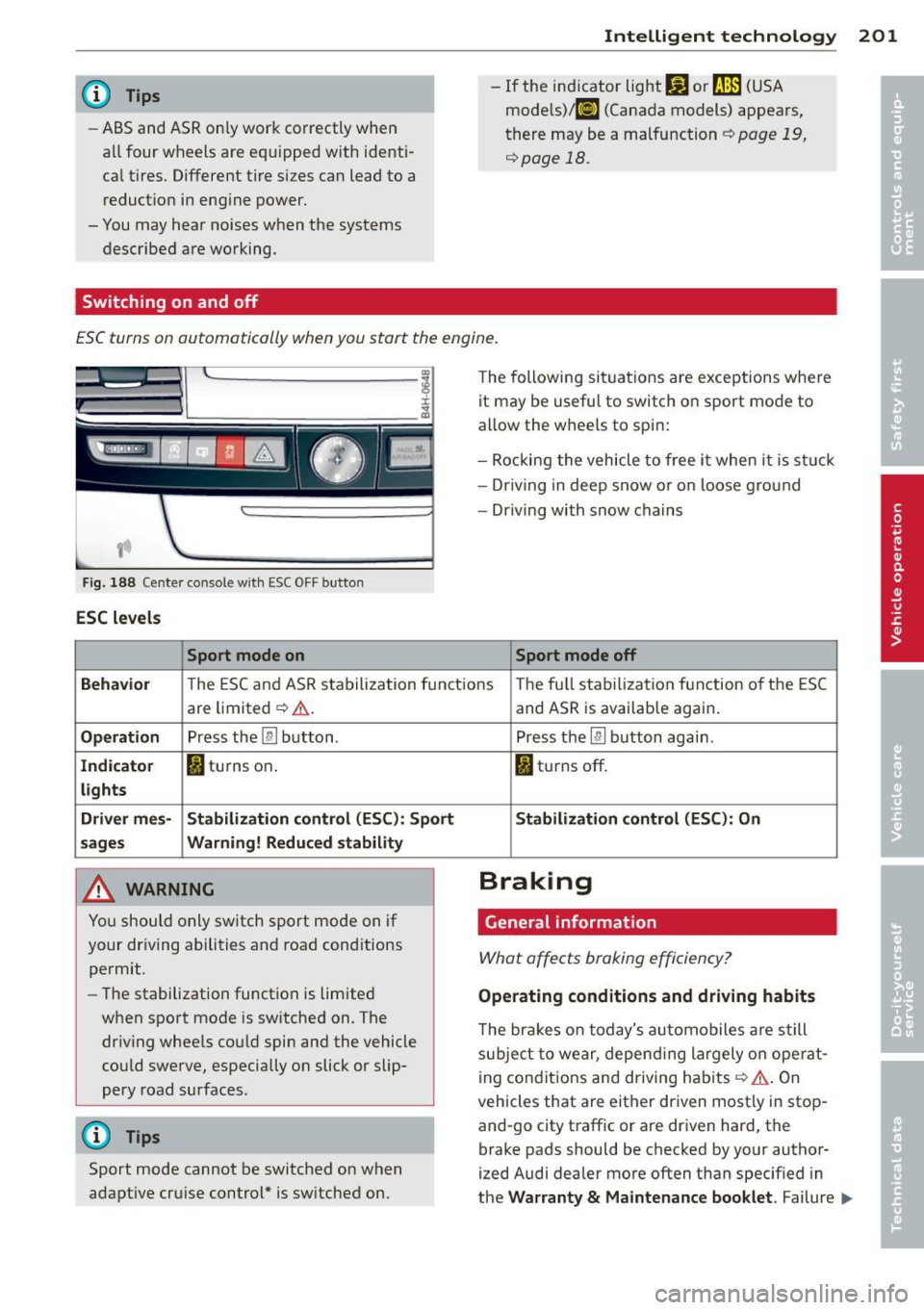
ESC turns on automatically when you start the engine.
Fig . 188 Center co nsole with ESC O FF bu tton
ESC levels
Sport mode on
The following si tua tions are exceptions whe re
it may be usefu l to switch o n sport mo de to
allow the w heels to spi n:
- Rockin g the vehicle to free it when i t is st uck
- Dr iv ing in deep s now o r on loose g ro un d
- Dr iving with snow chains
Sport mode off
Behavior
T he E SC and AS R sta bilization f unct io ns The fu ll sta biliz ati on f uncti on o f the ES C
are limited¢ ,&.
Operation Press the [ru button .
Indicator II turns on .
lights
Driver mes· Stabilization control (ESC): Sport
sages Warning! Reduced stability
A WARNING
Yo u should o nly sw itch sport mo de on i f
your dr iv ing abili ties and road cond itions
permit.
- The stabilization function is limited
when sport mode is sw itched on. The
dr iv ing whee ls co uld spin and the vehicle
cou ld swe rve , especially on slick or slip
pery road surfaces.
(D Tips
Sport mode cannot be switched o n when
adapt ive cr uise c ontrol* is sw itched on.
-
and AS R is availab le again .
Press the
[ru button again .
II tur ns off.
Stabilization control (ESC): On
Braking
General information
What affects braking efficiency?
Operating conditions and driving habits
The bra ke s on today's au to m obiles a re s till
sub ject t o wear, depe nding la rgely o n ope rat
i ng con dit ions and d riving habits¢
A . On
vehicles that are either driven most ly in stop
and-go city traff ic or are driven hard , the
brake pads should be checked by your author
ized Audi dealer more often than specif ied in
t h e
Warranty & Maintenance booklet . Failure .,..
Page 204 of 314

202 Intellig ent technol ogy
to have your brake pads inspected can result
in reduced brake performance.
On steep slopes, yo u shou ld use the b rak ing
effect of the engine. Th is way, you prevent un
necessary wear on the brake system. If you
must use your brakes, do not hold the brakes
down continuously. P ump the brakes at inter
vals.
Operating nois e
Noises may occur when braking depending on
the speed, braking force and outside condi
tions such as temperature and humidity.
E ff ect of water and road salt
In certain situat ions, for example after driving
through water , in heavy ra in , after overn ight
condensation or after washing your car, the braking effect can be reduced by moisture or
ice on the brake rotors and brake pads. The
brakes must be dried first with a few careful
brake applications.
At higher speeds and with the windshield wip
ers turned on, the brake pads press against
the brake rotors for a short amount of time.
This occurs at regular intervals without the
driver noticing and provides for bet ter brake
response time under wet condit ions .
The effectiveness of the brakes can be reduced
when the vehicle is dr iven on a salt-covered
road and the brakes are not used . Likew ise,
you clean off accumulated salt coating from
brake discs and pads with a few caut ious ap
plications of the brake
9 .&, .
Cor ro sion
There may be a tendency for dirt to build up
on the brake pads and corrosion to form on
the discs if the car is not dr iven regularly or
only for short t rips with little use of the
b rakes .
If the brakes are not used frequently , or if cor
rosion has formed on the discs, it is advisable
to clean off the pads and discs by braking
firm ly a few times from a mode rately high
speed
9 .&, .
Faults in the brake syste m
If you shou ld notice a sudden increase in
brake pedal trave l, then one of the two brake
circuits may have fai led
9 & .
Low bra ke fluid lev el
Malfunctions can occu r in the bra ke system if
the b rake fluid level is too low. The brake flu id
level is monitored electro nica lly.
Brake lining we ar statu s
Brake lining wear may be checked by visual in
spect ion of the condition of the brake pads
th rough the open ings in the wheel. If neces
sary, the wheel may be removed for t his i n
spect ion
9 page 2 72, Changing a wheel.
A WARNING
- You shou ld perform braking maneuvers
for the purpose of cleaning the brake system only if road conditions permit.
Other road users must not be put at risk -
you may cause an accident!
- Before descending a steep grade, reduce
speed and sh ift transmission into a lower
gear or lower dr iving range. Do not ride
the brakes or hold the pedal down too
long or too often . This could cause the
b rakes to get hot and diminish braking
efficiency.
- Do not "ride the brakes" by rest ing your
foo t on the pedal when you do not intend
to brake. This may cause the brakes to
overheat, premature wear and increased
stopping distance.
- Unde r certain cl imatic and operat ing
conditions such as passing thro ugh wa
ter, driving in heavy rain or after washing
the vehicle, the effectiveness of the brakes can be reduced. In winter, ice can
accumu late on the brake pads, linings,
d iscs and drums. Carefully app ly brakes
for a test. Brakes will dry and ice coat ings will be cleaned off after a few care
fu l brake applicat ions.
- Driving for an extended period of t ime on
salt-covered roads without using your brakes can a lso affect bra king efficiency.
~
Page 205 of 314

Clean off accumulated salt coating from
brake discs and pads with a few careful
brake applicat ions .
-If you damage the front spoiler, or if you
install a different spoiler, be sure the air
flow to the front brakes is not obstruct ed . Otherwise the brake system could
overheat reducing the effectiveness of
the ent ire brake system.
- Failure of one brake c ircuit will impair
the braking capability resulting in an in
cr eased stopp ing distance. Avoid driv ing
the vehicle and have it towed to the near est Aud i dea ler or q ualified wor kshop .
- Never let the vehicle rol l to a stop w ith
t he engine shu t off.
- If the brake booster is not work ing, the
brake pedal must be pressed conside ra
bly harder to make up for the lac k of
booster assistance.
Brake booster
The brake booster adds extra braking power.
The brake booster works w ith vacuum pres
sure which is created only when the engine is
ru nning
9 ,&. .
,&. WARNING
-Never le t the vehicle ro ll to a stop w ith
t he engine shu t off.
- If the brake booster is not work ing, fo r
ex ample when towing your ve hicl e, or
because the b rake booste r has somehow
been damaged, the brake pedal must be
pressed considerab ly harder to make up
for the lack of booster assistance.
Servotronic - advanced
power steering system
-
The power steering systems use the power of
the running engine to allow precise steering
with little effort.
The advanced Servotronic power steering sys
tem senses the road speed and electron ically
ad ju sts powe r ass istance to provide comfor ta-
Int ellig ent technolog y 203
ble and safe steering response exactly match
ed to th e vehicle speed .
Power steer ing will not work if the engine is
off . As a result, the steering wheel will be h ard
to tu rn.
T he powe r stee ring fluid level is checked d ur
i ng t he sched uled maintena nce services.
(D Note
If there is an e lectronic malfunction, ser
votronic
will s till fu nction like a conven
tiona l powe r steering system, providing a
constant steering s upport force tha t is no
l onge r proportionate to the vehicle speed.
This is most noticeab le when t urni ng the
steering wheel at low speeds (for example
when parking), -more effort w ill be re
quired than usual.
- Be aware of the different than usual steering response and adjust your steer
ing force accordingly.
- Have the problem checked and set right by an Audi dealer as soon as possible.
(D Tips
-When the engine is running, never hold
the steering wheel turned all the way to
the right or to the left for longer than 15
seconds . The power steering pump will
overheat the hydraulic fluid if yo u keep
holding the stee ring wheel turned all the
way. This is likely to damage the power
steering sys tem.
- If the powe r stee ring system should fa il
entire ly, o r if t he engine is not runn ing
(for example, wh ile be ing towed), you
w ill still be able to steer the veh icle .
However,
considerably more effort will
be required to do so .
- If the powe r steering system sho uld
have a leak, or is not functioning proper
ly, contact your author ized Audi dealer
immediately.
- The power steering system req uires a
specially formu lated hydraulic fluid. The
power steering fluid reservoir is located
in the engine compartment
9 page 233. IJJ,,
•
•
Page 206 of 314
204 Intelligent technology
The correct f luid leve l in the reservoi r is
important for proper functioning of the
power steer ing.
Driving with your
quattro
With All Wheel Drive, all four wheels are driv
en.
General information
With All Wheel Drive, power is distributed to
all four wheels . This happens automatically
depending on your dr iving style and the road
conditions at the t ime . See a lso
c::;, page 199.
W ith the sport differential*, power distribu
tion to the rear wheels is var iable and can be
ad justed with Aud i drive select*
c::;,page 110.
Always read and fo llow safety precautions
¢ &, .
Winter tires
When driv ing in the w inter, your vehicle w ith
A ll Wheel Drive has an advantage, even with
r egular tires. In winter road conditions it may
be advisable to mount winter tires (or all-sea
son tires) for improved driveability and brak ing: these tires must be mounted on all four
wheels. See also c:;, page 263, Winter tires.
Snow chains
Where snow chains are mandatory on certain
roads, this normally a lso applies to vehicles
with A ll Wheel Drive
¢ page 264, Snow
chains.
Replacing wheels/tires
Vehicles with A ll Wheel Dr ive must always
have tires of the same size . Also avoid ti res
with different tread depths. For details see
page
c:;, page 2 59, New tires and replacing
tires and wheels.
Off-Road driving?
Your Aud i does not have enough ground clear
ance to be used as an off -road vehicle. It is
therefore best to avoid rough tracks and un
even terrain as much as possible. Also refer to
c::;, page209.
A WARNING
Always adjust your driving to road and traf
f ic conditions. Do not let the extra safety
afforded by All Wheel Drive tempt you into
taking extra risks.
- Although the All Wheel Drive is very ef
fective, always remember that braking
capacity is lim ited by tire traction. You
should therefore not drive at excessive
speeds on icy or slippery road surfaces.
- On wet road surfaces, be careful not to
drive too fast because the front wheels
could begin to slide on top of the water
(aquaplaning) . If this should occur, you
will have no warning from a sudden in
crease in eng ine speed as with a front
wheel drive vehicle. Always drive at speeds which are suited to the road con
ditions - risk of crash.
Energy management
Starting ability is optimized
Energy management controls the distribution
of electrical energy and thus optimizes the
availability of electrical energy for starting
the engine .
If
a vehicle with a conventiona l ene rgy system
is not driven for a long period of time, the bat
tery is discharged by idling current consumers
(e .g . immobilizer). In certain circumstances it
can resu lt in there being insufficient energy
available to start the engine .
Intelligent energy management in your vehi
cle handles the distribution of e lectrica l ener
gy. Starting ability is markedly improved and
the life of the battery is extended.
Basically, energy management consists of
battery diagnosis , idling current manage
ment
and dynamic energy management.
Battery diagnosis
Battery diagnosis continuously determines
the state of the battery. Sensors determine
battery voltage, battery current and battery ..,.
Page 216 of 314
214 Trailer towing
drive at the maximum permissible speed. Re
duce your speed even more if load, weather or
wind condit ions are unfavorable -part icu larly
when going downhill.
Reduce vehicle speed
immedi atel y if the trail
er shows the slightest sign of swaying .
Do not
tr y to stop th e sway ing by acceler ating .
Observe speed limi ts. In some areas, speeds
for vehicles towing trailers are lower than for
regular vehicles .
A lways apply brakes early. When driv ing
downhill, shift into a lower gear to use the en
gine braking effect to slow the vehicle . Use of
the brakes a lone can cause them to overheat
and fail.
Coolant t emperature
The coolant temperature gauge ¢ page 10
must be observed carefully. The coolant tem
perat ure can increase if you drive on long in
clines in a low gear at high engine speeds. Re
duce your speed immediate ly if the L EDs in
the top part of the display turn on.
F or more in formation about indicator lights,
refer to. ¢
page 16.
A WARNING
Anyone not properly restrained in a mov
ing veh icle is at a much greater risk in an
accident . Never let anyone ride in your car
who is not properly wear ing t he restra ints
provided by Aud i.
Trailer towing tips
Important to know
Your vehicle hand les different ly when towing
-
a trailer because of the addit ional weight and
d ifferent weight distribution . Safety, perform
ance and economy w ill greatly depend on how
carefully you load your trailer and operate
your rig.
Before you actually tow your trailer, practice
turning, stopp ing and back ing up in an area
away from traffic . Keep practicing until you have become completely familiar with the way
your vehicle-trailer combination behaves and responds .
Backing up is diffi cult and requ ires practice .
Backing up with a trailer gene rally req uires
steering action opposite to that when backing
up your vehicle without a tra iler.
Maintain a greater d ista nce between you r ve
hicle and the one in front of you . You wi ll need
more room to stop. To compensate for the
trailer, you w ill need a larger than normal
turning rad ius.
When passing, remember that you cannot ac
ce lerate as fast as you norma lly would be
ca use of the added load. Make sure yo u have
enough room to pass. After passing, allow
plenty of room for your trailer be fore chang
ing lanes again .
Avoid jerky starts, sharp turns or rapid lane changes.
(D Tips
- Do not tow a trailer during the break-in
period of your vehicle .
- If you tow a trailer, your Audi may re
quire more frequent maintenance due to
the extra load ¢
page 292.
Parking on a slope
Do not park on a slope with a trailer. If it can
not b e avoided, do so only after doing th e fol
lowing:
When par king:
.,. App ly the foot brake.
.,. Have someone p lace chocks under both the
vehicle and the tra iler wheels .
.,. With chocks in place, slowly release the
brakes unt il the wheel chocks absorb the
load .
.,. Turn the whee ls towards the curb .
.,. Apply the parking brake .
.,. Select the P se lector lever posit ion.
When re starting after parking:
.,. App ly the foot brake.
Page 217 of 314

~ Start the engine.
~ Se lect the D selector lever position.
~ Re lease the park ing brake and slowly pull
out and away from the wheel chocks .
~ Stop and have someone retrieve the wheel
chocks.
(D Tips
If you move the selector lever of the auto
matic transm ission to P before applying
the parking brake and before blocking the
wheels, you may have to use more force
later to move the lever out of the P posi
tion .
Trailer towing 215
•
•
Page 219 of 314

Vehicl e ca re a nd cl eanin g 217
Rinse the vehicle thoroughly again and let it
air dry. Remove any water residue using a
shammy .
Stubborn depos its s uch as bird dropp ings or
tree sap are best removed with plenty of wa
ter and a microfiber cloth.
A WARNING
-Only wash the vehicle when the ignition
is off and follow the instructions from
the car wash operator to reduce the risk
of accidents .
- To reduce the risk of cuts, protect your
self from sharp metal components when
wash ing the underbody or the inside of
the wheel housings .
- After washing the vehicle, the braking ef
fect may be delayed due to mo isture on
the brake rotors or ice in the winter. The
brakes must be dried first with a few
careful brake applicat ions .
- If you wash the vehicle in an automatic
car wash, you must fold the exterior m ir
rors in to reduce the r is k of damage to
the mirrors. Power folding exterior m ir- rors* must only be fo
lded in and out us
ing the power folding fu nction .
- T o prevent paint damage, do not wash
the vehicle in direct sunlight.
- T o reduce the r is k of damage to the sur
face, do not use insect removing spong
es, kitchen sponges or similar items.
- Matte finish painted vehicle compo
nents:
- To reduce the risk of damage to the
surface, do not use polishing agents or hard wax.
- Never use car wash cycles that apply
protective wax. It can destroy the
matte fin ish effect .
- Do not place any stickers or magnet ic
signs on vehicle parts painted w ith
matte fin ish paint. The paint cou ld be
damaged when the stickers o r magnets
a re removed.
@ For the sake of the environment
Only wash the vehicle in facilities spec ially
designed for that p urpose . This will reduce
the r is k of dirty wate r contam inated with
oil from entering the sewer system.
Cleaning and care information
When clea ning and caring for individual vehi
cle components, refer to the fo llow ing tab le.
The information contained there is simp ly rec
ommendations. For questions or for compo -nents that are not listed
, refer to a n author
ized Audi dea ler or a qualified workshop. Also
follow the information found in ¢ .&. .
Cle an ing exte rior
Component Situation Solution
Wipe r blades
Dirty ~ page 54, Cleaning windshield wiper blades
Headlight s/ Dirty Soft sponge with a mild soap solutiona>
tail ligh ts
S en sor s/
Dirty Sensors: soft cloth with a so lvent-free cleaning product
camera le nses Camera lenses: soft cloth with an alcohol-free cleaning
so lution
Snow/ice Hand brush/so
lvent-free de-icing spray
Wheel s Road salt Water
Brake dust Acid-free special cleaning
solution
•
•