ignition AUDI S8 2016 Workshop Manual
[x] Cancel search | Manufacturer: AUDI, Model Year: 2016, Model line: S8, Model: AUDI S8 2016Pages: 302, PDF Size: 75.68 MB
Page 173 of 302
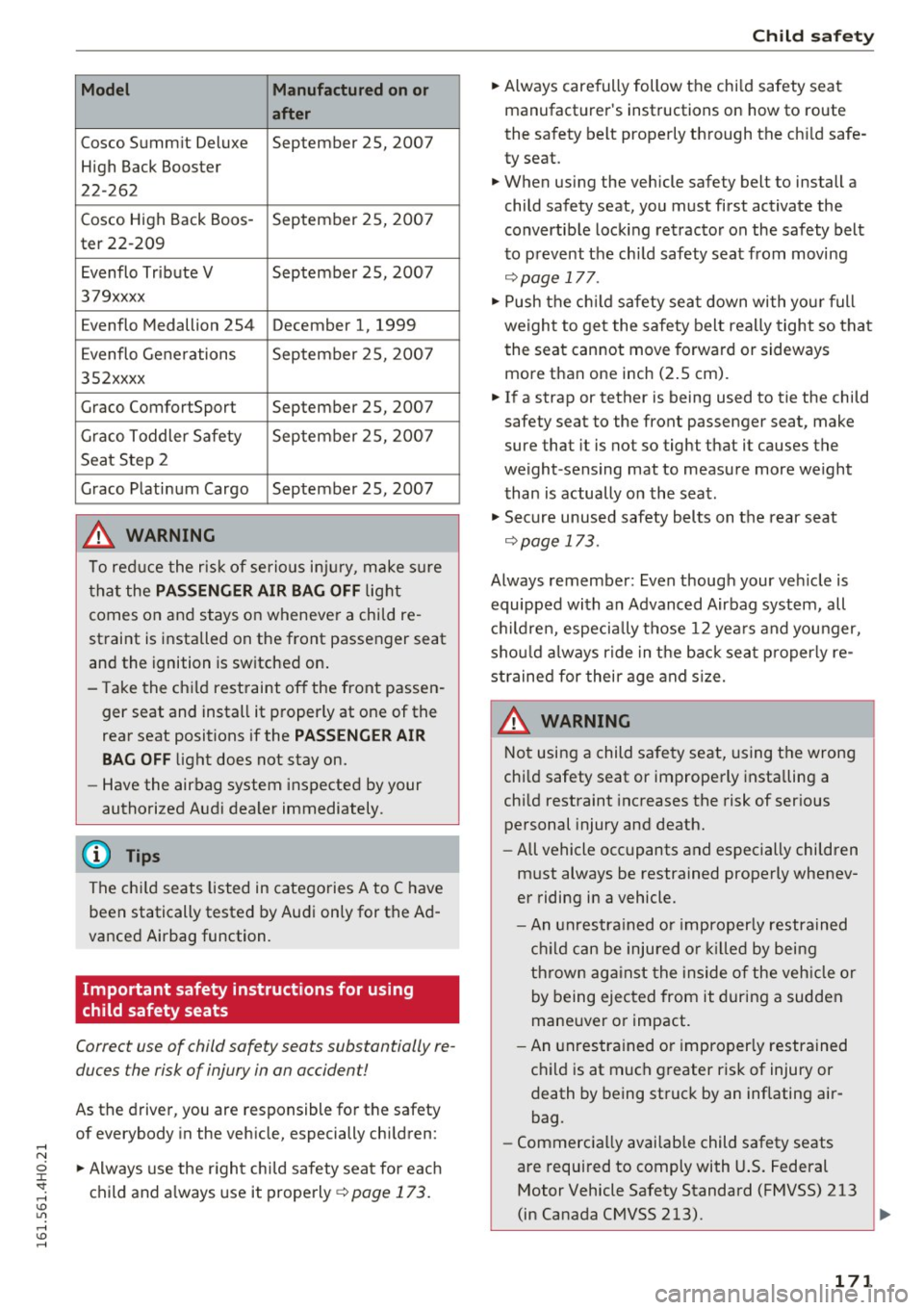
Model Manufactured on or
after
Cosco Summit Deluxe September 25, 2007
High Back Booster
22-262
Cosco High Back Boos -
September 25, 200 7
ter 22-209
Evenflo Tr ibute V September 25, 2007
379xxxx
Evenflo Medallion 254 December 1, 1999
Evenflo Generations September 25, 2007
352xxxx
Graco ComfortSport September 25, 2007
Graco Toddler Safety September 25, 2007
Seat Step 2
Graco Platinum Cargo September 25, 2007
.&, WARNING
To reduce the risk of serious inju ry, make sure
that the
PA SSEN GER AIR BAG OFF light
comes on and stays on whenever a child re
straint is installed on the front passenger seat
and the ignition is switched on.
- Take the child restraint off the front passen
ger seat and install it properly at one of the
rear seat positions if the
P A SSEN GER AIR
BAG OFF
light does not stay on.
- Have the airbag system inspected by your
authorized Audi dealer immediately.
(D Tips
The chi ld seats listed in categories A to C have
been statically tested by Audi only for the Ad
vanced Airbag function.
Important safety instructions for using
child safety seats
Correct use of child safety seats substantially re
duces the risk of injury in an accident!
As the driver, you are responsible for the safety
of everybody in the veh icle, especially children:
.,. Always use the right chi ld safety seat for each
child and a lways use it properly
q page 173.
Child safety
.,. Always carefully follow the chi ld safety seat
manufacturer's instructions on how to route
the safety belt properly through the ch ild safe
ty seat.
.,. When using the vehicle safety belt to install a
child safety seat, you must first activate the
convertible locking retractor on the safety belt
to prevent the chi ld safety seat from moving
q page 177.
.,. Push the ch ild safety sea t down with yo ur full
weight to get the safety belt really tight so that the seat cannot move forward or sideways
more than one inch (2.5 cm).
.,. If a strap or tether is being used to tie the child
safety seat to the front passenger seat, make
sure that it is not so tight that it causes the
weight -sensing mat to measure more weight
than is actually on the seat .
.,. Secure unused safety belts on the rear seat
q page 173.
Always remember: Even though your veh icle is
equipped with an Advanced Airbag system, all
c hi ldren, especia lly t hose 12 yea rs and younger,
sho uld a lways ride in th e back seat p roper ly re·
strained for their age and s ize.
A WARNING
=
Not using a child safety seat, using the wrong
chi ld safety seat or improperly insta lling a
chi ld restraint increases the risk of serious
personal injury and death.
- All vehicle occupants and especially children
must always be restrained properly whenev
er riding in a vehicle.
- An unrestra ined o r improperly restrained
c hi ld can be injured o r killed by being
thrown aga inst the inside of the veh icle or
by being ejected from it during a sudden
maneuver or impact.
- An unrestra ined or improperly restrained
child is at much greater risk of injury or
death by being struck by an inflating air bag.
- Commercially availab le child safety seats
are requi red to comply with U .S. Federal
Motor Vehicle Safety Standard (FMVSS) 213
(in Canada CMVSS 213). ..,_
17 1
Page 174 of 302
Child safety
-When buying a child restraint, select one
that fits your child and the vehicle.
- Only use child restraint systems that fully
contact the flat portion of the seat cush
ion. The child restraint must not tip or
lean to either side. Audi does not recom
mend using child safety seats that rest on
legs or tube-like frames . They do not pro
vide adequate contact with the seat.
- Always heed all legal requirements per
taining to the installation and use of child
safety seats and carefully follow the in
structions provided by the manufacturer
of the seat you are using.
- Never allow children under 57 inches
(1.45 meters) to wear a normal safety belt.
They must always be restrained by a proper
child restraint system. Otherwise, they
could sustain injuries to the abdomen and
neck areas during sudden braking maneu
vers or accidents.
- Never let more than one child occupy a child
safety seat.
- Never let babies or older children ride in a
vehicle while sitting on the lap of another
passenger .
- Holding a child in your arms is never a sub
stitute for a child restraint system.
- The strongest person could not hold the
child with the forces that exist in an acci
dent. The child will strike the interior of
the vehicle and can also be struck by the
passenger.
- The child and the passenger can also in
jure each other in an accident.
- Never install rear-facing child safety seats
or infant carriers on the front passenger
seat. A child will be seriously injured and
can be killed when the passenger airbag in
flates -even with an Advanced Airbag Sys
tem .
- The inflating airbag will hit the child safety
seat or infant carrier with great force and
will smash the child safety seat and child
against the backrest, center armrest, door
or roof .
- Always install rear-facing child safety seats
or infant carriers on the rear seat .
172
-Forward-facing child safety seats installed
on the front passenger's seat can interfere
with the airbag when it inflates and cause
serious injury to the child . Always install for
ward-facing child safety seats on the rear seat .
- If exceptional circumstances require the use
of a forward-facing child restraint on the
front passenger's seat, the child's safety
and well-being require that the following
special precautions be taken:
- Make sure the forward-facing seat has been designed and certified by its manu
facturer for use on a front seat with a pas
senger front and side airbag .
- Always carefully follow the manufacturer's
instructions provided with the child safety
seat or carrier.
- Always move the front passenger seat into
the rearmost position of the passenger
seat's fore and aft adjustment range, and
as far away from the airbag as possible be
fore installing the child restraint.
- Always make sure that nothing prevents
the front passenger's seat from being
moved to the rearmost position in its fore
and aft adjustment range.
- Always make sure that the backrest is in
the upright position.
- Always buckle the child safety seat firmly in
place even if a child is not sitting in it. A
loose child safety seat can fly around during
a sudden stop or in a collision.
- Always read and heed all WARNINGS when
ever using a child restrained in a vehicle is
being used¢
page 138, Safety belts,
¢ page 146, Airbag system
and
¢ page 168, Child safety.
A WARNING
To reduce the risk of serious injury, make sure
that the
PASSENGER AIR BAG OFF light
comes on and stays on whenever a child re
straint is installed on the front passenger seat
and the ignition is switched on. ..,.
Page 177 of 302
Toddlers and children who are older than one
year up to about 4 years o ld and weigh mor e than
20 lbs (9 kg) up to 40 lbs. (18 kg) must always be
properly restrained in a child safety seat certified
for their si ze and weight¢
fig. 175 and
¢fig. 176 .
The airbag on the passenger side makes the front
seat a potentially dangerous p lace for a child to
ride . The front sea t is not the safest place for a
child in a forward-facing child safety seat .
It is a
very dangerous place for an infa nt or a larger
child in a rearward-facing seat .
A WARNING
Not using a child safety seat , using the wrong
child safety seat or improperly installing a
child restraint increases the risk of serious
personal injury and death in a collision or oth
er emergency situation.
- Children on the front seat of any car, even with Advanced Airbags, can be seriously in
jured or even killed when an airbag inf lates.
A ch ild in a rearward-facing child safety seat
installed on the front passenger seat will be
seriously injured and can be killed if the
front airbag inflates -even with an Ad
vanced Airbag System .
- The inflating a irbag w ill hit the child safety
seat or infant carrier with great force and
will smash the ch ild safety seat and chi ld
against the bac krest, center arm rest , door
or roof.
- Always install rear-facing child safety seats
on the rear seat.
- If you must install a rearward fac ing ch ild
safety seat on the front passenger seat be
cause of exceptiona l circumstances and the
PA SSENGER AIR BAG OFF light does not
come on and stay on, immed iate ly install
the rear-facing child safety seat in a rear
seating position and have the airbag system
inspected by your Audi dealer.
- The rear side of the child safety seat should
be pos it ioned as close as poss ible to the
backrest on the vehicle seat. Adjust the rear
seat head restraint if it is diff icult to install
the ch ild seat with the head restraint in
Ch ild safety
place ¢ page 132. Driving with head re
stra ints that are not properly adjusted in
creases the risk of serious or fatal neck in
jury dramat ically .
- Always read and heed all WARNINGS when
ever us ing a child restrained in a vehicle is
be ing used
c> page 138, Safety belts,
¢ page 146, Airbag system and
¢ page 168, Important information.
A WARNING
If exceptional c ircumstances req uire the use
of a forward-facing ch ild restraint on the
front passenger's seat, the child 's sa fe ty and
well -being req uire that the following special
precautions be taken:
- Make sure the forward-fac ing seat has been
designed and certified by its manufacturer
for use on a front seat with a passenger
front and side airbag.
- Always follow the manufacturer's instr uc
tions provided with the child safety seat or
infant carrier.
- Always move the front passenger seat into
the rearmost pos ition of the passenger
seat's fore and aft adjustment range, and as
far away from the airbag as possib le before
installing the ch ild restraint .
- Always make sure that nothing prevents the
front passenger's seat from being moved to
the rearmost pos ition in its fore and aft ad
justment range .
- Always make sure the backrest is in an up
right position .
- Make sure that the
PAS SENGER AIR B AG
OFF
light comes on and stays on all the time
whenever the ignit ion is switched on.
- If the light does not stay on, perform the
checks ¢
page 156, Monitoring the Ad
vanced Airbag System .
-Take the child restra int off the front passen
ger seat and install it prope rly at one of the
rear seat positions if the
PA SSENGER AIR
BAG OFF
light does no t stay on whenever
the ignition is switched on.
175
Page 179 of 302
body and the front of the passenger compart
ment, the airbag can inflate completely and pro
vide supp lemental protect ion in certain frontal
collisions.
_&. WARNING
Not using a booster seat, using the booster
seat improperly, incorrectly installing a boos
ter seat or using the vehicle safety belt im properly increases the risk of serious personal
injury and death in a collision or other emer
gency situat ion. To help red uce the risk of se
rious personal injury and/or death:
- T he shoulder be lt must lie as close to the
center of the child's collar bone as possible
and must lie f lat and snug on the upper
body. It must never lie across the throat or
neck. The lap belt must lie across the pelvis
and never across the stomach or abdomen.
Make sure that the belt lies flat and snug.
Pull on the belt to tighten if necessary.
- Failure to properly route safety belts over a
child's body will cause severe injuries in an
accident or other emergency situation
¢page 138.
-The rear side of the child safety seat should
be pos itioned as close as poss ible to the
backrest on the vehicle seat. Adjust the rear
seat head restraint if it is difficu lt to install
the ch ild seat with the head restraint in
place
¢page 132. Driv ing with head re
straints that are not properly adj usted in
creases the risk of serious or fatal neck in
jury dramatically .
- Children on the front seat of any car, even with Advanced Airbags, can be seriously in
jured or even killed when an airbag inflates.
- Never let a child stand or knee l on any seat,
for example the front seat.
- Never let a child ride in the cargo area of your vehicle.
- Always remember that a child leaning for ward, sitting sideways or out of position in any way during an accident can be struck by
a deploying airbag. This will result in ser ious
personal injury or death.
- If you must install a booster seat on the
front passenger seat because of exceptional
Ch ild safety
circumstances the PASSEN GER AIR BAG
O FF
light must come on and stay on, when
ever the ignition is switched on.
- If the
PASS ENG ER AIR BAG OF F light does
not come on and stay on, perform the
checks described¢
page 156, Monitoring
the Advanced Airbag System.
-Take the child restra int off the front passen
ger seat and install it properly at one of the rear seat positions if the
PA SSENGER A IR
BAG OFF
light does not stay on whenever
the ignition is switched on.
- Always read and heed all WARNINGS when
ever using a child restrained in a vehicle is
be ing used¢
page 138, Safety belts,
¢ page 146, Airbag system and
¢ page 168, Important information .
Securing child seats
Securing a child safety seat using a safety
belt
Safety belts for the rear seats and the front pas
senger can be locked with the convertible locking
retractor to properly secure child safety seats .
The safety belts emergency locking retractors for
the rear seats safety belts and for the front pas senger's seat safety belt have a convertible lock
i ng retractor for child restra ints . The safety be lt
must be lo ck ed so that be lt webb ing cannot un
ree l. The ret racto r can be activated to lock the
sa fety be lt and prevent the safety belt webbing
from loosening up during norma l driving. A chi ld
safety seat can on ly be properly installed when
the safety belt is locked so that the ch ild and
child safety seat will stay in place.
Always remember: Even though your vehicle is equipped with an Advanced Airbag system, all
children, especially those 12 years and younger,
shou ld always ride in the back seat proper ly re
strained for their age and size.
_&. WARNING
-Improperly installed child safety seats in
crease the risk of serious personal injury and
death in a co llision.
-
177
Page 180 of 302
Child safety
-Always make sure that the safety belt re
tractor is locked when installing a child
safety seat. An unlocked safety belt retrac
tor cannot hold the child safety seat in place during normal driving or in a crash.
- Always buckle the child safety seat firmly in
place even if a child is not sitting in it . A
loose child safety seat can fly around during
a sudden stop or in a collision.
- Always make sure that the rear seat back
rest to which the center rear safety belt is
attached is securely latched whenever the
rear center safety belt is being used to se
cure a child restraint .
- If the backrest is not securely latched, the
child and the child restraint will be thrown
forward together with the backrest and will
strike parts of the vehicle interior. The child
can be seriously injured or killed.
- Never install rear-facing child safety seats or infant carriers on the front passenger
seat. A child will be seriously injured and can be killed when the passenger airbag in
flates.
- The inflating airbag will hit the child safety
seat or infant carrier with great force and
will smash the child safety seat and child
against the backrest, center armrest, door
or roof .
- Always install rear-facing child safety seats
or infant carriers on the rear seat .
- Forward-facing child safety seats or infant
carriers installed on the front passenger's
seat may interfere with the deployment of
the airbag and cause serious injury to the
child.
- It is safer to install a forward-facing child
safety seat on the rear seat.
-Always read and heed all WARNINGS when
ever using a child restrained in a vehicle is
being used ¢
page 168. Special precautions
apply when installing a child safety seat on
the front passenger seat¢
page 147, Child
restraints on the front seat- some impor
tant things to know.
178
A WARNING , .
Always take special precautions if you must
install a forward or rearward-facing child re
straint on the front passenger's seat in excep
tional situations:
- Whenever a forward or rearward-facing child restraint is installed on the front pas
senger seat, the
PASSENGER AIR BAG OFF
light must come on and stay on whenever
the ignition is switched on.
- If the PASSENGER AIR BAG OFF light does
not come on and stay on, perform the
checks described¢
page 156, Monitoring
the Advanced Airbag System.
- Take the child restraint off the front passen
ger seat and install it properly at one of the
rear seat positions if the
PASSENGER AIR
BAG OFF
light does not stay on whenever
the ignition is switched on.
- Improper installation of child restraints can
reduce their effectiveness or even prevent
them from providing any protection.
- An improperly installed child restraint can
interfere with the airbag as it deploys and
seriously injure or even kill the child.
- Always carefully follow the manufacturer's
instructions provided with the child safety
seat or carrier .
- Never place additional items on the seat
that can increase the total weight registered
by the weight-sensing mat and can cause in
jury in a crash.
A WARNING
Forward-facing child restraints:
- Always make sure the forward-facing seat
has been designed and certified by its man
ufacturer for use on a front seat with a pas
senger front and side airbag .
- Never put the forward-facing child restraint up, against or very near the instrument pan
el.
- Always move the passenger seat into its
rearmost position in the seat's fore and aft
-
Page 181 of 302
adjustment range, as far away from the air
bag as possible before installing the for
ward-facing child restraint. The backrest must be adjusted to an upright posit ion .
- Make sure that the
PAS SEN GER AIR BAG
OFF
light comes on and stays on all the time
whenever the ignition is switched on .
A WARNING
Rearward-facing child restraints:
- A child in a rearward-facing child safety seat
installed on the front passenger seat will be
seriously injured and can be killed if the
front airbag inflates -even with an Ad
vanced Airbag System.
- The inflating a irbag w ill hit the child safety
seat or infant carrier with great force and
will smash the ch ild safety seat and chi ld
against the backrest, center armrest, door
or roof.
- Always be especially careful if you must in
stall a rearward facing child safety seat on
the front passenger seat in exceptional cir
cumstances.
- A tight tether strap on a rearward-facing
child restraint attached to the front passen
ger seat can put too much pressure on the
weight-mat in the seat and register a heavi
er weight in the Advanced Airbag System .
The heavier weight registered can make the system work as though an adult were on the
seat and deploy the Advanced Airbag when
it must be suppressed causing serious or
even fatal injury to the child.
- Make sure that the
PASSENGER AIR B AG
OFF
light comes on and stays on all the time
whenever the ignition is switched on.
- If the
PASSENGER AIR BAG OFF light does
not come on and stay on, immediately in
sta ll the rear-fac ing ch ild safety sea t in a
rear seating position and have the airbag
system inspected by your Audi dealer.
Ch ild safety
Activating the convertible locking retractor
Use the convertible locking retractor to secure a
child restraint .
Always heed the child sa fety seat manuf actu rer 's
ins truc tions when ins talling a child restraint in
your vehicle . To activate the convertible locking
retractor:
.. Place the child rest raint on a seat, prefe rably
on the rear sea t.
.. Slowly pull the belt
all the w ay out .
.. Route it around or through the child restra int
be lt path ¢,&. .
.. Push the ch ild safety seat down with you r full
weight to get the safety belt really tight.
.. Insert the belt tongue into the buckle for that
seating position.
.. Guide the safety belt back into th e retractor un
til the belt lies flat and snug on the child safety
seat .
.. You should hear a ''cl icking" noise as the belt
w inds back into the inertia reel. Test the con
vert ible lock ing retractor by pulling on the belt .
You shou ld no longer be able to pull the belt
out of the retractor. The convertib le locking re
t ractor is now activated.
.. Make sure that the red release button is facing
away from the child restraint so that it can be
unbuckled quickly .
.. Pull on the belt to make sure the safety belt is
properly tight and fastened so that the seat
cannot move forward or sideways more than
one inch (2 .5 cm) .
A WARNING
Using the wrong ch ild rest raint or an improp
e rly installed child restra int can cause se rious
personal injury or death in a crash .
- Always make sure that the safety be lt re
tr actor is locked when installing a child
safety seat . An un locked safety be lt retrac
tor cannot hold the chi ld safety seat in p lace
during normal driving or in a crash.
- Always buckle the child safety seat firm ly in
p lace even if a child is not sitting in it. A
loose child safety seat can fly around during
a sudden stop or in a crash. .,.
179
Page 198 of 302
Smart Technology
ignition switched off, it controls the energy sup
p ly to the various electrical components. Data
from battery diagnosis is considered.
Depending on the battery's state of charge, indi
vidual consumers are gradually turned off to pre
vent excessive discharge of the battery and thus maintain starting capability.
Dynamic energy management
While the vehicle is being driven, dynamic energy
management distributes the energy generated
according to the needs of the individual compo
nents.
It regu lates consumption, so that more
electrical energy is not being used than is being
generated and ensures an optimal state of
charge for the battery.
(D Tips
- But even energy management cannot neg
ate the limits of physics . Cons ider that the
power and life of a battery are limited.
- If starting ability is threatened, the indica
tor light (•) appears
9 page 15, Cl Battery.
What you should know
The highest priority is given to maintaining start
ing capability .
The battery is severely taxed in short-distance
driving, in city traffic and during the cold time of
year. Abundant electrical energy is required, but
only a little is generated . It is also crit ica l if the
engine is not running and electrical components
are turned on . In this instance energy is be ing
consumed but none is being generated .
It is in precisely these situations that you will no
tice energy management actively regulat ing the
d istr ibut ion of energy .
Vehicle stands for an extended period
If you do not driv e your vehicle over a period of
several days or weeks, electrical components are
gradually cut back or switched off. This reduces
energy consumption and ma inta ins starting ca
pability over a longer period . Some of the con
ven ience funct ions may not operate, such as the
interior l ights or the power seat adjustment. The
196
convenience functions will be availab le again
when you switch on the ignition and start the en gine.
With the engine turned off
If you listen to the radio, for example, with the
engine turned off or use other MMI funct ions,
the battery is being d ischarged .
If starting capab ility is jeopardized due to energy
consumption, a message appears in the MMI dis
play .
The message indicates that the system will be
switched off automat ically in a moment . If you
wish to cont inue using the functions, you have to
start the engine.
With the engine running
Although electrica l energy is generated when the
vehicle is being driven, the battery can become
discharged. This happens mostly when little en
ergy is being generated and a great deal con
sumed and the battery's state of charge is not
opt imal.
To bring the energy balance back into equilibr i
um, consumers wh ich require espec ially large
amounts of energy are temporarily cut back or
switched off. Heating systems in particular re
quire a great dea l of energy. If you notice , fo r ex
amp le, that the heated seats* or the heated rear
window are not heating, they have been tempo
rarily cut back or switched off. These systems will
be available aga in as soon as the energy balance
has been restored.
You will also notice that engine idle speed has
been increased slig htly. This is norma l and not a
cause for concern . By increasing engine idle
speed the additional energy required is generat
ed and the battery is charged.
Page 200 of 302
Driving and th e en vironm ent
pollutants in the exha ust gas before they are re
leased into the atmosphere.
The exclusive use of unleaded fue l is critica lly im
portant for the l ife of the catalytic converter and
proper functioning of the engine.
A WARNING
T he temperature of the exha ust system is
high, both when driving and after stopping
the engine.
-
- Never touch the exhaust tail pipes once they
have become hot. This could result in burns.
- Do not park or operate the vehicle in areas
where the hot exha ust system may come in
contact with dry grass, brush, fue l spill or
other mater ial which can cause a fire.
- Do not apply additional undercoating or rustproofing on or near the exhaust mani
fold, exhaust p ipes, catalytic converter or
heat sh ields. During dr iv ing, the substance
used fo r undercoating could overheat and
ca use a fire.
(D Note
- Be aware that just one tank filling with
le aded fuel will already ser iously degrade
the performance of the catalytic co nverter .
- Do not exceed the correct eng ine oil level
<=;> page 225.
-Do not drive until the fuel tank becomes
complete ly empty. The engine could mis
fire. Unburned fuel could also get into the
exhaust system and this cou ld cause the
cataly tic converte r to overheat.
- Do not sw itch off the ignition while the veh i
cle is moving.
- Do not continue to operate your vehicle un
der these cond it ions, as otherwise fue l can
r each the catalyti c converte r. This cou ld re
su lt in overheating of the conve rter, req uir
i ng its replacement.
- T o assure efficient oper ation of the Emis
s ion Control Sys tem:
- Have your veh icle maintained properly and
in accordance with the service recommen
dations in your Warranty
& Maintenance
book let .
198
-Lack of proper ma intenance as well as im
proper use of the vehicle wi ll impair the
funct ion o f the emission control system
and could lead to damage.
@ For the sake of the environment
Even when the Emiss ion Control System is op
erating properly, the exhaust gas can have a
su lfu r-li ke exhaust gas sme ll under some op
erating states. Th is depends on the sulfur
content of the fuel being used. Us ing a d iffer
ent brand of fuel may help, or fi lling the tank
with lead-free super g rade gasoline.
Diesel particulate filter
App lies to: vehicles with diese l engine
The diesel particulate filter filters nearly all of
the soot part icles out of the exhaus t. The filte r
clea ns itself automat ica lly unde r no rma l dr iv ing
cond it ions. If the fil ter canno t clean i tself (fo r ex
amp le, because yo u are on ly driving short distan
ces), the filter becomes clogged with soot and
the
II symbol for the diese l particu late filter il
l uminates
¢ page 20.
A WARNING
- Do not park your vehicle over flammable
materials such as grass or leaves because
the high temperature of the diesel particu
la te filte r could sta rt a fi re.
-
- Do not apply an underbody protectant in the
exhaust system area or a fire could start.
Shutting down vehicle
If you would like your vehicle to remain inopera
tive for a longer period of time, contact an Audi
or other spec ia lized dealer . They can adv ise you
o n necessary p recautions e .g. corros ion preven
tion, ma intenance and storage . Pay attention to
additional informat ion concer ning t he battery.
Refer to
<::;> page 2 31.
Page 209 of 302
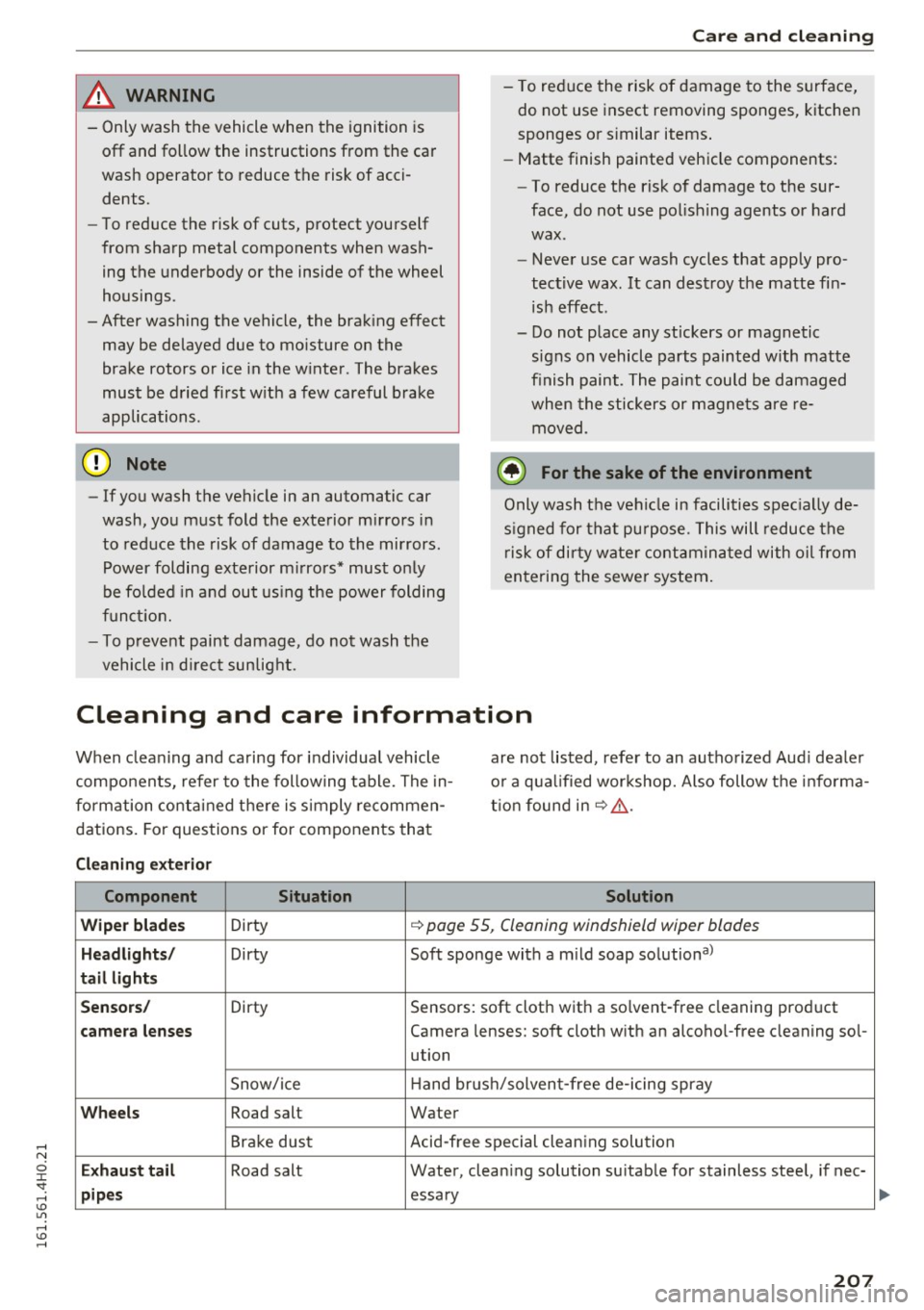
& WARNING
-Only wash the vehicle when the ignition is
off and follow the instructions from the car
wash operator to reduce the risk of acci
dents.
- To reduce the risk of cuts, protect yourself
from sharp metal components when wash
ing the underbody or the inside of the wheel
housings.
-After washing the vehicle, the braking effect
may be delayed due to moisture on the
brake rotors or ice in the winter . The brakes
must be dried first with a few careful brake
applications.
{[) Note
-If you wash the vehicle in an automatic car
wash, you must fold the exterior mirrors in
to reduce the risk of damage to the mirrors.
Power folding exterior mirrors* must only
be folded in and out using the power folding
function.
- To prevent paint damage, do not wash the
vehicle in direct sunlight.
-
Care and cleaning
-To reduce the risk of damage to the surface,
do not use insect removing sponges, kitchen
sponges or similar items.
- Matte finish painted vehicle components:
- To reduce the risk of damage to the sur-
face, do not use polishing agents or hard
wax.
- Never use car wash cycles that apply pro
tective wax. It can destroy the matte fin
ish effect.
- Do not place any stickers or magnetic
signs on vehicle parts painted with matte
finish paint. The paint could be damaged
when the stickers or magnets are re
moved .
@ For the sake of the environment
Only wash the vehicle in facilities specially de
signed for that purpose. This will reduce the
risk of dirty water contaminated with oil from
entering the sewer system.
Cleaning and care information
When cleaning and caring for individual vehicle
components, refer to the following table. The in
formation contained there is simply recommen
dations. For questions or for components that are not
listed, refer to an authorized Audi dealer
or a qualified workshop. Also follow the informa
tion found in
~ ,&. .
Cleaning exterior
Component Situation Solution
Wiper blades
Dirty ~ page 55, Cleaning windshield wiper blades
Headlights/ Dirty Soft sponge with a mild soap solution a>
tail lights
Sensors/
Dirty Sensors: soft cloth with a solvent-free cleaning product
camera lenses Camera lenses: soft cloth with an alcohol-free cleaning sol-
ution
Snow/ice Hand
brush/solvent-free de-icing spray
Wheels Road salt Water
Brake dust Acid-free special cleaning solution
Exhaust tail Road salt
Water, cleaning solution suitable for stainless steel, if nee-
pipes essary
207
Page 216 of 302

Fuel and Refueling
nearest authorized Audi dealer or author
ized Audi Service Facility for assistance.
These fuels contain substances that can se
verely damage the fuel system and the en
gine if the engine is started.
Refueling
Fuel filler neck
The fuel filler neck is located on the right rear
side panel behind the fuel filler flap.
If the power locking system should fail, you can
still open the flap manual ly -for detailed instruc
tions see
c;> page 216.
You can find the fuel tank capac ity of your vehicle
In .
The label on the inside of the fuel filler flap tells
you the correct fuel for your vehicle. For more in
formation about fue l specifications, see
c;> page 212.
Your vehicle fuel tank has an onboard refuelling
vapor recovery system. This feature helps to pre
vent fuel vapors from escaping from the tank and
pollut ing the environment while you refuel your
veh icle. In order to fill the tank properly while
protecting the environment, please follow this
refueling procedure carefully.
_& WARNING
Under normal operating conditions, never car
ry additional fuel containers in your car. Gas
canisters and other containers used to trans
port fuel can be dangerous. Such containers,
full or empty, may leak and could cause a fire
in a collision. If you must transport fuel to
use for you r lawn mower, snow blower, etc.,
be very careful and always observe local and
state laws regarding the use, transportation
and storage of such fuel containers. Make cer
tain the container meets industry standards
(ANSI/ASTM F852 -86).
(D Note
Never drive your vehicle until the fuel tank is
completely empty. The ir regular supply of
fuel can cause m isfiring. Gasoline could enter
214
the exhaust system and damage the catalytic
converter.
Refuelling
Fig. 188 Right rear vehicle side: Opening the fuel filler flap
Fig. 189 Fuel fille r flap with attached fuel cap
When activating the central locking, the fue l fill
er flap is automatically unlocked or locked. Re
fuel the vehicle with the ignition switched
off.
Taking the fuel cap off
.,. Press the left side of the fuel fil ler flap to open
it
c;>fig. 188- arrow- .
.,. Unscrew f uel filler cap counter-clockwise and
hang it on the fuel filler flap¢
fig. 189.
.,. Check the label on the inside of the fuel filler
flap to determine if the vehicle must be fueled
with gasoline or diesel fuel.
Refuelling procedure
.,. Insert the fuel nozz le from the gasoline pump
into the fue l filler neck as far as it will go.
.,. Select a medium refuelling rate so that the
nozzle switches off automatically when the
tank is full.