ignition AUDI S8 2016 Repair Manual
[x] Cancel search | Manufacturer: AUDI, Model Year: 2016, Model line: S8, Model: AUDI S8 2016Pages: 302, PDF Size: 75.68 MB
Page 217 of 302
Putting the fuel c ap back on
"' After filling your tank , tw ist the f uel fi ller cap
clockwise as far as it wi ll go .
"' Close the fuel filler flap.
To avoid fuel spill ing o r evaporating from the f uel
tank always close fuel filler cap properly and
comp let ely. An improperly closed fue l filler cap
may a lso caus e the MIL lamp ¢
page 28 to come
on (only vehicles with gasoline engine).
A WARNING
Improper refueling or handling of fuel can
cause fire, explosion and severe burns .
- Fuel is highly f lammable and can cause se
vere burns and other injur ies.
-
- Failure to shut the engine off wh ile refuel
ing and/or to insert the pump no zzle fully
into the fuel filler neck could cause fuel to
spray out of filler neck or to overflow . Fuel
spray and overflowing fue l can cause a fire .
- Never use a cellular telephone wh ile refuel
ing . The electromagnetic radiation can
cause spa rks that can ignite fuel vapors and
cause a fire.
- Never get back into your vehicle while refu
eling .
If in except io na l circumstances you
must get back in you r vehicle while refue l
ing, make certain tha t you close the door
and touch meta l to discharge static electric
ity before touchi ng the filler nozz le again.
Static electricity can ca use spa rks that can
ignite fuel vapors released during refueling .
- Never smoke o r have an open flame any
where in or near your vehicle when refueling or filling a portable f uel container.
- For yo ur safety , we strongly recommend
that you do not travel with a portable fue l
conta iner in your vehicle. The conta iner, full
or empty may leak and could cause a fire,
especially in a crash .
-If, under exceptional c ircumstances, you
must transport a portable fuel container,
please observe the follow ing :
- Neve r fi ll a portable fuel containe r wh ile i t
is anywhere in or on the vehicle (for exam
p le, in the luggage compartment, or on
the trunk) . Static e lectr icity can build up
Fuel and R efueling
whi le filling and can ignite fuel vapors
caus ing a fire .
- Always place a portab le fue l container on
the ground before f illing.
- Always keep the fi ller nozzle comp lete ly
inside the po rtable container before and
during f illing.
- If filling a portable container made of
metal, the filler nozz le m ust always be in
contact with the container. This will he lp
prevent stat ic electricity from discharging
and cause a fire .
- Never spill fue l inside the vehicle or lug
gage compartment. F uel vapors are highly
flammable .
- Always observe local and state/prov incial
laws regarding the use, storage and trans
po rtation of fuel co nta iners.
- Make ce rtain t he f uel container meets in
dust ry standards (ANSI/ ASTM F852-86) .
(0 Note
If any fuel has sp illed onto the car, it should
be removed immed iately to p revent damage
to the pa int.
@ For the sake of the environment
As soon as the correctly operated noz zle
switches off automatically for the first time,
the tank is fu ll. Do not try to add more fuel
because f uel may sp ill out . In add it ion, the
expans ion space in the fuel tank will be fi lled -
causing the fue l to overflow when it becomes
warm and po llute the environment.
(D Tips
- Runn ing your engine while refuelling may
cause vapors to escape or even ca use fue l to
spill out of the tank. This wo uld then shut
off the f uel no zzle befo re t he t ank is f ull.
- Do not ref ue l your veh icle with the ignition
switched on . The fuel gauge m ay o therwise
no t indicate the co rrect fuel leve l after refu
elling.
- Diesel vehicles* are equ ipped wi th a die sel
m isf ueli ng pro tector . It a llows the vehi cle
to be fuele d only with a d iesel fue l pump .,.
215
Page 223 of 302
-Do not remove the engine cover under any
circumstances. This increases the risk of
burns.
- If work on the fuel system or the electrical
system is necessary:
- Always d isconnect the battery.
- Never smoke or work near heaters or open
flames. Flu ids in the engine compartment
could start a fire.
- Keep an app roved fire ext inguisher imme
d iate ly availab le.
- To avo id electr ical shock and personal injury
wh ile the eng ine is running or being started,
never touch:
- Ignition cables
- Other components of the high voltage
electronic ignition system.
- If you must perform a check or repa ir with
the engine running:
- First, fully apply the parking brake, move
selector lever to "P" (Park).
- Always use extreme caution to prevent
cloth ing, jewelry, or long hair from get
ting caught in the radiator fan, V-belts or
other mov ing parts, or from contacting
hot parts. Tie back ha ir before starti ng,
and do not wear clothi ng that will hang or
d roop into t he engine.
- Min imize exposu re to emission and chem i
cal hazards¢ .&.-
_& WARNING
California Proposition 65 Warn ing:
- E ngine exhaust, some of its constituents,
and certain vehicle components contain or
em it chem ica ls known to the St ate of C ali
f orn ia to cause cancer and bi rth de fects and
reproductive harm . In addition, certain flu
ids contained in ve hicles and certain prod
ucts of component wear contain or emit
Ch eck ing and Filling
chemicals known to the State of California
to cause cancer and birth defects or other
reproductive harm.
- Battery posts, term inals and related acces
sories contain lead and lead compounds,
chemicals known to the State of Californ ia
to cause cancer and reproductive harms.
Was h hands afte r handling .
([) Note
When adding flu ids, always make sure that
they are poured into the proper co nta iner or
fille r opening, otherwise serious damage to
vehicle systems w ill occur.
® For the sake of the environment
To detect leaks in time, inspect the veh icle
floor pan from unde rneath regularly . If you
see spots from oil or other veh icle fluids, have
your vehicle inspected by an authorized Audi
dealer.
Closing the engine hood
.,.. Pull the hood down un til the press ure from the
struts is reduced.
.,.. Let the hood
drop down and latch in p lace . Do
not try to push it shut;
it may fail to engage
¢ _& .
_& WARNING
--A hood that is not completely latched co uld
fly up and block your view while driv ing.
- When you close the engine hood, check it to
make sure the safety catch has properly en
gaged . The hood s hou ld be flush with the
sur rounding vehicle body parts.
- If you notice while driv ing that the hood is
not secured properly, stop at once and close
it.
-
221
Page 226 of 302
Check ing and F illing
oil du ring the break -in period than they consume
after oil consumption has stabilized .
Unde r no rmal condi tions, the rate of o il con
sumpt ion depends on the quality and viscosity of
the oi l, the RPM (revolutions per minute) at
which the engine is operat ed, the ambient tem
perature and road cond itions . Further factors are
the amount of oil dilut ion from water condensa
tion or fuel residue and the oxidation level of the
oil. As any eng ine is subject to wear as m ileage
bu ilds up, the oil consumption may increase over
time until rep lacement of worn components may
become necessa ry .
W ith all these variables com ing into play, no
standard rate of oil consumpt ion ca n be estab
lished or specified . There is no a lternative to reg
ular and frequent checking of the oil leve l, see
Note .
If the ye llow eng ine oil level war ning symbol in
the instrument cluster
II lights up, you should
check t he oil leve l as soon as possib le
¢
page 224 o r ¢ page 225. Top off the o il at
your ea rliest convenience ¢
page 225.
A WARNING
Before you check anything in the engine com
partment, a lways read and heed a ll WARN
INGS ¢.&
in Working in the engine compart
ment on page 220.
(D Note
Driving with an insufficient oil level is likely to
cause severe damage to the engine .
@ Tips
-The oil pres sure warning display. i s not
an indicator of the o il level. Do not rely on
i t. Instead , check the oil level in your en
gine at regular intervals, preferably ea ch
time you refuel , and always befo re going
on a long trip.
- If you have the impression your engine con
sumes excessive amounts of oil, we recom
mend that you co nsul t yo ur Audi dealer to
have the cause of your concern p roperly di
agnosed . Keep in mind that the acc urat e
224
meas urement of oi l consumption re quires
great care and may take some t ime. Yo ur
Audi dea ler has instructions about how to
meas ure o il consumption acc urately.
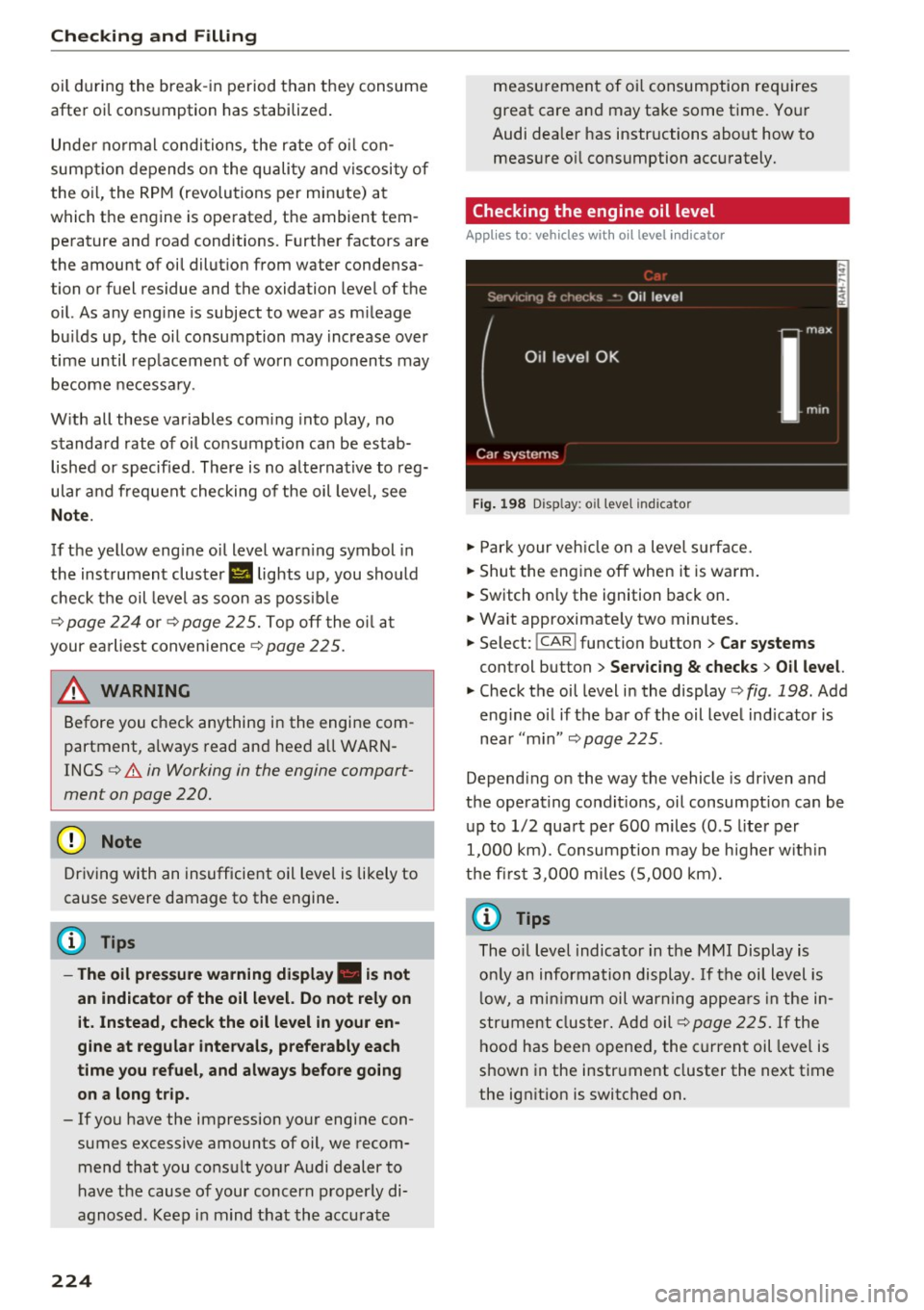
Checking the engine oil level
App lies to: vehicles wi th oil level indicato r
Fig. 198 Disp lay : o il leve l ind icato r
.,. Par k your veh icle on a leve l su rface.
.,. Shut the eng ine off when it is warm .
.,. Switch o nly the ignition back on.
.,. Wait approximate ly two minutes.
.,. Select:
!CAR ! function button > Car systems
control button > Servicing & checks > Oil le vel.
.,. Check the oil level in the display c> fig . 198 . Add
eng ine oi l if the ba r of the oil leve l ind icator is
nea r "m in"
¢ page 225 .
Depend ing on the way the vehicle is driven and
the operating cond it ions, oil consumpt io n can be
u p to 1/2 qua rt pe r 600 miles (0 .S liter per
1,000 km). Consumpt ion may be h igher w it hi n
the first 3, 000 mi les (5,00 0 km).
(D Tips
The o il level indicato r in the MMI Display is
o nl y an information display. If t he oi l level is
l ow, a m inimum oil w arn ing appea rs in the in
str ument clus ter. Ad d oil ¢
page 225. If the
hood has been opened, the curren t oil level is
shown in the instrument cluster the next t ime
the ignition is switched on .
Page 229 of 302
Cooling system
Coolant
The engine coolant performs two functions: it
keeps the engine from overheating and it pro
tects the engine from freezing in the winter .
The cooling system is sealed and generally re
quires little attention.
T he cooling system has been filled at the factory
with a permanent coolant which does not need to
be changed . The coolant consists of a mixture of
specially condit ioned water and the manufactur
er's glycol-based coolant additive Gl3 antifreeze
with anticorrosion additives (SO% for USA mod
e ls; 60% for Canadian mode ls). This m ixture
both ass ures the necessa ry frost protection and
protects metal components in the engine's coo l
ing system from corrosion and scaling .
It also
raises the boiling point of the coolant.
Do not red uce the concent ration of the coolant in
the summer by adding p lain water.
The propor
tion of coolant addit ive mu st be at least 50 %
but not more than 60 %
to mainta in antifreeze
protection and cooling efficiency. If the coolant
frost protection is too low, the coolant could
freeze and damage the vehicle heating and en
g ine cooling system .
For year-round driving, antifree ze is added at the
factory for temperatures down to :
- -31° F(- 3S°C)USA
- - 40 ° F ( - 40 °C) Canada.
If you must add coolant, use a m ixture of water
and coolant addit ive. M ixing the coolant additive
with d istilled water is recommended .
_& WARNING
Before you check anythi ng i n t he engine com
partment, always read and heed all WARN
INGS
¢ .&. in Working in the engine compart
ment on page 220 .
(D Note
-Befo re winter se ts in, have the coo lant
checked to see if the coolant additive in your
vehicle is sufficient to meet the cl imate con -
Check ing and Filling
ditions. This is especially important if you
live in a region where the winter is extreme
ly cold. If necessary, increase the proportion
of coolant additive to 60%.
- When adding coolant additive to your cool
ing system, remember :
- We recommend us ing only coolant add i
tive Gl2+ + or Gl3 for yo ur vehicle. This
coolant addit ive is avai lab le at aut horized
A udi dealers . O ther types of antifree ze can
significantly reduce corrosion pro tect ion .
The resulting corrosion can cause a loss of
coolant and serious engine damage.
- Do not add any type of radiator leak sealant
to your vehicle's engine coolant. Adding ra
diator repair fluid may adversely affect the
function and performance of your cooling system and cou ld resu lt in damage not cov
ered by your New Veh icle Limited Warra nty .
Checking the engine coolant level
The engine coolant level can be checked with a
quick glance.
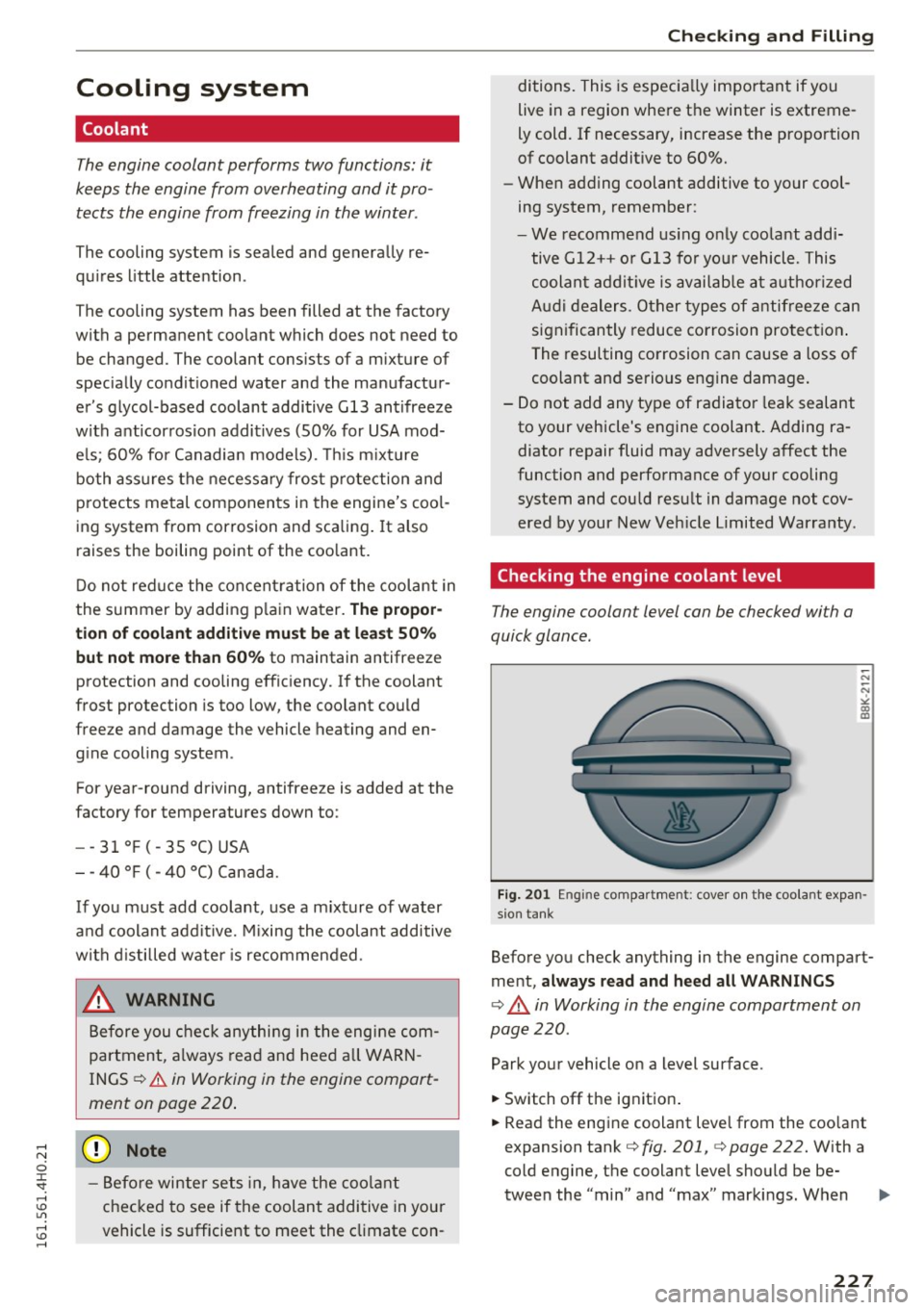
Fi g. 2 01 Engin e compar tmen t: cover o n th e coo lant expan
sion t ank
Before you check anything in the engine compart
ment,
always read and heed all WARNINGS
¢ A in Working in the engine compartment on
page 220 .
Park your vehicle on a level surface .
.,. Switch off the ignition .
.,. Read the engine coolant level from the coo lant
expansion tank
¢ fig . 201, ¢page 222. With a
cold engine, the coolant level should be be-
tween the "min" and "max" markings. When .,.
227
Page 231 of 302
& WARNING
-The cooling system is under pressure and
can get very hot. Reduce the risk of scald ing
from hot coolant by following these steps.
- Turn off the engine and allow it to coo l
down.
- Protect your face, hands and arms from
escaping flu id and steam by cover ing the
cap w ith a la rge, thick rag.
- Turn the cap slowly and very carefully in a
counter-clockwise d irection while applying
light, downward p ressure on t he top of
the cap.
- T o avoid bei ng bu rned, do not spill anti
free ze or coo la nt on the e xhaust sys tem or
hot engi ne parts. Under certa in cond i
tions, the ethylene glycol in eng ine cool
ant can catch fire .
- An tifreeze is poisonous. Always store anti
freeze in its original con tainer and well ou t
of the reach of children.
- If you dra in the coolant, it m ust be ca ught
and safely stored in a proper conta iner
clearly marked "poison" .
(D Note
-Do no t add coolant if the expa nsion tank is
empty. Air cou ld enter the cooling sys tem
and damage the eng ine. If this is the case,
do not continue driving. Seek professional
ass istance.
- Coolant po llutes the environment and could
ca use an eng ine fire . Excess coolant will be
fo rced o ut through the pressure relief valve
i n the cap when the eng ine becomes hot.
- If, in an emergency, only wate r can be add
ed, the correct ratio between water and an
tifreeze¢
page 22 7 must be restored as
soon as possib le.
@) For the sake of the environment
Drained coolant sho uld not be reused. Always
dispose of used coolant while observing all
,...,
"' environmental regulat io ns. 0 J:
'SI: ,...,
Ch eck ing and Filling
Rad iator fan
The radiator fan switches on automatically by it
self .
The radiator fan is driven by the engine via the V
belt. The v iscous clutch regulates t he speed of
the fan accord ing to the temperature of the cool
ant .
An auxiliary e lectr ic radiator fan* sw itches on and
off depend ing o n coo lant temperature and other
vehicle operating conditions.
After you switch the engine off, the auxiliary fan
can continue ru nning for up to 10 m inutes -even
with the ignition off. It can even switch on aga in
later by itself¢,& , if
- the temperature of the engine coolant rises due
to the heat build-up from the engine in the en
gine compartment, or
- the engine compartment heats up beca use the
veh icle is parked in intense sunlight.
& WARNING
- To reduce the r isk of persona l injury neve r
touch the radia to r fan .
- The auxiliary e lectr ic fan is temperature
controlled and can switch on s uddenly even
when the engine is not ru nning .
- The a uxiliary radiator fan sw itches on auto
mat ically when the eng ine coolant reaches a
certa in temperature a nd will continue to run
until the coolant temperature d rops.
229
Page 233 of 302
@ For the sake of the environment
Because of the problem of proper disposal of
brake fluid as we ll as the special toots re
quired and the necessary expertise, we rec
ommend that you have the brake fluid
changed by your authorized Audi dealer .
Battery
General information
Under normal operating conditions, the battery
in your Audi does not need any maint enance.
With
high outside temperatures or long daily
drives we recommend tha t you have the electro
lyte level checked by a service facility. The elec
trolyte level should also be checked each time
the battery is charged ¢
page 233.
Have the battery checked when you take your ve
hicle in for serv ice. You are well advised to re
place a battery that is older than 5 years .
With certain types of airbag deployment, the batte ry is disconnected from the vehicle electri
cal system for safety reasons¢
& in Repair, care
and disposal of the airbags on page 159 .
Disconnecting the battery terminals
Some vehicle functions (power window regu la
tors, for example) are lost if the battery te rmi
nals are disconnected. These functions have to be
relearned after the battery terminals are con
nected again. To prevent th is, the battery should
only be disconnected from the vehicle e lectr ica l
system when abso lutely necessary for repairs.
Vehicles not driven for long periods
If you do not drive your vehicle over a period of
several days or weeks, electrical components are
gradually cut back or sw itched off. This reduces
ene rgy consumption and ma inta ins starting ca
pability over a longer period ¢
page 195. Some
of the convenience functions may not operate,
such as the interior lights or the power seat ad
justment. The convenience funct ions will be
ava ilable again when you switch on the ignition
and start the engine.
Checking and Filling
Winter operation
During the winter months, battery capacity tends
to decrease as temperatures drop . This is be
cause more power is also consumed while start
ing, and the headlights, rear window defogger,
etc., are used more often.
Avo id unnecessary power consumption, particu
larly in city traffic or when traveling only short
distances . Let your authorized Audi dealer check
the capacity of the vehicle battery before winter
sets in ¢
page 233. A well charged battery will
not only prevent starting problems when the
weather is cold, but will also last longer .
(D Tips
If your vehicle is left standing for several
weeks at extremely low temperatures, the ve
hicle battery should be removed and stored
where it w ill not freeze . This will prevent it
from be ing damaged and having to be re
placed.
Working on the battery
Be especially careful when working on or near
the battery.
The battery is located in the luggage compart
ment under the floor . Before you check anything
in the luggage compartment,
read and heed all
WARNINGS ¢
&-
Always heed the safety warnings, when working
on the vehicle battery or the veh icle electrical
system to prevent injury.
The following WARNINGS are very important
when working on the battery:
Always heed the following WARNING SYM·
BOLS and safety precautions when working on
the battery.
®
Always wear eye protection.
~
Battery acid contains sulfuric acid. Al-
ways wear gloves and eye protection.
231
Page 234 of 302
Check ing and F illing
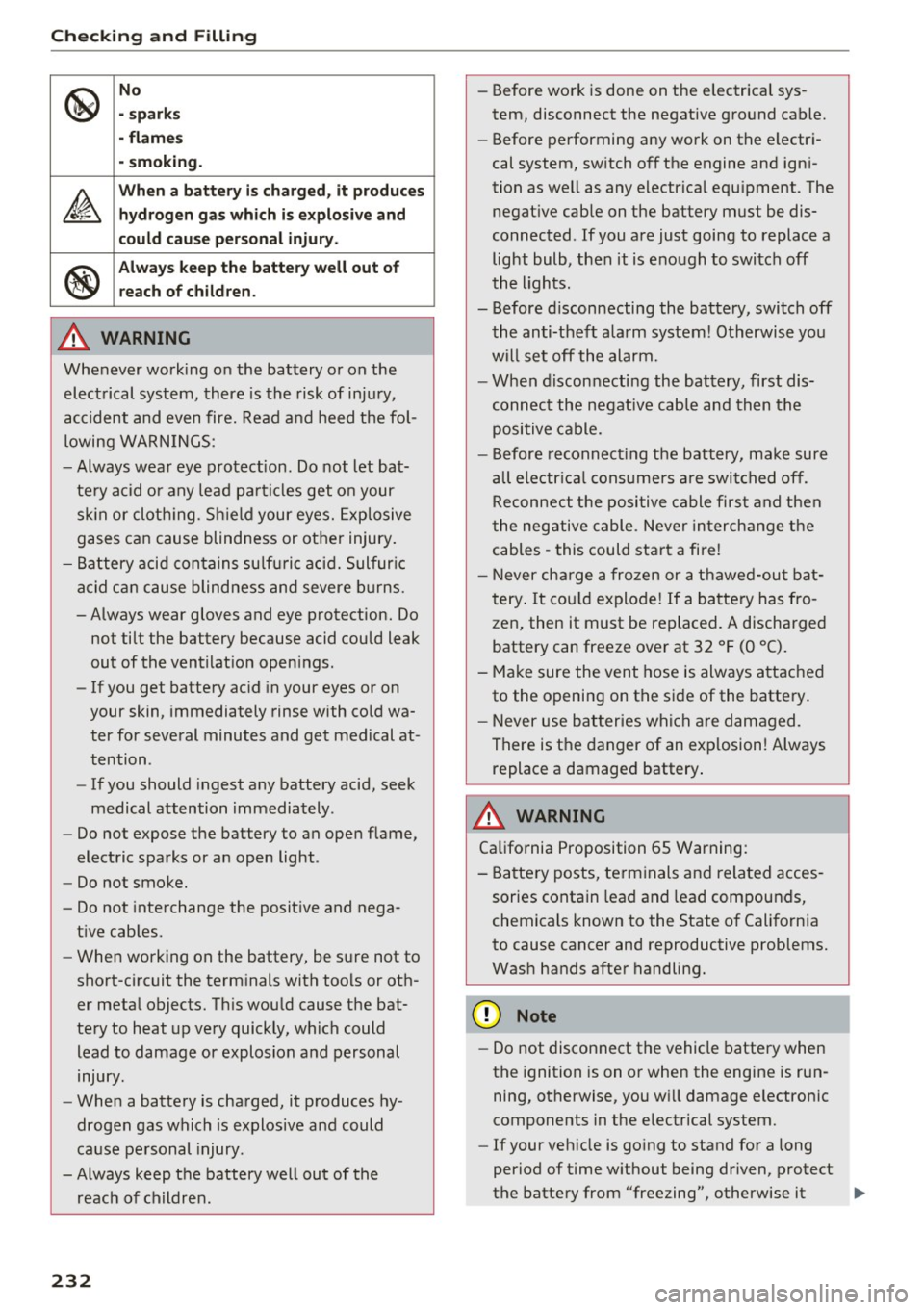
@
No
- spark s
- fl ame s
- smokin g.
~
Wh en a b att ery is ch arg ed , it produc es
h yd ro ge n ga s which i s explosive and
could cau se per sonal injury.
®
Always keep the b atter y well out of
r each of child ren.
A WARNING
Whenever work ing on the battery or on the
elect rical system, there is the risk of injury,
accident and
even fire. Read and heed the fol
lowing WARN INGS :
- Always wear eye protection. Do not let bat
te ry acid or any lead particles get on your
sk in or cloth ing . Sh ield your eyes. Explosive
gases can cause blindness or other injury .
- Battery acid con tains su lfu ric acid. Sulfur ic
acid can cause blindness and severe b urns.
- Always wear gloves and eye protection. Do
no t tilt the battery because acid could leak
out of the ventilat ion open ings .
- If you get battery ac id in your eyes or on
your skin, immediately rinse with cold wa
ter for several minutes and get medical at tention .
- If you should ingest any battery acid, seek
medical attention immediately .
- Do not expose the battery to an open flame,
electric sparks or an open light .
- Do not smoke.
- Do not interchange the positive and nega-
t ive cables.
- When working on the battery, be sure not to
short-circuit the terminals with tools or oth
er metal objects. Th is wou ld cause the bat
tery to heat up
very quickly, which could
lead to damage or explosion and personal
injury .
- When a battery is charged, it produces hy
drogen gas which is explosive and could
ca use personal injury.
- Always keep the battery well out of the reach of ch ildre n.
232
-
-Before work is done on the electrical sys
tem, disconnect the negative gro und cable.
- Before performing any work on the e lectri
cal system, switch off the engine and ign i
tion as well as any electrical equ ipment . The
negat ive cab le on the battery must be dis
connected . If you are just going to replace a
light bulb, then it is enough to switch off
the lights.
- Before d isconnecting the battery, switch off
the anti-theft alarm system! Otherwise you
will set off the alarm.
- When disconnecting the battery, first dis
connect the negative cab le and then the
positive cable.
- Before reconnect ing the battery, make sure
all electr ica l consume rs a re switched off .
Reconnect the positive cable first and then
the negative cable . Never in terch ange t he
cables -this could sta rt a fire!
- Never cha rge a frozen or a thawed-out bat
tery . It cou ld explode ! If a ba ttery has fro
zen, then it must be replaced. A discharged
battery can freeze over at 32 ° F (0 °C).
- Make sure the
vent hose is always attached
to the opening on the side of the battery .
- Never use batter ies which are damaged.
There is the danger of an exp losion! Always
replace a damaged battery .
A WARNING
Califo rnia Proposition 65 Warning :
- Batte ry posts, te rm inals and related acces
sories contain lead and lead compounds,
chemicals known to the State o f Cali fornia
to cause cancer and reproductive problems.
Wash hands after handling.
(D Note
- Do not disconnect the vehicle battery when
the ignition is on or when the engine is run
ning, otherwise, you w ill damage electronic
components in the electrical system.
- If your veh icle is go ing to stand for a long
period of time w ithout being driven, protect
the battery from "freezing", otherwise it ..,.
Page 235 of 302
will be damaged and will then have to be re
placed.
Battery charging
Starting the engine requires a well charged bat
tery.
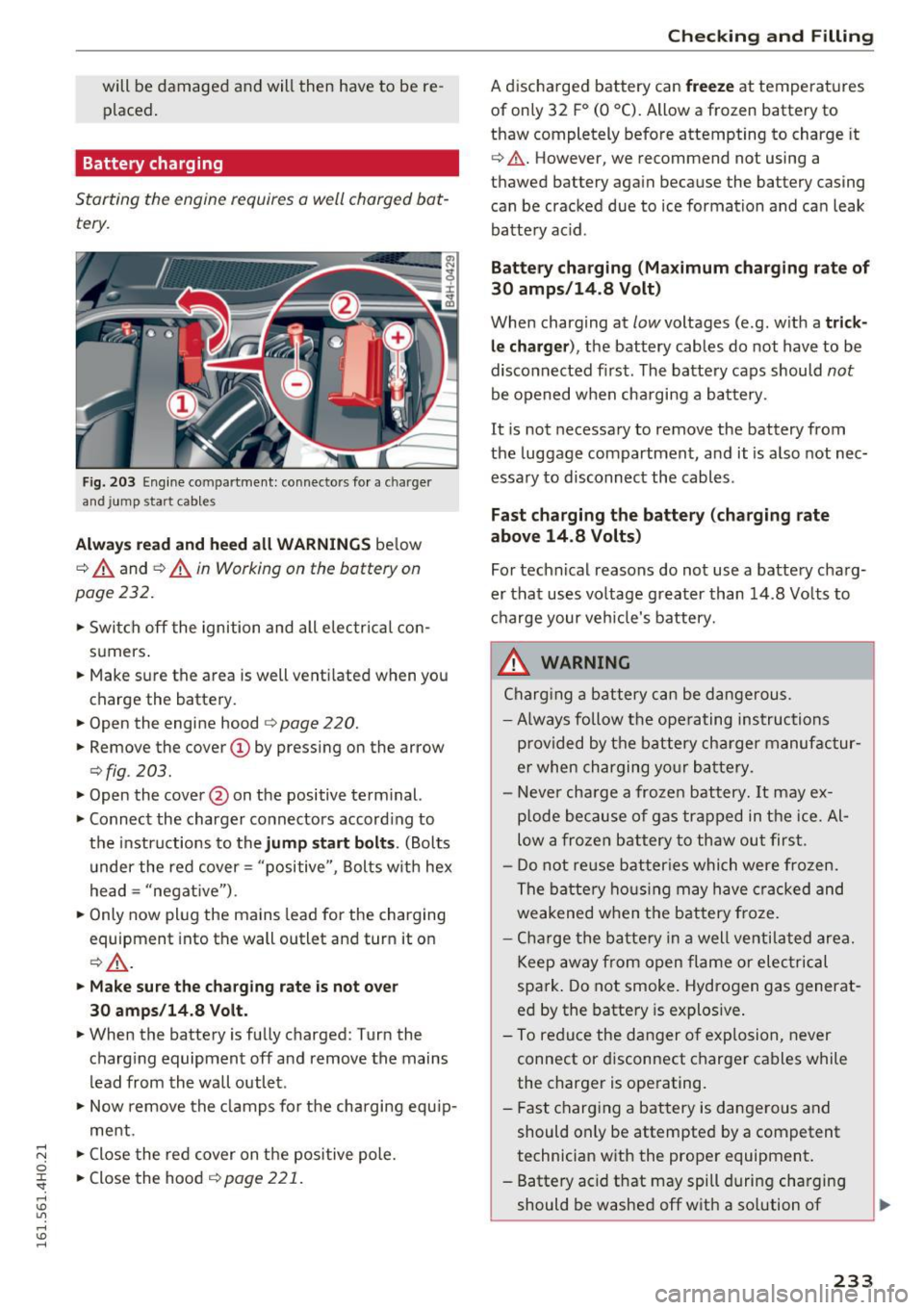
Fig. 203 Engine co mpa rtment: connectors fo r a c harger
and jump start cables
Always read and heed all WARNINGS below
~ &. and
¢ A in Working on the battery on
page 232.
• Switch off the ignition and all electrical con
sumers .
• Make sure the area is well ventilated when you
charge the battery.
• Open the engine hood
~ page 220.
• Remove the cover (D by pressing on the arrow
¢ fig . 203.
• Open the cover @on the positive terminal.
• Connect the charger connectors according to
the instructions to the
jump start bolts. (Bolts
under the red cover= "positive" , Bolts with hex
head
= "negat ive").
• Only now plug the mains lead for the charging
equipment into the wall outlet and turn it on
¢&,, .
• Make sure the charging rate is not over
30 amps/14.8 Volt.
• When the battery is fully charged: Turn the
charging equipment off and remove the mains
lead from the wall outlet .
• Now remove the clamps for the charging equip-
ment.
~ • Close the red cover on the positive pole. 0
~ • Close the hood~ page 221.
rl I.Cl U"I
rl I.Cl rl
Checking and Filling
A discharged battery can freeze at temperatures
of only 32 F
0 (0 °C). Allow a frozen battery to
thaw completely before attempting to charge it
¢ &. However , we recommend not using a
thawed battery again because the battery casing can be cracked due to ice formation and can leak
battery acid.
Battery charging (Maximum charging rate of
30 amps/14.8 Volt)
When charging at low voltages (e.g . w ith a trick
le charger),
the battery cables do not have to be
disconnected first. The battery caps should
not
be opened when charging a battery.
It is not necessary to remove the battery from
the luggage compartment, and it is also not nec
essary to disconnect the cables .
Fast charging the battery (charging rate
above 14.8 Volts)
For technical reasons do not use a battery charg
er that uses voltage greater than 14.8 Volts to
charge your vehicle's battery.
.&_ WARNING
Charging a battery can be dangerous.
- Always follow the operating instructions
provided by the battery charger manufactur
e r when charging your battery.
- Never charge a frozen battery. It may ex
p lode because of gas trapped in the ice. Al
low a frozen battery to thaw out first.
- Do not reuse batteries which were frozen.
The battery housing may have cracked and
weakened when the battery froze.
- Charge the battery in a well ventilated area.
Keep away from open flame or electrical
spark. Do not smoke. Hydrogen gas generat
ed by the battery is explosive.
- To reduce the danger of explosion, never
connect or disconnect charger cables while
the charger is operating.
- Fast charging a battery is dangerous and
should only be attempted by a competent
technician with the proper equipment.
- Battery acid that may spill during charging
should be washed off with a so lution of
233
Page 257 of 302
the recommended tire pressure for you r ve hicle
¢ page 246, fig . 208.
T ire tread circumference and v ibrat ion character
istics can change and cause a ti re pressure warn
ing if :
- the tire p ressure in one o r more tires is too low.
- the tire has structura l damage .
- the tire was replaced or the tire pressure was
changed and it was not stored¢
page 255 .
-the spare t ire* is installed.
Ind icat or light s
IE Loss of press ure in at least one tire q &. .
Check the tires and replace or repair if necessary.
Check/correct the pressures of a ll four tires and
store the pressure again in the Infotainment sys
tem ¢
page 255.
ffim (T ire Pressure Monitoring System) Tire
pressu re: Sys tem malfunction !.
Iffflm appears
after switching the ignition on or wh ile driving
and the
IE indicator light in the instrument clus
ter blinks for approximate ly one minute and then
stays on, there is system malfunction . Try to
store the correct tire pressures¢ page 255 . If
the indicator light does tur n off or t urns on again
a fte r a short period of time, dr ive to you r author
ized A udi dealer or qualified repair fac ility imme
diate ly to have the ma lfunction co rrected.
&_ WARNING
- If the tire pressu re indicator appears in the
display, reduce your speed immed iate ly and
avoid any hard steer ing or braking maneu
vers. Stop as soon as possib le and check the
t ir es and their press ure .
- The driver is responsib le for maintaining the
correct tire pressure. You must check the
t ir e pressu re regu la rly .
- Under certa in conditions (such as a sporty
dr iv ing style, wi nter cond itions or unpaved
roads), the tire p ressure monitoring system
indicator may be de layed.
- Do not use r un-flat tires on your vehicle. Us
ing them when not permitted can lead to
vehicle damage or accidents.
Wh eel s
(D Tips
-The tire p ressure monitoring system can al
so stop working when there is an ESC mal
function.
- Using snow c hains may result in a system
ma lf u nction.
- The tires wit h the identification "AO" or
"RO"
q page 243 have been matched wit h
your Audi t ire press ure monitoring system.
We recommend that you use these tires.
Storing tire pressures
If the tire pressure changes or a tire is replaced,
it must be confirmed in the Infotainment sys tem.
.,. Ma ke sure befo re storing t hat the t ire pressures
of all four tires meet the specified values and
are adapted to the load ¢
page 244.
.,. Switch the ignit ion on .
.,. Select: the
I CAR ! funct io n button > Car Systems
cont rol button > Serv icing & check s > Tire
pressure monitoring > Store tire pressures >
Ye s, store now .
(j) Tips
Do not sto re the tire pressures if snow chains
are ins talled. Ot he rw ise the system could
malfunc tion.
255
Page 268 of 302
Fuses and bulbs
Fuses and bulbs
Fuses
Replacing fuses
A fuse that has blown will have me tal strips that
have burned through .
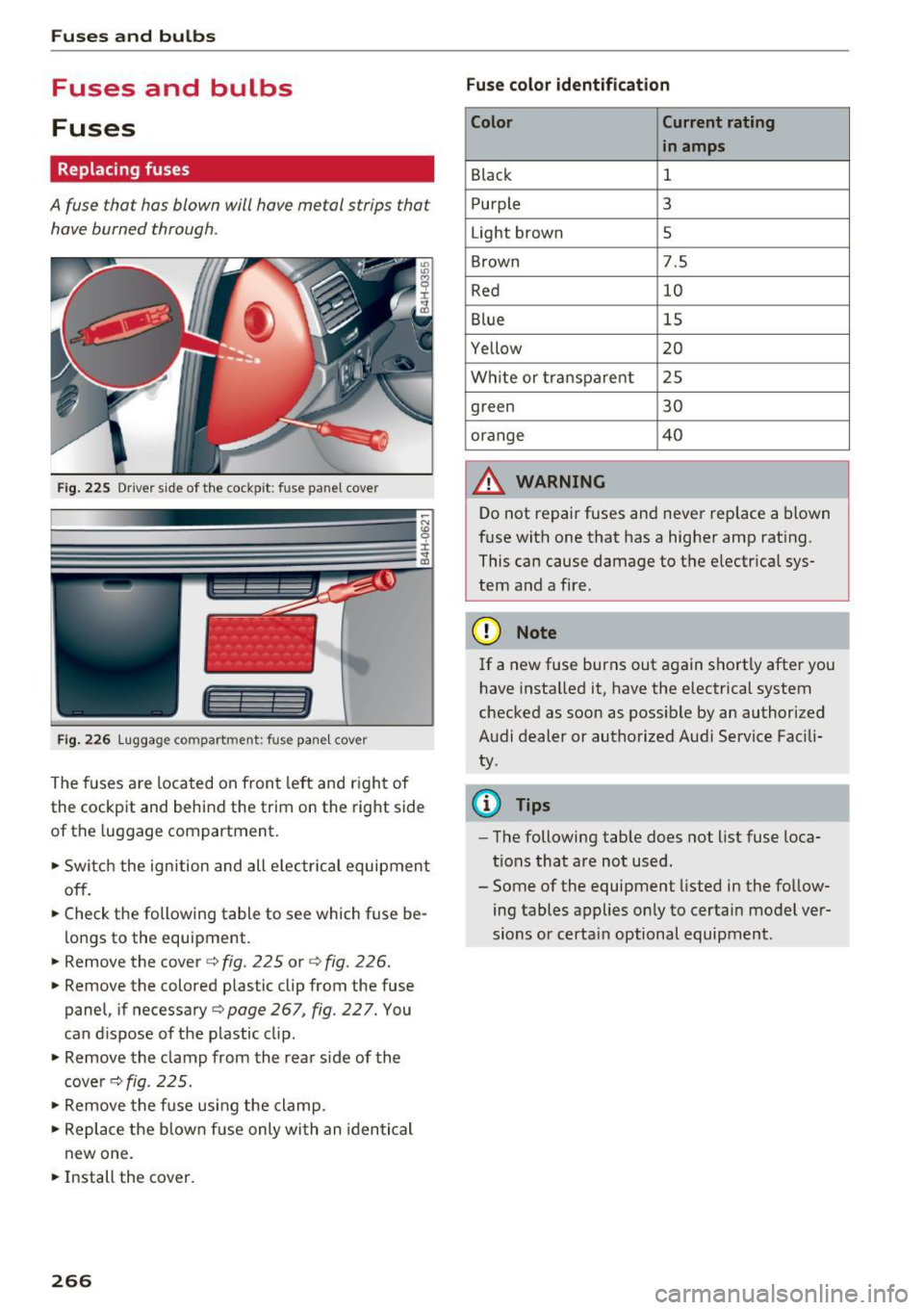
Fig. 2 25 Driver s ide of th e cockp it: fuse pa nel cover
I l I
Fig. 2 26 Lu ggage compartment: fuse pane l cover
The fuses are loca ted on front left and r igh t of
the cockpit and behind the trim on the right side
of the luggage compartment.
.. Swi tch the ignition and all e lec trica l equipment
off.
.. Check the following table to see which fuse be
lo ngs to the equipment .
.. Remove the cover c::> fig. 225 or
c:> fig. 226 .
.. Remove the colored plastic clip from the fuse
panel, if necessary
c:> page 267, fig. 22 7. You
can d ispose of the p lastic clip .
.. Remove the clamp from the rear s ide of the
cove rc::> fig. 225 .
.. Remove the f use usi ng the clamp .
.. Re place the b low n fu se only wi th an identi cal
new one .
.. Install the cover.
266 Fuse color identification
Color Current rating
in amps
Black 1
P urple 3
Light brown 5
Brown 7.5
Red 10
Blue 15
Yellow 20
Wh ite or transpa re nt 2 5
green 30
orange 40
A WARNING
-
Do not repair fuses and never replace a blown
f u se with one that has a highe r amp rat ing.
This ca n cause damage to t he e lectr ica l sys
tem and a fire.
(D Note
If a new fuse burns out again sho rtly after you
h ave insta lled it, have the electrical system
checked as soon as possible by an authorized
A udi dealer or authorized Aud i Service Fac ili
ty .
(D Tips
-The following table does not list fuse loca
tions that are no t used .
- Some of the equipment listed in the fo llow
ing tables applies on ly to certai n model ver
sions or certa in optional equipment .